5
X
October 2017
Experimental Investigation on Partial Replacement
of Cement by GGBS
N Sellakkannu1, Roshini P 2
1
Assistant Proffesor, Jct College of Engineering and Technology,
2
Pg Student, Jct College of Engineering and TechnologyCivil Department, Anna University
Abstract: The production of cement results in emission of many greenhouse gases in atmosphere, which are responding properties for global warming. The waste material having cementing properties which can be added in cement concrete as partial replacement of cement, without compromising on its strength and durability, which will results in decrease of cement production thus reduction in emission in greenhouse gases. The ground granulated blast furnace slag (GGBS) is a waste product from the iron manufacturing industry, which may be used as partial replacement of cement in concrete due to its inherent cementing properties. In this study Ground Granulated Blast Furnace Slag (GGBS) was partially replaced as 0%, 10%, 20%, 30%, and 40% in place of cement in concrete. Concrete are made for M -30 mix and the cubes, cylinders and prisms are casted for 7, 14 & 28 days of age in order to find out the optimum percentage of replacement of GGBS in concrete.
Keywords— GGBS, Workability, super plasticizer, Compressive strength, Tensile strength, Flexural strength
I. INTRODUCTION
Concrete is one of the most commonly used construction material in the world. It is basically composed of three components: cement, water and aggregates. Cement plays a great role in the production of concrete and is the most expensive of all other concrete making materials. In addition, there is environmental concern in the production of cement. The ground granulated blast furnace slag is a waste product from the iron manufacturing industry, which may be used as partial replacement of cement in concrete due to, is inherent cementing properties. GGBFS concrete had better water impermeability characteristics as well as improved resistance to corrosion and sulphate attack. Corrosion of steel reinforcement is a major concern in concrete construction located in aggressive environments such as coastal and marine structure, chemical plants, water and waste water treatment facilities and bridge, especially when de-icing chemicals are used. The corrosion resistant materials have significance in the durability properties of structural members.
II. GGBSINCONCRETE
Ground-granulated blast-furnace slag (GGBS or GGBFS) is obtained by quenching molten iron slag (a by-product of iron and steel-making) from a blast furnace in water or steam, to produce a glassy, granular product that is then dried and ground into a fine powder. GGBS is used to make durable concrete structures in combination with ordinary portland cement and/or other pozzolanic materials. GGBS has been widely used in Europe, and increasingly in the United States and in Asia (particularly in Japan and Singapore) for its superiority in concrete durability, extending the lifespan of buildings from fifty years to a hundred years. Two major uses of GGBS are in the production of quality-improved slag cement, namely Portland Blast furnace cement (PBFC) and high-slag blast-furnace cement (HSBFC), with GGBS content ranging typically from 30 to 70%; and in the production of ready-mixed or site-batched durable concrete.
Concrete made with GGBS cement sets more slowly than concrete made with ordinary Portland cement, depending on the amount of GGBS in the cementitious material, but also continues to gain strength over a longer period in production conditions. This results in lower heat of hydration and lower temperature rises, and makes avoiding cold joints easier, but may also affect construction schedules where quick setting is required. Use of GGBS significantly reduces the risk of damages caused by alkali–silica reaction (ASR), provides higher resistance to chloride ingress — reducing the risk of reinforcement corrosion — and provides higher resistance to attacks by sulphate and other chemicals.
III.MATERIALS
A. General
B. Materials Used
1) Cement: Ordinary Portland Cement (OPC) 53 Grade conforming to IS 12269, 19
Fig1- Cement
2) Fine Aggregate: Locally available river sand conforming to grading zone I of IS 383-1970Level-1
Fig2- fine aggregate
3) Coarse aggregate: Locally available crushed blue granite stones conforming to graded aggregate of nominal size 12.5mm as per IS 383-1970.
Fig3- coarse aggregate
4) GGBS: Physical properties of GGBS powder are: Specific gravity 3.44 and Fineness modulus 3.36, and the chemical composition of GGBS is Carbon (C) 0.23%, Sulphur (S) 0.05%,Phosphorous (P) 0.05%, Manganese (Mn) 0.58%, Free silica 5.27% and Iron (Fe)93.82%.
Fig4- GGBS
a) Water: Potable clean water was used in the present investigation for both casting and curing of concrete. b) Super plasticizer: Super plasticizer (Fosroc Conplast SP430 DIS, Sulphonated Napthalene Formaldehyde)
5) Material Properties
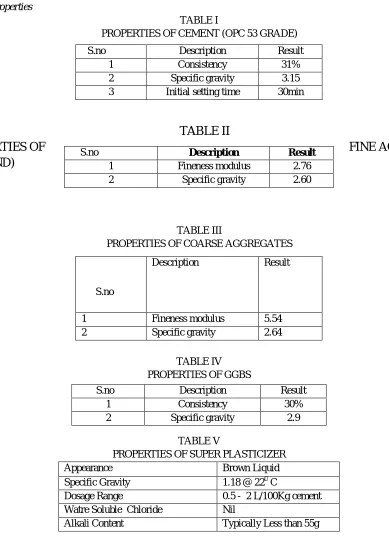
TABLE I
PROPERTIES OF CEMENT (OPC 53 GRADE)
TABLE II
PROPERTIES OF
FINE AGGREGATES
(SAND)
TABLE III
PROPERTIES OF COARSE AGGREGATES
TABLE IV PROPERTIES OF GGBS
TABLE V
PROPERTIES OF SUPER PLASTICIZER
Appearance Brown Liquid
Specific Gravity 1.18 @ 220 C
Dosage Range 0.5 - 2 L/100Kg cement Watre Soluble Chloride Nil
Alkali Content Typically Less than 55g
IV.CONCRETEMIXDESIGN
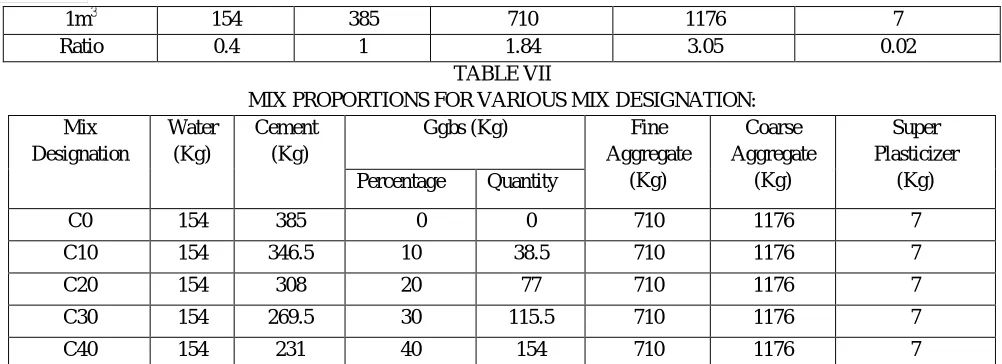
In this investigation, M30 mix concrete is considered to perform the test by-weight basis by replacing 0%, 10%, 20%, 30% and 40% of cement by GGBS. Different mix proportions used are shown in table VI
TABLE VI MIX PROPORTIONS
S.no Description Result
1 Consistency 31%
2 Specific gravity 3.15 3 Initial setting time 30min
S.no Description Result
1 Fineness modulus 2.76
2 Specific gravity 2.60
S.no
Description Result
1 Fineness modulus 5.54
2 Specific gravity 2.64
S.no Description Result
1 Consistency 30%
2 Specific gravity 2.9
TABLE VII
MIX PROPORTIONS FOR VARIOUS MIX DESIGNATION: Mix Designation Water (Kg) Cement (Kg)
Ggbs (Kg) Fine
Aggregate (Kg) Coarse Aggregate (Kg) Super Plasticizer (Kg) Percentage Quantity
C0 154 385 0 0 710 1176 7
C10 154 346.5 10 38.5 710 1176 7
C20 154 308 20 77 710 1176 7
C30 154 269.5 30 115.5 710 1176 7
C40 154 231 40 154 710 1176 7
V. EXPERIMENTALINVERSTIGATION
A. Compressive Strength test
The compression test is conducted to determine the internal resistance of a material towards the load acting onto it. The compressive strength of thirty cubes of 150mm x150mm x 150mm were tested for 7, 14 & 28 days. 2000 KN capacity compression testing machine (CTM) was used to measure the compressive strength of concrete. As per IS: 516-1959, loading rate of 2.5 kn/s was applied. Compressive strength was measured for 7, 14 & 28 days. The table below shows the compression strength for various mix trail.
TABLE VIII
COMPRESSION STRENGTH OF 7, 14 & 28 DAYS
0 5 10 15 20 25 30 35
C0 C10 C20 C30 C40
7Days 14Days 28Days
1m3 154 385 710 1176 7
Ratio 0.4 1 1.84 3.05 0.02
Sl. No GGBS% Compressive strength (N/mm2)
7 Days 14 Days 28 Days
1 C0 20.87 28.89 32.10
2 C10 21.59 29.87 33.21
3 C20 21.79 30.17 33.52
4 C30 22.52 31.18 34.64
Fig6: Comparison of compressive strength for 7, 14 & 28 – days
B. Split Tensile Strength test
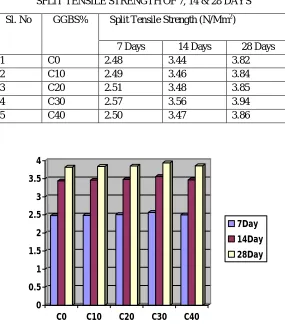
The Split tensile strength of 30 cylinders of 150mm diameter and 300mm long was carried out for 7, 14 & 28 days as per IS 5816-1976. The results are given in Table VIII.
TABLE VIIII
SPLIT TENSILE STRENGTH OF 7, 14 & 28 DAYS
0 0.5 1 1.5 2 2.5 3 3.5 4
C0 C10 C20 C30 C40
7Day 14Day 28Day
Fig7: Comparison of split tensile strength for 7, 14 & 28 – days
C. Flexural Strength Test
[image:6.612.164.449.174.505.2]strength of fifteen concrete prisms of 100mm x100mm x 500mm were tested for 7, 14 & 28 days was tested based on IS: 516-1959. The M30 mix ratio of 1: 1.84: 3.05:0.40 which gave better results when compared to the control mix. The given Table explains flexural strength of different replacement levels of GGBS at the age of 7, 14 and 28 days.
TABLE IX
FLEXURAL STRENGTH OF CONCRETE Sl. No GGBS% Flexural Strength (N/Mm2)
7 Days 14 Days 28 Days
1 C0 3.64 4.78 5.2
2 C10 3.71 4.87 5.3
3 C20 3.73 4.91 5.34
4 C30 3.79 4.98 5.42
Sl. No GGBS% Split Tensile Strength (N/Mm2)
7 Days 14 Days 28 Days
1 C0 2.48 3.44 3.82
2 C10 2.49 3.46 3.84
3 C20 2.51 3.48 3.85
4 C30 2.57 3.56 3.94
[image:6.612.135.470.616.731.2]5 C40 3.75 4.93 5.36
0 2 4 6 8 10
C0 C10 C20 C30 C40
7Day 14Day 28Day
Fig8: Comparison of flexure strength for 7, 14 & 28 – days
VI.CONCLUSIONS
The concrete mixture with 30% GGBS achieved highest compressive, split tensile, flexure strength at end of curing day with all variations in comparison to plain concrete mixture. Hence the optimum value is achieved for 30% GGBS. The 30% replacement of cement with GGBS gives optimum result but after that the strength got slowly decreases. Compression strength of cement by the replaced GGBS concrete specimens was higher than the plain cement concrete specimens. The strength differential between the GGBS concrete specimens and plain cement concrete specimens became more distinct after 28 days. Bleeding in GGBS concrete is significantly reduced and other properties like surface finish are improved. Results of this investigation suggest that GGBS could be very conveniently used in structural concrete.
Use of GGBS reduces the amount of cement content as well as heat of hydration in a mortar mix. Thus, the Construction work with GGBS concrete becomes environment friendly and also economical. GGBS can be Used as substitute for cement which will reduce the cost of cement in concrete and also reduce the
Consumption of cement. Therefore it is safe to replace the cement with 30% GGBS considering the strength.
VII. ACKNOWLEDGMENT
The authors express their deep and sincere thanks to the management, principal, head of civil engineering
department and staff of JCT College of engineering and technology, Coimbatore for their tremendous support
and valuable guidance from time to time, and authorities of Anna University for their support. The authors
wish to thank all who have guided and helped.
REFERENCES
[1] Vinayak Awasare, Prof. M.V.Nagendra “ Analysis of strength characteristics of GGBS concrete” International journal of advanced engineering technology, E-ISSN: 0976-3945
[2] S. Arivalagan “Sustainable studies on concrete with GGBS as a replacement material in cement” Jordan Journal of civil engineering, Volume 8, No.3, 2014 [3] Oner and S. Akyuz, “An experimental study on optimum usage of GGBS for the compressive strength of concrete” Cement & Concrete Composites vol. 29.
pp. 505 - 514 2007.
[4] Siddharth, Prof. Seetharam.Munnur “Experimental study on strength properties of concrete using steel fibre and GGBS as a partial replacement of cement” International journal of engineering research and technology- ISSN: 2278-0181, Vol. 4, January 2015
[5] M S Shetty, Concrete Technology Theory and Practice, S Chand Publication,2013 [6] IS:10262-2009 “Concrete Mix Proportioning – Guidelines”
[7] IS:516-1959 “Methods of tests for strength of concrete” [8] IS: 5816-1999 “Splitting Tensile Strength Of Concrete.”