R E S E A R C H
Open Access
Recurrent evolution of heat-responsiveness
in
Brassicaceae COPIA
elements
Björn Pietzenuk
1,2, Catarine Markus
1,3, Hervé Gaubert
4,5, Navratan Bagwan
1,6, Aldo Merotto
3, Etienne Bucher
7and Ales Pecinka
1*Abstract
Background:The mobilization of transposable elements (TEs) is suppressed by host genome defense mechanisms.
Recent studies showed that the cis-regulatory region of Arabidopsis thalianaCOPIA78/ONSENretrotransposons contains heat-responsive elements (HREs), which cause their activation during heat stress. However, it remains unknown whether this is a common and potentially conserved trait and how it has evolved.
Results:We show thatONSEN,COPIA37,TERESTRA, andROMANIAT5are the major families of heat-responsive TEs in A. lyrataandA. thaliana. Heat-responsiveness ofCOPIAfamilies is correlated with the presence of putative high affinity heat shock factor binding HREs within their long terminal repeats in sevenBrassicaceaespecies. The strong HRE ofONSENis conserved over millions of years and has evolved by duplication of a proto-HRE sequence, which was already present early in the evolution of theBrassicaceae. However, HREs of most families are species-specific, and inBoechera stricta, theONSENHRE accumulated mutations and lost heat-responsiveness.
Conclusions:Gain of HREs does not always provide an ultimate selective advantage for TEs, but may increase the probability of their long-term survival during the co-evolution of hosts and genomic parasites.
Keywords:Brassicaceae,COPIA, Evolution, Heat stress,ONSEN
Background
Transposable elements (TEs) are ubiquitous components of eukaryotic genomes. Their functions and roles range from DNA parasites, through regulators of gene transcription to facilitators of genome evolution (reviewed in [1, 2]). To-gether with other types of repeats, TEs comprise 10–80 % of plant genome content and specific families of long ter-minal repeat (LTR) retrotransposons can reach thousands of copies per genome [1, 3]. Plants evolved several layers of sophisticated epigenetic silencing mechanisms in order to suppress TE activity. Their transcripts are degraded by the post-transcriptional gene silencing (PTGS) pathway, which greatly reduces possible transposition events [4]. In parallel, transcriptional gene silencing (TGS) stably silences TEs by deposition of DNA methylation via RNA directed DNA methylation (RdDM) mechanism (reviewed in [5, 6]). The repressed state is further stabilized by accumulation of spe-cific histone modifications and faithfully transmitted in a
DNA replication-dependent manner to the next genera-tions. External or internal factors [7, 8] can lead to transient loss of silencing, but the epigenetic control will be re-established through tissue-specific RdDM activity [9]. In addition to the nimble epigenetic silencing system, entire TEs can be physically removed from the host genome by deletion-biased homologous recombination processes [10].
In spite of the multi-layer amplification barriers, many TE families show signs of recent transpositions [11–13], sug-gesting that TEs occasionally escape epigenetic surveillance. There is increasing evidence that stress treatments affect chromatin structure and may lead to transposon activation (reviewed in [1, 14]). A possible mechanism was proposed based on the analysis of stress-induced TEs. LTRs of medi-cago cold-inducible repetitive element (MCIRE) retrotrans-poson contain a putative cold-responsive element (CRE) in alfalfa (Medicago sativa) [15]. The CRE is specified by a conserved 5-bp core sequence (CCGAC) typical for C-repeat (CRT)/dehydration-responsive elements (DRE) that are recognized by cold-specific transcription factors (TFs) [16]. LTRs of heat-responsiveCOPIA78/ONSEN(used as synonyms in this study) retrotransposon inArabidopsis * Correspondence:[email protected]
1Department of Plant Breeding and Genetics, Max Planck Institute for Plant
Breeding Research, Cologne 50829, Germany
Full list of author information is available at the end of the article
thaliana[7, 8, 17], contain a cluster of four nGAAn motifs forming a heat-responsive element (HRE) [18]. During heat stress (HS), theONSENHRE is bound by heat shock factor A 2 (HSFA2), which triggers its transcriptional ac-tivity. This regulation is very specific and greatly inde-pendent of TGS control as the loss of decreased DNA methylation 1 (DDM1) in mutant plants did not trigger ONSENtranscriptional activation [7], in contrast to other typical LTR retrotransposons [19].
Presence of HRE and CRT/DRE motifs inONSENand MCIRE, respectively, suggested that the TEs’response to stresses may be mediated by specific TF binding motifs. HREs were previously classified into four types based on their structure and, most likely, also activity [20]. The strongest 4P HRE contains at least four adjacent nGAAn motifs and is bound by two HSFA2 trimers. The 3P HRE is bound by a single HSFA2 trimer and represents a mod-erately responsive HRE. In contrast, gap and step HREs with irregularly and more distantly spaced nGAAn motifs have on average lower HRE activity. Therefore, the HRE composition needs to be considered in order to define the strength of transcriptional response.
Here we identified multiple heat-responsive COPIA families in Arabidopsis lyrata and A. thaliana, two closely related species, using RNA sequencing (RNA-seq). Subsequently, we extended our analysis to five other Bras-sicaceae species and reconstructed putative HREs, their evolutionary history, and validated our predictions by transcriptional analysis after HS treatment.
Results
Identification of heat-responsive TE families inA. thaliana andA. lyrata
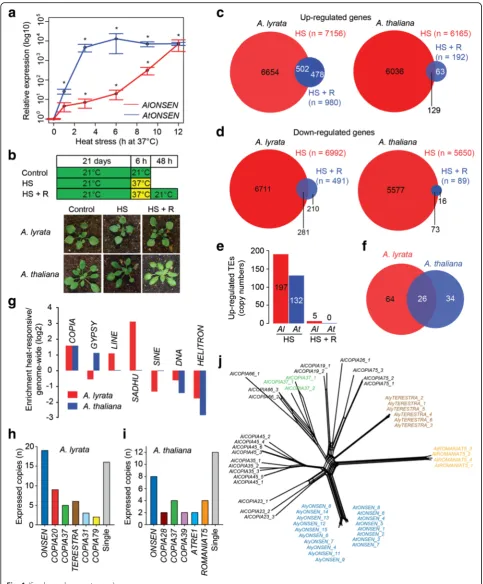
First, we determined HS conditions that would be effect-ive and comparable for A. lyrataMN47 and A. thaliana Col-0 plants. As theA. lyratagenome contains sequences with high homology to theA. thaliana ONSEN retrotrans-poson, we quantified ONSEN transcripts in both species by reverse transcription quantitative polymerase chain re-action (RT-qPCR) during a HS (37 °C) time series using soil-grown plants. Transcripts accumulated faster in A. thaliana, but to comparable amounts in both species after 12 h of HS (Fig. 1a). We selected 6 h at 37 °C, leading to a significant and reproducibleONSENtranscript accumula-tion in both species (T-test, P<0.05), as the standard HS treatment. Subsequently, samples of control, heat-stressed (6 h HS), and recovered (6 h HS + 48 h 21 °C) plants were RNA-sequenced (Fig. 1b).
To assess the extent of plant responses to HS, we moni-tored transcript levels from 32,793A. lyrataand 32,678A. thaliana protein-coding genes. This revealed significant upregulation (adjustedP<0.05; DESeq) of 21.8 %A. lyrata genes (n= 7156) and 18.9 % A. thalianagenes (n= 6165) after 6 h HS (Fig. 1c; Additional files 1 and 2). After
recovery, we found only 2.9 % (n= 980) of genes still up-regulated inA. lyrataand 0.6 % (n= 192) inA. thaliana. A. lyrata showed 21.3 % (n= 6992) downregulated genes after HS and 1.5 % (n = 491) after recovery (Fig. 1d). There were 17.3 % (n= 5650) significantly downregulated genes after HS and only 0.3 % (n= 89) after recovery in A. thaliana. Hence, HS treatment induced a similar degree of transient transcriptional changes in both species.
Because there is no publicly availableA. lyrataTE annota-tion, we prepared custom-made catalogues of 53,089A. lyr-ataand 17,009A. thalianarepetitive elements (Additional files 3 and 4, respectively). Although the two species differed threefold in their TEs numbers, their spectra of TE families were similar (Additional file 5: Figure S1). The multi-copy nature of many TEs hinders RNA-seq analysis using stand-ard protocols. Therefore, we developed the COMparative EXpression of TEs (COMEX) method, which allows quanti-fication of transcripts derived from individual TE copies and effective removal of the RNA-seq reads mapping across TE families (see “Methods;” Additional files 6 and 7). We found 197 and 132 significantly (adjustedP <0.05; DESeq) upregulated TEs, representing 90 and 60 families (26 in common), after 6 h HS in A. lyrataand A. thaliana, re-spectively (Fig. 1e, f; Additional files 8 and 9). Comparing the major upregulated TE groups versus those in the whole genome revealed general under-representation of DNA transposons andHELITRONsandA. lyrata-specific under-representation of SINEs. In contrast, we found an over-representation of heat-responsiveSADHU andLINE retro-transposons in A. lyrata, GYPSY elements inA. thaliana, andCOPIATEs in both species (Fig. 1g). Heat-responsive AlCOPIAs (n = 60; 100 %) comprised six families with at least two heat-inducible elements (Fig. 1h): AlCOPIA31 (n= 3; 3 %),AlCOPIA79(n = 2; 3 %),AlCOPIA37(n= 5; 11 %),AlCOPIA20(n= 9; 14 %),AlONSEN(n= 19; 37 %), and a so far unknown family which we named
TEMPERATURE RESPONSIVE TRANSPOSON
Next, we tested whether heat-responsiveCOPIAfamilies represent a particular COPIA clade. We reconstructed phylogeny of HS-responsive COPIA37, ONSEN, TERES-TRA,ROMANIAT5, and seven HS-non-responsiveCOPIA families (19, 23,26,35,45,66,75) based on their RT se-quences (Fig. 1j; Additional file 5: Figure S2). The coding sequence was preferred over LTRs for the similarity ana-lysis because this is strongly influenced by length of the in-put sequences, which may vary drastically in case of LTRs from different families. All heat-responsive families formed distinct and early separated branches, suggesting multiple independent origins ofCOPIAheat-responsiveness.
The structure and evolution ofONSEN heat-responsiveness
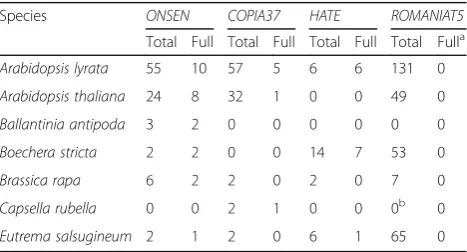
There are 24 COPIA78 elements in A. thaliana Col-0 (TAIR10) including eight full-length copies and 16 frag-ments (Table 1, Additional file 5: Table S1). However, only the eight full-length ONSEN copies were found to be heat-responsive (Additional file 9). We performed in silico reconstruction of the putative HREs using a pro-posed classification [20], which suggested two HREs in all heat-responsive AtONSENs: a low efficiency gap HRE and the highest efficiency 4P HRE (Fig. 2a; Additional file 5: Figure S3). While the gap HRE is present in all eight A. thalianafull-lengthONSENs, the 4P was changed into a 3P
HRE with moderate efficiency inAtONSEN4, due to loss of the fourth motif (Additional file 5: Figure S3). In contrast, none of the 16 fragments or solo LTRs contains functional HREs nor shows heat-responsiveness according to RNA-seq (Additional file 9).
We found 55 COPIA78 TEs in A. lyrata. Ten are full-length elements and 45 are fragments, either solo LTRs or incomplete according to the gaps in the genome assembly (Table 1; Additional file 5: Figure S3 and Table S2). In total, 15 copies contain at least one putative HRE with three or more adjacent (≤5 bp) nGAAn motifs. Remarkably, a high number ofAlONSENscarry HREs identical toA. thaliana copies (Fig. 2a; Additional file 5: Figure S3). AlONSEN 2 and 8 have A. thaliana-like gap HREs; the 4P type is present inAlONSEN 10and both co-occur inAlONSEN 6, 7, 9,11, 14, 15,17. In addition, we observed putative low efficiency gap/step HREs substituting the 4P HRE in AlON-SEN 1, 4,5, 12, and13. AllAlONSENs with predicted 4P HREs were upregulated after 6 h HS (Additional file 8). AlONSEN 3and16were also found upregulated although they did not contain putative HREs. This was most likely caused by ambiguity in RNA-seq analysis, as 100 % of the reads mapping to these elements were multiply mapping to otherONSENs. Hence, there is a high correlation between the predicted HREs and RNA-seq results.
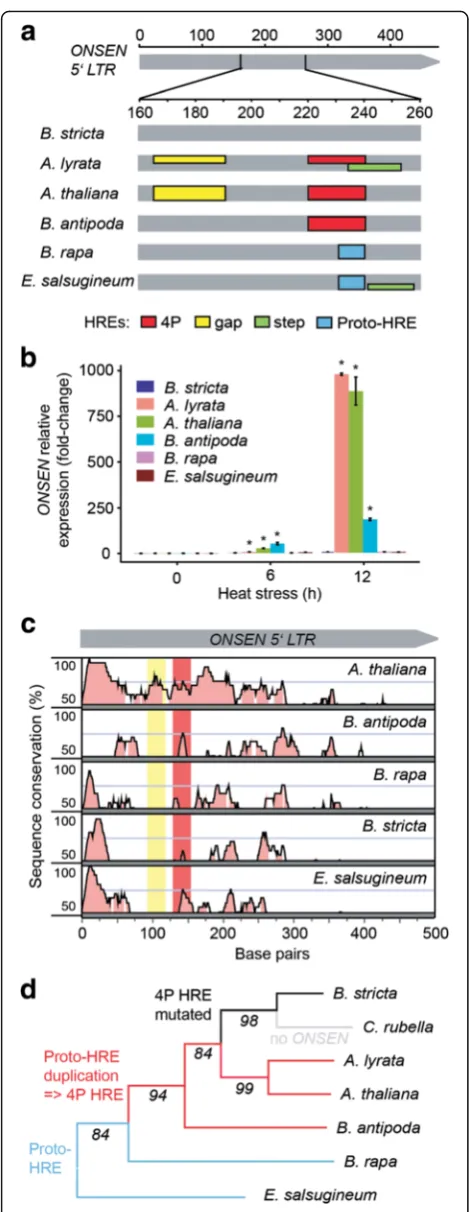
[image:4.595.57.291.589.715.2]Conservation of the most frequent HRE haplotype be-tween the Arabidopsis species raised the question about the evolutionary history ofONSENheat-responsiveness in the Brassicaceae. Therefore, we searched for COPIA78 elements in whole-genome assemblies ofBoechera stricta v1.2,Brassica rapaFPsc v1.3 (both JGI; Phytozome), Cap-sella rubella [21], Eutrema salsugineum [22], and low coverage assembly ofBallantinia antipoda(Vu, Finke, and Pecinka; unpublished data) using genome-wide BLAST searches. We confirmed the absence ofCOPIA78in Cap-sella[23], but found at least oneONSENcopy in all other species (Table 1). RT nucleotide sequence identity was >80 % (Additional file 5: Figure S4), fitting previously proposed criteria for a single TE family [24]. The LTR identity was lower (typically <70 %) due to the presence of insertions and deletions and decreased with phylogenetic distance
Table 1Copy numbers of elements within analyzedCOPIA
families inBrassicaceaespecies
Species ONSEN COPIA37 HATE ROMANIAT5
Total Full Total Full Total Full Total Fulla
Arabidopsis lyrata 55 10 57 5 6 6 131 0
Arabidopsis thaliana 24 8 32 1 0 0 49 0
Ballantinia antipoda 3 2 0 0 0 0 0 0
Boechera stricta 2 2 0 0 14 7 53 0
Brassica rapa 6 2 2 0 2 0 7 0
Capsella rubella 0 0 2 1 0 0 0b 0
Eutrema salsugineum 2 1 2 0 6 1 65 0
a
AllROMANIAT5elements lacked integrase domain
b
Only three solo LTRs were found inC. rubella (See figure on previous page.)
Fig. 1Transcriptome analysis of heat-stressedA. lyrataandA. thalianaplants.aEffects of HS onONSENheat-responsiveness inA. thalianaandA. lyrata. Both species were stressed at 37 °C for the indicated number of hours (h) and subsequently analyzed for the amount ofONSENtranscript
(log10) by RT-qPCR relative toGAPD-Htranscript amounts. * significant (t-test,P<0.05) transcript enrichment relative to 0 h control.Error barsindicate
standard deviation of three biological replicates.bDesign of plant HS treatment for RNA-seq and representative phenotypes of control, 6 h heat-stressed
at 37 °C and recovered plants.c,dNumber of significantly (c) upregulated or (d) downregulated protein-coding genes after 6 h at 37 °C
and 48 h recovery at non-stress conditions in both species.e,fNumber of significantly upregulated (e) TEs and (f) TE families after 6 h
HS and 48 h recovery.gIdentification of TE groups enriched for heat-responsive copies. Retrotransposons were divided intoSINE,SADHU,
LINE,COPIA, andGYPSYfamily members. The relative enrichment of heat-activated TEs was calculated as ratio between % of all heat-activated to % of
all TEs genome-wide and expressed on a log2 scale. The major heat-responsiveCOPIAfamilies in (h)A. lyrataand (i)A. thaliana. The families containing
a single HRE are displayed as“single copies.” jRT amino acid sequences (Additional file 12)-based phylogenetic network of selected
heat-responsive (colored) and non-responsive (black)A. lyrataandA. thaliana COPIAfamilies. The data are also provided as un-rooted three in
(Additional file 5: Figure S5). Nevertheless, it allowed us reconstructing putative HREs. None of the other species contained theA. thaliana-like gap HRE (Fig. 2a; Additional file 5: Figure S3). However, there was a perfectly conserved 4P HREs in two out of three ONSENs in B. antipoda. ONSENsof other species either did not contain any HREs (B. stricta) or they represented only lower efficiency types and were non-homologous to theArabidopsisHREs (Fig. 2a). To challenge the predicted HREs, we grew all species in vitro and quantified ONSEN transcript levels after 6 h and 12 h of HS (Fig. 2b). In agreement with RNA-seq results, we found massive 884–976-fold upregulation in A. lyrataand A. thaliana. There was also high (185-fold) upregulation in B. antipoda containing the putative 4P HRE, but lacking an additional gap HRE (Fig. 2a, b). In con-trast,B. stricta, B. rapa, and E. salsugineum predicted to have no or only low efficiency HREs did not show strongly increasedONSENtranscript amounts (Fig. 2b).
To test whether HREs represent a majorcis-regulatory element in ONSEN LTRs, we performed phylogenetic shadowing of the LTR consensus sequences (Fig. 2c). Al-though the 4P HRE region was partially conserved, there are several other similarly conserved regions. The lon-gest stretch of conserved LTR sequence comprises ap-proximately the first 25–30 bp (Fig. 2c), which may be required for TE RT.
By anchoring the structural information on the Brassica-ceaechalcone synthase-based phylogeny, we reconstructed the evolutionary trajectory ofONSENHREs (Fig. 2d). The nTTCnnGAAn motif, which can be considered as the non-functional sequence preceding the 4P HRE (proto-HRE), is present inB. rapaandE. salsugineum(Fig. 2a; Additional Fig. 2Evolution ofONSENheat-responsiveness.aSchematic representation
of in silico reconstruction of putative HREs inONSEN5’LTR in different
Brassicaceaespecies. HRE reconstruction follows criteria proposed by [20].
Colored boxesspanning the entire height of thegray fieldindicate HREs
found in≥50 % of the heat-responsive copies inA. thalianaandA.
lyrataor all copies in other species. Thelower boxesrepresent less frequent (<50 %) variants. Detailed information including sequences underlying individual HREs can be found in Additional file 5: Figure S2.
bTranscript levels ofONSENelements inBrassicaceaeafter 6 h and 12 h
at 37 °C. Quantitative PCR values were obtained using species-specific
primer pairs and normalized toUBC28. Error barsindicate standard
deviation of three biological replicates and *P<0.05 in Student’s
t-test.cSequence conservation over theONSEN5’LTR. Species-specific 5’
LTR consensus sequences were compared toA. lyrataquery using 20 bp
sliding window and 7 bp minimum consensus length. They-axisfor
each species shows 50–100 % sequence conservation. Regions with
≥70 % similarity (pink-filled) were considered as conserved.Redand
yellow background colorsindicate theA. lyrata4P and gap HRE regions.
dReconstruction ofONSENHRE evolution. The phylogenetic tree was
developed using theCHALCONE SYNTHASEgene of each individual
species. The numbers at branches indicate bootstrap values.Blue lines
show species with proto-HREs,redshows those carrying 4P HREs,black
shows loss of HREs inB. stricta, andgrayshows theCOPIA78family in
[image:5.595.56.291.83.690.2]file 5: Figure S3), suggesting that it existed already at the onset ofBrassicaceaeevolution. Later, proto-HRE became duplicated and instantly created the high affinity 4P HRE. Molecular dating of the split of the B. antipoda lineage [25] suggests that this motif was maintained over 6–9 million years of evolution. However, the 4P HRE was occa-sionally lost due to accumulation of the point mutations (B. stricta) or deletion of whole elements (Capsella).
Species-specific gain of HREs inCOPIA37and the novel familyTERESTRA
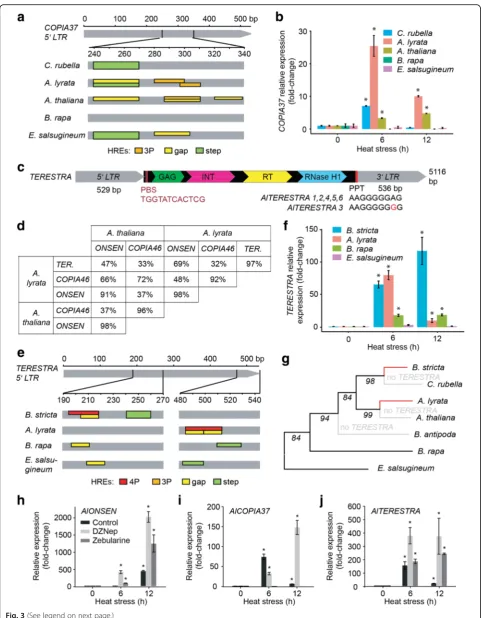
The other TE family found to be heat-responsive in both Arabidopsis species wasCOPIA37 (Fig. 1h, i). However, this phenotype was restricted to fewer copies as only 8.8 % (five out of 57) and 12.5 % (four out of 32) ofA. lyrata andA. thaliana COPIA37s, respectively, showed upregula-tion upon HS (Addiupregula-tional files 8 and 9). The 5’LTRs of all heat-responsive copies contained putative low affinity bind-ing gap and step HREs (Fig. 3a; Additional file 5: Figure S6). In addition, we found putative 3P HREs in three AtCO-PIA37sand twoAlCOPIA37s. These HREs originated from a common nTTCn rich LTR region, but were not identical. Search in other species revealed the presence ofCOPIA37 inB. rapa(n = 2),C. rubella(n= 2), andE. salsugineum (n= 2; Table 1), but here we found only low affinity binding gap and/or step HREs in the latter two species (Fig. 3a; Additional file 5: Figure S6). To test whether the predicted HREs correlate with heat-responsiveness, we ex-posed all species to 6 and 12 h HS and quantified the tran-script amounts by RT-qPCR (Fig. 3b). We observed up to 25-fold activation for A. lyrata COPIA37 and a weaker (fivefold) activation forA. thaliana, both carrying putative 3P HREs. The amount ofCOPIA37transcript reached its peak at 6 h and decreased in spite of continued HS. Other species, carrying only lower efficiency gap and or step HREs, did either not accumulate the transcript or only at a single experimental point. Hence, the most effective 3P HREs evolved independently inA. lyrataand A. thaliana and alsoCOPIA37elements of other species carry diverse set of HREs.
We also identifiedTERESTRAas a new retrotransposon heat-responsive family. TheA. lyratagenome contains six TERESTRAcopies sharing 97 % similarity (Fig. 3d). BLAST searches using TERESTRA sequences revealed only local similarities toONSENLTRs andCOPIA46GAG and POL domains and no other significant hits. Therefore, we per-formed de novoTERESTRAanalysis. Based on the order of GAG and POL,TERESTRAwas unambiguously identified as Ty1/COPIA LTR-retrotransposon (Fig. 3c). Based on only 70 % similarity in an alignment of TERESTRA to COPIA46andONSENelements (Fig. 3d), we defined TER-ESTRAas a novelCOPIA family. The consensus length of the completeAlTERESTRAelement was 5116 bp and the 5’and the 3’ LTR were 529 and 536 bp long, respectively
(Fig. 3c; Additional file 5: Figure S7). Sequence analyses of AlTERESTRAsrevealed that all copies are full length, con-tain a tRNA primer binding site and a polypurine tract, suggesting their autonomy (Fig. 3c). TERESTRALTRs are relatively A-T-rich (69 %) and the consensus sequence contained only a small number of cytosines in symmetrical contexts (CG = 5, CHG = 0; H = A, T or C), which resem-bles LTR nucleotide composition of ONSEN [18]. TER-ESTRA was missing in the A. thaliana Col-0 genome. Therefore, we extended our search to 50 A. thaliana accessions by genotyping them with TERESTRA-specific primers (Additional file 5: Table S3). This screen also gave negative results and suggested the absence ofTERESTRA in A. thaliana. However, we found TERESTRA TEs in Arabidopsis cebennensis (95 % identity; Additional file 5: Figure S8) and Arabidopsis halleri (91 % identity; Additional file 5: Figure S9) using the NCBI sequence data-base. Furthermore, there wereTERESTRAsinB. stricta (n= 14), B. rapa (n= 2), and E. salsugineum (n= 6; Table 1), but not outside of theBrassicaceae.
All six AlTERESTRAs were heat-responsive (Fig. 1h; Additional files 8). Screening of AlTERESTRA LTRs for possible HREs revealed a cluster of six nGAAn motifs, which can assemble either two partially overlapping gap HREs or a 4P HRE (Fig. 3e; Additional file 5: Figure S10). Based on the high AlTERESTRA transcriptional heat re-sponse (Fig. 3f), we favor the latter possibility. Another species with high TERESTRA transcriptional activation after 6 h and 12 h HS wasB. stricta(Fig. 3f). By BLAST we found 14TERESTRA copies in the B. strictagenome (Table 1). Eleven copies among them contain a complex cluster of up to five adjacent nGAAn motifs in their 5’ LTRs (Fig. 3d; Additional file 5: Figure S10). According to a conservative approach, three nGAAn motifs within this cluster can putatively form a low affinity gap HRE, but highTERESTRA activation in B. stricta suggests that all five motifs can establish 4P HREs as compatible with a more relaxed prediction (Fig. 3e, f ). Importantly, all pre-dictedB. strictaHREs are at positions different from those in A. lyrata HREs (Fig. 3e), highlighting their species-specific evolution (Fig. 3g). In B. rapa, one TERESTRA copy carries a putative gap HRE and another one a step HRE (Fig. 3e). Out of sixTERESTRAs inE. salsugineum, three had putative step and one also an additional gap HRE. However, none of the HREs found inB. rapaandE. salsugineumwas homologous toArabidopsis orBoechera HREs and their predicted low HSF binding efficiency was congruent with the absence of heat-responsiveness in the RT-qPCR experiments (Fig. 3f).
a lack ofA. lyrataTGS mutants, we used a pharmacological approach to interfere with TE silencing [26]. We treated 14-day-oldA. lyrataplants with 10μM 3-deazaneplanocin A (DZNep) and 40μM zebularine, including control plants without treatment. DZNep is an S-adenosylhomocysteine synthesis inhibitor, which blocks the production of SAM, the methyl group donor required for DNA and his-tone methylation. Zebularine is a cytidine analog lead-ing to DNA de-methylation and loss of silenclead-ing from specific transposons [27–29]. After two days of drug treat-ment, plants were heat-stressed for 0, 6, and 12 h and the amount of transcript analyzed by RT-qPCR (Fig. 3h–j). Control DZNep and zebularine treatment increased COPIA37 and ONSEN transcript tenfold and fivefold, respectively (Additional file 5: Figure S11), suggesting that both TEs can be weakly activated by TGS interfer-ence also without HS treatment. TERESTRA was not activated by the drug treatment. A combination of HS with drug treatments had strong additive effects in all cases, except for zebularine and HS-treated COPIA37 (Fig. 3h–j). Both ONSEN and TERESTRA transcripts accumulated at much higher levels that were not de-creasing at 12 h HS (Fig. 3h, i). The effect was generally stronger for DZNep and weaker for zebularine. This suggests that the heat-induced TE transcript accumula-tion is rapidly suppressed by epigenetic means, in par-ticular for TEs carrying lower affinity binding HREs.
AtROMANIAT5contributes to transcriptional regulation of
APUM9under HS
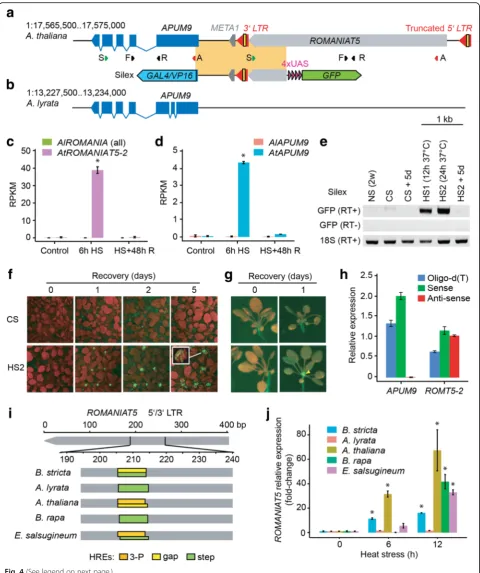
There are four heat-responsive ROMANIAT5 TEs in A. thalianabut none inA. lyrata(Fig. 1h, i; Additional files 8 and 9). All AtROMANIAT5 elements lack an integrase domain, suggesting that these elements are incomplete and non-autonomous (Table 1). A previous study revealed that one of the heat-responsive copies
AtROMANIAT5-2 (At1g35735) is under complex epigenetic control by Morpheus molecule 1 (MOM1) and RdDM pathways, and loss of this control causes upregulation of the Ara-bidopsis PUMILIO9 (APUM9; At1g35730) gene located directly downstream of the TE [30]. To better under-stand the potential role of ROMANIAT5 in regulating APUM9 during HS, we reconstructed their loci in A. thaliana and A. lyrata (Fig. 4a, b) and also retrieved the number of reads mapping to both loci under differ-ent experimdiffer-ental conditions (Fig. 4c, d). Interestingly, we observed significant (t-test, P<0.05) upregulation of APUM9 upon HS in A. thaliana but not in A. lyrata (Fig. 4c, d), where the nearby ROMANIAT5 is missing. This suggested that ROMANIAT5-2 controls APUM9 transcription under HS. To validate this observation, we used a reporter line (called Silex) which contains the APUM9upstream region and theROMANIAT5-23’LTR upstream of a GFP reporter (Fig. 4a) [31]. The Silex re-porter construct is silenced during entire A. thaliana de-velopment, except for developed siliques, but the reporter activity can be restored in the background of MOM1 RdDM double mutants and histone deacetylase 6 mutants [31]. We grew Silex reporter plants under controlled con-ditions with and without HS. GFP transcripts were missing in the control plants but present after 12 and 24 h at 37 °C (Fig. 4e). GFP accumulated in the apical meristem after 24 h of HS recovery and remained detectable for at least five days (Fig. 4f, g), although GFP transcript was not present anymore (Fig. 4e). Heat-responsiveness of Silex transgene in the absence of ROMANIAT5-2 5’ LTR suggested that the locus may be at least partially controlled by a bi-directional heat-responsive promoter activity of the 3’ LTR. Indeed, we found putative 3P/gap HREs within the 3’ LTRs (and also the 5’LTRs) of all heat-responsive AtRO-MANIAT5 TEs. However, transcription from the 3’ LTR could result in ROMANIAT5-2 antisense transcript. To (See figure on previous page.)
Fig. 3COPIA37andTERESTRAare novel heat-responsiveCOPIAfamilies.aIn silico reconstruction of putative HREs in the 5’LTR ofCOPIA37in different
species. HRE classification follows criteria proposed by [20].Colored boxesspanning the entire height of thegray fieldindicate HREs found in≥50 % of
the heat-responsive copies inA. thalianaandA. lyrataor all copies in other species. Thelower boxesrepresent less frequent (<50 %) HREs. Detailed
information including sequences underlying individual HREs can be found in Additional file 5: Figure S5.bTranscript levels ofCOPIA37inBrassicaceae
after 6 and 12 h 37 °C HS. The values were normalized to transcript levels ofUBC28. Error barsindicate standard deviation between three biological
replicates and *P<0.05 in Student’s t-test.cSchematic representationofA. lyrata TERESTRA(TERESTRA). LTRs are indicated in gray. Capsid protein (GAG),
integrase (INT), RT, and RNAse H1 domains are shown within thelight-blue-labeled TERESTRAprotein-coding part. Primer binding sequence (PBS) and
polypurine tract (PPT) are indicated byred boxes.dSequence similarities within pair-wise LTR alignments betweenA. lyrataandA. thaliana TERESTRA,
ONSEN, andCOPIA46families. More than 70 % similarity was expected for members of the same family.TERESTRAis absent inA. thaliana.eIn silico
reconstruction of putative HREs in the 5’LTR ofTERESTRA. The criteria were as described for Fig. 3a. Detailed information including sequences
underlying individual HREs can be found in Additional file 5: Figure S9.fTranscript levels ofTERESTRAin response to 6 and 12 h 37 °C HS in
differentBrassicaceae. The experiment was performed as described in (b).gReconstruction ofTERESTRAHRE evolution. The phylogenetic tree
was developed using a chalcone synthase gene of each individual species. The numbers at the base of the branches indicate bootstrap values.
Black linesshow species with low efficiency HREs andred lineshighlight independently evolved high efficiency HREs inA. lyrataandB. stricta. Gray linesdenote species whereTERESTRAcould not be found. TE transcript accumulation of (h)ONSEN, (i)COPIA37, and (j)TERESTRAafter 0, 6,
and 12 h 37 °C HS preceded by 48 h control (no inhibitor), 10μM 3-deazaneplanocin A (DZNep), or 40μM zebularine treatment. Transcript amounts
were normalized toUBC28mRNA and signals from drug and heat-treated samples were recalculated as fold-changes relative to 0 h.Error barsindicate
test this, we isolated A. thaliana RNA after HS and per-formed complementary DNA (cDNA) synthesis using strand-specific RT primers (Fig. 4a). Control cDNA from RT with oligo-d(T) primers gave signals for both genetic elements (Fig. 4h). Strand-specific RT-qPCR revealed HS-induced sense transcript, but no antisense transcript, for APUM9. In contrast, both types of primers resulted in amplification ofROMANIAT5-2transcripts, suggesting that it is transcribed in both directions under HS. The dis-tribution of RNA-seq reads did not indicate large amounts of a read through transcription from ROMANIAT5-2 to APUM9(Additional file 5: Figure S12). Altogether, this con-firms the 3’LTR as bi-directional HS-responsive promoter.
We foundROMANIAT5elements in genomes of all spe-cies except forB. antipoda(Table 1). Putative HREs were present in at least some copies ofROMANIAT5in all spe-cies except for C. rubellathat contained only solo LTRs. There were step and gap HREs inA. lyrata,B. rapa, and B. stricta, 3P/gap HREs inE. salsugineum, and 3P HREs inA. thaliana(Fig. 4i; Additional file 5: Figure S13). The predicted HSF binding affinity of individual HREs corre-lated well with the amount of ROMANIAT5 transcripts found after 6 and 12 h of HS (Fig. 4j). The only exception was B. rapa, which showed 42-fold upregulation after 12 h HS but the analyzed copies carried at most only low af-finity step HRE. This could be due to the presence of heat-responsiveROMANIAT5copies in the part of theB. rapagenome that is not yet assembled.
Discussion
Transpositions and insertions of TEs may lead to loss of gene functionality [32, 33]. Therefore, TEs activity and mo-bility are tightly controlled by epigenetic means throughout the entire plant development [5, 6]. On the other hand, new insertions contribute to genome evolution and regula-tion of gene transcripregula-tion [2]. Therefore, it was already suggested in the early days of transposon research that, under conditions when diversity of regulatory patterns in a population may provide a better basis for selection, lim-ited transposon activation could be beneficial [34]. How-ever, how occasional TE expression is provoked and how
control is regained later is still a matter of debate. There is a rapidly increasing number of reports showing transient TE activation under various stress conditions reviewed in [1]. Therefore, it was hypothesized that stresses may open a window for transpositions. Here, we introduced the ONSEN (COPIA78) family as a model for under-standing TE control and behavior under HS. ONSEN shows massive transcriptional upregulation upon HS in A. thaliana and new insertions in progenies of heat-stressed Pol IV mutant [7, 8, 17]. The molecular basis ofONSENheat-responsiveness was puzzling until recently, when a typical HSFA2 TF binding HRE was identified in its cis-regulatory region [18]. Presence of canonical TF binding motifs in TE promoters was described forD. melanogaster andM. truncatula[15, 35]. However, the frequency of such activation strategy among TEs was unknown.
We analyzed LTRs of A. thaliana and A. lyrata heat-responsiveCOPIATEsONSEN,COPIA37,TERESTRA, and ROMANIAT5for putative HREs. A minimum of three ad-jacent (<5 bp) nGAAn motifs can form a basal HRE, whose activity will depend on their distance and the total number [20]. Heat-responsiveCOPIAsfeatured the whole spectrum of HREs ranging from the 4P types inONSENand TERES-TRA, through 3P types inCOPIA37andROMANIAT5to a dozen of variable gap and step HREs in all these families. By comparing predicted HREs with transcriptional data, we conclude that gap and step HREs are mostly not sufficient to trigger HS-induced TE upregulation. This is congruent with their proposed low HSF binding efficiency [36]. Predicted 3P HREs correlated with up to a hundred-fold (COPIA37, ROMANIAT5) and 4P HREs with up to a thousand-fold (ONSEN,TERESTRA) transcript accumula-tion upon HS. This suggests a strong correlaaccumula-tion between putative HREs and the transcriptional response of the TEs.
Previously it was shown that the TGS machinery an-tagonizes the TE activation [7, 17]. We found that the speed of re-silencing during or after HS depends on the HRE type. WhileONSEN, with the strong 4P HRE, accu-mulated transcript during entire HS exposure, TEs car-rying lower affinity HREs typically showed a maximum transcript amount at 6 h HS and lower levels at 12 h (See figure on previous page.)
Fig. 4ROMANIAT5-2controls heat-responsiveness ofAPUM9inA. thaliana.aSchematic representationof theROMANIAT5-2–APUM9region inA. thaliana. Theyellow blockwithin the 3’LTR represents a 3P/Gap heat responsive element (HRE).Sposition of primers for RT of the sense transcripts,A
position of primers for RT of the anti-sense transcripts,FandRforward and reverse quantitative PCR primers.META1is a transposon fragment flanking
ROMANIAT5-23’LTR. Silex: theorange blockcorresponds to the genomic fragment cloned upstream of the 4דupstream activating sequence”(UAS,
violet) and green fluorescent protein (GFP;green).bSchematic representationof theA. lyrata APUM9locus. Reads per kilobase per million reads (RPKM)
for (c)ROMANIAT5and (d)APUM9under control, 6 h at 37°C HS and HS with 48 h recovery at control conditions (HS + R). *P<0.05 in t-test.eRT-PCR
analysis of Silex reporter construct response to HS.NSnon-stressed control plants,CSandHScontrol- or heat-stressed plants, respectively,+0and+5d
days of recovery at non-stress conditions,RT+andRT–samples with and without RT, respectively. 18S rRNA transcript serves as positive control.fGFP
signal in control and 24 h heat-stressed (HS2) Silex, detected after 0, 1, 2, or 5 days of recovery.Red–chlorophyll,green–GFP.gClose-up viewof plants
treated as described in (f).hStrand-specific RT-qPCR ofAPUM9andROMANIAT5-2inA. thalianaafter 6 h HS.iPutative HREs inROMANIAT5
LTRs inBrassicaceae.jRT-qPCR forROMANIAT5inBrassicaceaeafter 6 and 12 h at 37 °C HS. The values were normalized toUBC28. Error bars
HS. This silencing can be reduced by treatment with DNA methylation inhibitors. Hence, stressed plants take active measures to prevent TE transpositions already dur-ing ongodur-ing HS treatment. However, HS-induced TE acti-vation must not always aim at transposition, but can be part of the plant regulome [2]. InA. thaliana, we found that heat-responsive AtROMANIAT5-2 controlled tran-scription of theAPUM9 gene located downstream of the element. As we did not observe any evidence for high amount of a read-through transcript fromROMANIAT5-2 towards APUM9, we hypothesize that this transcriptional activation may be mediated rather by a specific three-dimensional chromatin organization at this locus.APUM9 gene was previously shown to be under control byHDA6 and synergistically by MOM1 and RdDM pathways, but not DDM1 and MET1 [30, 31]. Therefore, AtROMA-NIAT5-2 may represent a domesticated transposon with fine-tuned HS-regulated activation, contributing to tran-scriptional control ofAPUM9.
To challenge the hypothesis that HREs could be bene-ficial for TE amplification (but not necessarily for the host genome stability), we reconstructed evolutionary trajectories for HREs of ONSEN,COPIA37,TERESTRA, and ROMANIAT5 in the Brassicaceae. ONSEN was not heat-responsive in the early separated lineages repre-sented by B. rapa and E. salsugineum, because its LTRs contained only one half of the 4P HRE (proto-HRE), which does not constitute a functional HRE. The proto-HRE became duplicated approximately 6–9 millions of years ago [25] and directly formed the present days 4P HRE found in the genus Arabidopsisand in the Austra-lian speciesB. antipoda. Hence,ONSEN4P HRE repre-sents an evolutionary conserved cis-regulatory element. However, it should be noted that there are several other similarly or even more conserved regions within the ONSEN LTR. Whether they represent other TF binding sites and/or enhancers remains currently unknown. Fur-thermore, theONSENexample shows that even high af-finity HREs do not allow a TE to overrule the host genome defense, because their heat-responsiveness was lost inB. stricta, and the whole family became vanished from theC. rubellagenome. InTERESTRA, high affinity 4P HREs evolved independently at two different LTR re-gions in the closely related species A. lyrata and B. stricta, while 3P HREs of COPIA37 emerged multiple times from a common nTTCn-rich LTR region. In con-trast toONSEN, HREs of these families are evolutionary young and species-specific. Whether they will be evolu-tionary successful, is an open question, but we speculate this to be the case for A. lyrata TERESTRA, where all genomic copies are full length, carry strong HRE, and respond to heat.
At present it is unknown whether higher temperatures in southern latitudes lead to greater amplification of
heat-responsive TEs in subtropical relative to temperate zones. Although this is possible, there are also several factors that may act against such correlation. First, southern popula-tions may reduce effects of HS by adaptation and growth at favorable microclimatic and/or temporal conditions [37]. Second, the genomes are subject to purification mecha-nisms and the higher transposition rate may be opposed by a greater frequency of TE removal [10]. Indeed, HS was shown to increase frequency of DNA sequence removal by a single strand annealing type of homologous recombin-ation in transgenic constructs structurally resembling a LTR retrotransposon [38, 39]. Therefore, the final number of stress responsive TEs per genome may be the result of multiple effects acting in a complex network.
Conclusions
TEs evolvecis-regulatory elements, such as HREs, rapidly and independently in many groups. This may represent a strategy to produce new copies, constantly challenging the host defense system by searching for potential weak points. Successful regulatory elements may become evolu-tionary conserved and spread by new TE insertions in a self-reinforcing loop. However, these copies will be si-lenced and frequently removed from the genome. Hence, stress-mediated TE activation is likely not an unequivocal and straightforward winning principle, but rather a neces-sary strategy to survive under the pressure of the host defense systems. It is also likely that the host genome can benefit to some extent, and in specific cases, from cis-regulatory elements spread by TEs.
Methods
Plant materials and growth conditions
day regime (16 h light/8 h dark) and constant temperature of 21 °C. Plates with rosettes at the pre-bolting stage were then placed in another chamber with 37 °C for 6 h. For combined drug and heat treatments,A. lyrataplants were grown as described above, then transferred to plates with no inhibitor, 10 μM DZNep, or 40 μM zebularine (both Sigma-Aldrich) for 48 h and then exposed to 0, 6, or 12 h at 37 °C HS. Aerial plant tissues were harvested immedi-ately after the stress, flash frozen in liquid nitrogen, and stored at–80 °C.
Seeds of the Silex reporter line were sown directly on potting soil and stratified at 4 °C for 48 h. The pots were then placed in a Percival CU-22 L chamber at 21 °C with 12 h light (140 mmol m−2s−1) and 12 h dark. When the plants turned 14 days old, the pots were placed at 6 °C under the same light conditions for 24 h. At this time, control plants were moved back to the 21 °C chamber while HS plants underwent 24 h HS at 37 °C with light conditions as before. Immediately after the HS treat-ment, all pots were placed again at 21 °C. Fluorescence pictures of control and HS plants were taken at 0 and after 1, 2, and 5 days of recovery. Fluorescence imaging was performed using an Aequoria dark box with a mounted ORCAII CCD camera (Hamamatsu, Japan).
Nucleic acids extraction, cDNA synthesis, and RT-qPCR
Genomic DNA was isolated using the Phytopure gDNA Kit (GE Healthcare). Total RNA was isolated with the RNeasy Plant Mini Kit (Qiagen) with an on column DNaseI (Roche) digestion or by the standard Trizol method with additional DNaseI (Thermo Scientific) digestion. cDNA was synthe-sized from 1μg total RNA per sample using the Revert Aid H-Minus First Strand cDNA synthesis kit with the oligo-d(T) primer (all Thermo Scientific). For strand-specific RT, total RNA of 6 h HS A. thalianaplants was divided into five aliquots which were converted into cDNA using (1) oligo-d(T) primer,APUM9(2) sense and (3) antisense tran-script primer, and ROMANIAT5-2 (4) sense and (5) anti-sense transcript primers. RT-qPCR analysis was performed on three biological replicates with at least two technical replicates in a CFX384 instrument (BIO-RAD) using the SensiMix Plus SyBr Kit (PEQLAB). Expression values were calculated relative to control-treated samples using the standard curve method [40] and normalized using the glyceraldehyde-3-phosphate-dehydrogenase C2 (GAPC-2) or theUBC28gene with a stable expression under mock, HS, and recovery conditions. Primers used in this study are listed in Additional file 5: Table S4.
RNA sequencing
One μg total RNA per sample with RIN >8.0 (Agilent Bioanalyzer 2100) was used to construct strand non-specific sequencing libraries with the Illumina TruSeq RNA Library Kit v2 according to the manufacturer’s
instructions. Library quality was tested on a Bioanalyzer and high-quality libraries were subsequently sequenced in the 100 bp single-end read mode using a HiSeq 2500 sequencer (Illumina). Adaptor sequences and low quality bases were trimmed and low quality reads were filtered out with the FAST-X toolkit (http://hannonlab.cshl.edu/ fastx_toolkit/) using custom-made scripts. Subsequently, reads were mapped to the corresponding reference gen-ome (TAIR 10 gengen-ome assembly orA. lyrata genome as-sembly v1.0) using tophat2 [41] with default settings. On average, >15 million sequencing reads per library passed trimming and quality filtering. The numbers of reads map-ping to specific genomic positions were retrieved using Qualimap and the latest A. thaliana genome annotation TAIR10 andA. lyratagenome annotation v2 [42] for genes and custom-made repeat annotations for TEs. The TE data were further processed with COMEX (see below) and data for genes were analyzed directly using the DESeq package in R software [43, 44].
COMparative EXpression of transposable elements (COMEX)
same TE family was retrieved using a strand non-specific protocol in Qualimap. To avoid a bias by repeated counting of SMM reads, we used the proportional read count method that divides the power of a read by the number of mapped positions. This provided the number of reads per individual TE families and TEs, which were subjected to statistical ana-lysis using the DESeq package in R software [43]. To avoid considering potentially large number TEs with minimal transcriptional changes, which would be later difficult to validate experimentally, we considered only those which had at least 0.55 RPKM in one of the experimental time points.
In silico sequence analysis
Sequences of interest were extracted from corresponding TE annotation files using bedtools [45]. LTR reconstruc-tion was carried out in LTR-Finder [46] or manually by pairwise and multiple alignments of the 3'end to the 5'ends of TE annotated regions using MUSCLE or multa-lin with the DNA 5–0 comparison table option. Structural analysis and annotation of TERESTRA was performed using LTR Finder and blastx using NCBI non-redundant protein sequences database. LTR_Finder was used in both analyses with the threshold option set to 2.0 using the tRNA database of A. thaliana to predict PBS. The LTR length range was set from 100–3500 and the minimum LTR distance was set to 1000. Other parameters were left at default settings. Search for ONSEN sequences within genomes of variousBrassicaceaewas done using BLASTN within Phytozome 10 [47, 48]. Hits with a sequence iden-tity of >70 % were extracted and manually investigated. Positive hits with a query coverage <70 % were analyzed manually for sequence similarity with Multialign using the DNA 5–0 comparison table option. The input ONSEN RT and LTR sequences are provided in Additional files 10 and 11, respectively.
Phylogenetic analysis
To analyze the evolutionary distance of the Ty1/COPIA LTR-retroelements, multiple sequence alignments of the RT domains were performed using the genomic nucleo-tide sequences in MUSCLE [49]. RT protein sequences used for construction of the network and the tree (Fig. 1j and Additional file 5: Figure S2, respectively) are pro-vided in Additional file 12. The evolutionary history was inferred using the Neighbor-Joining method (Kimura-2-Parameter method) with 1000 bootstrap replicates. Posi-tions containing missing data and gaps were removed (pairwise deletion option) leading to a total of 862 pos-ition in the final dataset. The tree was visualized as an unrooted tree. Phylogenetic network of genomic RT domain sequences from Ty1/COPIA LTR-retroelements was constructed using Neighbor-Net [50] within the splitstree 4.0 package [51, 52]. The phylogenetic
distances were calculated by LogDet-pairwise genetic distances using LDDIST [53] with imputed missing matrix entries. Multiple sequence alignments ofCHSgenomic se-quences were performed using MUSCLE [49]. The CHS phylogeny was inferred using the Maximum Likelihood tree based on the Kimura-2-parameter model with 1000 bootstrap replicates.CHS sequences were retrieved from [25]. All positions containing gaps and missing data were eliminated. There were a total of 1267 positions in the final dataset. All phylogenetic trees were constructed within MEGA 7 [54]. Phylogenetic shadowing and analysis of motif conservation was performed with mVISTA [55, 56] using LTR consensus sequences of different species prepared in BioEdit [57], allowing fasta ambiguity codes for low conserved positions. Sequences were aligned using AVID [58]. The cutoff was defined as≥70 % conservation over a 20 bp sliding window with the minimal consensus of 7 bp relative toA. lyrata5’LTR sequence.
Accession numbers
Short sequence reads were deposited in the NCBI GEO archive under accession number GSE69077.
Additional files
Additional file 1:Table listing transcriptional changes of genes after 6 h
HS and recovery inA. lyrata. (XLSX 6774 kb)
Additional file 2:Table listing transcriptional changes of genes after 6 h
HS and recovery inA. thaliana. (XLSX 6407 kb)
Additional file 3:List ofA. lyrataTEs in general feature format. (GFF 4554 kb)
Additional file 4:List ofA. thalianaTEs in general feature format. (GFF 1310 kb)
Additional file 5: Figure S1.Number of TE families inA. thaliana(n= 364) andA. lyrata(n = 376) as identified by RepeatMasker.Figure S2.Unrooted
phylogenetic tree of heat-responsive and -non-responsiveCOPIATEs.
Table S1.List ofONSENelements inA. thalianaCol-0 genome.Figure S3.
HREs found in 5’LTRs ofONSENelements.Table S2.List ofCOPIA78/ONSEN
elements inA. lyrataMN47 genome.Figure S4.Percentage identity matrix
of the RT nucleotide sequences ofONSENelements from different species.
Figure S5.Percentage identity matrix of LTR nucleotide sequences ofONSEN
elements from different species.Figure S6.HREs found in the 5’LTRs of
COPIA37elements.Figure S7.Consensus DNA sequence ofA. lyrata TERESTRAs.Table S3.List ofA. thalianaaccessions negatively tested
for presence ofTERESTRAelements.Figure S8.The fragment ofTERESTRAfrom
A. cebennensisclone 44.Figure S9.A. halleri TERESTRAreconstructed based on
NCBI BLASTs usingA. lyrata TERESTRAconsensus sequence.Figure S10.HREs
found in 5’LTRs ofTERESTRAelements.Figure S11.Transcriptional response
ofONSEN,COPIA37, andTERESTRAto DNA methylation inhibitor treatments in
A. lyrata.Figure S12.Density of RNA-seq reads mapping overAPUM9– ROMANIAT5-2region.Figure S13.Putative HREs in 5’/3’LTRs of
ROMANIAT5elements. (PDF 2864 kb)
Additional file 6:Table listing transcriptional changes of all TEs after 6 h
HS and recovery inA. lyrata. (XLSX 6086 kb)
Additional file 7:Table with transcriptional changes of all TEs after 6 h
HS and recovery inA. thaliana. (XLSX 1850 kb)
Additional file 8:Table showing significantly upregulated and
downregulated TEs after 6 h HS and recovery inA. lyrata. (XLSX 63 kb)
Additional file 9:Table listing significantly upregulated and downregulated
Additional file 10:Contains RT sequences ofONSENsfrom different species and was used to generate Additional file 5: Figure S4. (FASTA 15 kb)
Additional file 11:Includes LTR sequences ofONSENsfrom different species and was used to generate Additional file 5: Figure S5. (FASTA 14 kb)
Additional file 12:Contains RT amino acid sequences ofCOPIATEs used for to generate Fig. 1j and Additional file 5: Figure S2. (FASTA 73 kb)
Acknowledgements
We thank J. de Meaux, E. Schranz, S. Woody, and K.S. Schumaker for seed material. We are grateful to B. Eilts, R. Gentges, P. Pecinkova, and D. Hamacher for plant care and technical assistance, A. Abdelsamad for basic identification of TEs using RepeatMasker, J. Ali for preparation of the shell script, O. Mittelsten Scheid for critical reading of the manuscript, and M. Koornneef, V. Cavrak, K. Schneeberger, and J. Jimenez-Gomez for numerous discussions.
Funding
This work was supported by the German Research Foundation (DFG) grant AP1859-2 to A.P within the Science Priority Program 1529 Adaptomics and by the Coordenação de Aperfeiçoamento de Pessoal de Nível Superior (CAPES) fellowship BEX 10896/14-7 to C.M.
Availability of data and materials
RNA-sequencing data have been uploaded to the Gene Expression Omnibus
and are available under accession numbers [GEO: GSE69077]. Lists ofA. lyrata
andA. thalianaTEs are provided in Additional files 3 and 4. Primers for PCR analyses are available in Additional file 5: Table S4. The COMEX method is described in detail and is available to download from https://github.com/ bpietzenuk/COMEX; this software is licensed under GNU General Public License version 3. The seeds of plants used in this work can be requested from the corresponding author.
Authors’contributions
Experiments in this study were conceived by AP, EB, and AMJ. Experiments were performed by BP, CM, HG, NB, and AA. RNA sequencing was analyzed by BP and NB. Phylogenetic analyses were performed by BP. Transcript quantifications were done by CM, BP, and HG. Silex experiments were performed by HG. AP wrote the manuscript with contribution of all authors. All authors read and approved the final manuscript.
Competing interests
The authors declare that they have no competing interests.
Ethics approval and consent to participate Not applicable.
Author details
1Department of Plant Breeding and Genetics, Max Planck Institute for Plant
Breeding Research, Cologne 50829, Germany.2Present address: Department of Plant Physiology, Ruhr-University Bochum, Bochum, Germany.
3Department of Crop Science, Federal University of Rio Grande do Sul, Porto
Alegre, RS 91540000, Brazil.4Department of Plant Biology, University of Geneva, Sciences III, 30 Quai Ernest-Ansermet, 1211 Geneva 4, Switzerland. 5Present address: The Sainsbury Laboratory, University of Cambridge,
Cambridge, UK.6Present address: Cardiovascular proteomics, Centro Nacional de Investigaciones Cardiovasculares, Madrid 28029, Spain.7UMR1345 IRHS, Université d’Angers, INRA, Université Bretagne Loire, SFR4207 QUASAV, 49045 Angers, France.
Received: 5 April 2016 Accepted: 23 September 2016
References
1. Grandbastien M-A. LTR retrotransposons, handy hitchhikers of plant regulation
and stress response. Biochimica et Biophysica Acta (BBA) - Gene Regulatory
Mechanisms. 2015;1849:403–16.
2. Lisch D. How important are transposons for plant evolution? Nat Rev Genet.
2013;14:49–61.
3. Vu GTH, Schmutzer T, Bull F, Cao HX, Fuchs J, Tran TD, et al. Comparative
genome analysis reveals divergent genome size evolution in a carnivorous plant genus. Plant Genome. 2015;8:0021. doi:10.3835/plantgenome2015.04.0021.
4. Mari-Ordonez A, Marchais A, Etcheverry M, Martin A, Colot V, Voinnet O.
Reconstructingde novosilencing of an active plant retrotransposon. Nat
Genet. 2013;45:1029–39.
5. Law JA, Jacobsen SE. Establishing, maintaining and modifying DNA methylation
patterns in plants and animals. Nat Rev Genet. 2010;11:204–20.
6. Matzke MA, Mosher RA. Rna-directed DNA methylation: An epigenetic
pathway of increasing complexity. Nat Rev Genet. 2014;15:394–408.
7. Pecinka A, Dinh HQ, Baubec T, Rosa M, Lettner N, Scheid OM. Epigenetic
regulation of repetitive elements is attenuated by prolonged heat stress in
Arabidopsis. Plant Cell. 2010;22:3118–29.
8. Tittel-Elmer M, Bucher E, Broger L, Mathieu O, Paszkowski J, Vaillant I.
Stress-induced activation of heterochromatic transcription. PLoS Genet. 2010;6:e1001175.
9. Baubec T, Finke A, Mittelsten Scheid O, Pecinka A. Meristem-specific
expression of epigenetic regulators safeguards transposon silencing in
Arabidopsis. EMBO Rep. 2014;15:446–52.
10. Devos KM, Brown JKM, Bennetzen JL. Genome size reduction through
illegitimate recombination counteracts genome expansion in Arabidopsis.
Genome Res. 2002;12:1075–9.
11. Hu TT, Pattyn P, Bakker EG, Cao J, Cheng J-F, Clark RM, et al. TheArabidopsis
lyratagenome sequence and the basis of rapid genome size change. Nat
Genet. 2011;43:476–81.
12. Seymour DK, Koenig D, Hagmann J, Becker C, Weigel D. Evolution of DNA
methylation patterns in theBrassicaceaeis driven by differences in genome
organization. PLoS Genet. 2014;10:e1004785.
13. Willing E-M, Rawat V, Mandáková T, Maumus F, James GV, Nordström KJV, et
al. Genome expansion ofArabis alpinalinked with retrotransposition and
reduced symmetric DNA methylation. Nature Plants. 2015;1:14023.
14. Gutzat R, Mittelsten Scheid O. Epigenetic responses to stress: Triple defense?
Current Opin Plant Biol. 2012;15:568–73.
15. Ivashuta S, Naumkina M, Gau M, Uchiyama K, Isobe S, Mizukami Y, et al.
Genotype-dependent transcriptional activation of novel repetitive elements
during cold acclimation of alfalfa (Medicago sativa). Plant J. 2002;31:615–27.
16. Nakashima K, Ito Y, Yamaguchi-Shinozaki K. Transcriptional regulatory
networks in response to abiotic stresses in Arabidopsis and grasses. Plant
Physiol. 2009;149:88–95.
17. Ito H, Gaubert H, Bucher E, Mirouze M, Vaillant I, Paszkowski J. An siRNA
pathway prevents transgenerational retrotransposition in plants subjected
to stress. Nature. 2011;472:115–9.
18. Cavrak VV, Lettner N, Jamge S, Kosarewicz A, Bayer LM, Mittelsten Scheid O.
How a retrotransposon exploits the plant’s heat stress response for its
activation. PLoS Genet. 2014;10:e1004115.
19. Zemach A, Kim MY, Hsieh P-H, Coleman-Derr D, Eshed-Williams L, Thao K, et al.
The Arabidopsis nucleosome remodeler DDM1 allows DNA methyltransferases
to access H1-containing heterochromatin. Cell. 2013;153:193–205.
20. Sakurai H, Enoki Y. Novel aspects of heat shock factors: DNA recognition,
chromatin modulation and gene expression. FEBS J. 2010;277:4140–9.
21. Slotte T, Hazzouri KM, Agren JA, Koenig D, Maumus F, Guo Y-L, et al. The
Capsella rubellagenome and the genomic consequences of rapid mating
system evolution. Nat Genet. 2013;45:831–5.
22. Yang R, Jarvis DJ, Chen H, Beilstein M, Grimwood J, Jenkins J, et al. The
reference genome of the halophytic plantEutrema salsugineum. Frontiers
Plant Sci. 2013;4:46.
23. Ito H, Yoshida T, Tsukahara S, Kawabe A. Evolution of theONSENretrotransposon
family activated upon heat stress inBrassicaceae. Gene. 2013;518:256–61.
24. Wicker T, Sabot F, Hua-Van A, Bennetzen JL, Capy P, Chalhoub B, et al. A unified
classification system for eukaryotic transposable elements. Nat Rev Genet.
2007;8:973–82.
25. Mandakova T, Joly S, Krzywinski M, Mummenhoff K, Lysak MA. Fast diploidization
in close mesopolyploid relatives of Arabidopsis. Plant Cell. 2010;22:2277–90.
26. Pecinka A, Liu C-H. Drugs for plant chromosome and chromatin research.
Cytogenet Genome Res. 2014;143:51–9.
27. Baubec T, Pecinka A, Rozhon W, Mittelsten SO. Effective, homogeneous and
transient interference with cytosine methylation in plant genomic DNA by
zebularine. Plant J. 2009;57:542–54.
28. Foerster AM, Dinh HQ, Sedman L, Wohlrab B, Mittelsten SO. Genetic
rearrangements can modify chromatin features at epialleles. PLoS Genet. 2011;7:e1002331.
29. Liu C-H, Finke A, Diaz M, Rozhon W, Poppenberger B, Baubec T, et al.
Repair of DNA damage induced by the cytidine analog zebularine
30. Yokthongwattana C, Bucher E,Čaikovski M, Vaillant I, Nicolet J, Scheid OM, et al. MOM1 and POL-IV/V interactions regulate the intensity and specificity
of transcriptional gene silencing. EMBO J. 2010;29:340–51.
31. Hristova E, Fal K, Klemme L, Windels D, Bucher E. HISTONE DEACETYLASE 6
controls gene expression patterning and DNA methylation-independent
euchromatic silencing. Plant Physiol. 2015;168:1298–308.
32. Mirouze M, Reinders J, Bucher E, Nishimura T, Schneeberger K, Ossowski S,
et al. Selective epigenetic control of retrotransposition in Arabidopsis.
Nature. 2009;461:427–30.
33. Miura A, Yonebayashi S, Watanabe K, Toyama T, Shimada H, Kakutani T.
Mobilization of transposons by a mutation abolishing full DNA methylation
in Arabidopsis. Nature. 2001;411:212–4.
34. McClintock B. The significance of responses of the genome to challenge.
Science. 1984;226:792–801.
35. Guerreiro MPG. What makes transposable elements move in the Drosophila
genome? Heredity. 2012;108:461–8.
36. Enoki Y, Sakurai H. Diversity in DNA recognition by heat shock transcription
factors (HSFS) from model organisms. FEBS Lett. 2011;585:1293–8.
37. Wilczek AM, Cooper MD, Korves TM, Schmitt J. Lagging adaptation to
warming climate inArabidopsis thaliana. Proc Natl Acad Sci U S A.
2014;111:7906–13.
38. Boyko A, Filkowski J, Kovalchuk I. Homologous recombination in
plants is temperature and day-length dependent. Mut Res.
2005;572:73–83.
39. Pecinka A, Rosa M, Schikora A, Berlinger M, Hirt H, Luschnig C, et al.
Transgenerational stress memory is not a general response in Arabidopsis. PLoS One. 2009;4:e5202.
40. Larionov A, Krause A, Miller W. A standard curve based method for relative
real time pcr data processing. BMC Bioinformatics. 2005;6:62.
41. Kim D, Pertea G, Trapnell C, Pimentel H, Kelley R, Salzberg S. Tophat2:
Accurate alignment of transcriptomes in the presence of insertions, deletions and gene fusions. Genome Biol. 2013;14:R36.
42. Rawat V, Abdelsamad A, Pietzenuk B, Seymour DK, Koenig D, Weigel D, et
al. Improving the annotation ofArabidopsis lyratausing RNA-seq data. PLoS
One. 2015;10:e0137391.
43. Anders S, Huber W. Differential expression analysis for sequence count data.
Genome Biol. 2010;11:R106.
44. R Core Team. R: A language and environment for statistical computing. Vienna:
Foundation for Statistical Computing; 2013. http://www.R-project.org/.
45. Quinlan AR, Hall IM. Bedtools: A flexible suite of utilities for comparing
genomic features. Bioinformatics. 2010;26:841–2.
46. Xu Z, Wang H. Ltr_finder: An efficient tool for the prediction of full-length
LTR retrotransposons. Nucleic Acids Res. 2007;35:W265–8.
47. Altschul SF, Gish W, Miller W, Myers EW, Lipman DJ. Basic local alignment
search tool. J Mol Biol. 1990;215:403–10.
48. Goodstein DM, Shu S, Howson R, Neupane R, Hayes RD, Fazo J, et al.
Phytozome: A comparative platform for green plant genomics. Nucleic
Acids Res. 2012;40:D1178–86.
49. Edgar RC. Muscle: Multiple sequence alignment with high accuracy and
high throughput. Nucleic Acids Res. 2004;32:1792–7.
50. Bryant D, Moulton V. Neighbor-net: An agglomerative method for the
construction of phylogenetic networks. Mol Biol Evol. 2004;21:255–65.
51. Huson DH. Splitstree: Analyzing and visualizing evolutionary data.
Bioinformatics. 1998;14:68–73.
52. Huson DH, Bryant D. Application of phylogenetic networks in evolutionary
studies. Mol Biol Evol. 2006;23:254–67.
53. Thollesson M. Lddist: A perl module for calculating logdet pair-wise distances
for protein and nucleotide sequences. Bioinformatics. 2004;20:416–8.
54. Kumar S, Stecher G, Tamura K. Mega7: Molecular evolutionary genetics
analysis version 7.0 for bigger datasets. Mol Biol Evol. 2016;33:1870–4.
55. Mayor C, Brudno M, Schwartz JR, Poliakov A, Rubin EM, Frazer KA, et al.
Vista: Visualizing global DNA sequence alignments of arbitrary length.
Bioinformatics. 2000;16:1046–7.
56. Frazer KA, Pachter L, Poliakov A, Rubin EM, Dubchak I. Vista: Computational
tools for comparative genomics. Nucleic Acids Res. 2004;32:W273–9.
57. Hall TA. Bioedit: A user-friendly biological sequence alignment editor and
analysis program for windows 95/98/nt. Nucleic Acids Symp Ser. 1999;41:95–8.
58. Bray N, Dubchak I, Pachter L. Avid: A global alignment program. Genome
Res. 2003;13:97–102.
• We accept pre-submission inquiries
• Our selector tool helps you to find the most relevant journal
• We provide round the clock customer support
• Convenient online submission
• Thorough peer review
• Inclusion in PubMed and all major indexing services
• Maximum visibility for your research
Submit your manuscript at www.biomedcentral.com/submit