Technology (IJRASET)
A Load Balanced Data Collection Framework for
Wireless Sensor Network Using Dual Data
Uploading and Polling Technique
B.Nancy1, Mrs. L. K. Indumathi2, M.Tech, Ph.D* 1
II year M.E (CSE Department), National College of Engineering, Maruthakulam 2
Assistant Professor, Department of CSE, National College of Engineering, Maruthakulam.
Abstract—The concept is to gather data from different mobiles in wireless sensor network. To achieve this, three layers of frame work is used. They are sensor layer, cluster head layer, mobile collector layer. This framework employs distributed load balanced clustering and dual data uploading (LBC-DDU).In sensor layer, a distributed load balanced clustering (LBC) algorithm is used to self organize them in cluster. In cluster head layer multiple cluster heads are placed in one cluster. Multiple cluster heads are used for dual data uploading. To guarantee the connectivity among the clusters, inter-cluster transmission range is chosen. Inter-cluster transmission transfer the information into sencar which is in mobile collector layer and sencar is equipped with two antennas. This enables two cluster head to act simultaneously and upload data by multi-user multiple-input and multiple-output (MU-MIMO) technique. The trajectory planning is used for dual data uploading by selecting polling points in each cluster. By visiting each selected polling point, sencar gather data from cluster head and transfer to sink. In contrast to existing methods the proposed scheme generates multiple cluster heads in each cluster to balance data. Multiple cluster heads are used to save energy in inter cluster communication.
Keywords—Wireless sensor networks (WSNs), data collection, load balanced clustering, dual data uploading, multi-user multiple-input and multiple-output (MU-MIMO), mobility control, polling point
I. INTRODUCTION
The implementation for low-cost, low-power, multifunctional sensors has made wireless sensor networks (WSNs) a prominent data collection paradigm for extracting local measures of interests. Such applications, sensors are generally densely deployed and randomly scattered over a sensing field and left unattended after being deployed, which makes it difficult to recharge or replace their batteries. When sensors around the data sink deplete their energy, network connectivity and coverage may not be guaranteed. Due to these constraints, it is crucial to design an energy-efficient data collection scheme that consumes energy uniformly across the sensing field to achieve long network lifetime. Therefore, an efficient, large-scale data collection scheme should aim at good scalability, long network lifetime and low data latency. Several approaches have been proposed for efficient data collection in previews. We drive them into three categories.
The first category is the enhanced relay routing in which data are relayed among sensors. Besides relaying, some other factors, such as load balance, schedule pattern and data redundancy, are also considered. The second category organizes sensors into clusters and allows cluster heads to take the responsibility for forwarding data to the data sink Clustering is particularly useful for applications with scalability requirement and is very effective in local data aggregation since it can reduce the collisions and balance load among sensors. The third category is to make use of mobile collectors to take the burden of data routing from sensors these are facing inefficiencies in their work. In relay routing schemes does not provide prolong network lifetime. In cluster- based schemes, cluster heads will inevitably consume much more energy than other sensors due to handling intra-cluster aggregation and inter-cluster data forwarding. Though using mobile collectors may alleviate non-uniform energy consumption, it may result in unsatisfactory data collection latency.
Technology (IJRASET)
II. RELATED WORK
Relay routing is a simple and effective approach to routing messages to the data sink in a multi-hop fashion. We studied deployments of relay nodes to elongate network lifetime[5]. Evaluated collection tree protocol (CTP) via testbeds in [6]. CTP computes wireless routes adaptive to wireless link status and satisfies reliability, robustness, efficiency and hardware independence requirements. Another approach is to allow nodes to form into clusters to reduce the number of relays [10], [11]. Then proposed a cluster formation scheme, named LEACH, which results in the smallest expected number of clusters. However, it does not guarantee good cluster head distribution and assumes uniform energy consumption for cluster heads. Further proposed “HEED,” in which a combination of residual energy and cost is considered as the metric in cluster head selection. HEED can produce well-distributed cluster heads and compact clusters.[11] In these cluster-based schemes, besides serving as the aggregation point for local data collection, a cluster head also acts as a scheduler or controller for in-network processing.[13] The cluster heads utilize the spatio-temporal correlation to minimize the readings for energy saving. Nevertheless, traditional single-head clustering schemes may not be compatible with MU-MIMO. Thus, for generality, we propose a load-balanced multi-head clustering algorithm in this paper.
III. PROPOSED SYSTEM
The propose a three-layer mobile data collection framework, named Load Balanced Clustering and Dual Data Uploading (LBC-DDU). The main motivation is to utilize distributed clustering for scalability, to employ mobility for energy saving and uniform energy consumption, and to exploit Multi-User Multiple-Input and Multiple-Output (MU-MIMO) technique for concurrent data uploading to shorten latency. First, we propose a distributed algorithm to organize sensors into clusters, where each cluster has multiple cluster heads. In contrast to clustering techniques proposed in previous works, our algorithm balances the load of intra-cluster aggregation and enables dual data uploading between multiple intra-cluster heads and the mobile collector. Second, multiple cluster heads within a cluster can collaborate with each other to perform energy efficient inter-cluster transmissions. Third, we deploy a mobile collector with two antennas (called SenCar in this paper) to allow concurrent uploading from two cluster heads by using MU-MIMO communication.
The SenCar collects data from the cluster heads by visiting each cluster. It chooses the stop locations inside each cluster and determines the sequence to visit them, such that data collection can be done in minimum time. Our work mainly distinguishes from other mobile collection schemes in the utilization of MUMIMO technique, which enables dual data uploading to shorten data transmission latency. We coordinate the
mobility of SenCar to fully enjoy the benefits of dual data uploading, which ultimately leads to a data collection tour with both short moving trajectory and short data uploading time.
In rest of paper the polling-based mobile data gathering, a subset of sensors will be selected as polling points that buffer locally aggregated data and upload the data to the mobile collector when it arrives. It uses the centralized algorithm that places the pooling points (PPs) on the shortest path trees rooted at the sensors closest to the data sink.
In Priority based data Storage, data is classified as high and low priority based on the deadline and urgency. The high priority data is buffered near the polling points. When there is overload of data at the mobile data collector, the lower priority of data will be dropped.
[image:3.612.152.463.544.712.2]Technology (IJRASET)
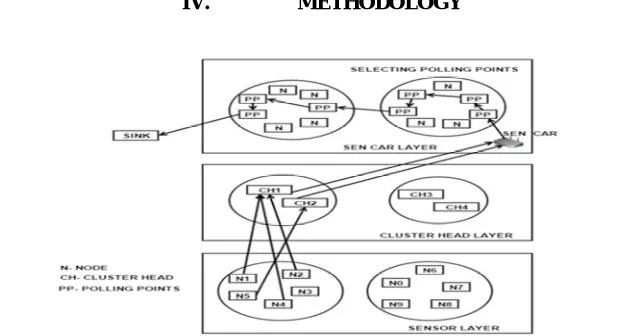
An overview of LBC-DDU framework is depicted which consists of three layers: sensor layer, cluster head layer and SenCar layer. The sensor layer is the bottom and basic layer. For generality, we do not make any assumptions on sensor distribution or node capability, such as location-awareness. Each sensor is assumed to be able to communicate only with its neighbors, i.e., the nodes within its transmission range. During initialization, sensors are self-organized into clusters. Each sensor decides to be either a cluster head or a cluster member in a distributed manner. In the end, sensors with higher residual energy would become cluster heads and each cluster has at most M cluster heads, where M is a system parameter. For convenience, the multiple cluster heads within a cluster are called a cluster head group (CHG), with each cluster head being the peer of others. The algorithm constructs clusters such that each sensor in a cluster is one hop away from at least one cluster head.
The benefit of such organization is that the intra-cluster aggregation is limited to a single hop. In the case that a sensor may be covered by multiple cluster heads in a CHG, it can be optionally affiliated with one cluster head for load balancing. To avoid collisions during data aggregation, the CHG adopts time-division-multiple-access (TDMA) based technique to coordinate communications between sensor nodes. The cluster head layer consists of all the cluster heads. As aforementioned, inter-cluster forwarding is only used to send the CHG information of each cluster to SenCar, which contains an identification list of multiple cluster heads in a CHG. Such information must be sent before SenCar departs for its data collection tour. Upon receiving this information, SenCar utilizes it to determine where to stop within each cluster to collect data from its CHG.
To guarantee the connectivity for inter-cluster communication, the cluster heads in a CHG can cooperatively send out duplicated information to achieve spatial diversity, which provides reliable transmissions and energy saving. Moreover, cluster heads can also adjust their output power for a desirable transmission range to ensure a certain degree of connectivity among clusters. The top layer is the SenCar layer, which mainly manages mobility of SenCar. There are two issues to be addressed at this layer. First, we need to determine the positions where SenCar would stop to communicate with cluster heads when it arrives at a cluster. In LBC-DDU, SenCar communicates with cluster heads via single-hop transmissions. It is equipped with two antennas while each sensor has a single antenna and is kept as simple as possible. The traffic pattern of data uploading in a cluster is many-to-one, where data from multiple cluster heads converge to SenCar. Equipped with two receiving antennas, each time SenCar makes dual data uploading whenever possible, in which two cluster heads can upload data simultaneously.
By processing the received signals with filters based on channel state information, SenCar can successfully separate and decode the information from distinct cluster heads. SenCar measures channel state information before each data collection tour to select candidate locations for data collection. We call these possible locations SenCar can stop to perform concurrent data collections polling points. In fact, SenCar does not have to visit all the polling points. Instead, it calculates some polling points which are accessible and we call them selected polling points. In addition, we need to determine the sequence for SenCar to visit these selected polling points such that data collection latency is minimized. Since SenCar has pre-knowledge about the locations of polling points, it can find a good trajectory by seeking the shortest route that visits each selected polling point exactly once and then returns to the data sink.
V. SYSTEM MODULES
In this section, the distributed load balanced clustering algorithm was discussed. The essential operation of clustering is the selection of cluster heads. To prolong network lifetime, we naturally expect the selected cluster heads are the ones with higher residual energy. The LBC algorithm is comprised of four phases: (1) sensor identification (2) Cluster forming (3) Inter cluster transmission and (4) Polling Points
A. Sensor Identification
In the initialization phase, each sensor acquaints itself with all the neighbors in its proximity. If a sensor is an isolated node (i.e., no neighbor exists), it claims itself to be a cluster head and the cluster only contains itself. Otherwise, a sensor, say, si, first sets its status as “tentative” and its initial priority by the percentage of residual energy. Then, si sorts
its neighbors by their initial priorities and picks M1 neighbors with the highest initial priorities, which are temporarily treated as its candidate peers. We denote the set of all the candidate peers of a sensor by A. It implies that once si successfully claims to be a cluster head, its up-to-date candidate peers would also automatically become the cluster heads, and all of them form the CHG of their cluster. si sets its priority by summing up its initial priority with those of its candidate peers. In this way, a sensor can choose its favorable peers along with its status decision. the initialization phase of the example, where M is set to 2, which means that each sensor would pick one neighbor with the highest initial priority as its candidate peer.
Technology (IJRASET)
2) if My.N= Φ then
3) set My.cluster_head to My.id; 4) set My.status to cluster_head; 5) else
6) My.init_prio Eres/Etot ; 7) My.cluster _head 0; 8) My status tentative;
9) My.A {v/v can_peers(N)};
10) My.prio My.init_prio+∑vєMy.Av.init-prio;
11) My.B,My.C Φ; 12) Iter 0;
B. Cluster Forming
The second phase is cluster forming that decides which cluster head a sensor should be associated with. The criteria can be described as follows: for a sensor with tentative status or being a cluster member, it would randomly affiliate itself with a cluster head among its candidate peers for load balance purpose. In the rare case that there is no cluster head among the candidate peers of a sensor with tentative status, the sensor would claim itself and its current candidate peers as the cluster heads. The details are given shows the final result of In case a cluster head is running low on battery energy, re-clustering is needed. This process can be done by sending out a re-clustering message to all the cluster members. Cluster members that receive this message switch to the initialization phase to perform a new round of clustering.
1) if My.status=cluster_headthenMy.cluster_head My.id; 2) Else
3) recv_pkt();
4) My.B Fnl_N(My.B); 5) if My.B≠Φ then
6) My.status cluster_member;
7) My.cluster_head Rand_one(My.B).id;
8) send_pkt(3,My.id,My.cluster_head,cluster_member,My.init_prio); 9) else
10) My.status cluster_head; 11) My.cluster_head My.id;
12) send_pkt(2,My.id,ID_List(My.A),cluster_head,My.prio);
C. Inter Cluster Transmission
How cluster heads in a CHG collaborate for energy-efficient inter-cluster communication. We treat cluster heads in a CHG as multiple antennas both in the transmitting and receiving sides such that an equivalent MIMO system can be constructed. The self-driven cluster head in a CHG can either coordinate the local information sharing at the transmitting side or act as the destination for the cooperative reception at the receiving side. Each collaborative cluster head as the transmitter encodes the transmission sequence according to a specified space-time block code (STBC) to achieve spatial diversity. Compared to the single-input single-output system, it has been shown in that a MIMO system with spatial diversity leads to higher reliability given the same power budget. An alternative view is that for the same receive sensitivity. MIMO systems require less transmission energy than SISO systems for the same transmission distance.
1) While My.N|>0&Iter≤|My.N|&My.status=tentative do 2) if My.prio> Rand(1)&My ∉My.B then
3) Add myself to My.B;
4) send_pkt(1,My.id,null,tentative,My.prio);
5) /*send_pkt(msg.type,node id,node list,node status,node priority);*/ 6) if My.B≠Φ then
Technology (IJRASET)
8) if Iter=|My.N| then9) My.status cluster_head; 10) recv_pkt();
11) send_pkt(2,My.id,ID_List(My.A),cluster_head,My.prio); 12) else if Lowest_prio(My.B)=My.id &Fnl_N(My.B)≠Φ then 13) if My.prio≤ τm then
14) My.status cluster_member; 15) else if My.prio> τh then 16) My.status cluster_head; 17) recv_pkt();
18) send_pkt(2,My.id,ID_List(My.A), τh,My.prio); 19) Iter Iter+1;
D. Polling Points
SenCar is equipped with two antennas, as it is not difficult to mount two antennas on Sen- Car, while it likely becomes difficult and even infeasible to mount more antennas due to the constraint on the distances between antennas to ensure independent fading. Note that each cluster head has only one antenna. The multiple antennas of SenCar, which act as the receiving antennas in data uploading, make it possible for multiple cluster heads in a CHG to transmit distinct data simultaneously. To guarantee successful decoding when SenCar receives the mixed streams, we need to limit the number of simultaneous data streams to no more than the number of receiving antennas. In other words, since SenCar is equipped with two receiving antennas, at most two cluster heads in a CHG can simultaneously send data to SenCar in a time slot. The SenCar will choose a selected polling point for each of them. When SenCar arrives at a cluster, it will visit each selected polling point, where it stops to simultaneously collect data from the two cluster heads in a scheduling pair.
To collect data as fast as possible in a cluster, the following two requirements should be satisfied. The two cluster heads in a scheduling pair both should be covered by SenCar with the same transmission range as a sensor, i.e., Rs, when SenCar is at the selected polling point specific for this scheduling pair. By visiting the selected polling points in a cluster, SenCar should achieve maximum sum of the uplink MIMO capacities in the cluster.
1) if My.status=clster_head;then
2) send beacon msg withMy.init_prio,My.clock,etc; 3) receive beacon msg b from other nodes in CHG; 4) if b.init_prio>My.init_prio;then
5) My.clock b.clock;
VI. IMPLEMENTATION
Using NS-2 to simulate our proposed Distributed load balanced clustering (LBC) algorithm. The performance evaluated mainly according to achieve 20 percent less data collection time compared to SISO mobile data gathering and over 60 percent energy saving on cluster heads.
VII. OUTPUT
Technology (IJRASET)
Data SendingSelect the polling point
Technology (IJRASET)
VIII.CONCLUSION
Technology (IJRASET)
REFERENCES [1] B. Krishnamachari, Networking Wireless Sensors. Cambridge, U.K.:Cambridge Univ. Press, Dec. 2005.
[2] R. Shorey, A. Ananda, M. C. Chan, and W. T. Ooi, Mobile, Wireless,Sensor Networks. Piscataway, NJ, USA: IEEE Press, Mar. 2006.
[3] I. F. Akyildiz, W. Su, Y. Sankarasubramaniam, and E. Cayirci, “A survey on sensor networks,” IEEE Commun. Mag., vol. 40, no. 8,pp. 102–114, Aug. 2002. [4] W. C. Cheng, C. Chou, L. Golubchik, S. Khuller, and Y. C. Wan“A coordinated data collection approach: Design, evaluation, and comparison,” IEEE J. Sel.
Areas Commun., vol. 22, no. 10, pp. 2004–2018, Dec. 2004.
[5] K. Xu, H. Hassanein, G. Takahara, and Q. Wang, “Relay node deployment strategies in heterogeneous wireless sensor networks,” IEEE Trans. Mobile Comput., vol. 9, no. 2, pp. 145–159,Feb. 2010.
[6] A. A. Somasundara, A. Ramamoorthy, and M. B. Srivastava,,“Mobile element scheduling for efficient data collection in wireless sensor networks with dynamic deadlines,” in Proc. 25th IEEE Int. Real-Time Syst. Symp., Dec. 2004, pp. 296–305.
[7] W. Ajib and D. Haccoun, “An overview of scheduling algorithms in MIMO-based fourth-generation wireless systems,” IEEE Netw., vol. 19, no. 5, Sep./Oct. 2005, pp. 43–48.
[8] S. Cui, A. J. Goldsmith, and A. Bahai, “Energy-efficiency of MIMO and cooperative MIMO techniques in sensor networks,” IEEE J. Sel. Areas Commun., vol. 22, no. 6, pp. 1089–1098, Aug. 2004.
[9] S. Jayaweera, “Virtual MIMO-based cooperative communication for energy-constrained wireless sensor networks,” IEEE Trans.Wireless Commun., vol. 5, no. 5, pp. 984–989, May 2006.
[10] S. Cui, A. J. Goldsmith, and A. Bahai, “Energy-constrained modulation optimization,” IEEE Trans. Wireless Commun., vol. 4, no. 5,pp. 2349–2360, Sep. 2005. [11] Z. Zhang, M. Ma, and Y. Yang, “Energy efficient multi-hop polling in clusters of two-layered heterogeneous sensor networks,”IEEE Trans. Comput., vol. 57.
no. 2, pp. 231–245, Feb. 2008.