Technology (IJRASET)
The Review of Data Mining based on Image
Filtering Techniques
Lovepreet Kaur1, Er. Priya Kapoor2
Department of Computer Science & Engineering, I K Gujral Punjab Technical University
Abstract— Noise in images has turn out to be one of the most influences in digital image processing. A lot of digital image
based techniques generate inaccurate results when noise exists in the digital images. Many of the researchers have proposed novel techniques to decrease noise from images. In this paper, there are various types of noises and noise removal techniques which are useful to detecting and removing the impulse. In digital image processing, to converting the images from its analog to digital form we need some techniques because of the presence of noises.Some filters results in over smoothed image. Medical photographing is the process of creation and expression of representation of interior of body means of certain clinic analysis techniques & medical instruments.
Keywords— Types of noise, types of filters, noise detector,impulse noise, morphological filter
I. INTRODUCTION
This Digital image processing allows the enhancement connected with quality of being clearly seen for detail in images using algorithms and other techniques that apply arithmetic and statistical procedures to stored pixel values, Digital image processing has many advantage over analog image processing. An image is a collection of pixels. More precisely it can be defined as two dimensional operators i.e. , here x & y are two coordinates. The amplitude of f (x,y) is known as the quality of being intense at that point or sometime it called gray level image. The discrete values when the x & y are intensity quantities of f are finite. Then it will be called a digital image.
A. The basic three steps are including in digital image processing
Importing the image with digital art of producing images.
Manipulating and analyzing the image in which includes data compression and image improvement or enhancement. Final information is based on the image analysis in which results can be modified images.
B. Objective of image processing
It is use for Imagining, that means to supervise the objects those are incorrigible in view.
It is beneficial to make sharp image and to reconstructing the image. Restoration and sharpening both are use to improved the formation of a picture.
Another goal of image processing, the calculation of main model or shape that evaluate the focus thought of the image. Main objective is identification of the image so that easily recognized the articles which are used in image.
C. Applications of DIP
1) Digital camera images: Digital cameras generally include specialized digital image processing hardware – either dedicated chips or added circuitry on other chips – to convert the raw data from their image sensor into a color-corrected image in a standard image file format Images from digital cameras can be further processed to improve their quality or to create desired special effects. This additional processing is typically executed by special software programs that can manipulate the images in a variety of ways.
Technology (IJRASET)
Enhancement of selected frequency ranges; Equalizer for audio systems
Edge enhancement in images
II. KINDSOFNOISE
The noise originates in digital picture when an image comes by digital cameras is also called image acquisition & while broadcasting the image. There are several reasons those are responsible for the miserable presentation of image as an example of harmful preparation of surroundings while taking an image or image acquisition and due to miserable condition of device that receives a stimulus. Like an example, whenever we take an image by using charge coupled device i.e. CCD, the temperature of device that responds to physical stimuli is an important cause that influences the quantity of available noise in image as a final outcome. The illuminates level of an image also a significant factor that affects the resulting image. The major factor of random electrical signals is due to scrambling in the particular transmission medium. The noisy image can be exhibited as:
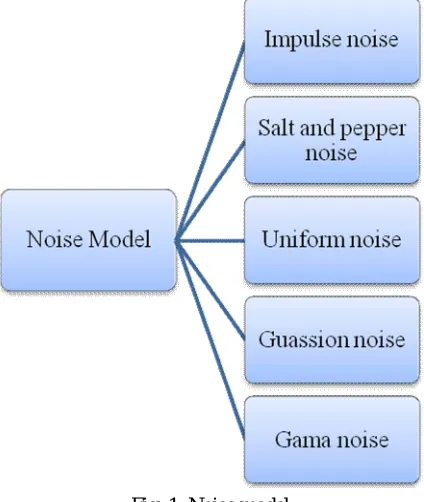
[image:3.612.201.413.266.517.2]Here A(x,y) is an real image and B(x,y) is noisy image and C(x, y) is the resulting image. According to noise levels the name of noises are different. There are several kinds of noises are available in given noise model:
Fig. 1. Noise model
A. Impulse Noise
Impulse noise is an exceptional noise which can have many different origins. Some filtering techniques cannot remove the impulse noise. Linear filtering is failed to removing impulse noise; over a wide area we use non-linear filtering techniques to removing impulse noise. Impulse noise is a gray scale image that is hazy or not clear see. Gray scale image represented by 2D array. Another type of noise is salt and pepper noise.
B. Salt and pepper noise
Technology (IJRASET)
incorrect while digitizing the image. Standard values are 255 for salt noise & 0 for pepper noise for digital image.
C. Uniform noise
The purpose of uniform noise is to subdivide the pixels components of image in specific set number of several levels. This is also called quantization of noise. It has uniformly division approach. In this type of noise the gray values of damaged pixels is uniformly handed out beyond specific stages.
D. Gaussian noise
In this kind of noise the regular distribution of faulty pixels has Probability Density Function also called Gaussian act of distribution. It is the major part of the image sensor which are use to read noise that is present in dark area of the image at constant level.
E. Gamma Noise
This kind of noise acquired for the laser based image by using low pass filtering in digital image processing.
III.FILTERINGINDIGITALIMAGEPROCESSING
In digital image processing, firstly described the term filtering. Filtering in image processing is an important technique to make the image perfect. We use many types of filtering methods which described below in this paper. The main idea to using filtering in image processing is to modify the pixels of image. To convert the intensity of pixel for improve the contrast of image i.e. enhancement and to exhibit the other characteristics like smoothing i.e. remove noises and to detect known patterns also called template matching. There are several techniques to exhibit these characteristics of an original image. The term noise is a random electrical signal in digital image; due to these signals we can’t see the image clearly because noise reduces the visualization of image. When image is converted from one form to another one form some degradation occurs at the result. The result is damaged due to the presence of noises like salt and pepper noise, impulse noise. Impulse noise is an exceptional noise which can have many different origins. Some filtering techniques cannot remove the impulse noise. Linear filtering is failed to removing impulse noise; over a wide area we use non-linear filtering techniques to removing impulse noise. Impulse noise is a gray scale image that is hazy or not clear to see. Gray scale image represented by 2D array. The other type of noise is Salt and Pepper noise. This type of noise also reduced by non-linear filtering i.e. standard median filtering technique, it is a good technique which has a good power to remove unutilized signals from digital image.
A. Kinds of filters
In digital image processing, filtering is a basic operate to obtain various task like reduction of noise, insertion of something new & sampling also. The normal process of filtering on the details of images is used maximum times in image processing Filtering of image’s data is a fundamental process used in almost all image processing techniques. The selection of filter is depending on the type or behaviors of the task execute by using filter and manner of acting and also types of data. Filters are used to removing the noise from presented image when it conserves the description of important part of the image processing.
1) Spatial domain filtering: The spatial domain in a domain or plane where a digital image is explained by spatial coordinates of its pixels. The spatial domain processes can be symbolizes by following expression g(x,y)=T[f(x,y)] where f(x,y) is the input images, g(x,y) is the output image and T is a operator explained over a local neighborhood of pixel with the coordinates (x,y). There are two types of spatial filters: Smoothing filters & Sharpening filters
a) Smoothing filter
Technology (IJRASET)
increased and less contrast.
ii) Median filtering: Median filtering is accomplishing their task by one neighborhood at one time, the mask that used by it, is not a linear function. A median filter substitutes the pixel value with the median of neighborhood. Mainly, this kind of filter is used for eliminating the noise from a single image.
b) Sharpening filter
i) High pass filter: The impact that high pass filters have on an image is precisely opposite that of low pass fitters. The fundamental goal of low pass filtering is to emphasize the description of image. These types of filtering also use to enhance the very detailed information because of blurring the original picture and the filtered picture
ii) High boost filtering: In this type of filtering the foggy picture deducted from the real one to get unsharpened masked picture. After that we conclude the number of unsharpened to original to get sharpened picture. As an example of unsharp masking due to high boost filter.
iii) Frequency domain filtering: In this type of filtering, the methods are based on moderate the ghostly converting of an image. It converts the picture to act of performing in its frequency formulation and then computes setback transform to spatial domain and perform image processing. The high rate of occurrence of function corresponds to pixel values that change swiftly across the image.
iv) Smoothing frequency filtering: Smoothing method is obtained in frequency domain Smoothing is achieved in the frequency domain by bring down out of frequency ingredient.
Filtering basic model is given below:
Here, H(u,v) is the filtered transform function and F(u,v) is the Fourier transform of the image being filtered. Low pass filtering is used only pass the low level frequencies and bring down the high ones.
2) Sharpening frequency domain filtering: The edges and fine description in images are connected with expensive frequency componenets. The main idea behind using median filtering is to reduce the impulse noise. Smoothing refers to removing noise but after performing smoothing operation it is not sure that the resulted image is free from noise. The edges can be blurred. While using median filtering operations the noise essentially dissipate on the edges of image.
IV.MATHEMATICALMORPHOLOGY(MM)
MM is in most cases applied for digital images, but can usually employed on equity graphs, surface solids and several other spatial structure. MM is usually the groundwork of morphological image processing, which consists of a set that are connected with operators used to transform the images in a particular row with the above characterizations.
To effectively restore the images spoiled by impulse noise particularly at high noise ratios, we recommended a morphological based on switched median filter. In this filter, noise pixels are identified by the morphological noise discovery based on some important morphological operator as erosion, dilation, opening and closing. The discovered noise pixels are reconstructed by combining the enhanced median filter with the conditional morphological filter. The advantage of the recommend filter in noise discovery and noise ejecting has been exhibit by extensive comparisons with numerous well-known decision-based filters operating on regular check images.
A. Morphological operators are: 1) Erosion
2) Dilation
Technology (IJRASET)
4) closingMorphological noise detector
It is often well known the pixels damaged by impulse noise may display intensity extremes of their neighborhood. Accordingly, the erosion operator and the dilation user are adopted to recognize all the particular corrupted pixels in the pair of operators correspond to finding the particular least possible & greatest possible amount the pixel values in just particular environment.
Morphological based median filter
The hybrid filters combining the conditional morphological filter with the improved median filter. It will probably adapt to ejecting the discovered impulses. For virtually any damaged pixel within the image, the conditional erosion and conditional dilation might be defined on such basis as the pair of operators; those are conditional opening and conditional closing. To removing the impulses, a switching median based on morphological filter recommended.
V. LITERATURESURVEY
Chengbin Zhang et al.[2] has presented an effective switching median mean filter is recommended to remove at extremely high level compactness of impulses from digital images. The recommended technique can be composed of the discovery of immorally pixels and filtering stages. The pixels those are without reservations in noise, the discovery stage for immorally pixels abide unchanged and other pixels in the presence of noise are exchanged by the reference image based on suggested filter with the help of 3×3 window. The counterfeit results describe that the suggested filter outperforms some living methods. Results shows both in envision and pertaining to quality measurements.
Dung dang et al. [3] has Introduced new algorithms that consist of detection and filtering of impulse noise be composed by two stages. First is, to determine the morality of an image pixel by using a method i.e. two stage detection method that operates the second order differences in middle of pixels. Second stage is, to appraise original value of each noisy pixel by relating the fixed-value and accidentally noise with extremely discovery rate.
How-lung et al. [5] has discussed the noise adaptive soft-switching median filter works on the basis of some point of issues for accomplish to a great extent improved filtering performance by removing of impulse noise. NASM works by using : 1) Threshold decision making. 2) Exactness of noise discovery. 3) Appropriate beneficial median filtering.
S. Mukhopadhyay et al.[12] has proven a method for improving the degree of excellence of the gray-level images by diminish the effect of noise using multiscale morphology. The thought of the action is to assign incrementally less significance to attribute of small scales as their probability to being noisy particles are more? Noisy attributes at different scales are ejected by using morphological filtering. The algorithm has been experimented on an image that are spoiled with different type of noise.
Shuqun Zhang, et al. [14] has described the latest impulse noise discovery method for switching mean filters is presented, which is based on the minimum absolute values of four convolutions achieve using one dimensional laplacian operators. In specific, the suggested filter is directed to improve the conservation. We've got proposed a more rewarding impulse detector that can effectively independent with noise and without noise pixels. In detailed, it prevents the removal of fine details including thin lines in images and provides increased impulse recognition capability.
Technology (IJRASET)
digital cameras. It can be used in digital television (DTV) also to expel impulse noise. This can also be done due to its performance and low complexity.
Zhou Wang et al.[19] has analyzed a latest median based filtering, progressive switching median filtering, is recommend to restore images. Those images are spoiled by salt and pepper impulses. The technique is build by using two important techniques. First technique is, switching technique is an impulse discovery algorithm
TABLEI
COMPARISON TABLE
Name of the author,place & year of publication
Title of the paper
Issues Technique Benefits Limitations
Chengbin Zhang, Kaifu Wang,
; Optik 126 (2015) 956– 961[2]
A switching median–mean filter for removal of high-density impulse noise from digital images
Noise repression & conservation of detail
Switching median & mean filtering by using detection and filtering stages
Better image quality in shorter computation
NA
Dang, W. Luo, Signal Process. 87 (9) (2007) 2017–2025.[3].
Impulse noise removal utilizing second-order difference analysis
Two stage detection scheme and noise estimates the actual value of noisy pixel
Unbiased detection criteria treats with fixed value and random valued noise at high level
It gives accurate results by locating & correcting every single pixel in image as compare to BDND
algorithm
It need improve their speed, accuracy
because of only lightweight & fast filtering can gives improved results
1.
H.L. Eng, K.K. Ma, IEEE Trans. Image Process. 10 (2) (2001) 242– 251. [5]Noise adaptive soft-switching median filter
Fixed thresholding, noise decision accuracy, pixel characteristics type identifying
Ideal-switching
filtering PSNR value are high and stable performance across wide range of noise density from 10% to 70%
Technology (IJRASET)
2.
S.Mukhopdhysy, B. Chanda, Signal Process. 82 (4) (2002) 527–544.[12].
An edge preserving noise smoothing technique using multi-scale morphology
Scale-specific feature in noisy image
Edge preserving smoothing of gray-scale images using multiscale morphology
Satisfactory and superior
performance like correct
processing ratio & signal-to-noise ratio
NA
3.
Shuqun Zhang,Member, ieee, ieee signal processing letters, vol. 9, no. 11, november 2002.[14].
A New Impulse Detector for Switching Median Filters
Values of Four convolution based on One dimension laplacian operator
Noise free pixels separated by edges and the noise pixel taken by gray value in images
Thin lines easily removed and has lowest
computational complexity
MSE increased when the noise intensity above 30%
4.
T. Chen, H.R. Wu, ieee signal process. lett. 8 (1) (2001) [15].Adaptive impulse
detection using center-weighted median filters
center weight, impulse noise, median filter
Impulse
detection using center weighted median filter
Best services in between detail preservation and noise
suppression.
NA
W. Luo, ieee Trans.Consumer Electron. 52 (2) (2006) 523– 527.[17]
Efficient
removal of impulse noise from digital images
Gray scale test image
Fuzzy impulse detection technique
It is less complex & suitable for hardware implementation i.e. removing the impulse noise from digital cameras & from digital television
It cannot remove impulse noise more than 20% or 30% and it does not required noise-free references. It only required noisy-pixel
Zhou wang and david zhang.ieee transactions on circuits and systems,vol. 46, no. 1, january 1999
Progressive switching median filter for the removal of impulse from highly corrupted images
Salt & pepper impulse
detection and removal
Switching scheme and progressive methods
When noise ratio is high it will give better results by using MSE parameter as compare to other filters and maintain the image details
NA
VI.CONCLUSIONS
Technology (IJRASET)
appearance. I found several types of noises and filtering techniques from literature work. This paper has focused on a novel switching median and morphological filter which has the capability to reduce the high density of noise from images and also perform better over others when input image is noise-less. Morphological noise detector has ability to detect the noise so that it will remove easily by applying an appropriate filter. This technique also able to preserve the edges by using morphological operators. This proposed technique will be designed and implemented in MATLAB tool using image processing toolbox. Many types of the images or digital images will be taken for its experimental results. According to image’s noise level the appropriate filter will work for experimental purposes.
REFERENCES
[1] Cao Yuan, Yaqin Li ” Switching median and morphological filter for impulse noise removalfrom digital images” Optik 126 (2015) 1598–1601.[1].
[2] Chengbin Zhang, Kaifu Wang” A switching median–mean filter for removal of high-density impulsenoise from digital images” Optik 126 (2015) 956–961[2]. [3] Dang, W. Luo, Impulse noise removal utilizing second-order difference analysis, Signal Process. 87 (9) (2007) 2017–2025.[3].
[4] D. Zhang, Z, Wang, Progressive switching median filter for the removal of impulse noise from highly corrupted images, IEEE Trans. Circuits Syst. II: Analog Digit. Signal Process. 46 (1) (1999) 78–80.[4].
[5] H.L. Eng, K.K. Ma, Noise adaptive soft-switching median filter, IEEE Trans. Image Process. 10 (2) (2001) 242–251. [5] .
[6] J. Song, E. Delp, The analysis of morphological filters with multiple structuring elements, Comput. Vis. Graph. Image Process. 50 (3) (1990) 308–328.[6] . [7] K.S. Srinivasan, D. Ebenezer, A new east and efficient decision-based algorithm for removal of high-density impulse noises, IEEE Signal Process. Lett. 14
(2007) 189–192. [7].
[8] M.H. Sedaaghi, Q.H. Wu, Weighted morphological filter, Electron. Lett. 34 (16)(1998) 1566–1567.[8].
[9] Ng, P.-E. Ma, K.-K.” A switching median filter with boundary discriminative noise detection for extremely corrupted images” Volume 15, Issue 6, June 2006, 1506-1516[9].
[10] Pei-Yin Chen , Chih-Yuan Lien “An Efficient Edge-Preserving Algorithm for Removal of Salt-and-Pepper Noise”Dept. of Comput. Sci. & Inf. Eng., Nat. Cheng Kung Univ., Tainan ; Signal Processing Letters, IEEE2008; 833 – 836[10]
[11] R. H. Chan, C.-W. Ho, and M. Nikolova, “Salt and pepper noise removal by median type noise detectors and detail preserving regularization[11]. [12] S. Mukhopdhysy, B. Chanda, An edge preserving noise smoothing technique using multi-scale morphology, Signal Process. 82 (4) (2002) 527–544.[12]. [13] Shuenn-Shyang Wang, Cheng-Hao Wu “A new impulse detection and filtering method for removal of wide range impulse noises” Volume 42, Issue 9,
September 2009[13].
[14] Shuqun Zhang, Member, IEEE A New Impulse Detector for Switching Median Filters, IEEE SIGNAL PROCESSING LETTERS, VOL. 9, NO. 11, NOVEMBER 2002.[14].
[15] T. Chen, H.R. Wu, Adaptive impulse detection using center-weighted median filters, IEEE Signal Process. Lett. 8 (1) (2001) [15].
[16] K.K.V. Toh, N.A.M. Isa, Noise adaptive fuzzy switching median filter for salt-and-pepper noise reduction, IEEE Signal Process. Lett. 17 (2010) 281–284[16]. [17] W. Luo, Efficient removal of impulse noise from digital images, IEEE Trans.Consumer Electron. 52 (2) (2006) 523–527.[17] .