Technology (IJRASET)
Performance of RC Frame With and Without
Bracing Pushover Analysis
Miss. Sayli S Kamble.1, Prof. Dr. D. N. Shinde2 1
Department of civil Engineering, PVPIT Budhgaon, Shivaji university, Maharashtra, India.
2
Associate Professor, P. G. Coordinator, PVPIT Budhgaon, Shivaji university, Maharashtra, India.
Abstract— Now a days an earthquakes are more affected on concrete structures have been severely damaged or collapsed. So there is a need of to evaluate the seismic adequacy. We can’t avoid the future earthquakes but we can manage or prepare the building to safe construction, and to reduce the extent damage and loss. For this to strengthen and to resist the lateral load on building for future earthquakes, some procedure are used. One of the procedure the non-linear static pushover analysis. Pushover analysis is used for the seismic assessment of structure. In the present study the RC frame is designed as per the IS 456:2000 and IS 1893:2002 and pushover analysis is carried out on unsymmetrical RC frame of 6 storied (G+5) with X bracing and without bracing. Bracings are provided in two locations at X-Z face, and overall face. For analyzing RC frame under pushover analysis used the most common software SAP 2000 (Version 15). The main objective of this study is Storey displacement, story drift ratio, storey shear. After all results are getting it is clear that the X bracing provided at different locations are reduced the storey displacement, storey drift as well as storey shear.
Keywords—RC frame, Bracing, pushover analysis, storey displacement, storey drift ratio, storey shear.
I. INTRODUCTION
RC (reinforced concrete) Frame is nothing but the structural skeleton of structural horizontal or vertical members beam, column, etc. In RC frame the column vertical member are is very important than horizontal. If the frame damage to a beam it will affect only one floor, but damage to the column it will bring down the entire building. RC frames preferred because of it is sustain the economy and simple to the construction. Compression and tension are both reaction act as in once in RC frame. But if more lateral load act on the frame it will damage the beam, column and beam column joint. So for increase strength factor of RC frame it is necessary to provide some additional structural member to it. Like bracings, infill wall, shear wall, etc. In construction to reinforce building structures in which diagonal supports intersect. Bracing is a structural member to resist the lateral load act on building Two bracing system are generally considered External bracing and internal bracing .in the external bracing system existing building are retrofitted by attaching a local or global steel bracing system to the exterior frame . In internal bracing method the buildings are retrofitted by incorporating a bracing system inside the individual bays of the RC frame. There are various types of bracing system used to structure.1. Steel bracing 2.Rc bracing. There are various types of steel bracings such as Diagonal, X, K, V, and inverted V type...Etc. Braced frames are a very common form of construction, being economic to construct and simple to analyze. Economy comes from the inexpensive, nominally pinned connections between beams and columns. In braced construction, beams and columns are designed under vertical load only, assuming the bracing system carries all lateral loads. For this study we use the X bracing at two different locations, at X-Z face and overall face.
A. Types of bracing
1) Cross-Bracing: Cross-bracing (or X-bracing) uses two diagonal members crossing each other. These only need to be resistant to tension, one brace acting to resist sideways forces at a time depending on the direction of loading. As a result, steel cables can also be used for cross-bracing. However, this provides the least available space within the façade for openings and results in the greatest bending in floor beams.
2) V-bracing: This involves two diagonal members extending from the top two corners of a horizontal member and meeting at a center point at the lower horizontal member, in the shape of a V.
Technology (IJRASET)
II. PUSHOVER ANALYSIS
The pushover analysis of a structure is a static non-linear analysis under permanent vertical loads and gradually increasing lateral loads. A plot of total base shear versus top displacement in a structure is obtained by this analysis that would indicate a premature failure or weakness. All the beams and columns which reach yield or have experienced crushing and even fracture are identified. A pushover analysis is performed by subjecting a structure to a monotonically increasing pattern of lateral loads that shows the inertial forces which would be experienced by the structure when subjected to ground motion. Under incrementally increasing loads many structural elements may yield sequentially. Using a nonlinear static pushover analysis, a representative non-linear force displacement relationship can be obtained. Since the Institute Main Building (structure under consideration) was constructed more than 50 years ago, it may be vulnerable to seismic excitation. Hence to estimate the performance of the structure a Pushover analysis for the structure has been carried out. If the structure shows signs of failure then suitable retrofit measures may also be suggested. Pushover analysis may be categorized as displacement controlled pushover analysis when lateral movement is executed on the building and its equilibrium designates the forces. In the same way, when lateral forces are enforced, the analysis is termed as force-controlled pushover analysis. Response of structure beyond full strength can be bent on only by displacement controlled pushover analysis. Hence, in the present study, displacement-controlled pushover method is used for analysis of structural RC frames. A plot of the total base shear versus top roof displacement in a building is attained by this analysis that would specify any early failure or weakness. The analysis is performed up to failure, thus it permits purpose of collapse load and ductility capacity.
TABLEI
PERFORMANCELEVELOFBUILDING
Level Description
Operational Very light damage, no permanent drift, structure retains original strength and stiffness, all systems are normal
Immediate Occupancy
Light damage, no permanent drift, structure retains original strength and stiffness, elevator can be restarted, fire protection operable.
Life Safety Moderate damage, some permanent drift, some residual strength and stiffness left in all stories, damage to partition, building may be beyond economical repair
Collapse prevention
Sever damage, large displacement, little strength and stiffness but loading bearing columns and wall function, building is near collapse.
III. DESCRIPTION OF RC FRAME STRUCTURES
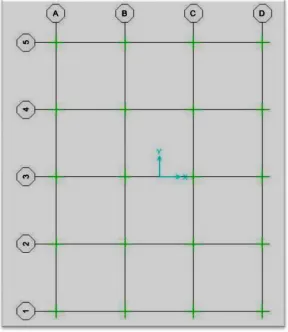
From previous research work the building description are taken for study. For a new study some modifications are done for this problem work. For this obtaining related results of parameters considering a G+5, 3D building frame. This containing a three bays in X-direction and four bays in Y-direction. All columns are fixed at the foundation level. Importance factor (I):1 Reduction factor (R):5 the total description is given below:
TABLEII
DESIGNDATAANDBUILDINGDISCRIPTION No of stories 6
Height of story 4m No of bays in X-direction 3 No of bays in Y-direction 4 Bay width along X-direction
5m
Technology (IJRASET)
Plinth height 0.8m Wall thickness 230mm Slab thickness 150mm
Live load 2KN/m2 typical floor Roof live 1KN/m2 roof level Floor finish 0.5KN/m2
Seismic zone Zone IV
Type of soil Type II, Medium soil as per IS: 1893. Earthquake load As per IS-1893(Part-1)2002.
Size of beam 230 X 1000
Size of columns Side column (mm) Middle column (mm)
Ground floor 450 x900 450x1000 First 450 x900 450x1000 Second 700x450 450x900
Third 700x450 450x900
Fourth 700x350 700x450
Fifth 700x300 700x350
A. Material Properties
[image:4.612.162.450.368.700.2]The material used for the building is Concrete of M25 grade and Reinforcing steel of Fe-415 grade.
Technology (IJRASET)
Fig. 2 Elevation of G+ storey RC
IV. RESULTS AND DISCUSSION
A. Displacement
After doing a pushover analysis the displacement values are tabulated in below. TABLEIII Displacement in m X Bracings displacement
No. of storey
SIMPLE RAME
In X direction In Y direction
X-Z FACE OVERALL X-Z FACE OVERALL 6 0.0792 0.0541 0.021 0.0092 0.0274 5 0.0732 0.0491 0.019 0.0081 0.0247 4 0.063 0.041 0.0159 0.0066 0.0209 3 0.0492 0.0309 0.0122 0.0049 0.0163 2 0.0287 0.0198 0.008 0.0031 0.0107 1 0.0116 0.0098 0.0043 0.0015 0.0057
0 0 0 0 0 0
B. Storey Drift Ratio
After doing a pushover analysis the storey drift ratio and compare with IS 1893 are tabulated in below. TABLEIV
Inter storey drift ratio
C. Storey Shear
X bracings drift ratio
No. of Storey
SIMPLE FRAME
In X direction In Y direction
IS 1893 X-Z
FACE
OVERAL L
X-Z FACE
OVERAL L
6 0.0015 0.0012 0.0005 0.0003 0.0005 0.004 5 0.0025 0.002 0.0007 0.0004 0.001 0.004 4 0.0034 0.0025 0.001 0.0004 0.0012 0.004
3 0.0051 0.0027 0.001 0.0005 0.0012 0.004 2 0.0042 0.0025 0.001 0.0004 0.0012 0.004 1 0.0024 0.002 0.0008 0.0003 0.0012 0.004
Technology (IJRASET)
TABLEV Storey shear in kN
Fig.3. Displacement of G+5 storey building
Fig.4. Inter storey drift ratio of G+5 storey building
0 0.001 0.002 0.003 0.004 0.005 0.006
0 1 2 3 4 5 6 7
st o re y D ri ft R a ti o
No. of Storey STOREY DRIFT
SIMPLE FRAME In X direction
In X direction
In Y direction
In Y direction
IS 1893
X bracings storey shear
No. of Storey
SIMPLE FRAME
In x direction In Y direction
X-Z FACE OVER ALL
X-Z FACE
OVER ALL 1 1135.56 1164.29 1205.83 2475.49 3337.34 2 932.54 954.2 998.07 1879.52 2383.35 3 723.12 737.16 767.5 1299.2 1529.5
4 517.39 524.14 547.16 800.81 847.25 5 309.29 305.82 316.02 347.91 347.89 6 114.5 110.36 136.7 100.64 102.39
0 0.01 0.02 0.03 0.04 0.05 0.06 0.07 0.08 0.09
0 1 2 3 4 5 6 7
D is p la ce m en t
No of Storey
DISPLACEMENT
SIMPLE FRAME
In X direction
In X direction
In Y direction
Technology (IJRASET)
Fig.5. Displacement of G+5 storey building
V. DISCUSSION
It can be seen that the lateral displacement in braced building in both ‘X’ and ‘Y’ direction in x-z and overall face are reduced in comparison with unbraced frame. The displacement at the top story in X direction of ‘X’ braced frame is reduced by 25 % of x-z face bracing provided and the displacement is reduced by 58 % of Overall bracing provided in exterior face. And in Y direction of ‘X’ braced frame is reduced by 70 % of x-z face bracing provided and the displacement is reduced by 52.2 % of overall bracing provided. As per IS 1893:2002 the storey drift in any storey due to minimum specified design force shall not be exceed 0.004 times the storey height. It showed that the drift is increased up to height 8.8 m and then showed a considerable decrease. . But when bracing provided in X-Z face and overall face cases the drift is less than unbraced frame. In both directions X and Y.
The braced frame can resist more force than the unbraced RC frame. The stoey shear is more for X bracing provided in OVERALL FACE than the simple frame in X direction. The stoey shear is more for X bracing provided in OVERALL FACE than the simple frame in Y direction.
VI.CONCUSION
The performance of reinforced concrete frames with and without bracing was investigated using pushover analysis. From the investigations following conclusion were drawn.
A. It is observed that the bracing reduces the storey displacement as well as storey drift while it shows maximum storey shear.
B. The analysis of RC frame with bracing at different locations shows that the bracings provided at X-Z FACE and OVERALL FACE shows reduction in displacement and drift
C. While storey shear is more as compared SIMPLE FRAME (unbraced RC frame).
D. When X bracing provided in the OVERAL FACE the displacement at top is reduced to 73%. drift ratio is within the limit (Not exceed 0.004) for X bracing
REFERENCES
[1] Gunderao V Nandi, G S Hiremath, June-2015, “Seismic Behavior of Reinforced concrete Frame with Eccentric steel bracings”. International Journal of civil Engineering.
[2] Choudhari V. A., Dr. Nagaraj T.K. June-2015, “Analysis of moment resisting frame by keen bracing”. International Journal of Innovations in Engineering Research and Technology.
[3] R.Sowmya, M.Saravanan, V.Marimuthu, M.Surendran, P.Prabha, G.S.Palani, N.Sakthieswaran, 2015), “Seismic Performance Evaluation of Steel Moment Resisting Frames”. International Journal ofInnovative Research in Science, Engineering and Technology.
[4] Abhijeet maske, Nikhil Maske, Preeti Shiras, October-2014, “Pushover Analysis of Reinforced concrete frame structures: A Case study”. International Journal of Advanced Technology in Engineering and Science.
[5] ATC- 40, “Seismic Evaluation and Retrofit of Concrete buildings”, Applied Technology Council, 1996.
[6] FEMA356, “Seismic Rehabilitation of Buildings”, Federal Emergency Management Agency, Washington DC, 2000.
[7] IS: 875 (Part 1) -1987, “Code of practice for design loads (other than the earthquake) for building and structures” “PART 1 DEAD LOADS — Unit Weights of Building Materials and Stored Materials, Second revision, India.
[8] IS: 875 (Part 2) -1987, “Code of practice for design loads (other than the earthquake) for building and structures” PART 2 IMPOSED LOADS, Second revision, India
[9] IS: 1893- 2002, “Criteria for earthquake resistant design of structures”, Third revision, India [10] IS 800: 2007 General Construction in steel – Code of Practice
0.00 500.00 1000.00 1500.00 2000.00 2500.00 3000.00 3500.00 4000.00
1 2 3 4 5 6
Storey Shear kN
N o o f st o re y
STOREY SHEAR Overall X in y
direction
X-Z X in Ydirection
Overall X
X-Z face X