Technology (IJRASET)
Design and Implementation of ASIC Based Dual
Data Rate SDRAM Memory Controller
V.Suresh1, Y.Murali2, M.Tech
2 nd Year M.TechVLSI, Assistant Professor
Department of ECE, Audisankara College of Engineering & Technology, gudur, (Autonomous)
Abstract- A Dedicated Memory Controller is of prime importance in applications that do not contain microprocessors (high-end applications). The Memory Controller provides command signals for memory refresh, read and write operation and initialization of SDRAM. Our work will focus on ASIC Design methodology of Double Data Rate (DDR) SDRAM Controller that is located between the DDR SDRAM and Bus Master. The Controller simplifies the SDRAM command interface to standard system read/write interface and also optimizes the access time of read/write cycle. Double Data Rate (DDR) SDRAM Controller is implemented using Xilinx 14.3.
Keywords: DDR SDRAM Controller, Read/Write Data path.
I. INTRODUCTION
We found memory devices in almost all systems and now a days high speed and high performance memories are having great demand. For better throughput and speed, the controllers are to be designed with clock frequency in the range of megahertz. As the clock speed of the controller is increasing, the design challenges are also becoming complex. Therefore the next generation memory devices require very high speed controllers like double data rate and quad data rate memory controllers. In this paper, the double data rate SDRAM Controller is implemented using ASIC methodology.
Synchronous Dynamic RAM (SDRAM) is preferred in embedded system memory design because of its speed and pipelining capability. In high-end applications, like microprocessors there will be specific built in peripherals to provide the interface to the SDRAM. But for other applications, the system designer must design a specific memory controller to provide command signals for memory refresh, read and write operation and initialization of SDRAM.
In this paper, the SDRAM controller, located in between the SDRAM and the Bus master, minimizes the effort to deal with the SDRAM memory by providing a simple system to interact with the bus master.
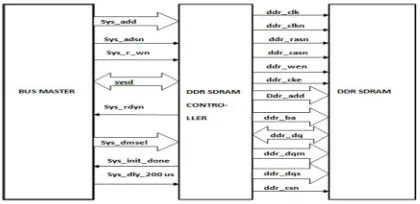
Figure 1 is the block diagram of the DDR SDRAM Memory Controller that is connected between the bus master and SDRAM . SDRAM’s are classified based on their data transfer rates.
A. Single Data Rate SDRAM’s
B. Double Data Rate SDRAM’s
[image:2.612.198.408.585.687.2]The DDR SDRAM Controller architecture is implemented using Verilog HDL. The methodology followed is ASIC design flow. The basic steps that an ASIC design must go through are Design entry and Analysis, Technology Optimization and Floor planning, Design Verification, Layout . The RTL Synthesis and Simulations are performed using Xilinx 14.3.
III. DDR SDRAM CONTROLLER ARCHITECTURE
DDR SDRAM Controller module receives the addresses and control signals from the BUS Master. The Controller generates command signals and based on these signals the data is either read or written to a particular memory location. The DDR SDRAM Controller architecture is shown in Figure 2. It consists of three modules:
A. Main Control Module
B. Signal Generation Module
C. Data Path Module.
The main control module has two state machines and a refresh counter. The two state machines are for initialization of the SDRAM and for generating the commands to the SDRAM. They generate iState and cState outputs according to the system interface control signals. The signal generation module now generates the address and command signals depending upon the iState and cState. The data path module performs the read and write operations between the bus master and DDR.
Following are some of the important features of DDR SDRAM Controller:
1) The DDR SDRAM Read and Write operations are simplified by the controller.
2) For initializing the DDR SDRAM controller, separate state machines are designed internally.
3) The access time for read and the write cycle is minimised based on the CAS latency and burst length of the DDR SDRAM.
4) The auto refresh for the DDR SDRAM is done by the controller.
The main control module consists of three sub modules: 1.Initialization FSM module (INIT_FSM). Command FSM module (CMD_FSM)
Counter module.
A. Main Control Module
The DDR SDRAM Controller has to undergo an initialization process by a sequence of command signals before the normal memory access. The initialization finite state machine in the main control module is responsible for the initialization of the DDR SDRAM controller. Figure 3 shows the state diagram of
the initialization FSM (INIT_FSM).
Technology (IJRASET)
Fig.2. Functional block diagram of DDR SDRAM controller .
After satisfying the i_tMRD timing delay the initialization FSM will switch to i_ready state. The initialization FSM will remain in the i_ready state for normal memory access. And also, when the initialization FSM switches to i_ready state signal sys_INIT_DONE is set to high to indicate that DDR SDRAM controller initialization is completed. The i_PRE, i_AR1, i_AR2, i_EMRS and i_MRS states are used for issuing DDR commands.
CMD_FSM handles the read, write and refresh of the SDRAM. The CMD_FSM state machine is initialized to c_IDLE during reset.
After reset, CMD_FSM stays in c_IDLE as long as sys_INIT_DONE is low which indicates the SDRAM initialization sequence is
signal. If logic high is sampled, the state machine switches to c_READA. If a logic low is sampled, the state machine switches to
c_WRITEA. For read cycles, the state machine switches from c_READA to c_cl for specified delay, then switches to c_rdata for transferring data from SDRAM to bus master.
After the data is transferred, it switches back to c_IDLE. For write cycles, the state machine switches from c_WRITEA to c_wdata for transferring data from bus master to SDRAM, and then switches to c_tDAL. After writing the data, it switches back to c_IDLE state.
B. Data Path Module
The DDR SDRAM Controller design interfaces between the 8-bit data bus, and the bus master with a 16-bit data bus. The data path module for read and write are shown in figure. The data path module depends on cState for its read/write operation. The cState is generated by the CMD_FSM present in the Main Control module.
Technology (IJRASET)
Fig.5. Read data path for DDR SDRAM Controller.
Fig.6. Write data path for DDR SDRAM Controller
C. Signal Generation Module
The DDR SDRAM Signal generation module should generate the command signals to the DDR SDRAM. The command signals include ddr_add; for generating addresses, ddr_casn and ddr_rasn; for selecting particular column and row address. These signals are generated based on the iState and cState received from the CMD_FSM and INIT_FSM present in the Main Control module.
Fig.7. Simulation results of DDR SDRAM controller
Technology (IJRASET)
Fig.9. Technology Schematic of DDR SDRAM
V. CONCLUSION
ASIC Design methodology is opted for Double Data Rate (DDR) SDRAM Controller. The DDR SDRAM Controller architecture is implemented in Verilog HDL. The RTL Simulation and Synthesis results are obtained using Xilinx tool.
REFERENCES
[1] DDR SDRAM Controller white paper, Lattice Semiconductor Corporation, Reference Design: RD1020, April 2004. [2] SDR SDRAM Controller white paper, Lattice Semiconductor Corporation, Reference Design: RD1010, April 2011.
[3] Chen Shuang-yan, Wang Dong-hui, Shan Rui Hou Chao, “An Innovative design of DDR/DDR2 SDRAM Compatible Controller”, ASICON International Conference, pp 62-66 24th Oct 2005.
[4] Micron Technology, Micron’s Synchronous DRAM (2002).
[5] Michael John Sebastian Smith, “Application Specific Integrated Circuits”, 2004.
AUTHORS
1