www.ijraset.com
Vol. 1 Issue III, October 2013
ISSN: 2321-9653
I N T E R NA T I ON A L J OU R N A L F OR R E S E A R C H IN A P PL I E D S C I ENC E AND
E N G I N E E R I N G T E C H N OL O GY (I JR A S E T)
Acoustic Echo Cancellation by Adaptive Combination of
Normalized Sub band Adaptive Filters by Using Stochastic
Gradient Algorithm
Sunita, Parveen Bajaj
Electronics & Communication Engg. Deptt. Maharishi Markandeshwar University, Sadopur
Ambala, India
Abstract:Acoustic echo is a common occurrence in today’s telecommunication systems. It occurs when an audio source and sink operate infull duplex mode; an example of this is a hands-free loudspeaker telephone. In this situation the received signal is output through the telephone loudspeaker (audio source), this audio signal is then reverberated through the physical environment and picked up by the systems microphone (audio sink). The effect is the return to the distant user of time delayed and attenuated images of their original speech signal. The signal interference caused by acoustic echo is distracting to both users and causes a reduction in the quality of the communication. Adaptive filtering techniques are used to reduce this unwanted echo thus increasing communication quality. The input signal of the adaptive filter is highly correlated and the impulse response of the echo path is very long. These characteristics will slow down the convergence rate of the adaptive filter if the well-known normalized least mean-square (NLMS) algorithm is used. The normalized subband adaptive filter (NSAF) offers a good solution to this problem because of its decorrelating property, Which requires a tradeoff between fast convergence rate and small steady state mean-square error (MSE). The proposed combination is carried out in sub band domain and the mixing parameter that controls the combination is adapted by means of a stochastic gradient algorithm which employs the sum of squared sub band errors as the cost function. For the adaptation of the component filters, in addition to the conventional decoupling update method, we also propose a coupling one, which can further improve the performance of the adaptive combination scheme.
Keywords: Acoustic echo canceller, Steady-state Mean-Square Error (MSE), Normalized least-Mean-Square (NLMS) algorithm, Sub band Adaptive Filters (SAFs), Normalized Sub band Adaptive Filters (NSAFs), hands-free telephone, teleconferencing system.
1.INTRODUCTION
A common problem encountered in hands-free telephones and teleconferencing systems is the presence of echoes which are generated acoustically by the coupling between the loudspeaker and the microphone via the impulse response of a room. In recent years, there has been a great interest in the use of adaptive filters as acoustic echo cancellers to remove echoes. An adaptive filter can be characterized by its structure and adaptive filtering algorithm. The transversal filter with the well-known normalized least-mean-square algorithm is one of the most popular adaptive filters because of its simplicity and robust performance. In acoustic echo cancellation (AEC) applications, the speech input signal of the adaptive filter is highly correlated and the impulse response of the acoustic echo path is very long. These two characteristic will slow down the convergence rate of the acoustic echo canceller if the NLMS-based adaptive filter is used to remove echoes. One technique to solve the above problem is subband
adaptive filtering. In conventional subband adaptive filters (SAFs), each subband uses an individual adaptive subfilter in its own adaptation loop, which decreases the convergence rate of SAFs because of the aliasing and band -edge effects. Lee and Gan presented a normalized SAF (NSAF) from the principle of minimum disturbance, with its complexity close to that of the NLMS-based adaptive filter.
Its central idea is to use the subband signals, normalized by their respective subband input Variances, to update the tap weights of a fullband adaptive filter. Although these SAFs can obtain fast convergence rate when applied to AEC applications, they all require a tradeoff between fast convergence rate and small steady-state mean-square error (MSE) because of the use of a fixed step size. They all need to estimate the system noise power in advance.
power. More recently, a combination of subband adaptive filters for AEC has been proposed. In this paper, a new subband adaptive combination scheme to deal with the tradeoff problem encountered in acoustic echo cancellers which are implemented by NSAFs. The proposed combination is carried out in subband domain and the mixing parameter that controls the combination is adapted by means of a stochastic gradient algorithm which employs the sum of squared subband errors as the cost function. We have been improving adaptive combination of NSAFs. In which large convergence rate & small steady state MSE can be greatly achieved by using less amount of less amount of adaptive filters as comparison to previous adaptive combination scheme.
2. SIGNAL MODEL AND NSAF
2.1Signal Model of Acoustic Echo Canceller
A block diagram for acoustic echo canceller is illustrated in Fig.1.When the far-end signal u(n) goes through the echo pathW0 (z) of a room, the acoustic echo is produced. The
acoustic echo is picked up by the microphone together with the near-end signal η(n), resulting in the microphone signal d(n).The near-end signal may contain the system noise v(n) and near-end speech s(n).The goal of the adaptive filter wˆ(k) is to produce a replica of the echo signal, y(n), by adaptively adjusting the tap-weights of Wˆ(z).Then y(n) can be used to cancel the echo by subtracting it from the microphone signal d(n).
2.2 NSAF
Fig.2 shows the structure of the NSAF, which is a subband representation of Fig. 1.subband structure, both the microphone signal d(n) and the far-end signal u(n) are partitioned into N subband signals via the analysis filter Hi(z),i= 0,1,..,N-1.The subband signals di(n) and yi(n) for i
= 0,1,.., N −1 are all critically decimated to a lower sampling rate. The decimated subband error signals are then defined as ei, D(n)=diD(n)-yiD(n),i = 0,1,…,N-1.Here we use
the variable n and k to index the original and decimated sequences, respectively. Then the update of the NSAF can be formulated by
Where
is the length of the adaptive filter wˆ(k), μ is the step-size, andδ is the regularization parameter.
3. ADAPTIVE COMBINATION OF TWO NSAFS
www.ijraset.com
Vol. 1 Issue III, October 2013
ISSN: 2321-9653
I N T E R NA T I ON A L J OU R N A L F OR R E S E A R C H IN A P PL I E D S C I ENC E AND
E N G I N E E R I N G T E C H N OL O GY (I JR A S E T)
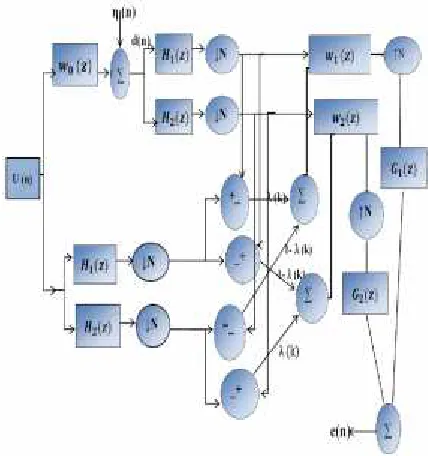
The proposed subband adaptive combination scheme using two NSAFs (called the CNSAF). The update of the NSAFs in Fig. 3 can be written as.
we assume μ1> μ2. Then wˆ1(k) has a faster convergence rate but a
larger steady-state MSE than wˆ2 (k) .The subband outputs of the
overall filter are
Where λ(k) is the mixing parameter that lies between zero and one. Using (4) in (5) yields.
Instead of directly adjusting λ(k) , we will adapt a variable α(k) that definesλ(k) as sigmoidal function.
λ(k)= 1/1+e-α(k)
The update equation forα(k) is given by α(k+1)
Whereμ αis the step-size for adaptingα(k).
4. IMPROVED ADAPTIVE COMBINATION SCHEME
In improved adaptive combination scheme, large convergence rate and small steady state MSE can be greatly achieved by using less amount of adaptive filters as comparison to previous adaptive combination scheme. This can be achieved by using the idea of adaptive combination of speech input signal before going to the NSAFS. This improved CNSAF is called ICNSAF. The algorithm of Improved ACNSAFs such as:
Partitions the full band input and desired signals into N sub bands.
Decimates the sub band signals from the original sampling rate fs to the lower rate of fs /N. The long M-tap filter is now replaced by N shorter MS-tap FIR filters (where MS <M) operating in parallel at a lower rate. The analysis filter bank consists of N parallel band pass filters that are designed to partition the full band signal into N overlapped frequency bands.
Before going into NSAF filter they are adaptively combined by using a mixing parameter lambda.
A synthesis filter bank is used to combine the N sub band output signals, yi, D(n), i = 0, 1, . . .,N− 1, into a full band signal y(n). The
[image:4.612.325.539.460.688.2]synthesis filter bank consists of a bank of interpolators that up sample the sub band signals before filtering and adds these sub band signals. The main advantage of this proposed method is that, it has requires less no. of filters. As it requires less no. of filters also requires less memory.
5. EXPERIMENTAL RESULTS
The full band and band systems, adaptive combination of sub-band adaptive filters and its improvement were modeled in MATLAB Simulink and many simulations for different inputs and number of sub-bands were performed. For the adaptive algorithm several different algorithms can be used, but the most common one is the normalized least mean squares (NLMS). The order of the NLMS filters was chosen from N=64 to N=2 .The designs were made in MATLAB Simulink environment and the simulations were run for speech input. A reverberating effect was added to the input by an artificial Schroeder reverberate which contained four comb filters in parallel and two all-passes filters series connected. The first estimation of a system capability is represented by SNR (signal to noise ratio).The second estimation of a system capability is represented by the (output error-voice input) , but in order to measure its potential, Echo Return Loss Enhancement (ERLE) should be computed; it is defined as the ratio of the power of the desired signal over the power of the residual signal.
Figure 5.1: Performance Analysis of ERLE and Output Error-Voice Input of ACNSAF and IACNSAF for Variable Step Size µ=20.
Figure 5.1 shows the MATLAB Simulink results of adaptive combination of NSAFs, and Improved ACNSAFs. The MATLAB Simulink results mainly include waveform of original speech, error speech, echoed speech and output error-voice input and finally ERLE performances.
Now comparison based on SNR (signal to noise ratio) is shown in table 5.1.which shows that IACNSAF has greater SNR than ACNSAF. Graph 5.1 shows graphical representation of MATLAB observation as shown in table 5.1.
Table 5.1: Comparison Analysis of SNR of ACNSAF and
IACNSAF Keeping α=4,=0.5 and Varying Step Size Parameter µ
Step size parameter
ACNSAF IACNSAF
2 35.5819 35.8952
4 35.5923 36.2693
6 35.6089 36.4327
8 35.6227 36.505
10 35.6478 36.5452
12 35.6768 36.5954
14 35.7088 36.6242
16 35.7417 36.6645
18 35.7711 36.6979
20 35.792 36.6964
Graph 5.1: Graphical Representation of Table 5.1
6. CONCLUSION
The NSAF & CNSAF are good methods for implementing acoustic echo cancellers because of its fast convergence rate. However, it requires a tradeoff between fast convergence rate and small steady-state MSE. This paper presented an improved adaptive 5. EXPERIMENTAL RESULTS
The full band and band systems, adaptive combination of sub-band adaptive filters and its improvement were modeled in MATLAB Simulink and many simulations for different inputs and number of sub-bands were performed. For the adaptive algorithm several different algorithms can be used, but the most common one is the normalized least mean squares (NLMS). The order of the NLMS filters was chosen from N=64 to N=2 .The designs were made in MATLAB Simulink environment and the simulations were run for speech input. A reverberating effect was added to the input by an artificial Schroeder reverberate which contained four comb filters in parallel and two all-passes filters series connected. The first estimation of a system capability is represented by SNR (signal to noise ratio).The second estimation of a system capability is represented by the (output error-voice input) , but in order to measure its potential, Echo Return Loss Enhancement (ERLE) should be computed; it is defined as the ratio of the power of the desired signal over the power of the residual signal.
Figure 5.1: Performance Analysis of ERLE and Output Error-Voice Input of ACNSAF and IACNSAF for Variable Step Size µ=20.
Figure 5.1 shows the MATLAB Simulink results of adaptive combination of NSAFs, and Improved ACNSAFs. The MATLAB Simulink results mainly include waveform of original speech, error speech, echoed speech and output error-voice input and finally ERLE performances.
Now comparison based on SNR (signal to noise ratio) is shown in table 5.1.which shows that IACNSAF has greater SNR than ACNSAF. Graph 5.1 shows graphical representation of MATLAB observation as shown in table 5.1.
Table 5.1: Comparison Analysis of SNR of ACNSAF and
IACNSAF Keeping α=4,=0.5 and Varying Step Size Parameter µ
Step size parameter
ACNSAF IACNSAF
2 35.5819 35.8952
4 35.5923 36.2693
6 35.6089 36.4327
8 35.6227 36.505
10 35.6478 36.5452
12 35.6768 36.5954
14 35.7088 36.6242
16 35.7417 36.6645
18 35.7711 36.6979
20 35.792 36.6964
Graph 5.1: Graphical Representation of Table 5.1
6. CONCLUSION
The NSAF & CNSAF are good methods for implementing acoustic echo cancellers because of its fast convergence rate. However, it requires a tradeoff between fast convergence rate and small steady-state MSE. This paper presented an improved adaptive 5. EXPERIMENTAL RESULTS
The full band and band systems, adaptive combination of sub-band adaptive filters and its improvement were modeled in MATLAB Simulink and many simulations for different inputs and number of sub-bands were performed. For the adaptive algorithm several different algorithms can be used, but the most common one is the normalized least mean squares (NLMS). The order of the NLMS filters was chosen from N=64 to N=2 .The designs were made in MATLAB Simulink environment and the simulations were run for speech input. A reverberating effect was added to the input by an artificial Schroeder reverberate which contained four comb filters in parallel and two all-passes filters series connected. The first estimation of a system capability is represented by SNR (signal to noise ratio).The second estimation of a system capability is represented by the (output error-voice input) , but in order to measure its potential, Echo Return Loss Enhancement (ERLE) should be computed; it is defined as the ratio of the power of the desired signal over the power of the residual signal.
Figure 5.1: Performance Analysis of ERLE and Output Error-Voice Input of ACNSAF and IACNSAF for Variable Step Size µ=20.
Figure 5.1 shows the MATLAB Simulink results of adaptive combination of NSAFs, and Improved ACNSAFs. The MATLAB Simulink results mainly include waveform of original speech, error speech, echoed speech and output error-voice input and finally ERLE performances.
Now comparison based on SNR (signal to noise ratio) is shown in table 5.1.which shows that IACNSAF has greater SNR than ACNSAF. Graph 5.1 shows graphical representation of MATLAB observation as shown in table 5.1.
Table 5.1: Comparison Analysis of SNR of ACNSAF and
IACNSAF Keeping α=4,=0.5 and Varying Step Size Parameter µ
Step size parameter
ACNSAF IACNSAF
2 35.5819 35.8952
4 35.5923 36.2693
6 35.6089 36.4327
8 35.6227 36.505
10 35.6478 36.5452
12 35.6768 36.5954
14 35.7088 36.6242
16 35.7417 36.6645
18 35.7711 36.6979
20 35.792 36.6964
Graph 5.1: Graphical Representation of Table 5.1
6. CONCLUSION
www.ijraset.com
Vol. 1 Issue III, October 2013
ISSN: 2321-9653
I N T E R NA T I ON A L J OU R N A L F OR R E S E A R C H IN A P PL I E D S C I ENC E AND
E N G I N E E R I N G T E C H N OL O GY (I JR A S E T)
combination of two NSAFs to solve this problem. For adaptation of component filters, in addition to the conventional decoupling update method, we also propose a coupling one, which can further improve the performance of the adaptive combination scheme. To verify the effectiveness of the proposed scheme, simulations using different input signals as well as system noises with different SNRs were performed. The experimental results demonstrated that the proposed scheme can obtain improved performance as compared to the CNSAF.
ACKNOWLEDGMENT
The author would like to thank Prof. Parveen Bajaj
at Maharishi Markandeshwar University, Sadopur (Ambala) for giving valuable guidance to accomplish this paper. He has given extreme support to perform experimental results.
REFERENCES
[1] Quatieri, T.F. ;O'Leary ,G.C. ;“Far-echo cancellation in the presence of frequency offset [full duplexmodem”IEEE Transactions on communication.Volume:37,Issue:6, Publication Year: 1989 , Page(s): 635 - 644 .
[2] Murano,K.; Unagami,S.; Amano,F.; “Echo cancellation and applications”Communications Magazine, IEEE Volume: 28 , Issue: 1, Publication Year: 1990 , Page(s): 49–55.
[3] P. P. Vaidyanathan, Multirate Systems and Filter Banks. Englewood Cliffs, NJ: Prentice-Hall, 1993.
[4] Birkett, A.N.; Goubran, R.A.; “Nonlinear loudspeaker compensation for hands free acoustic echo cancellation” volume: 32, issue: 12 publication year: 1996 , page(s): 1063–1064.
[5] Tahernezhadi, M.; Dai, M.; “Application of QR-LS algorithm for one-channel and two channel acoustic echo cancellation” IEEE 39th Midwest symposium on circuits and systems.Issue Date : 18-21 Aug 1996 ,Volume : 2 ,On page(s): 813 - 816 vol.2 .
[6] M. D. Courville and P. Duhamel, “Adaptive filtering in subbands using a weighted criterion,” IEEE Trans.Signal Process., vol. 46, no. 9, pp. 2359–2371, Sep. 1998.
[7] Pan, J.Z.; Kuo, S.M.; “Integrated adaptive noise and echo cancellation microphone system “Fourth International Conference onsignal processing, Issue Date :1998 .
[8] S. S. Pradhan and V. U. Reddy, “A new approach to subband adaptive filtering,” IEEE Trans. Signal Process., vol. 47, no. 3, pp. 655–664, Mar. 1999.
[9] S. Haykin, Adaptive Filter Theory. Upper Saddle River, NJ: Prentice- Hall, 2002.
[10] Gustafsson, S.; Martin, R.; Jax, P.; Vary,P.; “A psychoacoustic approach to combined acoustic echo cancellation and noise
reduction”IEEE Transactions on Speech and Audio Processing, Volume: 10, Issue: 5,2002.
[11] K. A. Lee and W. S. Gan, “Improving convergence of the NLMS algorithm using constrained subband updates,” IEEE Signal Process. Lett., vol. 11, no. 9, pp. 736–739 , Sep. 2004.
[12] Youhong Lu; Fowler, R.; Tian, W.; Thompson, L.; “Enhancing echo cancellation via estimation of delay “Signal Processing, IEEE Transactions on Volume: 53 ,Issue: 11 ,2005.
[13] J. Arenas-Garcia, A. R. Figueiras-Vidal, and A. H. Sayed, “Mean-square performance of a convex combination of two adaptive filters,” IEEE Trans. Signal Process., vol. 54, no. 3, pp. 1078–1090, Mar. 2006.
[14] M. M. Sondhi, “The history of echo cancellation,” IEEE Signal Process. Mag., vol. 23, no. 5, pp. 95–98, Sep. 2006.
[15] Jean-Marc Valin, Member, IEEE, and Iain B. Collings, Senior Member, IEEE“Interference-Normalized LeastMean Square Algorithm” IEEE Signal Processing Letters, Vol. 14, No. 12, December 2007.
[16] N. J. Bershad, J. C. M. Bermudez and J.-Y. Tourneret,―An affine combination of two LMS adaptive filters Transient mean-square analysis, IEEE Trans. Signal Process., vol. 56, no. 5, pp.1853–1864, May 2008.
[17] A. H. Sayed, Adaptive Filters. New York: Wiley, 2008. [18] J. Ni and F. Li, “A variable regularization matrix normalized subband adaptive filter,” IEEE Signal Process. Lett., vol. 16, no. 2, pp. 105–108, Feb. 2009.
[19] Irina Dornean, Marina Topa, Botond Sandor Kirei, Marius Neag,2009”Sub-Band Adaptive Filtering for Acoustic Echo Cancellation”.