5
VIII
August 2017
933
©IJRASET (UGC Approved Journal): All Rights are ReservedMaximization of Energy Efficiency and Trade Off of
Energy Efficiency
Ruchi Patel1, Jaya Dipti Lal2, Mrs. S.V. Charhate3
1ME Student , 2Assistant Professor, 3Professor , SGSITS INDORE
Abstract: Due to the exponentially growth in wireless network traffic, both licensed and unlicensed spectrum band have become congested. There are no enough spectrum bands left to accommodate further this exponential growth of mobile traffic. Since spee d of wireless communication network is growing and with this energy consumption of cellular network is also increasing. The effe ct of EM radiated emissions has hazardous effect on human health. Hence user demands energy efficient wireless communication also known as green communication. This paper investigates various trade-off in Energy Efficient wireless network and an appro ach to minimize Energy consumption. In which we examine about users terminal cooperating with other wireless communication network in an energy efficient manner. The distance between the BS and user terminals also an impacting factor in energy efficie nt network. The EE Trade-off has been discussed based on physical layer protocol only.
Keywords: Cognitive Radio, Cooperation, Green Communication, Energy Efficiency, Spectral Efficiency, Trade-Off
I. INTRODUCTION
The significant growth in wireless communication e.g. CDMA, GSM, 3G, 4G, 5G network etc. has resulted in growing demand of ene rgy consumption[1]. As the device switch from lower speed of network to higher, the energy consumption gets approximately double on each next evolution as shown in bar graph 1.1. Because of limited battery capacity, the cellular network demands an EE transmissi on scheme. It is claimed that battery capacity has only increased by 80% within the last decade, while the processor performance doub les every 1, 5 year [2]. Only around 10% of the entire consumption is associated with the end user equipment, while the remaining 90 % is taken up by network components of which around 2/3 is used by the BS. This means that a BS consumes more than 60% of its pe ak consumption even in periods of idle operation. Therefore, strategically turning-off some of the base stations during the off peak hou rs promises a great potential to improve the system’s energy efficiency. The energy consumption of UT based on what kind of service they are operating like video, audio, data etc. The energy consumption also depends on the bandwidth used by the service being used by UT. Cell phone technology has grown exponentially in the decade. The value of Power Density (PD) at public exposure zone shoul d not greater then f/200 watt/ for 400-2000 MHz band. Due to this requirement of energy the higher evolutions e.g. 4G LTE operated devices restricted to certain locations. 4G LTE devices are expected to support higher data rates and multi standard radio interfaces (U MTS, LTE, and Wi-Fi, Bluetooth etc.) to provide streaming connection. This demand of high speed connection achieved at the cost o f higher energy consumption. The organisation of the paper is as follows: at first we discuss about the network model, after that we de scribe the impact of various transmission parameters which are responsible for impact on cellular network, than problem of cellular ne twork has described, the remaining portion of this paper is about to the methodology or process, and at the end we conclude the whole discussion.
A. Network Model
Volume 5 Issue VIII, August 2017- Available at www.ijraset.com
934
©IJRASET (UGC Approved Journal): All Rights are Reserved
Fig.2.2 Cellular network with CR network
The Cognitive Radio transmission process is simply composed of two important phases:
1) Spectrum Sensing Phase: The method of detecting unused spectrum is known as spectrum sensing. When the channel is not
using by primary users for particular time i.e. channel is in idle state, then allot this channel to secondary users. There are many techniques are available for spectrum detection some of them are energy detection (ED), matched filtering (MF), and feature extraction (FE). Due to computational complexity, the FE detector consumes more energy as compared to the ED and the MF detector.
2) Transmission Phase: When the detected channel is in ideal state the process of transmission of data between secondary users
takes place at that available frequency channel.
B. Trade-Offs in Energy Efficient Cellular Network
Energy efficiency is formally defined as the number of bits that can be successfully transmitted with unit power consumption. Energ y consumption is critical in wireless systems in terms of Cost, Availability, QoS, Usability and Robustness. In the process of power consumption minimization of cellular wireless network there are number of parameters which are responsible for trade off in EE wir eless network. The EE Trade–off exists in each layer of protocol (physical layer, data link layer, network, transport etc.) In this pap er we are discussing about the EE trade-offs which are related to physical layer protocol. They are as follows:
C. SE-EE Trade-off
More bandwidth higher the transmission rate hence higher will be the capacity of channel. For a given transmission rate the expansion of the signal bandwidth is preferred to reduce transmit power to achieve better EE. More bandwidth also means that there is higher th noise power at the receiver. Since noise is equally distributed throughout the bandwidth Shannon’s formula assumes a Gaussian distri buted input into the channel and can be referred to as the continuous input continuous output memory less channel. Shannon channel c apacity formula says,
= bits/seconds/Hz (1)
Where P is the power of transmitted symbol, is the noise power, B bandwidth of the channel, is spectrum efficiency and energy efficie ncy. Eq. (3) shows that EE and SE are inversely proportional to each other, which says that we can’t maximize power efficiency at the same time that a higher level of SE achieved.EE approaches to zero as SE tends to infinite. Spectrum efficiency can be enhanced by a pplying NC in CRNs. The authors in [6] proposed a scheme in which NC, Orthogonal Frequency Division Multiplexing (OFDM), and multicast are combined efficiently to increase spectrum efficiency for future 5G systems.
D. Energy vs. Coding
Network Coding (NC) is a scheme used to provide effective and secure communication by improving the network capacity, through put, robustness and efficiency. In network coding scheme, data packets are encoded and forword by intermediate nodes and then dec oded at the destination nodes. In CRNs, network coding techniques are also used to improve the spectrum utilization, to maintain the effective and secure transmission of data packets over the wireless channel [7]. NC has been applied to CRN to increase the through put of CRN by reducing the transmission time for SUs. Network coding results Delay, Overhead, increased Spectrum Sensing time and Decision time. This parameter is cause of increased power consumption hence EE reduced.
Cognitive base Station
935
©IJRASET (UGC Approved Journal): All Rights are ReservedE. Bandwidth vs. Power
Shannon’s capacity formula shows that power is logarithmic function of power. Hence if bandwidth increases the power of transmis sion is reduces.
=B* (1 + ) bits/second (
F. Problem Description
We consider the Rayleigh channel model that incorporates the RF, Path Loss and fading effects in characterising wireless channel. In t his paper we use the concept of orthogonality to reduce interference and to increase overall spectrum efficiency.
As we know noise is equally distributed throughout the given channel bandwidth. We incorporate the cooperative base-station operati on to improve the energy-efficiency of the cellular networks without sacrificing the quality of service (QoS) of the users. We guarante e the channel outage probability by identifying the UEs situated at the worst-case locations and use BS cooperation to ensure their min imum QoS requirements. It is shown that significant energy saving potential can be achieved by the proposed scheme. From the discu ssion above, green wireless communications is a new communications paradigm, which requires a new way of thinking and design ph ilosophy in all layers of the communications system.
G. Proposed Solution
There are many techniques for reducing the energy consumption in wireless networks. Some are focusing on improving the EE in diff erent modes such as active or sleep modes. Some are dealing with reducing interference to achieve higher S/N ratio with the same tran smission power. By introducing cognitive radio technology with cooperation of different wireless network we can reduce the power c onsumption of the network [8]. Cooperative spectrum sensing (CSS) is considered as one of the solutions to tackle these problems in which more than on CR user collaboratively performs the spectrum sensing [9]. Today as digital communication is growing, because of its good quality and high speed. Analog Televisions are switching to digital Television. This switching from Analog to digital leave s analog frequency band free. These free analog TV spaces which are not using by any services are known as TV white space [10]. T V band channels have a very good transmission and penetration capability. Therefore these free bands can be used by cellular network Two approaches toward energy efficient wireless networks.
1) To find appropriate solutions to the energy efficiency challenges for already existing network.
2) To design future network from energy efficient perspective.According to [15] energy efficiency (EE) is defined as the ratio of the average transmission rate to the average power consumption. In green communication network EE is the ratio of transmission throughput to transmit power.The quest is why using spectrum more efficiently is important and how it can reduce power consumption
3) The answer lies under Shannon’s capacity formula, where we can see the trade-off between the Bandwidth and Power. 4) The capacity of wireless channel increases linearly with bandwidth, but only logarithmically with power.
To reduce power we should seek for more bandwidth. Manage the spectrum optimally and dynamically. To remove these challenges green communication comes in picture. Selecting the frequency based on the transmission distance. OFDM is a method of encodin g digital data on multiple sub-carriers
H. Nodes Cooperation using Alamouti’s Transmit Time Coding
OFDM enables the transmission of broadband high data rate information by dividing the data rate into several interleaved, parallel bit streams modulation in separate carrier. It is a robust solution to counter the adverse effects of multiple propagation and ISI.
A database-assisted TV white space network can achieve the goal of green cognitive communication by effectively reducing the energ y consumption in cognitive communications [11].
Volume 5 Issue VIII, August 2017- Available at www.ijraset.com
936
©IJRASET (UGC Approved Journal): All Rights are Reserved [image:5.612.175.424.147.276.2]We are using alamauti transmit time coding. Consider that we have a transmission sequence for example {x1,x2}. Group the symbol s into group of two. In the first time slot send{x1,x2) from the BS and TVS transmitting antenna. In the next time slot send {x1*,-x2 *} from the BS and TVS transmitting antenna. In the third timeslot send and so on. Since we are grouping two symbols, we still nee d two time slots to send two symbols. Hence there is no change in data rate.
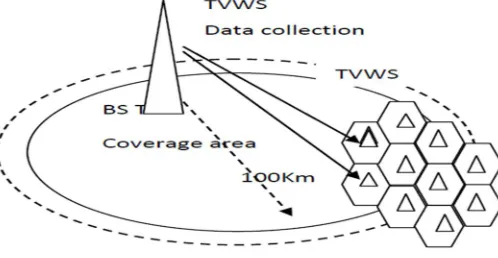
Fig 4.3 TVWS data collection by cooperation of CR devices
Cooperative spectrum sensing is considered as a one of the solution to tackle these problems in which more than one CR user collabra tely perform the spectrum sensing. The reliability of nodes depends on the past decisions of corresponding node and of the central nod e.
1) To be specific the cellular devices first have to identify the unused spectral bands using their spectrum sensing functionality. 2) Then they cooperate for exploring the detected spectrum holes to support EE cellular communication.
3) Each CR prepares a preference list of other radios in the vicinity for cooperation and hence to form a table.
Suppose TV carrier is available, in this case transmission is taken place with cooperation of TVS and BS. Consider packet size of k of LTE packet format is 376+N and packet size of IEEE 802.22 packet is 2376+ N then the effective bits are
Effective data ratio is given by
= Bits (3) Where, k is ratio of the effective data size to the whole packet size (N + x) i.e.
= (4) Power consumption of terminals given by
=− ∗ ∗ ∗ ∗ ∗( )
∗ ∗ ∗ ∗ ( ) (5)
Battery energy consumption E is given by,
=( ∈) +( ) + (6) Where, P1 is power, is pulse duration, is the battery efficiency factor, is the extra power loss factor of the power amplifier, V is the battery voltage and is the transfer efficiency of DC-to DC converter.
TABLE 1.System parameters used in numerical evaluation
-174dBm , 0 dB 0.05
2100MHz ∆ ,∆ 4 dB 0.8
55.25MHz , 1 105.8mW
937
©IJRASET (UGC Approved Journal): All Rights are Reserved5MHz 1.33*10 c 3*10
, 5 dB V 3.7A 10
[image:6.612.61.523.74.414.2]I. Results
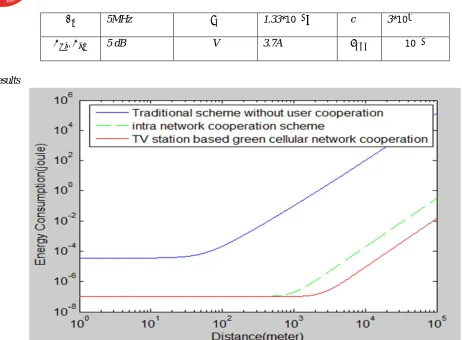
Fig. Energy consumption versus link distance from U1/U2 to BS and TVS of various transmission schemes with effective rate R’=1 0Mbits/s, N=1000Ebits/packet.
II. CONCLUSION AND FUTURE WORK
In this paper we have study the challenges that exist in energy efficient wireless cellular network. We have studied that how the energ y consumption can be reduce to certain amount by using cooperation of wireless networks(TV and relays) with cellular network. To s olve the trade-off between EE and SE, green communication is a newly emerging approach. The point of attraction is that how user te rminal at cellular network will select the cooperative network which will provide transmission at lowest energy cost. The interference of user terminal at cellular network from other network who invoked to use that unused TV spectrum is also the area of interest.
REFERENCES
[1] JIA ZHU AND YULONG ZOU, Cognitive Network Cooperation for Green Cellular Networks, , (Senior Member, IEEE) School of Telecommunications and In formation Engineering, Nanjing University of Posts and Telecomm, Nanjing 210003, China
[2] G. Y. Li et al., 2011, “Energy efficient wireless communications: Tutorial, survey, and open issues”, IEEE Wireless common. Magi. 18(6), 28-35
[3] F. Akyildiz, W. Y. Lee, M. C. Vuran, and S. Mohanty, “Next generation/dynamic spectrum access/cognitive radio wireless networks: A survey,” Computer Net works, vol. 50, pp. 2127–2159, 2006
[4] M. H. Rehmani, A. C. Viana, H. Khalife, and S. Fdida, “SURF: A distributed channel selection strategy for data dissemination in multi- hop cognitive radio net works,” Computer Communications, vol. 36, no. 10, pp. 1172–1185, 2013
[5] Distributed Dynamic Resource Allocation for Cooperative Cognitive Radio Networks With Multi-Antenna Relay Selection, Jeroen Van Hecke, Paolo Del Fiore ntino, Vincenzo Lottici, Filippo Giannetti, Luc Vandendorpe, and Marc Moeneclae
[6] Z. Liu, W. Xu, S. Li, and J. Lin, “Network-coded primary-secondary cooperation in OFDM-based cognitive multicast networks,” EURASIP Journal on Wireles s Communications and Networking, no. 1, pp. 1–13, 2015.
[7] Network Coding in Cognitive Radio Networks: A Comprehensive Survey Ayesha Naeem, Mubashir Husain Rehmani, Senior Member, IEEE, Yasir Saleem, St udent Member, IEEE, Imran Rashid, and Noel Crespi, Senior Member, IEEE
Volume 5 Issue VIII, August 2017- Available at www.ijraset.com
938
©IJRASET (UGC Approved Journal): All Rights are Reserved[9] Improved weighted cooperative spectrum sensing algorithm based on reliability in cognitive radio Networks, IEEE international conference on recent trends in electronics communication technology, may 20-21, 2016,india