Automating the Lower and Higher Normal Form Process
for the Database Systems
Manal Fadel Younis
Department of Computer Engineering, University of Baghdad Baghdad-Iraq
ABSTRACT
Normalization is an important technique for the analysis of relational databases. It aims to create a set of relational tables with minimum data redundancy that preserve consistency and facilitate correct insertion, deletion, and modification. It is very much time consuming to do this data analysis manually. Thus in this paper, a system is proposed which aims to automate the most complex phase of the database design normalization. It will help to achieve a good database design and eliminate the drawbacks of manual normalization process. This system is suitable to eliminate redundancy and inconsistent dependency automatically. It aims to handle the normalization process up to fifth normal. This includes creating tables and establishing relationships between those tables by using their general definitions in a step-by-step feature on the set of functional dependencies to remove redundant data. Then this system is tested on many examples with multiple candidate keys taken from different sources.
General Terms
Normalization, Relational Database System
Keywords
Functional Dependency, Keys, Redundancy, Normal Forms.
1.
INTRODUCTION
Good relational database system is not enough to avoid the data redundancy. Normalization is a process used for evaluating and correcting table structures to minimize this redundancy, and reducing the data anomalies which is based on their functional dependencies and primary keys. The normalization process involves assigning attributes to tables based on the concept of determination [1].
It usually involves dividing a database into two or more tables and defining relationships between the tables. The objective is to isolate data so that additions, deletions, and modifications of a field can be made in just one table and then propagated through the rest of the database via the defined relationships [2].
Key is one or more attributes which determine other attributes [1][3].
Superkey: An attribute (or combination of attributes) that uniquely identifies each row in a table.
Candidate key: A superkey that does not contain a subset of attributes that is itself a superkey.
Non-prime attribute: A non-prime attribute is an attribute that does not occur in any candidate key. Primary key: A candidate key selected to uniquely
identify all other attribute values in any given row cannot contain null entries.
2.
A FUNCTIONAL DEPENDENCY (FD)
[1][4][3]
The attribute B is functionally dependent on the attribute A if each value in column A determines one and only one value in column B. (written A → B)
Partial dependency: The determinant is only part of the primary key.
Full functional dependency: If attribute B is functionally dependent on a composite key A but not on any subset of that composite key, the attribute B is fully functionally dependent on A. Transitive dependency: Is a functional dependence
exists among nonprime attributes.
Multivalued dependency: Two or more attributes are dependent on a determinant and each dependent attribute has a specific set of values. The values in these dependent attributes are independent of each other.
Join dependency: A table T is subject to a join dependency if T can always be recreated by joining multiple tables each having a subset of the attributes of T.
Normalization works through a series of stages called normal form, these are [1][5]:
• First Normal Form (1NF). • Second Normal Form (2NF). • Third Normal Form (3NF). • Boyce-Codd Normal Form (BCNF) • Fourth Normal Form (4NF). • Fifth Normal Form (5NF). The first normal form (1NF):
There are no repeating groups in the table. In other words, each row/column intersection contains one and only one value, not a set of values.
Define the primary key.
Define all dependencies on the table. The second normal form (2NF):
It is in 1NF.
Remove all partial dependencies. The third normal form (3NF):
It is in 2NF.
It contains no transitive dependencies. The Boyce-Codd normal form (BCNF):
Is special case of 3NF, when the table contains only one candidate key, then 3NF and the BCNF are equivalents.
The fourth normal form (4NF): It is in 3NF.
Remove the multivalued dependencies. The fifth normal form:
It is in 4NF.
The entity has no join dependencies. Also called project-join normal form.
This section 1 describes the introduction of the proposed work. Section 2 focuses on literature survey. Section 3 describes the proposed system for automatic higher normal form. Section 4 focuses on the result of the proposed system..
3.
LITERATURE SURVEY
This section focus on literature survey of the paper:
Sherry Verma,”Comparing manual and automatic normalization techniques for relational database”, [6] proposed the Comparing manual and automatic normalization techniques for relational database, based on the dependency matrix and approach primary key to generate automatically identified the final table.
Amir Hassan bahmani, Mahmoud Naghib zadeh, “Automatic database normalization and primary key generation”, [7] the authors proposed an approach for automatic database normalization and primary key generation. In discussed an automatic distinguish one primary key for every final table which is generated. The problem is to normalize the database tables automatically. In the current normalization process, even first normal form, second normal form and third normal forms are difficult by doing automatically.
P.B. Alappanavar, Dhiraj Patil, Radhika Grover, Srishti Hunjan, Yuvraj Girnar ,“An Ameliorated Approach towards Automating the Relational Database Normalization Process”, [8] aims to automate the most complex and elaborate phase of the database design process-Normalization, which will help to achieve the trademarks of an acceptable database design.
G.Sunitha, Dr.A.Jaya, “A KNOWLEDGE BASED
APPROACH FOR AUTOMATIC DATABASE
NORMALIZATION”, [9] aims to provide automatic normalization of databases up to 3NF in order to reduce the time consuming in manually normalization.
Moussa Demba, “ALGORITHM FOR RELATIONAL DATABASE NORMALIZATION UP TO 3NF”, [2] the author proposed an algorithmic approach for database normalization up to third normal form by taking into account all candidate keys, including the primary key.
4.
PROPOSED SYSTEM FOR
[image:2.595.308.513.81.187.2]AUTOMATIC ALL NORMAL FORM
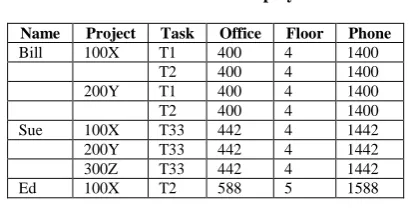
First Case study: Consider the following table with set of attributes to apply the proposed system:Table 1: Employee
Name Project Task Office Floor Phone
Bill 100X T1 400 4 1400
T2 400 4 1400
200Y T1 400 4 1400
T2 400 4 1400
Sue 100X T33 442 4 1442
200Y T33 442 4 1442
300Z T33 442 4 1442
Ed 100X T2 588 5 1588
First Normal Form:
Step 1: Eliminate the Repeating Groups
Eliminate the nulls by making sure that each repeating group attribute contains an appropriate data value.
Step 2: Identify the Primary Key
The above table has more than one field that represent the primary key (Name, Project, Task) because the field Name is not uniquely identify all of the remaining entity (row) attributes. For example, the Name value Bill can identify any one of two projects. Then if the primary key composed from (Name and Project) so not uniquely identify any one of two tasks.
To maintain a proper primary key that will uniquely identify any attribute value, the new key must be composed of a combination of Name, Project and Task.
[image:2.595.323.531.464.572.2]For example, if Name=Bill, Project=100X and Task=T1 the entries for the attributes Office, Floor and Phone must be 400, 4, 1400 and so on. This change converts the table Employee to table Employee2 which is in 1NF.
Table 2: Employee2
Name Project Task Office Floor Phone
Bill 100X T1 400 4 1400
Bill 100X T2 400 4 1400
Bill 200Y T1 400 4 1400
Bill 200Y T2 400 4 1400
Sue 100X T33 442 4 1442
Sue 200Y T33 442 4 1442
Sue 300Z T33 442 4 1442
Ed 100X T2 588 5 1588
Step 3: Identify All Dependencies
The primary key in step 2 identified the following dependency:
Name, Project, Task Office, Floor, Phone a- Partial dependency:
Name Office, Floor, Phone b- Fully dependency: None c- Transitive dependency:
Office is the office number for the employee. Bill works in office number 400.
Floor is the floor on which the office is located.
Phone is associated with the phone in the given office.
Office Floor, Phone
Second Normal Form:
[image:3.595.320.540.68.460.2]Split the table which results from the 1NF according to partial dependency into two relations (tables):-
Table 3: EmpNPT (Name, Project, Task)
Name Project Task
Bill 100X T1
Bill 100X T2
Bill 200Y T1
Bill 200Y T2
Sue 100X T33
Sue 200Y T33
Sue 300Z T33
Ed 100X T2
Table 4:EmpNOFP (Name, Office, Floor, Phone)
Name Office Floor Phone
Bill 400 4 1400
Sue 442 4 1442
Ed 588 5 1588
Third Normal Form:
Step 1: Identify the transitive dependency:-
There is transitive dependency in table EmpNOFP (Name, Office, Floor, Phone)
[image:3.595.66.268.126.227.2]Step 2: Split EmpNOFP into two tables
Table 5 : EmpNPT (Name, Project, Task)
Name Project Task
Bill 100X T1
Bill 100X T2
Bill 200Y T1
Bill 200Y T2
Sue 100X T33
Sue 200Y T33
Sue 300Z T33
[image:3.595.66.268.254.295.2]Ed 100X T2
Table 6: EmpNO (Name, Office)
Name Office
Bill 400
Sue 442
Ed 588
Table 7: EmpOPF (Office, Phone,Floor)
Office Phone Floor
400 1400 4
442 1442 4
588 1588 5
Boyce-Codd Normal Form
Is special case of the 3NF, every determinant in the table is a candidate key. When the table contains only one candidate key, then the 3NF and the BCNF are equivalent. Then the above tables are in BCNF.
Fourth Normal Form:
Step 1: Determine the multivalued dependency: Name Project
Name Task
Table 8: EmpNP ( Name, Project)
Name Project
Bill 100X
Bill 200Y
Sue 100X
Sue 200Y
Sue 300Z
Ed 100X
Table 9: EmpNT ( Name, Task)
Name Task
Bill T1
Bill T2
Sue T33
Ed T2
Table 10: EmpNO (Name, Office)
Name Office Floor
Bill 400 4
Sue 442 4
Ed 588 5
Table 11: EmpOPF (Office, Phone)
Office Phone Floor
400 1400 4
442 1442 4
588 1588 5
Second Case study of BCNF:
To check for BCNF, it must identify all the determinants and make sure that they are candidate keys. For example, STUDENT relation is given below with attributes StdID, Major and Advisor.
Table 12: Student
StdID Major Advisor
MS-100 Math Prof. B
MS-100 Physics Prof. S
MS-200 Chemistry Prof. R
MS-300 Physics Prof. A
MS-300 Math Prof. B
The functional dependencies in this relation are: StdID, major → Advisor
Advisor → Major
The following may be the candidate keys: (StdID, Major) is one candidate key (StdID, Advisor) is another candidate key
Suppose (StdID, Major) as a primary key for the STUDENT relation. It is represented as:
STUDENT (StdID, Major, Advisor)
[image:3.595.64.270.382.652.2] [image:3.595.315.541.513.707.2]separate relation. It must be the key of that relation. Suppose, the two relations are STD_ADVISOR and ADV_MAJOR such as:
[image:4.595.66.268.151.294.2]STD ADVISOR (StdID, Advisor) ADV MAJOR (Advisor, Major)
Table 13: STDADV Table 14: ADVMAJ
StdID Advisor Advisor Major
MS-100
Prof. B Prof. B Math
MS-100
Prof. S Prof. S Physics
MS-200
Prof. R Prof. R Chemistry
MS-300
Prof. A Prof. A Physics
MS-300
Prof. B
Third Case study of 4NF: Employee relation is shown below: Table 15: Employee
Eid Language Skill
100 English Teaching
100 Kurdish Politics
100 English Politics
100 Kurdish Teaching
200 Arabic Singing
200 English Cooking
200 Arabic Cooking
200 English Singing
Step 1: Check the table must be in 3NF and BCNF. Step 2: Determine the multivalued dependency: Eid Language
Eid Skill
[image:4.595.315.543.443.678.2]The table is projected to the following two non-loss projections which are in forth normal form:
Table 16: EL Table 17: ES
Eid Language Eid Skill
100 English 100 Teaching 100 Kurdish 100 Politics 200 Arabic 200 Singing 200 English 200 Cooking Fourth Case study of 5NF is shown below: Step 1: Check the table must be in 4NF. Step 2: Check the join dependency.
Table 18: AgentCompanyProduct
Agent Company Product
Smith Ford Car
smith Ford Truck
smith Gm Car
smith Gm Truck
jones Ford Car
This relation has a join dependency (Agent, Company, Product) among the three projections:
R1(Agent,Company), R2(Agent,Product), and R3(Company,Product) of AgentCompanyProduct. To remove the join dependency, it must create the following relations:
AC(Agent, Company) AP(Agent, Product) CP(Company, Product)
Table 19: AC Table 20: AP
Table 21: CP
5.
TESTING THE PROPOSED SYSTEM
This proposed approach aims to normalize the database automatically to reduce the time of the design. The following figure is showing this:
Fig 1: The main interface
Fig 2: Load unnormalized table
Agent Company Agent Product
Smith Ford smith Car
Smith Gm smith Truck
Jones Ford jones Car
smith Truck
Company Product
Ford car
Ford truck
Gm car
[image:4.595.64.269.531.609.2]Fig 3: Select the primary key
Fig 4: The table in 1NF
Fig 5: The table in second normal form
Fig 6: The table in 3NF
Fig 7: The tables in 4NF form
The result of the second case study about BCNF:
Fig 8: Load unnormalized table
Fig 9: The tables in BCNF form
The third case study about 4th:
Fig 11: The tables in 4NF form
The third case study about 5th:
[image:6.595.55.283.205.499.2]Fig 12: Load unnormalized table
Fig 13: The table in 5th form
6. CONCLUSION
This work presented a system to perform database normalization up to fifth normal form automatically to design a database.
This work has the following advantages: Less time required for normalization. Easily remove the redundant dependencies.
7.
REFERENCES
[1] Coronel C., Morris S., and Rob P. 2011. Database Systems: Design, Implementation, and Management, United States of America, 9th edition, 175-197.
[2] Demba M. 2013. Algorithm for Relational Database Normalization up to 3NF, International Journal of Database Management Systems ( IJDMS ) 5(3): 39-40, June.
[3] Sushant S. Sundikar Introduction to Database Management System.
[4] Ryan K., Ronald R., 2001. Database Design, United States of America, 208-216.
[5] Sushant. S. Sundikar Introduction to Database Management Systems, 5-8.
[6] Verma S. 2012. Comparing manual and automatic normalization techniques for relational database. IJREAS, 2(2): 59-67, Feb.
[7] Bahmani A, Naghibzadeh M., Bahmani B. 2008. An Automatic Database Normalization – Primary Key Generation, IEEE.
[8] Alappanavar B., Radhika P., Hunjan S., Girnar Y. 2013. An Ameliorated Approach towards Automating the Relational Database Normalization Process. International Journal of Engineering and Advanced Technology (IJEAT) ISSN: 2249 – 8958, 2(4), April.