Architecture based Comparison of Semantic Web
Service Composition Processes
Aditya Khamparia
Research Scholar
School of Computer Science and Engineering Lovely Professional University
Phagwara, Punjab
Babita Pandey
Associate Professor School of Computer Applications
Lovely Professional University Phagwara, Punjab
ABSTRACT
Semantic web services development become rapidly increased as dynamic changes are occurred. Various approaches are adopted to develop composite service systematically. This paper aims to make development process easier by classifying the literature on web services composition based approaches like selection, discovery, orchestration, choreography, mediation, automatic composition to facilitate the end to end semantic web service composition easier. Applying semantics in web process cycle helps to address critical issues in reuse, integration and scalability. In order to find best approach, various composition approaches on these requirements were evaluated and suggestions were provided on what approach can be used in which scenario to achieve best results.
Keywords
Semantic web service, Service Composition approaches, Selection, Discovery, Orchestration, Choreography.
1.
INTRODUCTION
Semantic web is an extension of current web, in which information is given well defined meaning, better enabling computer and people to work in cooperation [1]. The objective of research around semantic web service is to facilitate automatic handling of web services. Semantic web transforms the web into repository of computer readable data, while web services provide tool for automatic reuse of that data. Sometimes single service component unable to satisfy user needs then some mechanisms like discovery [4], selection [18], mediation [12], matchmaking etc. are used for finding service component and semantic composition helps to aggregate the component of various services according to tasks. In previous work we have made a survey on different approaches of semantic web services [18]. The main objective of this paper is to discuss some existing composition techniques like Workflow based, Artificial Planning, Context based, Agent based, Ontology based, Orchestration and Choreography to solve semantic web composition problem with their attributes. In addition, we have also classified and compared different web service composition methods. Apart from introduction part, section 2 deals with various composition based method for semantic web service, section 3 covers framework of service composition methods, section 4 covers classification and comparison among several approaches and conclusion in section 5.
2.
EXISTING APPROACHES FOR WEB
SERVICES COMPOSITION
Various software programs are available to facilitate automatic composition of services. Such programs enable user
to specify composition of programs to perform some varied tasks. In this section we will focus on several approaches like workflow based, AI Planning approach, Orchestration, Choreography, Mediation, Ontology based, Agent based, Discovery, Selection for semantic web service composition.
2.1
Workflow based SWS Composition
approach
A workflow is abstraction of a business process. It comprises of tasks, dependencies among tasks, rules and participants. Task represent a software system in which task flow from one web services to another service and performed appropriate functionality. OWL-S process model [2] is work flow driven model for web service composition. This model uses DAML based match maker. Workflow is composed with help of composite and atomic processes. Various compositions constructs like conditional and looping constructs are used to perform automated composition. Knowledge based approaches used domain knowledge for composition and selection of services and also used WSDL [9] to accompanied the description and execute the workflow. Framework must comprise of knowledge representations and ontology, web services modules, semantic environment. Input request matching also uses work flow pattern, this matching process is used to find services available for clients input request and output matching is done with last service in work flow.
Fig 1: Workflow based Service Composition
2.2
AI Planning based approaches
based approaches. Precondition and effect properties of service in OWL-S indicate the state change during implementation of services. Various AI planning based model developed like Zeng et al. [3] proposed rule inference engine in which services are annotated with QoS features. Sirin et al. [4] Proposed hierarchical task network planning which supports non deterministic services and observability of service effects. Berardi at al. [5] discussed automatic synthesis of finite state machines to support real world, external services. Functional compositions based planning model [6] uses Casual Link Matrix (CLM) to composite link between various services and store these casual links. Links shows dependency between input and output parameters of different web services.
2.3
Service orchestration & choreography
Orchestration refers to an executable process and choreography tracks message sequence between parties and
[image:2.595.61.274.548.633.2]source. In orchestration the involved web service are under the control of single end point central process. This process coordinates the execution of different operations on web service participating in orchestra. BPEL is an orchestration language with an XML based syntax supporting specification of process that involves operations provided by web services. Choreography doesn’t depend on central coordinator. Each web service that participates in choreography has to know exactly when to become active and with whom to interoperate. It must be conscious of business process, operations to execute, messages to exchange, as well as timing of message exchange. WS-CDL is a recommendation language in area of service composition.
Fig 2: Service orchestration and Choreography
2.4
Ontology based composition approach
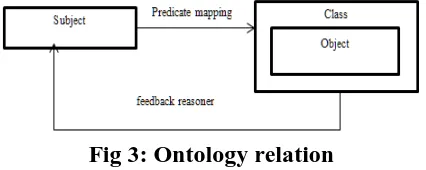
Ontology describes the knowledge representation about specific domain. Relationship among classes and objects is used for semantic composition of services in ontology domain. Stack of ontology based model [7] uses ODE reasoning. In this services are graphically designed and then instance is created. Design of service ontology is checked and instance of ontology are translated into OWL-S specification. It helps in producing graphical design of services.
Fig 3: Ontology relation
2.5 Semantic service mediation
Semantic level mediation is a mediator between concurrent semantic representations of services, to allow semantic web service matchmaking algorithms to compare capabilities of distinct semantic web service. It requires identifying similarity across distinct web service representations. Manual one to one and semiautomatic mapping are governed in mediation process level. They used mediation space as a mediator approach. It computes similarity to identify most appropriate semantic web service for given request.
Fig 4: Service mediation
2.6 Agent based approach for composition
feedbacks techniques are used to improve agent intelligence to complete desired tasks.
Fig 5: Agent based composition approach
3.
FRAMEWORK OF SERVICE
COMPOSITION METHOD
Service composition life cycle involves following phases to develop end to end service composition. It includes
[image:3.595.139.459.292.416.2]specification, planning, validation, discovery, execution and monitoring.
Fig 6: Framework of service composition
Service provider propose web services for use, service requester consume information or service offered by service provider. Translator converts or translates external language used by participants and internal languages used by service generator. If more than one plan found validator validates and evaluates all plans and proposes the best plan for execution. Execution engine executes the plan and return the result to service provider.
4.
CLASSIFICATION AND
COMPARISON OF VARIOUS
SEMANTIC WEB SERVICE
COMPOSITION TECHNIQUES
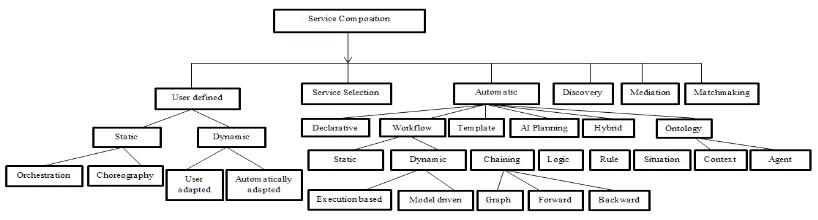
Various semantic web service composition techniques or approaches are classified as shown in figure name. Service classification is based on six categories user defined, service selection, automatic, discovery, mediation and matchmaking. Main concern here is to include all static and dynamic automated approaches like orchestration, choreography, discoveryetc.
Fig 7: Classification of service composition approaches
[image:3.595.96.505.598.708.2]
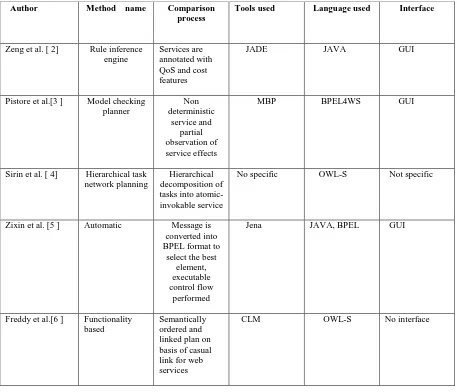
Table 1: Tabular comparison of AI Planning approaches
Author Method name Comparison process
Tools used Language used Interface
Zeng et al. [ 2] Rule inference engine
Services are annotated with QoS and cost features
JADE JAVA GUI
Pistore et al.[3 ] Model checking planner
Non deterministic
service and partial observation of service effects
MBP BPEL4WS GUI
Sirin et al. [ 4] Hierarchical task network planning
Hierarchical decomposition of tasks into atomic-invokable service
No specific OWL-S Not specific
Zixin et al. [5 ] Automatic Message is converted into BPEL format to
select the best element, executable control flow
performed
Jena JAVA, BPEL GUI
Freddy et al.[6 ] Functionality based
Semantically ordered and linked plan on basis of casual link for web services
CLM OWL-S No interface
Table 2: Tabular comparison of Orchestration and Choreography approaches
Author Method name Comparison
process
Tools used Language Interface
Jaydev & William [ 7]
Orc Orc supports a structured model of concurrent and distributed programming
Orc tool RDF-S, JAVA, BPEL
GUI
Sung –Shik et al. [ 8]
Reo based Input as description of service, WSDL interface to generate code
[image:4.595.47.505.540.700.2]Table 3: Tabular comparison of Workflow based compositions methods
Author Method name Comparison
process
Tools used Language Interface
BROGI et al. [ 9] YAWL Simulation and analysis of behavior of P2P peers and services
Not specific SMoL, BPEL GUI
Rongen et al.[10 ] Knowledge based system
Web service creation using knowledge base and ontology for composition
FaCT DAML-S WCI- GUI
Javier Rios et al. [ 11]
Magallenes Enables web service discovery and automatic work flow composition
[image:5.595.47.535.470.692.2]Magallenes tool RDF-S GUI
Table 4: Tabular comparison of semantic level mediation service
Author Method name Comparison
process
Tools used Language Interface
Stefan Dietze et al. [ 12]
Mediation Using mediation spaces to identify most appropriate web service
MS OWL-S GUI
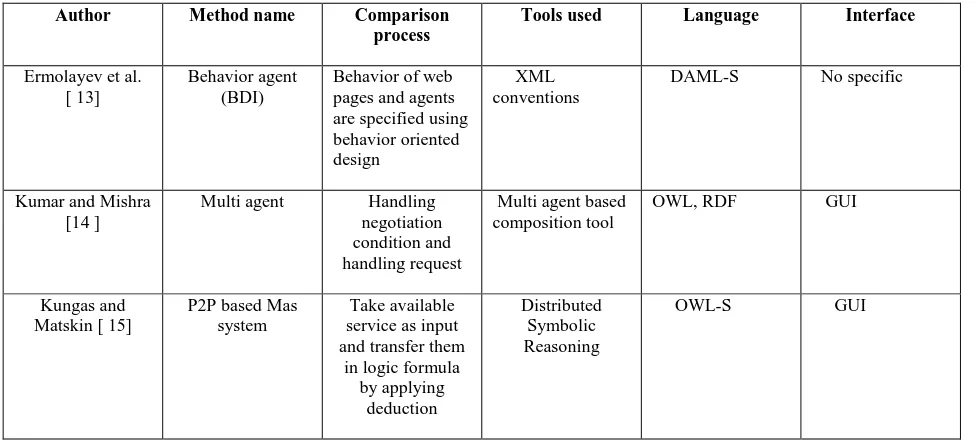
Table 5: Tabular comparison of agent based semantic web service composition
Author Method name Comparison
process
Tools used Language Interface
Ermolayev et al. [ 13]
Behavior agent (BDI)
Behavior of web pages and agents are specified using behavior oriented design
XML conventions
DAML-S No specific
Kumar and Mishra [14 ]
Multi agent Handling negotiation condition and handling request
Multi agent based composition tool
OWL, RDF GUI
Kungas and Matskin [ 15]
P2P based Mas system
Take available service as input and transfer them
in logic formula by applying
deduction
Distributed Symbolic Reasoning
OWL-S GUI
5.
CONCLUSIONS
The motivation behind this paper is to study the various researches carried out in semantic web services. This paper puts an effort in comprehensive study on Web service composition and related techniques or approaches. This paper
ontology among classes objects and their relationships and agent based technology to mediate agents and their problem solving approach. As growing need of semantic web services there is need to provide flexible, dynamic, intelligent solutions to remove limitations of AI planning approaches and focused more on agent based approach to facilitate real world applications.
6.
REFERENCES
[1] Rao, J. and Su, X. 2004 “A survey of Automated Web Service Composition Methods”, In Proc. Of 1st International Workshop of Semantic Web Service and Process Composition.
[2] Huiyuan Zheng, Jian Yang, QoS. 2010 “Analysis and Service Selection for Composite Services”, in the Proceedings of International Conference on Services Computing.
[3] Piergiorgio Bertoli, Alessandro Cimatti, Marco Pistore and Paolo Traverso. 2003 “A Framework for Planning with Extended Goals under Partial Observability”, in Proceedings of ICAPS-03.
[4] Wu, D., Sirin, E., Hendler, J., Nau, D., and Parsia, B. 2003 “Automatic Web Services Composition Using SHOP2”, in Twelfth World Wide Web Conference.
[5] Zixin Wu, K Gomadam, Amit P. Sheth. 2009 “ A miller automated semantic web service composition” WWW.cs.uga.edu/~jam/papers/zLSDIpapers/zixin.doc. [6] Freddy Lecue and Alain Leger. 2005 “A formal model for
semantic web service composition, 5th international semantic web conference, Athens, Georgia, pp. 86-95. [7] Jayadev Mishra and William cook. 2006 “Computation
orchestration- basis for wide area computing”, Journal of software system model, Springer-Verlag, pp. 83-110. [8]. Sung- Shik, Francesco Santini et al. 2013 “Orchestrating
web services using Reo”, SOCA Springer-Verlag. [9] Antonio BROGI, Razvan POPESCU 2008 “Workflow
based semantics for peer to peer specifications”, Journal of front computer science, Springer-Verlag, pp. 398-412.
[10]. Erik Rongen, Peter Sloot et al. 2005 “An automatic Composition and Selection of Semantic Web Services”, LNCS, Springer Berlin, pp. 184-192.
[11] Javier Rios, Johan Karlsson. 2009 “Magallenes - A web services discovery and automatic workflow composition tool”, Journal of BMC Bioinformatics, pp. 334-346. [12] Stefan Dietze, John Domingue et al. 2010 “An automated
approach to Semantic Web Services Mediation”, Springer Verlag SOCA, pp. 261-275.
[13] Ermolayev V., N. Keberle et al. 2007 “Towards a Framework for Agent Enabled Semantic Web Service Composition”, International journal of Web Services Research, pp. 63-87.
[14] Sandeep Kumar and R.B. Mishra. 2008 “ Semantic web service composition”, IETE Technical Review, pp. 105-121.
[15] P Kungas and M Matskin.2006 “Semantic web service composition through a P2P based multi agent environment”, lecture notes in computer science, pp. 4118.
[16] V. Portchelvi, V Prasanna. 2012 “Achieving web service composition – a survey”,International journal of software engineering, pp. 195-202.
[17] Yasmine Charif and Nicolas Sabouret. 2006 “An Overview of semantic web service composition approaches, Elsevier electronic notes in computer science, pp. 33-41.
[18] Aditya Khamparia and Babita Pandey. 2013 “Review on Semantic Web Service Processes”, 2nd
International conference on computing science, Elsevier Indexed, pp. 387-392.
[19] Aditya Khamparia and Babita Pandey. 2014 “An ontology driven multi-agent approach for diabetes management”, international multitrack conference on science energy and innovations, pp. 257-259.