N A N O E X P R E S S
Open Access
Gate-Controlled WSe
2
Transistors Using a
Buried Triple-Gate Structure
M. R. Müller
1,5,6, R. Salazar
2, S. Fathipour
3, H. Xu
3, K. Kallis
1, U. Künzelmann
4, A. Seabaugh
3, J. Appenzeller
2and J. Knoch
5*Abstract
In the present paper, we show tungsten diselenide (WSe2) devices that can be tuned to operate asn-type and p-type field-effect transistors (FETs) as well as band-to-band tunnel transistors on the same flake. Source, channel, and drain areas of the WSe2flake are adjusted, using buried triple-gate substrates with three independently controllable
gates. The device characteristics found in the tunnel transistor configuration are determined by the particular geometry of the buried triple-gate structure, consistent with a simple estimation of the expected off-state behavior.
Keywords:Electrostatic doping, Tungsten diselenide (WSe2), Reconfigurable device
Background
In recent years, two-dimensional layered materials, such as graphene and transition metal dichalcogenides (TMDs), have attracted a great deal of interest as channel material in high-performance field-effect transistors (FETs) [1–8]. A major advantage of these materials is their ability to drive high electrical currents in only few layers or even a monolayer (<1 nm). In addition, there are a number of semiconducting TMDs that exhibit band gaps≥1 eV. Thus, they are in principle ideally suited for ultimately scaled FETs as well as for band-to-band tunnel FETs tunnel field-effect transistors (TFETs) since the ultrathin channel layer enables excellent gate control yielding ultim-ate scalability and a large band-to-band tunnel probability [9–16].
However, a major challenge for the application of TMDs is the realization of an appropriate source-channel-drain doping profile because conventional (e.g., impurity, chemical) doping is extremely challenging [17, 18], and in the case of TFETs, the right amount of doping is subject to tedious optimization: if the doping concen-tration is too small, the gate action is not sufficiently screened, and the band-to-band tunneling probability cannot be made large enough. On the other hand, a large doping concentration may lead to a large Fermi
energy, and as a result, carriers are injected from the Boltzmann tail of the source Fermi distribution func-tion giving rise to a TFET with an inverse subthreshold slope close to 60 mV/dec [19–21]. A viable alternative is source-drain doping by means of electrostatic poten-tials, which has already been employed to investigate carbon nanotube, graphene, and nanowire FETs as well as optoelectronic devices [9, 22–28]. This approach not only allows convenient doping, but in a TFET, it en-ables to disentangle screening in source from the posi-tion of the Fermi energy [21]. Moreover, electrostatic doping adds device level functionality through the tun-ability to operate the same device in various transistor configurations. Specifically, if the electrostatic doping is controllable individually for source and drain, not only then-type andp-type FETs can be realized [29] but the device can also be switched into a TFET mode of operation which allows tuning to devices from conven-tional to low-power operation.
Here, we present a tungsten diselenide (WSe2) device which we tune by electrostatic doping to function as an nFET (n-n doping profile), pFET (p-p doping profile), and TFET (n-pdoping profile). WSe2is used here since, in contrast to molybdenum disulfide (MoS2), it pro-vides an approximately mid-gape Fermi level line-up for (e.g., nickel) ensuring that electrons as well as holes can be injected efficiently in the different device con-figurations [30]. In addition, it exhibits a smaller band gap and lower effective masses compared to MoS2,
* Correspondence:[email protected]
5Institute of Semiconductor Electronics, RWTH Aachen University, Sommerfeldstr. 24, 52074 Aachen, Germany
Full list of author information is available at the end of the article
both known to improve the performance of TFETs [13–16, 21]. The electrostatic doping is realized by a modified version of our previously employed buried triple-gate (BTG) structure [31]. This structure fea-tures three independently controllable gates: one center-gate and two side-gates for electrostatic doping. Since all three gates are buried and the BTG’s surface is entirely flat, the structure serves as a platform for convenient deposition and investigation of devices from various kinds of novel channel materials. The electrostatic environment is fully determined by the BTG structure, therefore, allows true comparison of various materials in terms of their suitability for future FET or TFET devices.
[image:2.595.56.291.322.686.2]Methods
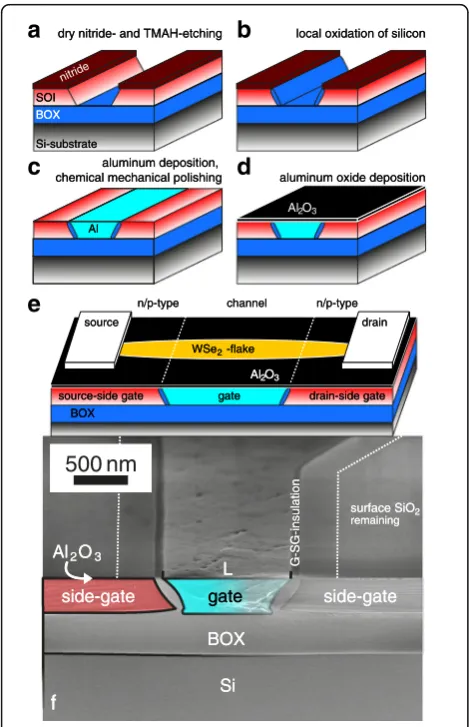
Figure 1 illustrates the manufacturing process of the BTG structure. The starting material is a 4′′ silicon-on-insulator (SOI) wafer with a top layer of 340 nm (100) Si
and a 400 nm buried oxide (BOX). The silicon is im-planted with 1015 cm−2of phosphorous at 75 keV, 7.5°, yielding a peak implantation depth of 104 nm. After-wards, the wafer is RCA-cleaned, and a 200-nm layer of Si3N4is deposited by a plasma-enhanced chemical vapor deposition. Subsequently, a furnace treatment at 900 °C for 20 min heals the implantation damage, activates the dopants, and condenses the nitride. Optical lithography in combination with CHF3+ O2plasma etching is used to pattern the nitride layer. After the removal of the photoresist (PR) and directly after an additional buffered oxide etch dip, tetramethylammonium hydroxide (TMAH), 25 wt% at 80 °C, is used to anisotropically etch through the SOI top layer (cf. Fig. 1a). Wet thermal oxidation is used to grow the gate-side-gate (G-SG) insulation (Fig. 1b). After-wards, the nitride mask is removed by a two-step pro-cedure: (i) CHF3 + O2 plasma removes the oxidized nitride and (ii) H3PO4at 160 °C removes the remaining nitride. No apparent oxidation under the nitride mask (bird’s beak) is present. A thin oxide (~10 nm) is grown on the silicon surface in order to serve as an additional insulation and as a stopping layer for the following damas-cene process: After sputter-deposition of aluminum onto the surface, chemical–mechanical planarization (CMP) is employed to remove the Al overburden yielding an en-tirely planar structure (Fig. 1c). To reduce the thermally induced growth of hillocks on the Al-surface, a repolishing procedure is used [32]. The gate dielectric is obtained by atomic layer deposition (ALD) of 7 nm Al2O3 (Fig. 1d). The BTG structures are completed by selectively etching the oxides using CHF3+ Ar plasma in the contact regions and subsequent deposition of 10 nm Ti + 170 nm Au as side and top-gate contact metals using a lift-off technique. The finished wafer is cut into sample pieces of 7.5 × 7.5 mm2; Fig. 1e shows a schematic device cross-section and bird’s-eye view.
Figure 1f presents a scanning electron microscopy (SEM) micrograph of the BTG’s surface and cross-section. Clearly visible is the G-SG insulation of 90 nm. Not visible is the 7 nm Al2O3dielectric cap layer on the surface. An excellent topography, with a dishing of only ~1 nm per micron, and quality (only few pits and scratches, roughness down to 1-nm root mean square) of the polished aluminum is achieved [32, 33].
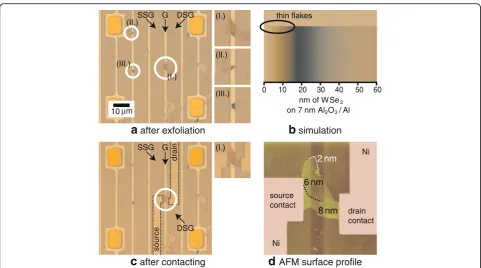
For the fabrication of the WSe2 devices on the BTG structure, first, WSe2 is exfoliated from bulk material using a blue tack tape. Figure 2a shows a section of a BTG meander with additional electron-beam lithography markers. The sample is inspected using optical micros-copy in order to identify thin flakes (<10 nm) lying across the aluminum gate, e.g., a flake as in location (I.). Thin flakes were found to exhibit a characteristic yellow-ish color on the gate region (Al2O3/Al) with a strong contrast to thicker flakes of ~15–25 nm, which appear
500
nm
gate
Si BOX
L
side-gate side-gate
surface SiO2
remaining
Al O2 3
G-SG-insulation
Al O2 3
dry nitride- and TMAH-etching local oxidation of silicon
aluminum deposition, chemical mechanical polishing
nitride
aluminum oxide deposition SOI
Si-substrate BOX
Al
f
gate
source-side gate drain-side gate
BOX
WSe -flake2
Al O2 3
source drain
n/p-type channel n/p-type
500
nm
gate
Si BOX
L
side-gate side-gate
surface SiO2
remaining
Al O2 3
G-SG-insulation
Al O2 3
dry nitride- and TMAH-etching local oxidation of silicon
aluminum deposition, chemical mechanical polishing
nitride
aluminum oxide deposition SOI
Si-substrate BOX
Al
a
b
c
e
d
f
gate
source-side gate drain-side gate
BOX
WSe -flake2
Al O2 3
source drain
n/p-type channel n/p-type
Fig. 1a–dManufacturing process of the LOCOS BTG structure.
distinctly blue-colored (cf. locations (II.) and (III.)). Interestingly, such a clear distinction is not present on the side-gate region (Al2O3/SiO2/Si/SiO2/Si). The char-acteristic swing from blue to yellowish colors identifying the thinnest flakes is also confirmed by our simulations, as shown in Fig. 2b [34].
After identification of appropriate flakes, electron-beam lithography is used to pattern source/drain contact structures into polymethyl methacrylate (PMMA). Sub-sequently, deposition of 90 nm nickel and lift-off are employed to obtain the contact structures and complete the devices. Figure 2c depicts the flake from (a) after contact formation. In order to determine the thickness of the flakes, atomic force microscopy (AFM) is con-ducted. Figure 2d shows the AFM surface profile of the presented flake, indicating a thickness of ~6–8 nm.
Results and Discussion
Figure 3 illustrates the operational principle of our de-vices: For the realization of an nFET (Fig. 3b), positive and equal voltage is applied to both side-gates (this means that VSSG=VDSG> 0. For simplicity, this will be called side-gate voltage VSG in the following) which lowers the bands in the regions controlled by the side-gates (SSG and DSG) and yields an n-n doping profile. Note that all given voltages are in reference to the ground potential at the source contact. The described electrostatic doping yields a thinning of the source and
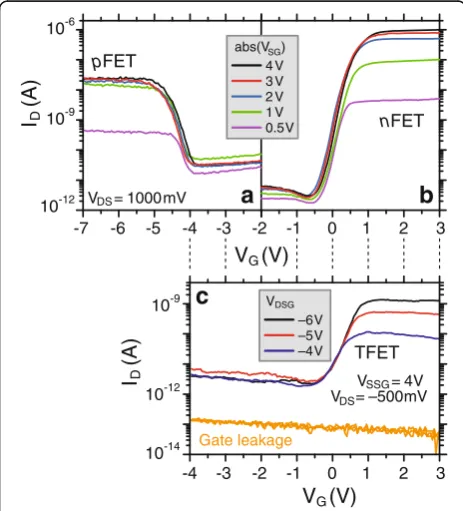
drain Schottky barriers (SB) for electron injection while suppressing hole injection at the same time. As a result, a unipolar device behavior is expected in contrast to the usually observed ambipolar behavior of WSe2transistors. Applying positive voltage to the center gate, i.e., the actual gate of the device (denoted with VG in the following), yields a lowering of the bands in the gate-controlled re-gion (G) and switches the device on. The described mech-anism can be employed similarly to realize apFET device (i.e., a p-p doping profile) by applying VSG< 0,VG< 0 (cf. Fig. 3d). Figure 4 displays transfer characteristics of a WSe2with a thickness ofdWSe2= 3 nm determined by AFM. The source-drain bias (VDS) is constant at 1 V and the various curves presented are from different side-gate voltages. Then-doping (Fig. 4a) leads to an increase of the drain current up to an Ion/Ioffratio of >3 × 10⁵at VSG= 4 V. As already mentioned above, apFET device is realized forVSG< 0,VG< 0. In this case, we find anIon/Ioffratio of ~103 at VSG=−4 V (cf. Fig. 4b). The ~100× larger n-current in comparison to the p-current (as well as the larger leakage current on the pFET compared to the nFET) is attributed to the influence of the nickel contacts, which were shown to be slightly more n-type [7, 30]. The subthreshold swings are 180 mV/dec (nFET) and 240 mV/dec (pFET), respectively. Note, that the current for large positive (n-type device) and negative (p-type device) gate voltages VG saturates, and current flow is then limited by the injection
a
after exfoliation2 nm
6 nm
8 nm
c
after contactingb
simulationd
AFM surface profile 0 10 20 30 40 50 60nm of W Se2
on 7 nm Al O / Al2 3
thin flakes
10µm
(I.) (III.)
(II.) (I.)
(II.)
(III.)
(I.)
source contact
Ni
Ni
drain contact
SSG G DSG
DSG
SSG G
source
drain
Fig. 2Fabrication process of WSe2devices on the LOCOS BTG structure:aExfoliation of WSe2flakes on the structure,bvisibility simulation,cfabrication of
[image:3.595.57.539.85.353.2]through the source-side SB. Since the tunneling prob-ability is a function of the barrier height (0.54 and 0.74 eV in the case of electron and hole injection, res-pectively) and effective mass (0.34 and 0.44 m0for elec-trons and holes, respectively), a different modulation of
the tunneling probability through the SB is obtained for then-type and thep-type [30]. As a result, the side-gates have considerably less impact on the SB in thep-type de-vice which is reflected in the drain current forabs(VSG)> 2 Vthat hardly changes anymore.
In addition, for this device we are also able to set up a TFET device configuration with an n-type source and a p-type drain contact using VDS=−500 mV,VSSG= 4 V, VDSG<−4 V. As displayed in Fig. 4c, the gate leakage current in the TFET device configuration is at least 30× lower than the drain current. It is important to note that usually temperature-dependent measurements of the off-state are used to demonstrate TFET behavior. How-ever, in the present case, we were able to demonstraten -and p-type device behavior proving that a conduction-/ valence-band profile appropriate for TFETs can be ad-justed using the BTG. And since gate leakage can be neglected, we ascribe the exponential increase of current aroundVG= 0 V to band-to-band tunneling. This is also consistent with the fact that increasingly negative DSG voltages improve the band-to-band tunneling probability (by increasing the electric field at the G/DSG junction) while at the same time hinder thermionic transport due to an increased potential barrier carriers from drain have to overcome.
The Ion/Ioff ratio is ~4.5 × 10²at VDSG=−6 V, and the inverse subthreshold slope is S≈366 mV/dec. This ra-ther large value is due to the fact that overpolishing dur-ing the CMP fabrication process leads to a G-SG insulation of approximately dG-SG= 90 nm (cf. Fig. 1f ). Interpreting the band-to-band tunneling barrier as a SB, the expected inverse subthreshold slope can be computed V (V)G
I
(A)
D
4 V 3 V 2 V 1 V 0.5V
abs(V )SG
VDS= 1000mV
pFET
nFET
–6V –5V –4V
VDSG
TFET
VSSG= 4V
VDS= –500mV
Gate leakage
10-6
10-9
10-12
-7 -6 -5 -4 -3 -2 -1 0 1 2 3
-4 -3 -2 -1 0 1 2 3 10-9
10-12
10-14
I
(A)
D
V (V)G
a
b
c
Fig. 4Transfer characteristics of a ~3-nm-thick WSe2flake,
electrostatically doped to function asaannFET (VSG> 0) andbpFET
(VSG< 0). Note that the gate leakage current is always less than 10−12A;
for clarity, it is not shown inaandb.cDevice in TFET configuration
S
D n–n doping
p –p doping S
D
S
D
S
D n–p doping
no doping
“SSG” “G” “DSG”
a
b
c
d
Fig. 3Schematic band diagrams for electrostatically dopednFET,pFET, and TFET devices.aIllustration in the case of zero gate voltage in source,
[image:4.595.59.540.88.289.2] [image:4.595.57.289.428.684.2]with S≈kBT=q⋅lnð Þ10 1=2þ1=3⋅
ffiffiffiffiffiffiffiffiffiffiffi dG‐SG
p
dWSe2
[35, 36] yielding S≈358 mV/dec. This agrees very well with the experimental value showing that it is the G-SG insulation that limits the performance of the device withn-pdoping. Further improvements in the BTG fabrication will there-fore allow a substantial performance increase. In addition, the channel layer thickness, i.e., the WSe2flake thickness, plays a prominent role for the device performance of the TFETs [15, 16]. Indeed, in the case of a device with an ap-proximately 13-nm-thick WSe2flake, we found a strongly deteriorated TFET behavior (not shown here). In turn, a thinner flake should allow substantial improvements in terms of inverse subthreshold slope and on-state current in the TFET configuration.
From the mere consideration of the band gap of WSe2, we would expect a larger on/off current ratio with significantly smaller off-state currents. However, an ex-planation of this phenomenon requires a detailed simu-lation of the device structure including the fact that in the present device, the distribution of the injected current among the various WSe2layers [37] depends on the different (side-) gate voltages. We therefore speculate that band-to-band tunneling as well as interlayer coup-ling is responsible for the electrical behavior of the de-vice in TFET configuration.
Conclusions
We demonstrated that electrostatic doping allows the realization of a tunable device to function as nFET, pFET, and as band-to-band tunnel FET on the same WSe2flake. Based on a BTG substrate, we were able to dope source and drain regions independently to create the required band-profiles for the three transistor con-figurations. An optimized triple-gate configuration thus enables to dynamically switch transistors from conven-tional (nFET,pFET) to low-power (TFET) operation.
Acknowledgments
The authors would like to thank the cleanroom teams of the University of Notre Dame and TU Dortmund University for their support. The partial financial support by the German Research Foundation (DFG) (grant number KN545/3-2) is acknowledged.
Authors’contributions
MM carried out the bulk part of the device fabrication and wrote the paper. RS, SF and HX carried out device processing and did electrical
measurements together with MM. KK and MM developed tha modified LOCOS process. UK and MM developed the chemical mechanical polishing process. AS, JA and JK provided device physics know-how and helped inter-preting the experimental data. JK developed the layout of the BTG structures, provided processing know-how and revised the manuscript. All authors read and approved the final manuscript.
Competing interests
The authors declare that they have no competing interests.
Author details
1Intelligent Microsystems Chair, TU Dortmund, Emil-Figge-Str. 68, 44227 Dortmund, Germany.2Birck Nanotechnology Center, Purdue University, 1205
W. State Street, West Lafayette, IN 47907, USA.3Department of Electrical Engineering, University of Notre Dame, Notre Dame, IN 46556, USA.4Institute of Semiconductor and Microsystems Technology, TU Dresden, 01062 Dresden, Germany.5Institute of Semiconductor Electronics, RWTH Aachen University, Sommerfeldstr. 24, 52074 Aachen, Germany.6Present address: Infineon Technologies, Siemensstrasse 2, 9500 Villach, Austria.
Received: 18 July 2016 Accepted: 8 November 2016
References
1. Jena D (2013) Tunneling transistors based on graphene and 2-D crystals. Proc IEEE 101:1585–1602
2. Fiori G, Bonaccorso F, Iannaccone G, Palacios T, Neumaier D, Seabaugh A, Banerjee S, Colombo L (2014) Electronics based on two-dimensional materials. Nat Nanotechnol 9:768–779
3. Sik Hwang W, Remskar M, Yan R, Protasenko V, Tahy K, Doo Chae S, Zhao P, Konar A, Xing HG, Seabaugh A, Jena D (2012) Transistors with chemically synthesized layered semiconductor WS2exhibiting 105room temperature
modulation and ambipolar behavior. Appl Phys Lett 101:013107-1–3 4. Radisavljevic B, Radenovic A, Brivio J, Giacometti V, Kis A (2011) Single-layer
MoS2transistors. Nat Nanotechnol 6:147–150
5. Fathipour S, Remskar M, Varlec A, Ajoy A, Yan R, Vishwanath S, Rouvimov S, Hwang WS, Xing HG, Jena D, Seabaugh A (2015) Synthesized multiwall MoS2nanotube and nanoribbon field-effect transistors. Appl Phys Lett 106:
022114 1–3
6. Fathipour S, Ma N, Hwang WS, Protasenko V, Vishwanath S, Xing HG, Xu H, Jena D, Appenzeller J, Seabaugh A (2014) Exfoliated multilayer MoTe2
field-effect transistors. Appl Phys Lett 105:192101-1–3
7. Das S, Appenzeller J (2013) WSe2field effect transistors with enhanced
ambipolar characteristics. Appl Phys Lett 103:103501-1–3
8. Fathipour S, Hwang WS, Kosel T, Xing HG, Haensch W, Jena D, Seabaugh A (2013) Exfoliated MoTe2field-effect transistor. Dev Res Conf (DRC) 71:115–116
9. Appenzeller J, Lin Y-M, Knoch J, Avouris P (2004) Band-to-band tunneling in carbon nanotube field-effect transistors. Phys Rev Lett 93:196805-1-4 10. Bhuwalka KK, Born M, Schindler M, Schmidt M, Sulima T, Eisele I (2006)
P-channel tunnel field-effect transistors down to sub-50 nm P-channel lengths. J J Appl Phys 45:3106
11. Boucart K, Ionescu AM (2007) Double-gate tunnel FET with high-k gate dielectric. IEEE Trans Electron Dev 54:1725–1733
12. Knoll L, Schmidt M, Zhao Q, Trellenkamp S, Schaefer A, Bourdelle K, Mantl S (2013) Si tunneling transistors with high on-currents and slopes of 50 mV/dec using segregation doped NiSi2 tunnel junctions. Solid-State Electron 84:211–215 13. Ionescu A, Riel H (2011) Tunnel field-effect transistors as energy-efficient
electronic switches. Nature 479:329–337
14. Seabaugh AC, Zhang Q (2010) Low-voltage tunnel transistors for beyond CMOS logic. Proc IEEE 98:2095–2110
15. Sandow C, Knoch J, Urban C, Zhao Q-T, Mantl S (2009) Impact of electrostatics and doping concentration on the performance of silicon tunnel field-effect transistors. Solid-State Electron 53:1126–1129 16. Knoch J (2009) Optimizing tunnel FET performance—impact of device
structure, transistor dimensions and choice of material. Internat. Symp. VLSI Technol., Syst. Appl VLSI-TSA. 45–46
17. Gong Y, Liu Z, Lupini AR, Shi G, Lin J, Najmaei S, Lin Z, Elias AL, Berkdemir A, You G, Terrones H, Terrones M, Vajtai R, Pantelides ST, Pennycook SJ, Lou J, Zhou W, Ajayan PM (2014) Band gap engineering and layer-by-layer mapping of selenium-doped molybdenum disulfide. Nano Lett 14:442–449 18. Kiriya D, Tosun M, Zhao P, Kang JS, Javey A (2014) Air-stable surface charge
transfer doping of MoS2by benzyl viologen. J Am Chem Soc 136:7853–7856
19. Knoch J, Mantl S, Appenzeller J (2007) Impact of the dimensionality on the performance of tunneling FETs: bulk versus one-dimensional devices. Solid-State Electron 51:572–578
20. Gnani E, Gnudi A, Reggiani S, Baccarani G (2013) Drain-conductance optimization in nanowire TFETs by means of a physics-based analytical model. Solid-State Electron 84:96–102
21. Knoch J (2016) Chapter eight—nanowire tunneling field-effect transistors. Semicond Semimet 94:273–295
22. Appenzeller J, Knoch J, Bjork MT, Riel H, Schmid H, Riess W (2008) Toward nanowire electronics. IEEE Trans Electron Dev 55:2827–2845
Raman scattering in an electrochemically top-gated graphene transistor. Nat Nanotechnol 3:210–215
24. Zhang Y, Tang T-T, Girit C, Hao Z, Martin M, Zettl A, Crommie M, Shen Y, Wang F (2009) Direct observation of a widely tunable bandgap in bilayer graphene. Nature 459:820–823
25. Knoch J, Chen Z, Appenzeller J (2012) Properties of metal-graphene contacts. IEEE Trans Nanotechnol 11:513–519
26. Xu H, Fathipour S, Kinder EW, Seabaugh AC, Fullerton-Shirey SK (2015) Reconfigurable ion gating of 2H-MoTe2field-effect transistors using
poly(ethylene oxide)-CsClO4solid polymer electrolyte. ACS Nano 9:4900–4910
27. Wang Z, Wang F, Yin L, Huang Y, Xu K, Wang F, Zhan X, He J (2016) Electrostatically tunable lateral MoTe2 p-n junction for use in high-performance optoelectronics. Nanoscale 27:5534–5540
28. Baugher BWH, Churchill HOH, Yang Y, Jarillo- Herrero P (2014) Optoelectronic devices based on electrically tunable p–n diodes in a monolayer dichalcogenide. Nat Nanotechnol 9:262–267
29. Heinzig A, Slesazeck S, Kreupl F, Mikolajick T, Weber WM (2012) Reconfigurable silicon nanowire transistors. Nano Lett 12:119–124 30. Appenzeller J, Zhang F, Das S, Knoch J (2016) Transition metal
dichalcogenide Schottky barrier transistors: a device analysis and material comparison. In "2D Materials for Nanoelectronics", CRC Press, Taylor and Francis Group, Boca Raton, p. 207–240
31. Mueller MR, Gumprich A, Schuette F, Kallis K, Kuenzelmann U, Engels S, Stampfer C, Wilck N, Knoch J (2014) Buried triple-gate structures for advanced field-effect transistor devices. Microelectron Engin 119:95–99 32. Mueller MR, Kallis K, Menzel S, Kuenzelmann U, Petrov I, Knoch J (2014)
Tackling hillocks growth after aluminum CMP. Internat. Conf. Planarization/ CMP Technol. (ICPT). 129–132
33. Kuenzelmann U, Mueller MR, Kallis KT, Schuette F, Menzel S, Engels S, Fong J, Lin C, Dysard J, Bartha JW, Knoch J (2012) Chemical-mechanical planarization of aluminium damascene structures, Internat. Conf. Planarization/CMP Technol. (ICPT); 1–6
34. Mueller MR, Gumprich A, Ecik E, Kallis KT, Winkler F, Kardynal B, Petrov I, Kunze U, Knoch J (2015) Visibility of two-dimensional layered materials on various substrates. J Appl Phys 118:145305
35. Knoch J, Zhang M, Mantl S, Appenzeller J (2006) On the performance of single-gated ultrathin-body SOI Schottky-barrier MOSFETs. IEEE Trans Electron Dev 53:1669–1674
36. Das S, Prakash A, Salazar R, Appenzeller J (2014) Toward low-power electronics: tunneling phenomena in transition metal dichalcogenides. ACS Nano 8:1681–1689
37. Das S, Appenzeller J (2013) Where does the current flow in two-dimensional layered systems? Nano Lett 13:3396–3402
Submit your manuscript to a
journal and benefi t from:
7Convenient online submission
7Rigorous peer review
7Immediate publication on acceptance
7Open access: articles freely available online
7High visibility within the fi eld
7Retaining the copyright to your article