Sari, B.A. and Koster, E.H.W. and Derakhshan, Nazanin (2017) The effects
of active worrying on working memory capacity. Cognition and Emotion 31
(5), pp. 995-1003. ISSN 0269-9931.
Downloaded from:
Usage Guidelines:
Please refer to usage guidelines at or alternatively
For Peer Review Only
Running head: EFFECTS OF WORRY ON WORKING MEMORY
The effects of active worrying on working memory capacity
Berna A. Sari¹, Ernst H. W. Koster¹, and Nazanin Derakshan²
1
University of Ghent
2
Birkbeck, University of London
* Corresponding author: Berna Ayse Sari, Ghent University, Department of Experimental
Clinical and Health Psychology, Henri Dunantlaan 2, B-9000 Ghent, Belgium. Tel: +0032 09 264
86 56, fax: +0032 09 264 64 89, e-mail: [email protected]
* Corresponding author:: Ernst H. W. Koster, Ghent University, Department of Experimental
Clinical and Health Psychology, Henri Dunantlaan 2, B-9000 Ghent, Belgium. Tel: +0032 09 264
64 46, fax: +0032 09 264 64 89, e-mail: [email protected]
Nazanin Derakshan, Birkbeck, University of London, Department of Psychological Sciences,
Malet Street, London WC1E 7HX, UK. Tel: +44 (0) 207 6316538, fax: +44 (0) 207 6316132,
e-mail: [email protected]
This work was supported by Fund for Scientific Research-Flanders (FWO, #G094012N) awarded
to Ernst H. W. Koster, Gilles Pourtois, & Nazanin Derakshan.
For Peer Review Only
Abstract
According to the Attentional Control Theory of Anxiety (Eysenck, Derakshan, Santos & Calvo,
2007), worry, a crucial component of anxiety, impairs task performance outcome(s) through its
direct effect on working memory capacity (WMC), by using up the limited resources available
for performance thus reducing attentional control. We tested this hypothesis in the current study
by examining the causal influence of active worrying on WMC in a sample of undergraduate
university students assigned either to a worry condition (n = 32) in which state worry was
induced or to a non-worry control condition (n = 32). Participants performed a change detection
task before and after the worry/control manipulation. Mediation analyses showed that the level of
self-reported worry mediated the effects of condition on change in WMC as demonstrated by the
significant indirect effect of worry and the resulting non-significant direct effect of condition on
change in WMC. Similar results were obtained when using state anxiety measures as mediating
factors. Results of the current study are amongst the first to demonstrate that worry impairs
WMC and as such have important implications for understanding the impact of worry in
educational as well as clinical outcomes.
Keywords: anxiety, worry, working memory capacity, change detection, attentional control
For Peer Review Only
Introduction
Worry has been described as a state of experiencing uncontrollable, apprehensive, and
intrusive negative thoughts about the future (Borkovec, Robinson, Pruzinsky, & DePree, 1983). It
is considered as a main cognitive characteristic of anxiety (Eysenck, 1982; Mathews, 1990),
believed to hijack important attentional resources from a limited working memory capacity
(WMC) system, leaving fewer resources available for task demands, thus reducing attentional
control (e.g., Derakshan & Eysenck, 2009; Berggren & Derakshan, 2013; Hirsch & Mathews,
2012). According to the attentional control theory of anxiety (ACT; Eysenck, Derakshan, Santos,
& Calvo, 2007), worry is a key mechanism explaining why efficient processing of the main
executive functions of working memory are hampered in anxiety, leading to impaired or
inefficient task performance.
While worry provides a mechanism by which the effects of anxiety on cognitive
performance outcomes can be explained, there have been relatively few studies examining the
possible causal influence of worry on cognitive performance. Hayes, Hirsch, and Mathews (2008)
assessed the effects of worrying on performance using a random key-pressing task measuring
attentional control. During this task, participants were asked to press any one of 15 buttons
available upon hearing a beep. Randomness of button press was interpreted as a measure of
attentional control since producing a more novel and random sequence requires a greater level of
attention as compared to following a regular and practiced sequence. In that study, participants
were assigned to a ‘worry’ condition where they were instructed to think of a personally relevant
worrying concern and a ‘control’ condition where they were asked to think of a personally
relevant positive future event while completing this task. Hayes et al. (2008) found that high trait
worry was associated with fewer random button presses. Furthermore, high trait worriers
For Peer Review Only
produced less random sequences during the worry condition as compared to the control condition,
which was not the case for the low worriers. This latter result was consistent with the prediction
that state worry reduces processing efficiency, especially in individuals with trait characteristics
compatible with this thinking style (see Eysenck et al., 2007). This finding was replicated in a
sample of generalized anxiety disorder (GAD) patients (see Stefanopoulou, Hirsch, Hayes,
Adlam, & Coker, 2014) who conducted the same task with the addition of completing an n-back
working memory task first. In this study, working memory performance was also shown to be
affected with GAD participants performing worse on the n-back task than control subjects.
More recently, two studies have looked at how trait vulnerability to worry modulates
cognitive as well as neural processes related to attentional control. Stout, Shackman, Johnson and
Larson (2015) using an emotional working memory (WM) task in healthy participants assessed
the role of worry and anxiety in relation to working memory on filtering efficiency using an
emotional face change detection task with faces depicting threatening and neutral expressions. In
this task, participants were required to focus on the target faces and indicate if they had changed
in a subsequent recall phase while ignoring the distracter faces. Results of this study
demonstrated an increased filtering cost both for neutral and threat distracters in high trait
anxious individuals. Furthermore, trait worry also increased filtering costs but for the threat
related distractors only. In another study, using a modified version of the flanker task under low
and high working memory load, where angry and neutral facial expressions of emotions served as
distractors, Owens, Derakshan and Richards (2015) found that trait vulnerability to worry was
associated with a greater recruitment of the N2 ERP component upon the inhibition of distractors
with this neurophysiological effect being greater under high working memory load, providing
For Peer Review Only
support for the notion that trait worry reduces attentional control especially under conditions
where attentional resources compete to meet task demands.
Extending recent demonstrations that trait vulnerability to worry reduces processing
efficiency, the current study sought to establish that this effect can be explained through the
effect of worry on WMC. Recent theoretical accounts (see Shipstead, Lindsey, Marshall, & Engle,
2014) have argued that WMC, i.e., the efficacy by which goal relevant information is attended,
stored, and maintained while task irrelevant information is suppressed, is strongly related to
attentional control. This suggests that in line with former predictions of ACT, active worrying
should reduce WMC. To our knowledge, no study has directly examined the impact of active
worrying on WMC in an unselected population. However, this research question is key in gaining
a better understanding of how anxiety related impairments on cognitive performance in situations
such as examinations for example, where the efficient regulation of attentional control is needed
under competing task demands, could emerge. We assessed WMC using a modified visual
change detection task (CDT) with (neutral) shapes (Owens, Koster & Derakshan, 2013) that was
based on (Vogel, McCollough, & Machizawa, 2005). During this task, participants were
instructed to remember the orientation of shapes and monitor change occurring between the
sample display and the test display. In order to observe the influence of active worrying, we used
a worry manipulation similar to Hayes et al. (2008). In a between subjects design, participants
were asked to focus on either a worrisome concern (worry condition) or positive future event
(control condition). They performed the CDT before and after the manipulation. This enabled us
to test how active worrying causally influenced WMC. During the experiment, mood ratings in
response to worry were also obtained. We predicted that increased worrying would be related to
For Peer Review Only
impaired WMC with reductions or limited improvements in WMC post vs. pre manipulation for
the worry as compared to control condition.
Method
Participants
Sixty-four participants (27 male, 37 female) aged between 18-53 (M = 27, SD = 8) were
recruited via advertisements from the campus of Birkbeck University of London (N = 39) and
Ghent University (N = 25). They were compensated 5 GBP/5 Euro or given course credit for
their contribution. The first participant was randomly assigned to either the ‘Worry’ (N = 32) or a
‘Control’ (N = 32) condition and subsequent participants were assigned to the different
conditions alternately. Data from 10 participants were excluded either due to difficulties during
the manipulation (i.e., they could not think of a personally relevant worrisome future event, N =
3), poor accuracy on the change detection task (less than 50% accuracy, N = 4), high response
bias (false alarms more than 2.5 SD of the mean, N = 3), leaving a final sample of 54 individuals
(26 in the ‘Worry’ and 28 in the ‘Control’ condition).
Materials and Procedure
Questionnaires. Participants completed the trait and state anxiety scales of the STAI
(State Trait Anxiety Inventory; STAI; Spielberger, Gorsuch, Lushene, Vagg & Jacobs, 1983), the
trait worry (Penn State Worry Questionnaire; PSWQ; Meyer, Miller, Metzger, & Borkovec, 1990)
and the trait rumination scales (Ruminative Responses Scale, RRS; Nolen-Hoeksema & Morrow,
1991). During the experiment state worry and state anxiety were also assessed via 0 – 100 mm
visual analogue scales (VAS; 0 = not at all, 100 = extremely).
For Peer Review Only
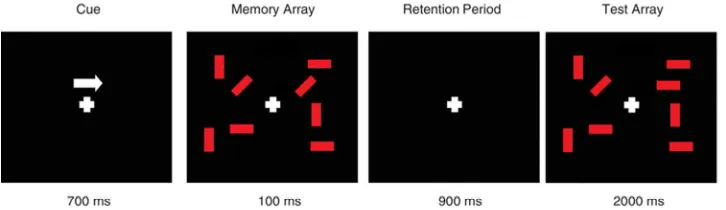
Change Detection Task. A schematic overview of the trial sequence is presented in
Figure 1. Each trial started with a fixation cross with an arrow above pointing either to the right
or left (700 ms). This arrow served as cue and participants were informed to attend to the side of
the screen indicated by this symbolic cue. Afterwards, either 2 or 4 rectangles appeared at the
right and left side of the screen for 100 ms (3° away from the fixation cross, within a region of 4°
x 7.2°; memory array). Participants were asked to memorize the orientation of the red rectangles
on the attended side. After a retention interval of 900 ms, the rectangles reappeared at the right
and left side of screen (test array). Participants were instructed to indicate whether the orientation
of one of the (four or two) red rectangles they had memorized had changed or not within a two
second interval, as accurately as possible.
The task included two item, four item, and distractor conditions. In the two item and four
item conditions, all rectangles were red in color while the distractor condition included two blue
rectangles as distractors in addition to the two red rectangles. In each condition, the rectangles
appeared on random positions with a minimum of 2° distance from each other. There were 4
possible orientations for the rectangles: vertical, horizontal, 45° left and 45° right tilted. All
possible conditions were randomly distributed within the task. There were 4 possible orientations
for the rectangles: vertical, horizontal, 45° left and 45° right tilted. Fitting these criteria, we had
98 stimuli set for the four item, 105 stimuli set for the two-item and 101 stimuli set for distractor
condition. The same stimuli set was not presented more than once during the task. All possible
conditions were randomly distributed within the task.
The task included four experimental blocks including 48 trials each (in half of the trials
orientation of a rectangle has changed and in the other half it remained the same). Participants
practiced the task until they reached an accuracy level of > 50% before starting the main
experimental trials.
For Peer Review Only
---
Insert Figure 1 here
---
Procedure. Participants first read and signed the consent form. Then, they completed
STAI-TA, PSWQ and RRS. Next, they performed the CDT, after which they provided mood
ratings using VAS on the extent to which they felt worried, relaxed, happy and anxious
(pre-manipulation). Afterwards, participants were assigned either to Worry or Control condition where
they were asked to think of a personally relevant future event (in line with Stefanopoulou et al.,
2014). In the Worry condition participants focused on a personal concern or a worrisome event,
whereas the Control condition participants focused on a positive event. Since worry is strongly
related to low self-esteem and beliefs about personal inadequacies (Davey & Levy, 1998), finding
a personally relevant future scenario was strongly emphasized. Next, participants were shortly
interviewed by the experimenter about these events for approximately 2 minutes. They were
asked to discuss the positive (control condition) or negative (worry condition) aspects of the
events they were focusing on. Once the interview was terminated, participants were told to
actively keep thinking about the future events they just described until the end of the experiment.
Then, mood ratings were taken for the second time (post-manipulation) alongside a question
about the personal relevance of the event they had described. In addition to the mood ratings,
participants also completed STAI-SA. Finally, they performed the CDT for the second time after
which mood ratings were assessed for the final time (after the task). In the end, participants were
asked to rate the frequency by which they had thought about the personal topic they had
described earlier.
For Peer Review Only
Data Analytic Approach. In order to assess performance on the CDT, we calculated
WMC scores via the widely used formula (Pashler, 1988): K = S x (H - F)/(1-F) where K (WMC)
is calculated as a function of S: the set size of the array, H: the observed hit rate and F: proportion
of false alarms. In keeping with Lee, Cowan, Vogel, Valle-Inclan and Hackley (2010) and Owens
et al. (2013), we calculated WMC for the 4-item condition, eliminating possible ceiling or floor
effects which can occur from two-item condition or distracter condition. In order to assess the
level of worry during the task performance, we averaged the VAS scores for the worry ratings
obtained after the manipulation (before starting CDT for the second time) and at the end of the
task to produce an average score of worry (worry level). Since worry is defined as a more verbal
and cognitive form of state anxiety (Mathews, 1990; Eysenck et al., 2007), we also calculated the
same index for the anxiety ratings (anxiety level). In addition, STAI-SA scores were also
included in our analysis. Strong correlations were observed amongst levels of worry, STAI-SA
and VAS measures of anxiety (worry and VAS anxiety, r(54) = .83, p < .001; worry and
STAI-SA, r(54) = .73, p < .001; VAS anxiety and STAI-SA, r(54) = .62, p < .001). Other VAS ratings
on relaxed mood and happiness were obtained to reduce the sole focus on anxiety which could
enhance anxious mood. Since the focus of the study was change in WMC as a function of the
worry manipulation, we calculated change scores in WMC by subtracting the scores at
pre-manipulation from the scores at post-pre-manipulation. Larger change in WMC scores indicated
improved performance at post-manipulation compared to pre-manipulation. Due to the variability
in responding to mood manipulation (cf. Grol, Koster, Bruyneel & De Raedt, 2014) further
analyses focused on the relationship between condition and WMC considering the level of worry
or anxiety.
For Peer Review Only
To test the main hypothesis, mediation analysis with condition as the independent variable,
worry level as the mediating (intervening) factor, and change in WMC as dependent variable was
conducted. Figure 2 depicts the tested model. In order to test the conditions of the mediation
model (Mathieu & Taylor, 2006), significance of the indirect effect (path ab), the total effect
(effect of condition on change in WMC scores without taking worry level into account (path c);
and the direct effect (i.e., effect of condition on WMC scores after considering worry level (path
c’) were investigated.
Significance of the indirect effect was tested using a bootstrapping approach (Preacher &
Hayes, 2008) via random resampling (Hayes, 2013). We estimated 10000 bias-corrected
bootstrap 94% confidence intervals, excluding 0 for the indirect effect to be significant.
Significance of the indirect effect was tested using a bootstrapping approach (Preacher &
Hayes, 2008) via random resampling (Hayes, 2013). We estimated 10000 bias-corrected
bootstrap 94% confidence intervals, excluding 0 for the indirect effect to be significant.
These settings were chosen to decrease the range of the confidence intervals, which
increases the stability of the results.1 Significance of total effect (path c) and direct effect (path
c’) were tested and reported via regression coefficients. Similar mediation analyses were repeated
with STAI-SA and VAS anxiety as intervening variables, separately. All mediation models were
controlled for heteroscedasticity. Analyses were conducted using IBM SPSS 19 and the macro
PROCESS 2.13.2 (Hayes, 2013).
---
Insert Figure 2 here
---
For Peer Review Only
Results
Condition Description
Participants in the Worry and Control condition did not differ from each other on
STAI-TA, PSWQ or RRS (all ts< 1, NS). There were no group differences in age (t < 1, NS) or gender
distribution (χ2 (1, N = 54) = .32, p = .57).
Mood induction Check
Mood ratings at the beginning of the experiment (pre-manipulation) were compatible
across condition groups, all ts< 1.2, NS. As expected, participants in the Worry condition were
more worried, less relaxed, more anxious, and less happy than in the Control condition (all ts >
4.5, all ps <.001) after the manipulation (post manipulation; see table 1 for descriptive statistics),
although there was substantial individual variability within conditions. Furthermore, the Worry
condition had higher STAI-SA scores (M = 48, SD = 9) relative to the Control condition (M = 36,
SD = 11); t(52) = 4.39, p < .001). Participants in the worry condition reported that the selected
future event was highly personal, and reported that on average they spent about 67% of the time
thinking about their personal topic at post manipulation. There were no condition differences in
ratings of relevance, t (52)= 1.38, p = .17, or on time spent thinking about their personal topic, t
< 1, NS. At the end of the experiment, participants in the Worry condition were still significantly
more worried, less relaxed, more anxious, and less happy compared to participants in the Control
condition: all ts > 3.7, all ps < .01 (see Table 1).
---
Insert Table 1 here
---
For Peer Review Only
Change Detection Task
The Worry and Control condition did not significantly differ from each other on WMC
prior to the experimental manipulation, t < 1, NS (Worry: M = 1.42, SD = .76; Control: M = 1.53,
SD = 1.05). Furthermore, participants did not differ from each other based on the location they
were recruited from (UK or Belgium) in terms of WMC at pre-manipulation, post-manipulation
or pre to post change scores (all ts < .1, NS).
Results of the bias-corrected bootstrapping procedure showed that the indirect effect of
condition on change in WMC via Worry was significant (path ab, b = -.41; boot 94% CI =
[-1.0295, -.0045]) with medium-to-large effect size (K2 = .18, boot 94% CI = [.0233, .4082];
Preacher & Kelley, 2011)2. The direct effect (path c’, b = .06, t(51) < 1) was not significant. The
total effect (path c, b = -.35, t(52) = -1.47, p = .15) did not reach significance. These results
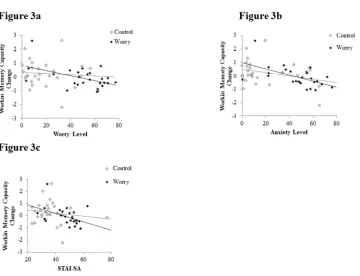
indicate that worry mediated the relationship between condition and change in WMC. Figure 3a
shows the relationship between the level of worry and the change in WMC in each condition.
Results of the bias-corrected bootstrapping procedure also showed significant indirect
effects of condition on change in WMC via VAS Anxiety level (path ab, b = -.48; boot 94% CI =
[-1.0190, -.1516] and via STAI-SA (path ab, b = -.26; boot 94% CI = [-.8396, -.0533] separately.
Both effects represented medium to large effect sizes (for VAS Anxiety, K2 = .24, boot 94% CI =
[.0788, .4486]; for STAI-SA, K2 = .14, boot 94% CI = [.0331, .3403]; Preacher & Kelley, 2011).
The direct effects were not significant in either of the analyses (path c’, all ts < 1, NS). Results
indicate that the level of state anxiety scores assessed via VAS anxiety and also STAI-SA
mediated the relationship between condition and WMC change (See figure 3b –for anxiety level-
For Peer Review Only
and 3c –for STAI-SA- for the relationship between state-anxiety and change on WMC in the
worry and control conditions separately).
It is noteworthy to mention that our mediation model did not fit the criteria of traditional
full mediation model where the total effect should be significant (Baron & Kenny, 1986).
However, recent theoretical approaches on mediation analyses (Mathieu & Taylor, 2006; Hayes,
2009) have offered new insights into the validity of mediation where the significance of the total
effect is no longer a prerequisite, usually referred to as an indirect effect model (Mathieu &
Taylor, 2006). In an indirect effect model, a significant indirect effect is expected while the direct
effect is not significant and the pre-requisite of the significance of the total effect is not required.
This model indicates that the independent variable influences the dependent variable only
through an intervening factor.
---
Insert Figure 3 here
---
Additional analysis
We also assessed the relationship between the time participants spent thinking about their
personal topic and change in WMC. In the worry condition, correlational analysis indicated a
negative relationship between these variables (r(26) = -.54, p < .01) suggesting that the time
participants spent thinking about their personal topics was associated with smaller improvements
in WMC. This relationship was not found in the control condition (r(28) = .08, p = .68). These
two correlation coefficients differed from each other significantly (Fisher’s z = 2.38, p < .05).
For Peer Review Only
Discussion
The purpose of the present study was to investigate the direct influence of active worry on
WMC. In keeping with the predictions of the ACT (Eysenck et al., 2007), active worry was
expected to reduce processing efficiency and lead to reduced WMC. The results were in line with
that prediction. Our mediation model found that levels of active worry mediated the relationship
between condition and changes in WMC indicating that worrying interfered with improvements
in WMC. Furthermore, the time participants spent thinking about their personal topic was also
related to smaller improvements in WMC in the worry condition. These results are among the
first to demonstrate a direct effect of active worrying on a measure of WMC and in this sense
have direct implications for theories of anxiety and worry (e.g., Eysenck et al., 2007; Berggren &
Derakshan, 2013; Hirsch & Mathews, 2012) that attempt to understand the main mechanism by
which anxiety related effects impair performance outcome(s). Accordingly, our results showed
that worrying likely depletes resources of working memory that are needed for efficient task
performance providing the first direct support for one of the main predictions of the ACT
(Derakshan & Eysenck, 2009).
In recent research, it has been demonstrated that high levels of trait susceptibility to worry
are associated with reduced attentional control in the presence of threat related distractors (Stout
et al., 2015; Owens et al., 2015) with other work showing that active worrying can have a
detrimental effect on working memory performance in a healthy population (Hayes et al., 2008)
as well as in GAD patients (Stefanopoulou et al., 2014). Our results extend these findings by
shedding light on a mechanism by which worrying can adversely affect working memory through
its influence on WMC. Interestingly, in line with previous work (e.g., Stout et al., 2015) our
results showed that higher levels of anxiety were also related to greater detriments on WMC.
For Peer Review Only
Impaired WMC using the CDT in anxiety has also been documented elsewhere (Qi, Chen,
Hitchman, Zeng, Ding, Li, & Hu, 2014). In this study, Qi et al. (2014) observed reduced WMC at
the neurophysiological level for high anxious participants suggesting disrupted processing
efficiency by anxiety. This result was more evident when the task was more difficult and higher
WMC was required. The authors explained these results in terms of elevated worry due to a
stressful situation (task difficulty) in high anxious individuals.
Understanding the influence of worry on processing efficiency is valuable for educational
as well as clinical reasons. An important implication of these results can be found in academic
and evaluative conditions where worrying can have serious and severe (deleterious) effects on
cognitive performance outcome(s) through its direct depletion of WMC leading to adverse
consequences on academic achievement levels that are dependent upon WMC (Owens,
Stevenson, Hadwin, & Norgate, 2012). Accordingly, results of the current study show that
worrying can harm WMC and in situations such as academic evaluations where WMC resources
are needed for task demands it can exert a direct detrimental effect on outcomes. Secondly,
excessive worrying is one of the main characteristics of mood and anxiety disorders (Hirsch &
Mathews, 2012; Nolen-Hoeksema, 1991). Hence, clarifying the role of worry on processing
efficiency and WMC would help to gain greater insight into the cognitive risk factors of onset
and maintenance of these disorders. According to recent models of working memory (see
Shipstead et al., 2014; Gazzaley & Nobre, 2012), WMC and attentional control are highly
inter-linked at a conceptual as well as a measurement level. Given the wealth of accumulating
evidence documenting attentional control deficits in anxiety, the investigation that reduced WMC
can explain the onset and recurrence of anxiety related symptomatology is imperative to
developing clinical models of anxiety that are keen to understand the causal mechanisms behind
For Peer Review Only
anxiety related disorders. In this respect, there is an increasing interest in targeting working
memory through adaptive cognitive training regimes meant to establish not only plasticity
induced changes in cognitive function (Owens et al., 2013) but also training-dependent
reductions in anxious symptomatology over time (e.g., Sari, Koster, Pourtois, & Derakshan,
2015). The current findings motivate the targeting of WMC to reduce the effects of worry related
thoughts on a wide range of behavioral outcomes.
The present study established that worrying can cause disruptions to WMC. Interestingly,
condition did not influence WMC directly but through the levels of state worry and anxiety
implying the importance of individual differences in emotional reactivity. This might be related
to trait factors like trait anxiety. However, the current study did not investigate the role trait
worry/anxiety. In a related manner, given the vast evidence on attentional bias towards negative
emotional stimuli being conceived as a well-known vulnerability factor for anxiety (Bar-Haim,
Lamy, Pergamin, Bakermans-Kranenburg, & Van Ijzendoorn, 2007) active worrying might be
related to increased attentional bias towards threat, as well as hypervigilance for threat (see
Eysenck, 1992) leading in turn to detriments to performance. To this end, future studies are
recommended to examine how worrying can increase attentional bias for threat through reducing
WMC. Furthermore, here we found that both state anxiety and worry were related to impairments
in working memory. Since worry is described as a cognitive component of anxiety (Mathews,
1990), it is not surprising that increased level of worry led to elevated anxiety and similar results
were observed both for worry and anxiety. Given the high correlation between worry and anxiety
it is impossible to conclude that the effect observed on WMC is specific only for worry. Thus,
although this study was framed in terms of worry capturing attentional resources and impairing
working memory storage, other mechanisms could also be at play. For instance, anxiety or
For Peer Review Only
heightened arousal may have an influence on working memory as increased anxious arousal was
associated with impaired spatial working memory (Shackman, Sarinopoulous, Maxwell,
Pizzagalli, Lavric, & Davidson, 2006; Lavric, Rippon & Gray, 2003). Future studies could focus
on this distinction in order to understand the unique role of worry on working memory in
situations where anxiety and worry are less entangled. Another limitation of the current study was
limited sample size. In order to obtain stable confidence intervals in our sample size, the
confidence level we used in mediation analyses needed to be re-adjusted.
In conclusion, the current study provides further evidence that worrying can reduce WMC.
This suggests a mechanism by which the detrimental effects of anxiety and worry on
performance outcome can be explained.
For Peer Review Only
References
Bar-Haim, Y., Lamy, D., Pergamin, L., Bakermans-Kranenburg, M. J., & Van Ijzendoorn, M.
H. (2007). Threat-related attentional bias in anxious and nonanxious individuals: a
meta-analytic study. Psychological bulletin, 133(1), 1.
Baron, R. M., & Kenny, D. A. (1986). The moderator–mediator variable distinction in social
psychological research: Conceptual, strategic, and statistical considerations. Journal of
personality and social psychology, 51(6), 1173.
Berggren, N., & Derakshan, N. (2013). Attentional control deficits in trait anxiety: why you see
them and why you don’t. Biological Psychology, 92(3), 440-446.
Borkovec, T. D., Robinson, E., Pruzinsky, T., & DePree, J. A. (1983). Preliminary exploration
of worry: Some characteristics and processes. Behaviour research and therapy, 21(1),
9-16.
Davey, G. C., & Levy, S. (1998). Catastrophic worrying: Personal inadequacy and a
perseverative iterative style as features of the catastrophizing process. Journal of
Abnormal Psychology, 107(4), 576.
Derakshan, N., & Eysenck, M. W. (2009). Anxiety, processing efficiency, and cognitive
performance: New developments from attentional control theory. European
Psychologist, 14(2), 168-176.
Eysenck, M. (1982). Attention and arousal: Cognition and performance. Springer Science &
Business Media.
For Peer Review Only
Eysenck, M. W., Derakshan, N., Santos, R., & Calvo, M. G. (2007). Anxiety and cognitive
performance: attentional control theory. Emotion, 7(2), 336.
Gazzaley, A., & Nobre, A. C. (2012). Top-down modulation: bridging selective attention and
working memory. Trends in cognitive sciences, 16(2), 129-135.
Grol, M., Koster, E. H. W., Bruyneel, L., & De Raedt, R. (2014). Effects of positive mood on
attention broadening for self-related information. Psychological research, 78(4),
566-573.
Hayes, A. F. (2009). Beyond Baron and Kenny: Statistical mediation analysis in the new
millennium. Communication monographs, 76(4), 408-420.
Hayes, A. F. (2013). Introduction to mediation, moderation, and conditional process analysis:
A regression-based approach. Guilford Press.
Hayes, S., Hirsch, C., & Mathews, A. (2008). Restriction of working memory capacity during
worry. Journal of abnormal psychology, 117(3), 712.
Hirsch, C. R., & Mathews, A. (2012). A cognitive model of pathological worry. Behaviour
research and therapy, 50(10), 636-646.
Lavric, A., Rippon, G., & Gray, J. R. (2003). Threat-evoked anxiety disrupts spatial working
memory performance: an attentional account. Cognitive therapy and research, 27(5),
489-504.
Lee, E-Y., Cowan, N., Vogel, E., Rolan, T., Valle-Inclan, F., & Hackley, S. (2010). Visual
working memory deficits in patients with Parkinson’s disease are due to both reduced
For Peer Review Only
storage capacity and impaired ability to filter out irrelevant information. Brain, 133,
2677–2689. doi: 10.1093/brain/awq197.
Mathews, A. (1990). Why worry? The cognitive function of anxiety. Behaviour research and
therapy, 28(6), 455-468.
Mathieu, J. E., & Taylor, S. R. (2006). Clarifying conditions and decision points for
mediational type inferences in organizational behavior. Journal of Organizational
Behavior, 27(8), 1031-1056.
Meyer, T. J., Miller, M. L., Metzger, R. L., & Borkovec, T. D. (1990). Development and
validation of the penn state worry questionnaire. Behaviour research and therapy,
28(6), 487-495.
Nolen-Hoeksema, S. (1991). Responses to depression and their effects on the duration of
depressive episodes. Journal of abnormal psychology, 100(4), 569.
Nolen-Hoeksema, S., & Morrow, J. (1991). A prospective study of depression and
posttraumatic stress symptoms after a natural disaster: the 1989 Loma Prieta
Earthquake. Journal of personality and social psychology, 61(1), 115.
Owens, M., Derakshan, N., & Richards, A. (2015). Trait Susceptibility to Worry Modulates the
Effects of Cognitive Load on Cognitive Control: An ERP Study.
Owens, M., Koster, E. H. W., & Derakshan, N. (2013). Improving attention control in
dysphoria through cognitive training: Transfer effects on working memory capacity and
filtering efficiency. Psychophysiology, 50(3), 297-307.
For Peer Review Only
Owens, M., Stevenson, J., Hadwin, J. A., & Norgate, R. (2012). Anxiety and depression in
academic performance: An exploration of the mediating factors of worry and working
memory. School Psychology International, 33(4), 433-449.
Pashler, H. (1988). Familiarity and visual change detection. Perception & psychophysics, 44(4),
369-378.
Preacher, K. J., & Hayes, A. F. (2008). Asymptotic and resampling strategies for assessing and
comparing indirect effects in multiple mediator models. Behavior research methods,
40(3), 879-891.
Preacher, K. J., & Kelley, K. (2011). Effect size measures for mediation models: quantitative
strategies for communicating indirect effects. Psychological methods, 16(2), 93.
Qi, S., Chen, J., Hitchman, G., Zeng, Q., Ding, C., Li, H., & Hu, W. (2014). Reduced
representations capacity in visual working memory in trait anxiety. Biological
psychology, 103, 92-99.
Sari, B. A., Koster, E. H. W., Pourtois, G., & Derakshan, N. (2015). Training working memory
to improve attentional control in anxiety: A proof-of-principle study using behavioral
and electrophysiological measures. Biological Psychology.
Shackman, A. J., Sarinopoulos, I., Maxwell, J. S., Pizzagalli, D. A., Lavric, A., & Davidson, R.
J. (2006). Anxiety selectively disrupts visuospatial working memory. Emotion, 6(1), 40.
Shipstead, Z., Lindsey, D. R., Marshall, R. L., & Engle, R. W. (2014). The mechanisms of
working memory capacity: Primary memory, secondary memory, and attention
For Peer Review Only
control. Journal of Memory and Language, 72, 116-141.
Spielberger, C. D., Gorsuch, R. L., Lushene, R., Vagg, P. R., & Jacobs, G. A. (1983). Manual
for the State-Trait Anxiety Inventory. Palo Alto, CA: Consulting Psychologists Press.
Stefanopoulou, E., Hirsch, C. R., Hayes, S., Adlam, A., & Coker, S. (2014). Are attentional
control resources reduced by worry in generalized anxiety disorder?. Journal of
abnormal psychology, 123(2), 330.
Stout, D. M., Shackman, A. J., Johnson, J. S., & Larson, C. L. (2015). Worry is associated with
impaired gating of threat from working memory. Emotion, 15(1), 6.
Vogel, E. K., McCollough, A. W., & Machizawa, M. G. (2005). Neural measures reveal
individual differences in controlling access to working memory. Nature, 438(7067),
500-503.
For Peer Review Only
Acknowledgements
We would like to express our thanks to Gilles Pourtois and Igor Marchetti for their comments on
an earlier version of the manuscript.
For Peer Review Only
Table caption
Table 1. Mean VAS scores at pre-manipulation, post-manipulation and at the end of the task for
Worry and Control conditions. SDs are reported in parenthesis.
For Peer Review Only
Figure captions
Figure 1. Example of a 4-item condition in a change trial. Participants are instructed to remember
the orientations of the rectangles, and respond during the test array to indicate whether a change
occurred or not.
Figure 2. Theoretical diagram for indirect, total, and direct effects of condition on change in
working memory capacity with either WorryMean, AnxietyMean or STAI-SA as an intervening
variable.
Figure 3a. Relationship between the level of worry and the change in WMC in each condition.
Figure 3b. Relationship between the level of anxiety and the change in WMC in each condition.
Figure 3c. Relationship between STAI-SA scores and the change in WMC in each condition.
For Peer Review Only
Footnotes
Footnote 1. Although bootstrapping is a recommended method that is also robust in smaller
sample sizes, in our study the upper-lower bounds of the confidence intervals varied slightly
upon repetition of the analyses. Increasing the number of bootstrap samples is one of the
ways to overcome this problem (Hayes, 2013). Hence, we used 10000 bias-corrected
bootstrap while 5000 is usually an acceptable number. Furthermore, we slightly decreased
the confidence interval to 94% from 95%. As the level of confidence decreases, the gap
between the upper and lower bound of the confidence interval gets smaller.
Footnote 2. Mediation analyses with condition as an independent variable, change scores in
working memory capacity as a dependent variable and the level of worry as intervening factor in
the distractor condition (b = -.0580; boot 94% CI = [-.3724, .1774]) and two-item condition (b =
-.1227; boot 94% CI = [-.2860, 0140]) did not lead to significant indirect effects.
For Peer Review Only
Table 1. Mean VAS scores at pre-manipulation, post-manipulation and at the end of the task for Worry and Control conditions. SDs are reported in parenthesis.
254x190mm (96 x 96 DPI)
For Peer Review Only
[image:29.612.118.481.175.280.2]
Figure 1. Example of a 4-item condition in a change trial. Participants are instructed to remember the orientations of the rectangles, and respond during the test array to indicate whether a change occurred or
not.
254x190mm (96 x 96 DPI)
For Peer Review Only
[image:30.612.184.413.161.329.2]
Figure 2. Theoretical diagram for indirect, total, and direct effects of condition on change in working memory capacity with either WorryMean, AnxietyMean or STAI-SA as an intervening variable.
254x190mm (96 x 96 DPI)
For Peer Review Only
[image:31.612.124.484.120.396.2]
Figure 3a. Relationship between the level of worry and the change in WMC in each condition.\r\nFigure 3b. Relationship between the level of anxiety and the change in WMC in each condition.\r\nFigure 3c.
Relationship between STAI-SA scores and the change in WMC in each condition.\r\n 254x190mm (96 x 96 DPI)