IJPSR (2019), Volume 10, Issue 9 (Research Article)
Received on 30 December 2018; received in revised form, 29 March 2019; accepted, 01 April 2019; published 01 September 2019
LC-MS ANALYSIS OF BIOLOGICALLY ACTIVE EXTRACTS FROM POLYHERBAL FORMULATION TO TREAT PSORIASIS
S. Elavarasi *, Horne Iona Averal and Cybil Ignatius
PG and Research Department of Zoology, Holy Cross College (Autonomous), Tiruchirappalli - 620002, Tamil Nadu, India.
ABSTRACT: The present study deals with the identification of the phytochemical compounds in ethanol, acetone and benzene extracts from polyherbal formulation composed of the bark of Ficus religiosa, the root of Smilax chinensis, seeds of Nigella sativa, the fruit of Emblica officinalis, Terminalia chebula and Terminalia bellerica which is used to treat psoriasis. The bioactive components of different extracts of the polyherbal formulation were determined by liquid chromatography coupled with mass spectroscopy (LC-MS) analysis. LC-MS analysis of the ethanol extract of the polyherbal formulation revealed the presence of the 9 bioactive chemical constituents, 5 phytochemicals in the acetone extract of polyherbal formulation and the benzene extract consist of 4 bioactive compounds. The results of this present study provide scientific support to medicinal uses of the polyherbal formulation. These compounds may exhibit an antipsoriatic activity which can be done in further studies.
INTRODUCTION: Plants possess various medicinal properties which can be used for the treatment of several diseases. Medicinal properties of the plants are determined based on the presence of the bioactive constituents. Plants have been used in medicines since time immemorial. Several herbs which possess curative properties have been found recorded in “Charak Samhita” and “Sushruta Samhita” 1
. The outward reversal of tendency from western to herbal medicine is because synthetic drugs have always shown contrary reactions and other adverse side effects. This has led to the belief that natural products are safe because they are more symphonic with biological systems 2.
QUICK RESPONSE CODE
DOI:
10.13040/IJPSR.0975-8232.10(9).4330-38
The article can be accessed online on www.ijpsr.com
DOI link: http://dx.doi.org/10.13040/IJPSR.0975-8232.10(9).4330-38
However, prominent side effects of such drugs are the main reason for an increasing number of people seeking alternative therapies that may have less severe or no side effects 3, 4.
Liquid chromatography-mass spectrometry (LC-MS) is a technology of emerging importance in the field of therapeutic drug monitoring (TDM) because development of commercial immunoassays for new TDM applications is sparse at best. LC-MS approaches have shown tremendous potential in the field of TDM 5. LC-MS (Liquid chromatography-mass spectrometry) technique has become the most widely used tool to identify the bioactive compounds. The analyses consist of sample preparation, chromatographic separation, mass spectrometric detection, and data processing is slightly typical, in which the sample must be pure to reduce the specificity of detection. A commonly used sample preparation method in LC/MS analysis is still traditional liquid-liquid extraction (LLE), although the method is time-consuming and produces great amounts of solvent waste 6.
Keywords:
Polyherbal formulation, Bioactive compounds, LC-MS,
Medicinal use, Psoriasis
Correspondence to Author: S. Elavarasi
PG and Research Department of Zoology,
Holy Cross College (Autonomous), Tiruchirappalli - 620002, Tamil Nadu, India.
Another commonly used method, solid phase extraction (SPE), uses a sorbent material containing a solid phase and a flowing liquid phase to isolate a compound or certain type of compounds from a liquid sample. The sample is loaded into a cartridge, undesired compounds are washed away, and the analytes are eluted with a different solvent
7
.Thus, the present results revealed the presence of several bioactive compounds which helps to isolate the compounds for further evaluation.
There are six different types of plants selected to formulate the polyherbal formulation. All the plants possess various activities such as anti-inflammatory, antioxidant, antidiabetic, anti-microbial, antifungal, etc. The polyherbal formulation is composed of the bark of Ficus religiosa, the root of Smilax chinensis, seeds of
Nigella sativa, the fruit of Emblica officinalis, Terminalia chebula and Terminalia bellerica.
In the present study, we investigate the bioactive compounds which present in the ethanol, acetone and benzene extract of the polyherbal formulation through liquid chromatography-Mass spectroscopy analysis. The result of the present study will provide scientific evidence to the researchers to carry out further research.
MATERIALS AND METHODS:
Collection of Plant Material: The bark of Ficus religiosa, the root of Smilax chinensis, seeds of
Nigella sativa, the fruit of Emblica officinalis, Terminalia chebula and Terminalia bellerica were collected, chopped, shadow dried and powdered.
Extraction of the Plant Material: Polyherbal formulation has been extracted separately using three different types of solvents chosen based on the polarity. The solvents are ethanol, acetone and benzene for sample extraction and to compare the compounds present in it. The plant powder was extracted by the Soxhlet extraction method and evaporated to dryness using a rotary evaporator. All dried extracts were stored at 4 ºC until analysis.
Liquid chromatography-mass spectrometry (LC/MS) is performed on sample types that are thermally unstable, large, polar, ionic or non-volatile, or which need to be derivatized. Typical LC/MS samples include nucleotides, peptides, steroids, hormones, dyes, fatty acids, and alcohols.
As a result, LC/MS is preferentially used in pharmacokinetics, proteomics, metabolomics, lipidomics, and drug development.
Liquid chromatography is first used to separate sample components so that their relatively purified forms can be introduced into the mass spectrometer. Electrospray ionization (ESI) or atmospheric pressure chemical ionization (APCI) is typically applied to generate charged ions from the sample, and it is these ions that pass into the mass analyzer. The identity of the target ion is determined by comparing its mass: charge (m/z) ratio against a spectral database such as MassBank, METLIN, and mzCloud. Total LC/MS sample preparation must take into consideration both the mobile phase (containing the analyte) and stationary phase (packing material or support). Soluble and insoluble matrix components should also be considered and whether they might interfere with the analyte’s final elution from the column. It goes (almost) without saying that the mobile phase generation should always make use of the highest purity water, solvents and buffers available because each of these components contributes to background noise. If a mass spectrogram features a high level of background noise, limits of detection and quantitation will be compromised. The bioactive compounds of the different extracts of the polyherbal formulation were identified through LC-MS analysis.
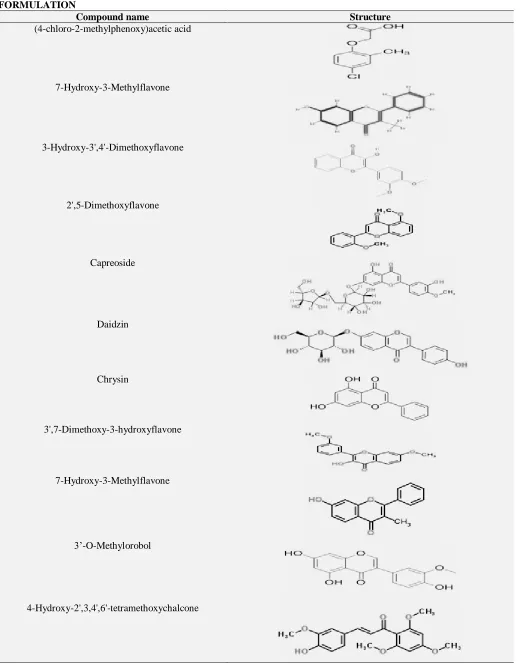
Quercetin-3-O-(6’’-3-hydroxy-3-methyl glutaryl)-a-galactoside, 2’,5-Dimethoxyflavone, capreoside, and daidzin were present in the ethanol extract of polyherbal formulation. LC-MS analysis of the acetone extract of the polyherbal formulation showed the biochemical constituents such as chrysin, 3’,7-Dimethoxy-3-hydroxyflavone, 7-hydroxy, 3-methylflavone, 3’-O-Methylorobol and
4-Hydroxy-2’,3’,4’,6’-tetramethoxychalcone. And the benzene extract of the polyherbal formulation consists of Rhamnetin, Chrysoriol-hexose, rotenone, and Kaempferol- 3- Glucoside- 2”- p- coumaroyl. The chromatograms of ethanol, acetone and benzene extract of the polyherbal formulation were shown in Fig. 1, 2 and 3 respectively. The structure of the compounds as shown in Table 1.
(4-chloro-2-methylphenoxy) acetic acid
7-hydroxy-3-methylflavone
Cinnamic acid-O-hexoside
Triterpenoid derivative
Quercetin-3-O-(6’’-3-hydroxy-3-methyl glutaryl)-â-galactoside
Capreoside
Daidzin
FIG. 1: CHROMATOGRAM OF ETHANOL EXTRACT OF POLYHERBAL FORMULATION
Chrysin
7-Hydroxy-3-Methylflavone
3’-O-Methylorobol
4-Hydroxy-2',3,4',6'-tetramethoxychalcone
FIG. 2: CHROMATOGRAM OF ACETONE EXTRACT OF POLYHERBAL FORMULATION
Rhamnetin
Chrysoriol-hexose
Rotenone
Kaempferol-3-Glucoside-2''-p-coumaroyl
TABLE 1: CHEMICAL STRUCTURE OF THE COMPOUNDS IDENTIFIED IN THE POLYHERBAL FORMULATION
Compound name Structure
(4-chloro-2-methylphenoxy)acetic acid
7-Hydroxy-3-Methylflavone
3-Hydroxy-3',4'-Dimethoxyflavone
2',5-Dimethoxyflavone
Capreoside
Daidzin
Chrysin
3',7-Dimethoxy-3-hydroxyflavone
7-Hydroxy-3-Methylflavone
3’-O-Methylorobol
[image:8.612.50.575.67.733.2]CONCLUSION: Thus, the present results revealed the presence of several bioactive compounds which helps to isolate the compounds for further evaluation.
ACKNOWLEDGEMENT: The Authors thank the Management, the Principal for providing necessary facilities to carry out the research, and Department of Science and Technology, Science and Engineering Research Board for financial support.
CONFLICT OF INTEREST: There is no conflict of interest.
REFERENCES:
1. Kamboj VP: Herbal medicine. Current Science 2000; 78(1): 35-39.
2. Revathi G, Elavarasi S, and Saravanan K: Evaluation of the toxic effect of traditionally used antidiabetic polyherbal formation on albino rats. Int J Pharm Bio Sci 2015; 6(4): 181-87.
3. Revathi G, Elavarasi S and Saravanan K: Phytochemical screening and GC-MS analysis of polyherbal formulation for diabetes. Int J Adv Res 2018; 6(5): 1439-43.
4. Elavarasi S and Saravanan K: Ethnobotanical study of plants used to treat diabetes by tribal people of Kolli Hills, Namakkal district, Tamil Nadu, Southern India. International Journal of Pharm Tech Research 2012; 4: 404-11.
5. Elavarasi S, Saravanan K and Renuka C: A systematic review on medicinal plants used to treat diabetes mellitus. International Journal of Pharmaceutical, Chemical and Biological Sciences 2013; 3(3): 983-92.
6. Manohar M and Marzinke MA: Application of Chromatography Combined With Mass Spectrometry in Therapeutic Drug Monitoring. Clinical Challenges in Therapeutic Drug Monitoring 2016; 45-70.
7. Nováková L and Vlˆcková H: A review of current trends and advances in modern bio-analytical methods: Chromatography and sample preparation. Anal Chim Acta 2009; 656: 8-35.
8. Chen Y, Guo Z, Wang X and Qiu C: Sample preparation. J Chromatogr 2008; 1184: 191-19.
9. Crutchfield CA, Lu W, Melamud E and Rabinowitz JD: Mass Spectrometry-Based Metabolomics of Yeast. Methods in Enzymology 2010; 470: 393-26.
All © 2013 are reserved by International Journal of Pharmaceutical Sciences and Research. This Journal licensed under a Creative Commons Attribution-NonCommercial-ShareAlike 3.0 Unported License.
This article can be downloaded to Android OS based mobile. Scan QR Code using Code/Bar Scanner from your mobile. (Scanners are available on Google Play store)
How to cite this article: