N A N O E X P R E S S
Open Access
Effects of Size and Aggregation/
Agglomeration of Nanoparticles on the
Interfacial/Interphase Properties and Tensile
Strength of Polymer Nanocomposites
Muhammad Aqeel Ashraf
1,2, Wanxi Peng
1*, Yasser Zare
3and Kyong Yop Rhee
4*Abstract
In this study, several simple equations are suggested to investigate the effects of size and density on the number, surface area, stiffening efficiency, and specific surface area of nanoparticles in polymer nanocomposites. In addition, the roles of nanoparticle size and interphase thickness in the interfacial/interphase properties and tensile strength of nanocomposites are explained by various equations. The aggregates/agglomerates of nanoparticles are also assumed as large particles in nanocomposites, and their influences on the nanoparticle characteristics, interface/ interphase properties, and tensile strength are discussed. The small size advantageously affects the number, surface area, stiffening efficiency, and specific surface area of nanoparticles. Only 2 g of isolated and well-dispersed nanoparticles with radius of 10 nm (R= 10 nm) and density of 2 g/cm3produce the significant interfacial area of 250 m2with polymer matrix. Moreover, only a thick interphase cannot produce high interfacial/interphase parameters and significant mechanical properties in nanocomposites because the filler size and aggregates/agglomerates also control these terms. It is found that a thick interphase (t= 25 nm) surrounding the big nanoparticles (R= 50 nm) only improves theBinterphase parameter to about 4, whileB= 13 is obtained by the smallest nanoparticles and the thickest interphase.
Keywords:Polymer nanocomposites, Particle size, Aggregation/agglomeration, Interfacial/interphase properties
Background
The nanocomposites exhibit substantial properties by only small content of nanofiller [1–5]. The important properties of polymer nanocomposites cause a wide range of applications in various technologies such as ad-vanced materials and goods, medicines, energy devices, and sensors [6]. The studies on different types of poly-mer nanocomposites aim to achieve high-performance products by an easy fabrication process and low cost.
The considerable properties of polymer nanocompos-ites are attributed to good interfacial properties between polymer matrix and nanoparticles such as interfacial area and interaction/adhesion at interface [7–13]. The high levels of interfacial properties lead to formation of
another phase as interphase around the nanoparticles which is different from both polymer matrix and nano-particles shows the advantage of nanocomposites com-pared to conventional micro-composites [14–18]. Many theoretical investigations on interfacial/interphase prop-erties have given a large amount of information to attain the desirable properties. However, the high surface area of nanoparticles and the strong attractive interaction be-tween particles result in the aggregation/agglomeration [19,20]. The strong and dense collectives of nanocles denote the aggregation, but the loosely joint parti-cles show the agglomeration which may be broken by mechanical stress [21].
The aggregation/agglomeration of nanoparticles reduces the potential enhancement of mechanical properties in nanocomposites, due to the restriction of interfacial area [22, 23]. Therefore, the main challenge in production of nanocomposites includes the achievement of small nano-particles and good dispersion of nanonano-particles. It is vital to * Correspondence:[email protected];[email protected]
1School of Forestry, Henan Agricultural University, Zhengzhou 450002, China 4Department of Mechanical Engineering, College of Engineering, Kyung Hee
University, Yongin 446-701, Republic of Korea
Full list of author information is available at the end of the article
overcome the attractive forces between nanoparticles pro-ducing the aggregation/agglomeration, instead of disturb-ing the structure of nanoparticles. Surprisdisturb-ingly, Dorigato et al. [24] suggested a model which shows the primary filler aggregation reinforces the polymer nanocomposites, while the agglomerated nanoparticles commonly induce negative effects on the mechanical performances of poly-mer nanocomposites [21, 25]. Accordingly, the study on aggregation/agglomeration of nanoparticles is required to reveal its real effects on the properties of nanocomposites. Although the nanoparticle size is assumed as an attractive benefit in polymer nanocomposites, the effects of isolation or aggregation/agglomeration on the main properties of nanoparticles such as number, surface area, and specific surface area have not been studied in the literature. More-over, the aggregation/agglomeration of nanoparticles has been assumed as a general term which qualitatively changes the behavior of nanocomposites. Also, the pos-sible roles of nanoparticle and interphase dimensions on the interfacial/interphase properties have not been de-scribed in previous studies.
Methods
In this paper, the effects of filler size and density on the number, surface area, stiffening efficiency, and specific surface area of nanoparticles in polymer nanocomposites are explained by proper equations. Also, the aggrega-tion/agglomeration of nanoparticles is assumed as large particles and their influences on various terms are re-vealed. Similarly, the possible roles of nanoparticle and interphase sizes in the interfacial/interphase parameters and tensile strength of nanocomposites are discussed. The main focus of this article is on the spherical nano-particles, but other nanoparticle geometries can be stud-ied by development of the suggested equations.
The number of spherically isolated nanoparticles in a nanocomposite can be calculated by the weight of nano-particles (Wf) as:
N¼ Wf df
4 3πR
3: ð
1Þ
wheredfandRare the density and radius of nanopar-ticles, respectively. In this condition, the total surface area of dispersed nanoparticles is given by:
A¼N4πR2: ð2Þ
A can be considered as the interfacial area between polymer matrix and nanoparticles. Replacing ofN from Eq.1into Eq.2leads to:
A¼3Wf
dfR: ð
3Þ
which correlates theAwithWf,df, andR.
Each nanoparticle introduces a stiffening effect in polymer matrix by mechanical involvement of polymer chains. The level of stress sharing between polymer matrix and nanoparticles depends on the interfacial area and the stiffness of nanoparticles. As a result, a novel parameter as the stiffening efficiency of nanoparticles can be defined as:
SE¼AEf ¼ 3Wf
dfREf: ð
4Þ
whereEfis the Young’s modulus of nanoparticles. The stiffening efficiency as a function of the properties of nanoparticles expresses the capability of nanoparticles for the stiffening of nanocomposites. Additionally, the specific surface area of particles is expressed as:
Ac¼ A
m¼ A dfv¼
4πR2
df 4 3πR
3¼
3
dfR: ð
5Þ
wheremandvare total mass and volume of nanopar-ticles, respectively. This parameter expresses the surface area of 1 g particles and so, does not depend on the con-centration of nanoparticles in nanocomposite.
Now, the tensile strength and interfacial/interphase properties are given by simple equations. Pukanszky [26] suggested a model for tensile strength of composites as a function of filler content and interfacial/interphase prop-erties as:
σ¼σm 1−φf
1þ2:5φf exp Bφf
: ð6Þ
whereσmshows the tensile strength of polymer matrix and φf is the volume fraction of nanofiller. This model was originally suggested for composites, but this model has shown good agreements with the experimental results of different polymer nanocomposites. A good agreement is obtained between the experimental data of tensile strength and the predictions of Pukanszky equa-tion in many samples such as PP/SiO2[27], PEEK/SiO2
[28], PVC/CaCO3 [29], PP/CaCO3 [30], and PVC/SiO2
[31] calculating theB parameter as 4.12, 3.15, 3.07, 2.5, and 2.1, respectively. These examples validate the appli-cation of Pukanszky model for the tensile strength of polymer nanocomposites.
B¼ 1þAcdft
ln σi
σm : ð
7Þ
wheretand σiare the thickness and strength of inter-phase, respectively.
Replacing of Ac from Eq. 5 into the latter equation presents:
B¼ 1þ3t
R
ln σi
σm : ð
8Þ
Applying the above equation into Pukanszky model offers the relative strength (σ/σm) as:
σR¼ 1−φf
1þ2:5φf exp 1þ3
t R
ln σi
σm φf
: ð9Þ
which explicitly links the tensile strength to filler and interphase properties. Also, we should indicate the size effects, which undoubtedly exist when modeling fracture [32–34].
The volume fraction of interphase (φi) for nanocom-posites containing spherical nanoparticles can be consid-ered [35] by:
φi¼ Rþt
R
3
−1
" #
φf: ð10Þ
in which t= 0 results in φi= 0 indicating the absence of interphase in nanocomposite. The analytical models in this study may be applicable where other models such as cohesive zone describe the interphase regions. Some previous studies have considered the interphase by some models such as 2D finite element [36,37].
In our previous work [38],a interphase parameter for polymer nanocomposites reinforced with spherical nano-particles was defined as:
a¼10 t
R
10Ei
Ef − 1
: ð11Þ
where Ei is the modulus of interphase. This equation correlates theato various effective parameters of nano-filler and interphase. a was calculated for some nano-composites ranging from 0.8 to 19 [38]. It was reported that a higher level of a introduces a better modulus in nanocomposite.
Results and discussion
At the first part of this section, the effects of size and density on different properties of nanoparticles are plot-ted by contour plots and the results are discussed to clarify the influence of aggregation/agglomeration. At the next step, the roles of nanoparticle radius (including the aggregation/agglomeration) and interphase thickness
in the interfacial/interphase properties and nanocompos-ite performances are studied.
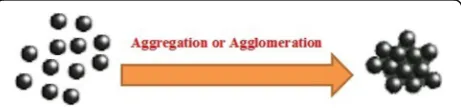
Figure 1 illustrates the aggregation/agglomeration of nanoparticles in a nanocomposite. When the isolated and dispersed nanoparticles are accumulated, it can be assumed that a large nanoparticle is formed. According to Fig. 1, if isolated nanoparticles with R radius aggre-gate/agglomerate, a big particle is produced with high radius. As a result, the aggregation/agglomeration of nanoparticles can be physically assumed by growth of particle size in nanocomposites. This occurrence affects the characteristics of nanoparticles and interphase which finally change the behavior of nanocomposites.
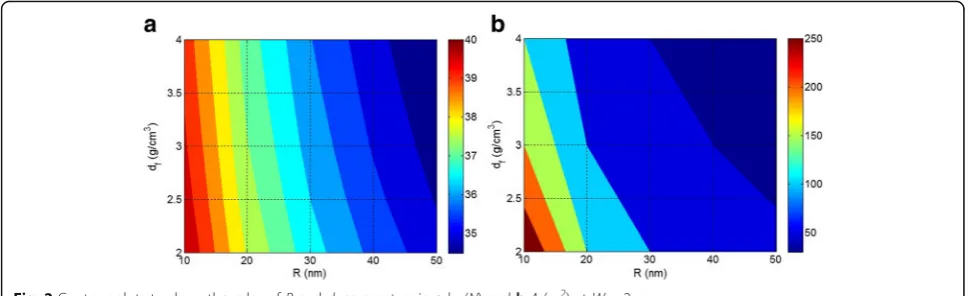
Figure 2 shows the roles of Rand df in ln (N) andA levels at constant Wf= 2 g. According to Fig.2a, lowN is observed by the high values of R and df, but N in-creases when Randdfdecrease. So, the density and size of nanoparticles inversely affect the number of particles in polymer nanocomposites at a constant filler concentra-tion. The small nanoparticles with low density produce a large number of nanoparticles in nanocomposites, while the big and dense nanoparticles make few particles. Ac-cordingly, the aggregates/agglomerates significantly de-crease the number of nanoparticles in nanocomposites at a constant filler concentration.
Figure2billustrates the effects ofRanddfparameters on the total surface area of nanoparticles (A in m2) at Wf= 2 g. The surface area of nanoparticles is assumed as the interfacial area between polymer and nanoparticles transferring the stress from matrix to nanoparticles. The stress may be efficiently transported from polymer to nanoparticles to improve the mechanical properties, when the interfacial area is big enough [39, 40]. As ob-served in Fig.2b, the largest interfacial area is achieved by the smallest ranges of R and df. It is also interesting that only 2 g of isolated and well-dispersed nanoparticles withR= 10 nm and df= 2 g/cm3produce about 250 m2 interfacial area with polymer matrix. However, the inter-facial area reduces by increasing the size and density of nanoparticles and A below 50 m2 is obtained at R> 40 nm and df> 3 g/cm
3
. The significant difference between the interfacial areas at different particle sizes in-dicates that the nanoparticle size is an important param-eter in nanocomposites. The large nanoparticles cause small interfacial area which deteriorates the significant
[image:3.595.307.538.640.694.2]advantage of nanoparticles in nanocomposites. It should be noted that the filler concentration in nanocomposites may not be too high compared to micro-composites, but the extraordinary surface area of nanoparticles commonly results in the interaction between particles and aggrega-tion/agglomeration. As a result, although the high con-tents of nanoparticles in nanocomposites strengthen the accumulation, the aggregation/agglomeration of nanopar-ticles generally occur in polymer nanocomposites at differ-ent filler concdiffer-entrations which decrease the interfacial area and weaken the performance.
Figure 3a displays the contour plots of ln (SE) as a function of R and df at Wf= 2 g and Ef= 100 GPa. The stiffening efficiency of nanoparticles increases when small nanoparticles with low density are incorporated in polymer matrix, demonstrating that the nanoparticle size causes an effective role in the stiffening of nanoparticles in polymer nanocomposites. On the other hand, the ag-gregated/agglomerated nanoparticles deteriorate the per-formances of polymer nanocomposites by reduction of nanoparticle efficiency. The small nanoparticles with low density meaningfully increase the stiffness of nanocom-posites through the great level of stress transferring be-tween polymer chains and nanoparticles. A previous
study in this area has explained the physics of the influ-ence of filler radius on the stress transfer from polymer matrix to fiber using the molecular dynamics simula-tions [41]. However, the large and dense particles cannot introduce the high stiffness of nanoparticles to polymer matrix suggesting a composite with poor stiffness. Therefore, the characteristics of nanoparticles signifi-cantly control the properties of nanocomposites.
Figure3balso shows the levels ofAc parameter at dif-ferentRanddfvalues atWf= 2 g andEf= 100 GPa. It is observed that the best Ac is obtained by small and low-density nanoparticles, while the worst one is produced by large and dense particles. The Ac value of about 140 m2/g is achieved by R= 10 nm and df= 2 g/ cm3, while Ac level of less than 20 m2/g is shown by large particle size and high density. As a result,Randdf parameters show negative effects on Ac in polymer nanocomposites. It is concluded that Ac parameter ex-pressing the interfacial area of 1 g isolated nanoparticles gives the best levels by small nanoparticles. As a result, the large nanoparticles or aggregates/agglomerates can-not produce a considerable Ac which decreases the effi-ciency of nanoparticles in polymer nanocomposites. It is known that the performances of nanocomposites such
Fig. 2Contour plots to show the roles ofRanddfparameters inaln (N) andbA(m2) atWf= 2 g
[image:4.595.56.541.88.236.2] [image:4.595.58.540.575.713.2]as mechanical, flame retardation, and barrier properties directly relate to the interfacial area between polymer and nanoparticles [10, 42]. A large Ac can produce acceptable levels for nanocomposite properties by little amount of nanoparticles, due to the high interfacial area between polymer matrix and nanoparticles. Accordingly, controlling the size and density of nanoparticles are chal-lenging in nanocomposites to create the best properties.
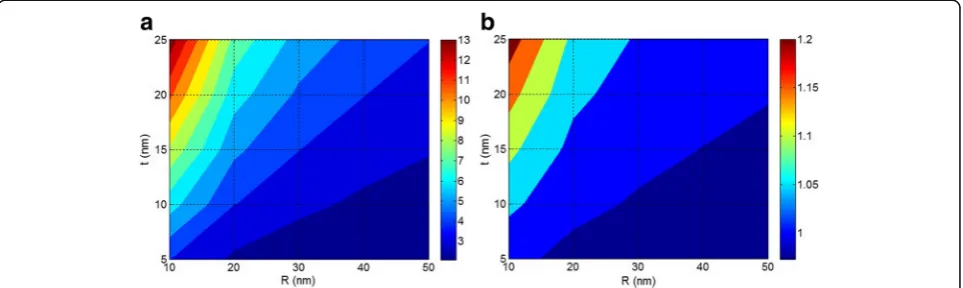
Now, the effects of nanoparticle and interphase sizes on the interfacial/interphase properties and tensile strength of nanocomposites are explained by the pro-posed equations. Figure4illustrates the effects ofRand t on B interfacial parameter and tensile strength by Pukanszky model (Eq. 6) at σi/σm= 5 and φf= 0.02. Based on Fig. 4a, the B level of 13 is obtained by the smallest nanoparticles and the thickest interphase. Also, B decreases to below 3 when the size of nanoparticles grows to about 40 nm and the interphase thickness decreases to less than 10 nm. Therefore, the sizes of nanoparticles and interphase play dissimilar roles in B parameter. Also, it should be noted that the small nano-particles without formation of a strong interphase can-not give a high B in polymer nanocomposites. On the other hand, a thick interphase (t= 25 nm) surrounding the big nanoparticles (R= 50 nm) only improves the B parameter to about 4. As a result, both nanoparticle and interphase dimensions are important to obtain a high level of B in nanocomposites. However, at a constant level of interphase thickness, the growth of nanoparticle size by aggregation/agglomeration decreases B param-eter demonstrating the negative effects of aggregates/ag-glomerates on the interfacial/interphase properties.
Figure4balso shows the effects ofRandtparameters on the tensile strength of nanocomposites by Pukanszky model. It is observed that small nanoparticles and thick interphase improve the strength of nanocomposites. However, a poor strength is observed by big particles and thin interphase. Therefore, bothRand tparameters affect the tensile strength of nanocomposites. Moreover,
it is found that the strength of nanocomposites reduces when the size of nanoparticles grows, due to aggrega-tion/agglomeration. Accordingly, it is essential to isolate and disperse the nanoparticles in polymer matrix at small size to achieve the best performances. Since nano-particles naturally tend to aggregation/agglomeration, modification of their surface or functionalization of poly-mer chains can prevent the accumulation [19,43,44].
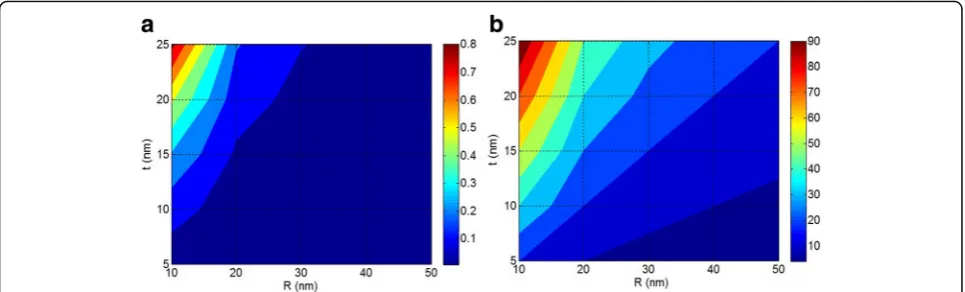
Figure5depicts the dependences of interphase volume fraction (φi) and ainterphase parameter onRand t pa-rameters atφf= 0.02,Ef= 100 GPa, andEi= 50 GPa. Ac-cording to Fig. 5a, the smallest nanoparticles and the thickest interphase give the highest level of φi as 0.8 which significantly reinforces the nanocomposite. This level of φi is more than φf demonstrating the effective roles ofRandtparameters in the performances of nano-composites. Furthermore,φidecreases to about 0 atR> 30 nm, i.e., a thick interphase (t= 25 nm) cannot make a highφiin polymer nanocomposites when large nanopar-ticles are incorporated in the polymer matrix. This oc-currence shows the significant role of nanoparticle size in the formation of interphase regions. So, the size of nanoparticles considerably changes the interphase prop-erties revealing that the aggregation/agglomeration of nanoparticles mostly decreases the interphase concen-tration which causes poor modulus and strength in nanocomposites [5,45]. It should be mentioned that the interphase regions may overlap in the systems contain-ing high filler concentration. Therefore, the expressed equation for φi (Eq. 10) is reasonable for normal nano-composites containing low filler content.
Figure5balso shows the effects ofRand tlevels ona interphase parameter.aincreases by small nanoparticles and thick interphase, whereas it gives less values (less than 10) at R> 40 nm and t< 10 nm. This evidence re-veals that adepends on both Rand t parameters. Since a high a parameter improves the Young’s modulus of nanocomposites [38], small nanoparticles and thick inter-phase are desirable for nanocomposites performances.
[image:5.595.58.540.569.713.2]According to Fig. 5b, the aggregates/agglomerates of nanoparticles (high R) produce slight a event by thick interphase. This occurrence indicates that a strong inter-phase cannot give a great a or high modulus when the nanoparticles are aggregated/agglomerated in nanocom-posites. As a result, the aggregates/agglomerates of nano-particles cause negative effects on the properties of polymer nanocomposites. Based on the mentioned remarks, the aggregation/agglomeration weakens the ben-efits of nanoparticles and properties of interface/inter-phase; therefore, the nanoparticles cannot present a strong reinforcement in polymer nanocomposites.
Conclusions
The effects of filler size and density as well as interphase thickness on the characteristics of nanoparticles and the interface/interphase properties were studied by simple equations. Also, the aggregates/agglomerates of nanopar-ticles were assumed as large parnanopar-ticles and their influ-ences on the interphase parameters and the tensile strength of nanocomposites were discussed. The small size and low density cause significant levels for number, surface area, stiffening efficiency, and specific surface
area of nanoparticles. Only 2 g of small and
well-dispersed nanoparticles (R= 10 nm) with df = 2 g/ cm3 can produce about 250 m2 interfacial area with polymer matrix. On the other hand, big size and aggre-gates/agglomerates weaken the positive attributes of nanoparticles in nanocomposites. Small nanoparticles and thick interphase present the high levels forB param-eter, tensile strength, interphase volume fraction, and a interphase parameter. B decreases to below 3 when the size of nanoparticles grows to about 40 nm and the interphase thickness reduces to less than 10 nm. However, B= 13 is obtained by the smallest nanoparticles (R= 10 nm) and the thickest interphase (t= 25 nm). This occurrence confirms that the interfacial/interphase properties depend on the nanoparticle size beside the interfacial interaction/ad-hesion. Additionally, large nanoparticles produce low
interfacial/interphase properties and poor tensile strength even at high interphase thickness revealing the main role of particles size. The smallest nanopar-ticles and the thickest interphase give the highest level of φi, while φi decreases to about 0 at R> 30 nm. This evidence demonstrates that only a thick inter-phase (t= 25 nm) cannot make a high φi when large nanoparticles or aggregates/agglomerates are present in nanocomposites. Accordingly, the aggregated/ag-glomerated nanoparticles negatively affect the inter-facial/interphase properties and tensile strength of polymer nanocomposites.
Authors’contributions
The authors contribute to the calculations and discussion. All authors read and approved the final manuscript.
Competing interests
The authors declare that they have no competing interests.
Publisher’s Note
Springer Nature remains neutral with regard to jurisdictional claims in published maps and institutional affiliations.
Author details
1School of Forestry, Henan Agricultural University, Zhengzhou 450002, China. 2Faculty of Science, Department of Geology, University of Malaya, 50603
Kuala Lumpur, Malaysia.3Young Researchers and Elites Club, Science and Research Branch, Islamic Azad University, Tehran, Iran.4Department of Mechanical Engineering, College of Engineering, Kyung Hee University, Yongin 446-701, Republic of Korea.
Received: 12 April 2018 Accepted: 28 June 2018
References
1. Perets Y, Aleksandrovych L, Melnychenko M, Lazarenko O, Vovchenko L, Matzui L (2017) The electrical properties of hybrid composites based on multiwall carbon nanotubes with graphite nanoplatelets. Nanoscale Res Lett 12(1):406
2. Bershtein V, Fainleib A, Egorova L, Gusakova K, Grigoryeva O, Kirilenko D et al (2015) The impact of ultra-low amounts of amino-modified MMT on dynamics and properties of densely cross-linked cyanate ester resins. Nanoscale Res Lett 10(1):1
3. Zare Y (2016) Shear, bulk, and Young’s moduli of clay/polymer nanocomposites containing the stacks of intercalated layers as pseudoparticles. Nanoscale Res Lett 11(1):479
[image:6.595.57.540.88.234.2]4. Sagalianov I, Vovchenko L, Matzui L, Lazarenko O (2017) Synergistic enhancement of the percolation threshold in hybrid polymeric nanocomposites based on carbon nanotubes and graphite nanoplatelets. Nanoscale Res Lett 12(1):140
5. Ma X, Zare Y, Rhee KY (2017) A two-step methodology to study the influence of aggregation/agglomeration of nanoparticles on Young’s modulus of polymer nanocomposites. Nanoscale Res Lett 12(1):621 6. Kato M, Usuki A, Hasegawa N, Okamoto H, Kawasumi M (2011)
Development and applications of polyolefin–and rubber–clay nanocomposites. Polym J 43(7):583–593
7. Zare Y, Rhee KY (2017) Development of Hashin-Shtrikman model to determine the roles and properties of interphases in clay/CaCO3/PP ternary nanocomposite. Appl Clay Sci 137:176–182
8. Zare Y, Rhee KY (2017) Development and modification of conventional Ouali model for tensile modulus of polymer/carbon nanotubes nanocomposites assuming the roles of dispersed and networked nanoparticles and surrounding interphases. J Colloid Interface Sci 506:283–290
9. Zare Y, Rhee KY, Park S-J (2017) Predictions of micromechanics models for interfacial/interphase parameters in polymer/metal nanocomposites. Int J Adhes Adhes 79:111–116
10. Chopra S, Deshmukh KA, Peshwe D (2017) Theoretical prediction of interfacial properties of PBT/CNT nanocomposites and its experimental evaluation. Mech Mater 109:11–17
11. Zare Y, Rhee KY (2017) Dependence of Z parameter for tensile strength of multi-layered interphase in polymer nanocomposites to material and interphase properties. Nanoscale Res Lett 12(1):42
12. Montazeri A, Naghdabadi R (2010) Investigation of the interphase effects on the mechanical behavior of carbon nanotube polymer composites by multiscale modeling. J Appl Polym Sci 117(1):361–367
13. Jahanmard P, Shojaei A (2015) Mechanical properties and structure of solvent processed novolac resin/layered silicate: development of interphase region. RSC Adv 5(98):80875–80883
14. Zare Y, Rhee KY (2017) Development of a conventional model to predict the electrical conductivity of polymer/carbon nanotubes nanocomposites by interphase, waviness and contact effects. Compos A: Appl Sci Manuf 100: 305–312
15. Zare Y, Rhee KY (2017) Development of a model for electrical conductivity of polymer graphene nanocomposites assuming interphase and tunneling regions in conductive networks. Ind Eng Chem Res 56(32):9107–9115 16. Zare Y, Rhee KY (2017) A simple methodology to predict the tunneling
conductivity of polymer/CNT nanocomposites by the roles of tunneling distance, interphase and CNT waviness. RSC Adv 7(55):34912–34921 17. Rafiee R, Pourazizi R (2015) Influence of CNT functionalization on the
interphase region between CNT and polymer. Comput Mater Sci 96:573–578 18. Herasati S, Zhang L, Ruan H (2014) A new method for characterizing the
interphase regions of carbon nanotube composites. Int J Solids Struct 51(9): 1781–1791
19. Esbati A, Irani S (2018) Effect of functionalized process and CNTs aggregation on fracture mechanism and mechanical properties of polymer nanocomposite. Mech Mater 118:106–119
20. Jouault N, Vallat P, Dalmas F, Said S, Jestin J, Boué F (2009) Well-dispersed fractal aggregates as filler in polymer−silica nanocomposites: long-range effects in rheology. Macromolecules 42(6):2031–2040
21. Zare Y (2016) Study of nanoparticles aggregation/agglomeration in polymer particulate nanocomposites by mechanical properties. Compos A: Appl Sci Manuf 84:158–164
22. Chen J, Yu Y, Chen J, Li H, Ji J, Liu D (2015) Chemical modification of palygorskite with maleic anhydride modified polypropylene: mechanical properties, morphology, and crystal structure of palygorskite/polypropylene nanocomposites. Appl Clay Sci 115:230–237
23. Khan A, Shamsi MH, Choi T-S (2009) Correlating dynamical mechanical properties with temperature and clay composition of polymer-clay nanocomposites. Comput Mater Sci 45(2):257–265
24. Dorigato A, Dzenis Y, Pegoretti A (2013) Filler aggregation as a reinforcement mechanism in polymer nanocomposites. Mech Mater 61: 79–90
25. Zare Y (2016) The roles of nanoparticles accumulation and interphase properties in properties of polymer particulate nanocomposites by a multi-step methodology. Compos A: Appl Sci Manuf 91:127–132
26. Pukanszky B (1990) Influence of interface interaction on the ultimate tensile properties of polymer composites. Composites 21(3):255–262
27. Bikiaris DN, Papageorgiou GZ, Pavlidou E, Vouroutzis N, Palatzoglou P, Karayannidis GP (2006) Preparation by melt mixing and characterization of isotactic polypropylene/SiO2 nanocomposites containing untreated and surface-treated nanoparticles. J Appl Polym Sci 100(4):2684–2696 28. Zhang G, Schlarb A, Tria S, Elkedim O (2008) Tensile and tribological
behaviors of PEEK/nano-SiO2 composites compounded using a ball milling technique. Compos Sci Technol 68(15):3073–3080
29. Xie X-L, Liu Q-X, Li RK-Y, Zhou X-P, Zhang Q-X, Yu Z-Z et al (2004) Rheological and mechanical properties of PVC/CaCO3 nanocomposites prepared by in situ polymerization. Polymer 45(19):6665–6673
30. Chen H, Wang M, Lin Y, Chan CM, Wu J (2007) Morphology and mechanical property of binary and ternary polypropylene nanocomposites with nanoclay and CaCo3 particles. J Appl Polym Sci 106(5):3409–3416 31. Chen G, Tian M, Guo S (2006) A study on the morphology and
mechanical properties of PVC/nano-SiO2 composites. J Macromol Sci Part B 45(5):709–725
32. Talebi H, Silani M, Rabczuk T (2015) Concurrent multiscale modeling of three dimensional crack and dislocation propagation. Adv Eng Softw 80:82–92 33. Talebi H, Silani M, Bordas SP, Kerfriden P, Rabczuk T (2014) A computational
library for multiscale modeling of material failure. Comput Mech 53(5):1047– 1071
34. Budarapu PR, Gracie R, Yang S-W, Zhuang X, Rabczuk T (2014) Efficient coarse graining in multiscale modeling of fracture. Theor Appl Fract Mech 69:126–143
35. Ji XL, Jiao KJ, Jiang W, Jiang BZ (2002) Tensile modulus of polymer nanocomposites. Polym Eng Sci 42(5):983
36. Msekh MA, Cuong N, Zi G, Areias P, Zhuang X, Rabczuk T (2018) Fracture properties prediction of clay/epoxy nanocomposites with interphase zones using a phase field model. Eng Fract Mech 188:287–299
37. Hamdia KM, Silani M, Zhuang X, He P, Rabczuk T (2017) Stochastic analysis of the fracture toughness of polymeric nanoparticle composites using polynomial chaos expansions. Int J Fract 206(2):215–227
38. Zare Y (2015) Assumption of interphase properties in classical Christensen– Lo model for Young’s modulus of polymer nanocomposites reinforced with spherical nanoparticles. RSC Adv 5(116):95532–95538
39. H-x L, Zare Y, Rhee KY (2018) The percolation threshold for tensile strength of polymer/CNT nanocomposites assuming filler network and interphase regions. Mater Chem Phys 207:76–83
40. Razavi R, Zare Y, Rhee KY (2018) A model for tensile strength of polymer/ carbon nanotubes nanocomposites assuming the percolation of interphase regions. Colloids Surf A Physicochem Eng Asp 538:148–154
41. Vu-Bac N, Lahmer T, Zhang Y, Zhuang X, Rabczuk T (2014) Stochastic predictions of interfacial characteristic of polymeric nanocomposites (PNCs). Compos Part B 59:80–95
42. Xu Q-J, Wang S-B, Chen F-F, Cai T-C, Li X-H, Zhang Z-J (2016) Studies on the interfacial effect between nano-SiO2 and nylon 6 in nylon 6/SiO2 nanocomposites. Nanomaterials and Nanotechnology 6:31 43. Ferreira F, Pinheiro I, Gouveia R, Thim G, Lona L (2018) Functionalized
cellulose nanocrystals as reinforcement in biodegradable polymer nanocomposites. Polym Compos 39(S1):E9