Summary
Tudor domain proteins function as molecular adaptors, binding methylated arginine or lysine residues on their substrates to promote physical interactions and the assembly of
macromolecular complexes. Here, we discuss the emerging roles of Tudor domain proteins during development, most notably in the Piwi-interacting RNA pathway, but also in other aspects of RNA metabolism, the DNA damage response and chromatin modification.
Key words: Tudor domain, RNA metabolism, Chromatin, piRNA
Introduction
The tudor gene was originally discovered in Drosophila melanogasterin 1985 in a screen for maternal factors that regulate embryonic development or fertility (for a timeline, see Box 1) (Boswell and Mahowald, 1985). The Tudor protein contains 11 repeats of a domain, later termed the Tudor domain, that was subsequently found to be present in many other proteins that function in RNA metabolism (Ponting, 1997; Callebaut and Mornon, 1997). Over the past two decades, Tudor domain proteins have emerged as a class of proteins that regulate not only multiple aspects of RNA metabolism – including RNA splicing and small RNA pathways – but also a number of other processes, such as histone modification and the DNA damage response (reviewed by Chen et al., 2011; Siomi et al., 2010; Lasko, 2010; Thomson and Lasko, 2005). Through these activities, Tudor domain proteins affect a wide variety of processes during development, including cell division, differentiation, genome stability and gametogenesis. We present the current knowledge gained from studies in Drosophila melanogaster, mice and human cell lines regarding how the Tudor domain functions and the roles of different Tudor domain proteins in biological pathways.
Tudor domain proteins function as adaptor proteins
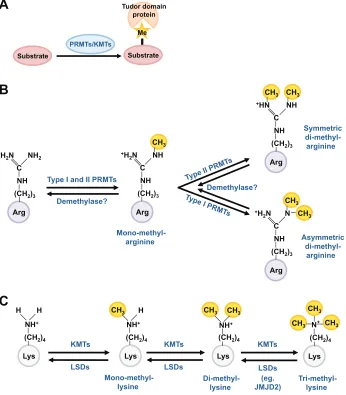
The Tudor domain is a conserved protein structural motif of ~60 amino acids that is characterized by a strongly bent anti-parallel -sheet composed of five -strands with a barrel-like fold (Sprangers et al., 2003). The Tudor domain has been reported to recognize and bind methylated lysines and arginines of target substrates (Fig. 1A), and this is thought to be the key in their ability to facilitate the assembly of protein complexes at discrete cellular compartments (Friberg et al., 2009; Liu et al., 2010a; Liu et al., 2010b; Tripsianes et al., 2011). A subset of Tudor domain proteins bind methylated lysines, whereas the rest have methyl-arginine-binding capacity.
However, the factors that determine this specificity are still poorly understood (Kim et al., 2006; Chen et al., 2011). Here, we focus primarily on the methyl-arginine-binding Tudor domain proteins and their roles in RNA metabolism. The roles of lysine methylation in regulating histone and non-histone proteins have been recently reviewed (Zhang et al., 2012), so we will discuss only some functions for methyl-lysine-binding Tudor domains. A list of Tudor domain proteins discussed here is given in Table 1.
Tudor domain proteins involved in RNA metabolism have been studied extensively, especially for their functions in germline and gonadal development. These Tudor domain proteins harbor an ‘extended Tudor domain’ of ~180 amino acids, containing the 60 amino acid core Tudor domain, and interact with methylated arginines on target proteins. Structural analysis has shown that the Tudor domain binds to symmetrically dimethylated arginines with a higher affinity than its binding to asymmetrically dimethylated arginines (Liu et al., 2010a; Liu et al., 2010b). Arginine residue methylation is catalyzed by enzymes known as protein arginine methyltransferases (PRMTs) (Fig. 1B). Arginine can be methylated by Type I and II PRMTs to form mono-methylated arginine. This mono-methylated form can then be further methylated by either a Type I or Type II PRMT to form an asymmetric or symmetric di-methyl-arginine, respectively (Gary and Clarke, 1998; Bedford and Richard, 2005; Bedford and Clarke, 2009; Boulanger et al., 2004). Thus, PRMTs establish the methyl-arginine marks that are recognized and bound by Tudor domain proteins. Recently, JMJ20 and JMJ22 (Jumonji domain-containing proteins) have been shown to function as histone arginine demethylases in Arabidopsis(Cho et al., 2012); however, it remains unclear whether such an eraser of arginine methylation exists in animals. Lysine methylation and demethylation are catalyzed by lysine methyltransferases (KMTs) and demethylases (LSDs), respectively (Fig. 1C) (Zhang and Reinberg, 2001; Zhang et al., 2012).
A common function of Tudor domain proteins is to act as an ‘adaptor’ that links methylated arginine or lysine marks to ‘effectors’ with specific catalytic activities. A minority of Tudor domain proteins containing only Tudor domains function as adaptors that recruit downstream effectors (Table 1). The rest of the family contain additional catalytic, enzymatic or functional domains (e.g. nuclease or RNA helicase domains) and may themselves also function as effectors. This theme will be seen recurrently in the following sections, as we discuss the functions of different Tudor domain proteins in various biological processes.
Tudor domain proteins in RNA metabolism
Tudor domain proteins have been found to be involved in many processes that regulate the metabolism of RNA molecules, such as RNA processing, stability and translation. To target RNAs, Tudor domain proteins typically contain RNA-binding motifs themselves or bind to di-methylated arginines of proteins that are directly bound to RNAs. Below, we discuss prominent examples that display the diversity of Tudor domain functions in RNA metabolism.
Development 139, 2255-2266 (2012) doi:10.1242/dev.073304 © 2012. Published by The Company of Biologists Ltd
Tudor domain proteins in development
Jun Wei Pek1,*,‡, Amit Anand1and Toshie Kai1,2,*1Temasek Life Sciences Laboratory, 1 Research Link, National University of Singapore, Singapore 117604. 2Department of Biological Sciences, National University of Singapore, 14 Science Drive 4, Singapore 117604.
*Authors for correspondence ([email protected];[email protected])
‡Present address: Carnegie Institute for Science, Department of Embryology, 3250
San Martin Drive, Baltimore, MD 21218, USA.
D
E
V
E
LO
P
M
E
N
Splicing
In higher eukaryotes, splicing to remove introns from pre-mRNAs is a highly coordinated and regulated event catalyzed by small nuclear ribonucleoproteins (snRNPs) (Han et al., 2011). snRNPs are assembled in the cytoplasm, before being re-imported into the nucleus where they function. The survival motoneuron (SMN) protein, a Tudor domain protein, mediates the assembly of snRNPs, by binding snRNAs and recruiting asymmetrically di-methylated arginines of SM proteins that form the protein constituent of the snRNPs (Table 1) (Cheng et al., 2007; Fischer et al., 1997; Pellizzoni et al., 1998). Together with Germins 2-8, SMN promotes the subsequent binding of the snRNAs to the SM proteins to form mature snRNPs that function as effectors (Fig. 2). Not only SMN, but also SPF30 (SMNDC1, survivor motoneuron domain containing 1), a paralog of SMN, has been shown to function in promoting spliceosome assembly via an interaction with methylated arginines of SM proteins (Rappsilber et al., 2001; Cote and Richard, 2005). However, it is currently unclear whether SMN and SPF30 perform specific or overlapping functions. The importance of SMN is demonstrated by the fact that mutations in the gene encoding it have been linked to spinal muscular atrophy disease, which is characterized by the degeneration of motoneurons leading to muscle weakness and even death in severe cases (Gubitz et al., 2004).
Small RNA pathways
Many Tudor domain proteins are involved in RNA interference (RNAi) and related pathways, in which small RNAs regulate gene expression, both post-transcriptionally and transcriptionally. Generally, there are three different classes of such small RNAs – microRNAs (miRNAs), small interfering RNAs (siRNAs) and Piwi-interacting RNAs (piRNAs) (Ghildiyal and Zamore, 2009; Kim et al., 2009; Siomi and Siomi, 2009). First, we will discuss the roles of Tudor domain proteins in the miRNA and siRNA pathways, before focusing on the piRNA pathway, where Tudor domain proteins play particularly important roles.
miRNA and siRNA pathways
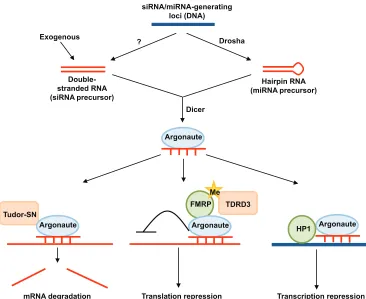
The miRNA pathway regulates cellular functions ranging from cell division, differentiation and embryogenesis to regeneration (Hatfield et al., 2005; Li and Carthew, 2005; Bushati et al., 2008; Pek et al., 2009; Yin et al., 2008). In this pathway, endogenous hairpin transcripts are processed into mature 22-nucleotide miRNAs. These short single-stranded RNAs target mRNAs via base pairing between the seed sequence of the miRNA and the mRNA – most often but not always at the 3⬘UTR. This results in inhibition of gene expression, by either translational repression or mRNA degradation (Fig. 3) (Liu et al., 2005; Guo et al., 2010). Another form of small RNA regulation occurs via the siRNA pathway. Double-stranded RNAs, either exogenous or from endogenous double-stranded RNA encoding loci, are processed into exo- or endo-siRNAs of a specific length (between 20 and 25 nucleotides, depending on species), which silence their targets by post-transcriptional and transcriptional means (Fig. 3). The siRNA/endo-siRNA pathways are important for combating exogenous viral infections and endogenous retrotransposon activities, robust embryonic development and mitotic chromosome segregation (Chung et al., 2008; Czech et al., 2008; Ghildiyal et al., 2008; Kawamura et al., 2008; van Rij et al., 2006; Wang et al., 2006; Galiana-Arnoux et al., 2006; Lucchetta et al., 2009; Pek and Kai, 2011a).
The effector of both the miRNA and siRNA pathways is the RNA-induced silencing complex (RISC), which contains the protein Argonaute as a key catalytic component. In Drosophila, mammals and Caenorhabditis elegans, RISC also contains the Tudor-SN protein, which contains a Tudor domain and four nuclease domains (Table 1) (Caudy et al., 2003). Structural studies on Drosophila Tudor-SN have shown that its Tudor domain recognizes and binds to ligands containing a symmetrically di-methylated arginine (Friberg et al., 2009). However, the specific proteins to which Tudor-SN binds via arginine methylation in vivo are not known. The nuclease domains are required for RNA binding and cleavage during post-transcriptional silencing of target RNAs (Scadden, 2005), thereby functioning as enzymatic effectors. During stress, Tudor-SN localizes to stress granules (SGs), cytoplasmic structures that are involved in RNA metabolism (Box 2), and promotes their assembly (Gao et al., 2010). However, it remains unclear how Tudor-SN functions in SG assembly, or what its substrates are.
Another Tudor domain protein, Tudor domain containing (TDRD) 3, also localizes to SGs upon stress (Table 1). In human cell lines, TDRD3 binds to methyl-arginines of fragile X mental retardation protein (FMRP), a translational repressor, via its Tudor domain, and promotes SG formation (Goulet et al., 2008; Linder et al., 2008). As FMRP has been linked to mediating translation repression via the miRNA pathway (Caudy et al., 2002; Jin et al., 2004; Edbauer et al., 2010), TDRD3 may function in this context as an adaptor to recruit the effector FMRP.
piRNA pathway
In addition to the miRNA and siRNA pathways that function ubiquitously, a gonad-specific form of silencing, the piRNA pathway, functions primarily to protect the genome from deleterious selfish genetic elements such as transposons (Khurana and Theukauf, 2010; Saito and Siomi, 2010; Pek et al., 2012; Senti and Brennecke, 2010). In Drosophila, piRNAs are transcribed from piRNA cluster loci, which are special regions of the genome that harbor imperfect and fragmented copies of transposons that are incapable of mobilization (Malone and Box 1. Timeline of the major discoveries on Tudor
domains
1985.Discovery of tudorin Drosophila. The gene was named after an extinct English royal family, the Tudors, for its grandchildless phenotype in which mutant females produce embryos with defects in primordial germ cell specification (Boswell and Mahowald, 1985). 1997.Identification of conserved Tudor domain (Ponting, 1997; Callebaut and Mornon, 1997).
2001.SMN binds symmetric dimethylated arginines in spliceosomal SM proteins (Friesen et al., 2001; Brahms et al., 2001). Tudor domain structure solved (Selenko et al., 2001).
2003.Tudor domain ‘royal’ family defined to also include Tudor, MBT, PWWP, chromo and plant Agenet domains (Maurer-Stroh et al., 2003).
2005.Tudor domain proposed to recognize methyl-arginines (Cote and Richard, 2005).
2006.Tudor domain proposed to recognize methyl-lysine (Kim et al., 2006).
2006.Structure of Tudor domain bound to methyl-lysine solved (Huang et al., 2006; Botuyan et al., 2006).
2009. Germline Tudor domain proteins shown to recognize methylated Piwi proteins (Kirino et al., 2009; Reuter et al., 2009; Wang et al., 2009; Vagin et al., 2009; Chen et al., 2009; Nishida et al., 2009).
2010.Structure of Tudor domain bound to methyl-arginine solved (Liu et al., 2010a; Liu et al., 2010b).
D
E
V
E
LO
P
M
E
N
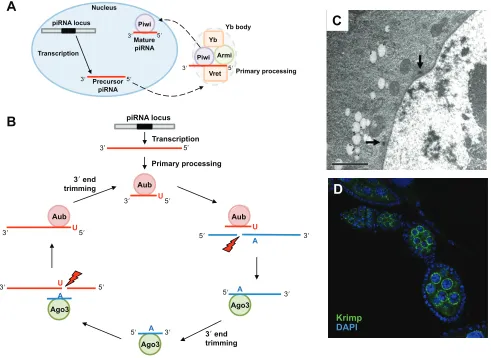
Hannon, 2009). Most clusters are transcribed bi-directionally, but several are transcribed from only one direction. Cluster transcripts in the antisense direction relative to the transposon mRNAs are processed to generate piRNAs against the active transposons. In addition to cluster transcripts, piRNAs are also produced from cellular mRNAs and from transposon mRNAs. piRNAs biogenesis occurs by two mechanisms: primary processing, which is present in both germline and somatic cells (Fig. 4A); and secondary processing, the ping-pong amplification loop that occurs only in germline cells (Fig. 4B). piRNA processing is independent of Dicer – the key endonuclease that processes miRNA precursors (Vagin et al., 2006) and mature piRNAs range from 24 to 29 nucleotides in length (Khurana and Theukauf, 2010; Saito and Siomi, 2010; Pek et al., 2012; Senti and Brennecke, 2010).
The core of the piRNA pathway consists of Piwi clade proteins from the Argonaute family. Piwi proteins are conserved from invertebrates to mammals; for example, the mouse genome encodes MIWI, MILI and MIWI2 (also called PIWIL1, PIWIL2 and PIWIL4, respectively), and Drosophila encodes Piwi, Aubergine (Aub) and Argonaute3 (Ago3). Piwi proteins can be arginine methylated, suggesting that they may be targets for Tudor domain binding (Chen et al., 2009; Kirino et al., 2009; Liu et al., 2010a; Liu et al., 2010b; Nishida et al., 2009; Vagin et al., 2009).
During piRNA biogenesis, the 5⬘end of piRNAs is generated by the slicer activity of Piwi family proteins (Gunawardane et al., 2007), but their 3⬘ end is generated by unknown mechanisms (Kawaoka et al., 2011).
Primary processing involves processing of the precursor transcripts in a cytoplasmic structure called the Yb body. The mechanism of primary processing is better studied in the Drosophilasoma compared with the germline, but still little is known about the molecular functions of the processing machineries. In the soma, the Piwi-bound piRNA precursors are exported to the Yb body where processing occurs (Fig. 4A). Mature Piwi-bound piRNAs are then imported back to the nucleus to regulate transcription by promoting heterochromatin formation (Olivieri et al., 2010; Saito et al., 2010; Qi et al., 2011). A Tudor domain protein containing a DEAD-box helicase motif, Yb, is required for the primary processing of piRNAs and transposon repression (Table 1) (Szakmary et al., 2009; Olivieri et al., 2010; Saito et al., 2010; Qi et al., 2011). Yb localizes to the Yb body via its Tudor domain and functions as an adaptor by binding and recruiting Armitage (Armi), another primary processing protein, to the Yb body. Without Yb, Piwi is not loaded with piRNAs, remains cytoplasmic in Yb bodies and cannot enter the nucleus. Although the molecular function of the helicase domain is currently unknown, Yb itself may also
B
Type I and II PRMTs
(CH2)3
NH
Arg C
NH2
+H 2N
(CH2)3 NH
Arg C
NH
+H 2N
CH3 (CH2)3
NH
Arg C
NH
+HN
CH3
CH3
(CH2)3
NH
Arg C
N
+H 2N
CH3
CH3
Mono-methyl-arginine
Symmetric
di-methyl-arginine
Asymmetric
di-methyl-arginine Substrate Substrate
Tudor domain protein
Me
PRMTs/KMTs
A
C
(CH2)4 NH+
Lys H H
KMTs
(CH2)4 NH+
Lys H CH3
(CH2)4 NH+
Lys CH3
KMTs
CH3
KMTs (CH2)4
N+
Lys CH3
CH3
CH3
Mono-methyl-lysine
Di-methyl-lysine
Tri-methyl-lysine LSDs
(eg. JMJD2) LSDs
LSDs
Type II PRMT s
Type I PRMT
s
Demethylase?
[image:3.612.52.398.63.458.2]Demethylase?
Fig. 1. Tudor domains bind methylated arginines and lysines. (A)Substrates are methylated by protein arginine
methyltransferases (PRMTs) or lysine methyltransferases (KMTs), which are recognized and bound by Tudor domains. (B)PRMTs mediate either symmetric or asymmetric di-methylation of arginine. (C)Lysine methylation and demethylation pathways by KMTs and lysine
demethylases (LSDs), respectively.
D
E
V
E
LO
P
M
E
N
Table 1. List of Tudor domain proteins in different biological pathways
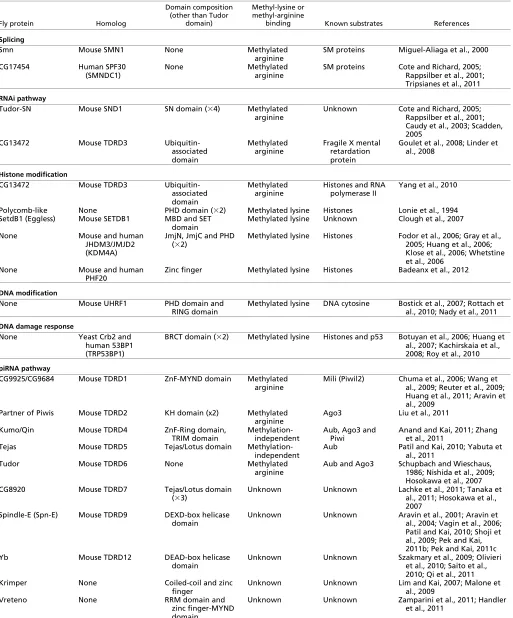
Fly protein Homolog
Domain composition (other than Tudor
domain)
Methyl-lysine or methyl-arginine
binding Known substrates References
Splicing
Smn Mouse SMN1 None Methylated
arginine
SM proteins Miguel-Aliaga et al., 2000
CG17454 Human SPF30
(SMNDC1)
None Methylated arginine
SM proteins Cote and Richard, 2005; Rappsilber et al., 2001; Tripsianes et al., 2011 RNAi pathway
Tudor-SN Mouse SND1 SN domain (⫻4) Methylated
arginine
Unknown Cote and Richard, 2005; Rappsilber et al., 2001; Caudy et al., 2003; Scadden, 2005
CG13472 Mouse TDRD3
Ubiquitin-associated domain
Methylated
arginine Fragile X mental retardation protein
Goulet et al., 2008; Linder et al., 2008
Histone modification
CG13472 Mouse TDRD3
Ubiquitin-associated domain
Methylated
arginine Histones and RNA polymerase II Yang et al., 2010
Polycomb-like None PHD domain (⫻2) Methylated lysine Histones Lonie et al., 1994 SetdB1 (Eggless) Mouse SETDB1 MBD and SET
domain Methylated lysine Unknown Clough et al., 2007
None Mouse and human
JHDM3/JMJD2 (KDM4A)
JmjN, JmjC and PHD (⫻2)
Methylated lysine Histones Fodor et al., 2006; Gray et al., 2005; Huang et al., 2006; Klose et al., 2006; Whetstine et al., 2006
None Mouse and human
PHF20
Zinc finger Methylated lysine Histones Badeanx et al., 2012
DNA modification
None Mouse UHRF1 PHD domain and
RING domain Methylated lysine DNA cytosine Bostick et al., 2007; Rottach et al., 2010; Nady et al., 2011 DNA damage response
None Yeast Crb2 and
human 53BP1 (TRP53BP1)
BRCT domain (⫻2) Methylated lysine Histones and p53 Botuyan et al., 2006; Huang et al., 2007; Kachirskaia et al., 2008; Roy et al., 2010 piRNA pathway
CG9925/CG9684 Mouse TDRD1 ZnF-MYND domain Methylated arginine
Mili (Piwil2) Chuma et al., 2006; Wang et al., 2009; Reuter et al., 2009; Huang et al., 2011; Aravin et al., 2009
Partner of Piwis Mouse TDRD2 KH domain (x2) Methylated
arginine Ago3 Liu et al., 2011
Kumo/Qin Mouse TDRD4 ZnF-Ring domain,
TRIM domain
Methylation-independent
Aub, Ago3 and Piwi
Anand and Kai, 2011; Zhang et al., 2011
Tejas Mouse TDRD5 Tejas/Lotus domain
Methylation-independent Aub Patil and Kai, 2010; Yabuta et al., 2011
Tudor Mouse TDRD6 None Methylated
arginine
Aub and Ago3 Schupbach and Wieschaus, 1986; Nishida et al., 2009; Hosokawa et al., 2007
CG8920 Mouse TDRD7 Tejas/Lotus domain
(⫻3) Unknown Unknown Lachke et al., 2011; Tanaka et al., 2011; Hosokawa et al., 2007
Spindle-E (Spn-E) Mouse TDRD9 DEXD-box helicase
domain Unknown Unknown Aravin et al., 2001; Aravin et al., 2004; Vagin et al., 2006; Patil and Kai, 2010; Shoji et al., 2009; Pek and Kai, 2011b; Pek and Kai, 2011c
Yb Mouse TDRD12 DEAD-box helicase
domain Unknown Unknown Szakmary et al., 2009; Olivieri et al., 2010; Saito et al., 2010; Qi et al., 2011
Krimper None Coiled-coil and zinc
finger
Unknown Unknown Lim and Kai, 2007; Malone et al., 2009
Vreteno None RRM domain and
zinc finger-MYND domain
Unknown Unknown Zamparini et al., 2011; Handler et al., 2011
53BP1, transformation related protein 53 binding protein 1; Ago3, Argonaute 3; Mili, Piwi-like homolog 2; Aub, Aubergine; JHDM3/JMJD2, lysine (K)-specific demethylase 4A; PHF20, PHD finger protein 20; SETDB1, SET domain, bifurcated 1; SMN, survival of motoneuron; SND, staphylococcal nuclease and tudor domain containing 1; SPF30/SMNDC1, survival motor neuron domain containing 1; TDRD, Tudor domain containing; UHRF1, ubiquitin-like, containing PHD and RING finger domains, 1.
D
E
V
E
LO
P
M
E
N
function as an effector to regulate piRNA processing. Another Tudor domain protein, Vreteno (Vret), also localizes to the Yb body and functions in the primary processing pathway (Table 1) (Zamparini et al., 2011; Handler et al., 2011). Vret contains RRM (RNA recognition motif) and MYND (myeloid, Nervy and DEAF-1) domains, and physically interacts with proteins required for primary processing, such as Piwi, Armi, Yb and Zucchini; therefore, it may act as both an adaptor and an effector in the repression of transposons in somatic follicle cells. However, it is currently unclear whether the binding of Yb and Vret to their partners is dependent on arginine methylation, and the exact molecular roles of the components in the primary processing pathway remain unclear.
Unlike in somatic cells, piRNAs in Drosophilagermline cells are generated by both primary and secondary processing pathways. The secondary pathway leads to amplification of mature piRNAs via the ping-pong cycle. The Piwi proteins Aub and Ago3 are central to this cycle, in which Aub-bound piRNAs in antisense orientation trigger the cleavage of the sense target (base paired to the antisense piRNA) to produce piRNAs in sense orientation. These sense piRNAs are loaded onto Ago3 and trigger cleavage of the antisense precursors to yield more antisense piRNAs (Fig. 4B). This secondary processing pathway is conserved in other animals, such as mouse and zebrafish (Siomi et al., 2011). Many of the proteins involved in this amplification cycle contain Tudor domains (Table 1) and exhibit a characteristic localization to the perinuclear
PRMT
Me
SM proteins
PRMT
Me
PRMT
SMN complex
U snRNA
PRMT SMN
complex
U snRNP
Me
[image:5.612.53.527.58.204.2]SMN complex
Fig. 2. Pre-mRNA splicing and spliceosome assembly. The assembly and maturation of small nuclear ribonucleoproteins (snRNPs) is mediated by the survival of motoneuron (SMN) protein complex. SM proteins are methylated (Me) by protein arginine methyltransferases (PRMTs), a process that promotes the binding of the SMN complex to the SM proteins. The SMN complex, together with SM proteins, binds to snRNAs and promotes the assembly and maturation of snRNPs. Tudor domain proteins are represented in orange.
Argonaute siRNA/miRNA-generating
loci (DNA)
Exogenous
Dicer
Hairpin RNA (miRNA precursor) Double-
stranded RNA (siRNA precursor)
Argonaute Argonaute
mRNA degradation Translation repression
Tudor-SN
TDRD3 FMRP
Transcription repression Argonaute HP1
Drosha ?
Me
Fig. 3. The miRNA and siRNA pathways. Exogenous double-stranded RNAs and double-double-stranded RNAs generated from endogenous loci are processed to form siRNAs/endo-siRNAs, while hairpin RNA transcripts form miRNAs. Both types of small RNAs are loaded into RNA-induced silencing complexes (RISCs) to regulate gene expression via mRNA degradation, translational repression or transcriptional silencing. The mechanism of regulation depends on the degree of complementarity between the small RNA and its target, as well as on cellular context. Red and dark-blue lines represent RNA and DNA, respectively. Tudor domain proteins are represented in orange. FMRP, fragile X mental retardation protein (FMRP); HP1, heterochromatin protein 1; Me, methyl; SN, staphylococcal nuclease.
D
E
V
E
LO
P
M
E
N
[image:5.612.51.417.437.736.2]nuage (an electron-dense structure) in the cytoplasm of germline cells in Drosophila, zebrafish and mouse (Fig. 4C,D) (Voronina et al., 2011; Pek et al., 2012; van der Heijden et al., 2010). Drosophila Aub and Ago3, and mouse MIWI, MILI and MIWI2 (which are required for the secondary amplification of piRNAs) also localize to the nuage. For this reason, the nuage has been proposed as the site where secondary amplification occurs (Arkov and Ramos, 2010; Pek et al., 2012; Siomi et al., 2011). Interestingly, in both mouse and Drosophila, the interaction of specific Tudor domain proteins, such as mouse TDRD1, TDRD2 and TDRD9 and fly Tudor and Partner of Piwis (Papi), with the Piwi proteins, is regulated by PRMT5 in mammals (or by Capsuleen in flies), which also localizes to the nuage, suggesting that these interactions are dependent on the arginine methylation of their partners (Kirino et al., 2009; Vagin et al., 2009; Anne et al., 2007; Anne and Mechler, 2005; Liu et al., 2011; Nishida et al., 2009).
Some Tudor domain proteins that localize to the nuage may function via their RNA-binding activities. Two DrosophilaTudor domain proteins, Tejas (Tej) and Spindle-E (Spn-E), have been proposed to function together in the assembly of the nuage, the production of germline piRNAs and the repression of transposons (Vagin et al., 2006; Lim and Kai, 2007; Patil and Kai, 2010). Similarly, mouse TDRD5 (a Tej homolog) is also required for nuage formation and retrotransposon Line-1 repression; however, its role in piRNA production is unknown (Yabuta et al., 2011). Tej contains a Tejas/Lotus domain that has been implicated in double-stranded RNA binding, whereas Spn-E contains a DSpn-EXD-box helicase domain (Table 1) (Patil and Kai, 2010; Anantharaman et al., 2010; Callebaut and Mornon, 2010; Gillespie and Berg, 1995). In Drosophila, Tej binds to Spn-E and Aub, and its interaction with Aub appears to be independent of arginine methylation (Partil and Kai, 2010). Tej and Spn-E are required for the recruitment of many piRNA pathway proteins, such as Aub, Krimper (Krimp), Ago3 and Maelstrom (Mael) to the nuage (Lim and Kai, 2007; Patil and Kai, 2010; Findley et al., 2003; Pek et al., 2009). Therefore, these proteins may function together as both adaptor and effector proteins in a subcomplex that links transposons and precursor piRNAs to piRNA-loaded Aub/Ago3 for effective ping-pong cycling via RNA-binding domains.
Recently, a unique Tudor domain protein Kumo/Qin has been reported to be involved in transposons silencing by secondary piRNA processing. DrosophilaKumo/Qin contains five Tudor domains and an E3 ligase domain (Table 1), and loss of kumo/qin results in an increase in the sense piRNAs from a few clusters and transposon families (Anand and Kai, 2011; Zhang et al., 2011). The two studies used different alleles and reported different degrees of piRNA loss; in neither case was the depletion as severe as that observed in other nuage components. Kumo/Qin localizes to the nuage and interacts with other piRNA pathway components such as Aub, Ago3, Vasa and Spn-E, and kumo/qinis required for the proper assembly of all the examined nuage components (Anand and Kai, 2011). The analysis of Aub-and Ago3-bound piRNAs in the kumo/qin mutant ovaries by Zhang et al. (Zhang et al., 2011) demonstrated the loss of Aub:Ago3 ping-pong and the increase in Aub:Aub ping-pong, suggesting that kumo/qin may function to maintain the heterotypic ping-pong between Aug and Ago3. The role of the E3 ligase domain of Kumo/Qin remains unknown, but it may regulate protein stability via ubiquitin-mediated protein degradation. The mouse homologue of Kumo/Qin, TDRD4/RNF17 (ring finger protein 17), which also localizes to the nuage, is important for spermatogenesis; however, its requirement for piRNA production is not known (Pan et al., 2005).
In addition to functioning directly in the processing of piRNAs, some Tudor domain proteins that localize to the nuage have been linked to the P-body in Drosophila(Box 2). Two of these proteins are Papi and Krimp (Table 1) (Lim and Kai, 2007; Liu et al., 2011). Papi contains a Tudor domain and two K homology (KH) domains, that may bind RNA (Table 1) (Liu et al., 2011). Papi functions as an adaptor by interacting with symmetric di-methyl-arginines of Ago3 and recruiting them to the nuage for transposon silencing. This function is probably conserved in the mouse Papi homolog TDRD2 (Chen et al., 2009; Vagin et al., 2009). Furthermore, in Drosophila, Papi physically associates with two P-body proteins, Tral and Me31B, suggesting that transposon silencing may be linked to P-body-mediated mRNA degradation. Like Papi, Krimp has also been linked to the Me31B, Dcp1/2 and Pcm P-body components, and it also is required for the generation of germline piRNAs via the ping-pong cycle (Malone et al., 2009; Lim et al., 2009). However, the binding partners, molecular functions and mammalian homolog of Krimp are currently unknown. Interestingly, another conserved Tudor domain protein, Ovarian Tumor (Otu), localizes to the P-body (Keyes and Spradling, 1997), but it has not yet been implicated in the piRNA pathway. The relationship between nuage proteins and P-body components is conserved: the Spn-E homolog TDRD9 forms a complex with MIWI2 and colocalizes with MIWI2 and MAEL in piP-bodies (cytoplasmic structures that also contain P body components), and it is required for Line-1 repression and piRNA production in the mouse male germline (Shoji et al., 2009; Aravin et al., 2009).
Some Tudor domain proteins that repress transposons do not appear to be required for piRNA production. In the mouse, TDRD7 localizes to the nuage and is essential for Line-1 retrotransposon repression but is not required for piRNA production (Table 1) (Lachke et al., 2011; Tanaka et al., 2011; Hosokawa et al., 2007). Similarly, TDRD1 localizes to the nuage and represses the expression of retrotransposons in mice and zebrafish (Table 1) (Chuma et al., 2006; Wang et al., 2009; Reuter et al., 2009; Huang et al., 2011). The Tudor domain of TDRD1 physically interacts with MILI/ZILI via symmetric di-methylarginines, and it is Box 2. Processing bodies and stress granules
Processing bodies (P-bodies) and stress granules (SGs) are microscopically visible structures in the cells containing mRNAs that are stalled during translation. P-bodies are always present in cells, whereas SGs appear under stressful conditions. P-bodies are considered to be sites for degradation and miRNA-based silencing of specific mRNAs. However, it is unclear whether the formation of P-bodies is a cause or a consequence of RNA silencing. P-bodies contain cap-binding proteins, decapping enzymes, RNases and proteins involved in miRNA-mediated silencing and general mRNA repression (Thomas et al., 2011).
By contrast, SGs mainly function to achieve global translational silencing, but they also activate synthesis of specific proteins to cope with various forms of stress, such as exposure to chemicals, heat shock and DNA damage. Therefore, SGs formed under different circumstances may differ in their composition; included proteins can range from signal transduction proteins and RNA helicases to apoptotic proteins. SG formation is often triggered by the phosphorylation of EIF2, the degradation of tRNAs or polysome disassembly, which lead to the aggregation of non-functional translation initiation complexes (Anderson and Kedersha, 2009).
D
E
V
E
LO
P
M
E
N
required for the formation of nuage but not for the production of piRNAs (Wang et al., 2009; Reuter et al., 2009; Huang et al., 2011). These data imply that besides piRNA amplification, the nuage may have another distinct role downstream of piRNA biogenesis in transposon silencing.
The protein in which the Tudor domain was initially discovered, Tudor, is a component of the nuage and pole plasm in Drosophila (Table 1). The pole plasm contains electron-dense organelles called polar granules that are composed of many proteins [including Tudor, Vasa, Staufen, Pgc (polar granule component) and Aub] and RNAs (such as oskar, cyclin Band hsp83), which are required for germline formation in the next generation (Thomson and Lasko, 2005). In the absence of Tudor, pole plasm assembly is disrupted, with consequent defects in the germline. More recent studies have suggested a function for Tudor in the nuage for the production of piRNAs in Drosophila (Nishida et al., 2009). Tudor binds to Aub and Ago3 in a symmetric di-methylated arginine-dependent fashion, probably functioning as an adaptor to regulate ping-pong
amplification. However, although Tudor regulates piRNA production, it is not required for transposon silencing (Lim and Kai, 2007; Handler et al., 2011).
In summary, many Tudor domain proteins localize to specific structures (such as the nuage and Yb body) in the gonads, and they are required for the assembly of these structures. Especially for piRNA production, it is evident that Tudor domain proteins function as scaffolds for multiple adaptors via binding to methylated arginines on Piwi family proteins (Chen et al., 2009; Chen et al., 2011; Kirino et al., 2009; Liu et al., 2010a; Liu et al., 2010b; Liu et al., 2011; Nishida et al., 2009; Siomi et al., 2010; Vagin et al., 2009). The additional catalytic domains on some Tudor domain proteins appear to be important for processing piRNAs to exert their function as effectors.
Other functions for Tudor domain proteins
We have discussed various Tudor domain proteins that recognize methylated arginines in order to mediate their functions in RNA metabolism. In the next section, we discuss how other Tudor
C
D
Krimp
DAPI
B
piRNA locusPrimary processing
U 3⬘ 5⬘
Aub
3⬘
5⬘
U
A
A
Ago3
A
Ago3
Aub
5⬘ 3⬘
3⬘
5⬘ A
Ago3
3⬘ U 5⬘
U
3⬘ 5⬘
Aub
3⬘ end trimming 3⬘ end
trimming
A
Piwi Armi Piwi
3⬘ 5⬘
Yb body Nucleus
3’ 5’
Transcription
3⬘ 5⬘
3⬘ 5⬘
piRNA locus
Transcription
Primary processing Mature
piRNA
Yb
Vret Precursor
[image:7.612.61.552.61.419.2]piRNA
Fig. 4. piRNA biogenesis. (A)Primary processing of piRNAs involves the Tudor domain proteins Yb and Vreteno (Vret). It also involves Piwi and Armitage (Armi), which localize to the Yb body. Mature Piwi-piRNA complex shuttles into the nucleus for its function in transcription regulation. (B)The ping-pong cycle involves the Piwi subfamily proteins Aubergine (Aub) and Argonaute 3 (Ago3). Mature antisense piRNAs generated in the primary pathway are loaded onto Aub, which target and slice sense transposon RNAs. Cleaved sense RNAs are loaded onto Ago3 to be further processed into mature sense piRNAs. Ago3-piRNA complexes target and cleave the antisense piRNA precursors. Antisense piRNAs are loaded onto Aub and are further processed into mature piRNAs. Red lightning indicates slicer activity. A, adenine; U, uracil. (C) Electron micrograph of a Drosophilagermline cell showing the electron-dense nuages (black arrows). Scale bar: 2mm. (D)Immunostaining of a Drosophilaovariole showing the perinuclear localization of Krimper (Krimp) (green). DNA, marked by DAPI, is in blue. Tudor domain proteins are in orange.
D
E
V
E
LO
P
M
E
N
domain proteins function to regulate the DNA damage response and chromatin organization by recognizing methylated histone lysines and arginines.
Tudor domain proteins in the DNA damage response
The DNA damage response (DDR) is an evolutionarily conserved pathway that protects the genome from insults from external stimuli (van Attikum and Gasser, 2009; Polo and Jackson, 2011). This pathway involves a cascade of events that begins with sensing of the DNA damage through adaptor proteins and ends with effectors triggering a set of responses, such as cell cycle arrest, DNA repair, transcriptional changes and/or apoptosis. The human p53-binding protein 1 (53BP1 or TRP53BP1) is a Tudor domain protein that is linked to the DDR. 53BP1 acts downstream of DNA damage sensors such as MRN [MRE11 (meiotic recombination 11)-RAD50-NBS1 (Nijmegen breakage syndrome 1)], PIKKs (phosphoinositide 3-kinase-like kinases), ATM (ataxia telangiectasia mutated) and ATR (ATM and RAD3-related) (FitzGerald et al., 2009). The Tudor domain of 53BP1 mediates its binding to histone H4 dimethylated at Lys20, which are sensors that accumulate at the sites of DNA damage (Botuyan et al., 2006). Ubiquitylation of 53BP1 by the ubiquitin ligases ring finger (RNF) 8 and RNF168 facilitates recruitment of AAA-ATPase valosin-containing protein (VCP, also known as p97) to site of DNA damage, which in turn removes the L3MBTL1 protein from H3K4 Lys20 methylated sites and promotes binding of 53BP1 at these marks (Acs et al., 2011; Doil et al., 2009; Kolas et al., 2007). The Tudor domain of 53BP1 also functions as the adaptor in the DDR by promoting effector recruitment to the site of DNA damage. The loaded effectors, such as check point kinase 1 (CHEK1), check point kinase 2 (CHEK2) and ATM, in turn activate the DDR, thereby linking the sensors to the final output (van Attikum and Gasser, 2009; FitzGerald et al., 2009).
53BP1 also interacts with multiple methylated lysines of p53 during the DDR (Huang et al., 2007; Kachirskaia et al., 2008; Roy et al., 2010). Methylation of p53 by Set9 promotes its binding to 53BP1 and increases its stability and downstream transcriptional activation of genes such as p21to induce G1 cell cycle arrest and allow DNA repair during the DDR (Chuikov et al., 2004; Kachirskaia et al., 2008). Taken together, 53BP1 plays multiple roles in the DDR by regulating multiple proteins.
Tudor domain proteins that interact with modified histones
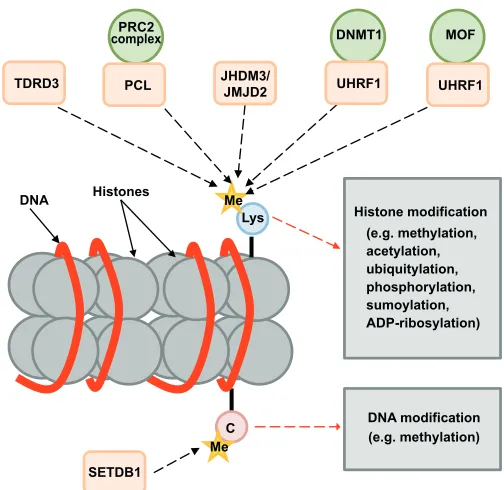
Tudor domain proteins also function to regulate DNA packaging during development. Modifications of histone tails and DNA have been reported to be major mechanisms that regulate the transcriptional activity of chromatin (Box 3, Fig. 5). These modifications function as ‘marks’ and are characteristic of transcriptional activation or repression via the so-called histone code (Strahl and Allis, 2000; Berger, 2002; Peterson and Laniel, 2004). Among those, Tudor domain proteins recognize particular methylated arginines and lysines and recruit downstream effectors that, in turn, can promote chromatin activation or silencing in a context-dependent manner. As the roles of Tudor domain proteins that bind to methylated histones have been thoroughly summarized (Adams-Cioaba and Min, 2009), we will focus on a few representative examples.
As in other examples discussed above, some of the Tudor domain proteins that bind methylated histones possess catalytic domains thereby also functioning as effectors. An example of transcriptional activation by a Tudor domain protein involves human TDRD3 (Table 1), discussed above as a SG component. In addition to this cytoplasmic function, TDRD3 in the nucleus specifically recognizes and binds to methylated arginines of histones to promote transcription of regions such as estrogen-responsive element (Yang et al., 2010). In addition, the Tudor domain of TDRD3 can also bind to a CARM1 (co-activator-associated arginine methyltransferase 1) Histone modification Histones
DNA
DNA modification (e.g. methylation)
TDRD3 PCL
PRC2 complex
Me
SETDB1
Me C
Lys JHDM3/
JMJD2 UHRF1
DNMT1
UHRF1 MOF
[image:8.612.312.564.56.301.2](e.g. methylation, acetylation, ubiquitylation, phosphorylation, sumoylation, ADP-ribosylation)
Fig. 5. DNA and histone modifications. DNA methylation on cytosine residues and modifications (including methylation) of the nucleosome histone tails recruit many factors that modulate chromatin structure and regulate gene expression. Among these are a number of Tudor domain proteins (orange), the binding of which to methyl groups has diverse consequences for transcriptional control. Tudor domain proteins are represented by orange boxes. DNMT1, DNA (cytosine-5)-methyltransferase 1; JHDM, Jumonji domain-containing; Lys, lysine; Me, methyl; MOF, male absent on the first; PCL, Polycomb-like; PRC2, Polycomb repressive complex 2; SETDB1, SET domain, bifurcated 1; TDRD3, Tudor domain containing 3; UHRF, ubiquitin-like, containing PHD and RING finger domains 1.
Box 3. Chromatin modification
Both the DNA and histone protein components of chromatin are subject to chemical modifications: DNA undergoes methylation, whereas histones are subjected to a wide variety of post-translational modifications (PTMs), such as methylation, acetylation, phosphorylation and ubiquitylation. Together, these constitute a code for genome organization and the regulation of gene expression. For example, a specific set of histone PTMs and DNA methylation can lead to tight packaging of DNA, making it inaccessible for transcription; this structure is termed heterochromatin. By contrast, other types of histone PTMs may lead to the opening of DNA to facilitate transcription. For example, methylation of H3K9 and H3K27 are representative of repressive marks, while methylation of H3K4 promotes transcription activation. However, the biological outcomes of PTMs often depend heavily on the chromatin context and the cellular context of the modification. DNA methylation and histone PTMs are dynamic, and are regulated by both intrinsic signals and environmental factors. In addition, some of these modifications are genetically transmitted to the next generation to regulate gene expression in the progeny – a process termed epigenetic inheritance.
D
E
V
E
LO
P
M
E
N
methylated site in the C-terminal domain of RNA polymerase II (RNAPII), suggesting that TDRD3 may also regulate the activity of RNAPII (Sims et al., 2011).
Unlike TDRD3, many other Tudor domain proteins function in transcription repression. These proteins recruit methyltransferases or function as methyltransferases themselves, and promote lysine methylation of the histone tails. One such factor, the Polycomb-like (PCL) protein contains a Tudor domain and two plant homeodomain (PHD) domains (Table 1). PCL functions as an adaptor to recruit core components of the Polycomb repressive complex 2 (PRC2), a histone H3K27 methyltransferase, to chromatin (Casanova et al., 2011). H3K27 methylation by PRC2 controls many developmental processes, including Drosophilapatterning, mouse embryonic stem cell self-renewal and differentiation, and X-chromosome inactivation (Nekrasov et al., 2007; Savla et al., 2008; Walker et al., 2010; Casanova et al., 2011). Histone methylation is also mediated by SETDB1 (Eggless in Drosophila), which contains two Tudor domains, a methyl-DNA-binding domain and a SET domain that methylates histone lysines (Clough et al., 2007). In Drosophila, SetdB1 (Egg) is important for oogenesis and the silencing of chromosome 4 (Clough et al., 2007; Tzeng et al., 2007; Seum et al., 2007). However, the roles of its Tudor domains and their potential binding partners are currently unknown.
Several Tudor domain transcriptional repressors promote the removal of methyl groups from histone lysine tails. One example is the human and mouse Jumonji domain-containing (JHDM3/JMJD2) family of proteins, which harbor two Tudor domains along with a Jumonji N (JmjN) domain, a Jumonji C (JmjC) domain and two PHD domains (Table 1). The Tudor domains of these proteins have been found to be essential for their interaction with methylated H3K4, H3K9 and H4K20, whereas the JmjN and JmjC domains have a demethylase activity that demethylates tri-methylated lysines at H3K9 and H3K36 (Huang et al., 2006; Whetstine et al., 2006; Klose et al., 2006; Cloos et al., 2006; Fodor et al., 2006; Kim et al., 2006). This family of proteins functions as effectors by binding to the co-repressor complex NCoR and has also been shown to repress E2F target genes by interacting with RB (retinoblastoma protein) (Gray et al., 2005; Zhang et al., 2005).
Besides regulating histone methylation, Tudor domain proteins can also regulate histone acetylation. PHF20 (plant homeo finger protein 20) contains a Tudor domain that binds dimethylated histone lysines. Although the precise mechanism is unclear, it is proposed to mediate crosstalk between histone lysine methylation and acetylation by recruiting the histone acetyltransferase MOF (male absent on the first) (Badeanx et al., 2012).
Finally, Tudor domain proteins can also promote transcriptional repression by mediating DNA methylation. For example, UHRF1 (ubiquitin-like, containing PHD and RING finger domains 1; also known as NP95 and ICBP90) functions to maintain DNA methylation during S phase in mammalian cells (Bostick et al., 2007). UHRF1 binds to H3K9me3 via its tandem Tudor domains and recruits DNMT1 [DNA (cytosine-5)-methyltransferase 1] to the chromatin to promote DNA methylation and heterochromatin assembly (Bostick et al., 2007; Rottach et al., 2010; Nady et al., 2011). In this way, UHRF1 functions to link histone lysine methylation to DNA methylation during the assembly of heterochromatin.
Conclusions
Tudor domain proteins function in diverse cellular processes and have wide-ranging effects in developmental processes and cellular events. Recent studies have shown that a large class of Tudor
domain proteins functions in the gonads to regulate gametogenesis and genome stability via the piRNA pathway. Despite the recent discovery that Tudor domains recognize methylated arginines/lysines on their substrates, there is still much to learn about how methyl-arginine/lysine binding relates to the known cellular functions of these proteins. Moreover, it is clear that many Tudor domain proteins cooperate in the same macromolecular complexes and processes, and the redundancies and interactions between them are still not well understood. Analysis of the spatial associations of individual Tudor domain proteins with other members of the family, with themselves (as oligomers) and with their binding partners should shed light on the molecular mechanisms underlying the functioning of Tudor domain protein complexes.
Acknowledgements
We thank members of the Ito and Kai Laboratories for discussion.
Funding
Research in the Kai laboratory was supported by the Temasek Life Sciences Laboratory and the Singapore Millennium Foundation.
Competing interests statement
The authors declare no competing financial interests.
References
Acs, K., Luijsterburg, M. S., Ackermann, L., Salomons, F. A., Hoppe, T. and Dantuma, N. P.(2011). The AAA-ATPase VCP/p97 promotes 53BP1 recruitment by removing L3MBTL1 from DNA double-strand breaks.Nat. Struct. Mol. Biol.
18, 1345-1350.
Adams-Cioaba, M. A. and Min, J.(2009). Structure and function of histone methylation binding proteins. Biochem. Cell Biol. 87, 93-105.
Anand, A. and Kai, T.(2011). The tudor domain protein Kumo is required to assemble the nuage and to generate germline piRNAs in Drosophila. EMBO J.
31, 870-882.
Anantharaman, V., Zhang, D. and Aravind, L.(2010). OST-HTH: a novel predicted RNA-binding domain. Biol. Direct5, 13.
Anderson, P. and Kedersha, N.(2009). RNA granules: post-transcriptional and epigenetic modulators of gene expression. Nat. Rev. Mol. Cell Biol.10, 430-436.
Anne, J. and Mechler, B. M.(2005). Valois, a component of the nuage and pole plasm, is involved in assembly of these structures, and binds to Tudor and the methyltransferase Capsuleen. Development132, 2167-2177.
Anne, J., Ollo, R., Ephrussi, A. and Mechler, B. M.(2007). Arginine methyltansferase Capsuleen is essential for methylation of spliceosomal Sm proteins and germ cell formation in Drosophila. Development 134, 137-146.
Aravin, A. A., Naumova, N. M., Tulin, A. V., Vagin, V. V., Rozovsky, Y. M. and Gvozdev, V. A.(2001). Double-stranded RNA-mediated silencing of genomic tandem repeats and transposable elements in the D. melanogaster germline. Curr. Biol.11, 1017-1027.
Aravin, A. A., Klenov, M. S., Vagin, V. V., Bantignies, F., Cavalli, G. and Gvozdev, V. A.(2004). Dissection of a natural RNA silencing process in the Drosophila melanogaster germ line. Mol. Cell. Biol.24, 6742-6750.
Aravin, A. A., van der Heijden, G. W., Castaneda, J., Vagin, V. V., Hannon, G. J. and Bortvin, A.(2009). Cytoplasmic compartmentalization of the fetal piRNA pathway in mice. PLoS Genet.5, e1000764.
Arkov, A. L. and Ramos, A.(2010). Building RNA-protein granules: insight from the germline. Trends Cell Biol. 20, 482-490.
Badeaux, A. I., Yang, Y., Cardenas, K., Vemulapalli, V., Chen, K., Kusewitt, D., Richie, E., Li, W. and Bedford, M. T.(2012). Loss of the methy lysine effector protein PHF20 impacts the expression of genes regulated by the lysine acetyltransfease MOF.J. Biol. Chem.287, 429-437.
Bedford, M. T. and Richard, S.(2005). Arginine methylation an emerging regulator of protein function. Mol. Cell 18, 263-272.
Bedford, M. T. and Clarke, S. G.(2009). Protein arginine methylation in mammals: who, what, and why. Mol. Cell33, 1-13.
Berger, S.(2002). Histone modifications in transcriptional regulation. Curr. Opin. Genet. Dev. 12, 142-148.
Bostick, M., Kim, J. K., Esteve, P. O., Clark, A., Pradhan, S. and Jacobsen, S. E.(2007). UHRF1 plays a role in maintaining DNA methylation in mammalian cells. Science317, 1760-1764.
Boswell, R. E. and Mahowald, A. P.(1985). Tudor, a gene required for assembly of the germ plasm in Drosophila melanogaster. Cell43, 97-104.
Botuyan, M. V., Lee, J., Ward, I. M., Kim, J. E., Thompson, J. R., Chen, J. and Mer, G.(2006). Structural basis for the methylation state-specific recognition of histone H4-K20 by 53BP1 and Crb2 in DNA repair. Cell127, 1361-1373.
D
E
V
E
LO
P
M
E
N
Boulanger, M. C., Miranda, T. B., Clarke, S., Di Fruscio, M., Suter, B., Lasko, P. and Richard, S.(2004). Characterization of the Drosophila protein arginine methyltransferase DART1 and DART4. Biochem. J.379, 283-289.
Brahms, H., Meheus, L., de Brabandere, V., Fischer, U., Luhrmann, R.(2001). Symmetrical dimethylation of arginine residues in spliceosomal Sm protein B/B’ and the Sm-like protein LSm4, and their interaction with the SMN protein. RNA
7, 1531-1542.
Bushati, N., Stark, A., Brennecke, J. and Cohen, S. M.(2008). Temporal reciprocity of miRNAs and their targets during the maternal-to-zygotic transition in Drosophila. Curr. Biol. 18, 501-506.
Callebaut, I. and Mornon, J. P.(1997). The human EBNA-2 coactivator p100: multidomain organization and relationship to the staphylococcal nuclease fold and to the tudor protein involved in Drosophila melanogasterdevelopment. Biochem. J.321, 125-132.
Callebaut, I. and Mornon, J. P.(2010). LOTUS, a new domain associated with small RNA pathways in the germline. Bioinformatics26, 1140-1144.
Casanova, M., Preissner, T., Cerase, A., Poot, R., Yamada, D., Li, X., Appanah, R., Bezstarosti, K., Demmers, J., Koseki, H. And Brockdorff, N.(2011). Polycomblike 2 facilitates the recruitment of PRC2 Polycomb group complexes to the inactive X chromosome and to target loci in embryonic stem cells. Development138, 1471-1482.
Caudy, A. A., Myers, M., Hannon. G. J. and Hammond, S. M.(2002). Fragile X-related protein and VIG associate with the RNA interference machinery. Genes Dev.16, 2491-2496.
Caudy, A. A., Ketting, R. F., Hammond, S. M., Denli, A. M., Bathoom, A. M., Tops, B. B., Silva, J. M., Myers, M. M., Hannon, G. J. and Plasterk, R. H.
(2003). A micrococcal nuclease homologue in RNAi effector complexes. Nature
425, 411-414.
Chen, C., Jin, J., James, D. A., Adams-Cioaba, M. A., Park, J. G., Guo, Y., Tenaglia, E., Xu, C., Gish, G., Min, J. and Pawson, T.(2009). Mouse Piwi interactome identifies binding mechanism of Tdrkh Tudor domain to arginine methylated Miwi. Proc. Natl. Acad. Sci. USA 106, 20336-20341.
Chen, C., Nott, T. J., Jin, J. and Pawson, T.(2011). Deciphering arginine methylation: Tudor tells the tale. Nat. Rev. Mol. Cell Biol. 12, 629-642.
Cheng, D., Cote, J., Shaaban, S. and Bedford, M. T.(2007). The arginine methytransferase CARM1 regulates the coupling of transcription and mRNA processing. Mol. Cell 25, 71-83.
Cho, J.-N., Ryu, J.-Y., Jeong, Y.-M., Park, J., Song, J.-J., Amasino, R. M., Noh, B. and Noh, Y.-S.(2012). Control of seed germination by light-induced histone arginine demethylation activity. Dev. Cell 22, 736-748.
Chuikov, S., Kurash, J. K., Wilson, J. R., Xiao, B., Justin, N., Ivanov, G. S., McKinney, K., Tempst, P., Prives, C., Gamblin, S. J., Barlev, N. A. and Reinberg, D.(2004). Regulation of p53 activity through lysine methylation. Nature432, 353-360.
Chuma, S., Hosokawa, M., Kitamura, K., Kasai, S., Fujioka, M., Hiyoshi, M., Takamune, K., Noce, T. and Nakatsuji, N.(2006). Tdrd1/Mtr-1, a tudor-related gene, is essential for male germ-cell differentiation and nuage/germinal granule formation in mice. Proc. Natl. Acad. Sci. USA103, 15894-15899.
Chung, W. J., Okamura, K., Martin, R. and Lai, E. C.(2008). Endogenous RNA interference provides a somatic defense against Drosophila transposons. Curr. Biol. 18, 795-802.
Cloos, P. A., Christensen, J., Agger, K., Maiolica, A., Rappsilber, J., Antal, T., Hansen, K. H. and Helin, K.(2006). The putative oncogene GASC1 demethylates tri- and dimethylated lysine 9 on histone H3. Nature442, 307-311.
Clough, E., Moon, W., Wang, S., Smith, K. and Hazelrigg, T.(2007). Histone methylation is required for oogenesis in Drosophila. Development134, 157-165.
Cote, J. and Richard, S.(2005). Tudor domains bind symmetrical dimethylated arginines. J. Biol. Chem.280, 28476-28483.
Czech, B., Malone, C. D., Zhou, R., Stark, A., Schlingeheyde, C., Dus, M., Perrimon, N., Kellis, M., Wohlschlegel, J. A., Sachidanandam, R., Hannon, G. J. and Brennecke, J.(2008). An endogenous small interfering RNA pathway in Drosophila. Nature453, 798-802.
Doil, C., Mailand, N., Bekker-Jensen, S., Menard, P., Larsen, D. H., Pepperkok, R., Ellenberg, J., Panier, S., Durocher, D., Bartek, J. et al.
(2009). RNF168 binds and amplifies ubiquitin conjugates on damaged chromosomes to allow accumulation of repair proteins. Cell136, 435-446.
Edbauer, D., Neilson, J. R., Foster, K. A., Wang, C. F., Seeburg, D. P., Batterton, M. N., Tada, T., Dolan, B. M., Sharp, P. A. and Sheng, M.(2010). Regulation of synaptic structure and function by FMRP-associated microRNAs miR-125b and miR-132. Neuron65, 373-384.
Findley, S. D., Tamanaha, M., Clegg, N. J. and Ruohola-Baker, H.(2003). Maelstrom, a Drosophila spindle-class gene, encodes a protein that colocalizes with Vasa and RDE1/AGO1 homolog, Aubergine, in nuage. Development130, 859-871.
Fischer, U., Liu, Q. and Dreyfuss, G.(1997). The SMN-SIP1 complex has an essential role in spliceosomal snRNP biogenesis. Cell90, 1023-1029.
FitzGerald, J. E., Grenon, M. and Lowndes, N. F.(2009). 53BP1: function and mechanisms of focal recruitment. Biochem. Soc. Trans. 37, 897-904.
Fodor, B. D., Kubicek, S., Yonezawa, M., O’Sullivan, R. J., Sengupta, R., Perez-Burgos, L., Opravil, S., Mechtler, K., Schotta, G. and Jenuwein, T.
(2006). Jmjd2b antagonizes H3K9 trimethylation at pericentric heterochromatin in mammalian cells. Genes Dev. 20, 1557-1562.
Friberg, A., Corsini, L., Mourao, A. And Sattler, M.(2009). Structure and ligang binding of the extended Tudor domain of D. melanogaster Tudor-SN. J. Mol. Biol.387, 921-934.
Friesen, W. J., Massenet, S., Paushkin, S., Wyce, A. and Dreyfuss, G.(2001). SMN, the product of the spinal muscular atrophy gene, binds preferentially to dimethylarginine-containing protein targets.Mol. Cell 7, 1111-1117.
Galiana-Arnoux, D., Dostert, C., Schneemann, A., Hoffmann, J. A. and Imler, J. L.(2006). Essential function in vivo for Dicer-2 in host defense against RNA viruses in drosophila. Nat. Immunol.7, 590-597.
Gao, X., Ge, L., Shao, J., Su, C., Zhao, H., Saarikettu, J., Yao, X., Yao, Z., Silvennoinen, O. and Yang, J.(2010). Tudor-SN interacts with and co-localizes with G3BP in stress granules under stress conditions. FEBS Lett.584, 3525-3532.
Gary, J. D. and Clarke, S.(1998). RNA and protein interactions modulated by protein arginine methylation. Prog. Nucleic Acid Res. Mol. Biol.61, 65-131.
Ghildiyal, M. and Zamore, P. D.(2009). Small silencing RNAs: an expanding universe. Nat. Rev. Genet.10, 94-108.
Ghildiyal, M., Seitz, H., Horwich, M. D., Li, C., Du, T., Lee, S., Xu, J., Kittler, E. L., Zapp, M. L., Weng, Z. and Zamore, P. D.(2008). Endogenous siRNAs derived from transposons and mRNAs in Drosophila somatic cells. Science320, 1077-1081.
Gillespie, D. E. and Berg, C. A.(1995). Homeless is required for RNA localization in Drosophila oogenesis and encodes a new member of the DE-H family of RNA-dependent ATPases. Genes Dev. 9, 2495-2508.
Goulet, I., Boisvenue, S., Mokas, S., Mazroui, R. and Cote, J.(2008). TDRD3, a novel Tudor domain-containing protein, localizes to cytoplasmic stress granules. Hum. Mol. Genet. 17, 3055-3074.
Gray, S. G., Lglesias, A. H., Lizcano, F., Villanueva, R., Camelo, S., Jingu, H., The, B. T., Koibuchi, N., Chin, W. W., Kokkotou, E. and Dangond, F.(2005). Functional characterization of JMJD2A, a histone deacetylase- and
retinoblastoma-binding protein. J. Biol. Chem.280, 28507-28518.
Gubitz, A. K., Feng, W. and Dreyfuss, G.(2004). The SMN complex. Exp. Cell Res.296, 51-56.
Gunawardane, L. S., Saito, K., Nishida, K. M., Miyoshi, K., Kawamura, Y., Nagami, T., Siomi, H. and Siomi, M. C.(2007). A slicer-mediated mechanism for repeat-associated siRNA 5⬘end formation in Drosophila. Science315, 1587-1590.
Guo, H., Ingolia, N. T., Weissman, J. S. and Bartel, D. P.(2010). Mammalian microRNAs predominantly act to decrease target mRNA levels. Nature466, 835-840.
Han, J., Xiong, J., Wang, D. and Fu, X. D.(2011). Pre-mRNA splicing: where and when in the nucleus. Trends Cell Biol. 21, 336-343.
Handler, D., Olivieri, D., Novatchkova, M., Gruber, F. S., Meixner, K., Mechtler, K., Stark, A., Sachidanandam, R. and Brennecke, J.(2011). A systematic analysis of Drosophila TUDOR domain-containing proteins identifies Vreteno and the Tdrd12 family as essential primary piRNA pathway factors. EMBO J.30, 3977-3993.
Hatfield, S. D., Shcherbata, H. R., Fischer, K. A., Nakahara, K., Carthew, R. W. and Ruohola-Baker, H.(2005). Stem cell division is regulated by the microRNA pathway. Nature435, 974-978.
Hosokawa, M., Shoji, M., Kitamura, K., Tanaka, T., Noce, T., Chuma, S. and Nakatsuji. N.(2007). Tudor-related proteins TDRD1/MTR-1, TDRD6 and TDRD7/TRAP: domain composition, intracellular localization, and function in male germ cells in mice. Dev. Biol. 301, 38-52.
Huang, Y., Fang, J., Bedford, M. T., Zhang, Y. and Xu, R.(2006). Recognition of histone H3 lysine-4 methylation by the double tudor domain of JMJD2A. Science
312, 748-751.
Huang, J., Sengupta, R., Espejo, A. B., Lee, M. G., Dorsey, J. A., Richter, M., Opravil, S., Shiekhattar, R., Bedford, M. T., Jenuwein, T. and Berger, S. L.
(2007). p53 is regulated by the lysine demethylase LSD1. Nature449, 105-108.
Huang, H. Y., Houwing, S., Kaaij, L. J., Meppelink, A., Redl, S., Gauci, S., Vos, H., Draper, B. W., Moens, C. B., Burgering, B. M. et al.(2011). Tdrd1 acts as a molecular scaffold for Piwi proteins and piRNA targets in zebrafish. EMBO J.
30, 3298-3308.
Jin, P., Zarnescu, D. C., Ceman, S., Nakamoto, M., Mowrey, J., Jongens, T. A., Nelson, D. L., Moses, K. and Warren, S. T.(2004). Biochemical and genetic interaction between the fragile X mental retardation protein and the microRNA pathway. Nat. Neurosci.7, 113-117.
Kachirskaia, I., Shi, X., Yamaguchi, H., Tanoue, K., Wen, H., Wang, E. W., Appella, E. and Gozani, O.(2008). Role of 53BP1 Tudor domain recognition of p53 dimethylated at lysine 382 in DNA damage signaling.J. Biol. Chem.283, 34660-34666.
Kawamura, Y., Saito, K., Kin, T., Ono, Y., Asai, K., Sunohara, T., Okada, T. N., Siomi, M. C. and Siomi, H.(2008). Drosophila endogenous small RNAs bind to Argonuate 2 in somatic cells. Nature453, 793-797.
Kawaoka, S., Izumi, N., Katsuma, S. and Tomari, Y.(2011). 3⬘end formation of PIWI-interacting RNAs in vitro. Mol. Cell 43, 1015-1022.