Journal of Criminal Law and Criminology
Volume 13 | Issue 4
Article 7
1923
Notes and Abstracts
Follow this and additional works at:
https://scholarlycommons.law.northwestern.edu/jclc
Part of the
Criminal Law Commons,
Criminology Commons, and the
Criminology and Criminal
Justice Commons
This Note is brought to you for free and open access by Northwestern University School of Law Scholarly Commons. It has been accepted for inclusion in Journal of Criminal Law and Criminology by an authorized editor of Northwestern University School of Law Scholarly Commons.
Recommended Citation
NOTES AND ABSTRACTS
Report on the Operation of the New Zealand Offenders Probation Act for the Year 1921-1922.-"Until the presentation of my last year's report, th6 operations under the First Offenders Probation Act of 1886 (consolidated 1908) were dealt with as a section of the annual Prisons Report, but the passing of the Offenders Probation Act, 1920, so enlarged the scope of the probation system that it became necessary to publish an independent report in order that the work of this important branch of my Department should receive the attention it merited. When the 1921 report was written the new Act had been in force for only seven months. It was therefore impos-sible to make any definite comparison between the figures under the old
and new systems. We have now, however, been working under the
new Act for twenty months, and have the statistician's figures for the full calendar year 1921.- We are thus enabled to arrive at a conclusion as to the extent to which the courts have availed themselves of the discretion given them to grant probation to all classes of offenders whether previously con-victed or not. The table below indicates clearly the increase in the number of offenders placed upon probation during the first full year under the amending Act, compared with the last twelve months under the old Act.
Number of Offenders Placed on Probation, Showing Periods of Probation
E W o ' .x>5l E
1921 ... 1 27 209 .. 5 190 117 9 17 575 1920 ... .. 14 96 .. 2 90 61 1 .. 264
Increase, 1921 over 1920 ... 1 13 113 .. 3 100 56 8 17 311
"From the foregoing table it will be seen that the number of persons placed on probation under the new Act is 117.8 per cent greater than under the original Act. This appears to indicate that the wider discretion given to the courts was appreciated both by judges and magistrates, as enabling them to vary to a greater extent than was previously possible the treatment to be applied in the various cases coming before them. In other words, it permitted a nearer approach to the individualization of punishment than under the former more rigid conditions.
PROBATION ACT 597
by the probation officers, the system will be abused and its good effect largely nullified. The New York State Probation Commission in its last year's report makes the following statement in regard to this question:
"'The commission has alhays urged that too much emphasis cannot be placed upon the need for careful discrimination in the use of probation, based on a thorough investigation and knowledge of the previous record in each case. The commission has never advocated, and never will advocate, pro-bation as a cure-all or as a treatment to be applied even once in every case. Some offenders should never be placed on probation; others may wisely be given more than one chance. The individual good judgment of the court and the probation officers must decide. . . . The method is most suc-cessful when applied to a large class of so-called accidental offenders, and others not inherently criminal but with delinquent tendencies exaggerated by improper environment and association. With this class of delinquents, which far outnumbers the professional kind, probation succeeds in the vast major-ity of cases, when applied as a real system of discipline and helpfulness.'
"In this country, as in others, there are many persons, both among the general public and even among those engaged in the administration of the criminal law, who assert that imprisonment is the only proper and adequate method of dealing with law-breakers; but that is not the opinion of Sir Evelyn Ruggles-Brise, K.C.B., Chairman of the Prison Commission for England and Wales, who, in his work The English Prison System, makes the following statement:
"'This is the meaning of the "individualization of punishment"-it is quite consistent with a firm administration of penal justice, but it destroys forever the old classcal idea of the "abstract type of criminal." In other words, justice demands that the old formula of "imprisonment with or
with-out hard labor," indiscriminately applied, shall 1o longer be held to satisfy all her clahns. The reaction against this so-called dosimitrie pinale-i. e.,
the abstract conception of crime and the mechanical application of punish-ment "according.to code," is a growing force. It is marked in the United States of America by the universal adoption of the "indeterminate sentence," and on the Continent of Europe by various decrees for conditional convic-tion and liberaconvic-tion which find their place in the latest penal codes. In England and America, probation; in France and Belgium, the sursis a l'execution
de la pehne-all mark the reluctance to resort to fixed penalties when justice
can be satisfied by other means.'
"From the quotations I have given it is apparent that the efficacy of probation as a 'treatment' to be applied in proper cases is well established, at all events, in the majority of English-speaking countries.
598 PROBATION ACT
Departmental and General
"Provision having been made under the 1920 Act for the appointment
of persons 'of either sex' as probation officers, four ladies'were
appointed-one in each center-to supervise the female probatiappointed-oners. This departure
from the older system, under which we had power only to appoint male probation officers, has worked out very satisfactorily.
"In view of the large increase in the volume of probation work, due to the passing of the new Act, it became necessary to appoint a deputy chief
probation officer to assist at headquarters. The appointment was conferred
upon Mr. D. A. Mackintosh, chief clerk of the Prisons Department, who is now the sectional head of the Probation Branch.
"During the year we lost the services of one of our most enthusiastic and hardworking honorary probation officers in the person of the Rev. F. R. Jeffreys, of Auckland, under whose able and sympathetic management in the
northern city district the system has been built up and consolidated. Mr.
Jeffreys's loss will be severely felt not only by the Department, of which he was a highly valued and efficient honorary officer, but by the probationers,
to whom he was guide, philosopher, and friend for so many years. Mr.
Jeffreys has been succeeded by Mr. W. J. Campbell, of the Auckland
Magis-trates' Court staff.
"The restitution-money and court costs collected from probationers for the last year ended the 31st December, 1921, amounted to £2,210. This, added to the figures quoted in last year's report, gives a total sum of £13,027, obtained from probationers since the passing of the First Offend-ers Probation Act in 1886."-Chas. E. Matthews, Chief Probation Officer.
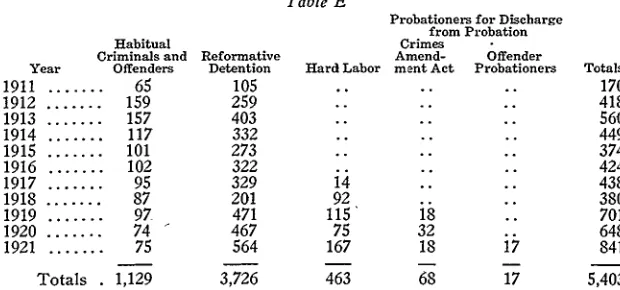
General Summary of the Annual Report of the Prisons Department of the Prisons Board of New Zealand for 1921.-The following table shows the
[image:4.612.68.378.390.535.2]cases considered year by year by the Board since its inception:
Table E
Probationers for Discharge
from Probation
Habitual Crimes
Criminals and Reformative Amend- Offender
Year Offenders Detention Hard Labor ment Act Probationers Totals
1911 ... 65 105 ... 170
1912 ... 159 259 ... 418
1913 ... 157 403 ... 560
1914 ... 117 332 ... 449
1915 ... 101 273 ... 374
1916 ... 102 322 .. .. 424
1917 ... 95 329 14 .. .. 438
1918 ... 87 201 92 .. 380
1919 ... 97 471 115 18 .. 701
1920 ... 74 467 75 32 648
1921 ... 75 564 167 18 17 841
Totals . 1,129 3,726 463 68 17 5,403
PRISONS DEPARTMENT
Offenders Probation Act, 1920. Where formerly the Board was restricted to the consideration of the cases of hard-labor prisoners whose sentences exceeded two years, it now, under the latest amendment to the Crimes Act, has had conferred upon it authority to deal with all hard-labor cases irrespec-tive of length of sentence.
As previously pointed out, the question of the variation of the terms imposed by the courts upon offender probationers has now been placed in the hands of the Board, and under the Act all such persons are eligible to petition the Board on completion of half ther respective probationary periods. As will be seen, during the first year of the operation of this pro-vision of the Act the cases of 17 offender probationers were dealt with, and everything points to this section being more frequently availed of as the provisions become more widely known to this particular class of offender.
Of the reformative-detention prisoners released by the Board since its inception the percentage of those who have "made good" remains much the same as that shown in the previous report. In view of the trade depres-sion and the consequential scarcity of employment the fact that 75 per cent of those released have "made good" must be considered highly satisfactory. The habitual criminals are in an entirely different category from the reformative-detention prisoners. Almost without exception they have been passing in and out of prison for a number of years, and have generally become confirmed in their criminal habits before being declared "habituals"
by the courts. Under the circumstances the fact that 24 per cent of those
granted their liberty on the Board's recommendation have not again offended is an indication that the passing of the indeterminate-sentence law has had and is still having a satisfactory effect on a number of our more hardened offenders.
600 PRISONS DEPARTMENT
There is also needed some institution for female derelicts--"the shavings from the workshops of humanity," as they have been termed. There has been established an institution of this class for men, but one is required for women, as we have pointed out before. It should be on a small farm or a large market garden not far removed from some city or town, where the inmates should be able to maintain themselves by work in the open air.
To have females serving a few months and then being discharged to again offend and be imprisoned until, against many, even sixty or seventy or more convictions are recorded is of no benefit to anyone. Old and irreclaim-able offenders should be segregated under reasonably comfortirreclaim-able condi-tions, though freedom to roam as they please be denied them.
When visiting farm properties under development by the Prisons Depart-ment the members of the Board have been impressed with the good effect of this work upon the inmates, and of the satisfactory financial results obtained by the sale of butterfat and general farm-produce. We understand that the total cash receipts of the prisons have been during the last financial year £49,806, but the value of the prisoners' labor is more than that sum, for the public works of the country have been aided by prison labor to the extent of £21,000.
In view of the reformative influence exercised on the individual inmates, and of the value to the state of the development of its lands, the Board desires to express its approval of the Department's latest undertaking at Hautu. Prisoners have been sent to reclaim pumice land near Taupo, and what may be termed an "open-air"prison has been established. When the
land has been reclaimed it is proposed to open it for settlement. This
system is capable of much development, and may be the means of encour-aging settlement in many parts of the Dominion that are lying waste and uncultivated.
The Board would also again direct the attention of the government to the resolution embodied in their last year's report. It was as follows:
"Whereas an increasing number of sexual offenses has been the sub-ject of frequent and serious judicial comment, especially in cases where young children were the victims, or the very serious nature of the charge con-noted a perversion dangerous to the moral well-being of society; and, as the experience of the Board in dealing with prisoners of this class accords, as far as it goes, with the now generally accepted opinion that, with certain exceptions, persons committing unnatural offenses labor under physical disease or disability, or mental deficiency or disorder, or both, which accounts for the sexual perversion and the morbid character of the offense charged: It is resolved by the Prisons Board to strongly recommend to the government an amendment of the Crimes Act under which such offenders could be dealt with
scientifically-"(1) Before sentence is pronounced, by furnishing expert medical or surgical reports or evidence;
"(2) By sanctioning an indeterminate sentence;
PRISONS DEPARTMENT 601
During last year the number of sexual crimes has increased, and it is necessary for our community that this request should be carefully considered, and, if possible, a remedy found for this evil-Robert Stout, President. Wellington, 31st July, 1922.
Standards of Effective Probation Work.-"Experience with Probation Work during the last decade not only in New York City but elsewhere, has taught many valuable lessons and established some fundamental prin-ciples which are now very well recognized. Below will be found thirty-one standards of effective probation work which represents the best thought on the theory and practice of probation in this country.
Standards of Probation
"1. The probation system should be standardized by the employment of as many officers as is required by the number of cases. Proper proba-tion work demands that no probaproba-tion officer should supervise more than fifty probationers at any one time.
"2. Earnest effort should be made to induce judges not to place on
probation the definitely feeble-minded, confirmed inebriates or habitual offenders. Unfit subjects on probation destroy the confidence of the public in the system and lowers the efficiency of the probation officers.
"3. Before placing on probation, judges should require a careful
investi-gation of the facts by probation officers. Investigation reports should be
treated as confidential communications and should not be made public, "4. Care should be exercised on the part of judges and magistrates throughout the country lest the making of preliminary investigations requires so much of the time of probation officers as to prevent them from properly performing their principal duties of looking after and aiding persons who are placed on probation.
"5. There is a certain advantage in having the preliminary investigation
made by the probation officer who subsequently supervises the probationer, but in large cities a division of the probation staff into a corps of investi-gators and supervisors is often desirable and practicable. Specialization also in family court work and in the treatment of youths produces favorable results.
"6. Provision should be made in all courts to secure the services of
physicians, psychiatrists and psychologists to examine defendants before
sentence. Probation officers should take steps to obtain this co-operation
where no provision has been made for it by the court:
"7. As soon as possible after the court places an individual on
proba-tion, it is important that the probation officer should see the probationer, entirely alone, and explain carefully the general and particular conditions of probation. Visits to the home and to other places to secure additional infor-mation and co-operation should be the next step. A plan of probation should then be formulated subject to modification as probation progresses.
"'8. The period of probation should be long enough to afford opportunity
per-PRISONS DEPARTMENT
sons on probation for an indefinite period, to be determined by the character and conduct of the probationer, is advisable.
"9. An essential factor of any successful probation work is vigorous
enforcement of the conditions of probation. Probationers should be returned to the court promptly when the probation officer is firmly convinced of the unfitness of the probationer for further probationary treatment. Every effort should be made to apprehend absconders.
"10. A constant endeavor should be made to vary the probation methods of treatment to meet the special needs of each individual, to better the conditions of the probationers and to develop a more personal and intimate study and contact with them. Points of concentration should be the 'family, health, education, employment, recreation, and spiritual development.
"11. Systematic- reporting and home visiting are both necessary in pro-bation work. Probation officers should make these meetings count in information obtained and advice given and in the establishment of a friendly relationship. Interviews with probationers should be in private and should not be hurried or stereotyped. The commingling of probationers should be
carefully avoided.
"12. True probation work consists of definite constructive effort to help probationers by means of kindly guidance, home visiting and practical service. Perfunctory supervision consisting principally of reports to the
probation office is not real probation work.
"13. Complete co-operation with the social agencies of the community in the effort to surround probationers with every helpful influence is neces-sary to effective probation work, and to the progressive development of the system. In general, probation officers should not undertake services for probationers which other agencies are better equipped to furnish.
"14. Probationers should be helped as much as possible to get suitable work and to succeed in it. The interest of employers should be secured and co-operation with employment bureaus maintained. In large offices, a bureau of employment should be established. Vocational guidance should be used, particularly in the problems of boys and girls of working age. Employers should not be generally told that employees are on probation unless known to be willing to employ probationers. Probationers should be sent only to places where decent standards of work are maintained.
"15. The proper supervision of the work of the individual probation officers by a chief probation officer or group of supervisors and also by the judges of the court is essential in developing a proper probation system. The co-operation and sympathy of the judge is needed by the probation officer. Frequent reports on the progress of probationers should be made to the judges.
"16. At the termination of the probation period, the probationer should be brought before the court privately for judicial review. In large cities where there are a considerable number of judges, a probation part or court should be oganized having central judicial control over the system.
PRISONS DEPARTMENT
county without a great loss of time. In very large cities the district system of assignment is a necessity.
"18. (a) Suitable office quarters with adequate equipment, and pro-vision for necessary expenses, should be supplied to probation officers.
"(b) Adequate clerical help should be granted to probation officers. It is poor economy to burden probation officers with clerical duties, as their
important- work is in the field.
"19. More complete, uniform and satisfactory records should be kept
by all probation officers. A central bureau 6f criminal records should be
established in each community.
"20. An esprit de corps and team-work should be cultivated in every group of probation officers. Weekly conferences by members of the staff at which common problems and difficult probation cases are discussed are desirable.
"21. Special case conference between probation officers and other social workers should be held frequently to consider difficult case problems.
"22. Careful study should be made of the relative merits of different methods of applying probation and a continual checking up and improvement of case treatment in the light of such study. Probation officers should recognize that there is a definite methodology and technique in social diag-nosis and case work and that in their daily work they are developing these
processes.
"23. By training, reading and conference, probation officers should en-deavor continually to increase their knowledge and capacity in order to meet the great opportunities of their work.
"24. Probation officers should seek legitimate and enlightened pub-licity for their work through public speaking and newspapers in order to develop a more appreciative and better informed public opinion concerning probation.
"25. Annual reports should be published and the material arranged in an interesting and an attractive style.
"26. It is highly desirable that the supervision of those released from penal and reformatory institutions on parole should be developed on the same lines of supervision and responsibility as the probation system. There is much to be said for some definite co-relation of the two lines of work in the various localities of -the country.
"27. Definite qualifications as to character, ability and training should be required of those who seek to become probation officers. Merit and fitness alone should be the basis of appointment.
"28. The salaries of probation officers should be made commensurate
with the importance of the work and should be high enough to attract and hold well-qualified men and women in the service. Reliance upon voluntary service alone fails to meet the need.
"29. Greater support, not only financial, but moral, is needed by the probation officers and the probation service.
COUNTY ALMSHOUSE
"31. We should encourage experimentation to see how probation will work when administered by a local commissioner or board, and consider the wisdom of building up, in addition to the work of the courts, supple-mentary thereto and working in close -harmony therewith, a plan of admin-istrative control by which the problems of probation may receive the study, supervision and constant revision and improvement that are secured for reformatory institutions by the boards of managers and executive officials thereof."--From "Manual of Probation Work," Magistrates' Courts of the
City of New York, 1922.
Recommendations as to the Solutions of the County Almshouse and County Jail Problems in
Missouri.-A. The Alsshouse Problem
The problem of adequate almshouses for the care of the aged and infirm poor of Missouri is one which should challenge the serious consideration of the State Board of Charities and Corrections.
At first glance it would seem that the problem was a local one, and one which could best be solved by local citizens. Closer examination will demon-strate that this is not the case.
It will be noted that in the richer agricultural section, north of the river, only one county maintains no almshouse; and that a majority fall in the "excellent" or "good" classifications. The situation is not primarily due to a more progressive spirit of the citizens of these counties, but principally to the fact that the taxable wealth of these counties is sufficient to meet their
community needs.
South of the river the -reverse is true, in the case of the large number of the counties. Population is smaller, and in many counties the average value of land is less than ten dollars per acre. This is insufficient to provide revenue necessary for carrying on the necessities of the local governments. Is it any wonder then that in such counties Boards of Visitors are unsuccess-fuil in obtaining modern institutions?
Fifteen counties south of the river have no almshouses, most of them resorting for economic reasons to the long-condemned system of letting out the care of the helpless by contract or bids.
In many cases the lowest bidders are farmers whose inability to make a living from their farms leads them to seek the inconvenience of "boarding the paupers," in order to provide food for their own families.
Where contracts are let from year to year, it is to be expected that accom-modations will be primitive, no one caring to risk the expenditure of any considerable sum of money in building adequate quarters, as the bidder never knows whether or not he will be given the contract the following year. Of the other counties where the almshouses have been classd as "fair," in many instancs only the poor quality of the private dwellings in the county could earn this classification. The grade, in such cases, has been given on the theory that if the average citizen of a county does not have modern home facilities for himself, it is too much to expect modern facilities for the objects
COUNTY ALMSHOUSE 605
Many of these county homes are totally lacking in modern sanitary facilities essential in caring for aged, infirm and mentally deficient persons.
If the leading citizens of a county do not have adequate sanitary' facil-ities in their own homes, an appeal for their installation in the county home gets no results.
The point I wish to make is that most of these counties, particularly the hill counties, are doing all that they can possibly do on the limited county revenues available. Consequently, it is cledr that the solution of the problem cannot be found if our present plan of each county for itself is continued.
Many counties have a very small number of inmates, and this fact keeps
some well-to-do counties from building suitable institutions. From their
point of view, it is difficult to see the advisability of expending many thou-sand dollars for modern institutions which will only serve a few people.
After a state-wide survey of almshouses in Missouri, and a careful con-sideration of the problems presented, it is my conviction that the aged and infirm poor can best be cared for by one or more state almshouses accessibly located.
By this means, counties which have poor facilities, or a small number of inmates, can provide proper care for their aged and infirm poor without the expense of erecting and maintaining individual almshouses. In this way better facilities and administration could be obtained, at a reduced expense per inmate. The state almshouse plan suggested provides for the payment by counties served of the maintenance cost of inmates from such counties.
Counties already having adequate almshouses could either avail them-selves of the state home, as desired or continue as at present. The poorer counties would have placed at their disposal institutional care such as they can never hope to provide by themselves individually.
It may be of interest to recall in this connection that some years ago the care of the insane in Missouri was considered a county matter. If pro-vision for the care of our aged and infirm poor in Missouri is to be placed on a plane with that of the insane, we must plan and work to bring about
state care.
B. The Jail Problem
The situation in regard to the jails in. the state is much the same. It
will be noted that only twelve jails have been graded "excellent." This
means that in addition to sanitary facilities, a vast majority of the jails are lacking in proper provisions for classification of prisoners.
This may seem of minor importance, yet it is basically the root of much of the evil resulting from jail sentences. What could be more harmful to the youthful offender than to serve a protracted time in company with thugs,
hold-up men. bank robbers and bootleggers? What the youth may lack
in specific knowledge of criminal methods, the tutelage of these men will supply. At best the youth will come out with his ideals lowered, and a distorted view of life.
crim-606 COUNTY ALMSHOUSE
inals, the stage is set for the education in lawlessness of the already way-ward boy.
This, of course, is of primary importance, yet in the state there are many jails which not only tend to pervert the minds of the prisoners, but also threaten their physical being.
It will be noted that thirteen jails are classed as "very poor." In most of these thirteen, a jail sentence of sixty days would be an inhuman punish-ment. Some jails are in the basements of courthouses, cut off from natural light and ventilation, limited as to space, lacking in sanitary facilities, damp and odorous.
The result of this condition is to make law enforcement as to misde-meanors a travesty, in many cases. No judge could with a clear conscience sentence men to lengthy stays in such jails. A fine is the usual thing in such counties, with the prisoner released to go back to his profitable lawless-ness, secure in the knowledge that his only danger is another fine-which in some cases is considered money well spent as advertising. It is no wonder that sheriffs in some of the counties have confided in your inspector their belief in the futility of trying to enforce the law. Such a condition makes for anarchy.
In many other counties escape is merely the matter of desire. Your inspector has heard prisoners boast that they could escape any time they made up their minds to go. One case was found where a man had escaped by the use of no other tool than his own heavy shoe. He simply kicked his way through the old cell block and the rotten brick wall.
Unlike the almshouse, almost every county feels the need of a jail, and
in all but six counties some sort of jail is maintained. It is hopeless to
attempt to secure adequate jails in most of the counties.
Many of the counties justify a poor jail on the grounds of infrequency of prisoners. This is a real argument, and yet as to individuals it is just as bad for one or two men to be incarcerated in an inadequate jail as for a
dozen.
These facts have long been quite generally known, yet for years this system has remained, the evils compounding with each generation.
The solution of the problem is perhaps not easily to be found, yet other states, notably Indiana," have found a satisfactory solution in what they term
a "State Farm for Misdemeanants." In Indiana any male prisoner given
as much as a thirty days' jail sentence must be sent to the state farm, and for less than thirty days may be sent, at the discretion of the judge.
At one stroke this plan removes the three cardinal counts in the indict-ment of the present jail system in Missouri-first, by proper classification of prisoners at the farm, the old offenders being kept from contact with first offenders; second, by productive work in the open air, prisoners have their time usefully employed; and, third, instead of leaving the jail physically impaired, as is likely to happen today, prisoners leave the farm after discharge physically improved, and with health sufficiefit to face the world with confidence again.
COMMISSION OF EUGENICS
the expenditure of large sums of money, has been found to be non-existent. Their farm has paid not only in the improvement of the prisoners, but is self-supporting, and is expected soon to return to the state treasury more than the original outlay by the legislature.
There is no question as to the ill effects of our present jail system. At best, we can only hope to have them kept clean and their officers advised as to proper administrative methods.
How much better it would be if Missouri should take her place along-side Indiana, the pioneer state, in this worth-while and far-reaching advance, which is one of the first real steps in the solution of the jail problem since the days of the whipping post and stocks.
My final recommendation to this Board, after visiting every county in the state, and I feel getting a clear conception of the state's needs, is that the good offices of this Board be directed toward securing state almshouses. and a state farm for misdemeanants.-From Bulletin of the State Board of
Charities and Corrections, Jefferson City, Mo., August, 1922.
International Commission of Eugenics.-The International Commission of Eugenics met at the rooms, Maison des M6decins, Bruxelles, of the Soci~t6 Beige d'Eug6nique, on Saturday, October 7, and Monday, October 9. There were present Major Leonard Darwin, Chairman; Dr. Albert Govaerts, Secretary; Dr. Van Herwerden of Utrecht, Holland; Dr. Wimmer, Pro-fessor of Psychiatry, Copenhagen; Dr. John Alfred Mjoen of the Winderen Laboratorium, near Christiania; M. Lucien March of "Statistique g6n~rale de la France," and Dr. Pinard, President Soc. Francaise d'Eugdnique, Paris;
and Dr. C. B. Davenport of Cold Spring Harbor.
It was voted unanimously to invite German delegates to the Commission. It was decided provisionally to hold the next meeting of the Commission at Lund, Sweden, and the next meeting of the Eugenics Congress in 1924 at Prague. These decisions are contingent upon the possibility of making appropriate arrangements for the meetings.
The occasion of the meeting of the International Commi'ssion of Eugenics at Bruxelles was taken advantage of for a meeting of the Ligue nationale Belge contre le Peril v~n6rien at the same place, and an extensive social program was arranged.
608 PROBATION OFFICER
the Prison de Forest and its laboratory of anthropology were visited. On Tuesday, addresses were given by Dr. Daisy M. Robinson, by M. Lucien March of'Paris, and Dr. Berthollet of Lausanne on matters partly of anti-venereal and partly of eugenical interest. At half past two in the afternoon, a meeting was held in the large hall of the Solvay Institute of Sociology, at which was inaugurated the eugenics room of the Institute. Two lectures were given on the practical organization of eugenics, "in the United States," by Dr. Davenport; "in Belgium," by Dr. Govaerts. On Wednesday a visit was made by the Congress to the City of Antwerp.-From Eugenical News, VII, 11, November, 1922.
Examination for Assistant Probation Officer in the Juvenile Court of Cook County (Chicago), Illinois.-On February 25, 1922, a citizens' exam-ining committee held the written portion of a competitive examination of candidates for the position of assistant probation officer of the Juvenile Court of Cook County. This method followed a precedent established in the Juvenile Court by Judge Merritt W. Pinckney in 1912, following a Supreme Court decision, which placed the appointive power in the judges of the Circuit Court. The committee, which served without compensation, was appointed by Judge Victor P. Arnold of the Juvenile Court and was given full authority to proceed in seeking candidates for appointment in whatever way it saw fit, the court agreeing to adhere strictly to the eligible list in making future appointments. The following named persons were members of the committee: Wilfred S. Reynolds, Chairman, Mrs. William S. Hef-feran, Mrs. Kenneth F. Rich, Mrs. Alfred D. Kohn, Rev. John W. Melody. The committee determined that eligibility should be confined to citizens of the United States, male or female, between the ages of 23 and 45 years, who had completed a four-year high school course or its educational equiva-lent. The examination consisted of three parts, credit being given as indi-cated:
Weight 1. Written examination covering (a) the theory and operation of the
Juvenile Court, (b) discussion of typical cases, (c) knowledge of
community facilities ... 4
2. Education and experience ... 4
3. Oral exam ination ... 2
In the education and experience test, credit was allowed on the following basis: Education: Graduate of university or college and school of social work ... 50
Graduate of university or college ... 40
Two years or more of university or college ... 30
High school and one year course at school of social work ... 25
High school graduate only ... 20
Law school graduate ... 30
CONGESTED DOCKETS 609
Experience:
Professional social work, 2 years or more ... 50
Teacher in private or public school, 3 years ... 30
Nursing (non-social) ... 20
Volunteer social work, 3 years ... 20 The grading of applicants was done entirely by members of the com-mittee. The written papers were marked first, the committee working in pairs until this work was completed. Those persons who failed to make a grade of 60 in this part of the examination were disqualified for further consideration. When the written papers were completed, the education and experience qualifications of the applicant were considered. An applicant whose average on the written paper and on the education and experience test was 60 or above was eligible for oral examination. The committee sat as a whole for the oral examination, interviewing 74 applicants who had successfully passed the first two tests. Four persons were disqualified in the oral examination, a list of 70 applicants being certified to Judge Arnold as probation officer material.
The eligible list established by this examination will continue in force during the pleasure of the court, in no event for more-than three years.
Copies of the questions used in the written part of the examination may be secured on request made of the undersigned.
This account is written in the belief that it will be of general interest to persons interested in methods of securing competent public employes. Under the decision of the Supreme Court, referred to above, the court has the sole power to choose its employes. The obvious advantages of an exami-nation method are:
1. The field from which the candidate is selected is greatly broadened since it is not necessary in order for a person to qualify that he be known to the appointing power;
2. There can be no favoritism since the identity of the candidate is not disclosed until the major part of the examination is completed; and
3. The person appointed holds his position due entirely to his own efforts. He is not indebted to any other individual, and is consequently freer in his work. Under the practice in force in the Cook County Juvenile Court, a probation officer holds his position so long as he continues to do his work in a satisfactory manner. The chief probation officer has the authority to suspend and to file charges with the judge of the court against any officer who fails to perform properly the duties of his position.-Joseph L. .Moss, Chief Probation Officer, Juvenile Court of Cook County, 900 County Building, Chicago.
Congested Dockets in the Federal Courts Menace to Justice Says Attorney General.-The following, from Harry M. Daugherty, Attorney General, has been distributed for publication:
wit-610 CONGESTED DOCKETS
nesses, defeat of justice and expense to taxpayers. Many cases can never
be tried. Large and small business interests lose heavily by this delay.
Steps ire now being taken to remedy this condition of affairs in the selec-tion of twenty-four addiselec-tional trial judges and the Department of Justice hopes soon to complete its investigations into the qualifications of those being considered for these judgeships.
"All through our history federal judges have established enviable records of loyalty and devotion to duty and country that has sustained for all time the wisdom of our constitutional fathers. Never swayed by popular pas-sions, but always true to the ideals of justice, law and order, these judges have carried on their work with the sole purpose of affording that protection to government and the American people to which they are so rightfully
entitled. Individuals, labor and capital, and Congress itself, have felt the
weight of their sound judgment and the influence of their opinions. Restrain-ing even the government, and society generally in its restless, somewhat im-pulsive and sometimes impatient course, but always true to the constitution they have sworn to support, these federal judges are a living monument to a separate and distinct judiciary. Their decisions constitute a sound record
of the social, economic and political history of our country. Often we do
not agree with them, but no man dares challenge the fact that their judg-ments always have been in accord with the highest conceptions of constitu-tional government. They have been philosophers and historians, viewing popular opinions and prejudices of the moment with understanding and patience, but never swerving from their duty to interpret the law as it is written, and not as the temporary wishes of a people might dictate.
"I have no patience with those who flaunt and scorn a judge because he has remained true to his oath and upheld the law contrary to selfish
social, economic or industrial interests. The growing disrespect of the
constitution and the law which the federal judiciary has so faithfully pro-tected and interpreted, must sooner or later be brought to an abrupt halt if government is to survive the assaults of all the vicious elements which revolt against law and order.
"Naturally we might expect a reaction from the idealism, unselfishness and restraints of war times. But the individualistic idea of freedom has led many to believe they themselves can violate the law, but others should remain straight-laced. A government can survive only as long as wise laws are passed and all laws are obeyed by all people.
CONGESTED DOCKETS 611
to loss of evidence and other attendant conditions. Most serious of all,
however, was the loss of prestige by the federal courts.
"In a government by law it is necessary that the law be enforced, and that trials be prompt and speedy, otherwise forced delays promote disrespect of the law.
"One hundred and forty-two thousand cases were pending and undisposed of on July 1, 1921, and conditions were critical the country over. Congress was asked for relief and suggestion was made at the same time that pro-vision for an annual conference be made at which the Chief Justice of the Supreme Court of the United States, each of the Federal Circuit judges, and the Attorney General could consider ways and means of perfecting the
administration of justice and relieving congestion. Recommendation was
made also that a greater elasticity was necessary so that judges could be assigned to handle temporary congestion without the expense of a per-manent judge.
"After some delay, 24 new judges were authorized, but in the meantime
congestion had increased to a point where there was an excess of 172,000 cases pending and undisposed of on July 1, this year. The new trial judges authorized by Congress just before adjournment are now being appointed. and I want to say here that no man, no matter what his ability may be, will ever be endorsed by the Attorney General unless he is 100 per cent Ameri-can in every shape and form. For the federal judiciary is the backbone of our government, and in these times of discontent and vicious radicalism, these judges must stand between the Constitution and the blind gropings of those
who are swayed by violent and unscrupulous leaders.
"If we are to be spared domination by organized minorities, then we must proceed in the selection of our judiciary with our eyes open and our vision unclouded by partisan views or princples. In the hands of the fed-eral judiciary rest the treasures of freedom, the liberties of our people, and
there cannot be too much care exercised in their selection. Temporary
officers of the government who serve the people for only a brief period, can of necessity have but a limited share in the upward climb of our country, which it might be said, incidentally, has not yet reached its full development nor attained its maximum of world influence and power.
"When the entire list of new judges is completed, and they get down to work, the congestion in all the courts will be speedily whittled down. But it is not alone in the trial of cases that law enforcement is handicapped. Congress has enacted numerous police laws as well as extended the scope
of criminal jurisdiction in interstate commerce. New revenue laws have
been passed which have afforded new temptations to the criminally inclined. Smuggling, bootlegging, robbery, forgery, conspiracies in restraint of trade, frauds and corruption exist everywhere and yet federal enfocement officers, with the exception of the customs officers and United States marshals, are clothed with little more power than a private individual.
"It is futile to pass laws without giving the federal government power
to enforce them. Although the states possess police powers, the same
612 JUVENILE OFFENDERS
The Juvenile Offenders Law.-[Reprinted from the Japan Weekly Chronicle, June 8, 1922.]
[At the last session of the Japanese Diet there was passed a Juvenile Offenders' Law, which among other things set.up a Children's Court. It
was promulgated on April 15th, 1922. As it indicates the fashion in which
Japan is endeavoring to deal with what is known as juvenile depravity, we reproduce the law at length, the translation being made by Dr. J. E. de Becker of the Yokohama Bar.]
CHAPTER I
General Provisions
Article 1.-The expression "Juvenile" in the sense of this Law means persons under eighteen years of age.
Article 2.-Matters connected with the punishment of juvenile criminals shall (with the exception -of those provided for in this Law) be governed by general precedents and usage.
Article 3.-This Law, with the exception of Articles 7, 8, and Articles 10-14, does not apply to the persons mentioned in Articles 8 and 9 of the Military Criminal Code and Articles 8 and 9 of the Naval Criminal Code.
CHAPTER II
Protective Measures
The following dispositions may be adopted in respect to juveniles who have violated, or who it is apprehended may violate, penal laws and
ordi-nances:
(1) They may be warned;
(2) The task of warning may be delegated to school masters; (3) They. may be caused to make a vow of reform in writing; (4) They may be conditionally handed over to their guardians;
(5) They may be entrusted to the care of temples and monasteries, churches, protective bodies or other suitable persons;
(6) They may be placed under the observation of an official protector of juveniles (shonen hogoshi);
(7) They may be sent to a reformatory (kankwa-in);
(8) They may be sent to a house of correction (kyosei-in); (9) They may be sent or entrusted to the care of a hospital.
The dispositions of the various numbers of the above paragraph may be discretionarily combined.
Article 5.-The dispositions of Numbers 5 to 9 of Paragraph 1 of the
preceding Article may be continuously executed, or may be rescinded or changed at any time during the continuance of such execution until the age of twenty-three is attained.
Article 6.-Juveniles who have been granted suspension of the
execu-tion of penalties, or a provisional discharge from prison, shall, during the
period of such suspension or provisional discharge, .be placed under the
observation" of an official protector of juveniles.
JUVENILE OFFENDERS 613
When the dispositions of Numbers 7 or 8 of Article 4, Paragraph 1, are made by virtue of the provisions of the preceding paragraph, observation by the official protector of juveniles shall be suspended during the con-tinuance of such execution.
CHAPTER III
Criminal Punishments
Article 7.-Neither the death penalty nor a perpetual penalty shall be imposed upon persons who have committed offenses but who are under the
age of sixteen. When the death penalty or a perpetual penalty shall be
imposed, a sentence of limited penal servitude or imprisonment of not less than ten and not exceeding fifteen years shall be imposed.
The provisions of the preceding paragraph do not apply when the crimes of Articles 73, 75, and 200 of the Criminal Code have been committed.
Article 8.-When limited penal servitude or imprisonment the maximum period of which exceeds three years is imposed in a juvenile, both the mini-mum and maximini-mum period within the extent of such penalty shall be decided and pronounced; but when a penalty is to be imposed the minimum period of which exceeds five years, then the minimum period shall be reduced to five years.
The minimum period of the penalty to be pronounced in virtue of the provisions of the preceding paragraph cannot exceed five years, and the maximum period cannot exceed ten years.
The provisions of the preceding two paragraphs do not apply when sentences suspending execution of penalties are pronounced.
Article 9.-Juveniles who have been sentenced either to penal servitude or imprisonment shall undergo the execution of their penalties in a jail specially built for them, or in a jail in a place specially divided off (segre-gated) for them.
Even after the person sentenced has attained the age of eighteen, execu-tion of his or her penalty may be continued, according to the provisions of the preceding paragraph, until he or she shall have reached the age of twenty-three.
Article 10.-Juveniles who have been sentenced to penal servitude or imprisonment may be provisionally liberated from jail after the periods hereinafter mentioned have elapsed:
(1) Seven years in respect to a perpetual penalty;
(2) Three years in respect to a penalty pronounced in virtue of the provisions of Article 7, Paragraph 1.
(3) In respect to a penalty pronounced in virtue of the provisions under Article 7, Paragraphs 1 and 2, one-third of the minimum period of that penalty.
Article ll.- hen ten years have elapsed after provisional liberation
has been granted to a juvenile who was sentenced to perpetual penalty, with-out such disposition being cancelled in the meantime, the execution of the penalty is deemed to be finished.
with-614 JUVENILE OFFENDERS
out, in the meantime, such disposition being cancelled, the provisions of the preceding paragraph also apply.
Article 12.-Regulations concerning the provisional liberation of juveniles from jail shall be determined by Ordinance.
Article 13-Sentences of detention in houses of labor shall not be pro-nounced on juveniles.
Article 14.-Persons on whom penalties other than the death penalty or a perpetual penalty were imposed for offenses committed when they were juveniles, and who have either completely served their sentences or had their penalties remitted, shall, for the future, be regarded, in connection with the application of laws and ordinances concerning personal capacity, as if they had never been sentenced to any penalty.
Persons on whom penalties were imposed for offenses committed when they were juveniles, but who were granted by the judgment suspension of the execution thereof, shall, during the period of suspension thereof, be regarded as if the execution of the sentences has been Eompletely ended, and the provisions of the preceding paragraph shall apply.
In the case of the preceding paragraph, when the judgment suspending execution of penalty is cancelled, it shall be deemed, in connection with the application of laws and ordinances concerning personal capacity, that sen-tence was pronounced at the time such cancellation took place.
CHAPTER IV
Organization of the Juvenile Court
Article 15.-For the purpose of adopting protective measures in regard to juveniles, Juvenile Courts shall be provided.
Article 16.-Regulations concerning the establishment, abolition, and jurisdiction of Juvenile Courts shall be determined by Imperial Ordinance. Article 17.-Juvenile Courts shall be subject to the supervision of the Minister of Justice.
The Minister of Justice may order the President of a Court of Appeal and the President of a District Court to supervise a Juvenile Court.
Article 18.-A Juvenile Court shall be provided with a Judge for Juveniles (shonen shimpan-kwan), an Official Protector of Juveniles (shonen hogoshi) and a Clerk (shoki).
Article 19.-Judges for Juveniles shall try cases alone.1
Article 20-The Judge for Juveniles shall manage the affairs of the Juvenile Court (where he sits) and shall exercise supervision over the members of the staff attached thereto.
In a Jhvenile Court where two or more Judges for Juveniles are
appointed, the senior2 judge shall perform the functions determined by the
provisions of the preceding paragraph.
Article 21.-(The office of) a Judge for Juveniles (shonen shimpan-kwan) may be additionally assumed by an ordinary judge (hanji).
A Judge for Juveniles who is qualified as a Judge (hanji) may addi-tionally assume the office of an ordinary judge.
Article 22.-When a Judge for Juveniles has reason to believe that a
"This means the judge will sit alone and decide the case single-handed.
2
JUVENILE OFFENDERS 615
cause exists which may give rise to a doubt as to the fairness of the trial, he must avoid acting in the matter.
Article 23.-The Official Protector of Juveniles shall assist the Judge for Juveniles, submit data for trial and take charge of observation affairs.
The Minister of Justice may commission persons who are experienced in the protection and education of juveniles, and other qualified persons, as Official Protectors of Juveniles.
Article 24.-The Clerk shall, subject to the instructions of his superior officials, take charge of drawing up documents concerning trials and attend to general affairs.
Article 25.-In exercising their functions, the Juvenile Courts and Official Protectors of Juveniles may commission either public officers or public func-tionaries, or may request them to render other necessary aid and assistance.
CHAPTER V
Procedure of Juvenile Courts
Article 26.-Persons committing offenses which come under the special competency of the Supreme Court shall not be placed on trial in a Juvenile Court.
Article 27-The persons mentioned hereunder shall not be placed on trial in a Juvenile Court unless they have been received either from the
(ordinary) courts or public procurators by whom they have been sent. (1) Persons who have committed offenses entailing the death penalty, perpetual imprisonment, or short period penal servitude or imprisonment for three years or dpwards.
(2) Persons who have committed offenses when they are sixteen years
of age or older.
Article 28.-Persons who are being tried in accordance with (ordinary) criminal procedure shall not be placed on trial in a Juvenile Court.
Persons who are under fourteen years of age shall not be placed on trial in a Juvenile Court except when they have been received from a local governor by whom they have been sent.
Article 29.-When a person considers that a certain juvenile should be placed under the protective measures of a Juvenile Court he shall notify either a Juvenile Court or a member of its personnel about the matter.
Article 30.-In giving such notice, the cause thereof shall be disclosed, and, if possible, the full name. of the person and his or her guardian (protec-tor), their domiciles, ages, occupations, character and conduct shall be stated: moreover, any materials which may serve as a reference shall be tendered.
The notice may be given either in writing or orally: in case of oral notice, a member of the personnel of the Juvenile Court shall take and record the statement.
Article 31.-When a Juvenile Court believes that a certain juvenile
should be placed on trial, it shall investigate the relations of the case and the character and conduct, environment, personal history, physical and mental conditions, and the degree of education of the principal (honnin).3
616 JUVENILE OFFENDERS
As regards mental and physical conditions, a doctor should, if possible, be caused to make an examination.
Article 32-Juvenile Courts shall give orders to the official protector of juveniles and cause him to make necessary investigations.
Article 33.-Juvenile Courts may order the guardian (protector) to make an investigation 'of facts, or may entrust such investigation to a body of protectors.
Guardians (protectors) as well as bodies of protectors may tender such data as may serve for reference.
Article 34.-Juvenile Courts may order persons for reference (sanko-nin) to appear in the Court, and may either.cause them to make depositions of facts or give expert opinions necessary for the investigation.
In the event provided in the preceding paragraph, should it be deemed necessary, the gist of the depositions and expert opinions may be taken down and recorded.
Article 25.-Persons for reference may claim for their expenses accord-ing to the provisions of Ordinance.
Article 36.-Juvenile Courts may, if necessary, cause an Official Pro-tector of Juveniles to accompany the principal at any time.
Article 37.-Juvenile Courts may, according to the necessity of the circumstances, provisionally adopt the following measures vis-a-vis the principal:
(1) They may give him into the charge of guardians (protectors) either conditionally or unconditionally;
(2) He may be entrusted to the care of temples and monasteries,
churches, protective bodies, or other suitable persons; (3) He may be entrusted to the care of a hospital;
(4) He may be placed under the observation of an official protector
of juveniles.
In cases when it is unavoidable, the principal may be provisionally sent either to a reformatory (kankwa-in), or house of correction (kyosei-in).
In the event of the dispositions of Numbers 1 to 3 of the first paragraph having been made, the principal shall be placed under the observation of an official protector of juveniles.
Article 38.-The dispositions of the preceding article may either be can-celled or altered at any time.
Article 39.-In the cases of the preceding three articles, the guardian (protector) must be immediately notified to that effect.
Article 40.-If Juvenile Courts, as the results of investigation, consider that a trial should be opened, they shall fix a date for trial.
Article 41.-In case a trial is not opened, the dispositions under Article 37 shall be cancelled.
The provisions of Article 39 apply mutatis mutandis to the case men-tioned in the preceding paragraph.
by a single English equivalent in all cases. In the Juvenile Offenders Law, it indicates the party principally concerned-that is, the accused-but the word
"accused" is not always appropriate. If, however, the word "principal"
JUVENILE OFFENDERS 617
Article 42.--Vhen a Juvenile Court opens a trial, it may, if necessary, appoint an attendant for the benefit of the principal.
The principal, his guardian (protector), or protective bodies, may, with the permission of the Juvenile Court, select and appoint an attendant.
Advocates, persons engaged in protective enterprises, or persons who are granted permission by the Juvenile Court shall be assigned as attendants.
Article 43.-On the day appointed for trial a Judge for Juveniles and a Clerk shall be present in court.
The official protector of juveniles may appear in court on the day ap-pointed for trial.
On the day appointed for trial, the principal, his guardian (protector), and the attendant shall be summoned; but when it is deemed to be practically useless, the guardian (protector) need not be summoned.
Article 44.-Official protectors of juveniles, guardians (protectors) and attendants may state their opinions in the room of the court.
In the case of the preceding paragraph, the principal shall be caused to withdraw from his seat; but when there is proper reason, he may be allowed to remain (in the court).
Article 45.-The trial shall not be open to the public; but the Juv, enile Court may permit relatives of the principal, persons engaged in protective enterprises, and other persons who are deemed to be proper, to sit in the court.
Article 46.-When a Juvenile Court has finished its investigation, a final disposition (of the case) must be made in accordance with the provisions of Articles 47 to 54.
Article 47.-When a criminal prosecution is deemed to be necessary, the case (under trial) shall be sent to the public procurator of the court having jurisdiction.
With regard to cases which have been received (by Juvenile Courts) from either the (ordinary) courts or public procurators, if it is deemed necessary that a criminal prosecution be instituted owing to the discovery of new facts, the procedure of the preceding paragraph shall be followed after hearing the opinion of the procurator of the court having jurisdiction.
When the dispositions of the preceding two paragraphs have been made, both the principal and his guardian (protector) shall be notified to that effect.
Public procurators shall notify the Juvenile Court of the dispositions made concerning cases which have been sent to and received by them in virtue of the provisions of either the first or second paragraph.
Article 48.-When it is deemed that a warning should be given, the wrongful conduct committed by the principal shall be pointed out to him or her, and he or she shall be admonished as to matters to be observed in the future.
In the case of the preceding paragraph, guardians (protectors) and attendants should, if at all possible, be cauged to be present.
Article 49.-When it is deemed that a head school-master should be entrusted with the duty of giving the warning, the necessary particulars shall be pointed out to him and he shall be instructed to admonish the principal.