BIROn - Birkbeck Institutional Research Online
Borel, L.-H. and Christodoulides, George (2016) Branding and digital
analytics.
In: Dall’Olmo Riley, F. and Singh, J. and Blankson, C. (eds.)
The Routledge Companion to Contemporary Brand Management. Routledge
Companions in Business, Management and Accounting.
Abingdon, UK:
Routledge. ISBN 9780415747905.
Downloaded from:
Usage Guidelines:
Please refer to usage guidelines at or alternatively
Branding and Digital Analytics
Laurence-Helene Borel and George Christodoulides
Keywords: branding, digital analytics, social media, consumer brand engagement
1. Introduction
A brand is commonly defined as a cluster of functional and emotional benefits that
promise a certain type of experience (e.g. de Chernatony & Christodoulides,
2004). Branding has traditionally focused on communications or one-way activities
(Rubinstein, 2002) aimed at brainwashing the consumers with a view to create
salience in their minds, develop positive associations and quality perceptions to
ultimately secure their loyalty (Christodoulides 2009; Mitchell 2001). Branding was
an exercise done to/for consumers as opposed to with consumers.
In the early days of the Internet the focus was on building corporate websites that
reinforced a positive brand experience (de Chernatony & Christodoulides, 2004). This
was known as the age of e-commerce when the aim was to build a corporate website
whose ‘look and feel’ would be in line with the personality of the brand, the brand
would be easy to locate online, the website would be reliable and the speed of
download would be fast, navigation would be intuitive and companies would offer a
differential reward for customers to visit and re-visit the corporate website. With the
advent of web 2.0 and the social web (O’Reilly, 2005) as it is argued by
Christodoulides (2009) the elements mentioned above became hygiene in that they no
to deliver on these elements. Therefore, the presence of these elements would add no
value to the brand; however, their absence would detract from the brand's equity.
With web 2.0 what have also become important is user-generated content (UGC) and
social media it is, thus, less important what the company says about its brand(s) but
what other customers and communities of interest say about the brand. A new host of
factors have become available including Groups, Pod/vodcasts, Video sharing, Blogs,
Widgets, VCAs, MUDs which allow consumers to also interfere with the values of
the brand, for instance, by creating an advert for a brand and uploading this on a
publicly accessible social media platform. By doing so, consumers are empowered to
(indirectly) influence the brand's values.
In this chapter we argue that those brands who manage to engage consumers on three
levels, cognitively, emotionally, and behaviourally, are those more likely to succeed in
this highly competitive and crowded digital space. We go on to discuss in greater
detail the three dimensions of engagement and how they can be measured and also
share examples and case studies of successful campaigns aiming to stimulate
cognitive, emotional and behavioural engagement.
2. From Web 1.0 to Web 2.0
Prior to the Internet, traditional branding was by and large the exercise of a narcissist,
the brand manager, who was preoccupied with creating a specific image for the brand,
primarily through corporate communications shouting how wonderful the brand is,
then passing on the desired image (identity) to consumers. Any voices diverging from
the most significant branding tool for marketers online was the corporate website
itself which often was static and resembled a catalogue. Marketers soon realized the
interactivity potential of the Web and focussed their efforts on developing a
compelling online brand experience for consumers.
By the early 2000, the Internet was undergoing significant transformation with a new
generation of Web 2.0 websites appearing that used technology beyond the static
pages of earlier websites. Coined in 1999 by Darcy DiNucci and popularized by Tim
O’Reilly at the O’Reilly Media Web 2.0 conference in late 2004 (O’Reilly, 2005),
Web 2.0 suggests the emergence of a new version of the World Wide Web; it does not
refer to an update to any technical specification, but rather to cumulative changes in
the way web pages are made and used. A Web 2.0 site allows users to interact and
collaborate with each other in a social media dialogue as creators of user-generated
content in a virtual community, in contrast to websites where people are limited to the
passive viewing of content. Examples of Web 2.0 websites include, social networking
sites (e.g. Facebook, Twitter, Instagram, YouTube, Pinterest, Google+), blogs, wikis,
video-sharing sites (e.g. YouTube, Vimeo, Vine), web applications and mashups.
This new branding philosophy resulting from the collaborative Web was first
articulated through the service-dominant logic (S-D logic) literature, suggesting that
customers make proactive contributions to brand interactions, rather than merely
acting as passive recipients of brand-related cues (e.g. Vargo & Lusch, 2004). As a
result, managers who had been accustomed to tightly controlling their brands
suddenly had to relinquish some control (de Chernatony 2001; Christodoulides 2009),
only interact with the firm but also with other consumers (Hoffman & Novak, 1996).
Consequently, brand management has undergone a significant transformation linked
to the rise of the Internet (Hoffman, 2000) necessitating brands to augment their
functional and emotional values also with social values (Yenicioglu &
Christodoulides, 2013), and shifting branding from a one-sided process ‘aimed at
consumers’ (Web 1.0) to a much more complex process that involves a multi-level
collaboration of firms, consumers, and brand communities (Web 2.0). This approach
of collaborative branding can take several forms ranging from user-generated content,
brand communities or consumer engagement tactics via social networks such as
Facebook, Twitter, YouTube, Google+, Instagram, LinkedIn, Pinterest or SnapChat,
which are currently the most commonly used social networking sites by marketers
and brands at the time of writing. These engagement tactics are increasingly referred
to as Content Marketing, defined by the Content Marketing Institute (2014) as ‘a
marketing technique of creating and distributing valuable, relevant and consistent
content to attract and acquire a clearly defined audience – with the objective of
driving profitable customer action’. Arguably, post-internet branding is about
facilitating conversations around the brand (Christodoulides, 2009), in order to
ultimately engage consumers on a cognitive, emotional and/or behavioural level.
Engaged consumers are thought to play a key role in enhancing brand performance
inter alia via greater emotional connection/attachment (Thompson & Sinha 2008;
Algesheimer et al. 2010; Brodie et al. 2013), advocacy (Algesheimer et al., 2005),
loyalty (Algesheimer et al. 2005; Bowden 2009; Brodie et al. 2011; Hollebeek,
2011a), and trust (Van Doorn et al. 2010; Vivek et al. 2011; Brodie et al. 2011, 2013).
Considerable conceptual/theoretical work has been carried out on the subject of
engagement across various disciplines, resulting in a plethora of conceptualizations.
However, research specifically addressing ‘customer/consumer engagement’ has only
transpired in the marketing literature relatively recently (e.g. Van Doorn et al. 2010;
Brodie et al. 2011).
There is not, however, such a thing as a common view of consumer engagement in the
academic literature; instead, various definitions and applications of the construct
exist. From the practitioner’s perspective, consumer engagement is defined as
establishing a strong and enduring bond between brand and consumers based on an
ongoing effort of the brand to activate consumers through interactions, shared values,
experiential content and rewards (Schultz 2007, p. 7). Brodie et al.’s (2011) definition
and conceptualization of consumer engagement is arguably the most comprehensive
definition to date, suggesting five fundamental propositions on which a general
definition of consumer engagement is drawn:
“Consumer engagement is a psychological state that occurs by virtue of interactive,
co-creative customer experiences with a focal agent/object (e.g. a brand) in focal
service relationships. It occurs under a specific set of context dependent conditions
generating differing consumer engagement levels; and exists as a dynamic, iterative
process within service relationships that co-create value. Consumer engagement
plays a central role in a nomological network governing service relationships in
which other relational concepts (e.g., involvement, loyalty) are antecedents and/or
consequences in iterative CE processes. It is a multidimensional concept subject to a
context and/or stakeholder-specific expression of relevant cognitive, emotional and/or
This definition is thought to be the most comprehensive in the literature for a number
of reasons. First, Brodie et al.’s (2011) definition of engagement encompasses
multiple perspectives of consumer engagement, resulting in a comprehensive
overview and conceptualization of the construct. Second, the above definition
includes other relational concepts such as involvement and loyalty, to reflect the
complexity of the focal construct such as its psychological dimension, rather than
solely focusing on the behavioural dimension of engagement. Third, the definition
takes into account the three dimensions of engagement described in the organizational
management literature (e.g. Fredricks et al., 2004), cognitive, emotional and/or
behavioural, in generic terms, so that it be consistent with the conceptualization of
consumer engagement in other contexts (Brodie et al., 2011). Each facet of consumer
engagement as well as contextual dimensions of engagement will subsequently be
discussed in this chapter.
3.1 Cognitive engagement
Cognitive engagement is one of the three dimensions of consumer engagement
recognized by scholars as a key facet in the consumer-brand engagement process.
Cognitive engagement draws on the idea of investment, and incorporates
thoughtfulness and willingness to exert the effort necessary to comprehend complex
ideas and master difficult skills (Fredricks, 2004). In the marketing literature, online
engagement is characterized as a cognitive and affective commitment to an active
relationship with the brand as personified by the website or other computer-mediated
entities designed to communicate brand value (Mollen & Wilson, 2010). Consistently,
the engagement process is initiated mainly by consumers’ information needs, which
indicates that the engagement process might originate from cognition. More
specifically, new members of a brand community may look for information within the
online brand community, which leads them to be cognitively engaged with the content
of the page (Brodie et al., 2013).
3.2 Emotional engagement
The second dimension of consumer engagement is emotional engagement, which
encompasses consumers’ positive and negative reactions (Fredricks, 2004). Consumer
engagement leads to increased levels of involvement and trust which may, in turn,
lead to the development of affective commitment, considered to be a more emotive
basis for purchase (Bowden, 2009). Emotionally engaged consumers feel ‘immersed’
and passionate about their chosen brands, which they are willing to spend significant
time and effort with (Hollebeek, 2011b). In addition to perhaps becoming more
satisfied and loyal (Brodie et al., 2011; Van Doorn et al., 2010), customers may also
experience relationship benefits from engaging with the brand community
(Gummerus & Liljander, 2012). When firms engage customers, there is an
opportunity that satisfying interactions may lead to trust; thus higher engagement
should produce higher trust in the relationship because the company is perceived as
caring (Vivek et al., 2012). However, excessive engagement levels may generate
customer draining and/or fatigue, which may potentially be detrimental to customer
loyalty outcomes (Hollebeek, 2011b).
The third dimension of consumer engagement is behavioural engagement, which
draws on the idea of participation. Behavioural engagement includes the involvement
construct and is considered crucial for achieving positive (for the brand) outcomes
(Fredricks, 2004). Markets can be viewed as a set of conversations between the
customer and the firm. This set of conversations implies interactivity, deep
engagement, and the ability and willingness to act on both sides (Prahalad &
Ramaswamy, 2004). Furthermore, consumer engagement is interactive, active,
continuous, and customer centric, involving both prospects and potential customers
(Sawhney et al., 2005). Behavioural engagement in the context of a brand community
can be defined as a consumer’s intrinsic motivation to interact and cooperate with
community members (Wirtz et al., 2013). Typical online engagement behaviours
include word-of-mouth recommendations, helping other consumers, blogging, writing
reviews, or even engaging in legal action (Van Doorn et al., 2010; Wirtz et al., 2013).
In engaging with a brand or a brand community, consumers aspire to obtain value
from the organization and their brands (Wirtz et al., 2013) while positive experiences
gained from these interactions serve to strengthen the consumer’s relationship with
the brand (Algesheimer et al., 2010). Active engagement in the form of membership
continuance, participation, giving and receiving recommendations from other
community members and creating brand-related user-generated content often lead to
positive brand outcomes such as higher levels of brand equity, brand loyalty and
customer advocacy (Algesheimer et al., 2005; Christodoulides et al. 2012). Finally,
active engagement may lead to an increased willingness to adopt a firm’s new
products and a reduced risk of embracing competing products (Thompson & Sinha,
2008).
In section 3, we discussed the importance of engagement and introduced its cognitive,
emotional and behavioural dimensions. As noted earlier, engagement from the
practitioner’s perspective has been defined as ‘establishing a strong and enduring
bond between brand and consumers based on an ongoing effort of the brand to
activate consumers through interactions, shared values, experiential content and
rewards’ (Schultz 2011, p.7). In other words, brand managers through their Facebook
posts, Tweets, Instagram photos and YouTube videos, aim to trigger positive
consumer engagement with a focal brand though Likes, shares comments, retweets, or
user-generated content creation.
Every marketing program has its key metrics. Email has open and click-through rates.
Web sites have unique/return visitors, page views, dwell time and conversions. Social
media has engagement rate. By measuring and monitoring consumer-brand
engagement rates, brand marketers can benchmark their marketing goals, evaluate the
effectiveness of social programs, and optimize brand campaigns for their target
audience by understanding what type of content is successful (or not!) for their
brands. A recent industry report published by the Internet Advertising Bureau (IAB
2014, p. 12), suggests that:
Cognitive engagement maps changes in awareness, interest, and intent.
Emotional engagement refers to how advertising or other brand related content
makes the user feel towards the brand.
Behavioural engagement may translate as user-initiated interactions.
Cognitive: link clicks, viewing photos/videos
Emotional: positive comments, blog posts, recommending a brand
Behavioural: following a brand, Liking, retweeting, sharing a post on social
media, or any form of conversation, which could be for instance by means of
hashtags after seeing an ad.
Although engaging consumers on these three dimensions is crucial, it is worth noting,
that practitioners tend to measure engagement as a whole, rather than through its
individual cognitive, emotional and behavioural dimensions. This is partly due to
limitations in metrics themselves, but also partly due to the necessity to provide
‘large’ engagement numbers to justify the effectiveness of social media efforts.
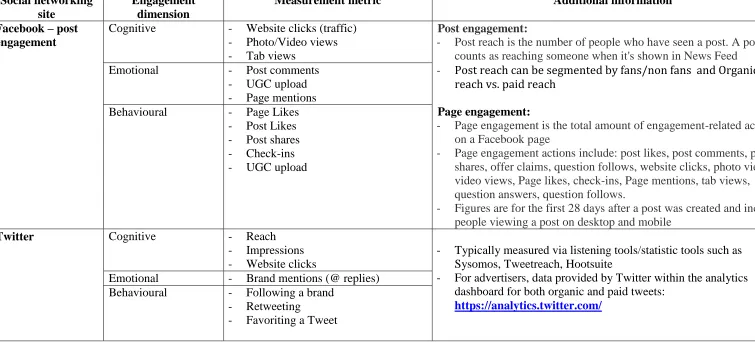
Table 1 below shows suggested consumer-brand engagement metrics across the main
social networking sites, and highlights how each engagement dimension can also be
measured.
[INSERT TABLE 1 HERE]
4.1 WoM referrals
Consumers talk within their online networks about brands, events and products,
whether brands are listening or not. These messages from customers, fans and
detractors can spread quickly and can have a large influence (positive or negative) on
other consumers. These conversations are referred to as online word-of-mouth (WoM
referrals). WoM referrals monitor is crucial to brand marketers in order to monitor
marketing communication, or pro-actively respond to negative comments in case of a
crisis. Furthermore, as noted by Christodoulides et al. (2012) managers should
thoroughly monitor all UGC related to their brand, not only from the defensive point
of view of adding value while avoiding damage, but also to gain rich, unfiltered
insights into customer perceptions of the brand.
The levels of WoM referrals around the brand would typically be measured using
industry tools such as Sysomos, Brandwatch or Radian 6. These industry tools scrape
the web for brand mentions using boolean queries, in other words, complex keywords
searches, that can include or exclude certain keywords to return the most accurate
results. Common WoM referrals metrics include:
- Sentiment analysis: the sentiment of each post would be analyzed manually to
understand how consumers feel about the brand/product.
- Topic analysis: the mentions are analyzed manually to understand how
consumers talk about the brand
- Media type analysis: the mentions are analyzed via the dashboard to
understand where are consumers talking about the brand the most (e.g.
Twitter, Facebook, blog posts, or mainstream media)
- Share of voice analysis: the mentions are analyzed via the dashboard to
measure the number of brand mentions vs. competitor brand mentions
4.2 Academic measures of engagement
Despite great academic interest in the engagement construct, scholarly research
addressing ‘engagement’ has been predominantly exploratory in nature, whilst
Brodie 2014). Hollebeek et al.’s (2014) recent development and validation of a scale
of consumer brand engagement specifically in social media settings, offers scholars
and practitioners a simple paper and pencil instrument to measure this complex
construct. The scale relies on consumer’s perceptions of cognitive, emotional, and
behavioural engagement with a brand in social media rather than on actual
engagement. However, this scale could be used to measure consumers’ engagement
levels by means of a survey with a view of complementing and enhancing practitioner
measures as outlined in table 1. Such triangulation of measures could facilitate the
undertaking of enhanced predictability of consumers’ future purchase intent of
specific brands within a brand’s portfolio (Hollebeek, Glynn and Brodie, 2014, p.
162). The scale of consumer brand engagement comprises of 10-items measuring the
cognitive, emotional and behavioural dimensions of the construct as shown in table 2.
[INSERT TABLE 2 HERE]
4.3 Measuring engagement: summary
Although the engagement construct comprises of three dimensions, cognitive,
emotional and behavioural, practitioners tend to measure construct as whole by
analyzing the number of interactions consumers have with a focal brand across the
brand’s social networking sites. This section has reviewed a number of metrics
utilized by practitioners to measure engagement levels on Facebook, Twitter,
YouTube as well as WoM referrals, which are used to evaluate the success of a
brand’s efforts and to optimize a brand’s content strategy. Despite a plethora of
metrics available to brand managers, one of the remaining challenges is the lack of
metrics can help measure a brand’s success in social media, these metrics do not
provide marketers with accurate sales figures, making it difficult to report on a social
media campaign’s ROI. It is, however, safe to say that social networking sites, are
working with marketers to solve this lack of social media attribution. Facebook for
instance, has recently announced the introduction of a new ‘Purchase’ button
(Facebook, 2014), which will appear in Facebook posts, thus allowing marketers to
directly measure accurately Social Media ROI. Twitter, on the other hand, have
recently rolled out conversion tracking within their advertising offering (Twitter,
2014), which allows managers to accurately track attribute conversions beyond last
URL-click, to include actions driven by all types of ad engagements (like clicks,
retweets, or favourites).
In sum measuring engagement can help brand managers:
- Understand what type of content is successful or fails to engage fans and use this
knowledge to optimize their brand’s content strategy
- Measure the success of brand campaigns (Social Media ROI)
- Benchmark social media efforts against key competitors either through engagement
metrics or WoM referrals metrics
- Drive traffic to the brand’s website to ultimately increase purchase consideration
and sales
- Report ROI figures to senior management; the more successful a social media
campaign, the higher the budget allocated to social media channels in the future
The previous two sections of this chapter have first defined the construct of
engagement, which comprises of three dimensions, cognitive, emotional, behavioural
engagement. As highlighted in section 4, the effectiveness of social media and content
activities is measured by looking at metrics such as engagement levels, reach,
impressions, videos views, engagement and WoM referrals, to establish what type of
content and tactics are successful for engaging consumers with brands. Managing
brands online is no longer about controlling or tightly managing brands, but about
facilitating conversations between the brand and consumers. The authors have argued
that brands that are successful in social media facilitate the three dimensions of
engagement: cognitive, emotional and behavioural through their content strategy.
5.1 Facilitating cognitive engagement
As noted earlier, cognitive engagement draws on the idea of investment, and
incorporates thoughtfulness and willingness to exert the effort necessary to
comprehend complex ideas and master difficult skills (Fredricks, 2004). When users
join a brand community or a brand’s social network site, they may become
cognitively engaged with the content of the page, by looking for information about
the brand.
Brodie et al.’s (2013, p. 109) engagement framework suggests that the engagement
objects within an online brand community may be themes (brands, product, services,
organization, industry), the online community itself, community roles or community
members. In their subsequent consumer engagement process framework (2013, p.
110) the authors reveal that members partake in a variety of tasks such as learning,
specific consumer engagement occur when the consumer recognizes a need to solve a
specific problem or satisfy a want, performs a search, identifies a specific online
community, and begins an interactive relationship with the community by posting a
comment. Thus, in order to cognitively engage consumers, brand managers should
ensure that cognitively engaging/informational content is easily searchable on their
social networking sites. This could be achieved, for instance, through photo albums,
custom-built forum/FAQ tabs on Facebook, pinned posts, YouTube, playlists, or
hashtags which allow tagging of information by topic and is easily retrievable.
Rolex (www.facebook.com/rolex) is a great example of a brand organizing its
Facebook content to cognitively engage consumers. Rolex have created a
custom-built Facebook tab, which pulls in video playlists directly from their YouTube
channel. The tab allows fans to browse various Rolex models and watch informational
videos about their chosen watch.
Marmite (www.facebook.com/marmite) the controversial ‘Love or Hate’ yeast spread
(known as Vegemite in Australasia) also has a custom-built Facebook tab, which
allows fans to browse recipes but also to submit their own, engaging fans not only
cognitively but also emotionally when submitting recipes through user-generated
content creation.
5.2 Facilitating emotional engagement
The second dimension of engagement is emotional engagement, whereby consumers
are ‘immersed’ and passionate about their chosen brands, and are willing to spend
based on definitions from the literature can be considered to be the ultimate goal for
brand managers, as emotionally engaged consumers are likely to follow brands across
multiple social networking sites and to advocate the brand’s products to their peers.
There is a number of ways in which brands can facilitate emotional engagement with
consumers through social networking sites or brand communities. For instance,
Nutella has recently launched its Nutella Stories campaign
(http://www.nutellastories.com/en_UK/) to celebrate the 50th anniversary of the
brand, and has received over 76,000 stories to date. Fans are encouraged to share their
love of Nutella by submitting their stories and photos, and will receive in return a gift
from Nutella. This campaign is a successful example of a brand positively influencing
brand-related communications, sharing the Nutella love, through user-generated
content.
Starbucks is another brand harnessing the power of their community through the My
Starbucks Idea community (http://mystarbucksidea.com). With a strong presence on
multiple social networks, the brand has set a high bar when it comes to being social
and engaging its customers. They are at or near the top of nearly every major brand
ranking in social media. The My Starbucks Idea website encourages customers to
submit ideas for better products, improving the customer experience, and defining
new community involvement, among other categories. Customers can submit, view,
and discuss submitted ideas along with employees from various Starbucks
departments ‘Idea Partners’. The company regularly polls its customers for their
favourite products and has a leader board to track which customers are the most active
crowd-sourcing tool, a source of market intelligence that brings customer priorities to
light, an on-line community, as well as an effective branding tool.
Furthermore, fans who are deeply passionate and emotionally engaged with their
brands, going as far as creating and running online Facebook pages and/brand
communities to share their passion for the brand with other fans. World Nutella Day
(http://www.nutelladay.com/) is a brand community set up in the early days of social
media in 2007, by Nutella fan Sara Rosso. The community boasts, at time of writing,
6,700 Twitter followers and 46,000 Facebook fans. In late 2013, Ferrero S.p.A, tried
to shut down the World Nutella Day fan community resulting in a backlash from
community members. Ferrero S.p.A’s move indicates a misunderstanding of brand
co-creation and engagement manifest through a narcissistic desire to tightly control
the brand. By contrast other brands comprehend and capitalize on consumers’ need to
co-create and jointly own the brand, for example Coca-Cola’s Facebook fan page was
originally set up unofficially by two fans before the brand took guardianship, although
the original creators are still actively involved in the management of the fan page.
As demonstrated in the World Nutella Day example brand managers faced in this
situation, should work together with emotionally engaged fans to preserve these
unofficial communities rather than attempt to shut them down. Ferrero S.p.A’s cease
and desist, could have negatively impacted on sales of the brand by upsetting
advocates of Nutella, in addition to a PR crisis. Following World Nutella Day fans’
outrage, Ferrero S.p.A made the decision to retract its cease and desist, and are now
collaborating with the unofficial community
Behavioural engagement is the dimension of engagement, which appears to be most
commonly triggered through brand managers’ activation attempts, and manifests itself
through Likes, shares, and tweets as a direct response to a campaign.
There are multiple ways to engage consumers through branded hashtags in terms of
media type (TV, print, OOH, online) but also in terms of different engagement
mechanics and intensity such as sharing (e.g. Budweiser’s SuperBowl #bestbuds ad),
gamification (e.g. British Airways #RacethePlane), WoM referrals such as
incorporating positive Tweets about a brand on a an advert or a website, or UGC (e.g.
Pantene’s #Shinestrong). Furthermore, recent empirical research conducted by the
authors in the context of branded hashtag engagement in advertising, identified four
main drivers of engagement: entertainment value, emotional value, and creativity.
The Budweiser 2014 Super Bowl commercial featured a baby Clydesdale and a puppy
who become friends against all odds. The commercial used a high emotional appeal,
resulting in high consumer engagement by means of hashtag, totalling 59K mentions
on Twitter, and was the ad that was the most Tweeted about during the Super Bowl
XLVIII (Adweek, 2014).
Pantene’s #ShineStrong is a perfect example of branded hashtag campaign
successfully tapping into sharing, WoM referrals, and UGC. The 60-second
commercial empowering women to #ShineStrong, was viewed more than 46 million
times in just a few months, inspiring discussion through the hashtag. Sheryl
Sandberg’s even shared the video on her Facebook page! In addition, Pantene teamed
up with popular YouTubers including Gigi Gorgeous, LaurDIY and Nanalew to
Branded hashtags, unlike other engagement tactics, have the benefit of allowing brand
managers to reach existing fans as well as non-existing fans of a brand. Furthermore,
excitingly for brand managers, branded hashtag engagement is not dependent on prior
brand familiarity or involvement with a brand (Borel, 2014). A well-executed branded
hashtag campaign can break through the clutter and engage existing or new customers
through high advertising appeals such as entertainment, emotion or creativity (Borel,
2014). However, as branded hashtag campaigns become more common, particular
care should be taken to ensure that the branded hashtag has a clear call to action, and
offers conversational and community benefits allowing a user to engage with other
users and grow their network. Thus, branded hashtag campaigns should be planned
carefully to achieve specific brand objectives such as heightened brand equity, brand
trust, WoM referrals and increased sharing intent, increasing the brand’s share of
voice through WoM referrals and eyeballs through sharing (Borel, 2014).
5. Summary and implications for brand managers
This chapter has highlighted the key challenges managers face when managing their
brands online. As noted in this chapter, traditional branding was by and large the
exercise of a narcissistic brand manager preoccupied with creating a specific image
for the brand, primarily through corporate communications and passing on the desired
image to consumers. The rise of Web 2.0 on the other hand, has marked a radical
transformation in the way brands are developed and managed. Brand managers who
had been accustomed to tightly controlling brands have had to learn to market with
anymore’, but want to interact, converse, buy and consume brands that care about
them.
The key construct resulting from this new branding philosophy, which underpins this
chapter, is the construct of engagement. This aims to establish a strong and enduring
bond between brand and consumers based on an ongoing effort of the brand to
activate consumers through interactions, shared values as well as experiential content
and rewards, and comprises of three dimensions cognitive, emotional, and
behavioural.
We have shown through various case studies and examples, how practitioners may
trigger each engagement, and argued that the most successful brands in the digital
space are the ones who concurrently activate these three dimensions through their
content strategy. Brand management in the era of the Social Web requires managers
to be both creative and analytical. On the one hand, managers [often with the help
from other consumers in a dialectical process, see Sing (2012)] need to create brand
stories that successfully engage consumers on a cognitive, emotional and/or
behavioural level. On the other hand, brand managers should be analytical in order to
measure engagement to tailor their brand stories based on consumer engagement
levels but also report on the success of their campaigns, and crucially secure social
media investment dollars from senior management by demonstrating the effectiveness
of these campaigns.
Engagement across Facebook, Twitter and YouTube is typically measured by looking
sources, geographic impact and audience retention in the case of YouTube. Measuring
engagement can help marketers not only tailor their content strategy but also crucially
report on the success of social media campaigns. Furthermore, measuring WoM
referrals using third party tools such as Sysomos, Brandwatch or Radian 6, can be
used as a powerful market research tool to understand how consumers feel and talk
References
Adweek (2014), Infographic: Budweiser wins the hashtag Super Bowl, Available
from:
http://www.adweek.com/news/technology/infographic-budweiser-wins-hashtag-super-bowl-155442
Algesheimer, R., Dholakia, U., M., Herrmann, A. (2005), “The Social Influence of
Brand Community: Evidence from European Car Clubs”, Journal of Marketing, 69
(July 2005), pp. 19–34
Algesheimer, R., Borle, S. Dholakia, U., M., Singh, S., S. (2010), “The Impact of
Customer Community Participation on Customer Behaviors: An Empirical
Investigation”, Marketing Science, 29 (4), pp. 756-769
Borel, L.H. (2014), “A model of antecedents and consequences of branded hashtag
engagement”, MRes thesis, Birkbeck, University of London
Bowden, J.L. (2009), “The Process of Customer Engagement, a conceptual
framework”, Journal of Theory and Practice, 17, pp. 63-74
Brodie, R.J., Hollebeek, L. D., Juric, B., & Ilic, A. (2011), “Customer
Engagement: Conceptual Domain, Fundamental Propositions, and Implications for
Research”, Journal of Service Research, pp. 252-271
Brodie, R.J., Llic, A., Hollebeek, L. (2013), “Consumer Engagement in a virtual
community: an exploratory analysis”, Journal of Business Research, 66 (1), pp.
105-114
Christodoulides, G. (2009), “Branding in the Post-Internet Era”, Marketing
Theory, 9 (1), pp. 141-144
Christodoulides, G., de Chernatony, L. (2004), "Dimensionalising on- and offline
brands' composite equity", Journal of Product & Brand Management, 13 (3) pp.168 –
Content Marketing Institute (2014), Useful content should be at the core of your
marketing strategy, Available from:
http://contentmarketinginstitute.com/what-is-content-marketing/
de Chernatony, L. (2001), “Succeeding with brands on the Internet”, Journal of
Brand Management, 8 (3), pp.186-195
Facebook (2014), Testing a New Way for People to Discover and Buy Products on
Facebook, Available from:
https://www.facebook.com/business/news/Discover-and-Buy-Products-on-Facebook-Test
Fredricks, J.A., Blumenfeld, P.C., Paris, A.H. (2004), “School engagement:
Potential of the concept, state of the evidence”, Review of Educational Research, 74,
pp. 59–109
Gummerus, J., Liljander, V. (2012), “Customer Engagement in a Facebook Brand
Community”, Management Research Review, 35 (9), pp. 857-877
Hoffman, D.L. (2000), “The Revolution will not Be Televised: Introduction to the
Special Issue on Marketing Science and the Internet”, Marketing Science, 19 (1), pp.
1–3
Hollebeek, L. D. (2011a), “Demystifying customer brand engagement: Exploring
the loyalty nexus”, Journal of Marketing Management, 27 (7-8), pp. 785-807
Hollebeek, L. D. (2011b), “Exploring customer brand engagement: definition and
themes”, Journal of Strategic Marketing, 19 (7), pp. 555-573
Hollebeek, L.D., Glynn, M.S., Brodie, R.J. (2014), “Consumer Brand Engagement
in Social Media: Conceptualization, Scale Development & Validation”, Journal of
Interactive Marketing, 28 (2), pp. 149-165
Mitchell, A. (2001), Right Side up: Building Brands in the Age of the Organized
Mollen A, Wilson H. (2010) “Engagement, telepresence and interactivity in online
consumer experience: reconciling scholastic and managerial perspectives”, Journal of
Business Research, 63, pp. 919–925
O’Reilly (2005), What is Web 2.0? Design Patterns and Business Models for the
New Generation of Software, Available from:
http://mediaedu.typepad.com/info_society/files/web2.pdf
Prahalad, C. K., Venkatram R. (2000), “Co-opting Customer Competence”,
Harvard Business Review, 78, pp. 79-87
Rubinstein, H. (2002), “Branding on the Internet: Moving from a communications
to a relationship approach to branding”, Interactive Marketing, 4(1), pp.33-40.
Sawhney, M., Verona, G., Prandelli, E. (2005), “Collaborating to Create: The
Internet as a platform for customer engagement in product innovation”, Journal of
Interactive Marketing, 19(4), pp. 4-17
Schultz, D.E., Block, M. P. (2011), “Understanding customer-brand engagement
behaviours in today’s interactive marketplace”, Micro & Macro-Marketing, 2, pp.
227-243
Singh, S. and Sonnenburg, S. (2012), “Brand Performances in Social Media”,
Journal of Interactive Marketing, 26(4), pp.189–197.
Social Bakers (2014a), Finding the right engagement rate for your page in 2014,
Available from:
http://www.socialbakers.com/blog/2137-finding-the-right-engagement-rate-for-your-facebook-page-in-2014
Social Bakers (2014b), Socialbakers now recommends interactions over
engagement rate, Available from:
Thompson, S.A., Sinha, R.K. (2008), “Brand communities and new product
adoption: the influence and limits of oppositional loyalty”, Journal of Marketing, 72
(6), pp. 65-80
Twitter (2014), Conversion Tracking for websites, Available from:
https://support.twitter.com/articles/20170807-conversion-tracking-for-websites
Van Doorn, J., Lemon, K. N., Mittal, V., Nass, S., Pick, D. N., Pirner, P., Verhoef,
P. C., (2010), “Customer Engagement Behavior: Theoretical Foundations and
Research Directions”, Journal of Service Research, 13 (3) 253-266
Vargo, S. L., Lusch, R. F. (2004), “Evolving to a New Dominant Logic for
Marketing”, Journal of Marketing, 69, pp. 1-17
Vivek, S.D., Beatty, S.E. & Morgan, R.M. (2012), “Consumer Engagement,
exploring customer relationships beyond purchase”, Journal of Marketing Theory and
Practice, 20 (2), pp. 122-146
Wirtz, W., Ramaseshan, B., Van de Klundert , J. , Canli, Z., G., Kandampully, J.
(2013), “Managing brands and customer engagement in online brand communities”,
Journal of Service Management, 24 (3), pp. 223-244
Yenicoglu, B. & Christodoulides, G. (2014), “Branding in the Age of Digital
Connectivity” In: Moutinho , L., Bigné, E. and Manrai A.K. (Eds.) The Routledge
Companion to the Future of Marketing, London: Sage.
Recommended reading
Brodie, R.J., Llic, A., Hollebeek, L. (2013), “Consumer Engagement in a virtual
community: an exploratory analysis”, Journal of Business Research, 66 (1), pp.
Christodoulides, G., Jevons, C., Bonhomme, J. (2012), “Memo to Marketers:
Quantitative Evidence for Change, How User-Generated Content really affects
Brands”, Journal of Advertising Research, 52 (1), pp. 53-64
Hollebeek, L.D., Glynn, M.S., Brodie, R.J. (2014), “Consumer Brand Engagement
in Social Media: Conceptualization, Scale Development & Validation”, Journal of
Abstract
This chapter addresses the changes branding has undergone in recent years with the
rise of Web 2.0 and the challenges marketers face managing and measuring brand
efforts in the digital world. Traditional branding was by and large the exercise of a
narcissist who was preoccupied with creating a specific image for the brand, primarily
through corporate communications, whereby consumers were passive recipients of
brand messages. The rise of Web 2.0 has however drastically changed consumer
behaviour and brand management, empowering consumers to interact and collaborate
with each other, freely sharing experiences about brands, both good and bad. As a
result brands have flocked social networking sites, in an attempt to join these
conversations and engage consumers with carefully selected brand content.
This chapter first introduces the construct of engagement, and its three dimensions,
cognitive, emotional and behavioural. Second, we discuss how marketers can measure
this engagement across a number of key platforms, including Facebook, Twitter,
YouTube to mobilize WoM. Finally, we discuss how brands can successfully manage
the three dimensions of engagement and share recent examples of successful
Tables and Figures for insertion
Table 1: Engagement metrics for the main social networking sites
Social networking site
Engagement dimension
Measurement metric Additional information
Facebook – post engagement
Cognitive - Website clicks (traffic) - Photo/Video views - Tab views
Post engagement:
- Post reach is the number of people who have seen a post. A post counts as reaching someone when it's shown in News Feed - Post reach can be segmented by fans/non fans and Organic
reach vs. paid reach
Page engagement:
- Page engagement is the total amount of engagement-related actions on a Facebook page
- Page engagement actions include: post likes, post comments, post shares, offer claims, question follows, website clicks, photo views, video views, Page likes, check-ins, Page mentions, tab views, question answers, question follows.
- Figures are for the first 28 days after a post was created and include people viewing a post on desktop and mobile
Emotional - Post comments - UGC upload - Page mentions Behavioural - Page Likes
- Post Likes - Post shares - Check-ins - UGC upload
Twitter Cognitive - Reach
- Impressions - Website clicks
- Typically measured via listening tools/statistic tools such as Sysomos, Tweetreach, Hootsuite
- For advertisers, data provided by Twitter within the analytics dashboard for both organic and paid tweets:
https://analytics.twitter.com/
Emotional - Brand mentions (@ replies) Behavioural - Following a brand
- Retweeting
[image:29.842.16.771.153.495.2]YouTube Cognitive - Video views - Audience retention - Traffic sources
- Audience demographics - Geographic impact
- Statistics available from the YouTube analytics panel
Emotional - Commenting - Sharing
- Remixing a video through UGC Behavioral - Favouriting a video
- Sharing a video
WoM referrals Emotional - Sentiment analysis - Topic analysis
- Share of voice analysis
- Media type analysis (e.g. Twitter, Facebook, blogs, mainstream media)
- Third party tools e.g. Sysomos, BrandWatch, Radian 6
Table 2: Scale of Consumer Brand Engagement (Hollebeek, Glynn and Brodie,
2014)
Engagement dimension Scale items
Cognitive processing COG. PROC.1: Using [brand] gets me to think about [brand COG. PROC. 2: I think about [brand] a lot when I’m using it COG. PROC. 3: Using bran stimulates my interest to learn more about [brand]
Affective (Emotional) AFFEC 1: I feel very positive when I use [brand] AFFEC 2: Using [brand] makes me happy AFFEC 3: I feel good when I use [brand] AFFEC 4: I’m proud to use [brand]
Activation (Behavioural) ACTIV 1: I spend a lot of time using [brand], compared to other [category] brands.
ACTIV 2: Whenever I’m using [category], I usually use [brand].
[image:31.595.60.529.149.408.2]Biographical notes
Laurence-Helene Borel is a Digital Marketing Manager with a decade experience in
international digital marketing across the automotive, oil and technology sectors. A
passionate advocate of social media and its impact on brand management,
Laurence-Helene recently completed a Masters by Research in Marketing at Birkbeck,
University of London, investigating the antecedents and consequences of branded
hashtag engagement. Laurence is a regular speaker at industry events and
conferences.
George Christodoulides is a Professor of Marketing at Birkbeck, University of
London. His research interests lie in the areas of brand management and e-marketing,
particularly consumer-based brand equity conceptualization and measurement and the
impact of interactive/social media on consumer-brand relationships. He is a regular
presenter and invited speaker at international conferences and his research has