Why might climate change not cause
conflict? an agent-based computational
response
Hassani Mahmooei, Behrooz and Parris, Brett
Department of Econometrics and Business Statistics, Monash
University, Australia
November 2012
Electronic copy available at: http://ssrn.com/abstract=2172669 Electronic copy available at: http://ssrn.com/abstract=2172669
Why might climate change not cause conflict?
An agent-based computational response
Behrooz Hassani-Mahmooei and Brett W. Parris
Department of Econometrics and Business Statistics, Monash University, VIC3800, Australia
November 2012
Abstract
In this paper, we first briefly review the recent literature on climate change, resource scarcity and
conflict. This is then followed by introducing an agent based computational model based on the
theory of production and conflict which is capable of simulating the dynamics of micro-level
resource conflicts. The model considers differences in resource attributes, differentiates between
conflict subjects, takes into account bounded rationality, nonlinearity and feedback loops, and is
enriched by a set of scenarios ranging between mild to severe resource shocks. Our results show
that agents tend not to get engage in conflict during mild resource scarcity scenarios as they adapt to
the changes and since the decreases in returns to resource predation and increases in their protective
practices act as negative feedback loops, discouraging resource predators from allocating further
effort to predation. The model results also show that scarcity is more likely to encourage product
predation rather than resource predation among the agents.
JEL: Q54, D74, Q34, C61, C63
Keywords: Climate Change, Resource Scarcity, Conflict, Security, Agent-based Model
Electronic copy available at: http://ssrn.com/abstract=2172669 Electronic copy available at: http://ssrn.com/abstract=2172669
1. Introduction
On December 8, 2009, a day after United Nations Climate Change Conference started in
Copenhagen, the Proceedings of the National Academy of Sciences (PNAS) published a paper by
Marshall Burke and his colleagues claiming that the risk of civil war increases in Africa when the
temperature is higher (Burke, et al., 2009). Almost a year later, the same journal published a paper
by Halvard Buhaug (2010a) titled “Climate not to blame for African civil wars”, rejecting the
results of Burke, et al. (2009). Few months later Burke and his colleagues responded to Buhaug’s
paper (Burke, et al., 2010b) which in turn received a response from Buhaug (Buhaug, 2010b).
Sutton et al. (2010) also published a letter in PNAS titled “Does warming increase the risk of civil
war in Africa?”, raising concerns with the findings of Burke et al. (2009) which received a response
later in the same year in an another letter to PNAS (Burke et al., 2010c).
This is not an isolated or unusual exchange since academic debate continues on whether climate
change might initiate new or intensify current conflicts (Salehyan, 2008; Scheffran, et al., 2012).
Several recent studies were reported in the special issue of Journal of Peace Research where Nils
Petter Gleditsch (2012, p.3) concludes: “Overall, the research reported here offers only limited
support for viewing climate change as an important influence on armed conflict.”
The editors of Climate Change, Human Security and Violent Conflict: Challenges for Societal
Stability stated moreover that “climate change has no automatic effect on human security, on
societal stability, or on violent conflict. Rather, there are multiple links in the chain between
changes in the natural environment and these phenomena, which mitigate or multiply the effects of
climate change” (Scheffran et al., 2012, p.797).
This paper attempts to respond to a critical question that we believe has not been addressed
comprehensively so far in the literature: Why, contrary to the theoretical perceptions and
expectations, might climate change and its consequent resource scarcity not lead to conflict and
To respond to this question, instead of investigating case studies or analyzing large-N datasets
which has caused controversy in this area so far, we present a theoretical computational model
based on a well-known economic framework which, borrowing Schelling’s (1978) terms, associates
individuals’ micro-motives with emergent macro-behaviors of conflict.
Next section introduces the unsettled literature on the climate-conflict (CC) link and briefly reviews
the current state of debate. After introducing our theoretical framework and analytical approach, the
model is introduced and its verification and basic outputs are presented. Finally, the scarcity
scenarios and their impacts on the results are discussed, followed by conclusions where we adress
our primary research question.
2. The Debate
The security aspects of climate change have been highlighted by high-ranking policymakers and
institutions. According to the Washington Post (Lynch, 2007), U.N. Secretary-General Ban
Ki-Moon first addressed the U.N. General Assembly on the issue in 2007, stating that future extreme
climatic events such as droughts, floods our constant inundations may lead to scarcity of arable land
and so drive war and conflict0F
1
. In September 2009, New York Times also published Barak Obama’s
speech on climate change at the U.N. General Assembly, warning against “conflict in places where
hunger and conflict already thrive” (Obama, 2009). In July 2011, The Guardian reported on a UN
Security Council meeting discussing the formation of “green helmets” as a peacekeeping force to
act when climate-induced conflicts occur (Goldenberg, 2011)1F
2
.
1
The full statement is available on the UN news centre at:
http://www.un.org/apps/news/story.asp?NewsID=21720&Cr=global&Cr1=warming
2
For further details see: Security Council 6587th meeting documents at:
Researchers are not as confident as politicians, since the issue of resource-driven conflicts has been
source of disagreement, when the impacts of both resource abundance and resource scarcity are
investigated.
In the final years of the last century, two studies, Sachs and Warner (1995) and Collier and Hoeffler
(1998), caused a wave of academic debate by showing how natural resource abundance can lead to
lower levels of economic growth and higher risks of war.
Over the next decade, many studies tried to better investigate the channels which may link resource
abundance to conflict and as time passed more evidence was presented concluding that in the
majority of cases, it is the institutional capacity of a country or a region in managing its natural
resource wealth which determines its growth and security, and not the resource abundance per se
(Ross, 1999; Maxwell and Reuveny, 2000; Mehlum et al. 2006; Brunnschweiler, 2008;
Brunnschweiler and Bulte 2009).
The same story can be observed for resource scarcity. The potential links between resource scarcity
and conflict, especially scarcity driven by climate change, have been discussed widely over the last
couple of decades and almost every paper published in this area over the past few years has briefly
or extensively reviewed how different studies have reached diverse, and sometimes even
contradictory conclusions2F
3
.
For instance, while authors such as Grossman and Mendoza (2003) and Homer-Dixon (1991 and
1994) used theoretical and empirical models to associate resource scarcity and conflict, interestingly,
many recent studies such as Adano et al. (2012), Benjaminsen et al. (2012), Butler (2012) and
Buhaug and Theisen (2012) highlights the social, economic and political institutions as the main
factors affecting the conflict decisions of individuals, communities or states. Raleigh and Urdal
(2007, p.674) concluded that: “political and economic factors far outweigh those between local
3
We avoid repeating the entire literature here since it has been broadly covered by Theisen (2008), Salehyan (2008),
level demographic/environmental factors and conflict”. Nevertheless, there are still studies
published recently, showing how conflict is significantly affected by resource scarcity such as
freshwater availability, land degradation and rainfall (Hendrix and Salehyan, 2012; Urdal, 2008).3F
4
In this paper, we apply a widely-used economic framework, called the theory of Production and
Conflict4F
5
(P&C) and implement it by developing an agent-based computational model to examine
what circumstances in which climate change might or might not cause conflict.
3. Theory and Modeling Approach
The building blocks of production and conflict theory are simple. According to this theory,
economic entities do not merely allocate effort to produce goods and services, but they may also
allocate some unproductive effort to predate others’ resources (raw materilas), final products, rights
and wealth, or protect themselves from being predated by others (Hirshleifer, 1988; Grossman,
1998, 2001).
While these types of models were originally developed to study topics in property rights protection,
later versions were applied to explore issues such as rent-seeking behavior and resource conflicts
(Garfinkel and Skaperdas, 2007; Hausken, 2005; Lahiri, 2010; Muthoo, 2004).
At least three studies have used this framework so far to explore the relations between resource
access and conflict. Grossman and Mendoza (2003) presented an equation-based model of this
theory where they found that resource scarcity, especially when it is transitory leads to further
appropriative competition. Reuveny et al. (2011) developed a game theoretic model based on this
theory and being able to replicate some of the real-world patterns and trends, concluded that
“increasing the resource carrying capacity and growth rate intensifies the fighting” (p.709). Butler
4
Authors such as Hartmann (2010), Brauch (2009) and Oels (2012) have warned against the securitization of climate change. Slettebak (2012, p.163) satates that “one worrying facet of the claims that environmental factors cause conflict is that they may contribute to directing attention away from more important conflict-promoting factors, such as poor governance and poverty.” It has also been claimed that scarcity can even lead to cooperation among stakeholders and provide motivation for innovation in the affected communities (Dinar, 2009, 2011).
5
and Gates (2012) also introduced a model partially based on this theory and showed that conflict is
sensitive to property rights protection asymmetries.
In order to analyze the complexity of conflict decision at the micro and macro level, we have
applied an agent-based model to simulate how individuals interact in an environment where they
can both produce and predate. Agent-based modeling is “the computational study of systems of
interacting autonomous entities, each with dynamic behavior and heterogeneous characteristics”
(Heckbert, et al., 2010, p.40). In economics, this approach is also known as Agent-based
Computational Economics defined by Tesfatsion (2003, p.264) as “the computational study of
economies modeled as evolving systems of autonomous interacting agents.”5F
6
In agent-based models, the computer provides a “flight-simulator-like interface” (Holland, 1992,
p.29) where agents can represent entities such as individuals, communities, firms, cars, agricultural
crops or climatic factors. Each agent is defined based on some features and functions and various
embedded rules which control its actions and reactions. This approach provides the opportunity of
taking into local interactions between heterogeneous autonomous players which can generate
non-equilibrium states which better explain the nature of a system (Epstein, 2006).
Various studies have discussed the advantages of using agent-based models, including being able to
address unsatisfactory features of conventional approaches such as the perfect rationality of the
agents (Axtell, 2000). Agent-based models are highly flexible and so are better able to represent the
“natural description of a system” (Bonabeau, 2002), especially when we want to present the
human-environment relations (Li and Liu, 2008).
Many authors suggest that the conflict analyses should be undertaken at more disaggregated levels.
Allouche (2011) believes that while long-term high-level data, such as international wars datasets,
can provide insights into how scarcity may lead to conflict, moving toward applying short-term data
6
Other definitions and introductory material on ABM are presented by Axelrod (1997) and also the second volume of
Handbook of Computational Economics (Tesfatsion and Judd, 2006), Macal and North (2010), Heath et al. (2009) and
at more disaggregated levels can be more beneficial, especially when food and water security are
studied. This has been echoed by other authors such as Nordås and Gleditsch (2007), Trombetta
(2012), Scheffran et al. (2012), Hendrix and Glaser (2007) and Theisen (2008), who suggest that
local, sub-national, small-scale and less intense conflicts should be taken in to account in CC
analysis6F
7
.
ABMs can also address the data limitation challenges that scholars face in CC research (Buhaug
and Theisen, 2012; Scheffran et al. 2012), by providing the opportunity to run the model under
different scenarios and study a range of possible outcomes.
Moreover, analyzing the associations between climate change and conflict, we are dealing with a
complex adaptive system (Brauch and Scheffran, 2012; Nardulli and Leetaru, 2012; Butler and
Gates, 2012). Following Ramalingam et al.’s (2008) framework of defining a complex system,
different features of complexity can be identified in our model:
Firstly, conflict as discussed in this paper, is an interaction between at least two parties (Hirshleifer,
1988) and so an agent’s decisions will directly and indirectly affect others’ conflict decisions. This
interdependence among system actors may lead to the formation of feedback loops such as violence
leading to further violence (Adano, et al., 2012). Also, as Trombetta (2012) discusses, assigning
deterministic behavior to humans in CC models and then aggregating them, is one of the issues
which needs to be corrected in these types of models since, as Grossman and Kim (2000) and
Reuveny (2011) discuss, the complex outcomes of these models at the macro level emerge from the
interactions among the individuals rather than decisions being aggregated.
Secondly, nonlinear patterns of behavior have been found in at least at two different levels in CC
models. Hendrix and Salehyan (2012) show how there is a nonlinear relation between rainfall and
social conflict in their studied group of countries in Africa and Scheffran et al. (2012) remind us of
7
the “possible tipping points” and “possible critical thresholds” that may exist in agents’ behaviors
that are capable of triggering climate-induced conflicts.
Conflict models also present high dependency on initial conditions and heterogeneity of features.
Beardsley and McQuinn (2009) comprehensively studied the history and characteristics of two
rebel groups in Asia, the Free Aceh Movement (GAM) in Indonesia and the Tamil Tiger
(Liberation Tigers of Tamil Eelam, LTTE) in Sri Lanka and explore how the differences among the
groups led to two totally different outcomes in the aftermath of the 2004 Indian Ocean earthquake
and tsunami.
ABMs have been widely used in modeling conflict, as presented by Rousseau and van der Veen
(2005), Epstein (2002), and Bhavnani and Miodownik (2009) and Hassani-Mahmooei and Parris
(2009, 2013).
4. Model
To ensure that the model is replicable, it is described using the Overview, Design concepts, and
Details (ODD) protocol (Grimm 2006; Grimm, et al., 2010). The associated Unified Modeling
Language (UML) diagrams (Booch, et al., 2005) are also provided as supplementary material.
Among numerous platforms available for implementing an agent-based model, we have used
NetLogo (Wilensky, 1999). Studies have shown that NetLogo is well equipped with the features
necessary for modeling in the social sciences (Blikstein, et al., 2005; Railsback, et al., 2006).
4.1. Purpose
The main purpose of this model is to implement an agent-based environment which is capable of
simulating effort allocation decisions between productive and conflict activities which is then used
to investigate how resource scarcity is likely to affect agents’ effort allocation between production
4.2. Entities, state variables, and scales
The model has four main entities including the agent, the network, the environment and the
resource.
Each agent represents an individual with six main variables. The variable mxage holds the
maximum expected age of the agent. Over time age, which is initially 1, increases and when it
reaches to mxage, the agent leaves child number of offspring and dies. child holds an integer with
uniform distribution which minimum and maximum values are determined based on the population
scenarios. mxage is a normally distributed random value. To associate agents’ allocation decisions
with their heterogeneous attitude, each agent has a variable which determines its risk taking level,
rsktl. When rsktl is higher, agents are more likely to allocate further effort to predation and less to
protection.
Over the simulation, agents select an effort allocation strategy from the pool of strategies. The
strategy is represented using a bit vector [X1 X2 X3 X4], where: X1 stands for a binary variable
representing predation of resource type 1, X2 similarly represents predation of resource type 2, X3
is for product predation and X4 shows whether the agents produces or not. So, if a bit is 1, the agent
allocates effort to that option and if 0, it does not. For example, the [0 0 1 1] strategy means an
agent predates other agents’ products along with producing itself. In the models which have just one
type of resource, the first two bits are combined and the strategy takes the [X1 X2 X3] format. For
simplicity, a strategy like [1 0 1] is presented as S101 from now on.
Agents are connected to each other through an undirected incomplete network where if A is
connected to B, B is connected to A as well. The connection priority is set so that agents will
connect to the agents spatially closer to them. Sensitivity analyses show that while this does not
affect the results, it improves the model interface. The links are fixed and if a link is broken for any
reason the agent will not attempt to establish new links, unless all of them are broken. The average
The environment is a 50 × 50 bounded square grid where each cell is called a patch. Patches all
have the same physical size in the model’s graphical user interface, representing an area able to
accommodate only one agent.
In our model, four different types of resources are studied. Land which represents agricultural land
is a private resource which can be accumulated and stored by the agent over the long-term and be
inherited between generations. Water-D represents a resource such as drinking water which has
only consumption usage. It is a common resource and can be preserved over a predefined short-term.
Water-P on the other hand has similar features to Water-D, but it represents irrigation water since it
yields utility through the production function. Finally, Water-B (water for Both uses) can be directly
consumed and can also be used in the production process.
The resource scarcity scenarios are mainly controlled by two variables: 1) the Duration of the
resource scarcity, D, and 2) the spatial Area which is affected by the resource scarcity, A. We also
allow for single or multiple occurrences of scarcity, the impacts of which are discussed later.
4.3. Process overview and scheduling
The model runs for 25,000 ticks, where each tick is the smallest discrete unit of time in the model.
During a tick there is a non-zero probability of all of the modules of the model being executed at
least once. Model outputs are recorded every 10 ticks and the first 500 observations are discarded
since they are highly affected by the initial conditions, finally leading to 2000 data points. Each
agent goes through seven steps as described below:
1. Measuring Insecurity: During each tick each agent measures the insecurity in its surrounding
environment. Equation 1 shows how insecurity (insec) is measured for the agent i, at each point of
time T, where attkdit-1 shows how intensively the agent i has been attachked predated in round t – 1.
The intensity of predation is the previous rounds is determined by how much effort the predators
1
1 ∑
(1)
In Equation 1, by using ∑ , at every point of time (T), the agent takes into
account his experience of being predated from time = 0 to time = T and measures a weighted
average value of those experiences by giving more attention to more recent incidents. The process is
adjusted using ϑ and σ. This is then taken to a logistic function to provide a nonlinear distribution of
values between zero and one. After calibrating the module, we have selected ϑ = 0.02 and σ = 1.001
based on the life-span of each agent.
2. Allocate resources: Each agent has one unit of effort to allocate during each tick. The first
decision an agent makes is about how much resources it wants to allocate to protection. Equation 2
shows the resources allocated to protection (protn) based on insecurity (insec) and risk-taking level
(rsktl) of agent i at time t.
1 (2)
Considering Equations 1 and 2, agents who are more risk-averse and have been frequently attacked
recently, allocate more effort to protection.
After deciding on the amount of effort to allocate to protection, the agent is left with (1– protn)
units of effort. This will be allocated between production, resource predation and product predation
as shown in Table 1. In this table, the allocation of effort is presented when only one resource is in
the model. If we have two types of resources, there are three steps for dividing the resource
predation effort (rprdn): 1) agents measure how much of the resource of they have, 2) agents
calculate how important each of these resources as a factor in their production function are, and 3)
agents consider the average of both step 1 and step 2. So, each agent at any point of time measures
the comparative benefit of predating Water-B against Land, and also considers how much Land and
Water-B it already owns to decide how it should allocate its resource predation efforts.
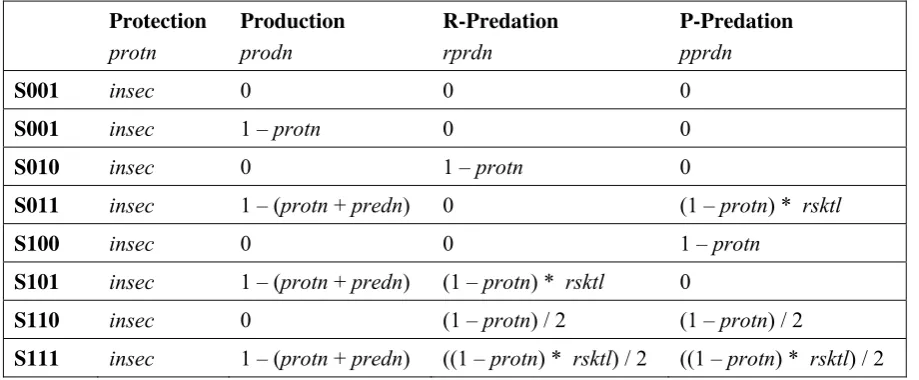
Table 1: Effort allocation patterns based on the strategy selected by the agents
Protection
protn
Production
prodn
R-Predation
rprdn
P-Predation
pprdn
S001 insec 0 0 0
S001 insec 1 – protn 0 0
S010 insec 0 1 – protn 0
S011 insec 1 – (protn + predn) 0 (1 – protn) * rsktl
S100 insec 0 0 1 – protn
S101 insec 1 – (protn + predn) (1 – protn) * rsktl 0
S110 insec 0 (1 – protn) / 2 (1 – protn) / 2
S111 insec 1 – (protn + predn) ((1 – protn) * rsktl) / 2 ((1 – protn) * rsktl) / 2
Strategy: SXYZ, where: X = 1 if the agent predates other agents’ resources and 0 if it does not; Y = 1 if the agent predates other agents’ products and 0 if it does not; and Z = 1 if the agent engages in production and 0 if it does not.
insec = Insecurity, protn = Protection, predn = Predation, rsktl = Risk-taking Level
3. Predate resources: Equation 3 is an extended standard success function, showing how the subject
of a particular conflict, such as the resource, is transferred from one agent to another during a
conflict. For a conflict between agents i and j, the transfers from agent i to agent j are a function of
their mutual predation and protection efforts and wealth, where θ is the predation factor and the
relative value of σ and τ determines the effectiveness of the prey’s protective efforts against the
attacker’s predatory effort. Wealth is measured as the accumulation of income.
. . (3)
By including both the allocation options (predn and protn) and wealth (welth), we ensure the
financial powers of the parties are considered as well as their individual effort. Predating resources
takes place before the production in each tick so the stolen resources can be used.
4. Produce: Equation 4 shows a Cobb-Douglas production function, where prodn represents the
effort allocated to production, techy is the technology, spcln is the agent’s degree of specialization
in production, welth is its wealth and resrs is its resources.
Total capital, 1 . , is measured by combining an agent’s access to
technology with its degree of production specialization and its wealth (financial capital). In
Equation 4, α, β and γ are random variables normally distributed in a way to ensure decreasing
returns to production factors for the majority of agents. At the end, prodd will contain the total
amount of goods produced by the agent i at time t.
5. Predate production: The process of predating products is similar to what was discussed for
resource predation, only the objects of predation are the products produced by the prey, rather than
the raw material as in resource predation.
6. Record: Over time, agents continuously observe their output based on different combinations of
strategies and allocation levels and keep records of the strategy which on average yields the greatest
returns, which is called the best strategy (bstry). In other words, bstry, which is initially set to [0 0 0]
or [0 0 0 0], always contains the strategy with the highest outcome resulting from production and
predation.
The learning module is then implemented through three genetic operators: 1) a mutation which
continuously introduces random changes into agents’ strategies, thereby guaranteeing that each
agent tries different strategies while looking for the strategy yielding the highest returns; 2) a
crossover between the parent’s strategy and the child’s strategy which provides strategy inheritance;
and 3) another crossover which occurs between an agent’s most recent strategy and its best strategy
(bstry), implementing the genetic learning process. The probability of each of these operations to
occur is controlled using mutation-rate, inheritance-rate and crossover-rate, respectively.
7- Check age and reproduce: at the final step, agents increase their age by one. If age is equal to
mxage, new agents are born. The offspring select a new random location and inherit their parent’s
4.4. Design concepts
As Grimm et al. (2010, p. 2765) mention, this design concepts section “does not describe the model
per se” but it is an attempt to review the main “characteristics” of the model.
Basic principles: As discussed earlier, the basic principles of actions and interactions in the model
are based on the theory of production and conflict, which shows how effort can be allocated
between productive and unproductive activities.
Emergence: We expect the final resource allocation trends to emerge from individual actions and
interactions rather than simply being the aggregation of micro-level effort allocation decisions.
Adaptation: The adaptive traits in the model can be direct and indirect. One direct adaptation occurs
when agents increase their protection in response to higher predation from their neighbors. Also, in
response to the changes in the environment such as population, technology or resource access,
agents can change their strategy and so their effort allocation patterns, to ensure that they gain the
highest outcome.
Objectives: The main objective of agent is to increase its outcome by taking into account its
personal features such as risk taking level and its neighbors’ and environment’s characteristics.
Learning: As our strategy framework revealed earlier, we have applied three genetic operators to
embed learning in our agent. This allows us to easily change the number of strategies and at the
same time to implement agents with bounded rationality, since they do not reflect on each strategy
at every point of time (Brenner, 2006), but instead search for a better situation over time and are
affected by a random process which manages the mutation and crossover probabilities. The strategy
framework with genetic operator also enables us to have inter-generational learning.
Prediction: The main prediction that the agent does is using a weighted measurement of its history
of being-attacked to form expectations about future insecurity.
Sensing: The agents detect the resource availability in the environment, the number of their
Interaction: The main interaction channel between the agents is through the predation process
where resources or products are transferred between them.
Stochasticity: The probability values for the genetic operators are considered to be random. Also a
random variable is also embedded in the predation function to control the success rate of predation.
Collectives: No collective actions are implemented in the model.
Observation: Two main sets of variables are observed in the model, including the mean efforts
allocated by all agents to each activity, production, resource predation, product predation and
protection and the share of each strategy selected from the pool.
4.5. Simulation Details
The further details of the model, especially the initial conditions and sensitivity analysis are
presented in this section.
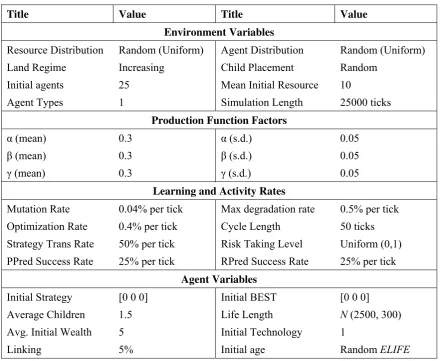
The model starts with 25 agents in a 50 by 50 cell environment. The main variables and their initial
values are listed in Table 3. Resources, agents and their children are distributed randomly in the
environment. The land regime is set in a way that the children can not only inherit land, but they
can also gain their own land over time. The mean value of initial resources in each cell is 10 and the
model has only one type of agent.
The Cobb-Douglas production function powers from Equation 4, α, β and γ, are all distributed
normally with mean = 0.3 and s.d = 0.05, which means that less than 10% of the entities experience
constant or increasing returns to scale.
4.5.1 Sensitivity Analysis
We ran a set of sensitivity analysis simulations to select the appropriate initial conditions for some
of the variables. As expected, changes in mutation, optimization and inheritance rates significantly
affect the model outputs since they determine how frequently agents’ bit patterns are updated over
time. High mutation and low inheritance rates increase the stochastic behavior, decreasing the
most beneficial strategy. On the other hand, while frequent optimization can ensure that agents
follow the best strategy, it prevents them from searching for global optimums.
Based on the calibration results and considering each agents’ life cycle, the value of the mutation
rate is set in a way to guarantee, on average, four mutations over its life time. Based on this, the
optimization rate is set to ensure that between each two mutations, on average, ten optimizations are
undertaken. Finally, the value of the inheritance rate is assigned to provide a 50% probability of the
agent following its parent across the whole bit thread.
The predation success rates for both product and resource are 25%. As expected, lower rates of
predation success decrease agents’ interest in attacking others, but since lower predation is a factor
encouraging agents to predate more as others protect themselves less and returns to predation are
[image:17.595.78.520.413.774.2]high, the success rate impacts are not as high as expected, but still statistically significant.
Table 2: Sample initial conditions
Title Value Title Value
Environment Variables
Resource Distribution Random (Uniform) Agent Distribution Random (Uniform)
Land Regime Increasing Child Placement Random
Initial agents 25 Mean Initial Resource 10
Agent Types 1 Simulation Length 25000 ticks
Production Function Factors
α (mean) 0.3 α (s.d.) 0.05
β (mean) 0.3 β (s.d.) 0.05
γ (mean) 0.3 γ (s.d.) 0.05
Learning and Activity Rates
Mutation Rate 0.04% per tick Max degradation rate 0.5% per tick
Optimization Rate 0.4% per tick Cycle Length 50 ticks
Strategy Trans Rate 50% per tick Risk Taking Level Uniform (0,1)
PPred Success Rate 25% per tick RPred Success Rate 25% per tick
Agent Variables
Initial Strategy [0 0 0] Initial BEST [0 0 0]
Average Children 1.5 Life Length N (2500, 300)
Avg. Initial Wealth 5 Initial Technology 1
Agents are each linked to 5% of the population in the environment. The impacts of different levels
of connectivity are mixed. While a higher level of connectivity leads to an increase in the chances
of predating, since the agents have more options to attack, it decreases the probability of one agent
being predated by one specific neighbor over time and these forces neutralize each other and the
changes in connectivity do not significantly affect the model output.
4.5.2. Randomness Sensitivity Analysis
The model is affected by two sets of factors. Firstly, the initial conditions which were reviewed in
the previous section, as well as the random seed which is selected by the software package.
NetLogo uses a pseudo-random number generating system which means that while the random
numbers are “random”, their generation process is deterministic, so choosing the same random seed
in different simulations ensures that the final thread of numbers produced will be the same. As these
differences can affect our results, we checked how sensitive the model is to the random seeds, by
running the model 30 times, each with a different random seed.
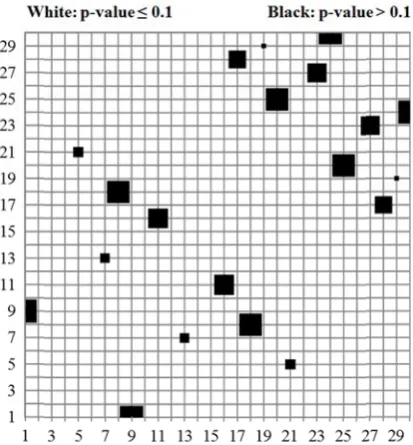
The results are presented in Figure1. Here, there are one line for each x and y coordinate making a
grid line of 900 crossovers when the lines cross. When a x crosses a y line, it produces a black area
if the two seed outputs are statistically significantly different7F
8
. Then, we consider all of these 870
values (900 observations minus 30 of them where a series is compared with itself) as one single
dataset and test if the mean of this sample is more than 0.01 which is rejected at 99% concluding
that there in not enough evidence to claim that the model outputs are significantly different under
different random seeds.
8
Figure 1: On
over the sim
Based on t
initial cond
seeds prov
significant
4.6. Basic
Before pre
scenarios a
scarcity sce
Figure 2 pr
pure produ whether sh and mainly neighbors’ Pure resou having reso ne-to-one sen mulations. H0 these result ditions impo
vides the ch
ly and so th
Model Ver
esenting the
are not act
enarios.
resents the
uct predator
hort-run vol
y result fro
decisions a
urce predati
ources.
nsitivity analy
: Equal mean
s, it can be
osed by dif
hance of ha
he results ca
rification
results, we
tive. This is
variations i
s (S010), or
atilities or l
om how age
and how dif
ion stays cl
ysis results fo
ns of any two
said that th
fferent rando
aving differe
an be analyz
first review
s done to v
in the propo
r pure resou
long-run cy
ents select t
fferent envi
lose to zero
or independe
simulations.
he model is
om seeds. I
ent experim
zed indepen
w a few outp
verify the c
ortion of ag
urce predato
yclical behav
their strateg
ironment va
o, since the
nce from ran
Larger squa
s not signifi
In other wor
ments, it do
ndently.
puts from th
code and a
ents who th
ors (S100) is
vior, are ob
gies based
ariables chan
ere is no dir
ndom seed va
ares show hig
cantly sens
rds, while u
es not chan
he basic mo
also better c
hink being p
s the best st
served in ev
on their pe
nge at the l
rect return
ariations and
gher values.
sitive to cha
using differ
nge the mo
odel where t
clarify the
pure produc
trategy. The
very single
ersonal attri
local and gl
to only pre
equal means
anges in the
Figure 2: Trends of pure production (S001), pure product predation (S010), and pure resource predation (S100).
Regressing the productive allocations against the strategies (excluding the S000), Table 3 shows
that majority of the strategies have significant impacts on the agents’ productive effort allocation
decision. As expected, the pure product predation strategy has the highest negative and the pure
production strategy has relatively the highest positive impact on the productive allocations, while
the dual production-predation strategies have lower or even insignificant effects. The insignificance
of the triple and dual strategies is due to the fact that these strategies, by omitting the protective
efforts, divide the rest of the effort between production and predation and so have unclear impacts
on productive allocations. The insignificant effect of S100 is due to the fact that the strategy is not
practiced by many agents and so its proportion value is close to zero.
Table 3: Productive allocation against the main strategies
Y: Productive Allocation
Durbin-Watson stat 2.087326 Standard Error 0.007744
R Square 0.957432 Observations 2150
Coefficients Standard Error t Stat
Intercept 0.2866 0.05859 4.8932
S001 0.2240 0.0628 3.5654
S010 -0.1945 0.0690 -2.819
S011 0.0985 0.0655 1.5023
S100 -0.0770 0.1055 -0.7304
S101 0.1072 0.0625 1.7131
S110 -0.1670 0.0696 -2.3976
S111 0.0545 0.0646 0.8442
-10% 0% 10% 20% 30% 40% 50%
0 500 1000 1500 2000
Strategy Selection
Time
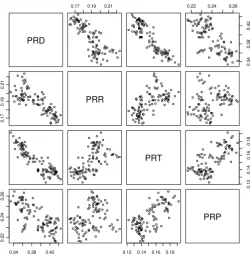
[image:20.595.137.461.542.778.2]Figure 3 presents the mutual resource allocation patterns between each pair of options. As expected
there is a negative relation between production and each of predation options, and between
[image:21.595.173.426.169.427.2]protection and production, and both predation options lead to higher levels of protection.
Figure 3: Mutual relations between any two effort allocation options for random observations.
In addition to the presented outputs and also using NetLogo debugging capabilities, each module
was tested separately, to ensure that the intended design is implemented correctly based on a simple
version of what is called abstract interpretation (Hermenegildo, 2005) in computer science, as well
as running the model under two sample agents to ensure correct communications and interactions.
5. Scarcity Models’ Results
The model provides us with an extended set of results which cannot all be presented in the course of
this paper. As a result, we only discuss the major outputs.
5.1. Land Scarcity
In Figure 4 the vertical dash of lines indicate the start and the end of a medium-intensity resource
shock period.
PRD
0.17 0.19 0.21 0.22 0.24 0.26
0.
34
0
.3
8
0.4
2
0
.1
7
0.
1
9
0.
21
PRR
PRT
0
.1
2
0.
14
0
.1
6
0.
18
0.34 0.38 0.42
0.
22
0
.24
0
.2
6
0.12 0.14 0.16 0.18
Figure 4: Changes in the efforts of all agents allocated to product predation (PPred) and percentage of product
predators (S010) in the population in a simulation with medium shock
Two main issues can be seen in the figure. On one hand, during the resource scarcity period, there is
an upward trend in product predation resource allocation, which finishes as soon as the shock
disappears. But this 25% increase in product predation is not unprecedented since as can be seen in
the figure, between times 5100 and 5200 another increase with similar amplitude but shorter time
period is experienced where no scarcity scenario is active. When the model is run under a set of
weak, medium and severe scarcity scenarios and the average of all is measured, at 95% confidence
level, the trends are similar to the models without any scarcity.
To better explore the role of Land shocks in the changes observed in the predatory trend, we
analyze the impulse responses in two different models. First, the model is run with one resource
shock at a predetermined time (t = 1100), while in the second, the model is hit by four shocks (t =
300, 700, 1100, 1400).
Confirming our initial findings, analyzing the impulse impacts shows that in the majority of cases
the changes in the allocation trends are temporary, if not insignificant and according to the results,
less than 5% of the changes in effort allocation patterns can be attributed to the resource shocks.
The model also shows that a single shock is more likely to cause a structural break in the effort
allocation trends, compared to multiple shocks.
R² = 0.7602
5% 10% 15% 20% 25% 30% 35%
5000 5200 5400 5600 5800 6000
Allo
ca
tio
n
Time
To study th
regions as
left side (s
agents loc
environme
In Figure 5
in that area
around 25%
almost 15%
by the sho
considering
[image:23.595.186.406.418.613.2]effort alloc
Figure 5: C
environmen
which takes
5.2. Water
As introdu
type which
he impacts o
shown in F
shadowed a
cated in ea
ent.
5 each black
a. It is clear
%, in the a
%. The high
ock, but is a
g that in m
cation acros
Changes in t
nt is divided
their resourc
r-D Scarcity
uced in Sect
h can only b
of Land sca
Figure 5 and
area). The
ach region
k dot shows
r that in a si
affected area
hest rate of p
also the fart
models with
ss the enviro
the product
into 10 regio
ce level to zer
y
ion 4-2, Wa
be consumed 20% 22% 24% 26% 28% 30% Allocated Effort
arcity more p
d the shocks
effort alloc
to see wh
s the averag
imulation w as average predatory e thest region random sho onment. predation ef
ons and only
ro.
ater-D (repr
d directly. F y = -0
% % % % % % 1 2 precisely, th
s were arran
cation patte
hether there
ge effort allo
where the av
product pre
ffort is obse
n from the
ocks, there
ffort allocatio
y four of the
resenting re
Figure 6 sho
.00x3+ 0.01x
R² = 0.
3 4 5
Region
he environm
nged to only
rns were th
e was any
ocated to pr
verage effor
edation is h
erved in Re
unaffected
are no stati
on in a mod
m, the shado
esources suc
ows how an
2- 0.05x + 0.3
.77
6 7 8 9
ns
ment was di
y affect the
hen monito
significant
roduct preda
t allocated t
higher than
gion 1, whi
area. These
istically sig
del with regi
owed area, a
ch as drinkin
n increase in 33
9 10
ivided into
40% of pat
ored separat
t variation
ation by age
to product p
the global
ich is not on
e results are
gnificant dif
ional shocks
are affected b
ng water) is
n the area af
10 different
tches on the
tely for the
across the ents located predation is average by nly affected e important fferences in
. The model
by the shock
s a resource
Water-D shock changes the average proportion of agents who prefer to be pure producers. As can
be seen, when the affected area extends, more agents decide to leave the pure production strategy
[image:24.595.128.465.168.325.2]and become predator by enabling their predation bit.
Figure 6: The final value for the proportion of pure producers in simulations with different levels of affected
areas affected by the shock.
To analyze the shock thoroughly, a set of impulse response tests was undertaken for all six main
strategies (leaving out S000 and S100) to investigate the short- and long-run impacts of the shocks,
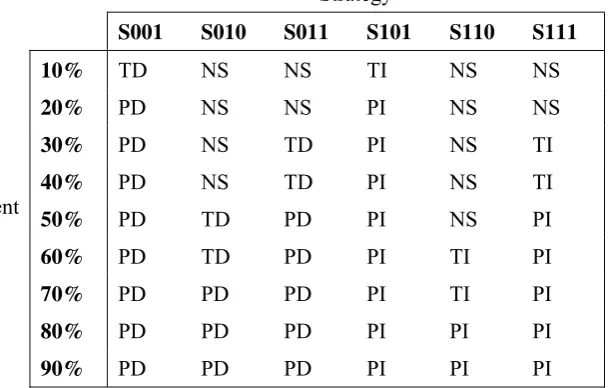
at different levels of scarcity. Table 4 contains the results for these tests.
Table 4: Agent populations’ selection of different strategies in reaction to the Water-D shocks for different
spatial extents. NS = Not Significant, TD = Temporarily Decreasing, TI = Temporarily Increasing, PD: =
Permanently Decreasing, PI = Permanently Increasing.
Strategy
S001 S010 S011 S101 S110 S111
Shock Extent (% of area)
10% TD NS NS TI NS NS
20% PD NS NS PI NS NS
30% PD NS TD PI NS TI
40% PD NS TD PI NS TI
50% PD TD PD PI NS PI
60% PD TD PD PI TI PI
70% PD PD PD PI TI PI
80% PD PD PD PI PI PI
90% PD PD PD PI PI PI
y = -9E-05x4+ 0.0023x3- 0.0174x2+ 0.0032x + 0.3268
R² = 0.9999
0% 10% 20% 30% 40%
A-10% A-20% A-30% A-40% A-50% A-60% A-70% A-80% A-90%
Allo
ca
tio
n
[image:24.595.113.418.541.735.2]As the table suggests, at the lower levels of shocks the producer agents (SXX1) temporarily switch
from just producing to predating Water-D as well as producing. At 20% level of shock, a similar
impact is found, but this time it is permanent since a bigger group of agents experience the shock.
As the shocks become more extensive the second group of non-resource-predating agents (S0XX)
gradually joins the formerly-pure producers, by first temporarily and then permanently allocating
effort to predating others’ resources. The results show that after the shock level passes 50% of the
area, almost all non-resource-predating agents are affected, since they attack others to gain Water-D
and survive. This becomes permanent when the shock is at its full extent, so model responses
changes in the long term changes.
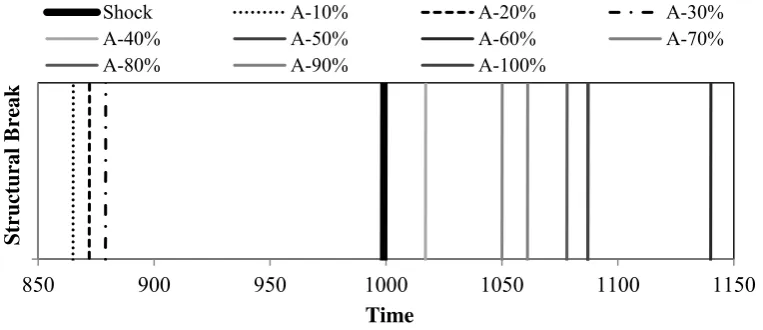
To identify possible structural breaks, the Chow test is applied to the allocation trends. As presented
in Figure 7, low intensity scenarios do not cause any breaks immediately after the shock, while
[image:25.595.109.491.421.586.2]when the shocks become severe, the model responds by a significant change in the output trends.
Figure 7: Shock and structural breaks in a sample run with Water-D as the resource - single run.
While the severe scarcity of a resource such as Water-D should lead to severe consequences for the
agents, such as death, we did not allow the agents to die due to resource scarcity in the initial model
in order to be able to follow the dynamics of their strategy selection over time. When we relax that
constraint allowing the extremely thirsty agents die after passing a pre-defined threshold, the
population trends react as shown in Figure 8. As the figure shows, while Water-D scarcity does not
0.1
850 900 950 1000 1050 1100 1150
Structural Break
Time
Shock A-10% A-20% A-30%
A-40% A-50% A-60% A-70%
affect population trends at low or medium levels of shock intensity, at higher levels the population
[image:26.595.130.465.144.292.2]drops very fast during the simulation.
Figure 8: Final population and affected area in a Water-D model with death – 30 runs
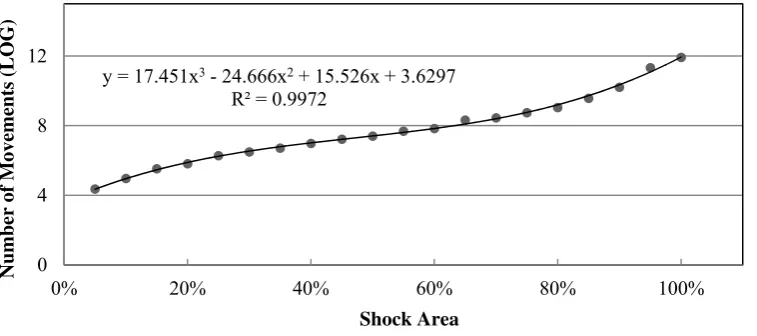
We relax another limitation by allowing the agents to move in response to Water-D scarcity,
searching for resources in the environment. As can be seen in Figure 9 where the natural log of the
number of movements is presented against the affected area, the number of movements increases
exponentially as a result of increasingly severe resource scarcities.
Figure 9: Changes in the number of moves in the model based on the different levels of scarcity – Multiple run.
Migration is an effective strategy also as Figure 10 shows, in the models with the migration option
active (white boxplots), the effort allocated to productive action has decreased less due to different
extents of shock, compared to the equivalent cases where migration is not allowed (grey boxplots).
y = -0.2454x4+ 4.3622x3- 27.212x2+ 68.455x + 148.14
R² = 0.9882
0 100 200
Population
Area Affected
y = 17.451x3- 24.666x2+ 15.526x + 3.6297
R² = 0.9972
0 4 8 12
0% 20% 40% 60% 80% 100%
Number of
Movements
(LOG)
[image:26.595.104.483.452.620.2]
Figure 10: Decreases in productive allocation when migration is active (white) and inactive (grey).
5.3. Water-P Scarcity
Figure 11 shows how allocation trends react to a Water-P (such as water for production) scarcity
scenario. As can be seen, during the shock, productive efforts are replaced by product predation,
which increases gradually when the shock starts and to a large extent disappears after the shock
finishes. As for the strategies, the significant increases in S010 (product predation) and S011
(product predation and production) are considerable, while effort allocated to the pure productive
[image:27.595.139.455.524.669.2]strategy falls when the shock starts and returns to its top position when the shock fades out.
Figure 11: Changes in a sample individual-run effort allocation due to Water-P shock – single run.
Figure 12 shows how different levels of resource shock can affect the average proportion of effort
allocated to production in a model with Water-P as the resource.
MA1000 MA2000 MA3000 MA4000 MA5000 MA6000 MA7000 MA8000 MA9000
30
40
50
6
0
A
ll
o
ca
te
d E
ff
o
rt
(
p
er
ce
nt
a
g
e
)
5% 15% 25% 35% 45%
500 700 900 1100 1300 1500 1700 1900
Allocation
Time
As can be shocks, ch shocks bec efforts whe According allocated t overall resu product pr considering
time and so
We have a
If there ha
give the s
[image:28.595.129.435.93.302.2]moving av
Figure 12:
seen, the p
anges to alm
come longe
en the basic
to the resu
o product p
ults show th
redation, si
g the fact t
o agents nee
also tested f
s been a bre
cenario a s
verage of the 2 2 2 3 3 3 Allo ca tio n
Changes in t
productive
most 30% i
er and affec
c scenario is
ults, the de
predation, s
hat as for L
nce the ret
that Water,
ed to consta
for the exist
eak immedi
score of 1,
e data. 15% 30% 25% 27% 29% 31% 33% 35% Shock Area 27%
the average p
allocation w
in less inten
ct a larger
s compared
crease in th
ince further
and, resour
turns to res
as a comm
antly allocat
tence of a s
iately within and otherw 45% 60% 75% a -29% 29% productive eff which was
nse shock sc
area. The
with very s
he producti
r resource p
rce shocks t
source pred
mon resourc
te effort to i
structural br
n 100 ticks
wise 0. Th
% 400
5000
%-31% 31
forts in Wate
more than
cenarios, th
results show
severe shock
ive efforts m
predation is
o Water-P s
dation decr
e in this m
its predation
reak in the m
after the sh
e tests wer 3000
00 Sh
%-33% 33
r-P shocks m
35% in the
en to slight
w a 25% d
ks.
mainly lead
s not efficie
shift the eff
rease due to
odel, canno
n.
model outpu
hock at 99%
re undertak 1000 2000 hock Duration 3%-35% multiple run.
e basic mod
tly over 25%
decrease in
d to more e
ent for the a
fort from pr
to the shoc
ot be stored
uts over the
% confidenc
ken using th 0
n
del without
% when the
productive
effort being
agents. The
roduction to
ck and also
d for a long
e scenarios.
ce level, we
Figure 13: T
area with va
Figure 13
increases a
less extens
in the effo
we did no
occurrence
5.4. Water
Figure 14
resource fo
impacts of
produce or
and produc
while prod
Testing for t
alue of 1, show
shows that
as well. In th
sive areas, b
ort allocation
ot find any
e.
r-B Scarcit
(top) illustr
for both co
f shock dur
r not. The
ct predation duct predatio Sh k D ti he existence
ws scenario c
t as the sho
he results, n
but with lon
n patterns b
y clear rela
ty
rates how p
nsumption
ration and a
middle and
n trends rea
on increases D1000 D2000 D3000 D4000 D5000 A Sh oc k D ura ti on of structura combinations ocks becom no structura
nger and mo
becomes mo
ation betwe
roductive e
and produ
area have s
d bottom pa
ct to the sca
s at high lev 0 0 0 0 0 1500 A3000
al break due
s which have
me more pow
al breaks are
ore extensiv
ore likely. D
een the sho
efforts decli
uction, Wate
significant
anels respec
arcity. Reso
vels of shoc
0 A4500 A
Shock Are
to Water-P r
caused a stru
werful, the
e experience
ve shocks t
Despite test
ock intensi
ne due to r
er-B. As ca
effects on ctively show ource preda ck intensity. A6000 A7500 ea resource shoc uctural break probability
ed for limite
he existenc
ting for diff
ty and the
esource sho
an be seen
the agents’
w how avera
ation does n
0 A9000
ck scenarios.
k.
y of a struc
ed shock du
ce of a struc
fferent scena
e timing of
ocks in a m
n, again the
’ decisions
age resourc
no change s
. The dashed
ctural break
urations and
ctural break
ario setups,
f the break
model with a
Figure 14: Resource Pr Changes in redation; Bot Shoc Allo ca tio n Sho Allo ca tio n Shock Allo ca tio n effort alloca ttom: Produc 10 00 20 00 40% 45% 50% 55% ck Duration 10 00 20 00 15% 20% ock Duration 30 00 40 00 50 00 k Duration
ation due to
t Predation 30 00 40 00 90% 40%-45% 30 00 40 00 90% n 20 00 30 00 15% 15%-20%
Water-B re
60 75% % 45%-50% 60 75% % 15%-20% 30% 45% 20%-25% esource shock 45% 0% Shock A % 50%-55% 45% 0% Shock Are % 60% 75% Shock Are % 25%-30%
ks. Top: pro
As we presented in previous cases, applying the impulse response tests shows that the impacts are
only significant when severe shocks affect the model.
5.5. Land and Water-B Scarcity
To measure the possible impacts of parallel Land and Water scarcities on how agents allocate their
efforts, different scenarios were designed based on low-, medium- and high-intensity Land and
Water scarcity combinations. The model was then run 30 times and the average results over
different random seeds were calculated separately for every scenario.
According to the results, when the productive effort allocation is regressed against the scarcity of
each resource, the coefficients are 0.004 and 0.003 for Land and Water, respectively. While the
closeness of the values can be attributed to the fact that both resources, on average, have similar
roles in linking the production function to scarcity, the larger coefficient of Land can be attributed
to the agents’ abilities to preserve their Land over time, which makes its predation more desirable.
Figure 15 shows how the productive allocation effort coefficients are distributed for Water and
Land over the 54 scenarios. As can be seen, while the Land coefficient distribution is close to a
normal distribution, the Water coefficient distribution is skewed. This shows that while Land, on
average, contributes more to the production process in this model, its role in production is less
sensitive to the scenarios, compared to Water which can generate utility via either predation or
[image:31.595.134.457.588.745.2]consumption.
Figure 15: Distribution of regression coefficients for Land and Water
0 10 20 30
0 0.001 0.002 0.003 0.004 0.005 0.006 0.007 0.008 0.009 0.01
Frequency
Coefficient
Individual regressions for each of the strategies were run against Water-B and Land levels in the
[image:32.595.55.541.187.487.2]model. The results are presented in Table 5.
Table 5: Strategy selection changes resulting from Land and Water variations. Dependent variable = strategies,
e.g. S0001 = f (Land, Water). SWXYZ: W: Water-B, X: Land, Y: Product Predation and Z: Production.
SWXYZ Land Water R2 SWXYZ Land Water R2
S0000 N/A N/A N/A S1000 -0.00067
(-47.8874)
-0.00085
(-11.5988) 0.590902
S0001 0.00349
(70.63291)
0.002721
(10.4183) 0.739972 S1001
-1.5E-05 (-0.66624)
-0.0021
(-17.178) 0.131499
S0010 -0.00083
(-55.9514)
0.000227
(2.894349) 0.597578 S1010
-0.00095 (-65.549)
-0.00067
(-8.74781) 0.707277
S0011 0.000987
(40.40638)
0.001007
(7.797153) 0.493947 S1011
0.000439 (17.46697)
-0.00041
(-3.07252) 0.117016
S0100 -0.0002
(-18.6174)
-0.00012
(-2.12893) 0.160524 S1100
-0.00025 (-19.3265)
-0.00094
(-13.8646) 0.284082
S0101 -0.00017
(-6.96071)
0.001391
(10.97296) 0.048042 S1101
-0.00086 (-44.0739)
-0.00116
(-11.3017) 0.554038
S0110 -0.00044
(-29.5389)
-0.00028
(-3.49163) 0.325794 S1110
-0.00057 (-36.5186)
-0.00089
(-10.724) 0.470349
S0111 0.000195
(7.560805)
0.002493
(18.31933) 0.203077 S1111
-0.00027 (-8.84087)
-0.00055
(-3.33685) 0.053989
According to the results, the pure production strategy, S0001, is significantly correlated with Land
and Water access, enjoying the highest levels of significance and R2. This clearly shows that the number of producers decreases due to resource scarcity in the model. Pure product predation is
negatively correlated with Land and positively with Water since Water scarcity shift efforts to
resource predation rather than product predation. The positive, statistically significant and highly
correlated coefficients for S0011 (production and product predation) illustrate the fact that during
the time of scarcity, since production levels fall, there may not be enough incentives for agents to
predate what others have produced, and it can also be due to the fact that this strategy is not capable
Pure resource predation strategies, S0100, S1000 and S1100, all increase due to scarcity, but since
Land cannot generate utility individually, the R2 is much higher for the cases where Water
predation is included in the strategy, S1XXX.
Two more interesting findings can be observed in Table 5. First, S1010, or Water and product
predation has a significant negative correlation with both Land and Water access. It seems that
during times of scarcity, agents prefer to predate Water and the final product to survive, rather than
Water and Land and produce themselves. The coefficients of S1101 (predating both resources and
producing) and S1110 (predating both resources and product predation) are comparatively high,
indicating that resource predation that is accompanied by either production or product predation
seems to be a popular strategy when resources get scarcer.
6. Discussion and Conclusions
It is widely believed that induced resource scarcity is the main factor causing
climate-driven conflicts. Applying the theory of production and conflict and using agent-based modeling
enabled us to address three challenges that have been highlighted in the literature. First, following
the suggestions by many researchers in this field, we applied disaggregated analysis to investigate
the possible links between climate change and conflict. Secondly, we addressed a challenge
highlighted by studies such as Theisen et. al (2011) and Scheffran et al. (2012) as we considered
different levels of intensity for resource scarcity. Finally, we took into account the complexities
involved in modeling conflict which arises from the interactions, feedback loops, thresholds and
nonlinearities which exist when conflict decisions are made.
In line with empirical studies such as Theisen (2008) and Raleigh and Urdal (2007), which claim
that only high or very high levels of land and water scarcity are likely to cause conflict, we showed
that while low levels of scarcity does not affect the effort allocation patterns significantly and
scarcity be trends beco Our findin the historic short-term economic o Figure 16 producer a
while in al
changes in
can be ide
resource sc
increases a
[image:34.595.69.521.466.729.2]allocate eff
Figure 16: S
without reso 0% 10% 20% 30% 40% 50% 60% 70% 80% 90% 100% Shock Area 0%-ecomes seve ome substan
gs on the li
cal patterns
climatic ev
or political
(left) summ
agents in the
most 50% o
n strategy se
entified. Ba
carcity and
as the resou
ffort to preda
Share of pure
ource scarcity % % % % % % % % % % % -25% 25%
ere, in dura
ntial, since m
inks betwee s McMicha vents, mediu challenges. marizes our e populatio
of the cases
election patt
ased on ou
conflict, a
urce shocks
ating others
e producers d
y.
Shock Du
%-50% 50
ation, spatia
many agent
en the durati
ael (2012) h
um- and lon
r results in
n are shown
(the dotted
terns, in the
ur results, w
s presented
s become m
s rather than
due to differen uration
0%-75% 7
al area or af
ts develop p
ion of scarc
has reviewe
ng-term cha
a sample
wn based on
d area), reso
e other half
we believe
d in Figure
more severe
n producing
nt levels of re
75%-100%
ffected popu
predatory be
city and the
ed: while so
anges are m
case where different le ource scarcit f, significan that there 16 (right),
due to high
g. esource shock Scarcity ulation, the ehavior. likelihood ocieties can
more likely t
e decreases
evels of sca
ty does not
t levels of d
is a nonlin
where the
her portion
ks compared
becomes mo
e impacts on
of conflict
n adapt to
to cause soc
in the sha
arcity. As c
lead to any
decrease in
near relatio
probability
n of agents
to the basic m
ore severe
n allocation
also follow
“recurring”
cial, health,
are of
pure-an be seen,