ISSN Online: 2160-8849 ISSN Print: 2160-8830
Research on the Collision-Free Path Planning of
Multi-AGVs System Based on Improved A*
Algorithm
Ruiping Yuan, Tingting Dong, Juntao Li
School of Information, Beijing Wuzi University, Beijing, China
Abstract
Path planning problem is the core and hot research topic of multiple Automatic Guided Vehicles (multi-AGVs) system. Although there are many research results, they do not solve the path planning problem from the perspective of reducing traffic congestion. A collision-free path planning method based on improved A* Algorithm for multi-AGVs logistics sorting system is proposed in this paper. In the method, the environment of warehouse operation for AGVs is described by using grid method. The estimated cost of A* algorithm is improved by adding the penalty value of the paths that AGVs share with each other to alleviate traffic congestion and collision resolution rules are made according to different types of collisions. Then the colli-sion-free path planning is done by combing the improved A* algorithm and collision resolution rules. The sorting efficiency of the method is compared with that of origi-nal A* algorithm. Simulation results show that the new collision-free path planning method can improve the sorting efficiency of multi-AGVs system and relieve traffic congestion.
Keywords
Multi-AGVs, Logistics Sorting, Collision-Free Path Planning, Improved A* Algorithm
1. Introduction
With the development of e-commerce, its scale is increasing rapidly and tends to de-velop in the direction of “muti-varieties and small batch” because of personalized needs of people. The velocity of logistics, as one of the important aspects of service quality evaluation in the express industry, is immediately influenced by the efficiency of sorting operation [1] [2]. The general sorting mode of “people to goods” can decrease the cost,
How to cite this paper: Yuan, R.P., Dong, T.T and Li, J.T. (2016) Research on the Collision-Free Path Planning of Multi- AGVs System Based on Improved A* Algo-rithm. American Journal of Operations Re-search, 6, 442-449.
http://dx.doi.org/10.4236/ajor.2016.66041
Received: October 20, 2016 Accepted: November 13, 2016 Published: November 16, 2016
Copyright © 2016 by authors and Scientific Research Publishing Inc. This work is licensed under the Creative Commons Attribution International License (CC BY 4.0).
http://creativecommons.org/licenses/by/4.0/
such as automated sorting machine and stereoscopic warehouse, which mainly depend on transmission equipment and logistics information technology, have the advantage of higher sorting efficiency, but they also have some shortages such as large area occupied, poor flexibility and robustness, etc. [3] [4] [5] [6].
Automatic Guided Vehicle (AGV) is a kind of advanced automatic logistics equip-ment which can meet the requireequip-ments of sorting operation and turn the “people to goods” sorting mode into “goods to people” sorting mode. The path planning problem is the core and hot topic of task allocation for multi-AGVs [7]. At present, there are many researches on dynamic and static path planning problems at home and abroad. The local and global path planning methods for mobile robots’ are summarized and induced by Gu Donglei et al. [8]. The two-stage dynamic path planning and scheduling problems in multi-AGVs system are studied by Liu Guodong et al. [9]. Further re-searches on route optimization problems of single AGV and multi-AGVs are also done by scholars abroad. Vehicle travelling models for AGV systems under various dis-patching rules is studied by Pyung Hoikoo et al. [10]. Tatsushi Nishi [11] conducted an experimental study on a local rescheduling procedure for dynamic routing autonomous decentralized AGV systems. Toshiyuki Miyamoto [12] studied local and random searches for dispatch and conflict-free routing problem of capacitated AGV systems. Mohammad Saidi-Mehrabada [13] proposed an ant colony algorithm for solving the new integrated model of job shop scheduling and conflict-free routing of AGVs. Al-though there are many research results about the problem of searching the shortest path, they do not solve the path planning problem from the perspective of reducing traffic congestion.
The paper is organized as follows. First, based on the dynamic sorting operation mode for multiple AGVs, the sorting environment is described by using grid method. Second, the estimated cost of A* algorithm is improved by adding the penalty value of the paths that AGVs share with each other to alleviate traffic congestion. Then the col-lision-free path planning is done by combing the improved A* algorithm and collision- free planning. Finally, the sorting efficiency of the improved A* algorithm is compared with that of other algorithms by simulation experiments.
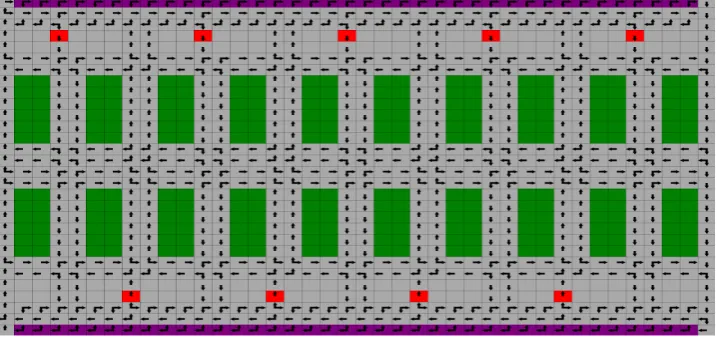
Figure 1. Warehouse environment modeled using grid method.
replenishment platform grid (set 3), pausing area grid (set 4), charging piles grid (set 5) and the other free grids is set 0. They are represented by grids with different color. The warehouse environment modeled using grid method is shown in Figure 1.
Based on the environment model, the work process of AGVs is given as follows. First AGVs receive tasks to carry shelves to the appointed sorting area from the appointed shelf area and the shelves wait to be sorted. Then shelves which had been sorted out are carried to the original position and AGVs are allocated another task. If there are no other tasks, AGVs will return to the pausing area. The direction of the arrow represents AGV’s driving direction. AGVs can drive in 4 directions: due east, due west, due south and due north.
3. The Improvement of A* Algorithm When Used in Collision-Free
Path Planning of Multi-AGVs System
3.1. The Original A* Algorithm
A* algorithm can calculate the shortest path in real time efficiently and is applied wide-ly in the practical engineering. Two factors including actual cost and estimated cost are taken into account for the method to calculate the distance between the current point and the target point [14]. The actual cost means the cost of the path that AGV had tak-en and the estimated cost means the cost of the path that the AGV will take. The gtak-ener- gener-al evgener-aluation function form is given as follows:
( )
( ) ( )
f n =g n +h n (1)
probably cannot be obtained. So the estimated cost is the emphasis and difficulty of the research.
3.2. The Improvement of A* Algorithm Considering Traffic Congestion
The moving directions for AGV in the storage environment are due east, due west, due south and due north. So usually the Manhattan Distance is used to calculate the esti-mated cost h n( )
when study the sorting route. The estimated cost according to the current point(
xn,yn)
and the target point(
xend,yend)
is given as follows:( )
n end n endh n = x −x + y −y
(2)
But if the Manhattan Distance is used as the estimated cost, the path planning will be restricted to the single AGV in static rather than dynamic environment, and it will cause traffic jam. In order to relieve traffic jam and improve calculation efficiency, at the intersection, the paths of AGVs are planned again and all the feasible paths are de-tected in which the penalty value of the paths that AGVs share with each other is added. The penalty value depends on the distance from the AGV and it is in inverse propor-tion to the distance. Eventually the estimated cost funcpropor-tion is chosen as follows.
( )
n end n endh n = x −x + y −y +αa+βb+γc (3)
In this function, a is the number of AGVs whose distance from the target point is 1-4 grids and its weight is α, b is the number of AGVs whose distance from the target
point is 4-8 grids and its weight is
β
, and the number of the other AGVs is c and its weight isγ
. α> >β γ
, Which means the closer the distance the greater the penalty value. Dynamic path planning is implemented by improving the estimated cost and the traffic jam is relieved. The final estimated cost function is given as follows:( )
( )
n end n endf n =g n + x −x + y −y +αa+βb+γc (4)
4. The Collision Resolution Rules
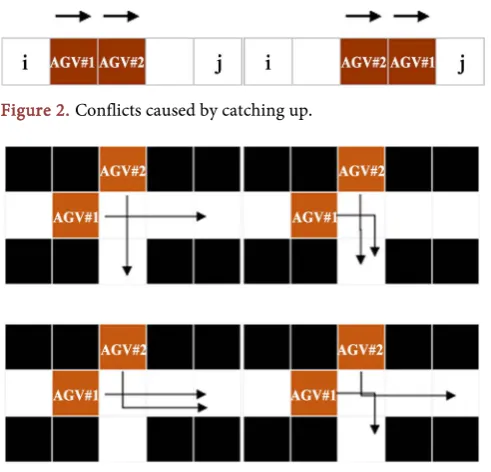
When using A* algorithm to plan the path of each AGV dynamically, collisions will happen when many AGVs work at the same time in practical operation. Two types of collisions in storage environment are given as follows.
4.1. Conflicts Caused by Catching Up
Conflicts caused by catching up are shown in Figure 2. To solve this conflict, the prior-ity of AGVs is not considered, the AGV behind should stop and wait until the AGV ahead passes, and then it continues to move.
4.2. Conflicts in Intersection
Figure 2. Conflicts caused by catching up.
Figure 3. Conflicts in intersection.
5. The Steps of Collision-Free Path Planning of Multi-AGVs
Based on Improved A* Algorithm
Based on the analysis above, collision-free path planning of multi-AGVs based on im-proved A* algorithm and collision resolution rules is carried out, the steps are as fol-lows.
Step 1: Define two tables named OPEN and CLOSE. OPEN means the set of nodes which will be searched definitely but cannot be ensured that they are on the shortest path. CLOSE is the set of nodes which have been searched already and the shortest path can be found from the starting point to the target point in these nodes.
Step 2: Choose nodes Vs and Vend which are the starting point and the target point respectively and Vi means the other points. Then Vs is placed in the table OPEN and table CLOSE is initialized to be empty.
Step 3: Choose the node n which makes the value of function f(n) minimum and then it is added into table CLOSE. Then if the point is the target point, the search is ended and the optimum solution is obtained, otherwise the next search is conducted. If table OPEN is empty, it means the path cannot be found and the algorithm is ended
Step 4: Extend searching for grid Vj
(
j≠i)
which is adjacent to Vi and has no obstacles and calculate the value of( )
Vi , then repeat step 3.If there are conflicts between AGVs, it is handled by collision resolution rules. The path of AGVs can be planed again using the method. So the new method can obtain the maximal benefit using the idea of reliving traffic jam on the premise of finding a colli-sion-free path.
6. Simulation Analyses
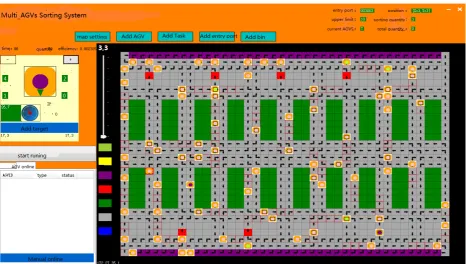
de-state and adjust AGV’s speed and accelerated speed. The right is work area modeled by gird method which can simulate the real sorting environment. Sorting efficiency indi-cators are shown in the top right corner. AGV’s application environment and the number of tasks required can be set automatically according to the need in the system.
[image:6.595.86.553.274.538.2]In the simulation experiment, the area of warehouse is 800 × 800 which is divided into 1 × 1 grids. The number of AGV is 80 and its size is 0.8 × 0.8. The speed of AGV is 2 m/s. When select the parameters of α, β, γ, we should ensure α> >
β γ
, which means the closer the distance the greater the penalty value. Here we the parameters of α, β, γ are set to be 0.6, 0.3 and 0.1 separately. On the platform, the sorting efficiency of multi-AGVs with path planning based on the improved A* algorithm is compared with that of original A* algorithm, as shown in Table 1. In the table, ASP/s stands for the average sorting pieces per second.Figure 4. The simulation platform of multi-AGVs sorting system.
Table 1. Comparison of the sorting efficiency between original A* algorithm and improved A* algorithm.
Simulation Times Time (h) ASP/s of the original A* algorithm ASP/s of the improved A* algorithm
1 1 3.54 3.85
2 2 3.43 3.79
3 3 3.32 3.78
4 4 3.22 3.75
5 5 3.12 3.75
[image:6.595.83.553.588.710.2]According to the simulation results, sorting speed of the two methods both decreases with time, but method based on the improved A* algorithm can sort more pieces of ex-press package and the sorting speed decreases more slowly than that of original A* al-gorithm. That is because traffic congestion and collision avoidance are considered in the improved algorithm. So the method based on the improved A* algorithm not only can meet the sorting system’s requirements for stability, but also can improve the sort-ing efficiency and relieve traffic jam.
7. Conclusion
On the basis of warehouse environment built by using grid method, the paths of AGV are planned from the perspective of relieving traffic jam and avoiding collisions by us-ing improved A* algorithm and collision resolution rules. Simulation results show that the new method can improve the sorting efficiency of multi-AGVs and relive traffic jam. In future research, more effective algorithms according to different scenarios will be studied.
Acknowledgements
This paper is supported by Funding Project for Beijing Intelligent Logistics System Collaborative Innovation Center; Funding Project for Beijing key laboratory of intelli-gent logistics system; Science and technology plan general program of Beijing Munici-pal Education Commission (ID: KM201510037001); Funding Project for Technology Key Project of Municipal Education Commission of Beijing (ID: TSJHG201310037036).
References
[1] Tang, N.N. (2012) The Research on Sorting Operation of Express Company. Ph.D. Thesis, Dalian Maritime University, Dalian.
[2] Gao, X.Q. (2014) The Analysis on Sorting Operation of Express Company. Marked Moder-nization Magazine, 29, 55-57.
[3] Xiang, W. and Li, P. (2013) A Preliminary Study of the Existing Domestic Express Industry Sorting Technology. China Business (Economic Theory Research), 3, 39-40.
[4] Zhang, Y.G. and Wu, Y.H. (2008) The Order Arrangement Optimization of an Automated SortingSystem with the Ability of Order Accumulation. Journal of Shandong University (English Science), 38, 67-71.
[5] Zhang, X.M. (2015) Picking Operation Optimization and Algorithm Research Based on KIVA System. Ph.D. Thesis, Beijing University of Posts and Telecommunications, Beijing. [6] Che, M., Ni, X.J. and Zhang, J. (2015) The Application Research on AGV Technology in the
Tobacco Industry Logistics System. Logistics & Material Handling, 20, 170-173.
[7] Lei, Y.M. (2011) Research on Dynamic Path Planning Method for Multi-robot Systems. Ph.D. Thesis, Harbin Engineering University, Harbin.
[8] Gu, D.L., Li, X.G. and Wang, S. (2014) Mobile Robot Path Planning Method. Robot Tech-nology and Application, 1, 28-30.
261.http://dx.doi.org/10.1023/A:1015831711304
[11] Nishi, T., Ando, M. and Konishi, M. (2006) Experimental Studies on a Local Rescheduling Procedure for Dynamic Routing Autonomous Decentralized AGV Systems. Robotics and Computer Integrate Manufacturing, 22, 154-65.
http://dx.doi.org/10.1016/j.rcim.2005.02.010
[12] Miyamoto, T. and Inoue, K. (2016) Local and Random Searches for Dispatch and Con-flict-Free Routing Problem of Capacitated AGV Systems. Computers & Industrial Engi-neering, 91, 1-9.http://dx.doi.org/10.1016/j.cie.2015.10.017
[13] Saidi-Mehrabada, M. and Dehnavi-Arania, S. (2015) An Ant Colony Algorithm (ACA) for Solving the New Integrated Model of Job Shop Scheduling and Conflict-Free Routing of AGVs. Computers & Industrial Engineering, 86, 2-13.
http://dx.doi.org/10.1016/j.cie.2015.01.003
[14] Atere, A. and Lehtinen, J. (2013) A Multiresolution A* Method for Robot Path Planning. Applications of Artificial Intelligence in Engineering XII, 19, 132-137.
[15] Guruji, A.K., Agarwal, H. and Parsediya, D.K. (2016) Time-Efficient A* Algorithm for Ro-bot Path Planning. Procedia Technology, 23, 144-149.
http://dx.doi.org/10.1016/j.protcy.2016.03.010
Submit or recommend next manuscript to SCIRP and we will provide best service for you:
Accepting pre-submission inquiries through Email, Facebook, LinkedIn, Twitter, etc. A wide selection of journals (inclusive of 9 subjects, more than 200 journals)
Providing 24-hour high-quality service User-friendly online submission system Fair and swift peer-review system
Efficient typesetting and proofreading procedure
Display of the result of downloads and visits, as well as the number of cited articles Maximum dissemination of your research work