http://www.scirp.org/journal/ojop ISSN Online: 2325-7091
ISSN Print: 2325-7105
Optimal Multiperiodic Control for Inventory
Coupled Systems: A Multifrequency
Second-Order Test
Marek Skowron, Krystyn Stycze
ń
Department of Control Systems and Mechatronics, Wrocław University of Science and Technology, Wrocław, Poland
Abstract
A complex autonomous inventory coupled system is considered. It can take, for ex-ample, the form of a network of chemical or biochemical reactors, where the inven-tory interactions perform the recycling of by-products between the subsystems. Be-cause of the flexible subsystems interactions, each of them can be operated with their own periods utilizing advantageously their dynamic properties. A multifrequency second-order test generalizing the π-test for single systems is described. It can be
used to decide which kind of the operation (the static one, the periodic one or the multiperiodic one) will intensify the productivity of a complex system. An illustrative example of the multiperiodic optimization of a complex chemical production system is presented.
Keywords
Optimal Multiperiodic Control, Complex Systems, Inventory Interactions, Nested Optimization, Multifrequency Second-Order Test
1. Introduction
We consider complex autonomous inventory coupled (IC) systems. Such systems can take, for example, the form of a network of chemical or biochemical networks, where the inventory interactions perform the recycling of by-products or by-streams from some subsystems to other subsystems as their input components or energy carriers [1]. Because of the flexible interactions of the subsystems, each of them can be operated with their own period utilizing advantageously its dynamic properties. In this context, we formulate the multiperiodic optimal control problem, which generalizes the period-ic control approach finding much attention for the optimization of chemperiod-ical and bio-How to cite this paper: Skowron, M. and
Styczeń, K. (2016) Optimal Multiperiodic Control for Inventory Coupled Systems: A Multifrequency Second-Order Test. Open Journal of Optimization, 5, 91-101.
http://dx.doi.org/10.4236/ojop.2016.53011
Received: June 24, 2016 Accepted: September 26, 2016 Published: September 29, 2016
Copyright © 2016 by authors and Scientific Research Publishing Inc. This work is licensed under the Creative Commons Attribution-NonCommercial International License (CC BY-NC 4.0).
http://creativecommons.org/licenses/by-nc/4.0/
technological processes [2]-[6]. We analyze three kinds of operation for IC systems: the steady state one, the periodic one, and the multiperiodic one with possibly incommen-surate operation frequencies of the subsystems. We develop a multifrequency second- order test, which can be used to ensure the best intensification of the productivity of IC systems preserving at the same time their advantageous ecological features: many by- products are recycled within a complex system. The justification of the test proposed is obtained by the approach avoiding the regularity conditions, which generalizes such an approach for single systems. We illustrate the theoretical considerations by the example of multiperiodic optimization of a complex chemical production system.
Notation: R+ is the set of positive reals; Rn
( )
n is the space of n-dimensional real (complex) vectors x with the norm x max0≤ ≤k n xk ; 1 1n
k k
x
∑
= x ; τ,n ∞ is the space of τ-periodic n-dimensional essentially bounded functions x equipped with the
norm
( )
0
esssup t
x x t
τ
∞ ≤ ≤ ;
, 1,
n
τ ∞
is the space of τ-periodic n-dimensional functions
with the essentially bounded derivative and the norm x1,∞ x∞+ x∞; On m×
( )
In is the zero (the identity) matrix of the dimension n m× (n n× ); Int X( )
is the inte-rior of the set X; nx is the dimension of a variable x; nx ∑
1≤ ≤i nnxi for x=( )
xi 1≤ ≤i n;,n
Tκτ is the set of τ-periodic n-dimensional trigonometric polynomials of degree κ; and
( )
Eτ f t is the average value of a τ-periodic function f t
( )
.2. Optimal Multiperiodic Control Problem
Consider the following optimal multiperiodic control problem for IC systems (the prob-lem M) composed of the set
{
1, 2,,N}
of N subsystems: find for eachsubsys-tem its operation period τi∈R+, and its τi-periodic control process
(
)
, ,1,
, i x i w
i i i i ni ni
i i i i
sτ xτ wτ ∈Sτ τ∞ ×τ∞ encompassing its τi -periodic state trajectory
i i
xτ , its τi-periodic extended control
i i
wτ , which minimize the performance index
(
,)
i( )
ii
s a y
∈
∑
τ
τ
(1)
being a scalar function of the τi-averaged outputs of the subsystems
( )
( )
(
)
(
)
0 1
, d ,
i i i
i i i i
i
y τh xτ t wτ t t i
τ
=
∫
∈(2)
and subject to the resource-technological constraints of the subsystems
( )
0,( )
0(
)
,i i i i
b y = c y ≤ i∈ (3)
the state equations of the subsystems
( )
(
( )
,( )
)
,[ ]
0,(
)
,i i i
i
i i i i i
xτ t = f xτ t wτ t t∈Tτ τ i∈
(4)
the inventory constraints
( )
(
)
0 1
d ,
i i
i i ij j
j i
K w t t K y i
τ τ
τ ∈
≤
∑
∈∫
(5)
and the box constraints for the process variables
( )
( )
(
)
, i , i , ,
i i i xi t Xi wi t Wi t T i
τ τ
τ
where the extended control
( )
(
( )
T( )
T)
T(
)
, ,
i i i
i
i i i
wτ t uτ t vτ t t∈Tτ of the ith subsystem encompasses its local control i i,nui
i
uτ ∈τ∞ , and its inventory control i i,nvi i
vτ ∈τ∞ , and
(
,)
vi ui vi
i n n n
K O × I , and , nxi, nwi
i ⊂R+ Xi ⊂R Wi ⊂R
are the box sets, and
: nyi , : nyi npi, : nyi nri,
i i i
a R →R b R →R c R →R
: nxi nwi nyi, : nxi nwi nxi,
i i
h R ×R →R f R ×R →R
, vi yj
n n
ij
K ∈R ×
while
( )
i ii i i i
sτ sτ ∈ ∈Sτ
∏
∈Sτ is the multiperiodic control process of the IC sys-tem. We denote the set of all such processes satisfying the constraints (2)-(6) with a fixed multiperiod τ
( )
τ
i i∈ by Sτad, and the corresponding problem M by Mτ.The objective function (1) represents the global benefits from the multiperiodic op-eration of the IC system, which are determined with the help of the τi-averaged
out-puts (2) of the subsystems depicting, for example, their averaged production perfor-mance or their averaged selectivity. The constraints (3) mirror the averaged availability of the resources used for the process operation, and the technological requirements for the averaged product purity. The inventory interactions (5) perform the recycling of by-products or by-streams of some subsystems to other subsystems as their input components or energy carriers [1]. Because of the flexible interactions of the subsys-tems each of them can be operated with their own period utilizing advantageously its dynamic properties, which leads to the nested multiperiodic optimization encompass-ing the static and periodic optimization as its particular cases. The structural matrices
i
K and Kij determine the averaged constraint of the inventory control of the ith sub-system by the averaged outputs of the other subsub-systems.
3. The Multifrequency Second-Order Test for Complex Systems
Constraining the variables i, ii i
xτ wτ to the steady functions x wi, i we obtain the
op-timal steady-state problem for the IC systems (the problem S):
( )
( )
(
) ( )
( )
(
)
(
)
min | , , 0, 0, , 0,
, , , ,
i i i i i i i i i i i i i
s S
i
i i ij j i i i i
i
J s a y y h x w b y c y f x w
K w K y x X w W i
∈ ∈
∈
= = ≤ =
≤ ∈ ∈ ∈
∑
∑
(7)
where s
( )
si i∈∈S∏
i∈Si is the steady-state control process of the IC systemwith the components
(
,)
(
nxi nwi)
i i i i i
s x w ∈S
∏
∈ R ×R . Let s ( )
si i∈ be a locallyoptimal steady-state process of the IC system (the s-process) with the components
(
,)
i i i
s x w (the si-processes).
Assumption 1: The functions h fi, i and a b ci, i, i are twice continuously
differen-tiable in some neighbourhoods of the points si and yi h si
( )
i , respectively(
i∈)
. Assumption 2: The steady states xi are lying in the interior of their box sets, i.e.( ) (
)
i i
x ∈Int X i∈ . Let
( )
, ii i
x t sτ be the solution of the differential equation
( )
(
( )
( )
)
( )
0, i , 0 ,
i i i i i i i
for the reduced τi-periodic control process of the ith subsystem
(
0)
,, x i w
i i i ni ni
i i i i
sτ x wτ ∈Sτ R ×τ∞ , sii xi0 wii .
τ τ
∞
+
Using the affine scaling of the variables i
i
wτ we convert the sets Wi into the hypercubes
[
1,1]
win
− . We write their
box constraints as
(
i( )
)
0i i
p wτ t ≤ , where the functions : nwi 2nwi
i
p R →R take the form
take the form
(
i( )
)
(
(
i( )
1)
T,(
i( )
1)
T)
T,i i i i i i
p wτ t −wτ t − wτ t − and
(
)
T1 1,1, ,1 nwi
i ∈R .
We convert the problem Mτ to the following reduced form (the problem Mτ):
( )
( )
(
( )
( )
)
( )
( )
( )
( )
(
)
(
( )
)
(
)
min | , , , 0, 0,
, , 0, , 0, ,
i i
i
i i i
i i
i i i i i i i i i i i
i
i i i i i i ij j i i
j
J s a y y E h x t w t b y c y
E f x t w t K w K y p w t t T i
τ τ τ
τ τ τ
τ τ ∈ ∈ ∈ = = ≤ = ≤ ≤ ∈ ∈
∑
∑
τ τ τ
s S s
s
where
( )
i ii i i i
τ τ
∈
∈ ∈
∏
τ τ
s s S S is the reduced multiperiodic control process normed
as max i
i i
τ ∈
τ
s s . The set of all admissible processes of the problem Mτ is de-noted by ad
τ
S .
The s-process induces a reduced locally optimal steady-state process s =
( )
si i∈ of the problem S (the s-process) with the components si (
x wi, i)
. The problemτ
M is locally proper at s iff s is not its local minimum. We approximate the controls i
i
wτ by the trigonometric polynomials i i,wi i
n i
wτ ∈Tκτ
(the T-controls) defined as
( )
( )
( )
0 1(
)
1
, cos sin
i
i i i
i
i i
i i i i i i
w t w w t w t w t w t t T
κ
κ κ
τ τ τ
τ κ κω κω = + + ∈
∑
with the coefficients nwi
i
wκσ ∈R and the operation frequency ωi2πτi. We denote
by
(
T T)
T(
)
, wi
i i i
n
i i i w w w
w w w ∈R n n +n the set of the coefficients of the T-controls
with
(
)
T 0 1 1 1 , 2 i i wi i i n i i
i w i w
w w w R n n
κ κ κ κ κ κ κ = = ∈
. We distinguish the subvectors
(
0,1, 2)
wik
n ik
w ∈R k= of the vector wi connected with its internal part
(
)
0 1 ,10 0
i i i
w ∈ − , and its boundary parts wi1=1i1 and wi2= −1i2, where
(
)
T1 1,1, ,1 nwik, 0,1, 2
ik ∈R k= . We fix the control i0
w on its optimal steady-state
level wi0, while we shift the controls wik,k=1, 2 to the interior of their box sets. We
impose on the subvectors wik the pure dynamic T-controls
, . i wik i i n ik
wτ ∈Tκτ We set
(
)
T0 0, 0, , 0 nwik, 1, 2
ik ∈R k= . We write the generalized function of the box
con-straints as
(
i( )
,)
0i i i
p wτ t d± ≤ , where the functions : nwi 2nwi
i
p R →R take the form
( )
(
)
(
(
( )
)
T(
( )
)
T)
T, ,
i i i
i i i i i i i
p wτ t d± −wτ t −d− wτ t −d+ for nwi,
i
d±∈R and
( )
(
i ,)
(
i( )
,)
i i i i i i
p wτ t d p wτ t d± for di di += −.
We write the multi-trigonometric approximation Mτ of the problem Mτ:
( )
( )
(
( )
( )
)
( )
( )
( )
( )
(
)
( )
(
)
min | , , , 0, 0,
, , 0, , 0 ,
i i
i
i i i
i
i i i i i i i i i i i
i
i i i i i i ij j i i
j
J s a y y E h x t w t b y c y
E f x t w t K w K y w i
τ τ τ
τ τ τ
τ ∈ ∈ ∈ = = ≤ = ≤ ≤ ∈
∑
∑
τ τ τ
s S s
where the mappings ,
(
(
1 2)
)
: i wi i 2i i i i
i
n n
i T R n nw nw r ni w
τ
κ → p p + +
p determining the con-
straints on the T-controls are defined as
( )
(
( ) ( )
( )
)
TT T T
0 , 1 , ,
i i i i
i
i wi i wi i wi ir wi
τ τ τ τ
p p p p
with
( )
(
(
) (
)
)
TT T
0 1, 1 , 2, 2 , 1 1 ,1 1 0 ,1 2 0 ,2 2 1 ,2
i
i wi pi w di i pi wi di di i di i di i di i
τ ± ± + − + −
p
( )
(
(
( )
)
(
( )
)
(
( )
)
)
TT T T
0 , 0 , 1 , 1 , 2 , 2 ,
i i i i
ir wi pi wi tir di pi wi tir di pi wi tir di
τ τ τ τ
p
(
1)
,{
1, 2, ,}
,ir i i i i
t τ r− r r∈ r
(
)
(
)
(
)
0 10 0 , 1 11 1 , 2 2 12 ,
i i i i i i i i i i i i
d ρ − w d ρ −w d ρ w −
and ρicos−1(πκi/ri), and
( )
ii i i iiτ τ
∈
∈ ∈
∏
τ τ
s s S S is the reduced multi-trigono-
metric control process of the IC system with the components
(
0)
,, x i wi
i i i i
i
n n
i x wi i i R T
τ
τ τ τ
κ
∈ ×
s S . The set of all admissible control processes of the
problem Mτ is denoted by Sτad.
Assumption 3: The number of points ri of the discrete time grid
{ }
1i
r ir r
t = is
coor-dinated with the degree κi of the trigonometric polynomials wii τ
such that ri>2κi.
Lemma 1. The s -process and the problems Mτ, Mτ and Mτ have the following
nesting ad ad ad
S
∈τ ⊂ τ ⊂ τ
s S S , which means that the set of the reduced admissible multi- trigonometric control processes ad
τ
S contains the s -process, and is contained in the set of the reduced admissible multiperiodic control processes ad
τ
S , which can be ex-tended to the set of admissible multiperiodic control processes ad
Sτ .
Proof. The s-process satisfies the constraints pi0 by their definition. It also veri-fies the constraints pir,r∈i, since its dynamic parts are nullified wiki 0ik
τ =
and
0, 0,1, 2.
ik
d > k= Thus ∈ ad
τ
s S . The constraints
(
0( )
, 0)
0i
i i ir i
p wτ t d ≤ mean that
( )
(
)
0i 0
i ir i i
wτ t ≤d r∈ , which implies, by the uniform norm evaluation of the T-control [7][8], the inequalities 0
( )
10 0i
i i i
wτ t ≤ −w and 0 0i
( )
10(
)
ii i i
w +wτ t ≤ t∈Tτ . The constraints p wi
(
i1i( )
tir ,di1)
0τ ≤
mean that
( )
(
) (
)
1i 11 1
i ir i i i i
wτ t ≤c −w r∈ , and imply by the same evaluation
(
11 1)
1( )
11 1(
)
.i
i
i wi wi t i wi t T
τ
τ
− − ≤ ≤ − ∈ On the other hand
the constraint p w di
(
i1, i1)
0± ≤ involves
1 1 1
0i ≤wi ≤1i . Hence
(
)
1 1 1 1
1i wi 1i wi
− − ≤ − − and 11 1 1i
( )
11(
)
i
i wi wi t i t T
τ
τ
− ≤ + ≤ ∈ . Similarly the constraints
( )
(
2i , 2)
0i i ir i
p wτ t d ≤ and p wi
(
i2,di2)
0± ≤ imply
( )
(
)
2 2 2 2
1 i 1
i
i wi wi t i t T
τ
τ
− ≤ + ≤ ∈ .
Thus ad ⊂ ad
τ τ
S S . The latter set can be extended to the set Sad
τ .
Let L y x w
(
, , ,µ)
∑
i∈L y x wi(
i, i, i,µ)
be the L(agrange)-function for the problem S with(
)
( )
(
(
)
)
( )
( )
(
)
( )
( )
T T T
0
T T T
, , , ,
, ,
i i i
i i j i
i i i i i i h i i i i b i i c i i
T
f i i i K i i K ji i p i i
j
L y x w a y h x w y b y c y
f x w K w K y p w
µ µ µ µ µ
µ µ µ µ
∈
+ − + +
+ + −
∑
+
where µ0 is the multiplier connected with the performance index of the problem S,
and hi, bi, ci, fi, Ki
i i i i i
n
n n n n
h R b R c R f R K R
µ ∈ µ ∈ µ ∈ µ ∈ µ ∈ and pi
i
n
p R
µ ∈ are the
(
)
(
1)
TT T
0, 1, , 1 N
n
N R n n n
µ
µ µ µ
µ µ µ µ ∈ + + + is the multiplier of the problem S
with
(
)
T(
)
T T T T T T
, , , , , i
i i i i i i i i i i i i i
n
i h b c f K p R n nh nb nc nf nK np
µ
µ
µ µ µ µ µ µ µ ∈ + + + + + , and
ci
n i
c∈R is the active part of the constraint ci at yi h x wi
(
i, i)
,Ki
n i
K ∈R is the
active part of the constraint Ki at
(
w yi, i)
, andpi
n i
p ∈R is the active part of the
constraint pi at yi. We set
( )
(
)
( )
(
)
( )
(
)
,i ,i , , , ,i ,i , , , , i , i , ,
i y i y i i i i x i x i i i i w i w i i i
L′
µ
L y x w L′µ
L y x w L′µ
L y x w .We exploit the finite-dimensional optimization theory avoiding regularity conditions discussed for nonlinear programing problems in [9], and in [10] as a particular case of a variety of abstract optimization problems.
Lemma 2. If s is a local minimum of the problem S, then there exists a nonzero multiplier µ∈Rµ such that the following conditions are satisfied
0 0, ci 0, pi 0,
µ ≥ µ ≥ µ ≥
( )
( )
( )
(
)
,i 0, ,i 0, , i 0 .
i y i x i w
L′
µ
= L′µ
= L′µ
= i∈ (8)Let ni
i R
ν
∈ p be the multipliers for the active constraintsi p , let
(
)
T1, 2, , i ,
n
N p
i
Rν nν n
ν ν ν ν
∈
∈
∑
and let
(
T T)
T(
)
, Rnλ nλ nµ nν
λ µ ν ∈ + be the multiplier of the problem Mτ. We
set
( )
0 0 ii
x x
∈
,
( )
ii i
wτ wτ
∈
,
(
)
T( )
,
i i
i wi i i i wi
τ ν ν τ
p , and we write the L-function of
the problem Mτ:
(
, 0, ,)
(
i i(
i, i( )
, ii , ii( )
,)
i(
ii, i)
)
.i
L y x w λ Eτ L y x t sτ wτ t µ wτ ν
∈
+
∑
τ τ
We abbreviate the (partial) derivatives evaluated at s as
( )
,( )
,( )
, 1 ,i( )
, 2 , i( )
, 1 ,i( )
,i i i i i i i i i i i x i i i w i i i x i
A a y′ B b y′ C c y′ H h′ s H h′ s F f′ s
( )
( )
( )
(
)
( )
ˆ(
)
2 , i , , i , , i , i , , , i , i , ,
i i w i i i w i i w i i w i i i w i i w i i
F f′ s P p′ w ′
ν
′ wν
′ν
′ wν
( )
(
)
0( )
0(
)
,i ,i , , , , ,i ,i , , , ,
' '
y y x x
Lτ
λ
Lτ′ y x wλ
Lλ
L′ y x wλ
τ τ
( )
(
)
( )
(
)
, i , i , , , , , i , i , , , .
' '
w w w w
Lτ λ Lτ′ y x wλ Lτ λ Lτ′ y x w λ
Assumption 4: The matrices j
ω
i nIxi −Fi1 are nonsingular for all ωi2πτi suchthat τ ∈i i.
This assumption eliminates the onset of free, and resonance oscillations in the sub-systems.
Lemma 3. The s-process satisfies the FON conditions of the problem Mτ
regard-less if it is its local minimum or not. These conditions take for a nonzero multiplier
(
T T)
T,
λ= µ ν the form
0 0, ci 0, pi 0, i 0,
µ ≥ µ ≥ µ ≥ ν ≥
( )
( )
( )
( )
( )
(
)
, i 0, ,i 0, , i , i 0, i 0 .
i y i x i w i w i w i
L′
µ
= L′µ
= L′µ
+′ν
= ′ν
= i∈(9)
Proof. The problem Mτ can be interpreted as the finite dimensional optimization
conse-quence of the nullifying of the derivatives , i
( )
, ,0( )
, , i( )
i
y x w
Lτ′ λ Lτ′ λ Lτ′ λ and Lτ′,wi
( )
λ
. They are satisfied for ν =0 andµ
≠0 following from the conditions (8). Thus the FON conditions of the problem Mτ cannot be used to discern improving
multiperiodic controls. The second order necessary (SON) conditions exploiting the set Dτ of critical directions can be useful to this end. Because of the averaging operation it may be defined in terms of the variations of the constant components δxi of the
pe-riodic state trajectories of the subsystems and the variations of their T-controls i i wτ
δ
(
)
(
)
(
)
1 2 1 2 1 2
1 2 1 2
: 0, 0, 0,
0, , 0
i i i i i i i i i i i i
i
i i i i i i ij j ij j i i
j
D s S A x A w B x B w C x C w
F x F w K w K x K w P w i
δ δ δ δ δ δ
δ δ δ δ δ δ
∈ ∈ ∈ + ≤ + = + ≤ + = ≤ + ≤ ∈
∑
∑
τ τ τ
where Aik A Hi ik,BikB Hi ik,Cik C Hi ik,Kijk K Hij jk,k=1, 2.
Let
{
: 1 1}
n n
Rλ λ Rλ λ
Λ ⊂ ∈ = be the set of the normalized multipliers satisfying the FON conditions (9) of the problem Mτ, let
∏
i∈i be the set of admissible multiperiods of the IC system, and let nwikik
wκ
δ ∈ are the subvectors of the complex
vector 0 1 wi
n
i i i
wκ wκ j wκ
δ
δ
−δ
∈
connected with the internal (k=0) and boundary
parts (k=1, 2) of the vector wi, respectively. Let us denote the spectral transfer
func-tion for the ith subsystem by Gi
(
jκωi)
(
jωi nIxi Fi1)
1Fi2 −−
, and by
(
)
(
)
( ) (
)
(
)
( )
( ) (
)
( )
* * , , , , ,i i i i
i i i i
i i i i i x x i i i i i x w
i w x i i i w w
G j L G j G j L
L G j L
κω λ κω λ κω κω λ
λ κω λ
′′ ′′
Π +
′′ ′′
+ +
its Π-matrix.
The contradiction of the SON conditions for the problem Mτ yields
Theorem 1. The problem Mτ is locally proper at the s-process if for a certain
ad-missible multiperiod τ∈ and a critical direction δsτ∈Dτ the inequality
( )
2
max L 0
λ∈Λ δ τ λ <
(10)
holds, where 2
( )
L
δ
τλ
is the second variation of Lτ at s taking the form( )
(
(
)
( )(
)
( )
( )
( )
(
)
T
2 T
1 2 , 1 2 ,
T T
, ,
1
2 ,
2
i i i i
i i i i
i i i i i y y i i i i i i x x i
i
i i
i i x w i i i w w i i i
L H x H w L H x H w x L x
x L w w L w wκ wκ
δ λ δ δ λ δ δ δ λ δ
δ λ δ δ λ δ δ κω λ δ
∈ ∗ ′′ ′′ + + + ′′ ′′
+ + + Π
∑
τ
or in the structural version
( )
(
(
)
( )(
)
( )
( )
( )
(
)
T
2 T
1 2 , 1 2 ,
2 2 2 2
T T *
, ,
=1 =1 =1 =0 =0
1
2 , ,
2
i i i i
i
i i ik il
i i i i i y y i i i i i i x x i
i
ik il
i i x w i ik i w w il ikl i
k l k l
L H x H w L H x H w x L x
x L w w L w w w
κ κ κ
κ
δ λ δ δ λ δ δ δ λ δ
δ λ δ δ λ δ δ κω λ δ
∈
′′ ′′
+ + +
′′ ′′
+ + + Π
∑
∑∑
∑∑∑
τ
and Πikl
(
κω λi,)
are the submatrices of the matrix Πi(
κω λi,)
of the dimension ik ilw w
n ×n with the upper left hand corner at
(
)
=0 ik, =0 il
k l
w w
k n l n
Proof. Lemma 2 shows that the finite-dimensional optimal steady-state process satis-fies the FON conditions with a nonzero Lagrange multiplier without regularity condi-tions. Lemma 3 shows that this process satisfies also the FON conditions of the optimal multiperiodic control problem regardless if it is local minimum or not. This means that such conditions do not allow to distinguish improving multiperiodic control processes. For this reason the attention is directed to the SON conditions, which take for multi-harmonic control variations especially simple form connected with the generalized Π-test
for single systems [11]. If the condition (10) is satisfied then the optimal steady-state process cannot be optimal for the multiperiodic control problem as violating its SON conditions. In a consequence an improving multiperiodic control process exists for the multiperiod exploited in (10).
The discussed second order test has the following distinctive features: it concerns the different (possibly incommensurate) basic operation frequencies ωi of the particular
subsystems utilizing advantageously their dynamic properties; structural notation of the pi-form distinguishes the improving influence of the variations of the internal as well as the upper and lower boundary extended controls; even for boundary steady-state ex-tended controls an arbitrary large number of harmonics κi is applicable in the second
order variation, which may be useful for highly nonlinear complex systems; the max-imization in the condition (10) is equivalent to the linear programming problem solva-ble in finite number of iterations by the simplex algorithm avoiding the verification of the regularity conditions for the s -process in the problem Mτ. On the other hand if the mentioned regularity condition can be verified by the MFCQ or the LICQ regularity condition then a normal multiplier λ=
( )
1,λ is applicable in the second order test.4. Example
Let two continuously stirred tank reactors be coupled by the inventory interactions. In each of them the parallel chemical reactions Ai→B Ai, i→Ci take place, where Ai
is the substrate of the ith reactor, Bi is its desired product, and Ci is its by-product
(
i=1, 2)
. The ith reactor is τi-periodically operated, xi1( )
t ,xi2( )
t ,xi3( )
t are its con-centrations of A B Ci, i, i, respectively, and( )
(
( )
( )
( )
)
T
T T T
1 , 2 , 3
i i i i
x t = x t x t x t is its state,
( )
1 i
w t is its input concentration control, wi2
( )
t is its input intensity control, and( )
3 i
w t is its inventory interaction transferring the by-product of the cooperating sub-system as the catalyst of its reactions, and
( )
(
T( )
T( )
T( )
)
T1 , 2 , 3
i i i i
w t = w t w t w t is its ex-tended control. Consider the following optimal control problem for the discussed sys-tem: minimize the objective function
11 21
y +y
being a scalar function of the averaged outputs
( ) ( )
(
)
( ) ( )
(
)
( ) ( )
(
)
1 1
2 0 2
3 3
, 1
, d
, i
i i i
i
i i i i i
i
i i i i
h x t w t y
y y h x t w t t
y h x t w t
τ
τ
= =
∫
( ) ( )
(
)
( )
( ) ( )
( ) ( )
(
)
( ) ( )
( ) ( )
(
)
( )
2
1 1 3 2 2 2
2 1 2
3 3
, ,
, ,
, ,
i i i i i i i i
i i i i i
i i i i
h x t w t c w t c w t x t h x t w t w t w t
h x t w t x t
−
and subject for i=1, 2 to the local constraints
2 0.5 0,
i
y − ≤
( )
( )
(
( )
( )
)
1( ) ( )
2(
2( )
)
1 2( ) ( )
1 2 1 1 1 3 1 0.2 1 2 3 1 ,
p
qi i qi
i i i i i i i i i i i
x t =w t w t −x t −κ w t x t +x t −κ w t x t
( )
( ) ( )
1( ) ( )
2(
2( )
)
12 2 2 1 3 1 0.2 1 ,
p
qi i
i i i i i i i
x t = −w t x t +κ w t x t +x t
( )
( )
( )
1 2 3 1 0,
i i i
x t +x t +x t − =
[
0.1, 20 ,]
1( )
[ ]
0,1 ,[
0,]
,i wi t t i
τ ∈ ∈ ∈ τ
and to the interaction constraints
( )
( )
1 2
13 23 23 13
0 0
1 2
1 1
d , d .
w t t y w t t y
τ τ
τ
∫
≤τ
∫
≤Thus ai
( )
yi =yi1,ci( )
yi = yi2−0.5,Ki=(
0, 0,1 ,)
Kii =(
0, 0, 0 ,)
Kij =(
0, 0,1) (
i≠ j)
. The objective function is equivalent to the maximization of the summary gain from the useful products of both reactors. The cost of the interactions is included. We assume the parameters q11=2, q12=0.75, q21=1, q22 =0.5, κ =11 4, κ =12 5, κ =21 5,21 5
κ = , p11=1, p21=0. The optimal steady-state solution is obtained for the
boun-dary input concentration controls and the internal other controls wˆ11=1, wˆ12 =0.5,
13
ˆ 0.59998
w = , wˆ21=1 , wˆ22=0.5 , wˆ22 =0.5 , xˆ11=0.10772 , xˆ12=0.15792 ,
13
ˆ 0.734355
x = , xˆ21=0.175035, xˆ22 =0.224985, xˆ23=0.59998.
The variation of the optimal steady state solution δwi = −
(
0.05, 0, 0.1−)
,(
)
1 0.00891, 0.0027925, 0.019006
x
δ = − , δx2 =
(
0.003070, 0.022744, 0.019673−)
moves the boundary input concentration controls to the interiority of their box sets, and satis-fies all the constraints of the set of critical directions:(
)
2
1 2 1 2
1
0.14089, 0.05,
i i i i i i i i
i
A
δ
x Aδ
w Cδ
x Cδ
w=
+ = − + = −
∑
(
)
2
1 2
1
0.1, 0.038679.
i i ij j ij j
i
K w
δ
Kδ
x Kδ
w=
= −
∑
+ =The positive component of the second order test generated by the steady state
varia-tion 13 13 23 23
2 2
1,w w 13 2,w w 23 0.16
L′′ δw +L′′ δw = does not disturb the multiperiodic control prob-lem to be proper.
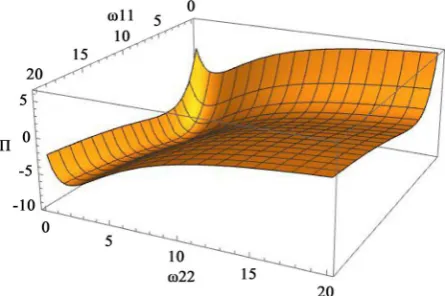
The multifrequency second order test for the discussed complex system with the inven-tory interactions is shown on Figure 1 and Figure 2 for different number of harmonics.
The second order test obtained shows the diversified advantageous operation fre-quencies for particular subsystems ω =1 5.5 and ω =2 2.5 for the single harmonic and
1 4.5
Figure 1. The single harmonic second order test for the complex sys-tem with the inventory interactions.
Figure 2. The five harmonics second order test for the complex
sys-tem with the inventory interactions.
5. Conclusion
In this note, we formulated the optimal multiperiodic control problem for inventory constrained subsystems. It is aimed at the intensification of the productivity of complex processes. We proposed a multifrequency second-order test for complex multiperiodic systems including the boundary optimal steady-state process and an arbitrary large number of harmonics used to verify its improvement by the multiperiodic operation. We generalized the method of critical directions for single periodic systems [10][11] to complex multiperiodic systems. We illustrated the approach proposed on the example of the multiperiodic optimization of a system of chemical reactors.
Acknowledgements
This work has been supported by the National Science Center under grant: 2012/07/B/ ST7/01216.
References
[image:10.595.262.485.256.404.2]Engineering, 2009, Article ID: 137483. http://dx.doi.org/10.1155/2009/137483 [2] Colonius, F. (1988) Optimal Periodic Control. Springer-Verlag, New York.
http://dx.doi.org/10.1007/BFb0077931
[3] Gräber, M., Kirches, Ch., Bock, H.G., Schlöder, J.P., Tegethoff, W. and Köler, J. (2011) De-termining the Optimum Cyclic Operation of Adsorption Chillers by a Direct Method for Periodic Optimal Control. International Journal of Refrigeration, 34, 902-913.
http://dx.doi.org/10.1016/j.ijrefrig.2010.12.021
[4] Skowron, M. and Styczeń, K. (2006) Evolutionary Search for Globally Optimal Constrained Stable Cycles. Chemical Engineering Science, 61, 7924-7932.
http://dx.doi.org/10.1016/j.ces.2006.09.005
[5] Silveston, P.L., Budman, H. and Jervis, E. (2008) Forced Modulation of Biological Processes: A Review. Chemical Engineering Science, 63, 5089-5105.
http://dx.doi.org/10.1016/j.ces.2008.06.017
[6] Hernandez-Martinez, E., Granados-Focil, A., Meraz, M. and Alvarez-Ramirez, J. (2011) Analysis of Periodic Operation of Bioreactors from a First-Harmonic Balance Approach. Chemical Engineering and Processing: Process Intensification, 50, 1169-1176.
http://dx.doi.org/10.1016/j.cep.2011.09.001
[7] Dzyadyk, V.K. (1977) Introduction to the Theory of Uniform Approximation of Functions by Polynomials. Naukova Dumka, Kiev. (In Russian)
[8] Styczeń, K. (1986) Trigonometric Approximation of Optimal Periodic Control Problems. International Journal of Control, 43, 1531-1542.
http://dx.doi.org/10.1080/00207178608933557
[9] Ben-Tal, A. (1980) Second-Order and Related Extremality Conditions in Nonlinear Pro-gramming. Journal of Optimization Theory and Applications, 31, 143-165.
http://dx.doi.org/10.1007/BF00934107
[10] Bernstein, D.S. (1984) A Systematic Approach to Higher-Order Necessary Conditions in Optimization Theory. SIAM Journal on Control and Optimization, 22, 211-238.
http://dx.doi.org/10.1137/0322016
[11] Bernstein, D.S. (1985) Control Constraints, Abnormality, and Improved Performance by Periodic Control. IEEE Transactions on Automatic Control, AC-30, 367-376.
Submit or recommend next manuscript to SCIRP and we will provide best service for you:
Accepting pre-submission inquiries through Email, Facebook, LinkedIn, Twitter, etc. A wide selection of journals (inclusive of 9 subjects, more than 200 journals)
Providing 24-hour high-quality service User-friendly online submission system Fair and swift peer-review system
Efficient typesetting and proofreading procedure
Display of the result of downloads and visits, as well as the number of cited articles Maximum dissemination of your research work
Submit your manuscript at: http://papersubmission.scirp.org/