Copyright © 2003, American Society for Microbiology. All Rights Reserved.
Outbreak of Extended-Spectrum

-Lactamase VEB-1-Producing
Isolates of
Acinetobacter baumannii
in a French Hospital
Laurent Poirel,
1Olivier Menuteau,
1Nathalie Agoli,
2Christian Cattoen,
2and Patrice Nordmann
1*
Service de Bacte´riologie-Virologie, Hoˆpital de Biceˆtre, Assistance Publique/Hoˆpitaux de Paris, Faculte´ de Me´decine
Paris-Sud, 94275 Le Kremlin-Biceˆtre,
1and Service de Biologie Clinique, CHG Valenciennes,
2France
Received 30 January 2003/Returned for modification 1 May 2003/Accepted 3 May 2003
Twelve clonally related and multidrug-resistant
Acinetobacter baumannii
isolates were recovered during a
4-month period from 12 patients hospitalized at the Valenciennes Hospital in France. Antibiograms
deter-mined by the double-disk diffusion technique on cloxacillin-containing plates detected a clavulanic
acid-inhibited extended-spectrum

-lactamase (ESBL). PCR and sequencing identified the gene encoding the
Ambler class A ESBL VEB-1. This gene was located on the chromosome and was part of a class 1 integron
identical to that previously identified in
Pseudomonas aeruginosa
isolates from Thailand. Additionally, seven
clonally related
bla
VEB-1-positive
A. baumannii
strains were identified in the immediate environment of the
hospitalized patients. This is the first report of the ESBL VEB-1 in
Acinetobacter
spp. and the first description
of VEB-1-producing strains as a source of an outbreak occurring outside Southeast Asia. This report
under-lines the difficulty of the identification of ESBLs in
A. baumannii.
Acinetobacter baumannii
is an opportunistic pathogen
in-volved in outbreaks occurring in intensive care units (ICUs) (2,
14). It is an important source of nosocomial septicemia,
pneu-monia, and urinary tract infections (4). Reports of
multidrug-resistant isolates have increased during the last decade,
prob-ably as a result of the extensive use of broad-spectrum
antibiotics (1). In many cases, these multidrug-resistant
iso-lates are resistant to expanded-spectrum cephalosporins and
carbapenems (1, 2, 28). Recent studies report that
carbap-enem-hydrolyzing

-lactamases of Ambler class B
(metalloen-zymes) and Ambler class D (oxacillinases) are sources of
mul-tidrug resistance in
A. baumannii
(3, 5, 24, 27, 30). However,
most of the expanded-spectrum

-lactamases of gram-negative
organisms are the clavulanic acid-inhibited extended-spectrum

-lactamases (ESBLs) of Ambler class A that have been
re-ported extensively in members of the family
Enterobacteriaceae
(19). They usually confer resistance to cefotaxime, ceftriaxone,
ceftazidime, and the monobactam aztreonam but do not confer
resistance to imipenem (19).
Most of these ESBLs that are disseminated worldwide are
structurally related to the narrow-spectrum TEM- and
SHV-type

-lactamases, but none of them has been detected so far
in
A. baumannii
(19).The non-TEM, non-SHV derivative
ESBL PER-1 is the only known ESBL in
A. baumannii
and has
been detected in Turkish and French isolates (21, 31, 32). An
epidemiological survey performed in Turkey in 1996 identified
the spread of PER-1-positive
A. baumannii
isolates (32), and
infections with these PER-1-positive isolates have been
asso-ciated with a higher risk of mortality (31).
Another non-TEM, non-SHV ESBL, VEB-1, has been
de-tected in
Enterobacteriaceae
and
Pseudomonas aeruginosa
strains from Southeast Asia (7, 8, 15–17, 23). Unlike most of
the ESBL genes,
bla
VEB-1is part of a gene cassette and is
located in class 1 integrons of various structures (7, 8, 15–17,
23). Integrons are genetic structures responsible for the
ex-pression of cassette-associated and mobile resistance genes
(25).
The aim of the present study was to analyze the molecular
mechanisms involved in the

-lactam resistance of
multidrug-resistant and nosocomial
A. baumannii
isolates. This study
identified for the first time the ESBL VEB-1 in
A. baumannii
.
It shows also that (i) ESBL-positive
A. baumannii
isolates may
be responsible for nosocomial outbreaks, (ii) ESBLs may
con-tribute to the multidrug resistance of
A. baumannii
isolates,
and (iii) that ESBL production may remain undetected in this
species.
(This work was previously presented in part at the 42nd
Interscience Conference on Antimicrobial Agents and
Chemo-therapy, 2002 [O. Menuteau, L. Poirel, N. Agoli, C. Cattoen,
and P. Nordmann, Abstr. 42nd Intersci. Conf. Antimicrob.
Agents Chemother., abstr. 1876, 2002].)
MATERIALS AND METHODS
Bacterial isolates.A. baumanniiclinical and environmental isolates (strains 1 to 20) were identified by using the API 32GN system (bioMe´rieux SA, Marcy
l’Etoile, France). ElectrocompetentEscherichia coliDH10B (GIBCO BRL, Life
Technologies, Cergy Pontoise, France) was used as the recipient strain in
trans-formation experiments. Rifampin-resistantE. coliHB101 was used as the host in
conjugation experiments (23).E. coliMG-1, which carries theblaVEB-1gene, was
used as a VEB-1-producing reference strain (23). E. coliK-12 DNA, which
generates seven I-CeuI restricted fragments of 2,460, 700, 670, 530, 130, 92, and
44 kb, was used as a size marker in pulsed-field gel electrophoresis (PFGE)
experiments. Reference strainA. baumanniiCIP7034T(Institut Pasteur Strain
Collection, Paris, France) was used as a nonclonally related strain in the PFGE experiments, and an in vitro-obtained rifampin-resistant derivative was used in conjugation experiments.
Susceptibility testing and screening for ESBL-producing strains.The
antibi-otic susceptibilities of theA. baumanniiisolates were first determined by the disk
diffusion method on Mueller-Hinton (MH) agar plates with antibiotic-containing disks (Sanofi Diagnostics Pasteur, Marnes-La-Coquette, France), and the results
* Corresponding author. Mailing address: Service de
Bacte´riologie-Virologie, Hoˆpital de Biceˆtre, 78 rue du Ge´ne´ral Leclerc, 94275 Le
Kremlin-Biceˆtre cedex, France. Phone: 21-36-32. Fax:
33-1-45-21-63-40. E-mail: [email protected].
3542
on May 15, 2020 by guest
http://jcm.asm.org/
were interpreted according to the guidelines of the Antibiogram Committee of the French Society for Microbiology (www.sfm.fr). The double-disk synergy test was performed with cefepime, ceftazidime, and ticarcillin-clavulanic acid disks on MH agar plates; and the results were interpreted as described previously (10). To counteract the effect of high-level expression of the naturally produced
AmpC-type-lactamase ofA. baumannii, double-disk synergy tests were also
performed on cloxacillin (200g/ml)-containing plates (6).
The MICs of the-lactams were determined by an agar dilution technique on
MH agar plates with or without cloxacillin (200g/ml) with an inoculum of 104
CFU per spot, as described previously (20). MIC results were interpreted ac-cording to the guidelines of the National Committee for Clinical Laboratory Standards (18).
IEF analysis.Cultures ofA. baumanniiisolates were grown overnight at 37°C in 10 ml of Trypticase soy (TS) broth. Analytical isoelectric focusing (IEF) was performed with an ampholine polyacrylamide gel, as described previously (20).
PCR-based amplification of-lactamase genes and class 1 integrons and sequencing.Under standard PCR conditions (26), a series of primers was used
for detection of Ambler class A-lactamase genes. Detection of genes coding for
-lactamases TEM, SHV, PER-1 or PER-2, VEB-1, and GES-1 was performed
as described previously (7, 8). Detection of anampC-type gene ofA. baumannii
was performed with primers preAB-1 (5⬘-ACAGAGGAGCTAATCATGCG-3⬘)
and preAB-2 (5⬘-GTTCTTTTAAACCATATACC-3⬘), which hybridized to the
internal part of this-lactamase gene. For each reaction, 0.5g of whole-cell
DNA of theA. baumanniiisolates was used. The primers used for detection of
class 1 integrons (primers 5⬘-CS and 3⬘-CS [12]) hybridized to sequences located
in the 5⬘and 3⬘conserved segments. Combinations of primer 5⬘-CS or 3⬘-CS and
blaVEB-1-specific primers (primers 5⬘-CS and VEB-B or primers 3⬘-CS and
VEB-F [15, 17]) were also used for determination of the genetic contents of the
class 1 integrons. Additionally, since theoxa-10andarr-2genes had been
asso-ciated with theblaVEB-1gene inE. coliMG-1 andP. aeruginosaisolates (7, 16),
their positions relative to that of theblaVEB-1gene were determined by PCR with
primers specific forblaVEB-1(primers 1A and 1B and primers
VEB-INV4F and VEB-INFV3B), forblaOXA-10(primers OXA-10promB, OPR-1, and
OPR-2), and forarr-2(primers ARR-2-F and ARR-2-B) (7, 8). Finally, since a
blaVEB-1-containing integron had been reported to be bracketed by two IS26
insertion sequences inE. coliMG-1 (15), PCRs withblaVEB-1-specific primers
and IS26-specific primers were also performed (16). Sequencing reactions were
performed with the sameblaVEB-1-specific primers and an automated sequencer
(ABI 377; Applied Biosystems, Foster City, Calif.). The nucleotide and deduced amino acid sequences were analyzed with software available over the Internet (22, 23).
PFGE.PFGE analysis was done according to the instructions of the
manufac-turer (Bio-Rad). In brief, whole-cell DNA of theA. baumanniiisolates was
digested with theApaI restriction enzyme overnight at 25°C (9). Electrophoresis
was performed with a CHEF DRII apparatus (Bio-Rad) through a 1% agarose
gel in 0.5⫻Tris-borate-EDTA buffer. Migration conditions were as follows:
temperature, 14°C; voltage, 5 V/cm; and switch angle, 120°, with one linear switch ramp of 5 to 20 s for 24 h. The ethidium bromide-stained gel was photographed
under UV illumination. A bacteriophageDNA ladder (Bio-Rad) was used as
a DNA molecular weight marker. The chromosomal fingerprints were compared by eye and assigned to PFGE types and subtypes (29).
Hybridizations.The I-CeuI restriction enzyme (Ozyme; New England
Bio-labs), which digests a 26-bp sequence in therrngenes for the 23S large-subunit
rRNA, was used to search the chromosome to determine whether the
-lacta-mase gene has a chromosomal location (13); and the fragments were separated
by PFGE. The sizes of the I-CeuI-generated fragments ofA. baumanniiclinical
isolates AYE and 13 and of reference strain CIP7034T were determined by
comparison with those ofE. coliK-12. After Southern transfer onto a nylon
membrane (Hybon N⫹; Amersham Pharmacia Biotech, Orsay, France) (26), the
DNAs were UV cross-linked (Stratalinker; Stratagene) and hybridized succes-sively with two probes: a 1,504-bp PCR-generated probe specific for the 16S and
23S rRNA genes (8) and a 650-bp probe specific forblaVEB-1(23). Labeling and
signal detection were carried out according to the instructions of the manufac-turer (Amersham Pharmacia Biotech).
Conjugation, electroporation, and plasmid DNA analysis.Conjugation
exper-iments were performed betweenA. baumanniiclinical isolate AYE andE. coli
HB101, which were resistant to rifampin, and in vitro-obtained rifampin-resistant
A. baumanniiCIP7034Tin solid and liquid media at 37°C, as reported previously
(20). Transconjugants were selected on TS agar plates containing 300g of
rifampin per ml and 150g of ticarcillin per ml. The plasmid DNA of theA.
baumanniiisolates was extracted as described previously (7, 22). Plasmid extracts
were electroporated intoE. coliDH10B, and recombinant strains were selected
on ceftazidime (2g/ml)-containing TS agar plates.
RESULTS
Preliminary PCR detection of

-lactamase gene.
A
multi-drug-resistant
A. baumannii
isolate, isolate AYE, was
recov-ered from a patient with a urinary tract infection. The patient
was a 61-year-old man who was hospitalized at the Biceˆtre
Hospital (Le Kremlin-Biceˆtre, France) in October 2001. He
had been transferred directly from the ICU of the
Valenci-ennes Hospital (a 1,000-bed facility in the north part of
France), where he had been hospitalized for pneumonia and
where an antibiotic regimen containing imipenem and
genta-micin had been given. Preliminary antibiotic susceptibility
test-ing by disk diffusion showed that
A. baumannii
isolate AYE
was resistant to all

-lactams except imipenem,
piperacillin-tazobactam, and ticarcillin-clavulanate. It was resistant to
other antibiotics such as fluoroquinolones, aminoglycosides,
chloramphenicol, and tetracycline and was of intermediate
sus-ceptibility to rifampin (data not shown). A synergy between
ceftazidime- or cefepime- and clavulanate-containing disks was
evidenced only when cloxacillin-containing agar plates were
used (Fig. 1). PCR experiments with primers specific for
bla
TEM,
bla
SHV,
bla
VEB-1,
bla
GES-1,
bla
PER-1, and
bla
CTX-M-1were
per-formed and gave a positive result for a
bla
VEB-1-like gene.
Sequence analysis of this
bla
VEB-1-like gene revealed a 100%
FIG. 1. Double-disk synergy test with
bla
VEB-1-positive
A.
bauman-nii
strain AYE. MH agar plates contained either no cloxacillin (A) or
200
g of cloxacillin per ml (B). The disks tested contained ceftazidime
(CAZ), cefuroxime (CXM), ticarcillin-clavulanic acid (TCC), cefoxitin
(FOX), and cefepime (FEP).
on May 15, 2020 by guest
http://jcm.asm.org/
identity of its DNA with that of
bla
VEB-1. In addition and as
expected, PCR with primers located at the ends of the
ampC
-type

-lactamase gene of
A. baumannii
gave a 1,242-bp DNA
fragment, indicating the presence of this naturally occurring

-lactamase gene in
A. baumannii
AYE.
MICs of

-lactams and IEF analysis.
The MICs of
ceftazi-dime and cefotaxime for
A. baumannii
AYE were lowered
when clavulanic acid was added, which is consistent with
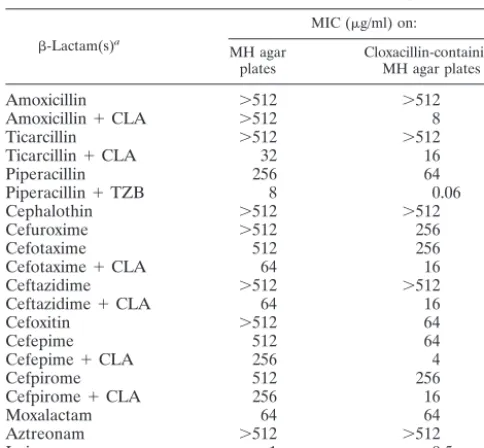
ex-pression of the ESBL VEB-1 (Table 1). The contribution of
VEB-1 to resistance to expanded-spectrum cephalosporins was
demonstrated by using cloxacillin-containing MH agar plates
(Table 1).
IEF analysis showed that
A. baumannii
AYE expressed
sev-eral

-lactamases with pI values of 6.3, 7.4, and 8.5. The pI
value of 6.3 likely corresponded to that of OXA-10 (7, 8), and
the pI value of 7.4 corresponded to that of VEB-1, whereas the
pI value of 8.5 corresponded to that of an AmpC-type
cepha-losporinase (3).
Identification of
bla
VEB-1-positive integron.
Fragments were
obtained by PCR with primers 5
⬘
-CS and 3
⬘
-CS for detection of
class 1 integrons and
bla
VEB-1-specific primers, indicating that
bla
VEB-1is part of a class 1 integron. Taking into account the
sizes of the amplified fragments, the structure of the integron
of
A. baumannii
AYE was identical to that found in most of the
P. aeruginosa
isolates from Thailand, which also contained
bla
OXA-10and rifampin resistance-encoding
arr-2
genes (Fig. 2)
(7). As in most of the Thai
P. aeruginosa
isolates (7), insertion
sequence IS
1999
was also located inside the class 1 integron
structure, interrupting the integron recombination site
attI
. A
PCR experiment also identified an IS
26
-like element upstream
of the
bla
VEB-1-positive integron in
A. baumannii
AYE.
Genetic location of
bla
VEB-1gene.
Transfer of the
ceftazi-dime resistance marker by conjugation failed with the
E. coli
and
A. baumannii
recipient strains. Although no plasmid was
detected in
A. baumannii
AYE, a suspension containing
puta-tive plasmid DNA of
A. baumannii
AYE was used to
electro-porate
E. coli
DH10B, but no ampicillin-resistant transformant
was obtained. The location of
bla
VEB-1was then determined by
using the technique with the endonuclease I-
Ceu
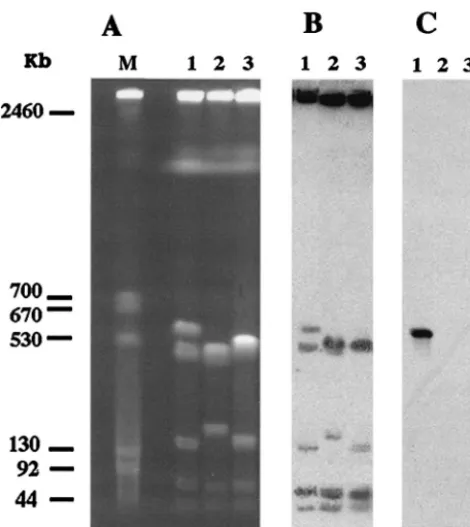
I. Five DNA
fragments (2,200, 500, 150, 60, and 40 kb) were generated from
the
A. baumannii
CIP7034
Treference strain, whereas six
ments (the five fragments mentioned above plus a 600-kb
frag-ment) were obtained from
A. baumannii
AYE (Fig. 3A). The
probe for the rRNA genes hybridized to all DNA fragments
except the 2,200-kb fragment for both
A. baumannii
strains
(Fig. 3B). Hybridization of restricted DNA of
A. baumannii
AYE with the
bla
VEB-1-specific probe gave a single signal
cor-responding to the additional 600-kb fragment, indicating a
chromosomal location of
bla
VEB-1(Fig. 3C).
Retrospective epidemiological survey.
No other
multidrug-resistant
A. baumannii
isolate was recovered in the ICU of
Biceˆtre Hospital when
A. baumannii
AYE was isolated. Thus,
a retrospective survey was performed at the ICU of the
hos-pital where the patient came from. Twelve additional
multi-drug-resistant
A. baumannii
isolates from 12 patients were
recovered during a 4-month period that surrounded the date of
isolation of
A. baumannii
AYE (isolates 1, 2, and 4 to 12 [Table
2] and isolate 13). Most of them suffered from pneumonia. In
addition, systematic screening performed during this period
gave seven additional multidrug-resistant
A. baumannii
iso-lates (isoiso-lates 14 to 20). These isoiso-lates were recovered from
ventilators in several ICU rooms (data not shown). PCR with
bla
VEB-1-specific primers and sequencing of the PCR products
revealed that all but one isolate (
A. baumannii
strain 13)
pos-sessed a
bla
VEB-1gene (data not shown). A similar
bla
VEB-1-positive class 1 integron was identified by PCR analysis with
whole-cell DNA of each
bla
VEB-1-positive strain as the
tem-plate. The
bla
VEB-1-positive isolates had the same multiple
antibiotic resistance patterns as strain AYE (data not shown).
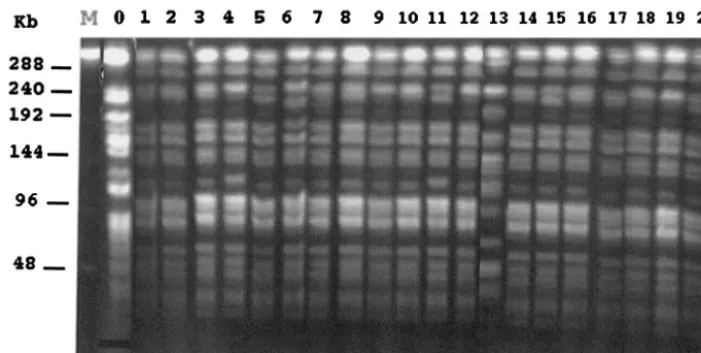
The PFGE profiles of
Apa
I-restricted DNA of all
A.
bau-mannii
isolates except isolate 13 and the reference strain were
identical (Fig. 4). An additional 220-kb fragment was identified
in five isolates (strains 5, 6, 11, 15, and 20). Thus, all
bla
VEB-1 [image:3.603.42.284.89.313.2]-FIG. 2. Schematic representation of the
veb-1
gene cassette-containing integron found in
A. baumannii
AYE. Gene cassettes are shown as
boxes, with arrows indicating the orientation of transcription and black circles indicating the 59-base element. The 5
⬘
conserved segment contains
the
intI1
gene, which encodes integrase; and the 3
⬘
conserved segment, downstream of the gene cassettes, includes the
qacE
⌬
1
gene, an antiseptic
resistance determinant. The IS
1999
inverted repeats are indicated by filled and empty triangles.
TABLE 1. MICs of

-lactams for
A. baumannii
AYE determined
on MH agar and cloxacillin-containing MH agar plates
-Lactam(s)a
MIC (g/ml) on:
MH agar
plates Cloxacillin-containingMH agar plates
Amoxicillin
⬎
512
⬎
512
Amoxicillin
⫹
CLA
⬎
512
8
Ticarcillin
⬎
512
⬎
512
Ticarcillin
⫹
CLA
32
16
Piperacillin
256
64
Piperacillin
⫹
TZB
8
0.06
Cephalothin
⬎
512
⬎
512
Cefuroxime
⬎
512
256
Cefotaxime
512
256
Cefotaxime
⫹
CLA
64
16
Ceftazidime
⬎
512
⬎
512
Ceftazidime
⫹
CLA
64
16
Cefoxitin
⬎
512
64
Cefepime
512
64
Cefepime
⫹
CLA
256
4
Cefpirome
512
256
Cefpirome
⫹
CLA
256
16
Moxalactam
64
64
Aztreonam
⬎
512
⬎
512
Imipenem
1
0.5
aCLA, clavulanic acid at a fixed concentration of 2g/ml; TZB, tazobactam
at a fixed concentration of 4g/ml.
on May 15, 2020 by guest
http://jcm.asm.org/
[image:3.603.49.537.650.686.2]positive isolates seemed to be clonally related. They had the
same antibiotic resistance pattern, according to disk diffusion
susceptibility testing (data not shown).
DISCUSSION
This work describes multidrug-resistant
A. baumannii
iso-lates as the source of an outbreak in an ICU. Production of an
ESBL was demonstrated, whereas dissemination of resistant
isolates had already occurred. A 2-week closure of the ICU was
the only way to control the outbreak, as demonstrated
previ-ously (11).
The clonally related
A. baumannii
isolates produced an
un-usual Ambler class A ESBL, VEB-1, whereas this enzyme has
been identified extensively from members of the family
Enter-obacteriaceae
and
P. aeruginosa
isolates in Southeast Asia (7, 8,
15–17, 23). Thus, this work identified this ESBL in
A.
bauman-nii
isolates for the first time (and is the second ESBL found in
A. baumannii
) and represents the first report of an outbreak
due to VEB-1-positive gram-negative organisms outside
Southeast Asia.
Interestingly, this ESBL gene was identified in a class 1
integron of
A. baumannii
that was encoded by the
chromo-some, as reported for most of the
bla
VEB-1-positive
P.
aerugi-nosa
isolates (7). The structure of this
bla
VEB-1-containing
integron was identical to that found in most of the
P.
aerugi-nosa
isolates in a study performed in Thailand (7). The
loca-tions of other antibiotic resistance genes in the same integron
may contribute to the multidrug resistance of
A. baumannii
.
Interestingly, this
bla
VEB-1-containing integron was bracketed,
at least upstream, by insertion sequence IS
26
, as was found for
the
bla
VEB-1-positive integron in
E. coli
MG-1 (16). Thus, the
chromosomal location of
bla
VEB-1in
A. baumannii
may result
from a transposition event.
Analysis of this outbreak due to ESBL-producing
A.
bau-mannii
strains raises the threat of endemicity of
multidrug-resistant
A. baumannii
isolates, as in Turkey (32). Indeed, a
nation-based study performed in that country found that 46%
of
A. baumannii
strains produce another ESBL, PER-1 (32).
The spread of ESBL-producing
A. baumannii
isolates may
be enhanced by underdetection and underreporting. We show
here that the use of cloxacillin-containing plates that inhibit
cephalosporinase activity may enhance the ability to detect
these organisms in a routine laboratory. Those plates should be
used in investigations of outbreaks due to multidrug-resistant
A. baumannii
isolates. Such investigations should be
per-formed, since outbreaks due to
A. baumannii
are usually more
difficult to control than those due to members of the family
Enterobacteriaceae
(2, 4). Indeed, the reservoirs of
A.
bauman-FIG. 3. (A) PFGE profiles of I-
Ceu
I-digested whole-cell DNA of
three
A. baumannii
strains. Lanes 1,
A. baumannii
AYE (
bla
VEB-1positive); lanes 2,
A. baumannii
isolate 13 (
bla
VEB-1negative); lanes 3,
A. baumannii
reference strain CIP7034
T(
bla
VEB-1
negative); lane M,
bacteriophage lambda DNA ladder. Southern hybridization was done
with a 16S-23S rRNA gene-specific probe (B) and a
bla
VEB-1-specific
[image:4.603.46.281.68.331.2]internal probe (C).
TABLE 2. Clinical features of the
bla
VEB-1-positive
A. baumannii
isolates
Isolate Date of isolation(mo-day-yr) Dates of hospitalization(mo-day-yr) Source Underlying disease Treatment
1
07-01-01
06-08-01 to 07-04-01
Blood
Sepsis
Cefotaxime, ciprofloxacin
2
08-24-01
08-07-01 to 09-12-01
Blood
Pneumonia
Ceftriaxone, ofloxacin
3 (AYE)
10-02-01
09-14-01 to 09-25-01
Urine
Pneumonia
Imipenem, gentamicin
4
10-10-01
09-14-01 to 10-14-01
Blood
Intestinal obstruction
Amoxicillin-CLA,
aofloxacin
5
10-10-01
09-28-01 to 10-15-01
Tracheal aspirate
Pneumonia
Imipenem, teicoplanin
6
10-11-01
10-01-01 to 10-18-01
Tracheal aspiration
Sepsis
Piperacillin-tazobactam
7
10-15-01
09-24-01 to 11-02-01
Urine
Pneumonia
Amoxillin-CLA, ofloxacin
8
10-15-01
10-06-01 to 10-15-01
Catheter
Pneumonia
Amoxicillin-CLA, ofloxacin
9
10-15-01
08-01-01 to 03-01-02
Tracheal aspirate
Guillain-Barre` syndrome
Ceftazidime, amikacin
10
10-15-01
10-02-01 to 10-22-01
Urine
Pneumonia
Amoxicillin-CLA, ofloxacin
11
10-22-01
09-16-01 to 10-28-01
Peritonitis fluid
Pneumonia
Imipenem
12
10-26-01
10-04-01 to 10-31-01
Rectal swab
Pneumonia
Teicoplanin, amikacin
aCLA, clavulanic acid at a fixed concentration of 2g/ml.
on May 15, 2020 by guest
http://jcm.asm.org/
[image:4.603.44.542.577.716.2]nii
are difficult to identify and control in hospital settings, since
this bacterial species may survive on dry surfaces for a long
time (2).
ACKNOWLEDGMENTS
This work was financed by a grant (grant UPRES-EA3539) from the
Ministe`re de l’Education Nationale et de la Recherche, Universite´
Paris XI, Paris, France.
We thank A. Karim for the identification of the ESBL-positive
A.
baumannii
isolate.
REFERENCES
1. Amyes, S. G. B., and H.-K. Young.1996. Mechanisms of antibiotic resistance inAcinetobacterspp.—genetics of resistance, p. 185–223.InE.
Bergogne-Berezin, M. L. Jolly-Guillou, and K. J. Towner (ed.),Acinetobacter:
micro-biology, epidemiology, infections, management. CRC Press, Inc., New York, N.Y.
2. Bergogne-Be´re´zin, E., and K. J. Towner.1996.Acinetobacterspp. as noso-comial pathogens: microbiological, clinical, and epidemiological features.
Clin. Microbiol. Rev.9:148–165.
3. Bou, G., G. Cervero, M. A. Dominguez, C. Quereda, and J. Martinez-Bel-tran.2000. Characterization of a nosocomial outbreak caused by a
multire-sistantAcinetobacter baumanniistrain with a carbapenem-hydrolyzing
en-zyme: high-level carbapenem resistance inA. baumanniiis not due solely to
the presence of-lactamases. J. Clin. Microbiol.38:3299–3305.
4. Cisneros, J. M., and J. Rodriguez-Bano.2002. Nosocomial bacteremia due toAcinetobacter baumannii: epidemiology, clinical features and treatment.
Clin. Microbiol. Infect.8:687–693.
5. Corbella, X., A. Montero, M. Pujol, M. A. Dominguez, J. Ayats, M. J. Argerich, F. Garrigosa, J. Ariza, and F. Gudiol.2000. Emergence and rapid spread of carbapenem resistance during a large and sustained hospital
out-break of multiresistantAcinetobacter baumannii. J. Clin. Microbiol.38:4086–
4095.
6. De Champs, C., L. Poirel, R. Bonnet, D. Sirot, C. Chanal, J. Sirot, and P. Nordmann.2002. Prospective survey of-lactamases produced by
ceftazi-dime-resistantPseudomonas aeruginosaisolated in a French hospital in 2000.
Antimicrob. Agents Chemother.46:3031–3034.
7. Girlich, D., T. Naas, A. Leelaporn, L. Poirel, M. Fennewald, and P. Nord-mann.2002. Nosocomial spread of the integron-locatedveb-1-like cassette
encoding an extended-spectrum-lactamase inPseudomonas aeruginosain
Thailand. Clin. Infect. Dis.34:603–611.
8. Girlich, D., L. Poirel, A. Leelaporn, A. Karim, C. Tribuddharat, M. Fen-newald, and P. Nordmann.2001. Molecular epidemiology of the
integron-located VEB-1 extended-spectrum-lactamase in nosocomial
enterobacte-rial isolates in Bangkok, Thailand. J. Clin. Microbiol.39:175–182.
9. Gouby, A., M. J. Carles-Nurit, N. Bouziges, G. Bourg, R. Mesnard, and P. J. M. Bouvet.1992. Use of pulsed-field gel electrophoresis for
investiga-tion of hospital outbreaks ofAcineobacter baumannii. J. Clin. Microbiol.
30:1588–1591.
10. Jarlier, V., M.-H. Nicolas, G. Fournier, and A. Philippon.1988. Extended
broad-spectrum-lactamases conferring transferable resistance to newer
-lactam agents inEnterobacteriaceae: hospital prevalence and susceptibility
patterns. Rev. Infect. Dis.10:867–878.
11. Koeleman, J. G., M. W. Van Der Bijl, J. Stoof, C. M. Vandenbroucke-Grauls, and P. H. Savelkoul.2001. Antibiotic resistance is a major risk factor for
epidemic behavior ofAcinetobacter baumannii. Infect. Control Hosp.
Epi-demiol.22:284–288.
12. Le´vesque, C., L. Piche´, C. Larose, and P. H. Roy.1995. PCR mapping of integrons reveals several novel combinations of resistance genes.
Antimi-crob. Agents Chemother.39:185–191.
13. Liu, S. L., A. Hessel, and K. E. Sanderson.1993. Genomic mapping with
I-CeuI, an intron-encoded endonuclease specific for genes for ribosomal
RNA, inSalmonellaspp.,Escherichia coli, and other bacteria. Proc. Natl.
Acad. Sci. USA90:6874–6878.
14. Mah, M. W., Z. A. Memish, G. Cunningham, and R. M. Bannatyne.2001.
Outbreak ofAcinetobacter baumanniiin an intensive care unit associated
with tracheostomy. Am. J. Infect. Control29:301–305.
15. Naas, T., F. Benaoudia, S. Massuard, and P. Nordmann.2000.
Integron-located VEB-1 extended-spectrum beta-lactamase gene in aProteus mirabilis
clinical isolate from Vietnam. J. Antimicrob. Chemother.46:703–711.
16. Naas, T., Y. Mikami, T. Imai, L. Poirel, and P. Nordmann.2001.
Charac-terization of In53, a class 1 plasmid- and transposon-located integron of
Escherichia coliwhich carries an unusual array of gene cassettes. J. Bacteriol.
183:225–249.
17. Naas, T., L. Poirel, A. Karim, and P. Nordmann.1999. Molecular charac-terization of In50, a class 1 integron encoding the gene for the
extended-spectrum beta-lactamase VEB-1 inPseudomonas aeruginosa. FEMS
Micro-biol. Lett.176:411–419.
18. National Committee for Clinical Laboratory Standards.2000. Methods for dilution antimicrobial susceptibility tests for bacteria that grow aerobically, 5th ed. Approved standard M7-A4. National Committee for Clinical Labo-ratory Standards, Wayne, Pa.
19. Nordmann, P.1998. Trends in-lactam resistance among Enterobacteri-aceae. Clin. Infect. Dis.27:S100–S106.
20. Poirel, L., M. Guibert, S. Bellais, T. Naas, and P. Nordmann.1999. Integron-and carbenicillinase-mediated reduced susceptibility to
amoxicillin-clavu-lanic acid in isolates of multidrug-resistantSalmonella entericaserotype
Ty-phimurium DT104 from French patients. Antimicrob. Agents Chemother.
43:1098–1104.
21. Poirel, L., A. Karim, A. Mercat, I. Le Thomas, H. Vahaboglu, C. Richard, and P. Nordmann.1999. Extended-spectrum-lactamase-producing strain ofAcinetobacter baumanniiisolated from a patient in France. J. Antimicrob.
Chemother.43:157–158.
22. Poirel, L., I. Le Thomas, T. Naas, A. Karim, and P. Nordmann.2000. Biochemical sequence analyses of GES-1, a novel class A extended-spectrum
-lactamase, and the class 1 integron In52fromKlebsiella pneumoniae.
An-timicrob. Agents Chemother.44:622–632.
23. Poirel, L., T. Naas, M. Guibert, E. B. Chaibi, R. Labia, and P. Nordmann.
1999. Molecular and biochemical characterization of VEB-1, a novel class A
extended-spectrum-lactamase encoded by an Escherichia coliintegron
[image:5.603.117.468.73.249.2]gene. Antimicrob. Agents Chemother.43:573–581.
FIG. 4. PFGE profiles of
Apa
I-digested whole-cell DNA of 21
A. baumannii
isolates. Lane 0,
A. baumannii
reference strain CIP7034
T; lanes
1 to 20,
A. baumannii
isolates 1 to 20 (clinical isolates 1 to 13 and environmental isolates 14 to 20, respectively). Clinical isolate 3 is also referred
as AYE throughout the text. Lane M, bacteriophage lambda DNA ladder.
on May 15, 2020 by guest
http://jcm.asm.org/
24. Poirel, L., and P. Nordmann.2002. Acquired carbapenem-hydrolyzing
-lac-tamases and their genetic support. Curr. Pharm. Biotechnol.3:117–127.
25. Recchia, G. D., and R. M. Hall.1995. Gene cassettes: a new class of mobile
element. Microbiology141:3015–3027.
26. Sambrook, J., E. F. Fritsch, and T. Maniatis.1989. Molecular cloning: a laboratory manual, 2nd ed. Cold Spring Harbor Laboratory Press, Cold Spring Harbor, N.Y.
27. Takahashi, A., S. Yomoda, I. Kobayashi, T. Okubo, M. Tsunoda, and S. Iyobe.2000. Detection of carbapenemase-producingAcinetobacter
bauman-niiin a hospital. J. Clin. Microbiol.38:526–529.
28. Tankovic, J., P. Legrand, G. De Gatines, V. Chemineau, C. Brun-Buisson, and J. Duval.1994. Characterization of a hospital outbreak of
imipenem-resistantAcinetobacter baumanniiby phenotypic and genotypic typing
meth-ods. J. Clin. Microbiol.32:2677–2681.
29. Tenover, F. C., R. D. Arbeit, R. V. Goering, P. A. Mickelsen, B. E. Murray, D. H. Persing, and B. Swaminathan.1995. Interpreting chromosomal DNA
restriction patterns produced by pulsed-field gel electrophoresis: criteria for
bacterial strain typing. J. Clin. Microbiol.33:2233–2239.
30. Towner, K. J., T. Gee, and T. Boswell.2002. An unwanted import to the UK:
a carbapenem-resistant clinical isolate ofAcinetobacter baumanniiproducing
metallo--lactamase. J. Antimicrob. Chemother.50:1092–1093.
31. Vahaboglu, H., F. Coskunkan, O. Tansel, R. Ozturk, N. Sahin, I. Koksal, B. Kocazeybek, M. Tatman-Otkun, H. Leblebicioglu, M. A. Ozinel, H. Akalin, S. Kocagoz, and V. Korten.2001. Clinical importance of extended-spectrum
-lactamase (PER-1-type)-producingAcinetobacterspp. andPseudomonas
aeruginosastrains. J. Med. Microbiol.50:642–645.
32. Vahaboglu, H., R. Ozturk, H. Aygun, F. Coskunkan, A. Yaman, A. Kaygusuz, H. Lecblebicioglu, I. Balik, K. Aydin, and M. Oktun.1997. Widespread
detection of PER-1-type extended-spectrum-lactamases among
nosoco-mialAcinetobacterandPseudomonas aeruginosaisolates in Turkey: a
nation-wide multicenter study. Antimicrob. Agents Chemother.41:2265–2269.