HYPERSPECTRAL SENSING POSSIBILITIES USING CONTINUUM REMOVAL
INDEX IN EARLY DETECTION OF GANODERMA IN OIL PALM PLANTATION
Nisfariza, M.N. Maris1, Helmi Zulhaidi M. Shafri2, Idris, A.S3, Steven M.4,Boyd, D.4 and Mior M.H.A.3
1Department of Geography, Faculty of Arts and Social Sciences, University of Malaya, 50603, Kuala Lumpur, Malaysia
2Department of Civil Engineering, Faculty of Engineering, Universiti Putra Malaysia 43400 Serdang, Selangor, Malaysia
3Plant Pathology and Weed Sciences Group, Biological Research Division, Malaysian Palm Oil Board, 43000 Kajang, Selangor, Malaysia
4School of Geography, University Park, University of Nottingham, Nottingham, NG7 2RD, United Kingdom Email: [email protected]
ABSTRACT
This study focuses on the possibility of early detection of Basal Stem Rot (BSR) disease caused by Ganoderma spp. a wood decaying fungi in oil palm plantation. The datasets were based on reflectance spectra measured with a GER 1500 spectroradiometer in the range of 350 – 1050nm. Relationship of oil-palm leaves reflectance spectra with the infestation of BSR was investigated. Two datasets from the same plantation were analysed; the young palm (5 years old) and the mature palm (17 years old). The palms were classified to three groups: T1 – healthy palm, T2 – palm infected with Ganoderma without any foliar symptoms but with white mycelium or fruiting body at base stem; and T3 – palm infected with Ganoderma with foliar symptoms and white mycelium or fruiting body at base stem. The reflectance was analysed using the continuum removed at several absorption features; the blue region (400-550nm), red region (550 – 750nm) and the NIR region (915-970nm). The continuum removal vegetation indices; Band Depth, Normalised Band Depth, Difference to Reflectance, Band Depth Normalised to Area and Continuum Removed in three absorption features were analysed on the sensitivity of the infection. The results were compared to the results of several other hyperspectral indices namely Red-Edge, NDVI, SIPI, MCARI, TCARI and OSAVI. It can be concluded that most of the continuum removed indices in the three absorption features were possible to be use as a tool in early detection of BSR in oil palm plantation.
Keywords: Hyperspectral Indices, Oil Palm, Ganoderma spp.
INTRODUCTION
Basal Stem Rot (BSR) disease is caused by species of Ganoderma. It is the only pathogenic disease causing
serious losses of field palms in South-East Asia [1]. It is a major problem of oil palm plantation in Malaysia Indonesia and affects the subsequent economic loss. There are no doubts about the economic importance of BSR disease which will continue to be problematic in absence of adequate control measures. The disease can result in death to 80% of plantings by half of the normal economic life, and losses reaching 50% have frequently occurred. Effects on yield reduction may occur from death of palms and reduced yield from standing palms [2].
Many researchers are in agreement that hyperspectral remote sensing could be a tool to evaluate the pathological conditions of plants and in detecting an invisible disease in plants. Using human eye as a detector could only lead to more severe deaths of oil palm plantation because some of the pathological effects of Ganoderma will
only be seen at later stage or in some cases it could not be seen at all.
2
MATERIALS AND METHODS
Field Method and Data Analysis
Two sets of experiments were carried out in order to investigate the effect of age of the oil palm in the field towards the spectra as well as indices generated from the spectra and separability amongst them.
Experimental test sites
Both experiments were carried out in the oil palm plantation in Perak, Malaysia (4° 6’ N 100° 53’ E). The age of palm trees in the plantation varies from 2-20 years of age. This site was verified in previous census to have a serious history of infection of Ganoderma BSR. The data acquisitions were accomplished in October 2009.
Experimental Design
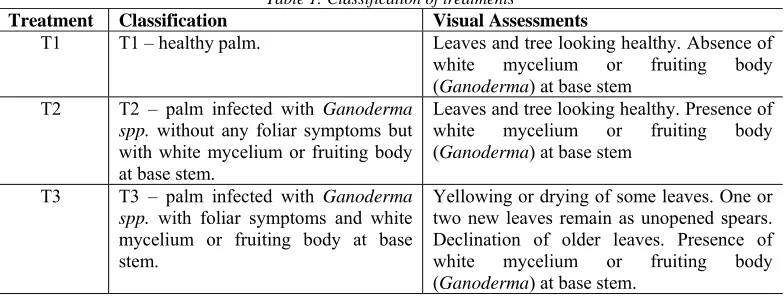
The experimental design of the study was based on visual assessments on the symptomatic view of the palms. The identification of groups was accomplished following MPOB (Malaysian Palm Oil Board) standard practice. The groupings were verified with stem sample collected from the palms. Two sets of data were obtained in this experiment; the young palm aged 5 years old and mature palm aged 17 years old. The young palms were acquired in 5 replicates of three treatments and the mature palms were acquired in 3 replicated of three treatments. The treatments or classification of the palms as explained in Table 1.
Table 1: Classification of treatments
Treatment Classification Visual Assessments
T1 T1 – healthy palm. Leaves and tree looking healthy. Absence of
white mycelium or fruiting body (Ganoderma) at base stem
T2 T2 – palm infected with Ganoderma spp. without any foliar symptoms but
with white mycelium or fruiting body at base stem.
Leaves and tree looking healthy. Presence of white mycelium or fruiting body (Ganoderma) at base stem
T3 T3 – palm infected with Ganoderma spp. with foliar symptoms and white
mycelium or fruiting body at base stem.
Yellowing or drying of some leaves. One or two new leaves remain as unopened spears. Declination of older leaves. Presence of white mycelium or fruiting body (Ganoderma) at base stem.
Spectral measurements
The spectral measurements for mature palms were sampled from two fronds, number 16 and 17. The T3 samples were selected as circumstances whereby the existence of fronds number 16 and 17 horizontally as in healthy trees to standardise the measurements. Palms which severely attacked by Ganoderma normally lost most of its lower fronds (fronds collapse and hanging on trunk) including fronds number 16 and 17.
Two of the most horizontal fronds from aerial view of the young palm were selected for spectral measurements, fronds number 9 and 10. The symptom of infections and severity of Ganoderma in younger palms is different
from the older palms and sometimes can be mistaken with other stresses. In view of this, stem sample were collected from the base stem of the palm to ensure that the visual symptoms are genuinely induced by the infection of Ganoderma BSR.
On each frond, six leaves were detached from the rachis and six measurements were obtained per frond and all the measurement was arithmetically average for each palm. GER 1500 (Geophysical and Environmental Research Corporation) handheld spectrometer was utilised for measuring the plant spectra. The GER 1500 has 512 channels ranging from 350nm to 1050nm, with a 1.5nm bandwidth per channel. The leaf reflectance was obtained using the fibre optic 23° probe around 3 cm from the leaf.
The acquisitions of the leaf spectra were taken in the clear blue sky between 10.00 am – 2.00 pm, Malaysian local time. The spectralon panel was used as the calibration panel for calculations of the reflectance. The reflectance of the spectralon was occasionally measured with the spectral measurement.
[image:2.612.112.504.316.464.2]Figure 1: The oil palm’s leaf detached from the rachis for spectral measurements
Sampled leaves from the fronds was measured for the relative chlorophyll content using the chlorophyll meter (MINOLTA™ SPAD-502), which measured the leaf greenness. The measurements were made by averaging of six readings along the length of second frond on middle abaxial leaf surface. The physiological parameters were recorded concurrently with spectral measurements.
Pathological Parameters
The pathological observations were a part of visual census of the plantation. The census was done based on visual severity of Ganoderma infection and classified as healthy palms (T1), disease standing palm without
foliar symptom (T2), disease standing palm with foliar symptom (T3) and vacant unknown (V).
The ultimate effect of infection by Ganoderma is the progressive destruction of the oil palm trunk, but the
external symptoms observed in the leaves are those of wilting and malnutrition. However, for the young palms the external symptom of BSR normally comprise on one-sided yellowing or mottling of the lower fronds followed by necrosis [10].
The normal first symptoms of the infection of Ganoderma are very similar to the conditions of draught; the
failure of the young leaves to open. A number of fully elongated but unopened spears are seen in the centre of the crown. For older palms, the lower leaves collapse, hanging vertically from the point of attachment to the trunk, this is then followed by the drooping of younger leaves which turn pale green or yellowish colour and die back from the tip. At later stage, the base of the stem blackens; gums may be exuded at the distinctive fructifications of Ganoderma. The whole crown of the palm may then fall off; the trunk may collapse [2] as
4
Figure 2: Basal Stem Rot: the oldest fronds hang down to form a skirt of dead leaves around the palm.
Hyperspectral Indices
According to [11] it is not always possible to detect disease or other stresses in crops directly from reflectance values. Whether a disease (or stress) will be detected in an early stage depends on how it occurs in the vegetation. The following four situations may occur when a disease is present in a crop. A disease may be difficult to detect at an early stage, e.g. fungi that attack the roots of plants or the base of their stem, but do not at first cause any reaction in the plants itself.
The reflection ratio of near infrared: red (NIR:R) and related indices especially the NDVI (normalised difference vegetation index), are the most widely used and well known in remote sensing, not only at ground level but also satellite level and airborne level. They are closely related with a range of highly inter-correlated biomass variables such as green biomass, leaf area index, leaf cover or chlorophyll per unit ground area [12]. Here we tested several indices; the Normalised Difference Vegetation Index (NDVI) [13], Modified Chlorophyll Absorption Ratio Index (MCARI) [14], Structural Independent Pigment Index (SIPI) [15], Optimised Soil Vegetation Index (OSAVI) [16] and Transformed Chlorophyll Absorption in Reflectance Index (TCARI) [17]. The index is given in the following equations.
(1) (2) (3) (4) (5)
Continuum Removed Spectra
To compare the effects of age in detecting Ganoderma BSR in oil palm we make use the entire three absorption
pit. The essence of feature selection lies on the isolation of the absorption features from the rest of the spectrum using a continuum line. Once absorption features have been isolated using this continuum line then the continuum-removed reflectance is normalised using a variety of methods in order to ease inter-comparison of reflectance and provide different manifestations of the spectra. Two methods explored by [18] for estimating the foliar biochemical of plants based on the depth of the absorption feature are band depth normalised to band depth at the centre of the absorption feature (BD) and band depth normalised to area of absorption feature (BDNA).
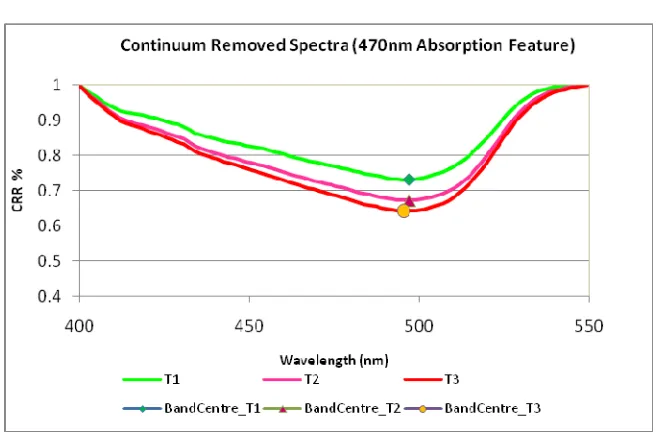
The edges of the absorption features were chosen such that the deepest absorption feature was located approximately in the centre of the continuum removed region [19].Three continuum removed region were selected in this research which located between blue region (400 – 550nm) and red region (550 – 750nm) and near infrared region (915 – 970nm). The Band Depth (BD) at each wavelength in the absorption features was
example of continuum removed regions in blue regions and effect between Treatments.
Figure 3: Reflectance and continuum removed regions
[image:5.612.142.471.319.536.2]6
RESULTS AND DISCUSSION
All statistical analyses were accomplished using the statistical software XLSTAT 2010 (version 2010.3.01, Addinsoft). The analyses were based on the determination of whether the variances of reflectance / indices between treatments are significant. The Mann-Whitney U Test was employed in the test, the reason for applying the non-parametric test in this study is that it does not assume a normal distribution on the sample. The Mann-Whitney U test is often used as an alternative to the ANOVA where the assumption of normality is not acceptable.
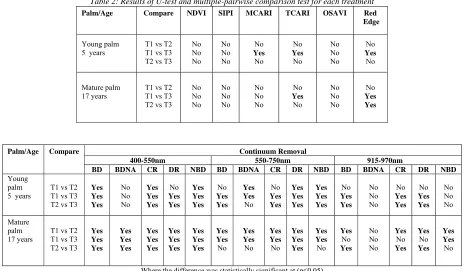
The analysis was done on NDVI, SIPI, MCARI, TCARI, OSAVI, the red-edge an d continuum removed spectra. In the investigation, were unable to distinguish the disease palm at T2 level. The performance of Red-edge, TCARI and MCARI are quite satisfying to distinguish the healthy and unhealthy palm spectra T1 between T3.
[image:6.612.74.540.275.546.2]Continuum removal indices of the blue absorption pit, red absorption pit and NIR absorption pit demonstrate a significant difference in detecting the infection of Ganoderma BSR both at age 5 years old and 17 years old. In depth, the continuum removal indices are consistence in separating T1 and T2 in mature palms, only BDNA in the NIR region fails to separate between them. In the young palms, selected continuum removed indices in blue and red regions shows good results. However, continuum removed in the NIR regions again, fails to distinguish T1 and T2. Please refer to Table 2.
Table 2: Results of U-test and multiple-pairwise comparison test for each treatment
Palm/Age Compare NDVI SIPI MCARI TCARI OSAVI Red
Edge
Young palm T1 vs T2 No No No No No No 5 years T1 vs T3 No No Yes Yes No Yes T2 vs T3 No No No No No No
Mature palm T1 vs T2 No No No No No No 17 years T1 vs T3 No No No Yes No Yes T2 vs T3 No No No No No Yes
Palm/Age Compare Continuum Removal
400-550nm 550-750nm 915-970nm
BD BDNA CR DR NBD BD BDNA CR DR NBD BD BDNA CR DR NBD
Young
palm T1 vs T2 Yes No Yes No Yes No Yes No Yes Yes No No No No No 5 years T1 vs T3 Yes No Yes Yes Yes Yes Yes Yes Yes Yes Yes No Yes Yes No T2 vs T3 Yes No Yes Yes Yes Yes No Yes Yes Yes Yes No Yes Yes No Mature
palm T1 vs T2 Yes Yes Yes Yes Yes Yes Yes Yes Yes Yes Yes No Yes Yes Yes 17 years T1 vs T3 Yes Yes Yes Yes Yes Yes Yes Yes Yes Yes No No No No Yes T2 vs T3 Yes Yes Yes Yes Yes No No No Yes No Yes No Yes Yes No
Where the difference was statistically significant at (p≤0.05)
CONCLUSIONS
In this study, two sets of data were compared. The mature palm and the young palm in oil palm plantation not only have dissimilar symptom or effect of Ganoderma infestation but also have dissimilar properties on the
hyperspectral indices. The best result to be expected from the experiment is the healthy palm T1 can be separable from the T2 palm. Ganoderma BSR infected palms were considered as root disease, the hyperspectral
indices which normally used to detect the lesion of the leaves by other researchers found not to be suitable in separating between class samples. From the analysis, most of the T2 level found to be significantly separable from the T1 in the continuum removed analysis. Commonly used hyperspectral indices such as SIPI, MCARI, TCARI and OSAVI, which uses NIR reflectance as a measure of internal leaf structure, were observed to be less effective in Ganoderma BSR discrimination. Only MCARI and TCARI from the same group of indices could do
the separation between T1 and T3.
accessibility to the facilities and manpower on acquisition of ground and ancillary data.
REFERENCES
[1] Turner, P.D. and Gillbanks, R.A. (2003) Oil Palm Management and Cultivation, The Incorporated Society of Planters.
[2] Corley, R.H.V. and Tinker, P.B. (2003) The Oil Palm, Blackwell Publishing Company, USA.
[3] Delalieux, S., Somers, B., Verstraeten, W.W, van Aardt, J.A.N, Keulemans and W., Coppin, P. (2009) Hyperspectral indices to diagnose leaf biotic stress of apple plants, considering leaf phenology, International Journal of Remote Sensing, 1366-5901, Volume 30, Issue 8, 2009: 1887-1912.
[4] Delalieux, S., Aardt, J. A., Keulemans, W., Scherevens, E. and Coppin, P. (2007) Detection of biotic stress
(venturia inaequalis) in apple tree using hyperspectral data: Non-parametric statistical approaches and physiological implications. European Journal of Agronomy 27: 130-43.
[5] Datt, B., Apan, A. and Kelly, R. (2006) Early Detection of Exotic Pests and Diseases in Asian Vegetables by Imaging Spectroscopy, A report for the Rural Industries Research and Development Corporation. Australia. http://www.rirdc.gov.au/reports/FIB/05-170.pdf. (accessed: 05 February 2008).
[6] Bernard J.V., Pattey, E. and Strachan B. I. (2004) Narrowband Vegetation Indices of Disease Damage in Soybeans, IEEE Geoscience and Remote Sensing Letters, Vol 1 (4) : 255-259.
[7] Smith, K.L., Steven, M.D. and Colls, J.J. (2004) Use of hyperspectral derivative ratios in the red-edge region to identify plants stress responses to gas leaks. Remote Sensing of Environment, 92(2): 207-217. [8] Zarco-Tejada, P. J., Miller, J. R., Mohammed, G. H. , Noland T. L. and Sampson P. H. (2002) Vegetation
Stress Detection through Chlorophyll a + b Estimation and Fluorescence Effects on Hyperspectral Imagery, Journal of Environmental Quality, 31:1433-1441.
[9] Lelong C. D., Roger, J.M., Brégand, S., Dubertret, F., Lanore, M., Sitorus, N.A., Raharjo, D.A. and Caliman, J.P. (2010) Evaluation of Oil-Palm Fungal Disease Infestation with Canopy Hyperspectral Reflectance Data. Sensors, 10: 734-747.
[10] Turner, P.D., Bull, R.A. (1967) Diseases and Disorders of the Oil Palm in Malaysia (pp 247). Incorporated Society of Planters, Kuala Lumpur.
[11] Clevers, J.G.P.W. (1986) Application of remote sensing to agricultural field trials (pp 227), Agricultural University Wageningen the Netherlands.
[12] Peñuelas, J. (1998) Visible and near-infrared reflectance techniques for diagnosing plant physiological status. Trends in plant science, 43:151-156.
[13] Habaudane, D., Miller, J.R., Pattey, E., Pablo, J., Zarco-Tejada, P. J. and Strachan, I.B. (2004) Hyperspectral vegetation indices and novel algorithms for predicting green LAI of crop canopies: Modeling and validation in the context of precision agriculture. Remote sensing of Environment, 90: 337–352. [14] Daughtry, C. S. T., Walthall, C. L., Kim, M. S., Brown de Colstoun, E., McMurtrey III, J. E. (2000)
Estimating corn leaf chlorophyll concentration from leaf and canopy reflectance. Remote Sensing of Environment, 74: 229– 239.
[15] Penuelas, J., Baret, F., Filella, I. (1995) Semi-empirical indices to assess carotenoids/chlorophyll a ratio from leaf spectral reflectance. Photosynthetica 31:221-230.
[16] Rondeaux, G., Steven, M., And Baret, F. (1996) Optimization Of Soil-Adjusted Vegetation Indices, Remote Sensing of Environment, 55: 95-107.
[17] Habaudane, D., Miller, J.R., Tremblay, N., Pablo, J., Zarco-Tejada, P. J. and Dextraze, L. (2002) Integrated narrow-band vegetation indices for prediction of crop chlorophyll content for application to precision agriculture Remote Sensing of Environment, 81: 416– 426.
[18] Kokaly R F, and Clark R N. (1999) Spectroscopic determination of leaf biochemistry using band-depth analysis of absorption features and stepwise multiple linear regression, Remote Sensing of Environment, 67: 267-287.