International Journal of Emerging Technology and Advanced Engineering
Website: www.ijetae.com (ISSN 2250-2459,ISO 9001:2008 Certified Journal, Volume 4, Issue 8, August 2014)
500
Design and Optimization of Helical Compression Spring for a
Speed Breaker Application using Six-Sigma Regression Tool
Pavan Kumar AV
1, Vinayaka N
2, Dr P B Shetty
3, Dr Kiran Aithal S
4, Gowtham V
51
BE -Student, 2Asst. Professor, 3,4 Professor, Dept of Mechanical Engineering, NMIT, Bangalore -560064 5BE -Student, Dept of Civil Engineering, SJCE, Mysore
Abstract— In reference to the project titled “Design based Electrical Power Generation using a Speed Breaker- A Green Power Appraoch”, the Helical Compression spring has been designed in such a way that when the vehicle travels over the spring, the spring takes the maximum load of 200 kg and the rest is taken by the ground. For this purpose, the spring is analyzed for the fatigue loads and has been optimized for the selection of material, wire diameter, carbon percentage and other governing parameters.
Keywords—Regression, Soderberg Equation, Endurance Strength, Ultimate Tensile Strength, Wahl’s Stress Factor, Helical Compression Spring, Squared and Ground Ends, Confidence Interval, Minitab.
I. HISTORY
Our challenge is to design a system which can generate the power from the road humps and should be of plug and play type. We have come up with the solution with a practical applicable design and analysis. The toughest part was found to be design and optimization of spring. Here we can come up with the optimization of the spring to use in this system, The design of the whole system is given in the reference section[1].
II. INTRODUCTION
A spring is an elastic object which is used to store mechanical energy. In everyday life, we come across different types of springs used for many purpose, as it has the vast variety it is classified into many types like helical springs, conical springs, leaf springs, coiled springs etc. Here we are concentrating on design and optimization of squared and ground type helical compression spring.
If we look at the properties of the spring, it shows some special properties unlike the normal materials, that material properties made us to choose the ides of coming up with
this solution.
III. CONCEPT
A plate is constrained at one end and the other end is free to move which is to be held inclined by the spring force. When the vehicle travels over it, the inclined plate gets deflected compressing the spring and plate gradually returns to its initial position once the vehicle travels over it. The design of the spring is to be in such a way that the spring should deflect completely when a small vehicle, like bike passes on it and should not be stressed more even if a heavy loaded truck of 40,000 kg passes on it. To solve this problem we have come up with a solution of assembling the spring 100 mm below the ground with the free length of 200 mm without action of any load. But while designing
the spring, we have to make sure that the spring is pre-stressed with the Plate of (3200 mm x 200 mm x 8
mm) which weighs 27 kg. Now the spring is kept under the plate and other end is buried 100 mm deep inside the road and fixed to ground.
IV. BOUNDARY CONDITIONS
Mass of pre-stressed plate is 27 kg.
Max kg- force of vehicle that should pass is
200 kg.
Max deflection for max load is 76 mm
Free length of spring is 200 mm.
V. PROPERTIES OF SPRING
The special properties of spring which made us to choose this concept is as follows
1. Fatigue load is always pulsating in case of spring, but
not fully reversed.
2. Yield Strength varies with the diameter of the wire.
3. Wahl’s stress factor takes care of direct stress as well
as bending stress.
4. Overload just closes the gap between coils
International Journal of Emerging Technology and Advanced Engineering
Website: www.ijetae.com (ISSN 2250-2459,ISO 9001:2008 Certified Journal, Volume 4, Issue 8, August 2014)
501 The above mentioned properties will take care of all the possible worst case conditions that can occur in the Speed Breaker application. The second property will give relation between yield strength and wire diameter, hence optimization of the diameter will take care of material requirements. Fourth property will take care of the factor of overloading, if the spring is made sure that the compressed length is not equal to the solid length, there will not be any dangerous deflection in the spring, for the same reason the spring is kept 100 mm inside the ground.
VI. OPTIMIZATION
A. Patented and Cold Drawn Spring Steel.
The patented and cold drawn spring steel is most commonly used spring material. The spring material is classified based on the percentage of carbon and other alloys, the ultimate yield strength is a function of diameter of spring wire. Regression a Six-Sigma tool is used to find the relation between the functions and the results are tabulated.
a) Grade 1 - Spring Steel
The grade 1 Spring Steel have following properties:
Carbon – 0.50% - 0.75 %
Silicon – 0.15% - 0.35%
Manganese – 1.00%
Copper- 0.120 %
Using Minitab statistical software, the relation between the tensile strength of the material with respect to the wire diameter is found out with 99.99% Confidence Interval and the R-sq value is found to be 99.6% which is much greater when compared to acceptable percentage of 75%, hence the results obtained are used for further calculations.
Fig-1. Grade 1 Spring Steel Strength function of diameter
After finding the relation, this relation is used to do the fatigue analysis of spring using Soderberg’s relation to find factor of safety and spring rate. For this reason, the excel sheet is prepared giving the required inputs and obtaining the required output. The variation of the factor of safety, and the Max Deflection is monitored with respect to the diameter of the wire and the results are tabulated as shown below.
Fig-2. Variation of FOS with diameter
Fig-3.Variation of Max deflection with diameter
b) Grade 2 - Spring Steel
The grade 2 Spring Steel have following properties:
Carbon – 0.60%-0.85%
Silicon – 0.15%-0.35%
Manganese – 0.80%
Copper- 0.120%
International Journal of Emerging Technology and Advanced Engineering
Website: www.ijetae.com (ISSN 2250-2459,ISO 9001:2008 Certified Journal, Volume 4, Issue 8, August 2014)
[image:3.612.54.292.178.337.2]502 The variation of factor of safety with respect to the variation of diameter of spring and the maximum deflection is plotted as shown in fig.5
[image:3.612.324.562.220.700.2]Fig 4. Grade 2 Spring Steel Strength function of diameter
Fig 5. Variation of FOS with diameter
In the graph, It can be seen that for 14.5 mm spring diameter and spring constant 8, the factor of safety is 1.1, But the maximum deflection was found to be 68 mm. Similarly, for the 76 mm deflection, 12.5 mm diameter is sufficient but the factor of safety is 0.8 which will leads to failure.
c) Grade 3 spring steel
The grade 2 spring steel have following properties:
Carbon – 0.75%-1.00%
Silicon – 0.15%-0.35%
Manganese – 0.80%
Copper- 0.120%
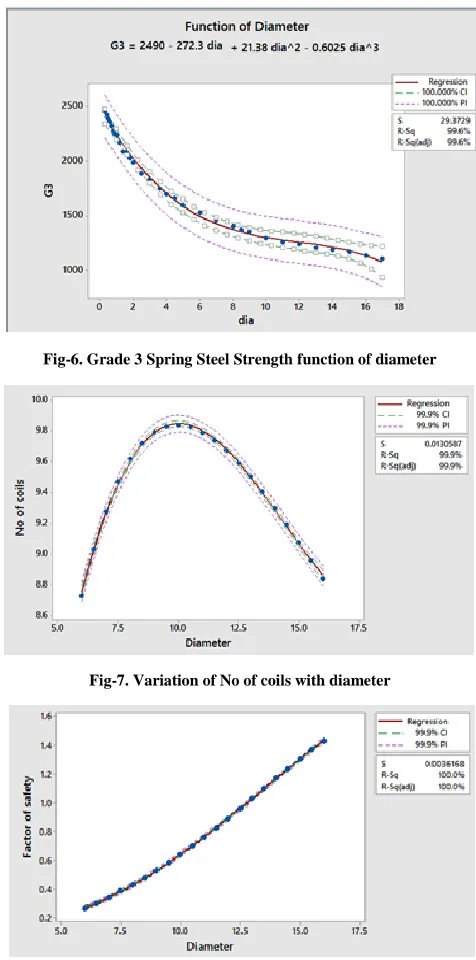
From the Minitab software, the relation between ultimate tensile strength and diameter of wire and the obtained relation is used for the calculation of fatigue strength of the spring.
[image:3.612.327.568.224.387.2]The variation of factor of safety with respect to the variation of diameter of spring and the maximum deflection variation is tabulated and analysed.
Fig-6. Grade 3 Spring Steel Strength function of diameter
Fig-7. Variation of No of coils with diameter
[image:3.612.47.299.279.518.2]International Journal of Emerging Technology and Advanced Engineering
Website: www.ijetae.com (ISSN 2250-2459,ISO 9001:2008 Certified Journal, Volume 4, Issue 8, August 2014)
503 The variation of the graphs are being analysed, 12.5 mm diameter can give a correct deflection but fails to bear the stress, whereas 14 mm diameter can bear the stress but fails to deflect.
It is observed that as the diameter of the wire varies, number of coils also varies, but it can be taken as next higher digit in case of fractions.
d) Grade 4 spring steel
The grade 2 spring steel have following properties
Carbon – 0.75%-1.10%
Silicon – 0.15%-0.35%
Manganese – 0.80%
Copper- 0.120%
From the Minitab software, the relation between ultimate tensile strength and diameter of wire is obtained and relation and is used for the calculation of fatigue strength of the spring.
Fig-9. Grade 4 Spring Steel Strength function of diameter
The variation of factor of safety with respect to the variation of diameter of spring and the maximum deflection variation is tabulated and analysed.
Fig-10. Variation of FOS with diameter
The figure shows the variation of the factor of safety with respect to diameter of wire, the results are tabulated, The 12.5 mm diameter wire can give the desired value of the deflection of 76 mm and factor of safety of 1.1 for which the spring rate is found to be 31.9 N/mm.
B. Oil Hardened and Tempered Spring Steel wire
The Oil hardness will increase the tensile strength of the material, hence the results are considered for the optimization. Using the Minitab software, the relation between wire diameter and ultimate strength is found out and is used further for calculations.
Fig-11. Oil Hardened Steel Strength function of diameter
The Relation between the factor of safety and the wire diameter is tabulated and results are analysed.
Fig-12.Variation of FOS with diameter
International Journal of Emerging Technology and Advanced Engineering
Website: www.ijetae.com (ISSN 2250-2459,ISO 9001:2008 Certified Journal, Volume 4, Issue 8, August 2014)
504 VII. RESULTS
As the diameter of spring increases, Ultimate Tensile
Strength increases.
As the carbon percentage increases, the Ultimate
Tensile Strength increases, but flexibility decreases.
As the diameter increases, factor of safety increases.
As the carbon percentage increases, the factor of
safety graph shifts up with respect to the previous grades.
As the carbon spring is oil hardened, the strength
increases and the factor of safety curve shifts up.
Optimum solution occurred at grade 4 cold drawn
steel.
REFERENCES
[1] Vinayaka N, Pavan Kumar A V, P B Shetty, Kiran Aithal S and Krithi H Kornaya, “Design based Electrical Power Generation using a Speed Breaker – A Green Power Approach”, International Journal of Current Engineering and Technology (IJCET-2014),Vol.4, No.4, pp.2818-2822
[2] Machine Design, An Integrated Approach by Robert L Norton. [3] Kulkarni K, Balasubrahmanyam K. Optimal design of open coiled
helical springs. J Instrum Eng (India) 1979;60:7–14.
[4] Yokota T, Taguchi T, Gen M. A solution method for optimal weight design problem of helical spring using genetic algorithms, pp. 71–76 in Proceedings of the 21st International Conference. Comput Ind Eng 1997;33:1–2.
[5] Kannan BK, Kramer SN. An augmented Lagrange multiplier based method for mixed integer discrete continuous optimization and its applications tomechanical design. J Mech Des 1994;116(2):405–11. [6] Sandregen E. Nonlinear integer and discrete programming in
mechanical design optimization. J Mech Des 1990;112(2):223–9. [7] Ancker, C.J., Goodier, J.N., 1958a. Pitch and curvature corrections
for helical springs. Transactions of the ASME Journal of Applied Mechanics 25, 466–470.
[8] Bjerken C, Melin S. Modelling and simulation of short fatigue cracks, Doctoral thesis. Division of Materials Engineering, Lund University, Sweden; 2003.