International Journal of Emerging Technology and Advanced Engineering
Website: www.ijetae.com (ISSN 2250-2459,ISO 9001:2008 Certified Journal, Volume 4, Issue 8, August 2014)
424
An Analysis Study of Various Multicast Routing Protocols in
MANETs
Deepika Vodnala
1, Dr. S. Phani Kumar
2, Srinivas Aluvala
31Research Scholar, 2Professor, Dept of CSE, GITAM University, Hyderabad, INDIA. 3Assistant Professor, Dept of CSE, SREC Warangal
Abstract—Multicasting in wireless networking is the latest technology that works with groups in the network. Multicast routing plays a vital role in point-to-point or multipoint’s communications. Multicasting gives wireless networks more efficient, reliable and secure communication than unicast routing. There exist a lot of multicast routing protocols, some works with wired networks and some work with wireless; some protocols deal with both wired and wireless networks. In this paper, multicasting protocols that deal with ad-hoc networks are analyzed, describing the process how they work and showing the reasons for developing these protocols. At the same time comparisons are made between the protocols to explain the advantages and limitations.
Keywords — Ad-hoc networks, Multicasting, Multipoint’s communications, Wireless.
I. INTRODUCTION
Mobile Ad hoc Network [1] (MANET) is a collection of wireless mobile nodes that form a network dynamically without any support of central administration. It is also called as self-organized network as it does not depends upon any infrastructure. Each node acts as a router. If the network topology is changed, then their routing tables will change automatically. The mobile nodes can directly communicate with each other. And also some intermediate nodes are used to route the packets. The mobile ad-hoc networks are fully distributed and robust [6]. Wireless applications, where sharing of information is mandatory, like Personal area networking (cell phone, laptop, ear phone, wrist watch), Military environments (soldiers, tanks, planes), Civilian environments (taxi cab network, meeting rooms, sports stadiums, boats, small aircraft) and Emergency operations (search-and-rescue, policing and fire fighting) require rapid deployable and quick adoptable routing protocols, due to these reasons there are needs for multicasting protocols.
II. MULTICAST ROUTING
Multicasting is the transmission of data packets to multiple nodes which shares one common multicasting address.
There may be more than one sender also may exist in a multicast group [2], so it is called as group-oriented computing. In wired networks, some of the routing protocols are well established which can provide efficient multicast, but when it comes to MANETs, these protocols may fail due to some unique characteristics of MANETs. When designing protocols [6] for multicast in mobile ad-hoc network, we should consider some key issues. It includes constant update of delivery paths, dynamic group membership, and little state information. A good multicast routing protocol should possess the characteristics listed below.
Robustness: For various reasons, some data packets can be dropped In Mobile Ad-Hoc Networks (MANETs). The dropping process causes a low packet delivery ratio [6]. Therefore, a multicast routing protocol should be robust to withstand the dynamic mobility of nodes and achieve a high packet delivery ratio.
Efficiency: Multicasting efficiency is the ratio of the total number of received packets to the total number of transmitted data and control packets in the network
Control overhead: bandwidth limitation is very important in MANETs. So, the design of a multicast protocol should reduce the total number of control packets transmitted for maintaining the multicast group.
Quality of service: in multicast routing quality of service is very essential in most cases and the data transferred in a multicast session is time-sensitive.
Dependency on the unicast routing protocol: when multicast routing protocol needs to deal with heterogeneous networks [6], it is very difficult for the multicast protocol to work. Therefore, the multicast routing protocol is independent of unicastrouting protocol
.
International Journal of Emerging Technology and Advanced Engineering
Website: www.ijetae.com (ISSN 2250-2459,ISO 9001:2008 Certified Journal, Volume 4, Issue 8, August 2014)
425 III. MULTICAST ROUTING PROTOCOLS IN WIRELESS
NETWORKS
[image:2.612.337.551.203.365.2]A Wireless network is a set of mobile nodes that are connected to each other called wireless links. The topology of the network changes randomly as the nodes move on. Due to dynamic change topology [7] and lack of central management, the protocols used to find a path from a source node to a destination node cannot be directly used in wireless networks. As a result many routing protocols for ad-hoc networks are developed in the recent past. Since multicast routing is complex.
Fig 1: Multicast Routing.
There are many classifications in multicast routing protocols; some classified depending on the functionality [9], while others depend on the structure. Multicast routing is continuously growing and not stable, because of that, a general overview about multicast routing protocols are stated in this paper.
Classification of Multicast Routing Protocols:
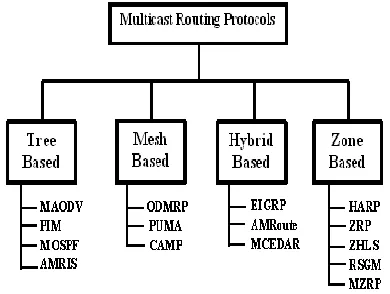
Based on the topology of the network, the multicast routing protocols [9] are classified into four types as shown in the following figure.
Fig 2: Classification of Multicast Routing Protocols
IV. TREE BASED MULTICAST ROUTING PROTOCOLS
[image:2.612.54.284.275.411.2]A Tree based multicast routing protocol establishes and maintains a shared routing tree to deliver data from a source to destination. These protocols are further classified into four types discussed below.
Fig 3: Tree Based Topology.
A. Multicast Ad-hoc on Demand Distance Vector Protocol (MAODV)
Multicast Ad-hoc On-Demand Distance Vector protocol is the extension to the Ad -hoc On-Demand Distance vector protocol. It has the capability of unicasting and as well as broadcasting. It can route the information using multicast routing. When a node wishes to join a multicast group then it originates a route request (RREQ) message and also if the node has some data to send to the group but it does not have a route to that group then also it does the same thing. Only the members of the multicast group respond to join RREQ [6]. If an intermediate node receives a join RREQ from a+ node which it is not member of multicast group, then it rebroadcast the RREQ to its neighbors. But if the RREQ is not a join request any node of the multicast group may res pond.
[image:2.612.71.266.552.699.2]International Journal of Emerging Technology and Advanced Engineering
Website: www.ijetae.com (ISSN 2250-2459,ISO 9001:2008 Certified Journal, Volume 4, Issue 8, August 2014)
426 They include PIM Sparse Mode (PIM-SM), PIM Dense Mode (PIMDM), PIM Source Specific Multicast (PIM -SSM) and Bidirectional PIM. In this protocol the state information is updated at the routers by periodic control messages.
C.Multicast Open Shortest Path First Protocol (MOSPF) Multicast Open Shortest Path First protocol is the extension of OSPF (Open Shortest Path) protocol to provide efficient multicasting within a network. IGMP (Internet Group Management Protocol) [12] is used in this protocol to examine the membership in multicast group by broadcasting IGMP host membership queries and receives IGMP host membership reports. The group information is transmitted in the network by flooding of OSPF Link State Advertisement (LSA). This information is used by the routers to build the shortest path tree where source is the root and multicast receivers are leaf nodes. A separate shortest path is created for each source destination group pair. Compare to Distance Vector Multicast Routing Protocol (DVM RP), faster network convergence is provided by MOSPF.
D.Ad-hoc Multicast Routing protocol utilizing Increasing id-numberS (AMRIS)
MAODV does not exhibit the limitations of AMRIS (Ad-hoc Multicast Routing protocol) utilizing increasing id number, which rely on underlying unicast protocol. AMRIS is an on-demand protocol that constructs a shared multicast delivery tree to support multiple senders and receivers in a multicast session and shared tree for multicast data forwarding. Each node in the network is assigned a multicast session ID number. The ranking order of ID numbers [12] is used to direct the flow of multicast data.
V. MESH-BASED MULTICAST ROUTING PROTOCOLS
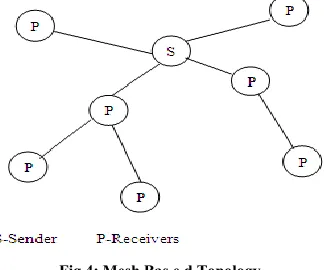
[image:3.612.364.526.142.277.2]Mesh based protocols provide multiple paths between sender and receivers.
Fig 4: Mesh Bas e d Topology
A.On-Demand Multicast Routing Protocol (ODMRP) The On-Demand Multicast Routing Protocol (ODMRP) is an on-demand mesh based protocol [2] where a mesh is formed by a group of nodes known as forwarding nodes. These nodes forward the data packets between the source and destinations and keep a message cache which helps in the detection of duplicate data and control packets. To maintain multicast group numbers a soft -state approach is used. This protocol is more attractive in mobile wireless networks due to reduction of channel/storage overhead and the richer connectivity.
B. Priority Unavoidable Multiple Access Protocol (P UMA)
International Journal of Emerging Technology and Advanced Engineering
Website: www.ijetae.com (ISSN 2250-2459,ISO 9001:2008 Certified Journal, Volume 4, Issue 8, August 2014)
427 C.Core-Assisted Mesh Protocol (CAMP)
CAMP [3] is a mesh based proactive multicast protocol. A node who wants to join multicast group has to search for the neighbors which are already mesh members [6]. If so, the node uses CAMP update message to announce its membership. In other cases node broadcasts request and try to reach the mesh members or sends join request to one of the core. CAMP has two types of mesh members
- Duplex member
- Simplex member
A duplex member is capable to send and receive multicast data and simplex member can only send out data multicast data packets.
VI. HYBRID BASED MULTICAST ROUTING PROTOCOLS
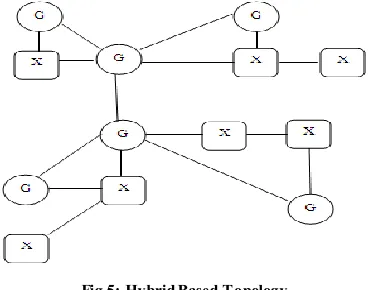
[image:4.612.76.261.354.499.2]The hybrid based multicast routing protocols inherits the properties of both tree and mesh based.
Fig 5: Hybrid Based Topology Where G=group member router, X=non-member.
A. Enhanced Interior Gateway Routing Protocol ( EIGRP) The Enhanced Interior Gateway Routing Protocol (EIGRP), referred to as an advanced Distance Vector protocol [9], offers radical improvements over IGRP. Traditional DV protocols such as RIP and IGRP exchange periodic routing updates with all their neighbors, saving the best distance (or metric) and the vector (or next hop) for each destination. EIGRP differs in that it saves not only the best (least-cost) route but all routes, allowing convergence to be much quicker. Further, EIGRP updates are sent only upon a network topology change; updates are not periodic. B.Ad-hoc Multicast Routing Protocol (AMRoute)
The Ad hoc Multicast Routing protocol (AMRoute) presents a novel approach for robust IP Multicast in mobile ad hoc networks by exploiting user-multicast trees and dynamic logical cores.
It creates a bidirectional, shared tree for data distribution using only group senders and receivers as tree nodes. Unicast tunnels are used as tree links to connect neighbors on the user-multicast tree [12]. Thus, AMRoute does not need to be supported by network nodes that are not interested/capable of multicast, and group state cost is incurred only by group senders and receivers.
C.Multicasting using Core Extraction Distributed Ad-hoc Routing Protocol (MCEDAR)
Multicast core extraction distributed ad hoc routing)
multicast routing algorithm for ad hoc
networks. MCEDAR is an extension to the CEDAR architecture and provides the robustness of mesh based routing protocols [6] and approximates the efficiency of tree based forwarding protocols. It decouples the control
infrastructure from the actual data forwarding
infrastructure. The decoupling allows for a very minimalistic and low overhead control infrastructure while still enabling very efficient data forwarding.
VII. ZONE BASED ROUTING PROTOCOLS
A.Hybrid Adhoc Routing Protocol (HARP)
Hybrid Ad hoc Routing Protocol (HARP) the Hybrid Ad hoc Routing Protocol (HARP) is a hybrid routing scheme, which exploits a two - level zone based hierarchical network structure. Different routing approaches are utilized in two levels, for intra - zone routing and inter-zone routing, respectively. The Distributed Dynamic Routing (DDR algorithm is exploited by HARP to provide underlying supports.
B.Zone Routing Protocol (ZRP)
International Journal of Emerging Technology and Advanced Engineering
Website: www.ijetae.com (ISSN 2250-2459,ISO 9001:2008 Certified Journal, Volume 4, Issue 8, August 2014)
428 C.Zone Based Hierarchical Link State Routing Protocol
(ZHLS)
Zone-based Hierarchical Link State Routing Protocol (ZHLS) [Joa-Ng99], the network is divided into non-overlapping zones. Unlike other hierarchical protocols, there is no zone-head. ZHLS defines two levels of topologies - node level and zone level. A node level topology tells how nodes of a zone are connected to each other physically. A virtual link between two zones exists if at least one node of a zone is physically connected to some node of the other zone. Zone level topology [9] tells how zones are connected together. There are two types of Link State Packets (LSP) as well - node LSP and zone LSP. A node LSP of a node contains its neighbor node information and is propagated with the zone where as a zone LSP contains the zone information and is propagated globally. So each node has full node connectivity knowledge about the nodes in its zone and only zone connectivity information about other zones in the network. So given the zone id and the node id of a destination, the packet is routed based on the zone id till it reaches the correct zone. D.Robust and Scalable Geographic Multicast Protocol
(RSGM)
It is based a two-tier membership management and forwarding structure. At the lower tier, a zone structure is built based on position information and a leader is elected on-demand when zone group members are present. A leader manages the group membership and collects the positions of the member nodes in its zone. At the upper tier, the leaders of the member zones report the zone membership to the sources directly a long a virtual reverse-tree-based structure. If a leader is unaware of the position or addresses of the source, it could obtain the information from the Source Home. With the knowledge of the member zones a source forwards data packets to the zones that have group members along the virtual tree rooted at the source. After the packets arrive at a member zone, the leader of the zone will further forward the packets to the local members in the zone along the virtual tree rooted at the leader.
E.Multicast Zone Routing Protocol (MZRP)
MZRP is a shared tree multicast routing protocol that proactively maintains the multicast tree membership for nodes’ local routing zones at each node while establishing multicast trees on-demand. It is scalable to a large number of multicast senders and groups. IP tunnel mechanism is used to improve the data packet delivery ratio during transmission [9]. These multicast protocols are distinct based routing protocols including tree, mesh, zone and hybrid. Each includes its own scalable performance difference in routing. So this study gives base for research on multicast routing protocols.
VIII. PERFORMANCE METRICS
Due to the nature of MANET, under different mobility speed, number of senders, number of receivers, multicast group size and network traffic load scenarios [16], some of the protocols will be advantageous over the others. The performance evaluation metrics for multicast routing protocol includes the following:
Data Packet Delivery Ratio: It is defined as the ratio of number of data packets successfully delivered to the number of data packets supposed to be received by the receivers of multicast group.
Data Forwarding Efficiency: It is defined as the number of data packets transmitted per data packet delivered. It is also known as delivery efficiency [16]. The transmitted packets include all transmitted packets which are transmitted by the original sender of the packet and the retransmission of the same packet by the intermediate nodes.
International Journal of Emerging Technology and Advanced Engineering
Website: www.ijetae.com (ISSN 2250-2459,ISO 9001:2008 Certified Journal, Volume 4, Issue 8, August 2014)
429 IX. PROTOCOL ANALYSIS
Table I:
Comparison of Multicast Routing Protocols
Protocol Multicast Topology Loop Free
Dependence on Unicast
Protocol QoS Support
Perio -dic Msg MAODV Tree Y
e s
Yes No Yes
PIM Tree Y No No Yes
MOSPF Tree Y Yes No Yes
AMRIS Tree Y e s
No No Yes
ODMRP Mesh Y e s
No No Yes
PUMA Mesh Y s s s e s
Yes No Yes
CAMP Mesh Y Yes No Yes
EIGRP Hybrid Y Yes Yes Yes AMRoute Hybrid N
o
Yes No Yes MCEDAR Hybrid Y
e s
Yes Yes Yes HARP Zone Y
e
Yes Yes Yes
ZRP Zone Y No Yes Yes
ZHLS Zone Y Yes No Yes
RSGM Zone Y No Yes Yes
MZRP Zone Y No Yes Yes
X. CONCLUSION
This paper presents a general view of multicast routing protocols in ad- hoc networks, also the main issues required in the design of an efficient ad-hoc multicast routing protocol. Then the aim of developing these protocols is presented, and the very brief operation mechanisms are discussed. Summarization of these protocols is illustrated in Table 1. Finally, all multicast routing protocol tries to solve some problems, all of these routing protocols has their own advantage and disadvantages too. There is no any protocol founded yet that can be solving all ad-hoc network problems. Therefore, there are many issues in multicast routing protocol that can be discussed to develop the protocols to perform better multicasting in the future.
REFERENCES
[1] C. Siva Ram Murthy, B.S. Manoj, Pearson Education, Adhoc Wireless Networks- Architectures and Protocols.
[2] Parul Vashist, K.Hema, International Journal of Innovations in Engineering and Technology (IJIET), ISSN: 2319-1058, Vol.2 Issue 2 April 2013, New Multicast Routing Protocol In Ad-Hoc Network, [3] Mohammad Banikazemi, IP Multicasting: Concepts, Algorithms,
and Protocols
[4] (IJCSE) International Journal on Computer Science and Engineering, Vol. 02, No. 03, 2010, 706-713 , Current Research Work on Routing Protocols for MANET: A Literature Survey.
[5] M Ravi Kumar, N Ramesh Babu, N Geethanjali, ISSN: 2277 128X, Volume 3, Issue 9, September 2013, (IJARCSSE) International Journal of Advanced Research in Computer Science and Software Engineering , A Review on Multicast Routing Protocols for Mobile Ad-Hoc Networks.
[6] Mohammed R. BAKER, M. Ali AKCAYOL, Gazi University Journal of Science, GU J Sci 24(3):451-462 (2011), A Survey of Multicast Routing Protocols in Ad-Hoc Networks.
[7] Tanu Preet Singh, Neha, Vikrant Das, International Journal of Advanced Research in Computer Science and Software Engineering, Volume 2, Issue 1, January 2012 ISSN: 2277 128X, MULTICAST ROUTING PROTOCOLS IN MANETS
[8] Sagar P. Latake, Gitanjali R. Shinde, Rajesh H. Kulkarni, International Journal of Computer Science and Information Technologies, Vol. 4 (3) , 2013, 485-488, ISSN: 0975-9646, Tree, Mesh Structure Based and Stateless Multicast Routing Protocols in Wireless Networks.
[9] R.Janakavi,V. Keerthana, S. Ramya, S. Gayathri Devi, International Journal of Scientific Engineering and Technology, ISSN: 2277-1581, Volume No.3 Issue No.4, pp : 418-4211April 2014, A Survey of Multicast Routing Protocols.
[10] Luo Junhai, Xue Liu b, Ye Danxia, 2008, Research on multicast routing protocols for mobile ad-hoc networks
[11] Xiao Chen, Jie Wu, Multicasting Techniques in Mobile Ad Hoc Networks
[12] CHEN-CHE HUANG AND SHOU-CHIH LO, A Comprehensive Survey of Multicast Routing Protocols for Mobile Ad-hoc Networks [13] Mohammed R. BAKER, M. Ali AKCAYOL,2011, A Survey of
Multicast Routing Protocols in Ad-Hoc Networks
[14] Abdussalam Nuri Baryun, and Khalid Al-Begain, ISBN: 978-1-902560-19-9 © 2008, A Design Approach for MANET Multicast Protocols
[15] Changling Liu, Jörg Kaiser , A Survey of Mobile Ad Hoc network Routing Protocols.