2017 International Conference on Computer Science and Application Engineering (CSAE 2017) ISBN: 978-1-60595-505-6
Speeding up Multi-Isosurface Extraction
based on Multi-Active Node Searching
Wei Zhang*, Wenke Wang and Xiaoqian Zhu
Academy of Marine Science and Engineering, National University of Defense Technology, 410005 Changsha, Hunan, China
ABSTRACT
Multi-isosurface extraction plays an important role in scientific data analysis. However, the existing isosurface extraction methods aim to speed up the extraction of single isosurface. In this paper, we propose an acceleration algorithm of multi-isosurface extraction based on multi-active node searching, which can extract multiple isosurfaces simultaneously and efficiently. Based on improving the BONO extraction algorithm, our algorithm can significantly reduce the number of nodes to be accessed in the process of searching active nodes, and thus time cost can be reduced obviously. We also propose the concept of active factor to research the relationship between multi-active node and acceleration effect. Experimental results show that the BONO_Multi algorithm we proposed has a significant acceleration effect compared with the existing methods, especially for the large data and numerous isosurfaces.
INTRODUCTION
Isosurfaces extraction and rendering is one of the basic visualization methods for 3D scalar field data. It is widely used in many scientific fields such as medicine and meteorology. The relationship between the position of isosurfaces and relevance of multiple adjacent isosurfaces can reveal the intrinsic structure of the scalar field data clearly. The correlation between the data and the overall characteristics are often obtained by a comprehensive analysis with multiple or even numerous isosurfaces.
In the medical imaging, isosurfaces are used to describe many different anatomical structures and tissues [1]. In the meteorology, many three-dimensional data field, such as temperature and salinity, usually need to extract multiple isosurfaces by some common values [2]. At present, so many visualization researchers focused on extraction [1] of single isosurface from the three-dimensional volume data, but less research on multi-isosurface acceleration extraction. Related work on extraction of single isosurface will be introduced later in this paper.
RELATED WORK
For single isosurface extraction, researchers have conducted a number of fruitful studies. Marching Cube [4] (hereafter referred to as MC) is the most classic algorithm. Because of its logicality and convenience, MC is in a wide range of applications.
Because of its advantages, many visualization researchers had proposed a series of optimization algorithms based on MC algorithm. The BONO algorithm [5] is the representative of related optimization algorithms based on spatial filtering. It can save storage space by subdividing the octree tree as a full tree in the concept. The Span space data representation method proposed by Livnat [6] can project voxels in the three-dimensional space onto the two-dimensional plane by extracting range features. According to filter voxels in the value space, the algorithm can accelerate the search for active voxels. On this basis, a series of improved algorithms are proposed: Livnat [6] proposed the NOISE algorithm used KD-tree data structure; Shen [7] proposed the ISSUE algorithm using grid division to further reduce time complexity; Paolo Cignoni [3] used the interval tree structure to accelerate. The literature [8] results show BONO algorithm has the best acceleration in related algorithms of MC algorithm.
In practical applications, analysts in the field of expertise usually need to extract multiple isosurfaces for data analysis. However, there are few studies on multi-isosurface extraction [9]. Hu [10] studied in the optimized algorithm for the multi-isosurface display quality, rather than acceleration. In recent years, a new field of visualization research, the interface extraction of heterogeneous objects, has rose up and has a certain connection with multi-isosurface acceleration extraction [9]. Zheng, Y [9] proposed a modeling method to extracting surface grids directly from implicit heterogeneous body data. Poston [11] proposed a multi-interface extraction algorithm based on the Skeleton Climbing algorithm, but only proves the feasibility. Zheng, Y [9] implements the algorithm proposed by Yang, but their algorithm focuses on the correctness and do not optimize for the complexity of the algorithm. Q. Shi [12] had improved the BONO and proposed POT algorithm, but it mainly applied to the visualization of time-varying data.
By improving BONO algorithm, this paper proposes an accelerated algorithm of multi-isosurface extraction to change the situation that only single isosurface can be extracted at once time. By using correlation between isosurfaces, we can achieve multi-isosurface accelerated extraction by optimization in voxel determination.
MUITI-ISOSURFACE EXTRACTION ALGORITHM BASED ON MULTI-ACTIVE NODE SEARCHING
Related Definitions
Grid unit containing isovalue are known as the active node or active voxel. For multi-isosurface extraction, if the value range of a node or voxel contains multiple isovalues, then the node or voxel is defined as a multi-active node or multi-active voxel. And a node is defined as an n active node if it contains n isovalues.
defined as the relevant node or relevant voxels. When the number of isovalue is 1, a relevant node satisfies both conditions is an active node.
Bono-Multi Algorithm
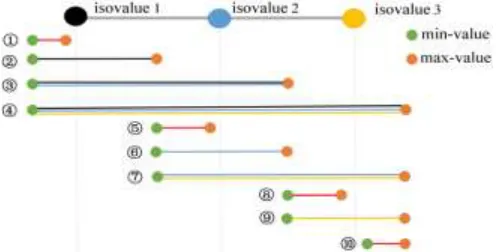
[image:3.612.184.432.193.319.2]The search efficiency can be optimized by using intrinsic relationship of multiple isovalues. Size of different isovalues is the most intuitive intrinsic relationship, and it is easy to input multiple isovalues in ascending (or descending) sequence with a negligible amount of time. Figure 1 shows sequence information of three isovalues.
Figure 1. Sequence information with 10 nodes and 3 isovalues.
[image:3.612.125.493.578.690.2]Figure 1 is a schematic diagram of the sequence information with three isovalues. The top three color points in the figure represent the three isovalues in ascending order, where the black one is the min-isovalue and the yellow one is the max-isovalue. Each node is signified by a green dot, an orange dot, and the lines of the different colors between them. The green dot represents the minimum value of the node, and the orange dot represents the maximum value. The location of green and orange dot relative to the three top points represent the relationship of their value: green dot on the left side of the black point represents the minimum value of the node is less than the min-isovalue, orange point on the right side of the black dot represents the maximum value of the node greater than the max-isovalue. The red line indicates range of the node does not contain any isovalue, and the black line indicates that the node contains black point represents the min-isovalue. A line of different colors (except red lines) between each pair of green and orange dots represents that the node include the isovalues signified by these colors. For any node, its position relationship with the isovalue contains only 10 patterns shown Figure 1.
In a general algorithm, the determination of an active point can be divided into two parts: the non-leaf node and the leaf node part. The process of a general isosurface extraction algorithm is shown in Figure 2. In the non-leaf node determination part, the algorithm first determines whether the range of node contains the current isovalue and it determines whether this node is subdivided down. In the leaf node level, it is directly determined whether it contains the currently isovalue. In multiple isosurface extraction, two decision procedures need to be repeated (repeated the number of isosurfaces), the process is lengthy and time-consuming.
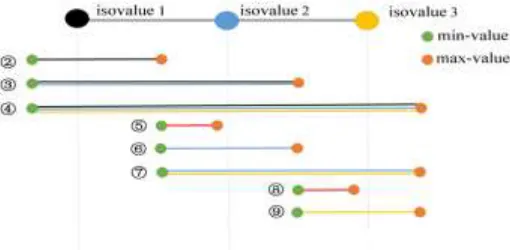
[image:4.612.180.435.233.358.2]In view of this problem, we have presented the Bono_Multi algorithm. In the non-leaf node level, we introduce the relevant point. For example, if we need to extract three isosurfaces, it should have finished the determination of the relevant nodes which are situation 2-9 in Figure 3, and then continue to search leaf node level.
Figure 3. Sequence information of relevant node.
TABLE I. PSEUDO-CODE OF BONO-MULTI ALGORITHM. Algorithm: Bono_Multi (v, isovalue)
Input: Bono tree root node v, n isovalues in ascending order Output: voxel containing the corresponding isovalue separately If (v does not exist), return;
If (v is a relevant point) If (v is a leaf node)
If (green dot of v is the first isovalue)
For (from the nth isovalue in descending order to the first isovalue)
If (orange dot of v on the right of the current isovalue which subscript is i) The voxel in the leaf node is outputted corresponding to 2nd to i-th isovalue, Else voxel in the leaf node is outputted corresponding to the first isovalue, return; For (the second to the n-1th isovalue in ascending order)
If (the green dot of v is on the left side of the current i-th isovalue) For (the nth to the i-th isovalue in descending order)
If (orange dot of v on the right side of the current isovalue with subscript j) Voxel in leaf node is outputted corresponding to i-th to j-th isovalue, retrun; If (orange point of v on the right side of the nth isovalue)
The voxel in the leaf node is output corresponding to the nth isovalue, retrun; Else Bono_Multi (son (v), isovalue)
point this leaf node ends all the determination and it contains isovalue a-b. If m> n, the leaf node is a multi-active point, or an n active point (n = j-i+1).
It is worth noting that we have finished the determination of relevant cell at non-leaf node level. So that when the minimum value of a leaf node is less than the min-isovalue, if the maximum value is less than the min-isovalue, the maximum value must be smaller than the min-isovalue. That means the voxel contains min-isovalue in leaf node. Similarly, when minimum value of leaf node does not less than max isovalue, it is only necessary to determine whether maximum value is greater than max-isovalue. Table I is the pseudo-code that can reflect operation of our algorithm.
Complexity Analysis
For the Bono algorithm used in the single isosurface extraction, it is assumed that exist n1non-leaf nodes, n2 leaf nodes, and k1 active voxels corresponding to the single
isosurface and m isosurfaces, time complexity is m * O (n1 + n2 + k1).
For the Bono_Multi algorithm, the average time complexity is O (n3 + n4 + k2)
which k2 is active voxels corresponding to isosurfaces, n3 and n4 is the number of
non-leaf and leaf nodes. For the same input data, Bono_Multi algorithm only determines whether a node is a relevant node on the non-leaf node level, rather than harsher active node. So the number of non-leaf node to be determined will be much smaller than Bono algorithm when extract the same isosurfaces. It is obvious that
n3<<n1<<m*n1. On the leaf-node level, the number of determinations is significantly
reduced, because we determine staggeringly all active leaf nodes simultaneously. When m > 2, the number of determination is reduced by 50% at least, so n4 < m * n2.
In conclusion, the Bono_Multi algorithm has been optimized for extracting the multi- isosurfaces active voxels compared with the Bono algorithm. Acceleration of the method is verified by several experiments below.
EXPERIMENTAL RESULTS AND ANALYSES Hardware Environment and Dataset
[image:5.612.85.507.603.654.2]In this paper, our proposals were tested on different datasets which is the 3-D sea water salinity scalar field obtained by ocean model of LASG / IAP climate simulation system. In our experiments, Bono_Multi algorithm is used to extract multiple isosurfaces comparing to BONO algorithm. The number of isosurfaces is divided into 12 levels from 3 to 100. The experimental environment and data information are shown in Table II. The data scalar is in the range of 6.4808-47.2982 (unit: psu).
TABLE II. HARDWARE ENVIRONMENT AND GRID DATA INFORMATION.
Hardware Environment grid data information
CPU i7-4790K 4GHz dataset A dimension and size 3602*1683*30, 12.16Gb RAM 16GB dataset B dimension and size 3602*1683*20, 8.12Gb
Disk 3TB dataset C dimension and size 3602*1683*10, 4.04Gb
Acceleration Effect
when we use BONO algorithm to extract the isosurface of isovalue 10.2000, number of non-leaf and leaf nodes to be determined is shown in Table III.
TABLE III. THE NUMBER OF NODES WHEN ISOVALUE IS 10.200.
Dataset Isovalue Grid Number Non-leaf Node Number Leaf Node Number
A 10.2000 9185400 372880 1301246
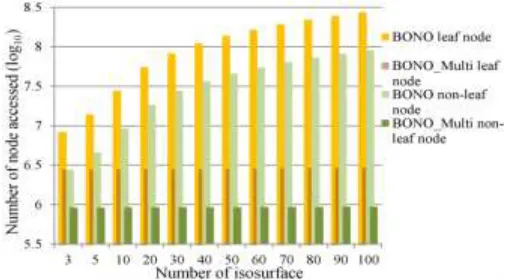
[image:6.612.181.435.283.423.2]The number of non-leaf and leaf nodes to be determined in BONO algorithm will increase in nearly direct proportion with the number of isosurfaces. In accordance with our analysis, this number in Bono_Multi algorithm will only slightly higher than that in singular isosurface extraction. To validate our analysis, the experiment 1 will extract multiple isosurfaces for dataset A, which isosurfaces are divided into 12 different numbers of sets. The values extracted in the experiment 1 will be starting at 10.0000 and increasing by the isosurfaces numbers at intervals of 0.2000. The number of nodes to be determined by the two algorithms is shown in Figure 4. For the sake of comparison, the vertical coordinates in Figure 4 indicate nodes number logarithm.
Figure 4. The number of nodes to be determined by multi-isosurface extraction in dataset A.
[image:6.612.97.500.570.706.2]As can be seen from Figure 4, the experimental result is well in line with our analysis. With the increase of isosurfaces, the number of nodes to be determined by Bono algorithm is increasing. Especially the number of leaf nodes is higher than that of non-leaf nodes an order of magnitude, while this number by Bono_Multi algorithm is almost constant. When the number of isosurfaces reaches 100, the number of nodes to be determined by Bono algorithm is nearly 4 orders of magnitude higher than that of Bono_Multi algorithm. Dataset B and C of experimental results shown in Figure 5.
Experiment 2 is similar to experiment 1, but the data set we used was extended to data A to C. It is worth noting that different extraction intervals may affect the actual acceleration effect. When the extraction interval is small, the same active voxel may contain more isosurfaces, and theoretically the better the acceleration effect. So in experiment 2, a small interval extraction test (starting at 20.0000) was added at intervals of 0.0500 beside the original large extraction at 0.2000 intervals. Data A-C is used to perform multiple isosurface extraction at both intervals, and the time taken to search and output the active voxel is as follows in Figure 6.
Figure 6. Time-consuming by multi-isosurface extraction in dataset A-C.
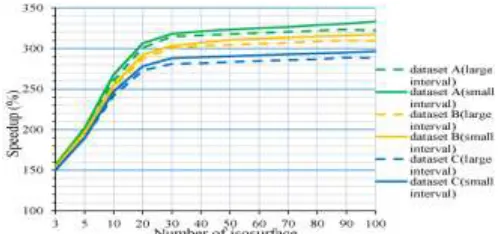
As can be seen from Figure 6, whether it is large or small interval extraction for data sets A to C, the time cost in BONO algorithm approximate increase in direct proportion with the number of isosurface. The accelerated effect of Bono_Multi algorithm is obvious. The acceleration effect can be visually represented by Figure 7.
Figure 7. Speed-up ratio of Bono_Multi algorithm in dataset A-C.
[image:7.612.183.432.390.507.2]Active Factor
In chapter 3, we have defined the concept of multi-active node. The Bono_Multi algorithm essentially reduces the number of nodes to be determined by using multi-active node determination instead that of single active cell, which achieves the purpose of multi-isosurface acceleratory extraction. In order to further explore the factors that affect the acceleration effect of the Bono_Multi algorithm and the relationship between the multi-active node and acceleration effect, we define an active factor Ac for each multi-isosurface extraction process in experiment 3 to measure the acceleration effect due to the existence of multi-active nodes.
Since the introduction of multi-active nodes, the number of nodes saved will be theoretically proportional to the acceleration effect in our analysis. In an extraction process of multiple isosurface, the more active cells exist, the more nodes be saved, so that the better the acceleration is.
The active factor Ac is defined as follows:
𝐴𝑐 = 1 − 𝐽_𝑛𝑜𝑑𝑒+𝐽_𝑙𝑒𝑎𝑓+𝛼∗𝐴𝑐_𝑛𝑜𝑑𝑒
𝐵𝑜𝑛𝑜_𝐴𝑐 +𝛼∗𝐴𝑐_𝑛𝑜𝑑𝑒 (1)
Among the definition, J_node and J_leaf are the number of non-leaf and leaf nodes, and Bono_Ac is the sum of sub-nodes that need to be determined in Bono algorithm. Since the Bono algorithm and the improved Bono_Multi algorithm are both output sensitive, we added to the Ac_node representing the total number of active voxels, multiplied by the parameter α to approximate time cost of total active voxel.
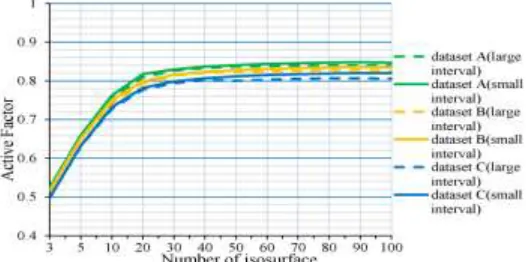
[image:8.612.177.440.399.530.2]When α = 0.5, active factors with dataset A-C are shown in Figure 8.
Figure 8. Active factor in multi-isosurface extraction process.
Active factors of different extraction process shown in Figure 8 correspond well to the results and problem shown in Figure 7. The acceleration began to be stabilized when the number of isosurfaces is greater than 30. The results in experiment 3 are in good agreement with that in experiment 2. It is shown that the active factors contained in each multiple isosurface extraction process determine the acceleration effect of the Bono_Multi algorithm, and prove the decisive effect of the multi-active node.
CONCLUSIONS AND FUTURE WORK
In this paper, we purpose an accelerated algorithm of multi-isosurface extraction based on multi-active node searching, which solves the problem that the traditional isosurface extraction algorithm only accelerates for single isosurface extraction. In our method, multi-active points, the active voxels containing multiple isosurfaces, are searched simultaneously by using the relationship between multi-isosurfaces. The theoretical analysis and experimental results show that the Bono_Multi algorithm we proposed has a good acceleration effect compared with the BONO algorithm and the average acceleration ratio is more than 250% and the maximum is nearly 350%. Considering the uneven distribution or the existence of thermocline and other factors in datasets, the concept of active factors is purposed to analyze the relationship between the acceleration ratio and the number of nodes to be determined. Experimental results show the acceleration effect will be better in the multi-isosurface extraction process with a higher active factor. On the whole, the Bono_Multi algorithm has a significant acceleration effect on the multi-isosurface extraction, especially the large data and numerous isosurfaces.
In this paper, there are some improvements in the algorithm. In the actual use, how to make the data have higher active factor and be more suitable for multi-isosurface extraction by pre-processing with the characteristics of input datasets, which is the focus of our future research work.
ACKNOWLEDGEMENT
The research was supported by Chinese 973 Program (2015CB755604) and the National Science Foundation of China (61202335).
REFERENCES
1. Yan, L. I., O. Tan, and H. L. Duan. 2001. "Review: Visualization of Three Dimensional Medical Images," J. Image & Graphics, 6(2):103-110.
2. Lundblad, Patrik, O. Eurenius, and T. Heldring. 2009. "Interactive Visualization of Weather and Ship Data," presented at the IEEE Information Visualization International Conference, October 11- October 16, 2009.
3. Cignoni P, Marino P, Montani C, and E Puppo. 1997. “Speeding up isosurface extraction using interval trees,” J. Visualization & Computer Graphics IEEE Transactions on, 3(2):158-170. 4. Lorensen, William E, and H. E. Cline. 1987. “Marching cubes: a high resolution 3D surface
construction algorithm,” J. ACM Seminal Computer graphics, 21(4):163-169.
5. Wilhelms J, Vangelder A. 1992. “Octrees for faster isosurface generation,” J. ACM Transactions on Graphics, 11(3):201-207.
6. Livnat, Yarden, H. W. Shen, and C. R. Johnson. 1996. "A Near Optimal Isosurface Extraction Algorithm Using the Span Space," J. Visualization & Computer Graphics IEEE Transactions on, 2(2):73-84.
7. HW Shen , CD Hansen , Y Livnat , CR Johnson. 2009. "Isosurfacing in Span Space with Utmost Efficiency (ISSUE)," presented at the Visualization ’96 Conference, October.27-November1, 2009. 8. Newman, Timothy S., and H. Yi. 1997. "A survey of the marching cubes algorithm," J. Computers
9. Zheng.Y, Q. Wang, and P. C. Doerschuk. 2012. "Three-dimensional reconstruction of the statistics of heterogeneous objects from a collection of one projection image of each object," J. Optical Society of America Optics Image Science & Vision, 20(6):959-70.
10. Huaquan, H. U., C. Yang, and W. U. Lingda. 2011. "Study on multi-layer isosurface hybrid render of electromagnetism environment," J. Computer Engineering & Applications, 47(35):206-209. 11. Poston, Tim, T. T. Wong, and P. A. Heng. 2010. "Multiresolution Isosurface Extraction with
Adaptive Skeleton Climbing," J. Computer Graphics Forum, 17(3):137-147.