University of Huddersfield Repository
Dehe, Benjamin, Bamford, David and Bamford, Jim
An Application of a MCDA Model for Healthcare Site Selection
Original Citation
Dehe, Benjamin, Bamford, David and Bamford, Jim (2011) An Application of a MCDA Model for Healthcare Site Selection. In: 22nd Annual Production and Operations Management Society (POMS) Conference 2011, April 29thMay 2nd 2011, Reno, Nevada, USA.
This version is available at http://eprints.hud.ac.uk/id/eprint/12122/
The University Repository is a digital collection of the research output of the University, available on Open Access. Copyright and Moral Rights for the items on this site are retained by the individual author and/or other copyright owners. Users may access full items free of charge; copies of full text items generally can be reproduced, displayed or performed and given to third parties in any format or medium for personal research or study, educational or notforprofit purposes without prior permission or charge, provided:
• The authors, title and full bibliographic details is credited in any copy; • A hyperlink and/or URL is included for the original metadata page; and • The content is not changed in any way.
For more information, including our policy and submission procedure, please contact the Repository Team at: [email protected].
POMS Abstract number: 020-0151
Title: “An Application of a MCDA Model for Healthcare Site Selection”
Authors Information:
Names Benjamin Dehe *corresponding author
David Bamford Jim Bamford Claire Moxham
Affiliation Manchester Business School
Manchester Business School
NHS Bradford and Airedale Manchester Business School Address Booth Street West
Manchester M15 6PB
Booth Street West Manchester
M15 6PB
Douglas Mill Bowling Old Lane
Bradford BD5 7JR
Booth Street West Manchester
M15 6PB
Tel 0161 306 8982 0161 306 8982 01274 256081 0161 200 3495
Email [email protected] [email protected] [email protected] [email protected]
POMS 22nd Annual Conference
Reno, Nevada, U.S.A.
An Application of a MCDA Model for Healthcare Site Selection.
Abstract
The aim of this paper is to report on the development of a Multiple Criteria Decision Analysis (MCDA) Model that was implemented to optimize the location selection for a new healthcare centre. The paper demonstrates how MCDA was used within healthcare to enhance the robustness and transparency of the decision making process.
Literature on MCDA was reviewed to contribute to the model development. It was developed in collaboration with a local Trust as part of a new health centre (£15 million project). A substantial set of data gathered from the public consultation and four specific workshops, allowed to assess the two alternatives using the Evidential Reasoning (ER) approach.
The final model has seven criteria and 28 sub-criteria. This technique was useful to reach a consensus and influenced the Board of Directors to justify the final decision thanks to the robustness and transparency of the process. The paper makes a contribution by implementing a MCDA model in the healthcare sector and by providing a model for future application.
Key Words: Multiple Criteria Decision Analysis, Site Selection, Healthcare.
1 -Introduction
Several techniques have been deployed over the 30 years to support decision makers. Through techniques such as financial modeling, cluster analysis, portfolio methods or simulation, organizations have managed to select optimum alternatives focusing on the output (Tavana, Sodenkamp, 2010). Moreover, it has been observed that within public organizations the multitude of stakeholders involved within the process is a barrier to t he transparency of the final decision.
This paper looks at the development and implementation of a MCDA model to select the optimum site for a future health and social care centre within the district of Bradford, UK. “MCDA methods provide a structured framework for information exchange among the different stakeholders and reduce the unstructured nature of the problem” (Tavana, Sodenkamp, 2010, p.1459). It will be seen to what degree a MCDA methodology, through the Evidential Reasoning (ER) technique, can support the optimization and the rationalization of the decision making process.
Two specific research questions were developed to provide a focus for the research: RQ1: How can the site selection decision be increasingly rational, inclusive and transparent within the NHS?
RQ2: What are the criteria that need to be considered to identify the optimum health infrastructure location in an urban area?
Following a review of appropriate literature and a presentation of core findings this paper makes a contribution by outlining the implementation of a MCDA model in the healthcare sector and by providing a robust model for future application.
2- Literature Review
2.1 Decision Making Theory
Decision making has been examined since early history and the development of logic with Plato and Aristotle (Hollnagel, 2007, Ormerod, 2010). Since then, it has been studied from different perspectives to understand what are the developments involved in selecting one alternative over another. Sharifi, Boerboom, Shamsudin and Veeramuthu (2006, p.86) defined decision making as “a process involving a sequence of tasks that starts with the recognition of a decision problem and ends with recommendation for a decision”. This is also the interpretation that Huber (1989) made when he considered the process of decision making as a problem-solving process.
influencing the decision. Second, decision makers are entirely sensitive; this means that decision makers are able to notice the slightest difference between the potential choices and two alternatives cannot be identical. Finally, it is also suggested that decision makers need to be rational individuals; this implies that alternatives can be systematically ranked by preference order.
This seems an idealistic scenario and it can be disproved from a realist perspective, which holds the view that in real life this never happens due to time and resources constraints. Hence, Hollnagel (2007) explained that a set of realistic assumptions can substitute the previous assumptions. “First, the decision making is a not a discrete and identifiable event; second, decision making is not primarily a choice among alternatives; and finally, decision making is not usually a distinct event taking place at a specific point in time” (Hollnagel, 2007, p.5). Considering this latter set of assumptions, the decision making becomes a phenomenon or an activity rather than a process. However, it is believed that when one explicitly attempts to resolve the problem by using even the simplest model such as comparison, or ranking techniques, then the decision making goes from a cognitive activity and becomes a process.
In this paper the authors have attempted to identify and implement a framework to design the decision making of the site location for new healthcare centre as a process, attempting to tend toward to the first set of assumptions as much as possible: informed, sensitive and rational. To achieve these objectives, many techniques have been developed over the past 30 years from different body of knowledge. Tavana and Sodenkamp (2010) explained that scoring methods, economics and financial models, portfolio approaches or simulation all are implemented to assess alternatives. These methods, although very powerful, might lack mechanisms to capture instinctive and tacit preferences; something that MCDA can offer.
Historically, within the NHS Trust the decision about the site location for a new health infrastructure has not systematically been a rational and transparent problem solving process but more of an arbitrary decision based on the knowledge available and the experts‟ feelings. This has been identified as an issue for the local community and solutions have been looked for. Here we will present how the MCDA process helped tending toward a transparent and rational decision for the selection of the new site, the process followed is detailed in the Appendix A.
To resolve this problem, instead of considering what were the alternatives and establishing a choice, data was collected in order to develop a hierarchy structure about what criteria needed to be considered to identify the optimum site location by assessing each alternatives against the same set of criteria. This enabled the decision making to be built as a process rather than an activity as Huber (1989) observed.
2.2- Location decision for a healthcare centre
optimum locations are either already developed or extremely expensive. Thus, techniques and models need to be developed to support decision making and to understand the impact of the decision on the overall activity. Cook and Hammond (1982, p.15) explained how in the private sector a poorly chosen location for a business can lead to its failure whereas a good location leads to its economic success. Moreover, Yang and Lee (1997) noticed that location problems have been increasingly investigated by academics and practitioners within both the public and private sector. Ghosh and Harche (1993) explained that facility location problems have attracted researchers within several disciplines: economics, industrial engineering, logistics and geography (cited by Yand and Lee, 1997, p.241). For these reasons the location problem became of interest for one of the authors.
Site selection decisions are deemed strategic due to their long lasting business impact. For instance manufacturers and retailers try to locate their facilities in such a way that the entire network‟s total cost is minimized or the profit is maximized - by supporting just-in-time strategies with their suppliers, and optimizing the market penetration by meeting the customers demand within short delays (Christopher, 2005; Cousins et al., 2008). However, within the public sector the objectives are likely to be very different, and often not as distinct as in the private sector (Rahman and Smith, 2000). For a public health facility the location decision has to consider criteria such the distance for the population, service availability, and the overall equity (Smith, Harper, Potts, Thyle; 2007, Rosero-Bixby, 2004). Therefore, models need to be used to support the decision making process. Rahman and Smith (2000, p.437) reviewed the role and the utilization of Location-Allocation models to support the healthcare facilities design in the developing countries and demonstrated the “usefulness of such methods in the site selection decision making process”. The aim of these models is to identify the set of optimal location for new healthcare facility, essentially by minimizing the distance or the cost of transportation between the node of demand and the facilities (Tao, 2010). This optimization would improve the accessibility. The p-median models have been an attractive method to resolve these location problems by calculating the smaller total weighted travel distance or time from the user to the facility (Rahman, Smith, 2000). Moreover, Salhi and Al-Khedhairi (2010, p.1619) developed a model “to solve p-centre problems aiming to locate p facilities and assign demand nodes to these p facilities so that the maximum distance between a demand nodes and the facility is minimized”. By developing such models the redesign of the whole system is likely to be improved. However, the mathematical methods are quite sophisticated, and complex to implement. This is in line with what Rahman and Smith (2000) remarked that most health centre locations disregard to a certain extent the implementation stage.
location, a large number of criteria would not be expressed, for instance the risk associated with the site, the size available to support a specific design or the potential for regenerating the district. Thus, one may wonder to what extent the solutions generated from these models will be transparent and robust. For these reasons, a Multiple Criteria Decision Analysis (MCDA) model was developed and thought to be the solution. This was also reinforced by Erkut and Neuman (1989, p.288) asserting that “real world location problems are clearly multiple objectives and multiple attributes decision making problems that shall be solved using multiple criteria decision making tools such as AHP”. 2.3- MCDA
Multiple Criteria Decision Analysis (MCDA) is a branch of Decision Science that provides methodologies and frameworks to cope with multiple and conflicting criteria situation. MCDA allows a coherent and visible decision making process by structuring the problem, modeling the preference, aggregating the alternative evaluation, and making recommendations (Belton and Stewart, 2001). Moreover, Cousins et al., (2008, p.69) explained that people have limited information processing capacity, hence, “do not necessarily make optimum decisions but instead seek to satisfy conflicting objectives”. Therefore, MCDA is appropriate to reduce the complexity by structuring the problem and establishing a systematic process to assess the alternatives. It will be seen to what extent MCDA frameworks supported the decision makers to be informed, sensitive, and rational matching the three assumptions detailed previously.
3- Methodology, Procedure and Model:
Literature on MCDA techniques was reviewed to contribute to the development of the final model. The model was developed in collaboration between the Bradford PCT and Manchester Business School as part of the planning of a new health centre project. A substantial set of data from public consultations was considered; as well as the data gathered from four specific workshops organized by Benjamin Dehe and Jim Bamford to capture both the „voice of the local community‟ and the „experts judgment‟. This data was used to identify the criteria, sub-criteria and their associated weightings as presented further. The assessment of the alternatives - the potential sites available, used the Evidential Reasoning (ER) approach rather than Analytical Hierarchy Process (AHP). ER was selected for its flexibility and capability to assess the uncertainty thanks to its assessment mechanism called „degree of belief‟ to measure and compare criteria and alternatives. Finally, the analysis was accommodated via IDS (Intelligent Decision Software), this package enabled to visualize the results and carry sensitivity analysis, enhancing the decision makers‟ comprehension (Xu, Yang, 2001). The process followed describes the methodology as Ormerod (2010) or Pidd (2003) suggested: background and definition of the problem, identification of the possible options, construction of the model and criteria identification, solution of the model and sensitivity analysis, validation of the model and implementation of the final results.
4- Case study 4.1- Background
Figure 1: Bradford and Airedale Deprivation District Map.
In 2006, according to the strategic objectives described previously (reduce the health inequalities and modernize the services and bring it closer to the local population), a project to develop a brand new health infrastructure in one of the most deprived area of Bradford district became an important priority. The centre might include GP practices, end of life care, local authority and third sector services, dental practices, community services, physiotherapy, elderly day services, cancer support and some of the outpatient, diagnostic and treatment services currently provided in the acute sector as reported internal documentation. This new healthcare centre would serve the whole community by meeting these needs (Turner, Hollingsworth, Watson, 2010).
4.2- Alternatives identification
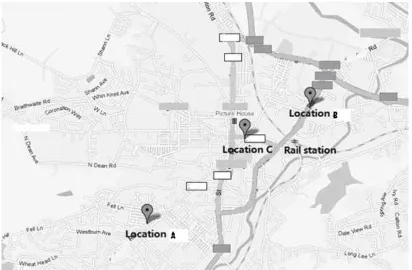
Figure 2: Potential sites location.
The site selection has been a real issue within the planning process. First of all, the local population has been genuinely concerned with the location of their future healthcare centre; this seems to be the most important element for the local population, which led to unconstructive debates during the public consultation, away from the other core elements such as the development and design of the future services provided (Dehe, Tao, 2010). Secondly, for the PCT, it has become complex to carry on the planning and design processes of the health premises whilst the location has not been determined for practical reasons. Moreover, a direct consequence of the high uncertainty associated with this decision is that project has been loosing pace and momentum, delaying the completion time. In other terms, within the planning stage the site selection appears to be the process bottleneck, thus, to improve the planning process, developing the MCDA model to optimize the site selection, seemed the relevant and appropriate methodology.
were asked their preferred location. Moreover, in such decision making a large number of stakeholders are directly involved, the PCT, the NHS staff, the patient, the council, and the local communities. All those stakeholders groups have different personal and political interests leading to conflicting site selection, which in the past, has slowed down the whole decision making process. This justifies the need to build up a process to enhance the robustness and the transparency of the decision by being inclusive based on the consensus of the stakeholders, to tend toward an optimum and rational decision.
5- Finding and Discussion
5.1- Construction of the model, and criteria identification
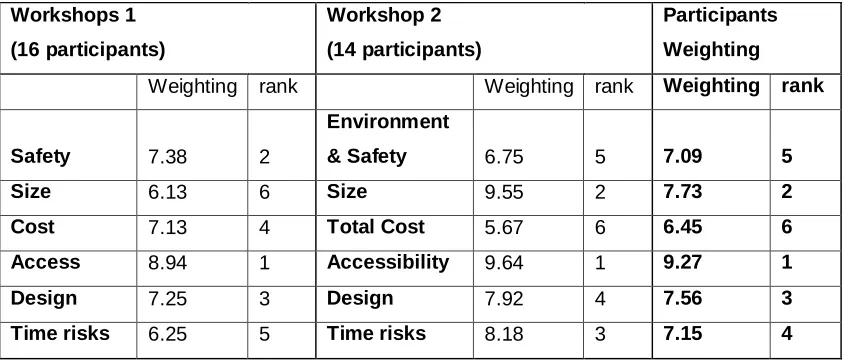
After the public consultation completed and analyzed, it was felt appropriate to engage further with the key stakeholders and the local community, allowing them to take part in the criteria identification that the decision makers shall consider when assessing the alternatives. The two main purposes were transparency and robustness of the decision making process. The intention was to bring together key stakeholders, including health and social care professionals, patients, service users and representatives from the district Town Council and the Voluntary Sector Racial Inclusion Group in order to ensure a wide range of views are included in the criteria and sub-criteria, both selection and weighting (Turner et al., 2010; Dehe and Tao, 2010). Therefore, the PCT has organized two workshops to determine the criteria and attributes, which shall be considered to make the decision. The workshops aimed to assess what are the criteria that stakeholders consider paramount to select the optimum site location and quantify their importance. This enabled us to develop an aggregated model, which takes into account multiple criteria to assist the decision makers to make a transparent and evidence based recommendation for the site selection.
Workshops 1 (16 participants)
Workshop 2
(14 participants)
Participants Weighting
Weighting rank Weighting rank Weighting rank
Safety 7.38 2
Environment
& Safety 6.75 5 7.09 5
Size 6.13 6 Size 9.55 2 7.73 2
Cost 7.13 4 Total Cost 5.67 6 6.45 6
Access 8.94 1 Accessibility 9.64 1 9.27 1
Design 7.25 3 Design 7.92 4 7.56 3
[image:12.612.96.521.71.251.2]Time risks 6.25 5 Time risks 8.18 3 7.15 4
Table 1: Workshops 1 and 2 Outcomes for the Criteria, (Dehe and Tao, 2010).
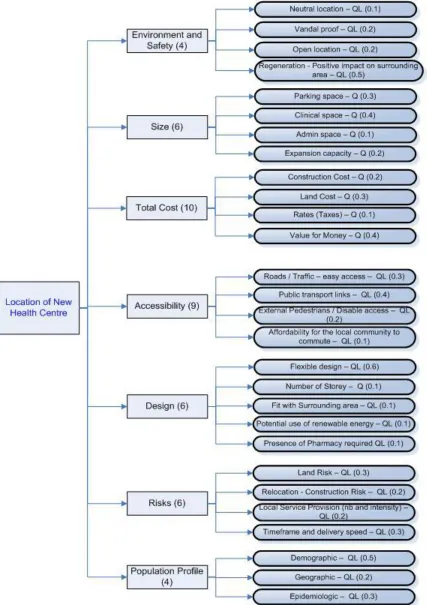
Environment and Safety: This criteria is related to the surrounding area safety and the potential for regenerating this part of the district by building a new health and well-being centre. The neutrality of the location according to the different communities was also taken into account.
Size: The size is linked to the number of square meters available to be able to accommodate the future health centre. Logically, the expansion capacity, the number of parking space and the square meters allocated for the clinical space and the administrative space have to be considered.
Total cost: Here both variable and fixed costs must be taken into account: construction cost, land cost, rates and taxes as well as the value for money that can differ from one alternative to another. Although this has scored the lowest by the participants, it is deemed to be to most important factor to be considered to take the decision, especially within the current financial and economical situation.
Accessibility: This criteria has been without a doubt the most important criteria from the public consultation and the workshops. Therefore, we shall consider and assess the alternatives against different type of access: public transport, road and traffic, pedestrians and disable accessibility. Another sub-criteria was identified: the affordability to commute for both the staff and the patients.
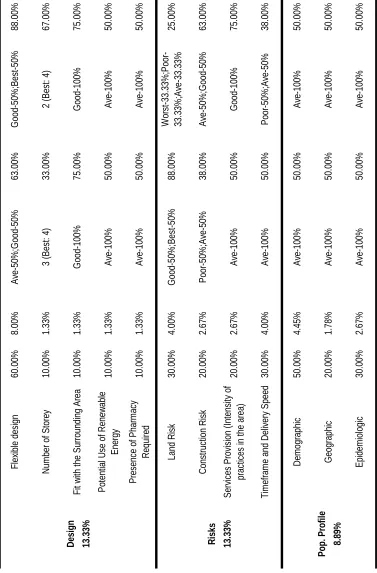
Design: The design aspect needs to be taken into account as this also impact the choice of the location. The number of floors, the presence of a pharmacy, the potential for a flexible design, the potential use for renewable energy, and the way the health centre will fit with the current landscape (planning regulation, design style) all are relevant issues to consider.
Risks: The risk is a criteria which have not been clearly stated throughout the workshops, and the public consultation, however, such strategic and long lasting decision must consider the risks associated. Here, we have highlighted the construction risks, the land risks, the intensity of other health and social services provision around (to also help reducing the inequalities), and the timeframe and the delivery speed risks (also a concern from the local communities).
Population profile: Within the analysis it also seems important to look at the demographic, geographic and epidemiologic profile of the different parts of the district even if in this case this did not influence the final outcome.
5.2- Alternatives Assessment
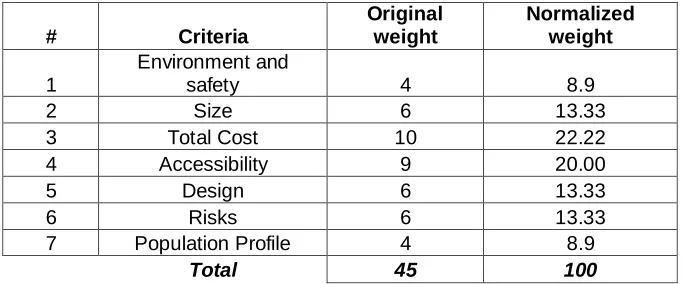
As previously explained at the start of the process three alternatives were being considered A, B and C. However, within the assessment process the location C had to be discredited due to external planning and political considerations. Thus, the following part describes the assessment of Location A and Location B. A team formed by experts has assessed each alternative A and B against each criteria and sub-criteria in IDS software (Intelligence Decision Software). The Table 2 below shows the assessment organized by Dehe and Tao in August 2010. Based on the in-house expertise the following table indicates the inputs of each criterion, including both weights and assessments for A and B. It needs to be noted that in IDS the weights have been normalized in percentage, which are the convention used.
# Criteria
Original weight
Normalized weight
1
Environment and
safety 4 8.9
2 Size 6 13.33
3 Total Cost 10 22.22
4 Accessibility 9 20.00
5 Design 6 13.33
6 Risks 6 13.33
7 Population Profile 4 8.9
[image:17.612.136.477.278.420.2]Total 45 100
Table 2: Normalized criteria associated weighting (Dehe and Tao, 2010).
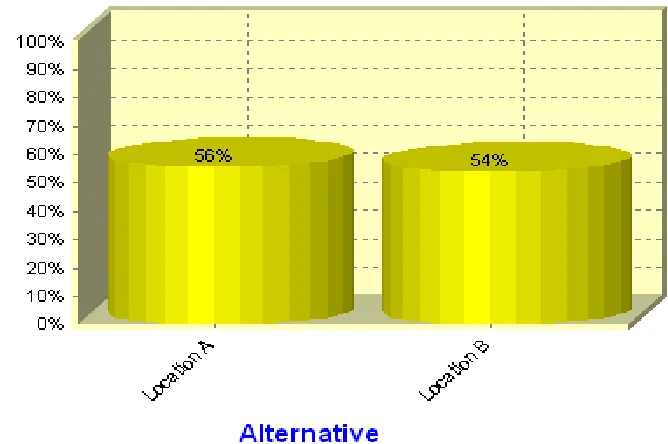
Based on this model and the presented inputs, Figure 5 shows the ranking of the alternatives A and B. From the assessment, Location A scored 56% and Location B scored 54%.
Figure 5: Ranking of the Alternatives.
Lc Location A Lc Location B
[image:20.612.105.510.442.686.2]From this assessment the preferred option was the location A with a percentage score of 56%, and location B scored 54%. By looking at Figure 6, it can be seen that Location A outstrips the Location B in 4 criteria: Environment and Safety by 11%, Total Cost by 32%, Accessibility by 2% and Risks 12% (meaning that A is believed being less risky than B). Whereas, the Location B outstrips the Location A in two criteria fairly substantially: Size by 41% and Design by 21%. Although Location A is the preferred option according to this assessment, it is relevant to understand the consequences of altering the weightings and inputs by undertaking sensitivity analysis.
5.3- Results analysis
This analysis was conducted by Dehe and Tao to inform further the decision makers and help them to appreciate the meaning of the results.
The difference in weighting between the model compiled by the public and the final model is showed in the table below:
PUBLIC FINAL
Criteria Weight Rank Weight Rank Environment & Safety 15.52% 5 8.90% 6
Size 17.07% 2 13.33% 3
Total Cost 14.41% 6 22.22% 1
Accessibility 20.62% 1 20.00% 2
Design 16.63% 3 13.33% 3
Risks 15.74% 4 13.33% 3
[image:21.612.145.468.305.429.2]Population Profile N/A N/A 8.89% 6
Table 4: Models’ weighting Comparison.
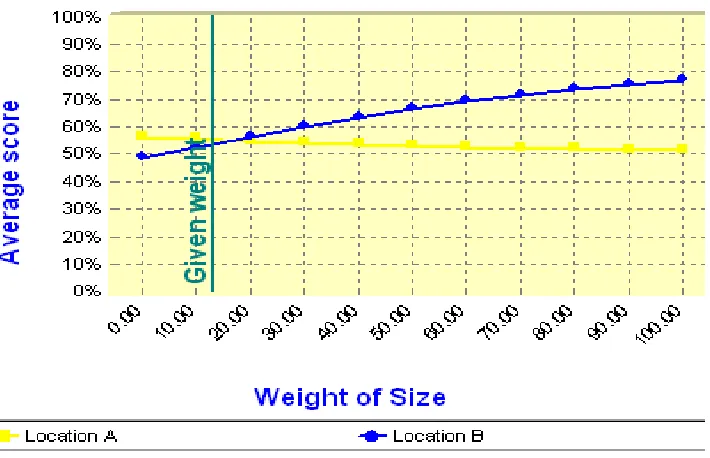
IDS was used to assess the model and to undertake the analysis. Thanks to IDS the authors were able to carry a sensitivity analysis for the weighting of the criteria. Three of the criteria could affect the final outcome: Size, Total cost and Design. This is interesting as previously mentioned Size and Design were the two criteria where Location B was outstripping the Location A. The Size had an associated weight of 13.33%, however, from the Figure 7 below if the weight associated increase to 16%, then Location B would reach a higher score. This has helped the decision makers to discuss to what extent the criteria Size can become a more important criteria. This was identified as very little in this case, thus Location A was still the preferred option.
Figure 7: Sensitivity analysis for the Size weight.
Figure 8: Sensitivity analysis for the Total cost weight.
The design weight has also been identified as a sensitive criteria. According to Figure 9, if the design was deemed more important to select the optimum site, and had an associating weight of 20%, then Location B would outstrip the Location A, and become the preferred option. Therefore, discussion around to what extent the design should be more important in the final decision, and again the decision makers agreed that was the right weight for this particular case.
[image:23.612.123.493.466.673.2]Therefore, this analysis was useful for the decision makers to appreciate the sensitivity of the weighting. This also enabled the decision makers to challenge to what extent the weighting were relevant for this site selection, discussions around these issues had taken place on the last workshop in the end of August. This was the opportunity to validate the final models. It was agreed amongst all the decision makers these weighting were based on a consensus in line with the strategy and the public consultation outcomes. However, it was appropriate to carry on further analysis to measure the sensitivity of the inputs, which were based on the expertise and the knowledge of the cross-functional team of experts. The Size was a sensitive criteria and its key sub-criteria was the clinical space, a quantitative sub-criteria assessed in square meters. Based on the internal knowledge, and the planning at that stage, the Location A would offers approximately clinical space available of 4,000 m2, this will allow to provide the services identified from the need assessment but with little room for flexibility; whereas, 5,000 m2 could be easily available in the Location B. Therefore, any improvements of the clinical space in location A would strengthen it as the preferred option as shows the Figure 10 below. This will be taken further into the design phase, to improve the overall quality of the infrastructure.
Figure 10: Input sensitivity anlysis for the Clinical Space.
Figure 11: Input sensitivity anlysis for the Flexible design.
Figure 12: Input sensitivity anlysis for the Cost of the land.
[image:26.612.102.511.362.543.2]5.4 - Research Questions
RQ1: How can the site selection decision be increasingly rational, inclusive and transparent within the NHS?
This paper has demonstrated that by following a MCDA process and including the local participants, the decision making became transparent and inclusive. The selection of the Location A as the preferred option was justified and challenged on several occasions. However, by the use of this process the decision makers were informed and aware of the differences lying in each alternative and supported by the sensitivity analysis, which allowed to rationally justifying the selection to the large range of stakeholders. In this case and based on the set of assumptions detailed in the literature part, we can state that the site selection has tended toward optimization and rationality. The robustness was also reached throughout the consensus agreement between the decision makers all along. The authors suggest that by having robust procedures in place the potential for information defects is reduced. Furthermore, it has been seen that thanks to this process the information asymmetry between Location A and Location B was considerably minimized, which also show that the quality of the inputs were taken into consideration by the decision makers. Thanks to the MCDA methodology and the collective process followed, the decision makers were able to draw rational interferences from the data collected. As Ormerod (2010, p.1767) explained “the rationality lies not in the mathematical model but in the structure of the decision choice”. To improve this model and the rationality of the outcome, we would suggest a bigger sample size, and a more quantitative sub-criteria assessment.
RQ2: What are the criteria that need to be considered to identify the optimum health infrastructure location in an urban area?
6- Conclusion:
Based on this piece of research, the decision makers were confident in recommending Location A as the optimum alternative for the local new healthcare centre. A limitation that the authors recognize is that due to resources and time constraints only two workshops involving the 30 people of the local communities actively participate to the model construction were undertaken. A major recommendation would be to start this process right at the beginning of the public consultation with a larger sample in order to improve all the objectives set: robustness, transparency for the public, and sensitivity for the decision makers to tend toward a rational decision making. We also appreciate that even thought the assessment have been as objective as possible, we do not know to what extent the participants, experts and decision makers were biased toward one site or the other affecting the final weighting, however, as it was based on consensus and agreement, we shall not take this issues into greater consideration.
This model influenced the NHS Board of Directors to make an informed final decision for the site location of the £15 million health centre. It has also been beneficial to the local population – the future patients, who were able to follow and take part in the whole decision making process. As several attributes were conflicting this technique was useful to aggregate the different shareholders perspectives and reach a consensus to select the most important factors leading to identify the optimum healthcare centre location. It was noticed that by going through this process the decision makers became more informed, more sensitive to appreciate the alternatives‟ differences, and also be more rational allowing ranking alternative by preferences.
The paper makes a contribution by implementing an MCDA model in the healthcare sector and by providing a potential model and process, which can be used as a starting point to replicate future local site selection decision. Over the next 5 years period, 10 new schemes are planned representing up to £ 150 million of investment for the Trust, the site selection decision will be carefully scrutinised and this methodology could be an effective and efficient solution. As far as the authors know this MCDA application has not been widely used in healthcare to identify optimum site.
References:
Bamford, D., (2009), KTP grant application and proposal form, Project Part A, Version 3.5, pp.1-8.
Belton, V., Stewart, T.J., (2001), Multiple Criteria Decision Analysis: an integrated approach, Kluwer Academic Publishers, Boston/Dordrecht/London.
Bhutta, K.S., Huq, F., (2002), Supplier selection problem: a comparison of the total cost of ownership and analytic hierarchy process approaches, Supply Chain Management: An international journal Vol. 7, No. 3, pp. 126-135.
Christopher, M., (2005), Logistics and Supply Chain Management, creating value-adding networks, Prentice Hall, Third Edition.
Cook, R., Hammond, K., (1982), Interpersonal learning and interpersonal conflict reduction in decision making groups, Chapter 2. (Guzzo, R., (1982), Improving group decision making in organizations: Approaches from theory and research, Academic Press, New York).
Cousins, P., Lamming, R., Lawson, B., Squire, B., (2008), Strategic Supply Management, principles, theories, practice, Prentice Hall.
Darzi Report, (2008), High quality care for all, Crown Copyright, Department of Health. Dehe, B., and Tao, T., (2010), Site assessment process and criteria identification, NHS Bradford report.
DoH, (2010), Equity and excellence, Liberating the NHS, Crown Copyright, Department of Health.
Erkut, E., Neuman, S., (1989), Analytical models for locating undesirable facilities, European Journal of Operational Research, Vol. 40, pp. 275-291.
Ghosh A., Harche, F., (1993), Location-allocation models in the private sector: progress, problems, and prospects, Location science, Vol.1 No.1, pp. 81-106.
Hollnagel, E., (2007), Decisions about „What‟ and Decision about „How‟, Chapter 1, pp. 3-13. (Cook, M., Noyes, J., Masakowski, Y., (2007), Decision Making in Complex Environment, Ashgate).
Huber, O., (1989), Information-processing operators in decision making, Chapter 1, pp. 3-21. (Montgomery, H., Svenson, O., (1989), Process and structure in human decision making, Wiley & Sons).
Pidd, M., (2003), Tools for thinking – Modelling in management science, John Wiley & Sons, Second Edition, Chichester.
Ormerod, RJ., (2010), OR as rational choice: a decision and game theory perspective, Journal of the Operational research Society, Vol. 61, No. 12, pp.1761-1776.
Rahman, S., Smith, K., (2000), Use of location-allocation models in health service development planning in developing nations, European Journal of Operational Research, Vol. 123, 437-452.
Ramani, K.V., Mavalankar D., Patel, A., Mehandiratta, S., (2007), A GIS approach to plan and deliver healthcare services to urban poor - A public private partnership model for Ahmedabad City, India, International Journal of Pharmaceutical and Healthcare Marketing, Vol. 1, No. 2, pp. 159-173.
Saaty, T., (1980), The Analytic Hierarchy Process – planning, priority setting, resource allocation, McGraw-Hill.
Salhi, S., Al-Khedhairi, A., (2010), Integrating heuristic information into exact methods: The case of the vertex p-centre problem, Journal of the Operational research society, vol. 61, No. 11, pp. 1619-1631.
Sharifi, M., Boerboom, L., Shamsudin, K., Veeramuthu, L., (2006), Spatial Multiple Criteria Decision Analysis in integrated planning for public transport and land use development study in Klang Valley, Malaysia, International Archives of Photogrammetry, Remote Sensing, and Spatial Information Sciences Vol. XXXVI - Part 2, ISPRS Technical Commission II Symposium, Vienna, pp. 85-91.
Smith, H., Harper, P., Potts C., Thyle, A., (2007) Planning sustainable community health schemes in rural areas of developing countries, European Journal of Operational Research 193, pp. 768–777.
Tao, T., (2010), The Multiple Criteria Decision Analysis model for a new health centre location selection problem: a case study, MSc Dissertation, University of Manchester. Tavana, M., Sodenkamp, M.A., (2010), A fuzzy Multi-Criteria Decision Analysis model for advanced technology assessment at Kennedy space centre, Journal of the Operational Research Society, Vol. 61, No. 10, pp. 1459-1470.
Turner, M., Hollingsworth, L., Watson, J., (2010), Final board report, NHS Bradford, Version 3.
Whitener, A., Davis, J., (1998), Minding your business with MapInfo, Onward Press. Wu, S., Lee, A., Tah, J.H.M., Aouad, G., (2007), The use of a multi-attribute tool
for evaluating accessibility in buildings: the AHP approach, Facilities, Vol. 25 No. 9/10, pp. 375-389.
Xu, L., Yang, J-B., (2001), Introduction to Multi-Criteria Decision Making and the Evidential Reasoning approach, Working Paper No. 0106, pp.1-21.
Yang, J., and Lee, H., (1997), An AHP decision model for facility location selection, facilities, Vol. 15, No.9/10, pp. 241-254.
Appendix B: Final Model details: Criteria and Sub-criteria.
Top-Criterion Describe Sub-Criterion Explanation Qualitative/ Quantitative
Environment and Safety (8.9%)
Include external factors affecting by the environment of the location.
Neutral Location (10.00%)
The site is in a neutral location. Qualitative (5-grads assessment) Vandal Proof (20.00%)
The surrounding area of the site is safe, with adequate security service around.
Qualitative (5-grads assessment)
Open Location (20.00%)
The surrounding area of the site is an open area without the obstacle that may impede evacuation.
Qualitative (5-grads assessment)
Regeneration-Positive Impact on the Surrounding Area
(50.00%)
The new health centre can positively improve socio-economically the
neighborhood, infrastructures, employment rate, and quality of life. Qualitative (5-grads assessment) Size (13.33%) Consider the space that the new health centre can potentially provide.
Parking Space (30.00%)
The number of parking space provided for in the new health centre.
Quantitative (Unite: Slot; Best: 250; Worst: 50.) Clinical Space
(Service design) (40.00%)
The space provided for clinical services in the new health centre.
Quantitative (Unite: m2; Best: 5,000; Worst: 3,000.) Admin Space
(Service design) (10.00%)
The space provided for Administration use in the new health centre.
Quantitative (Unite: m2; Best: 500; Worst: 250.) Expansion Capacity
(20.00%)
The potential for future expansion.
Quantitative (Unite: %; Best: 25%; Worst: 5%.)
Total Cost (22.22%)
Compare the cost of the new health centre in a site.
Construction Cost (20.00%)
The cost related with the construction of the new health centre. Qualitative (5-grads assessment) Land Cost (30.00%)
The cost associated to acquire the land for the new health centre.
Quantitative (Unite: £; Best: 0; Worst: 2m.)
Rates / Taxes (10.00%)
Other indirect costs associated with the new health centre, interests, taxes, etc.
Quantitative (Unite: £; Best: 0; Worst: 0.2m.)
Value for Money (40.00%)
Whether the total investment on the new health centre is effective, based on the financial modeling. Qualitative (5-grads assessment) Accessibility (20.00%)
Involve the factors that affect the access to the health centre.
Roads Traffic (Easy access)
(30.00%)
The general accessibility for road system around the site of the new health centre
Qualitative (5-grads assessment) Public Transport Links (40.00%)
Analysis of the public transport coverage of a site, such as bus routes, train station, taxi.
External Pedestrian and Disable Access (20.00%)
Whether the site provides good accessibility to the pedestrians and disabled users.
Qualitative (5-grads assessment)
Affordability for the Local Community to Commute
(10.00%)
The transport fees for the user to the health centre are reasonable, especially for those users who do not drive.
Qualitative (5-grads assessment) Design (13.33%) The design limitation that comes with the location choice.
Flexible design (60.00%)
The site can support further development that may occur in the future.
Qualitative (5-grads assessment)
Number of Storey (10.00%)
There are direct relationships between number of storey, design, health and safety, size.
Quantitative (Unite: storey; Best: 1; Worst: 4.) Fit with the
Surrounding Area (10.00%)
The health centre would not be in conflict with surrounding area in any form.
Qualitative (5-grads assessment) Potential Use of
Renewable Energy (10.00%)
The site for the new health centre can accommodate or facilitate the use of the renewable energy. Qualitative (5-grads assessment) Presence of Pharmacy Required (10.00%)
To what extent the pharmacy on site is needed, from a demand and regulation perspective. Qualitative (5-grads assessment) Risks (13.33%) Measure potential risks that may impact the cost and the time of the new health centre project
Land Risk (30.00%)
Risk related to the land on which the new health centre is built. For instance, unknown geographic factors may massively raise the cost.
Qualitative (5-grads assessment)
Construction Risk (20.00%)
Risk associated with the construction of the new health centre: disruption, health and safety, time for completion.
Qualitative (5-grads assessment) Services Provision
(Number and Intensity of practices in the area) (20.00%)
Evaluate the health service that already exists in the area, which may need to be relocated in the future.
Qualitative (5-grads assessment) Timeframe and Delivery Speed (30.00%)
Other risks time related that may negatively affect the new health centre. Qualitative (5-grads assessment) Population Profile (8.89%)
Involve factors of population profile that a new health centre needs to consider.
Demographic (50.00%)
Demographic coverage of a new health centre.
Qualitative (5-grads assessment) Geographic
(20.00%)
Geographic coverage of a new health centre. Qualitative (5-grads assessment) Epidemiologic (30.00%)
Epidemiologic features of a location that a new health centre needs to take into account.
Qualitative (5-grads assessment)
Appendix C: Sub-criteria comparison
Sub-Criteria Location A Location B
Vandal Proof No data suggesting that this is a high risk area for vandalism. This can be factored in when designing the building and regardless of the site location.
Open Location Slightly more open More industrial
Parking Space Site can allow up to 150 car parking spaces. Site can provide over 150 car parking spaces.
Expansion Capacity 2.5 acre site able to accommodate 4000m2 building 2 storey high with small room for expansion.
5 acre site able to accommodate 5000m2 building with ample room for expansion without building upwards.
Construction Cost Tight site and therefore construction restricted making it more costly. Need to find alternative accommodation for social care staff during construction.
Would be able to keep people on current site whilst work going on.
Rates (Taxes) Felt that both sites should be scored the same as not able to separate on rateable value.
Roads / Traffic – easy access
Both thought to be the same, it just depends on which road you would be travelling in from.
Public transport links Both considered the same.
External pedestrians / Disabled access
Main road not as busy for patients crossing, but may need to put a pelican crossing in.
Maybe advantageous with regard to access, however busier and wider main road to cross.
Affordability for the local community to
commute
Would depend on where people live and how they commute. No change for people as current site.
It is within walking distance for most people in the deprived surrounding areas. However it would cost other disadvantaged communities more as 2 buses could be required to commute.
Presence of Pharmacy required
Good for the pharmacy there at the moment. Maybe longer to get a pharmacy due to technical rules regarding pharmacy licenses.
Fit with surrounding area
Both the same. There are various buildings with different designs around, so shouldn’t be restricted with the design of the building.
Flexible Design Limited space on site. Larger site.
Construction Risk Restricted site meaning logistical challenges including limited car parking during construction period. Noise in surrounding residential area.
Large site and self contained so no phased construction required and no issues with car parking, site cabins.
Local Service Provision There are already several primary care providers within locality.
There is limited primary care provision within the locality (North Street Branch).
Timeframe and delivery speed
Slightly longer to build but land is already in PCT/council possession.
Land is privately owned and negotiations would need to be had with the owner and their agents.