2016 International Conference on Artificial Intelligence: Techniques and Applications (AITA 2016) ISBN: 978-1-60595-389-2
Modelling of Decision Making in the Production of
Stator Core Using a GA-ANN Approach
Manik RAJORA
1,
Pan ZOU
2, Wei XU
3,
Li-wei JIN
3, Wei-wei CHEN
3,
and Steven Y. LIANG
1,*1
George W. Woodruff School of Mechanical Engineering, Georgia Institute of Technology, Atlanta, Georgia, USA
2Mechanical Engineering College, Donghua University, Songjiang District, Shanghai, China
3
Shanghai Electric Group Co., Ltd. Central Academe, Shanghai, China
*Corresponding author
Keywords: Stator cores, Artificial neural network, Levenberg-marqurdt, Genetic algorithm.
Abstract. In the production of stator cores, it is relied upon experienced engineers to make time sensitive decisions on the number of compensation sheets to be added to achieve uniform pressure distribution though out the laminations. However, this method yields inconsistent results as humans are unable to store and analyze large amounts of data. In this paper ANNs have been employed to help the engineers with the decision making process. The ANNs are trained using a hybrid Genetic Algorithm (GA) – Levenberg-Marquardt (LM) to avoid local convergence. When used on testing data sets, the ANNs displayed a high degree of prediction accuracy indicating their ability to simulate the decision making process of these experienced engineers.
Introduction
With the rapid development of global industry, traditional manufacturing industries are facing many challenges, such as the higher complexity and flexibility of problem, the increasing human labor cost and the urgent requirement of sustainable production. These problems create bottleneck to the traditional manufacturing system due to the operator’s limitations on handling uncertainties, complexity and memorizing large amount of data [1]. The recent advancement in computing has enabled researchers to develop many artificial intelligence techniques and cope with the drawbacks of traditional manufacturing industries. Intelligent techniques such as Artificial Neural Networks (ANN), Suport Vector Mechanism (SVM), Fuzzy Logic (FL) etc. have enabled the transfer of the years of experience stored in the minds of the human operators to computers, thereby transferring the decision-making burden from man to machine. These intelligent techniques have increased production efficiency, decreased production and labor cost of the industries as they are self-adaptive and have the ability to handle complex nonlinear-problems and make accurate decisions in a timely manner.
The intelligent techniques mentioned above have showed great results when used for creating prediction models in the absence of physics based models. Azimi et al. [2] used an adaptive neuro-fuzzy inference system (ANFIS) for prediction of roller length of hydraulic jump on a rough channel bed. Prabhu et al. [3]used regression analysis, neural networks, and fuzzy logic to model the relationship between the process parameters (speed, feed, and depth of cut) and the performance
indicators (surface roughness with and without nanofluids) of grinding. Dewan et al. [4] used ANFIS
to create a forward prediction model between the process parameters i.e. spindle speed (N), welding speed (V), plunge force (Fz), and empirical force index (EFI) and the performance indicators, i.e.,
Though intelligent techniques have gained widespread usage in the traditional manufacturing industries, an area where traditional human decision making process is still utilized is in the production of stator cores. In this paper, ANNs have been employed to help the engineers with the decision making process. The ANNs are trained using a hybrid Genetic Algorithm (GA) – Levenberg Marquardt (LM) algorithm with the aim of increasing their prediction accuracy and give them the ability to simulate the human decision making process. The rest of the paper is organized as follows: the production of stator cores and decision making involved in their production is introduced. Next, the ANN used for modeling and the algorithms used for its training are highlighted and then results obtained when ANN is used to model the production of stator core process are presented. Lastly, some conclusions are drawn based on the results obtained.
Modelling
Description of Problem
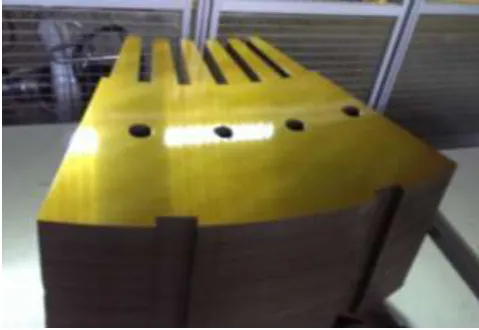
A turbogenerator stator is comprised of two major components: 1) the stator windings, and 2) the stator core. The stator core is made up of many individual steel laminations. The lamination is typically between 0.014" to 0.018" (29 to 26 gauge) thick and coated with a very thin layer of insulation, as little as 0.001" thick. A stator core is built up as laminations are placed side-by-side, seen in Figure 1, to make a complete circular or ringed layer. The next layer is laid, offsetting each layer like a brick or cinder block wall. Along its back, the stator core is held in place by rails, which are bolted to so-called guide bars. These guide bars can be mounted with insulation. Once the stacking is complete, the stator core is heated and pressed with a defined force. Using insulted clamping or through bolts, the required pressure is applied to the stator core in the axial direction by means of end plates and clamping fingers.
[image:2.595.177.417.560.725.2]The process of stacking, heating and pressing needs to be repeated several time in the production until the total height of the stator core reaches the desired value. To achieve uniform pressure distribution among the stator lamination layers, engineers align different shapes and sizes of compensation sheets between the layers of stator lamination according to the measurement result of the lead extrusions, as seen in Figure 2. Eight lead extrusions are distributed radially among the stator laminations and the thickness differences at different locations of the lead extrusions is used to indicate the radial pressure distribution difference. The goal of the engineers is to choose amongst the variety of compensation sheets available and insert them in between the stator laminations after each pressure application to achieve a constant pressure distribution thought the stator laminations.
Figure 2. Measurement points of the lead extrusion.
In this study, there were nine different types and sizes of compensation sheets available that could be inserted among the stator lamination. Experienced engineers in the industry decided the number of each type of compensation sheet based on the input values, given by Equations 1-4.
8 1 4 3 6 51 [ ( ) ( )]
8 1 i i i i i thickness thickness avg thickness thickness avg Input (1)
8 1 2 1 6 52 [ ( ) )]
7 1 i i i Input thickness thickness avg Input (2)
8 1 4 3 2 13 [ ( ) ( )]
8 1 i i i i i thickness thickness avg thickness thickness avg Input (3)
8 1 2 3 2 14 [ ( ) )]
7 1 i i i Input thickness thickness avg Input (4) 42 sets of historical data was obtained that contained information regarding the 4 inputs and how many types of different compensation sheets should be used for each combination of input parameters.
Modelling
ANNs [6], are a soft computing techniques that are commonly used in a variety of fields for the purpose of input-output mapping due to their ability to map from one multivariable space to another and to approximate functions according to the desired degree of accuracy. Another major advantage of NN is that the shape of the approximation function does not have to be assumed before training. During the training phase of the NN, its weight and bias values are updated with the aim of minimizing the difference between the predicted and the actual values. In classical ANNs, the training of the weights is accomplished using Gradient Descent (GD), a gradient based algorithm. Recently, however, Levenberg-Marquardt (LM) algorithm has instead been used for the training purpose as it has shown to outperform GD in a variety of problems [7,8,9,10]. As LM is still a gradient based technique, it can still converge to the local minimum depending on the initial weight values. To overcome this drawback, metaheuristic algorithms have been used in conjunction with gradient-based techniques for training purposes.
gradient based algorithms, this hybrid algorithm can avoid converging to the wrong local minima as it has global search ability due to the use of GA. During the training procedure the objective was to maximize the number of correctly predicted outputs.
Results and Discussion
Of the 42 data sets available, 34 of them were used for training, 4 for validation, and 4 for testing the trained ANN. A validation set was used to avoid overfitting of the weights to the training data set. During the training procedure, the weights were first trained using GA and then LM with the objective of maximizing the number of correctly predicted outputs. The best weights from each generation were saved and used to calculate the number of correctly predicted outputs for the validation data set. The set of weights that had the highest prediction accuracy for the validation data set were used as the final weight values. Table 1 and Table 2 show the settings used for GA and LM during the training procedure.
Table 1. Settings used for GA during training.
Population Size Number of Generations Crossover Rate Mutation Rate
[image:4.595.57.540.287.364.2]100 100 0.85 0.15
Table 2. Settings used for LM during training.
Epochs Validation Checks Minimum Performance Gradient
1000 50 e-7
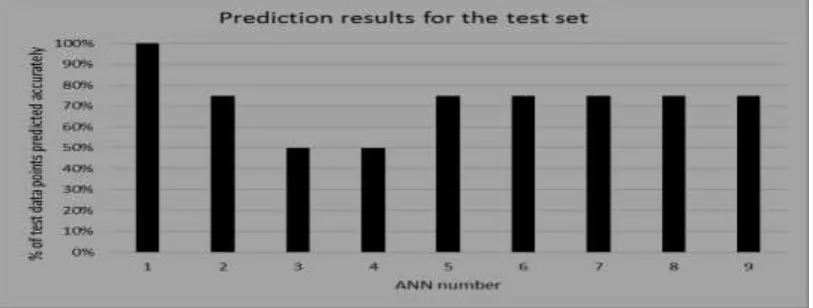
[image:4.595.96.503.520.674.2]Since there are no guidelines available for selecting the best ANN structure a trial-and-error based approach was used. It was determined that the highest prediction accuracy was achieved when each output was predicted using a separate ANN. The best ANN structure for each output was a 4-3-1 i.e. 4 inputs neurons, 3 hidden neurons, and 1 output neuron. Once the ANNs had been trained using the training and validation data sets, they were each given the same set of testing data set inputs to predict the number of compensation sheets to be added. For each trained ANN, its prediction accuracy was measured by observing how many test data points it could predict correctly. These results are shown in Fig. 3. In Fig. 3, the ANN number also corresponds to the output it was used to predict, i.e. ANN #1 was used to predict output 1.
Figure 3. Prediction results obtained using the trained ANNs.
Conclusion
In this paper, ANNs trained using a hybrid GA-LM algorithm was used to predict the number of compensation sheets to achieve good pressure distribution in the production of stator cores. The ANN was trained using a hybrid GA-LM algorithm to overcome the drawbacks of gradient based algorithms. The results obtained in this paper show that the hybrid algorithm was able to avoid local convergence and predict the output values accurately. The trained ANN provides the engineers an accurate tool to help them with the decision making process. Though 75% or higher accuracy was achieved for 7 out of the 9 outputs, 2 of the outputs only had a 50% prediction accuracy. Future works could include fine tuning the GA and LM parameters to avoid local convergence and further increase the prediction accuracy for these outputs.
References
[1] S.Y. Liang, M. Rajora, P. Zou, Intelligent Manufacturing System for Next Generation Factories. Advances in Intelligent Systems Research. (2015); In print
[2] H. Azimi, H. Bonakdari, I. Ebtehaj, D.G. Michelson, A combined adaptive neuro-fuzzy inference system–firefly algorithm model for predicting the roller length of a hydraulic jump on a rough channel bed. Neural Computing and Applications, 1-10.
[3] S. Prabhu, M. Uma, B.K. Vinayagam, Surface roughness prediction using Taguchi-fuzzy logic-neural network analysis for CNT nanofluids based grinding process. Neural Computing and Applications, 26.1 (2015), 41-55.
[4] M.W. Dewan, D.J. Huggett, T.W. Liao, M.A. Wahab, A.M. Okeil, Prediction of tensile strength of friction stir weld joints with adaptive neuro-fuzzy inference system (ANFIS) and neural network. Materials & Design, 92 (2016), 288-299.
[5] Ahilan, C., Somasundaram Kumanan, N. Sivakumaran, and J. Edwin Raja Dhas. "Modeling and prediction of machining quality in CNC turning process using intelligent hybrid decision making tools." Applied Soft Computing, 13.3 (2013), 1543-1551.
[6] K.S. Narendra, K. Parthasarathy, Identification and control of dynamical systems using neural networks. IEEE Transactions on neural networks, 1.1 (1990), 4-27.
[7] I. Mukherjee, S. Routroy, Comparing the Performance of Neural Networks Developed by Using Levenberg–Marquardt and Quasi-Newton with the Gradient Descent Algorithm for Modelling a Multiple Response Grinding Process, Expert Systems with Applications 39.3 (2012), 2397-2407.
[8] M. Nalbant, H. Gökkaya, I. Toktaş, G. Sur, The Experimental Investigation of the Effects of Uncoated, PVD- and CVD-coated Cemented Carbide Inserts and Cutting Parameters on Surface Roughness in CNC Turning and Its Prediction Using Artificial Neural Networks, Robotics and Computer-Integrated Manufacturing 25.1 (2009), 211-223.
[9] O. A. Dombaycı, M. Gölcü, Daily Means Ambient Temperature Prediction Using Artificial Neural Network Method: A Case Study of Turkey, Renewable Energy 34.4 (2009),1158-1161.