2017 2nd International Conference on Wireless Communication and Network Engineering (WCNE 2017) ISBN: 978-1-60595-531-5
Classification of Discussion Threads in MOOC Forums
Based on Deep Learning
Lin FENG*, Lei WANG, Sheng-lan LIU and Guo-chao LIU
Dalian University of Technology, Dalian, Liaoning Province, China*Corresponding author
Keywords: MOOCs, Deep learning, Classification of discussion threads, User interactive behaviors.
Abstract. As the only way for students and instructors to communicate in Massive Open Online Course (MOOCs), MOOC forum plays an important role in supervision of students’ learning. To guarantee the utilization of MOOC forums, classification of discussion threads is essential and should be reasonable. In this paper, we propose a model constructed by the convolutional neural network in deep learning to classify discussion threads in MOOC forums. In order to ensure that our model is not restricted by course contents and teaching languages, we define features (exactly 18) based on user interactive behaviors rather than the contents of threads. To validate our model and features, two groups of contrast experiments are conducted on Rossi’s dataset. Experimental results show that our features are superior to Rossi’s in measuring the characteristics of threads in different subforums. Meanwhile, the performance of deep model proposed in this paper is also much better than Rossi’s model and other models constructed by traditional classification algorithms. Especially the performance of our model with our features is increased by 21% on average than Rossi’ work. For Meetups and Assignments, the AUC are up to 0.919 and 0.882 respectively.
Introduction
Massive Open Online Course (MOOCs) which proposed in 2008 makes fast progress with the development of computer technology and draws more and more attention in recent years. From 2011 to 2016, 5.8 million people have participated in 6850 courses in more than 700 institutions [1]. As a new kind of education, MOOCs have following advantages: (1) Students can study courses anytime in anyplace as long as the Internet is provided; (2) MOOCs have rich course resources which cover most fields in different languages, and students can join in any course just by registering it; (3) All courses are free, which means a student can get the service of course resources, immediate questions, homework and exams without any fee and enjoy the best education all over the world.
In MOOCs, forum is the only way for users to communicate. Students can ask questions, get feedbacks from instructors or staffs, and even make friends with other students. However, with the increasing number of the students participated in MOOCs, there are hundreds of new discussion threads per day. It is hard for users to find what they need in so many threads. Therefore, to guarantee the utilization of MOOC forums, classification of discussion threads in MOOC forums is essential and should be reasonable.
In recent years, deep learning is a hot point in the field of machine learning. Inspired by the information processing mechanism of human brain, deep learning uses the outputs of lower layers as the inputs of higher layers to extract useful structural information from the input data [7]. Since proposed, deep learning has been applied in different fields leading to breakthroughs compared with traditional methods. Based on the work of Rossi et. al., this paper proposes a model constructed by the convolutional neural network in deep learning to classify discussion threads in MOOC forums and is not restricted by course contents and teaching languages by extracting features based on user interactive behaviors. Contrast experimental results show that our model outperforms Rossi’s.
Dataset
The dataset we use to classify forum threads is the first anonymous open Coursera forum dataset contributed by Rossi and stored in Github repository [8]. This dataset contains forum data of 60 courses in Coursera from March, 2013 to August, 2014.
In general, Coursera courses forum are structured as following: the forum home page shows the list of all subforums which include threads. Users can response to a thread with a post, or comment a certain post. They also can vote to posts and comments to show their attention or agreement. Coursera forums are split into 6 subforums generally, including (1) General Discussions, (2) Meetups, (3) Assignments, (4) Lectures, (5) Logistics, (6) Feedback.
The dataset has unified subforum names to the above 6 default subforum names and includes 99629 threads, 739074 posts and comments of 60 courses, among which 8 courses are not in English (in French, Spanish and Chinese, respectively). The duration of those courses varies from 5 to 17 weeks with a mean of 8.25. In average, each course has 1660 threads, 12318 posts and comments, and 2037 users among which 10% are anonymous.
Feature
As MOOCs get more and more popular, the amount of courses is increasing rapidly, and courses are taught in more and more languages, not only in English. In order to ensure that our model is not restricted by course contents and teaching languages, we define features based on user interactive behaviors rather than contents of threads
In this paper, we define 18 user interactive behaviors features of threads from aspects of structure, underlying social network, popularity and quality. These features describe interactive characteristics of subforums from different angles. Definitions of these features are shown in the following (regarding posts and comments as messages):
Thread structure:
1. Posts (npost): number of posts in a thread.
2. Comments (ncomment): number of comments in a thread.
3. Depth (ndeep): depth of a thread in its forum_chain.
4. Start time (tstart): the post time of the first post in a thread.
5. Relative time (trel): the start time of a thread relative to the duration time of the course,
computed as start start rel
end start
t c
t
c c
− =
−
Underlying social network:
6. Messages posted by students (nstu): number of messages posted by students in a thread.
7. Messages posted by instructors (ninstr): number of messages posted by instructors and
community TA in a thread.
8. Messages posted by staff (nstaff): number of messages posted by staff in a thread.
9. Messages posted by Coursera staff: number of messages posted by Coursera staff and Coursera Tech Support in a thread.
11. User chain (uchain): boolean feature to indicate that at least 3 users made more than 1 post each
in a thread.
Popularity measures:
12. Views (nviews): number of views in a thread.
13. Active time (tactive): the post time of the last post in a thread is treated as end time of a thread
(tend). Active time of a thread is computed as tend - tstart.
14. Relative active time (trel-active): the active time of a thread relative to the course duration.
Quality measures:
15. Votes (nvotes): total number of votes of posts and comments in a thread.
16. Max vote (maxvote): maximum votes of message in a thread.
17. User type of the post with maxvote (umax-vote): User type of the post which has maxvote in a
thread.
18. Order of the post with maxvote (omax-vote): order posts by posting time. And omax-vote is the order
of the post which has maxvote in a thread.
Model
Rossi’s work is to define 20 language independent features which used for the classification via a support vector machine (SVM) with linear kernels [6]. All the features are constructed by manual work. In this paper, we propose a classification model which using the convolutional neural network (CNN) in deep learning to code input features. CNN can extract more advanced deep features through the multi-layer convolutional layers combining the local feature learned from lower layer’s feature in higher layer.
The difference between CNN and the normal neural network is that CNN contains a feature extractor composed of the convolutional layer and the pooling layer. In the convolutional layer, the output of the previous layer is the input of this layer, and each neuron is connected to the local receptive field of the previous layer. The convolution operation is first performed by the convolution kernel, followed by adding bias, and then an activation function (usually a sigmoid function) is used to extract the local feature, as shown in following equation:
( ) ( ijk ijk )
i j k
conv x =S
∑∑∑
θ ⋅x +b (1)In Eq. 1 s(x) is sigmoid function, θ is parameter of the convolutional kernel, b is bias, i and j indicate
the size of the convolution kernel, and k is the number of feature maps in the previous layer. That neurons in different locations share parameters of the convolutional kernel reduces the parameters of the network. Multiple convolution operations performed by multiple convolution kernel can be used to extract multiple features [9]. After the convolutional layer, we will get a very high dimensional convolution feature vector. It is easy to occur overfitting learning classification with too large scale input, which leads to unreasonable result, so it is necessary to add a pooling layer which can reduce the dimensions of features, decrease the number of parameters and prevent overfitting. Commonly used pooling operation contains average-pooling and max-pooling, which mean replacing the local feature with the average value or maximum value of a region. In addition, pooling helps to make the representation become approximately invariant to small translations of the input [10].
The structure of CNN has a critical influence on the classification effect, and inappropriate network structure can easily lead to overfitting or underfitting [11]. In this paper, aiming at the classification of discussion threads in MOOC forums we improve the network shown in Figure 1(a) as followings based on basic CNN structure. The configuration of network is shown in Figure 1(b).
1. Apply batch normalization to input layer and every hidden layer. Batch normalization can decrease the influence of data distribution deviation and thus speed up training.
identification or automatic speech recognition. There is no relation between input features, so it is unnecessary to ensure invariance to translation. The purpose of using CNN in this paper is only to code features, therefore, the usage of pooling layers are reduced in this network. Actually, only one average-pooling layer is applied after the last convolutional layer to reduce the dimensions of features.
3. Use global pooling layer instead of fully connected layer. According to [12], it is easier to interpret and less prone to overfitting than traditional fully connected layer utilizing global average-pooling over feature maps in the classification layer.
(a) (b)
Figure. 1. (a) Convolutional neural network structure; (b) Configuration of network Experiments and results
In this paper, in order to ensure that the model is not restricted by course contents and teaching languages, the extracted features have nothing to do with thread contents, but are based on user interactive behaviors data. Therefore, to validate whether the model has the ability, we randomly select 40 courses forum data from all courses taught in English as training dataset which contains 57712 threads, and take the rest 12 courses taught in English and the other 8 courses taught in non-English forum data as test dataset which contains 22630 threads. In training dataset, the number of threads distributed in six subforums is shown in Figure 2.
20285
16165
5278
2475
10568
2941
0 5000 10000 15000 20000 25000
Gen. Disc. Assignments Meetups Feedback Lectures Logistics
n
u
m
b
e
r
o
f
th
r
e
a
d
s
Figure 2. Distribution of threads in different subforums
respectively. In order to solve class imbalance problem in training dataset, we adopts Synthetic Minority Over-sampling Technique (SMOTE) to sample training data.
We perform two groups of contrast experiments to validate that the model learned by CNN used in this paper has a better performance. Since AUC is insensitive to sample distribution and not affected by the classification probability threshold, AUC is chosen as the evaluation index for experimental result.
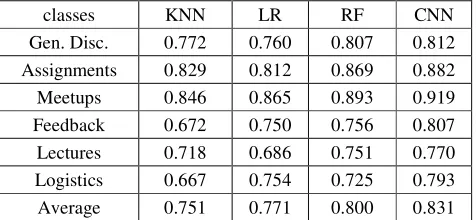
[image:5.612.188.426.222.332.2]1. Compare CNN with traditional classification algorithms. Besides the model trained by CNN, we also use three traditional classification algorithms: k-Nearest Neighbor(KNN), Logistics Regression(LR) and Random Forest(RF) to construct models respectively, and then use features we defined as input. The results are shown in Table 1.
Table 1. Classification performance of different subforums with different algorithms.
classes KNN LR RF CNN
Gen. Disc. 0.772 0.760 0.807 0.812 Assignments 0.829 0.812 0.869 0.882
Meetups 0.846 0.865 0.893 0.919
Feedback 0.672 0.750 0.756 0.807 Lectures 0.718 0.686 0.751 0.770 Logistics 0.667 0.754 0.725 0.793 Average 0.751 0.771 0.800 0.831
[image:5.612.96.518.407.519.2]2. Compare the model(m1) proposed in this paper with the model(m2) proposed by Rossi. We apply 18 features(the dataset has no relevant data of the other 2 features ) of 20 features defined by Rossi and 18 features defined in this paper to m1 and m2 to get four experiments.The results are shown in Table 2.
Table 2. Classification performance of Rossi’s model and our model with different features. classes SVM(Rossi’s Feature) CNN(Rossi’s feature) SVM(Our feature) CNN(Our feature)
Gen. Disc. 0.556 0.654 0.705 0.812
Assignments 0.673 0.711 0.812 0.882
Meetups 0.822 0.841 0.864 0.919
Feedback 0.543 0.660 0.734 0.807
Lectures 0.530 0.613 0.686 0.770
Logistics 0.593 0.652 0.728 0.793
Average 0.620 0.689 0.755 0.831
Table 1 shows that the classification performance of CNN is 8% higher than KNN’s, 6% higher than LR’s, and 3% higher than RF’s on average. The AUC of the six categories are at least 0.77, and the highest for Meetups is even up to 0.919. The results of this group of contrast experiment indicate that the classification performance of model learned via CNN in this paper is better than the model constructed by traditional classification algorithms.
Conclusion
As a research field of machine learning, deep learning has received more and more attention in recent years. With the development of computer technology, MOOCs also develop rapidly. This paper applies the convolutional neural network in deep learning to classify discussion threads in MOOC forums and tries to improve the performance of classification and promote the utilization of forums, and thus to improve course quality in MOOCs and students’ learning effect. We propose a model constructed by the convolutional neural network in deep learning. From dataset open by Rossi, which contains 60 courses in Coursera and nearly 100000 threads, we define 18 features based on user interactive behaviors rather than threads contents to train the model. The experimental results show the classification performance of our model for six thread categories gains at least 0.77, for Meetups and Assignments, the AUC are up to 0.919 and 0.882 respectively. Compared with model proposed by Rossi, the performance is increased by an average of 21%. In addition, we also conduct contrast experiment with CNN and three traditional classification algorithms including KNN, LR and RF, and the results show that the performance of CNN is better than all three traditional classification algorithms.
References
[1]Wei, Xiaocong, et al. "A Convolution-LSTM-Based Deep Neural Network for Cross-Domain MOOC Forum Post Classification." Information 8.3(2017):92.
[2]Coetzee, Derrick, A. Fox, and M. A. Hearst. "Should your MOOC forum use a reputation system?." ACM Conference on Computer Supported Cooperative Work & Social Computing ACM, 2014:1176-1187.
[3]Hecking, Tobias, I. A. Chounta, and H. U. Hoppe. "Analysis of User Roles and the Emergence of Themes in Discussion Forums." Network Intelligence Conference IEEE, 2015:114-121.
[4]Wise, Alyssa Friend, Y. Cui, and J. Vytasek. "Bringing order to chaos in MOOC discussion forums with content-related thread identification." International Conference on Learning Analytics & Knowledge ACM, 2016:188-197.
[5]Fu, S., et al. "Visual Analysis of MOOC Forums with iForum." IEEE Transactions on Visualization & Computer Graphics 23.1(2017):201.
[6]Rossi, Lorenzo A., and O. Gnawali. "Language independent analysis and classification of discussion threads in Coursera MOOC forums." IEEE, International Conference on Information Reuse and Integration IEEE, 2014:654-661.
[7]Lecun, Yann, Y. Bengio, and G. Hinton. "Deep learning." Nature 521.7553(2015):436-444.
[8]L. A. Rossi. Anonymized Coursera Discussion Threads Dataset, Github. http://github.com/elleros/courseraforums, July 2014.
[9]Lawrence, S., et al. "Face recognition: a convolutional neural-network approach." IEEE Transactions on Neural Networks 8.1(1997):98.
[10]Abdel-Hamid, Ossama, et al. "Applying Convolutional Neural Networks concepts to hybrid NN-HMM model for speech recognition." IEEE International Conference on Acoustics, Speech and Signal Processing IEEE, 2012:4277-4280.
[11]Abdelhamid, O., Li, D., and Dong, Y. 2013. Exploring convolutional neural network structures and optimization techniques for speech recognition.