499
CASCADED IMAGE STEGANOGRAPHY TO INCREASE
ROBUSTNESS AGAINTS ATTACK OF THE STEGO IMAGE
1
E.I.H.UJIANTO, 2A.HARJOKO, 2R.WARDOYO, 3A.MOESRIAMI
1
Doctorate Candidate of Computer Science, Gadjah Mada University, INDONESIA
2
Assoc. Prof., Department of Computer Science & Electronics, Gadjah Mada University, INDONESIA
3
Asstt Prof., Department of Information Technology, Telkom University, INDONESIA
E-mail: [email protected], 2aharjoko@ ugm.ac.id , [email protected],[email protected]
ABSTRACT
Information hiding is the most important method in hiding secret information from unauthorized party. The purpose of information hiding is to protect the secret information. One of the method commonly used is steganography. In this research, Cascaded Image Steganography based on spatial and tranformational domain is proposed. This method utilizes two steganography algorithms and double cover information hiding. There are two main processes which are encoding and decoding. The encoding process consists of two steps which are Encoding level-1 and Encoding level-2. The decoding process also consists of two steps which are Decoding level-1 and Decoding level-2. The robustness test is then performed against stego image that undergo images processing operations such as filtering, cropping, rotating, and compression. The results show that stego image undergoes filtering has SNR value of 53.6361 dB indicating good picture quality and high fidelity, whereas stego image undergoes JPEG compression has SNR value of 52.7693 dB indicating good picture quality and high fidelity. Image undergoes rotating(-) has poor image quality indicating low fidelity level, whereas image undergoes rotating(+) and cropping has unusable image quality indicating very low fidelity level. The Cascaded Image Steganography method is more secure due to the double cover information hiding.
Keywords: Cascaded Image Steganography, Image, Encoding, Decoding, Picture Quality
1.
INTRODUCTIONInformation hiding is the most important method in hiding secret information from unauthorized party. The purpose of information hiding is to protect the secret information, especially from other uninterested party. To perform information hiding, one of the technique commonly used is steganography.
The needs of the hiding secret message during transmission by digital communication media may utilized a number of secret communication techniques, one of them is steganography[1]. Steganography[2] is the art of fact hiding, the communication occured by hiding the information inside other information. Whereas, the definition of image steganography [3] is the art of information hiding inside the cover image.
One of the measurement of strength in steganography method is robustness factor. To
know about the robustness of a image
steganography product, it needs testing.
Robustness[4] shows the ability of hidden
information (payload) to persist from the embedding process and extraction, including some manipulations like filtering, cropping, rotating, and compression. Then, the measurement of image quality is performed to compare between the
orginal image and the modified image[5]. The
quantitative measurement can be done using two measures which are SNR (Signal to Noise Ratio) and NC (Normalized cross Correlation).
This research proposes Cascaded Image
500 hid inside cover image (cover-2) resulting in stego object.
2.
RELATED WORKThe related researches about image
steganography have been done by other researchers. Secure Steganography using LSB, DCT and Compression techniques (SSLDC) is proposed by Raja[6], using steganography algorithm Least
Significant Bit (LSB) and Discrete Cosine
Transform(DCT). Moreover, Sarreshtedari[7], in
his research also used steganography algorithm
Least Significant Bit (LSB) and Discrete Cosine
Transform (DCT), in which message image is hidden inside the cover image.
Steganography research using double cover
method has been done by Sharma[1],
steganography algorithm using Least Significant
Bit, in which audio and text messages is hidden inside the cover image. In this research, if the size of the hidden message is bigger than the image cover, compression of the hidden message was performed using lossy and lossless compression. The information hiding process was done by 2 (two) levels (double cover), which also include the processes analyzing the information.
There is significant differences between the proposed Cascaded Image Steganography with other methods. In the Cascaded Image Steganography the information hiding process is performed in 2 (two) steps using double cover, which are cover-1 (image) and cover-2 (also image).
3.
PROPOSED METHODIn this paper, the “Cascaded Image
Steganography” method is proposed based on the spatial domain and transform domain.This method uses 2 (two) steganography algorithms and 2 (two) levels of information hiding processes (double cover).The steganography algorithm used is Least Significant Bit (LSB) and Discrete Cosine Transform (DCT).The image that used in this research is greyscale type, in the format of bitmap.
3.1 Positioning “Cascaded Image Steganography”
The position of “Cascaded Image
Steganography” than the other steganography can be positioned based on: the characteristic and input/
output combination[8], the information hiding
media[2], the domain[9] and the cover type[10].
The Cascaded Image Steganography combines LSB and DCT algorithms to obtain optimum result of processing time and security. LSB algorithm is
used to hide information in first level (encoding level-1). Since LSB is considered simple steganography algorithm with short processing time, the DCT algorithm is then used to hide information in second level (encoding level-2). DCT algorithm is used since this algorithm is considered strong steganography algorithm that can increase robustness in protecting the hidden message from various attacks.
3.1.1 The Characteristic and Input/Output Combination
Steganography based on its characteristics and input/output combination is divided into pure steganography, secret steganography andpublic key
steganography[8]. Cascaded Image Steganography
is based on the characteristics and input/output combinations which can be categorized into pure
steganography category.In this case, Cascaded
Image Steganography do not use secret key like in the secret steganography or the combination of other techniques, like (cryptography) on thepublic key steganography.
3.1.2 The Information Hiding Media
Steganography based on the media in
information hiding consists of text, image,
audio/video, and protocol media[2]. Cascaded
Image Steganography based on the media used for information hiding belongs to image steganography category.Cascaded Image Steganography uses image as the cover for information hiding.
3.1.3 Domain
Steganography based on its domain consists
of spatial domain, frequency domain,
andparametric domain[9]. Cascaded Image
Steganography based on its domain is the
combination category between spatial domain and
frequency domain. Spatial domain is using of Least Significant Bit (LSB) algorithm that is used for text hiding into the image, whereas frequency domain is
using of Discrete Cosine Transform (DCT)
algorithm that is used for image hiding into the cover image.
3.1.4 The Cover Type
Steganography based on its cover type used in the embedding process is divided into substitution systems, transform domain techniques, spread spectrum techniques, statistical methods,
distortion techniques,andcover generation
501 shows in the using of LSB algorithm, and transform domain techniques, that is embedded secret information in a substitute signal room (for example in the frequency domain), shown in the using of DCT algorithm.
3.2 Cascaded Image Steganography Framework
In general, this method consists of 2 (two)
main processes, they are encodingand
decoding.Encoding is the information hiding
[image:3.612.97.298.294.515.2]process inside the cover, whereas decoding is the information extraction process inside the cover. The information hiding process (encoding) is performed in two steps (double cover). The unhiding process (decoding) is also performed in two steps.
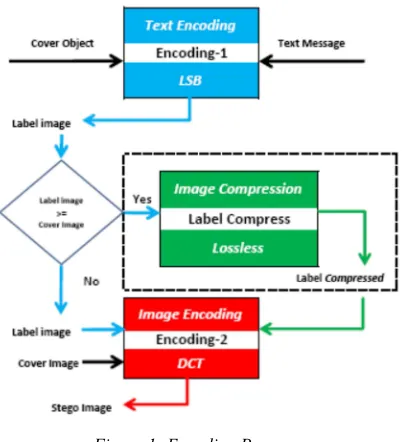
Figure 1: Encoding Process
The encoding process consists of 2 (two)
levels, they are Encoding level-1 andEncoding
level-2. So that the decoding process also consists
of 2 (two) levels, they are Decoding level-1
andDecoding level-2. The “Cascaded Image
Steganography” encoding process consists of 3
(three) sub-processes, they are: (1).Encoding level-1, (2).Label Compress, that is the process of compressed image using Lossless compression, and (3).Encoding level-2.
3.2.1 Encoding Level-1
In this research, encoding is an information hiding process both in the form of text and image inside the cover. The first encoding process in the form of text encoding or called Encoding level-1 is a text information hiding inside the Cover Object
using Least Significant Bit (LSB) algorithm, and it produces Stego Object / Label image.
The Least Significant Bit (LSB) is a simple approach to insert information inside cover image [4]. To hide an information inside an image without altering its noticeable properties, the cover image can be modified in the area of “noise” that has many color variations, so makes it unnoticeable when modification is performed [11] using masking, filtering, and transforming of the cover image [12].
3.2.2 Encoding Level-2
After that, the second encoding in the form of image encoding or called Encoding level-2 is a process of Label image hiding inside the Cover
Image using Discrete Cosine Transform (DCT),
and it produces Stego Image. If the size of the message that will be hidden more than the Cover
Image, so the Lossless compression happened. In
this experiment the compression process was not performed since the size of the Label image is smaller than the Cover Image.
Discete Cosine Transform (DCT) transforms points in spatial domain into similar points in frequency domain. The formula for two dimensional DCT [13] is shown in formula (1) and its inverse is shown in formula (2).
(1) ( ) ( ) ( ) ( ) ( ) ( ) ( ) > = = + + = ∑∑− = − = 0 untuk 1 0 untuk 2 1 2 1 2 2 1 2 , 2 , 1 0 1 0 x x x C N j y Cos N i x Cos y x pixel j C i C N j i DCT N x N y π π Where:
i = row position for DCT coefficient j = column position for DCT coeffient x = row position for pixel
y = column position for pixel N = the number of row or column
DCT is performed by transforming square matrix NxN from pixel values into similar NxN square matrix in frequency coefficients.
502 i = row position for DCT coefficient.
j = column position for DCT coeffient x = row position for pixel
y = column position for pixel N = the number of row or column
Pixels is shown inside a square matrix N x N of DCT’s coefficients, and the result is a square matrix N x N in frequency domain.
3.2.3 Decoding Level-1
The decoding process is the inverse of
encoding process.In this research, the decoding
[image:4.612.91.299.315.469.2]process is an extraction process both in the form of text and image inside the cover image.The decoding process of “Cascaded Image Steganography” consists of 2 (two) sub-processes which are: (1).Decoding level-1, and (2).Decoding level-2.
Figure 2: Decoding Process
The first decoding process in the form of image
decodingor called Decoding level-1 is the
extraction process of the image inside the Stego
Image using Discrete Cosine Transform (DCT)
algorithm, and it produces Label image.
3.2.4 Decoding Level-2
Then, the second decoding process in the form of text decoding or called Decoding level-2 is the extraction process of the text inside the Label
image using Least Significant Bit (LSB) algorithm,
and it produces text message.
4.
RESULT AND DISCUSSIONIn the real condition of Stego Image, the product of “Cascaded Image Steganography” process by the sender is transmitted by a network channel into the destination place, then the receiver analyzes information (decoding) to extract the original message.However, that image can get
“difficulties” during the process that it is assumed as the attack in this paper.The attacks meant in this research are the image processing operations, such
as: JPEG Compression, Filtering, Rotating, and
Cropping. 4.1 Message
Message is the information that will be hidden. In this research, message in the form of a bas.txt text file in the size of 64 bytes.
Dengan menyebut nama Allah Yang Maha Pemurah lagi Maha Penyayang
Figure 3: Text file (bas.txt)
4.2 Cover Object
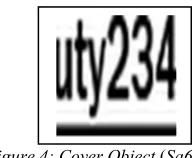
[image:4.612.360.456.324.403.2]Cover object is an image that has a function as the information hiding media. In this research, cover object is the image of bitmapsa64.bmp with 64x64 dimension.
Figure 4: Cover Object (Sa64.Bmp)
4.3 Stego Object
Stego object is the image product of encoding level-1 process that is the text hiding inside the cover object. In this research, the stego object is an image in the form of sam64.bmp bitmap with64x64 dimension. Then, stego object as the product of text
encoding process in this paper named as Label
image.
Figure 5: Stego Object (Sam64.Bmp)
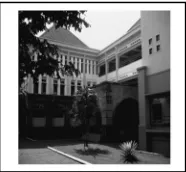
4.4 Cover Image
503
Figure 6: Cover Image (Kamp512.Bmp)
4.5 Stego Image
[image:5.612.143.236.230.316.2]Stego image is the image product of encoding level-2 process that is the Label image inside the Cover image. In this research, the stego image is an image in the form of StKamp512sam64.bmp bitmap with512x512 dimension.
Figure 7: Stego Image (Stkamp512sam64.Bmp)
The stego image as “Cascaded Image
Steganography” has SNR=62,8822 (Excellent) value.
4.6 Stego Attack
In this research, the stego image gets attack, they are image processing operations that consist of
JPEG Compression, Filtering, Rotating, and
Cropping.
4.6.1 Measure of SNR
SNR metrics is used to compare the cover and stego images. The formula to measure SNR is shown in formula (3).
(3) Where: Aij represent one pixel in the original image (before embedding the hidden data) and Bij represent one pixel in the stego-image (after embedding the hidden data) [14].
Stego image after the attack is calculated by its Signal to Noise Ratio (SNR) value, the result as followed:
Table 1: SNR Value
Image Processing SNR (dB) Picture
Quality
Jpeg Index 25 52,7693 Good
Jpeg Index 50 55,6974 Good
Jpeg Index 75 58,5901 Good
Jpeg Index 100 76,7972 Excellent LowPass Filtering 50,5668 Good
Median Filtering 53,6361 Good Rotating(+) 28,3247 Unusable
Rotating(-) 35,8622 Poor
Cropping 26,9607 Unusable
[image:5.612.313.522.231.405.2]The calculation of SNR value done to measure the image product quality of “Cascaded Image Steganography” after the attack happened.The low SNR value shows that the developed image has bad quality, inversely if the SNR has high value, it has good image quality.The graphic followed shows the image quality after the image processingoperations.
Figure 8: SNR – Value (Db)
When the stego image undergoes rotation, the image experiences resizing that makes the change of information in the Label Image inside the stego image. This change makes the poor and unusable image quality. Moreover, the cropping makes truncation of some part of the image to make new image. This operating will make significant change in information of Label Image in the stego image. This makes the unusable image quality.
4.6.2 Measure of NC
The result of Label imageextraction process inside stego image after the attack happened is
measured using NC (Normalized cross
Correlation). The high NC value shows bad image quality[5], inversely the low NC value shows good image quality.NC is the measurement of the qualitative similarity of the original image compared to the extracted image.
( )
( )
( )
[
]
∑ ∑
∑ ∑
−
= −
= −
= −
=
′
=
10 1
0
2 1
0 1
0
,
,
,
NC
Mi M
j M
i M
j
j
i
W
j
i
W
j
i
W
(4)
Where :
504 is the extracted image (Label)
is the original image (Label)
Table 2: NC Value
Stego Image (Attacked)
Label (Extracted)
NC
AtStKAMP512sam64-Jpg100 sam64-Jpg100 0,94539
AtStKAMP512sam64-Rot-17 sam64-Rot-17 0,95873
AtStKAMP512sam64-Rot+17 sam64-Rot+17 0,96427
AtStKAMP512sam64-Jpg75 sam64-Jpg75 0,96945
AtStKAMP512sam64-MedFil sam64-MedFil 0,97098
AtStKAMP512sam64-LowPass sam64-LowPass 0,97288
AtStKAMP512sam64-Jpg50 sam64-Jpg50 0,97418
AtStKAMP512sam64-Jpg25 sam64-Jpg25 0,97656
AtStKAMP512sam64-Crop512 sam64-Crop512 0,98899
Table 2: it shows Label image of the extraction product that refers to the best into the worst in a series.
5.
CONCLUSIONThe findings of this research shows the image quality in the “Cascaded Image Steganography”,
for example: the image with JPEG Compression
index 100 operation shows Excellent picture quality that means high fidelity level. The image with
JPEG Compression index 75, index 50, and index
25 operation shows Good quality image that means
high fidelity level. Similarly, the image with
Median Filtering and LowPass Filtering operation
shows Good quality image that means high fidelity
level.
However, there is also “Cascaded Image Steganography” that has not expected result, for example: The image with Rotating (-) operation, it shows Poor image quality and it has low fidelity level. Similarly, the image with Rotating (+) and
Cropping operation, it shows Poor image quality
and it has the lowest fidelity level.
While based on NC calculation, the data which shows best order is extracted Label image after JPEG Compression index 100. Then, it is followed
by extracted Label image after: Rotating(-),
Rotating(+), JPEG Compressionindex 75, Median
Filtering, LowPass Filtering, JPEG Compression
index 50, and JPEG Compression index 25. The
worst result is extracted Label image after
Cropping operation.
6.
FUTURE WORKThe attack form toward stego image in this
research is image processing operation, like: JPEG
Compression, Filtering, Rotating, andCropping. It
needs further research in expanding this method,
which include image research with stego
analysis.The other experiment that needed to be done is the using of media cover, the different message, and also the using of the other steganography algorithm, whether it is in the same domain or in the different domain.
REFERENCES:
[1] D.Sharma, 2010. A Two Level Message
Adaptive Steganographic Approach,
International Conference on Advances in Computer Engineering, New Delhi, India. [2] T.Morkel, J.H.P.Eloff, M.S.Olivier., 2005. An
Overview Of Image Steganography.
Information and Computer Security
Architecture (ICSA) Research Group,
Department of Computer Science, University of Pretoria, 0002, Pretoria, South Africa. [3] A.Nag, S.Biswas, D.Sarkar, P.P.Sarkar. “A
Novel Technique for Image Steganography Based on DWT and Huffman Encoding”, International Journal of Computer Science and Security (IJCSS), Volume (4), Issue (6), 2011, p.561-570.
[4] G.Kaur, A.Kochhar, “A Steganography Implementation based on LSB & DCT”,
International Journal for Science and
Emerging Technologies with Latest Trends, 4(1), 2012, 35-41, ISSN No.(Online):2250-3641.
[5] A.Verma, R.Nolkha, A.Singh, G.Jaiswal, “Implementation of Image Steganography
using 2-Level DWT Technique”,
International Journal of Computer Science and Business Informatics, ISSN:1694-2108, Vol.1, No.1, May 2013.
[6] K.B.Raja, C.R.Chowdary, K.R.Venugopal, L.M.Patnaik, “A Secure Image Steganography
using LSB, DCT and Compression
Techniques on Raw Images”, IEEE ICISIP,
pp. 170-176, Dec. 2005.
[7] S.Sarreshtedari, M.Ghotbi, S. Ghaemmaghami, 2009. On the Effect of Spatial to Compressed Domains Transformation in LSB-based Image
Steganography, Sharif University of
Technology, Tehran, Iran.
505 [9] A.G. Bors, I.Pitas, “Image Watermarking using
DCT Domain Constraints”, Proceeding of
Image Processing, International Conference
on 16-19 Sep 1996, Volume: 3, page(s): 231-234, Lausanne, Switzerland.
[10] N.F.Johnson, S.C.Katzenbeisser., “A Survey
of Steganographic Techniques”, in
S.C.Katzenbeisser, F.Petitcolas (Eds.):
Information Hiding, Artech House, Norwood,
MA., 2000, pp 43–78.
[11] R.Chandramouli, N.Memon, “Analysis of LSB
Image Steganography Techniques”, IEEE
International Conference on Image
Processing, vol. 3, 2001, pp. 1019–1022. [12] N.N.EL-Emam., “Hiding a Large Amount of
Data with High Security Using Steganography
Algorithm”, Journal of ComputerScience 3
(4):223-232, 2007, ISSN 1549-3636. [13] http://www.itacs.uow.edu.au, digital
watermarking tutorial, Date :12-10-2008, 09.15 wib .
[14] Hmood, A.K., Z. M. Kasirun, Hamid A. Jalab, Gazi Mahabubul Alam, A. A. Zaidan, and B.B. Zaidan. 2010. On the accuracy of hiding information metrics: Counterfeit protection for
education and important certificates.
International Journal of the Physical