44
Pretending Atomicity
Leslie Lamport and Fred B. Schneider
Systems Research Center
DEC’s business and technology objectives require a strong research program. The Systems Research Center (SRC) and three other research laboratories are committed to filling that need.
SRC began recruiting its first research scientists in l984—their charter, to advance the state of knowledge in all aspects of computer systems research. Our current work includes exploring high-performance personal computing, distributed com-puting, programming environments, system modelling techniques, specification technology, and tightly-coupled multiprocessors.
Our approach to both hardware and software research is to create and use real systems so that we can investigate their properties fully. Complex systems cannot be evaluated solely in the abstract. Based on this belief, our strategy is to demonstrate the technical and practical feasibility of our ideas by building prototypes and using them as daily tools. The experience we gain is useful in the short term in enabling us to refine our designs, and invaluable in the long term in helping us to advance the state of knowledge about those systems. Most of the major advances in information systems have come through this strategy, including time-sharing, the ArpaNet, and distributed personal computing.
SRC also performs work of a more mathematical flavor which complements our systems research. Some of this work is in established fields of theoretical computer science, such as the analysis of algorithms, computational geometry, and logics of programming. The rest of this work explores new ground motivated by problems that arise in our systems research.
DEC has a strong commitment to communicating the results and experience gained through pursuing these activities. The Company values the improved understanding that comes with exposing and testing our ideas within the research community. SRC will therefore report results in conferences, in professional journals, and in our research report series. We will seek users for our prototype systems among those with whom we have common research interests, and we will encourage collaboration with university researchers.
Pretending Atomicity
Leslie Lamport and Fred B. Schneider
Fred B. Schneider is a member of the faculty in the Computer Science Department of Cornell University. His work was supported in part by the Office of Naval Research under contract N00014-86-K-0092, the National Science Foundation under Grant No. CCR-8701103, and Digital Equipment Corporation. Any opinions, findings, and conclusions or recommendations expressed in this publication are those of the authors and do not reflect the views of these agencies.
c
Digital Equipment Corporation 1989
Author’s Abstract
Contents
1 Introduction 1
2 Lipton’s Theorem 2
3 A General Reduction Theorem 5
3.1 Definitions : : : : : : : : : : : : : : : : : : : : : : : : : : : : : 5 3.1.1 Programs: : : : : : : : : : : : : : : : : : : : : : : : : : 5 3.1.2 Histories : : : : : : : : : : : : : : : : : : : : : : : : : : 5 3.1.3 Commutativity : : : : : : : : : : : : : : : : : : : : : : : 6 3.1.4 Predicates and Safety Properties : : : : : : : : : : : : : : 6 3.1.5 Operations : : : : : : : : : : : : : : : : : : : : : : : : : 7 3.1.6 Sequential Composition : : : : : : : : : : : : : : : : : : 8 3.1.7 Possible Termination: : : : : : : : : : : : : : : : : : : : 8 3.2 The Reduction Theorem and Corollaries : : : : : : : : : : : : : : 9 3.2.1 Reduction : : : : : : : : : : : : : : : : : : : : : : : : : 9 3.2.2 The Reduction Theorem and a Corollary : : : : : : : : : : 10 3.2.3 Deriving Lipton’s Theorem : : : : : : : : : : : : : : : : 12 3.3 An Example : : : : : : : : : : : : : : : : : : : : : : : : : : : : 15
4 Constraints 17
5 Discussion 20
Appendix: Proof of the Reduction Theorem 20
1
Introduction
To specify a concurrent program, one must specify what its atomic actions are. If
x :DxC1 is executed as a single atomic action, then
cobegin x :DxC1 x :Dx C1coend
incrementsx by 2; if each read and store of x is a separate atomic action, then it
incrementsx by 1 or 2.
We specify that a statement is executed as a single atomic action by enclosing it in angle brackets. For example,hx :D x C1i is a statement that is executed as one atomic action. A statementx :Dx C1 in which each read and store ofx is a
separate atomic action can be written as
ht :Dxi;ht :DtC1i;hx :Dti
wheret is a new variable that is local to the process and represents an “accumulator”.
Representing a program using fewer atomic actions simplifies reasoning about it. One way to reduce the number of atomic actions in a program is to combine two or more atomic actions into a single larger one. This is often done by pretending that a statement is atomic if its execution contains at most one access (read or write) of a shared variable, tacitly applying what we will call thesingle-action rule. For the
example above, applying this rule would allow ht :Dxi;ht :DtC1i to be combined into the single atomic actionht :DxC1i.
The single-action rule cannot always be applied. For example, it would imply that any operation can be considered atomic in a single-process program, because no variable is shared. This would mean that a property of the program
hy :DxC1i;hx :D yi (1)
could be established by proving it for the program
hy :Dx C1;x :Dyi (2)
If the program is started in a state withx Dy, then x Dy holds in all
states reached during execution.
Execution of (1) reaches an intermediate state in whichx 6D y—a state that does
not occur when executing (2).
In this paper, we derive a general rule for combining atomic actions. It includes a correct version of the single-action rule as a corollary. Our rule applies only to safety properties, which include partial correctness, mutual exclusion, and deadlock-freedom, but not to liveness properties, such as termination and starvation-freedom. A safety property asserts that “something bad does not happen”, so if it is violated, then it is violated by a finite portion of a (possibly infinite) execution of the program. The idea of combining atomic actions is probably as old as the study of concurrent algorithms. To our knowledge, the single-action rule was first mentioned in print by Owicki and Gries [10], where it was informally claimed for partial correctness properties. In [9], Lipton formally proved a closely related theorem for partial correctness and deadlock-freedom. However, Lipton was primarily concerned with semaphore operations, and it was not widely recognized that the single-action rule is a corollary of his results. Doeppner [4] extended Lipton’s partial-correctness result to a somewhat larger class of safety properties. In this paper, we extend Lipton’s and Doeppner’s results to a more general class of safety properties.
2
Lipton’s Theorem
Before describing our result, we give an informal review of Lipton’s work [9]. The hypotheses of his main theorem involve commutativity relations between atomic actions. We begin by defining these relations, departing somewhat from Lipton’s original notation.
Henceforth, we refer to atomic actions simply as actions. Formally, an actionÞ is a set of pairs of program states, where.t;u/2Þ means that executingÞ in statet
can produce stateu. We say thatÞisenabled in state t iff (if and only if) there is a
stateu such that.t;u/2Þ. We writet !Þ u to denote that.t;u/is an element of
Þ. For example, a semaphore operation P.sem/is represented by an actionÞthat is enabled in statet iff control is at that operation and the value of sem is positive.
For this action,t !Þ u holds iff (i)Þ is enabled in statet and (ii) state u is the
same ast , except that control is after the semaphore operation and the value of sem
The program state includes control information, in addition to the values of program variables. Thus, two instances of a statementhx :DxC1iin a program are different actions because they have different effects on the control components of the state. IfÞandþare actions, thenÞþis defined to be the action such thatt Þþ!u iff there
exists av such thatt !Þ v andv !þ u. An action² right commutes with an
actionÞ ifft ²Þ!u implies t Þ²!u, for every pair of states t , u. In other words,
²right commutes withÞmeans that if it is possible to execute first²thenÞ, then it is possible to produce the same state by executing firstÞthen². Similarly,½left commutes withÞifft Þ½!u implies t ½Þ!u for every pair of states t , u. Thus,²
right commutes with½iff½left commutes with². Two actionscommute iff each
one left commutes and right commutes with the other.
The hypotheses of Lipton’s main theorem involve commutativity between actions in different processes. An action²in a process is called aright mover iff it right
commutes with the actions of every other process. An action½is aleft mover iff it
left commutes with the actions in every other process.
Lipton observed that, if semaphore operations are represented as atomic actions, thenP actions are right movers and V actions are left movers. To see that P actions
are right movers, let²be a P.sem/action, let½be an action in another process, and assume that executing² then½ from statet can produce state u. There are
three cases to consider.
ž ½ does not access the semaphore sem. In this case, ² can obviously be executed after½to produce the same stateu.
ž ½is another P.sem/ action. Executing the two P.sem/ actions in either order must produce the same state.
ž ½is a V.sem/action. In this case, executing½from statet produces a state
withsem > 0, so² can then be executed to produce stateu. (Note that²
does not left commute with½because, in a state withsem D0, it is possible to execute aV.sem/followed by a P.sem/, but not a P.sem/followed by aV.sem/.)
Similar reasoning shows that everyV action is a left mover.
To combine actions, Lipton introduced the notion of reducing a program by a
statement. Let S be a sequencehS1iI hS2iI: : :I hSki of statements in a program
5. Program 5 reduced by S, denoted 5=S, is the program obtained from 5
by replacing S with the single atomic statementhS1I: : :ISki. Lipton proved the
Lipton’s Theorem Let5be a program and S have the formhS1iI hS2iI: : :I hSki,
where, for some i:
1. S1,: : :, Si 1 are right movers.
2. SiC1,: : :, Sk are left movers.
3. From any program state in which execution of S has begun but not termi-nated, it is possible, by executing only actions in S, to reach a state in which S has terminated.
Then, programs5and 5=S satisfy the same partial correctness and deadlock-freedom properties.
The single-action rule asserts that, if S contains at most one access to a shared
variable, then we can prove a property of program5by proving it for5=S. If
an actionÞ does not access any variable that is accessed by any other process, then Þ is both a left and a right mover. LettinghSii be the single statement in
S that accesses a shared variable (or any statement if S does not access a shared
variable), Lipton’s Theorem implies the single-action rule for reasoning about partial correctness and deadlock freedom—except that the single-action rule does not require hypothesis 3. We will show that hypothesis 3 is not needed in Lipton’s Theorem for partial correctness properties, so the single-action rule is valid for partial correctness.
Partial correctness relates initial and final states, but makes no assertion about states in which control is insideS. Doeppner extended Lipton’s result to a more general
class of safety properties that also assert nothing when control is within S. A
precise statement of Doeppner’s result is given below.
To use Lipton’s Theorem (or Doeppner’s extension), one usually performs many reductions to decrease the number of separate actions in a program. We now show that these reductions can all be done at once. Let S and S0 be two disjoint sequences of statements. We show that if S and S0 both satisfy the hypotheses of Lipton’s Theorem, then.5=S/=S0, which equals.5=S0/=S, and 5satisfy the same partial correctness and deadlock-freedom properties. Since S satisfies the
hypotheses,5=S and5satisfy the same properties. An action that left or right commutes with every action of S in program5must left or right commute with hSiin program5=S. Therefore, if S0satisfies the hypotheses of Lipton’s Theorem in program 5, then it also satisfies these hypotheses in 5=S. Hence, a second
partial correctness and deadlock-freedom properties. Generalizing to an arbitrary number of reductions is obvious.
3
A General Reduction Theorem
We begin by defining the concepts needed to formalize the notion of reduction. Then, in Section 3.2, we state a generalization of Lipton’s Theorem; its proof is in the appendix. We derive Doeppner’s result as a corollary, and use it to prove Lipton’s Theorem. The section closes with an example of the use of our theorem.
3.1
Definitions
3.1.1 Programs
Thus far, we have viewed a program5as a set of states and a set of actions. (Recall that an [atomic] action is a set of pairs of states.) However, what matters for safety properties is not the set of actions, but the program’snext-state relation, which is
the union of all the program’s actions. For example, replacing the single program action
hx :D jxj C1i by the pair of actions
ifhx ½0!x :DxC1i hx <0!x :D xC1ifi
yields an equivalent program.
We therefore formally define a program5to consist of a set of states and a single action5b, where5b is the next-state relation. (The next-state relation, being the union of actions, is itself an action.) Observe that, although the specification of a program usually describes its possible starting states, we do not include any special starting or terminating states in our formal definition—they are irrelevant to our results.
3.1.2 Histories
Ahistory of5is a finite, nonempty sequencet0; : : : ;tnof states such thatti 1
b
5
5, starting in statet0and reaching statetn. Only such finite partial executions need
be considered when proving safety properties, even of nonterminating programs, since a safety property is, by definition, one that is satisfied by an infinite execution iff it is satisfied by every finite prefix [1].
3.1.3 Commutativity
Recall that an action²right commutes with an action½(and½left commutes with
²) ifft ²½!u implies t ½²!u for all states t and u. It follows from this definition
that, if²equals the union of actions²i and½equals the union of actions½j, then
²right commutes with½if every²i right commutes with every½j.
If there are no statess, t , and u such that s !² t !Þ u, soÞ cannot be executed immediately after², then ² right commutes withÞ. Hence, if ² is an action in a process of a concurrent program, then² right commutes with every action in that process, except the action immediately following it. Hypothesis 1 of Lipton’s theorem is therefore equivalent to the hypothesis thatS1,: : :, Si 1 right commute
with every program action not inS. Similarly, an action left commutes with every
action in the same process except the action immediately preceding it.
For any actionÞ, we defineH)Þ to be the reflexive, transitive closure of !Þ . Thus,
tH)Þ u iff t Du or there exists a statevsuch thatt !Þ v H)Þ u. In other words, t H)Þ u iff it is possible to go from state t to state u by “executing” actionÞzero or more times. We adopt the usual convention of writingtH)Þ vH)þ u to denote
thatt H)Þ vandvH)þ u hold.
3.1.4 Predicates and Safety Properties
Apredicate is a Boolean-valued function on the set of states. The value Q.t/of predicate Q on state t is written t jD Q. An actionÞ is defined to leave predicate
Q invariant iff t jD Q implies u jD Q whenever t !Þ u. It follows from this
definition that, ifÞ equals the union of actionsÞi, then Þ leaves Q invariant iff
everyÞi does. Note that ift jD Q implies thatÞ cannot be executed in statet , so
there is no stateu such that t !Þ u, thenÞ trivially leaves Q invariant. Thus, if U is the predicate asserting thatÞis enabled, thenÞleaves:U invariant.
IfInit and Q are predicates, then a program5satisfies the temporal logic formula
thenti jD Q, for 0i n. This property is equivalent to
For all statest and u: if t H)b5 u and t jD Init , then ujD Q.
Properties of the formInit )2Q are proved with the Owicki-Gries method [10]
and similar assertional methods [2, 6]. Moreover, by adding auxiliary variables to the program, any safety property can be expressed in this form.
3.1.5 Operations
The notion of a statement is meaningful only in the context of a programming language. To make our results independent of any language, we will define re-duction with respect tooperations rather than statements. The intuitive view is
that an operationS consists of a collection of related actions from a single process.
Actions are “related” iff, from the time the first action of S is executed until the
entire operation completes, the process can execute actions only fromS. Executing
the first action of S moves control inside S, and executing the last action moves
control outsideS. Only actions of S can move control inside or outside of S.
Formally, an operation S of program 5 consists of a subsetbS of the next-state
relation5btogether with a predicateE.S/(whereE stands forexternal), such that
b
5 bS leaves bothE.S/and:E.S/invariant. Being subsets of5b, an action,bS and
b
5 bS are themselves actions. This formal definition corresponds to the intuitive
view above, wherebS is the union of the actions constituting S, andE.S/ is the
predicate asserting that control is outsideS.1
We now define what it means for an operation to be atomic. We could define A
to be atomic iffE.A/holds in all states. However, we want5and5=S to satisfy
the same properties, so we want them to have the same set of states; this means that5=S may contain states in whichE.hSi/is false even though it hashSias an
atomic action. Therefore, we adopt the more general definition that an operation
A of program5is atomic iffE.A/ is left invariant by5b. Consequently, if A is
atomic, then control will remain outside A throughout any history that starts in a
state with control outsideA.
Observe that the concept of a process is not used in our formal definition of an operation, and nothing prevents actions of different processes from being part of a single operation. For example, a matching pair of communication statements in a CSP program can be represented by a single atomic operation [8].
1In the notation of [5],
3.1.6 Sequential Composition
Our reduction theorem involves the sequential compositionTIU of operations T
andU . Composition is usually defined for statements in a programming language.
A precise definition for sequential composition of operations is complicated. How-ever, the compositionTIU has the expected meaning if (i) control cannot be inside
bothT and U , and (ii) any execution of TIU consists of a (possibly null) sequence
of executions ofT followed by a (possibly null) sequence of executions of U . For
example, in the statement
if b then TIU1
else U2
fi
thethen and else clauses together define a single operation TIU , where the
oper-ationU is defined byUbDUb1[Ub2andE.U/DE.U1/^E.U2/. By our definition
of atomicity, if eachUiis atomic, thenU is atomic.
For a general definition of the sequential composition of operations, we must use
E.T/,E.U/,bT , andU to characterize when operation Tb IU is defined and, when it
is defined, whatTdIU andE.TIU/are. Such a definition is complicated; the only
simple part is that when TIU is defined, TdIU equals bT [U . Therefore, insteadb
of giving a formal definition, we just list in the appendix properties of sequential composition that we require.
IfT is null, meaning thatbT is the empty set andE.T/is identically true, thenTIU
equalsU . Similarly, if U is null, then TIU equals T .
3.1.7 Possible Termination
Hypothesis 3 of Lipton’s Theorem asserts that it is possible forS to terminate from
any state in which control is insideS. Control being inside S means that :E.S/
holds. Termination ofS means reaching a state in whichE.S/holds. Thus, Lipton’s
hypothesis 3 asserts that, for every statet , if t jD :E.S/then there exists a stateu
3.2
The Reduction Theorem and Corollaries
3.2.1 Reduction
The purpose of our reduction theorem is to justify pretending that an operation is atomic. To define what this pretense means, we first define the operationhSifor an arbitrary operation S in a program5. This requires defining actionhcSi and predicateE.hSi/. We defineE.hSi/to equalE.S/. Our definition ofhcSishould
assert thatt hSi!c u iff a complete execution of S can take state t to state u. A
“complete execution” is one that starts with control outsideS and ends as soon as
control leaves S. We definehcSito consist of all pairs.t;u/such thatt jDE.S/,
ujDE.S/, and there exist statest0,: : :,tn, with 0<n, such that
tDt0
bS !t1
b
S
!: : : !bS tn 1 !bS tn Du
andti jD :E.S/for 0<i<n.
For any actionÞ, definet H)Þ S
u to mean that there exist states t0, : : :, tn, with
0n, such that
tDt0
Þ
!t1
Þ
!: : : !Þ tn 1 !Þ tn Du
andti jD :E.S/for 0 < i <n. Then, t
Þ
H) S
u implies t H)Þ s. If u jD :E.S/,
thentH)Þ
S u and u
Þ
H)
S vimplyt
Þ
H) S v.
To see the relation between the two actionsbS and hcSi, suppose t jD E.S/ and
ujDE.S/. The definition ofhcSiimplies thatt
b
S H)
S
u iff t hSic!u or tDu. This in
turn implies thatt H)bS u iff t H)hSic u.
We can now formally define program5=S. We want 5=S to be the program
obtained by replacingS by an atomic action, so5=S is defined to have the same
set of states as5and to have its next-state relation5=dS equal to.5b bS/[hcSi. To show thathSiis an atomic operation of5=S, we must show that5=dS leaves
E.hSi/invariant. By definition of what it means for S to be an operation of5,
actionb5 bS leavesE.S/invariant. By definition ofhSi, actionhcSileavesE.S/
invariant. Therefore, .5b bS/[hcSi, which equals 5=dS, leaves invariantE.S/,
which equalsE.hSi/.
The useful part of the reduction theorem states that, for certain operations S, if a
Lemma 1 If Init )2Q is satisfied by program5then it is satisfied by program 5=S.
Proof of Lemma
1. For any statest and u, if t H)b5 u and tjD Init , then u jD Q. Proof : By the hypothesis that5satisfies Init)2Q.
2. For any statest and u, if t H)5=dS u then t H)b5 u.
Proof : By definition of reduction, since5=dS hcSi b5andv hSi!wimplies
v bS H)w.
3. For any statest and u, if t H)5=dS u and tjD Init then u jD Q. Proof : By 1 and 2.
4. Program5=S satisfies Init )2Q.
Proof : By 3 and the definition of what it means for5=S to satisfy Init )2Q.
End Proof of Lemma
3.2.2 The Reduction Theorem and a Corollary
We now state our reduction theorem, which is proved in the appendix, and derive a corollary.
Reduction Theorem Let5be a program, Init and Q be predicates, and S be an operation of 5having the form RI hAiIL, where
0. Init impliesE.S/.
1. (a) ActionR right commutes with actionb b5 bS.
(b) For all states t and u: if tH)bR u and t jD.Q^E.S//then ujD.Q_E.S//.
2. (a) ActionbL left commutes with action5b bS.
(b) For all states t and u: if t H)bL u and t jD .:Q ^ :E.S// then
ujD.:Q_ :E.S//.
3. For all states t : if t jD.:Q^E.RI hAi/^ :E.S//then there exists a state
u such that tH)bL u and u jDE.S/.
2
2
Then, Init )2Q is satisfied by5iff it is satisfied by5=S.
Observe that hypothesis 1(b) holds if R leaves Q invariant, and hypothesis 2(b)
holds ifL leaves:Q invariant. Thus, both of these hypotheses hold if R and L do
not change any part of the state on whichQ depends.
The conclusion of our reduction theorem asserts that if Q holds throughout the
execution of5=S then it holds throughout the execution of5. Weaker hypotheses lead to the weaker conclusion that, in the execution of5, predicateQ holds only
when control is external toS, giving a result obtained by Doeppner [4].
Corollary (Doeppner) Let5be a program and S have the form RI hAiIL, where
0. Init impliesE.S/.
1. ActionbR right commutes with action5b bS.
2. ActionbL left commutes with actionb5 bS.
Then, Init )2.Q_ :E.S//is satisfied by5iff Init )2Q is satisfied by5=S.
Proof of Corollary
1. Init )2.Q_ :E.S//is satisfied by5iff it is satisfied by5=S.
Proof : Apply the Reduction Theorem with Q _ :E.S/ substituted for Q.
Hypotheses 0, 1(a), and 2(a) of the theorem follow from hypotheses 0–2 of the corollary. Hypothesis 1(b) of the theorem holds trivially because.Q_ :E.S//_ E.S/is identically true. Hypothesis 2(b) of the theorem holds vacuously because
:.Q_ :E.S//^ :E.S/is identically false. Hypothesis 3 also holds vacuously
because:.Q_ :E.S//^E.RI hAi/^ :E.S/is identically false.
2. 5=S satisfies Init )2E.S/.
Proof : By hypothesis 0, since5=dS leavesE.S/, which equalsE.hSi/, invariant.
3. 5=S satisfies Init )2.Q_ :E.S//iff it satisfiesInit)2Q.
Proof : Follows from 2 and the definition of what it means for5=S to satisfy a
formula of the form Init )2P.
End Proof of Corollary
original program does. The correct version asserts that if the reduced program satisfies a property Init ) 2Q, then the original program satisfies the related
property Init ) 2.Q_ :E.S//. Only if:E.S/ implies Q does the original
program satisfy the same property as the reduced program.
3.2.3 Deriving Lipton’s Theorem
We now derive Lipton’s Theorem from the corollary. Lipton’s Theorem concerns partial correctness and deadlock freedom properties. We consider each of them separately.
The partial correctness property fPr eg5fPostg can be expressed in the form
Init )2Q by letting Init be the predicate asserting that control is at the beginning
of5andPre holds, and letting Q be T er m ) Post, where Term is the predicate
asserting that5has terminated—that is,Term asserts that control is at the end of
the program. Since control at the end of5implies thatE.S/holds,:E.S/implies
Q, so Q_ :E.S/is equivalent to Q. Hence, the corollary implies that, under the
hypotheses of Lipton’s Theorem,5satisfies fPr eg5fPostg iff5=S does. This
proves Lipton’s Theorem for partial correctness. Moreover, we have strengthened this part of Lipton’s Theorem by eliminating hypothesis 3. In so doing, we have shown that the single-action rule is valid for partial correctness properties.
We next show that the deadlock-freedom part of Lipton’s Theorem follows from the corollary. A program is deadlocked iff it has not terminated and no program action is enabled. Program5has terminated iff program5=S has. Thus, we need
show only that an action of5is always enabled iff an action of 5=S is always
enabled. Let Init be the predicate asserting that control is at the beginning of5
and letD F5be the predicate asserting that some action of5is enabled. Similarly, define D F5=S to assert that some action of5=S is enabled. The conclusion of
Lipton’s Theorem states, in our notation, that5satisfies Init )2D F5iff5=S
satisfies Init ) 2D F5=S. We use the corollary to show that this conclusion is
implied by the hypotheses of Lipton’s Theorem.
1. 5satisfiesInit )2.D F5=S_ :E.S//iff5=S satisfies Init )2D F5=S.
Proof : Apply the Corollary with D F5=Ssubstituted forQ.
2. D F5=S_ :E.S/impliesD F5.
2.1. D F5=SimpliesD F5.
of5must be enabled. 2.2.:E.S/impliesD F5.
Proof : By hypothesis 3 of Lipton’s Theorem.
3. D F5impliesD F5=S_ :E.S/.
Proof : It suffices to prove that D F5andE.S/implyD F5=S. For this, it suffices
to prove that for any statet , if there exists a state u such that t jD E.S/ and
t !5b u, then there exists a statevsuch thatt 5=d!S v.
Sincet !b5 u, either t 5b!bS u or else t !bS u. If t b5!bS u, then we can letv
equalu. Assume that t !bS u. If u jD :E.S/, then hypothesis 3 of Lipton’s
Theorem implies that there exists a statev such thatvjDE.S/andu
b
S H)v. If
u jDE.S/, then letvequalu. In either case, t
bS
H)v,t jDE.S/, andvjDE.S/,
sot hSi!v.
4. 5satisfiesInit )2D F5iff5=S satisfies Init )2D F5=S.
Proof : By 1, since 2 and 3 imply D F5DD F5=S_ :E.S/.
The single-action rule is not valid for deadlock freedom. For example, let5be the single-process program
hx := 0 or 1i;hawait x D0i
where the assignment nondeterministically setsx to 0 or 1, and the await delays
forever ifx D 1. Since every variable is local, a naive single-action rule would assert that this program is equivalent to
hx := 0 or 1; await x D0i which, by our definition ofhSi, is equivalent to
hx := 0i
The reduced program is deadlock free, but the original program is not—it deadlocks if the assignment statement setsx to 1.
Program51
variables
inp :infinite sequence of value;
out :sequence of value;
buf :array [0: : :N 1]of value;
x , y : value; fp, fc : Natural;
cobegin
Producer: loop
Dp: hx ,inp := head.inp/;t ail.inp/i;
Ap: hawait.f p f c/ <Ni;
Bp: hbu f [ f p mod N ] := xi;
Cp: h f p := f pC1i end loop
Consumer: loop
Ac: hawait.f p f c/ >0i;
Bc: hy := bu f [ f c mod N ]i;
Cc: h f c := f cC1i;
Dc: hout := outŽyi end loop
[image:20.612.137.406.243.558.2]coend
3.3
An Example
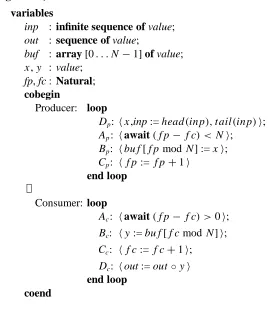
Program 51 of Figure 1 is a two-process concurrent program, where head and
tail are the usual operators on sequences, andŽdenotes concatenation. Using a bounded buffer, a producer process communicates an infinite sequence of values to a consumer process. The safety property of interest is that the sequence of values
out received by the consumer is a prefix of the initial value of the sequence inp.
This property is formulated asInit )2Q, where
ž Init asserts that bu f is empty, inp has some initial value inpinit, f p D f cD
0, and at.Dp/and at.Ac/ hold, where at.¾/ is a predicate that is true iff control is at action¾.
ž Q asserts that out is an initial prefix of inpinit.
To prove that51 satisfies this property, the Reduction Theorem is applied twice.
First, Program 51 is reduced by ApIBpICp, resulting in a program where the
producer has only two actions—Dp and hApIBpICpi. Then, that program is reduced byAcIBcICc, resulting in a final program having just four atomic actions. As we observed at the end of Section 2, these two reductions can be done at once. This is because a consumer action left (right) commutes with each of the actions
Ap,Bp, andCp iff it left (right) commutes with the single actionhApIBpICpi. For the first reduction, the theorem is applied with Ap for R, Bp for hAi, and Cp
forL. We now show that the four hypotheses of the theorem are satisfied.
Hypothesis 0. Init impliesE.ApIBpICp/.
Proof : This follows from the definition of Init andE, becauseInit implies
at.Dp/, andat.Dp/implies that control is external to ApIBpICp.
Hypothesis 1. (a) Action R right commutes with actionb 5b bS, where S is ApIBpICp.
(b) For all statest and u, if t H)dAp u and t jD.Q^E.S//thenu jD.Q_E.S//.
1. cAp right commutes withcDp.
Proof : cDpcannot be executed immediately after cAp. 2. cAp right commutes withAcb,Bcb, andcDc.
3. cAp right commutes withCcb.
3.1. Ifs dAp!cCc t and s Ccc!dAp t0, thent Dt0.
Proof : From the definitions of Acb andCcb.
3.2. If it is possible to execute firstcAp thenCcb on a states, then it is also
possible to execute firstCcb thencAp ons.
Proof : It is possible to executecApthenCcb ons iff
s jDat.Ap/^at.Cc/^.f p f c< N/ (3) It is possible to executeCcb thencAp ons iff
s jDat.Ap/^at.Cc/^.f p .f cC1/ < N/ (4) Obviously, (3) implies (4).
3.3. Ifs dAp!cCc t then s cCc!dAp t Proof : By 3.1 and 3.2.
4. Hypothesis 1(a) holds.
Proof : By 1, 2, and 3, since5b bS equals the union of cDp, Acb, Bcb,Ccb, andcDc.
5. Hypothesis 1(b) holds.
Proof : Action cAp does not modify any part of the state on which Q
depends, so it leaves Q invariant.
Hypothesis 2. (a) ActioncCp left commutes with actionb5 bS.
(b) For all statest and u, if t H)Cpc u and t jD .:Q^ :E.S//then u jD .:Q_ :E.S//.
Proof : The proof of this is similar to the proof of hypothesis 1. The key
step in the proof thatCp left commutes withAc is the observation that (i) it is possible to execute Ac then Cp on a states iff s jD .at.Ac/^at.Cp/^
.f p f c > 0//, and (ii) it is possible to execute Cp then Ac on s iff s jD .at.Ac/^at.Cp/^.f p f c ½ 0//. Hypothesis 2(b) holds because actionCp does not change any part of the state on which Q depends, so it
leaves:Q invariant.
Hypothesis 3. For all states t : if t jD.:Q^at.Cp//thenCp can terminate from
t .
The justification of the second reduction is similar to that of the first with p and c subscripts interchanged. We must prove that Acb left commutes and Ccb right commutes with the four actionscAp,cBp,cCp, and cDp. (Recall that this implies that they left and right commute with
( ( (
h h
h
hApIBpICpi.) Proving the symmetric versions of statements 0–3 in the proof of the first reduction allows our theorem to be applied to the second reduction. We omit the proofs. (Note that the proofs of the commutativity relations between Acb andcCp, and betweenCcb andcAp appeared in the proof of the first reduction.)
4
Constraints
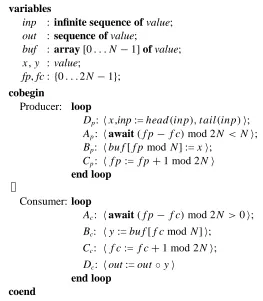
We can replace the unbounded integer variables f p and f c of Program51 by
in-tegers modulo 2N , to obtain producer/consumer program52of Figure 2. Program
52 can be viewed as an implementation of51in which the “left-most bits” of f p
and f c have been eliminated. We would, therefore, expect to be able to reduce52
to a program with only four atomic actions, just as we reduced51. Unfortunately,
we cannot. The action pairs cAp,Ccb and Acb,cCp of52 do not satisfy the required
commutativity relations. For example, ift is a state in which f p D f c, then there
are statesu andvsuch thatt dAp!u Cc!c v, but no stateu0such thatt cCc!u0 dAp!v because 1 mod 2N equals 2 N 1, which is greater than or equal toN . (Executing
b
Ccwhen f p D f c disablescAp.) Thus,cAp does not right commute withCcb. Program52admits “irreducible” histories—ones that are not equivalent to any of
the reduced program’s histories. However, these irreducible histories are irrelevant because they cannot arise when 52 is started in a “proper” initial state. The
property we want to prove isInit )2Q, which asserts that Q is always true for
any execution started in a state satisfying the predicateInit, and it turns out that
there is no irreducible history beginning with a state that satisfiesInit. For example,
histories containing a state in which f p D f c and bothcAp andCcb are enabled, so
cAp does not right commute withCcb, are irrelevant because such a state cannot be reached when Program52 is started withInit true.
We will dispense with these irrelevant histories by modifying52to eliminate them.3
We constrain the program by a predicateI to eliminate histories in which I becomes
false [7]. If the original program satisfiesInit )2I , then only irrelevant histories
3We could define these histories out of existence by including the initial state in the formal
Program52
variables
inp :infinite sequence of value;
out :sequence of value;
buf :array [0: : :N 1]of value;
x , y : value;
fp, fc : f0: : :2N 1g;
cobegin
Producer: loop
Dp: hx ,inp := head.inp/;t ail.inp/i;
Ap: hawait.f p f c/mod 2N < Ni;
Bp: hbu f [ f p mod N ] := xi;
Cp: h f p := f pC1 mod 2Ni end loop
Consumer:loop
Ac: hawait.f p f c/mod 2N >0i;
Bc: hy := bu f [ f c mod N ]i;
Cc: h f c := f cC1 mod 2Ni;
Dc: hout := outŽyi end loop
[image:24.612.139.402.246.547.2]coend
are eliminated.
For an actionÞ and a predicate I , defineÞjI (read Þ constrained by I ) to be the
actionf.s;t/ 2 Þ :.s jD I/^.t jD I/g. Thus,s ÞjI
! t iff s !Þ t and I holds
in statess and t . For a program5we define5jI to be the program whose states
are the states of5that satisfy I , and whose next-state relation is5bjI. If S is an
operation of5, thenSjI is the operation of5jI such thatcSjI equalsbSjI andE.SjI/
equalsE.S/with its domain restricted to the states of5jI.
The next-state relation d5jI is enabled only in states satisfying I , and 5djI can
produce only states satisfyingI . The histories of5jI consist of the histories of5
in which all states satisfy I . This implies that every history of5jI is a history of
5.
Suppose that Init ) 2I holds for a program5. Then, I is true for all states in
any history of5beginning in a state withInit true. Therefore, any history of5
beginning withInit true is also a history of 5jI. If5satisfies Init ) 2I , then 5satisfies Init )2Q iff5jI does. The propertyInit )2I can be proved by
ordinary assertional methods. Usually,I is an invariant of5.
To define the predicateI for52, we first define a function9pon the set of program
states:
9p D
²
1 ifat.Bp/_at.Cp/
0 otherwise
We define9csimilarly, replacing p by c. The predicate I is defined to equal
9c.f p f c/mod 2N N 9p
That I is an invariant of5can be established in the usual way. It is also easy to check thatInit implies I . Therefore, to prove that Init )2Q is satisfied by52,
we need to show only that it is satisfied by52jI.
We can now apply our Reduction Theorem to52jI, reducing it first byApjIIBpjIICpjI
and then by AcjIIBcjIICcjI. The proof is almost identical to that for 51 given
above. The major difference is in the proof thatApdjI right commutes withCcdjI. As
in step 3.2 above, we must show that if it is possible to executeApdjI followed by d
CcjI from a statet , then it is also possible to executeCcdjI followed byApdjI fromt .
It is possible to executeApdjI followed byCcdjI fromt iff
tjD I ^at.Ap/^at.Cc/^..f p f c/mod 2N < N/ (5) and it is possible to executeCcdjI followed by ApdjI fromt iff
SinceI^at.Ap/^at.Cc/implies that 1 f p f c mod 2 N N , it follows that
(5) implies (6).
5
Discussion
We have given a reduction theorem for proving that a safety property of the form
Init ) 2Q holds for a program 5if it holds for the coarser-grained program 5=S. In general, a reduction theorem allows one to conclude that 5satisfies a propertyP if5=S satisfies a related property P
0. It is proved by showing that for any history6of5, there is a corresponding history60 of5=S such that6 satisfies P if 6
0 satisfies
P
0. The history60 is derived from 6 by commuting actions and completing or eliminating any unfinished execution of S. Hypotheses
about commutativity and the possible termination ofL make it possible to derive
60. Additional hypotheses may be needed to guarantee that if60satisfies
P
0then
6satisfiesP. In our reduction theorem, these are hypotheses 1(b) and 2(b).
A reduction theorem is tailored to a particular class of properties. We chose the hypotheses of our reduction theorem to be as weak as possible for properties of the form Init ) 2Q. Lipton considered partial correctness and
deadlock-freedom properties, and Doeppner considered properties closely related to partial correctness. We do not know of a similar reduction theorem for liveness properties. We do know that such a theorem would need different hypotheses. For example, the hypotheses of Lipton’s Theorem are satisfied if S equals P.sem/IV.sem/, in which casehSileavessem unchanged. Suppose a program5contains a process that repeatedly executes S. Then 5=S might satisfy a progress property that is
not satisfied by5 because the repeated decrementing and incrementing of sem
prevents some other process from making progress. Thus, the hypotheses of Lipton’s Theorem are not sufficient for deriving liveness properties.
Back [3] does give a reduction theorem for total correctness—the conjunction of partial correctness (a safety property) and termination (a liveness property). However, his hypotheses involve commutativity relations between actions outside
S, so the theorem is not closely related to either our reduction theorem or Lipton’s.
Appendix: Proof of the Reduction Theorem
SC1. For any actionÞ, ifvH)Þ S w
, then there exists a statex such thatvH)Þ Ub T
x H)Þ bT
U w
.
[When executing S: first, actions in T or not in S are executed until control exits T ; then, actions in U or not in S are executed until control exits S.]
SC2. E.S/impliesE.T/^E.U/.
[If control is external to S, then it is external to its components T and U .]
SC3. :E.T/^ :E.U/is identically false. [Control cannot be internal to both T and U .]
SC4. :E.T/implies thatU is not enabled.b
[U cannot be executed when control is internal to T .]
SC5. IfU is an atomic operation andv !Ub wthenwjDE.S/.
[When control exits U , control is external to S; and control exits an atomic action when it is executed.]
Lemma 2 (a) LetÞand²be actions such that²right commutes withÞ ². For states t and u, if tH)Þ u then there exists a statevsuch that t H)Þ ² v H)² u.
(b) LetÞand½be actions such that½left commutes withÞ ½. For states t and u, if t H)Þ u then there exists a statevsuch that tH)½ vH)Þ ½ u.
Proof of Lemma
We prove part (a); the proof of part (b) is similar. The hypothesis asserts that
tDt0
Þ
!t1
Þ
!: : : !Þ tn 1 !Þ tn Du (7)
for some statesti, with 0n. Ifw !Þ x , then eitherw !² x orw Þ ²!x . By
the right-commutativity hypothesis, ifw !² x Þ ²! y, then there exists x0 such thatw Þ ²!x0 !² y. Thus, by repeatedly replacing !² x Þ ²!with Þ ²!x0 !² , we can deduce from (7) the existence ofk and of states t0
i such that tDt00
Þ ²
!t10
Þ ²
!: : : Þ ²!tk0
²
!: : : !² tn0 Du
This impliest H)Þ ² vH)² u, wherevDt0
k.
End Proof of Lemma
Lemma 3 Assume hypotheses 0–3 of the Reduction Theorem and the additional
4. t jDE.S/
5. ujDE.S/
6. t H)b5 u
Then tH)5=dS u.
Proof of Lemma
We prove by induction onn that, for any states t and u, if there exist states t0,: : :,
tn such that
tDt0
b
5
!t1
b
5
!: : : !b5 tn 1 !b5 tn Du (8)
thentH)5=dS u. The base case n D0 is trivial, since thentDu and the relationH)5=dS is reflexive.
We now prove the induction step, assumingn > 0. Assume states t0, : : :, tn
satisfying (8) exist. The proof thatt H)5=dS u is split into two cases, depending upon
whether or notti jDE.S/holds for some 0<i <n.
1. Ifti jDE.S/holds for some 0<i<n, then t
d
5=S H)u.
Proof : Since t H)b5 ti andti H)5b u, the induction hypothesis implies t H)5=dS ti
andti H)5=dS u. Thus, tH)5=dS u holds by transitivity ofH)5=dS . 2. Ifti jD :E.S/holds for all 0<i<n, then t
d
5=S H)u.
2.1. Choose a statevsuch thatt HH)b5 bL RIhAi v
b
5 RIhdAi HH)
L
u.
Proof : Statevexists by SC1, sincet H)b5 u by hypothesis 6, so t H)b5 S
u by
the antecedent of 2.
2.2. Choose a statewsuch thatt .HH)b5 bL/ dhAi
R w
.b5 bL/ bR HH) hAi v
b
5 RIhAid
HH) L
u.
Proof : Statewexists by 2.1 and SC1. 2.3.w hAi!vorw 5b!bS vorwDv.
2.3.1. wjDE.hAi/
Proof : By hypothesis 4 and SC2, t jDE.hAi/; proof step 2.2 implies
t H)b5 w; and5bleavesE.hAi/invariant by definition of atomicity.
2.3.2. Choose states w0, : : :, wm, for 0 m, such that w D w0
.b5 bL/ bR !
w1: : :wm 1
.b5 bL/ bR
Proof : By 2.2.
2.3.3. wj jDE.hAi/for 0< j<m.
Proof : By 2.3.1 and the definition of atomicity.
2.3.4. m1
Proof : By 2.3.2 (wj jD :E.hAi/for 0< j <m) and 2.3.3.
2.3.5. w hAi!vorw 5b!bS vorwDv
Proof : By 2.3.2 and 2.3.4, since.5b bL/ bRD.5b bS/[dhAi. 2.4. Ifw hAi! v then there exist statesx and y such that t H)b5bS x H)R w hAi!
v L
H)y H)b5 bS u.
Proof : Step 2.2 and the antecedent imply t .HH)b5 bL/hAidw hAi! v HH)5b RIhAid u. The
existence ofx follows from hypothesis 1(a) and part (a) of Lemma 2, and
the existence of y follows from hypothesis 2(a) and part (b) of Lemma 2,
since..5b bL/ hdAi/ R andb .5b
( (
h h
RI hAi/ bL both equal5b bS.
2.5. Ifw 5b!bS vorwDvthen there exist statesx and y such that t H)b5bS x H)R
v L
H)y H)b5 bS u.
Proof : Step 2.2 and the antecedent imply t .HH)b5 bL/hAid w HH)b5 bS v HH)b5 RIhAid u.
This implies t .HH)b5 bL/ dhAi v HH)b5 RIhAid u, since5b bS .5b bL/ hdAi. The existence ofx follows from hypothesis 1(a) and part (a) of Lemma 2, and
the existence of y follows from hypothesis 2(a) and part (b) of Lemma 2,
since..5b bL/ hdAi/ R andb .5b
( (
h h
2.6. Choose x and y such that t H)b5 bS x H)R w hAi! v H)L y H)b5 bS u or t H)b5 bS x H)R v H)L y H)b5 bS u.
Proof : By 2.3, 2.4, and 2.5.
2.7.t H)5=dS x and yH)5=dS u.
Proof : By 2.6, since.b5 bS/5=dS.
2.8. x H)hSic y
2.8.1. x jDE.S/
Proof : By hypothesis 4 and 2.6, since every action ofb5 bS leaves
E.S/invariant.
2.8.2. y jDE.S/
Proof : By hypothesis 5 and 2.6, since every action ofb5 bS leaves
:E.S/invariant.
2.8.3. x H)hSic y
Proof : By 2.6 (which implies x H)bS y), 2.8.1, and 2.8.2, and the
definition ofhSi. 2.9.t H)5=S u
Proof : By 2.6, 2.7, and 2.8, sincehcSi 5=dS.
3. tH)5=dS u
Proof : By 1 and 2.
End Proof of Lemma
Lemma 4 Assume hypotheses 0–3 of the Reduction Theorem, and the additional
hypotheses that, for states t and u:
4. 5=S satisfies Init )2Q
5. t jD Init
6. t H)b5 u
7. ujDE.S/
Proof of Lemma
1. tjDE.S/
Proof : t jD Init by hypothesis 5, and Init ) E.S/ by hypothesis 0 of the
Reduction Theorem. 2. tH)5=dS u
Proof : By hypotheses 6 and 7, and Lemma 3.
3. u jDQ
Proof : By 1, 2, and hypothesis 4.
End Proof of Lemma
Proof of Theorem
The “only if” part follows from Lemma 1. To prove the “if” part, it suffices to assume, for statest and u:
4. 5=S satisfies Init )2Q
5. tjD Init
6. tH)b5 u
and show thatujD Q.
The proof considers separately the casesu jDE.S/andu jD :E.S/. The second
case is further split into the casesu jDE.RI hAi/andu jD :E.RI hAi/, yielding a
total of three separate cases. 1. IfujDE.S/thenu jD Q.
Proof : By Lemma 4.
2. IfujD.E.RI hAi/^ :E.S//thenu jD Q.
Proof : The proof is by contradiction. We assume that ujD :Q.
2.1. Choose a statevsuch thatu H)bL vandvjDE.S/.
Proof : Statevexists by the assumption thatu jD :Q, the antecedent of 2,
and hypothesis 3. 2.2.t H)b5 v
2.3.v jDQ
Proof : By 2.2 and Lemma 4, sincevjDE.S/by 2.1. (Substitutevforu in
the lemma.)
2.4.u jD.:Q^ :E.S//
Proof : By the assumption that u jD :Q and the antecedent of 2.
2.5.v jD.:Q_ :E.S//
Proof : By 2.1, 2.4, and hypothesis 2(b), substituting u for t andvforu.
2.6. Contradiction.
Proof : 2.3, 2.5, and 2.1 (vjDE.S/).
3. IfujD.:E.RI hAi/^ :E.S//thenu jD Q.
3.1.t jDE.S/
Proof : By hypotheses 5 and 0.
3.2. Choose statevsuch thatt H)b5 vH)5b S
u andv jDE.S/.
Proof : Hypothesis 6 asserts the existence of states ti such thatt Dt0
b 5 ! t1 b 5
!: : : !b5 tk Du. Letvbe the lastti such thatti jDE.S/. By 3.1,ti
exists.
3.3. Choose statewsuch thatvHH)b5 bL RIhAi w
b
5 RIhAid
HH) L
u.
Proof : By SC1, since 3.2 asserts that v H)5b S
u, and S equals
.RI hSi/IL.
3.4. Ifw 6Du thenw b5!bS u andwjD :E.RI hAi/.
3.4.1. Choose states w0, : : :, wn such that w D w0
b
5 RIhAid
!
w1: : :wn 1
b
5 RIhAid
!wn Du andwj jD :E.L/for 0< j <n.
Proof : The stateswj exist by 3.3, which asserts thatw
b
5 RIhAid
HH) L
u.
3.4.2. u jD :E.RI hAi/
Proof : Antecedent of 3.
3.4.3. wj jD :E.RI hAi/for 0 j n
Proof : For j D n, this follows from 3.4.2 (since wn D u). For j < n, it follows by induction since5b
( (
h h
invariant. 3.4.4. 0n 1
Proof : By 3.4.1 (wj jD :E.L/ for 0 < j < n). By 3.4.3, wj jD
f alse for 0< j <n, since:E.L/^ :E.RI hAi/D f alse by SC3.
3.4.5. w 5b RIhAid!u
Proof : By 3.4.1 and 3.4.4, since w 6D u (the antecedent of 3.4)
impliesn 6D0. 3.4.6. w 5b!bS u
Proof : By 3.4.3, w jD :E.RI hAi/. By SC4, this implies bL is
not enabled in state w. Since bS D
( (
h h
RI hAi [bL, 3.4.5 then implies
w b5 bS !u.
3.4.7. Proof statement 3.4 holds.
Proof : By 3.4.3 and 3.4.6, sincewDw0.
3.5.v HH)5bbL RIhAi
u
Proof : By 3.3, which assertsvHH)5bbL RIhAi w
, and 3.4, since5b bS 5b bL
3.6. Choose statex such thatv.HH)b5 bL/hAid R
x HH).b5bL/ bR hAi
u.
Proof : From 3.5 by SC1.
3.7. Ifx 6Du then x 5b!bS u.
3.7.1. t H)b5 x
Proof : By 3.2 and 3.6.
3.7.2. x jDE.hAi/
Proof : 3.1 and SC2 imply t jDE.hAi/, and 3.7.1 and the definition
of atomicity then implyx jDE.hAi/.
3.7.3. x .5bbL!/ bR u
Proof : By 3.6, there exist states x0,: : :,xp such thatx D x0
.b5 bL/ bR !
x1: : :xp 1
.b5bL/ bR
! xp D u and xj jD :E.hAi/ for 0 < j < p. By
3.7.2 and the definition of atomicity, xj jD E.hAi/ for 0 j p.
3.7.4. x 5b!bS u
Proof : Since ujD :E.RI hAi/(by the antecedent of 3), SC5 implies
that ifx !Þ u, thenÞ6dhAi. Hence, 3.7.3 impliesx b5!bS u, since
..5b bL/ bR/ dhAiequals5b bS.
3.8.v HH).5bbS/[bR u
Proof : 3.6 and 3.7 implyv.HH)b5 bL/ dhAiu, and.5b bS/[bRD.5b bL/ dhAi. 3.9. Choose statey such thatvH)b5 bS y H)Rb u.
Proof : By 3.8 and Lemma 2.
3.10. y jDE.S/
Proof : From 3.9, sincevjDE.S/by 3.2, and5b bS leavesE.S/invariant.
3.11. y jD Q
Proof : Since t H)5b vby 3.2 andv H)5b bS y by 3.9, we have t H)5b y. Also, y jDE.S/by 3.10. Hence, Lemma 4, substitutingy for u, implies yjDQ.
3.12.u jD Q
Proof : By 3.9, 3.10, and 3.11, substituting y for t in hypothesis 1(b) implies u jD.Q_E.S//. The antecedent of 3 asserts thatu jD :E.S/.
4. u jDQ
Proof : By 1, 2, and 3.
References
[1] Bowen Alpern and Fred B. Schneider. Defining liveness. Information Pro-cessing Letters, 21(4):181–185, October 1985.
[2] E. A. Ashcroft. Proving assertions about parallel programs. Journal of Computer and System Sciences, 10:110–135, February 1975.
[3] R. J. R. Back.Refining atomicity in parallel algorithms. Reports on Computer
Science and Mathematics Ser. A, No 57, Swedish University of ˚Abo, February 1988.
[4] Thomas W. Doeppner, Jr. Parallel program correctness through refinement. In
Fourth Annual ACM Symposium on Principles of Programming Languages,
pages 155–169. ACM, January 1977.
[5] Leslie Lamport. The ‘Hoare logic’ of concurrent programs.Acta Informatica,
14(1):21–37, 1980.
[6] Leslie Lamport. Proving the correctness of multiprocess programs. IEEE Transactions on Software Engineering, SE-3(2):125–143, March 1977.
[7] Leslie Lamport and Fred B. Schneider. Constraints: A uniform approach to aliasing and typing. InProceedings of the Twelfth ACM Symposium on Princi-ples of Programming Languages, pages 205–216, ACM SIGACT-SIGPLAN,
New Orleans, January 1985.
[8] Leslie Lamport and Fred B. Schneider. The “Hoare logic” of CSP, and all that.
ACM Transactions on Programming Languages and Systems, 6(2):281–296,
April 1984.
[9] Richard J. Lipton. Reduction: A method of proving properties of parallel programs. Communications of the ACM, 18(12):717–721, December 1975.
[10] S. Owicki and D. Gries. An axiomatic proof technique for parallel programs.