IMPACT AND PERFORMANCE OF MOBILITY MODELS ON
GEOGRAPHICAL ROUTING PROTOCOLS
1N. PALANISAMY, 2
Dr.V. MURALIBHASKARAN
1
Research Scholar, Manonmaniam Sundaranar Universit
y,
Tirunelveli, Tamilnadu, India2
Principal, Dhirajlal Gandhi College of Technology, Salem, Tamilnadu, India
E-mail: 1[email protected] ,2[email protected]
ABSTRACT
Geographical routing is preferred for scalability in Mobile Ad Hoc Network (MANET). The main method to evaluate the characteristics of geographical routing is a simulation model that provides significant benefits for future research through the exploration of different routing metrics and mobility models. For real-time applications, it is obligatory to estimate the performance of routing protocol under realistic movement scenarios. High node mobility and different mobility models have a direct impact on routing. The realistic mobility modeling approach is essential to quantify and qualify the protocol in real-time network environment. Thus, the node mobility is often estimated through the use of synthetic mobility models when realistic models are not applicable practically. This paper mainly focuses on the impact of geographical routing protocols under high node mobility and different mobility models. Geographic routing routes the data packets using greedy fashion that only relies on node location and distance information. Node mobility and mobility models have a severe impact on the correctness of location information, in turn influences the performance of geographic routing. This work considers well-known geographical routing protocols such as Greedy Perimeter Stateless Routing (GPSR) and Position based Opportunistic Routing (POR) to evaluate routing performance under an entity and group mobility model. Finally, the simulation model illustrates how the routing performance of geographic routing protocols drastically varies with a high frequency of node mobility under different mobility models.
Keywords: Mobile Ad Hoc Network, Entity and Group Mobility Models, Greedy Perimeter Stateless
Routing, Position based Opportunistic Routing, Simulation Model.
1. INTRODUCTION
In a MANET [1], the mobile nodes are distributed randomly, and the mobility model dictates how they move in the network. The mobility model describes the node’s mobility and how the network topology changes in terms of the node position, speed, and direction over a certain period [2]. The limited capacity of the node in MANET necessitates multiple nodes to transmit data packets in a large scale network. Multi-hop communication is challenging owing to unpredictable node mobility, mobility model, and limited resources. Therefore, it is necessary to obtain knowledge about the node movement to enhance the protocol performance.
Generally, routing protocols are classified into topology and geographical routing. In the topology based routing, it is necessary to establish and maintain the end-to-end communication routes in advance, but it is typically experiencing a long
models randomly select the parameters of movement model and independent of each other. Reference Point Group (RPG) is the general model for group mobility. The random mobility model with steady state distribution function is illustrated in [9], and it also states that the average speed of mobile nodes decays with time.
This work analyzes the various mobility models and high node mobility effect on the geographical routing. The node mobility effect on geographic routing is different when it emulates the different mobility model and different frequency of node mobility. This work analyzes the performance of the geographical routing in terms of node connectivity, packet loss and service delay under various movement models of node mobility. Finally, the performance evaluation proves that the geographical routing provides a different level of services for various mobility models under a high frequency of node mobility. The aim and objectives of the work are
To study the different movement models and node mobility effects on geographical routing.
To classify the node mobility
models to consider both entity and group of node mobility based on the routing performance metrics such as node location, direction, speed, and acceleration over time
To propose the simulation
methodology and routing metrics to analyze the performance level of geographical routing under various mobility models
1.1 Problem Statement
Recently, the wireless communication has received significant attention on geographic routing that employs only the neighboring nodes’ physical location information for deciding the communication route to the intended destination. The major issues associated with the geographical routing are freshness of location information, high frequency of node mobility, and node mobility model in the network. Each node in the network maintains the location information of one hop neighbors to take routing decision; therefore, the main factor is the freshness of location information. The existence of errors in the node position information, the geographical data forwarding leads to routing loops, packet loss, and data delay. The location inaccuracy linearly increases with the frequency of node mobility in the network. Each node in the network can move at a different
frequency, and the performance level of the geographic-based routing is not well under the maximum frequency of node mobility. In considering the high frequency of node mobility and movement models to predict the node’s future location, it is necessary to trace the routing parameters such as node’s moving direction, speed, and a pause time resulting in high routing overhead. The node mobility effect on geographic routing is different, when it emulates different mobility model. Thus, there is a need to analyze the performance of geographical routing protocol with high frequency of node mobility under different mobility models.
1.2 Paper Organization
This paper is organized as follows: The section 2 discusses the previous works related to the performance analysis of geographical routing under different mobility models. A high frequency of node mobility and impact of various mobility models on geographical routing is discussed in the section 3. Section 4 shows the experimental results of the GPSR and POR performance under different mobility models and section 5 concludes the work.
2. RELATED WORKS
Two popular routing techniques in geographic routing are greedy and face routing.
Greedy Routing and Different Mobility Models
to enhance the planarization model.
Face Routing and Different Mobility Models
The base model of the face routing is the compass routing II in which the planar sub-graph is constructed using polygonal regions without any intersecting edges, and the destination closer node is determined within one complete face traversal using ‘right hand rule’ [17]. The face routing considers the Unit Disk Graphs (UDG) as the base model for planarization algorithm [18].
The design of Adaptive Face Routing (AFR) ties the destination determination cost into the routing function. However, the searching area limitation of Bounded Face Routing (BFR) into the elliptical shape increases data delay and overhead on routing due to the increased number of hops [19]. Hence, the greedy and perimeter routing are combined to enhance the geographic routing performance. However, the unpredictable node mobility and the interval of beacon broadcasting induce frequent changes are not addressed. It is necessary to retransmit the packets and reroute the neighbor list to employ accurate location information for packet transmission. Furthermore, the routing overhead is increased due to the increased number of control messages when frequently updating the neighbor list. Thus, the unpredictable node mobility induces location errors and degrades the performance of the position based geographic routing in MANET [20]. In RW Model, the node mobility does not consider the previous movement speed and direction, and it randomly selects the node speed and direction to move. In contrast, the RWP mobility model considers the series of pause and mobility time in the node movement. Several works exploit RWP mobility model for performance analysis of geographical routing protocols as it is easy to predict the node mobility rather than others. However, these mobility models are not enough to model the real time scenarios accurately.
3. SYSTEM MODEL
A general model for a MANET is represented as a graph G (V, C). V represents the set of N mobile nodes that are randomly deployed in the network. C represents the set of direct wireless connections among the mobile nodes (C [i, j]). Each node can make a direct connection with other nodes within the transmission range (R). For instance,
C [i, j], represents the node j is placed within the transmission range of node I called a neighbor.
Each node maintains the neighboring nodes in a list N(i). Each connection [C [i, j] ∀ N (I)] is capable of communicating in bidirectional. Each node appends its position information using the positioning system.
For any given node i ∈ V, and for each connection C [I, j] ∀ N (i) has reliability value (Rej)
that represents the link duration. Assume that each node N ∈ V may move freely in the network. Each node periodically sends hello packets and updates the neighbor list of N (i). If a node does not receive any reply from node j ∈ prior N (i), it assumes that the neighbor node j moves out of R (i). Each node N ∈ V emulates different models for its mobility based on direction (di), speed (si), and time (ti). The node Rej value varies for different mobility
models, and it makes highly dynamic network topology.
Entity Mobility Models
Initially, a node i is located at L1 location. As per RWP mobility model, node i choose a destination point L2 in the network, and it moves along a straight line L1 to L2. The speed of node i is s1 drawn between Smax and Smin. Once a node i
reaches L2, it waits for pi time, and it selects L3 which is independent of L2 and L1. According to the RW mobility model, a node i chooses a new direction, d2 from [0, 2π] and s2 from [0, Smax] and changes its location at each ti or di interval. A node moves to a new direction with an angle on (π -θ), when it contacts the border of the simulation field. In the gauss markov mobility model, a node si is correlated over ti. Based on this model, a node i change its location L1 to L2 is given as:
Group Mobility Models
Given any node i ∈ V, each connection C [i, j] ∀ N (i) is restricted as a group G (i). It considers node k is a reference point, and node k decides on any of the entity mobility pattern for other nodes ∈ N (i) movement based on the RPG mobility model. Initially, a node k moves to a random location L with random speed si and it commands the group nodes based on the selected entity mobility pattern. According to the nomadic communication model, each node N ∈ G (i) exploits the entity mobility model to move around the reference node k. In this model, the mobile
nodes ∈ G (i) can move for tmax. In the column
mobility model, each node N ∈ G (i) move around a particular line. It allows that the individual nodes N in a group to emulate one another and each node N in a group moves around the reference point k using an entity mobility model.
3.1 Geographical Routing
In geographical routing, the radical departure from topology based routing is the employment of physical location information, and the elimination of the topology storage dependency. In geographical routing, each device forward its physical location information to the radio neighbors and ensures the neighbors’ connectivity periodically using beacon messages. Instead of attempting to build and maintain the communication routes to the destination, an appropriate router is selected from the neighbor list. Hence, there is no need to consider the global topology information. In addition, the geographical routing eliminates the expensive control messages due to the removal of end-to-end route construction. The geographic routing requires accurate location information, but it is difficult when the network has a large number of mobile devices resulting in highly dynamic network topology. There is a need to evaluate the different mobility model and their impact on the geographic routing performance to handle the dynamic behavior of network topology. To describe the effect of node mobility and mobility model for geographical routing, this work takes GPSR [10] and POR [21].
The GPSR protocol consists of two data forwarding techniques such as greedy and perimeter routing. Each node periodically broadcasts hello packets within the communication range which carry the node identification and location information, and it measures the distance of each neighboring nodes in the communication range to the destination. The simple form of geographical routing such as greedy forwarding selects a node closer to the destination from the neighbor’s list to route. In the aspect of neighbor node distance to the destination node, the greedy forwarding timely delivers the data packets. However, the greedy routing fails when the communication hole is formed resulting in packet drop. In the case of local maximum where a communication hole is formed, it exploits the perimeter mode in data forwarding. In POR, several forwarding member caches the same data packet using the MAC interception concept. The
forwarding member forwards the data packet, when the next hop which is nearer to the destination fails to transmit the packet to the destination. Moreover, it handles the local maximum problem using Virtual Destination based Void Handling (VDVH). It virtually creates the destination and transmits data packets to a virtual destination in an opportunistic fashion.
3.2 The Effect of Node Mobility and Mobility Models on MANET Routing
For MANET, the simulation methodology is attractive as it is easy to control the node mobility and scalability [9] [22]. In the simulation, the real environmental factors are simplified to analyze the performance of routing protocols. Thus, it is easy to repeat the tests and obtain relevant results to real environments. An efficient wireless communication of the routing protocols is possible, only when each node in the network has accurate topology information. Each node forwards the data packets to the destination correctly with this topology information. It is necessary to characterize the node mobility and its model for the movement, and quantify the node mobility randomness in the network. The network scalability, node mobility, and their movement model in geographical routing are very significant factors to evaluate the protocol performance. The node mobility and its model rely on the parameters including node position, speed, direction, and time degrade the performance of geographical routing under MANET environment.
3.3 Analysis of Geographical Routing with Different Mobility Models
entity mobility model, frequently used models are the RW and RD. In the group mobility model, the RPG mobility model is widely used.
3.3.1 RWP Mobility Model
In the RWP, the mobile nodes are initially positioned at random locations. Each node selects a random location and moves independently. The mobile node speed is uniformly selected within the interval of Smin to Smax, and it is allowed to move in
a particular direction. The node waits for a pause time to move after reaching the desired destination. Then, the node again chooses the random destination to move with a new speed within the interval of Smin to Smax. In the RWP mobility model,
a node updates the mobility profile each time the node changes the moving direction and speed randomly. Each node maintains the following information in mobility profile: [tia, tib, tip, (xia, yia),
(xib, yib), sia-b] where tia is the time when a node i is
at a location (xia, yia), changes its location to (xib,
yib) with a node speed of sia-b ∈ Smin - Smax at a time
of tib. Then, a node waits for a pause time of tip.This
procedure is recurred for each node independently until it reaches the end of the simulation. The mobility profile of a node assists to determine the node location at any time of tic.
3.3.2 RW and RD Mobility Model
In the RW mobility model, the node movement profile changes its direction and speed randomly at regular distance or time interval. Each node movement is independent of the previous mobility, but it makes an impractical environment. Based on the RD mobility model, each node maintains the following information: [tia, tib, tip, tii,
xid, (xia, yia), (xib, yib)], where tia is the time that node
i is at the position (xia, yia), and it chooses the
random location (xib, yib) to move. It pauses for a tip
period,when it reaches the border of the simulation area. However, in the RW mobility model, it chooses the random location (xib, yib) at regular
distance xid, or a time interval.
3.3.3 Reference Point Group Mobility Model (RPG)
RPG is the general group mobility model for simulation. The RPG describes the movement of a group of mobile nodes and the motion of entity mobile nodes in a group. The reference point
decides the mobility speed and direction for each node. Based on the RPG mobility model, each node maintains the following information: [tia, tia’, tia’’,
(xia, yia), N(i) ∈ R (xia, yia)], where tia is the time that
node i is at the position (xia, yia), and its neighbor
nodes N(i) are located in the region (R (xia, yia)) of
node i. At the time of tia’, the reference point is
starting to move, and the group members are starting to move at tia’’ based on any one of the
entity mobility models.
3.4 Effect of Changes in Node’s Position, Direction, and Speed
Even a small movement of the mobile nodes in the system causes noticeable changes in the network topology. A highly dynamic network topology with different mobility models affects the routing performance metrics such as node connectivity, packet loss and service delay.
One of the variables in geographical routing to assure the neighbor connectivity is a beacon packet interval time that represents the interval time of beacon broadcasting for the location update. Each node sends a beacon reply packet that carries the current position information to the neighboring nodes. The position information carried by the beacon reply packet becomes inaccurate, when the frequency of node mobility is high. The inaccurate location information in the neighboring table induces packet loss and high service delay. There is a need to decrease the beacon packet interval time, but it increases the routing overhead. In addition, the pause time is another factor that affects the node connectivity. The low pause time represents less waits for mobile, thus induces high mobility scenario. Based on these factors, the performance level of routing protocols is varied under different mobility models.
3.4.1 Metrics Based Performance Comparison
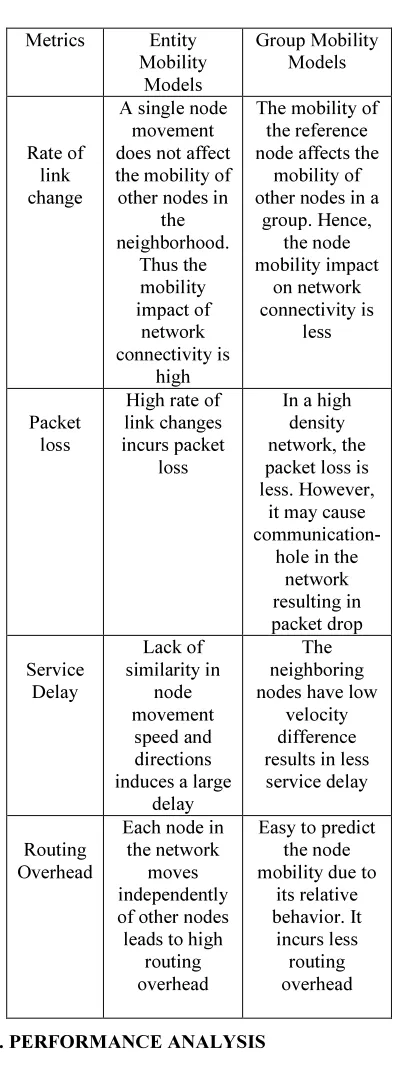
The metrics used to characterize the performance are the rate of link change, packet loss, service delay, and routing overhead. The packet loss is defined as lost packets for a total number of transmitting packets. The service delay is defined as the time taken by the network to transmit data packets to the destination. The rate of link change is defined as the number of changes in the neighboring nodes per second. These parameters are maintained within a reasonable limit, but these metrics varies for different mobility models under similar scenario. The main reason behind the increased rate of link changes, packet loss, service
x
i c= [s
i b-c* t
i b-c] + x
i b…… (3)
y
i c= [s
i b-c* t
i b-c] + y
i b[image:6.595.93.290.185.719.2]
delay, and routing overhead is frequent link failure or poor connectivity.
Table 1: Metrics Based Comparison of Entity and Group Mobility Models
Metrics Entity
Mobility Models
Group Mobility Models
Rate of link change
A single node movement does not affect the mobility of other nodes in
the neighborhood.
Thus the mobility impact of network connectivity is
high
The mobility of the reference node affects the
mobility of other nodes in a
group. Hence, the node mobility impact
on network connectivity is
less
Packet loss
High rate of link changes incurs packet
loss
In a high density network, the packet loss is less. However,
it may cause
communication-hole in the network resulting in packet drop
Service Delay
Lack of similarity in
node movement
speed and directions induces a large
delay
The neighboring nodes have low
velocity difference results in less service delay
Routing Overhead
Each node in the network
moves independently of other nodes leads to high
routing overhead
Easy to predict the node mobility due to
its relative behavior. It
incurs less routing overhead
4. PERFORMANCE ANALYSIS
This section formally analyzes the performance of GPSR and POR protocols under different mobility patterns. The performance
degrades mainly due to the unpredictable node mobility in the network. In this section, discuss the analytical result of packet delivery ratio (PDR) and routing overhead of GPSR [10] and POR [21].
4.1 Packet Delivery Ratio (PDR)
The high scalability and node mobility affects the PDR of routing protocols in MANET. The PDR is defined as the ratio of delivering data packets to generated data packets (Tpck). The PDR
of geographical routing protocol is tightly coupled with accurate location information. Consider a wireless communication between the source (Ns) and destination (Nd) node. The distance between Ns and Nd is represented as D (Ns-Nd) and average node density is represented as λ. This communication includes Hl the number of
intermediate nodes among Ns and Nd. The PDR of geographical routing protocols is given as:
In the equation (5), H1.suc denotes the
successful PDR between Ns and H1 and extends it to the entire communication path. The value of Hl
is increased with the factors of D (Ns - Nd) and λshown in the equation (6).
The error packets (ξpck) including the lost packets
due to the location error (ξl) and time-to-live (TTL)
expired packets (ξd) due to the packet
retransmission directly impact the PDR of routing protocols.
Each node neighbor list, N(i) is constructed and updated for every beacon interval, Bt. The packet loss is induced due to the location error, when a node’s pause time (Pt) is less than the beacon interval. Thus, the packet loss relies on the rate at which the node transmits the beacon packets is shown in the equation (9). Where the cup represents the communication period and k represents the average number of times a greedy node is changed,
Substituting the equation (7), (8) and (9) in the equation (5), the packet delivery ratio of geographical routing protocols is estimated. The PDR value of GPSR and POR is varied under
PDR (%) = 100 * {1- Hl (1- H1.suc)} .. (5)
Hl = D (Ns - Nd) * λ…… (6)
H1.suc (%) = 100 * (1- ξpck/ Tpck ) ... (7)
ξpck = ξl + ξd ………. (8)
similar scenario, because the number of delayed packets is high under perimeter routing.
The POR exploits the virtual-based void handling technique and air back up scheme that reduces the packet delay and duplicate data forwarding, resulting in less ξd. Thus, the PDR of
POR is improved significantly.
4.2 Routing Overhead
The routing overhead (Φ) is incurred due to the number of beacon packets transferred to the neighboring nodes (B), memory consumption (Mc), and redundant packets (Rd). The overhead of the geographical routing protocols is coupled with the current neighbor list N (i).
In GPSR, each node forwards the beacon packets B towards the nodes N ∈ N(i). Each neighbor node in communication range updates the neighbor list, when it receives the B packet from node i is shown in the equation (13). Each node updates the N(i) that relies on the rate at which the interval the beacon packets are transmitted for a total communication period (Cp). In memory consumption, Mc is negligible in GPSR, because each node transmits the data packets only to the next hop and cache its own packets in packet memory until it transmits the data packet to the next node. Due to the collision (C) and greedy node mobility (Mg), the sender node fails to receive the packet transmission by the greedy node, thus induces redundant retransmission is shown in the equation (14). Thus, the GPSR overhead is increased gradually, when the beacon interval Bt is decreased.
The main concern of POR is routing overhead mainly due to the opportunistic forwarding, as it increases the [Mc]Φand [Rd]Φ. In
POR, the beaconing overhead [B]Φis similar to the
GPSR. The movement of next hop and collision incurs [Rd]Φwhich is similar to the GPSR.To limit
additional duplicate relaying due to the opportunistic forwarding, only the Ns and next hop node forwards data packets through an opportunistic fashion that reduces the propagation area of data packets. Each forwarding node caches several data packets that have been received using MAC interception resulting in high [Mc]Φshown in
the equation (16).
Where N (i)pck represents the total number
of receiving packets by a node with its own address and the forwarding area (λ* π(R/2)2) is estimated for ∆T time to determine the total number of nodes in the forwarding area and their cached packets in the packet list (Tipck). Thus, the routing overhead in
POR is higher than the GPSR, because the opportunistic forwarding increases the node’s memory consumption.
PORΦ= {(B* |N (i)|) * (Cp/Bt)}Φ +
(λ* π(R/2)2)
[C+ Mg]Φ+{(N(i)pck + ∑ Tipck} … (17)
i=1 GPSRΦ< PORΦ… (18)
5. PERFORMANCE EVALUATION OF THE
GEOGRAPHICAL ROUTING
PROTOCOLS
5.1 Simulation Model
This section shows the performance of geographical routing such as GPSR and POR under different mobility models such as RWP, RD, and RPG mobility model. Network Simulator-2 (NS-2) is the simulation tool used to set-up the MANET environment. Simulation model consists of the randomly deployed 100 nodes within the 1000 x 1000 m2 area to transmit data packets of 1024 bytes. The moving velocity of the node is 0- 25 ms -1, and it pauses for 0- 40 s. It simulates an IEEE 802.11 MAC layer with a node communication range of 250m. The network is simulated for 900 seconds. This simulation study focuses routing parameters such as the rate of link changes, packet loss, and service delay to analyze the performance.
ξd(GPSR) > ξd(POR) ………(10)
PDRGPSR < PDRPOR … (11)
Φ = [B]Φ+ [Mc]Φ+ [Rd]Φ . (12)
[B]Φ= {(B* |N (i)| * (Cp/Bt)}Φ. (13)
GPSRΦ = {(B* |N (i)|) * (Cp/Bt) +
[C+Mg]Φ}Φ. ……(15)
[Rd]Φ= [C+ Mg]Φ…….. (14)
(λ* π(R/2)2) [Mc]Φ = {(N(i)pck + ∑ Tipck}∆T... (16)
5.2 Simulation Results
5.2.1 Packet Loss
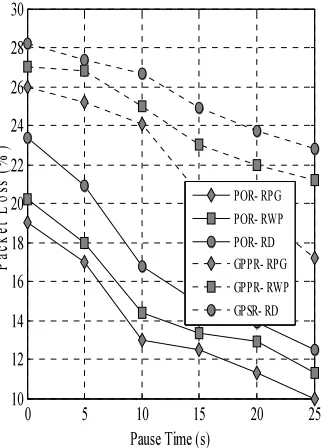
The impact of node pause time on packet loss is shown in Fig 1. The main reason behind the packet loss is unpredictable node mobility in MANET environment. In both POR and GPSR, the RPG mobility provides better performance than entity mobility models. As in an RPG, a group of nodes moves similarly and in that the node disconnection is less than entity mobility models. In addition, it has less chance to create the communication hole in network topology. Even when the node’s mobility increases (pause time varies from 0 to 25 seconds), POR still delivers 90% of transmitting data packets to the destination, while the packet loss of GPSR increases significantly. Each node in the neighborhood receives all data packets, because the opportunistic-based routing transmits data packets in a multicast mode. However, there is no way to transmit the data packets other than the packet retransmission when the data packets are dropped in GPSR. In POR, the forwarding members transmit the data packets when a next hop node fails to transmit the data packet. Thus, it increases packet delivery or decreases lost packets in POR than GPSR.
0 5 10 15 20 25
10 12 14 16 18 20 22 24 26 28 30
Pause Time (s)
P
ac
k
et
L
o
ss
(
%
)
POR- RPG POR- RWP
POR- RD GPPR- RPG GPPR- RWP
GPSR- RD
[image:8.595.313.486.446.685.2]
Figure 1: Pause Time Vs Packet Loss
5.2.2 Service Delay
The impact of node pause time on service delay is shown in Fig 2. The node movement in RPG nears each other as two groups of nodes have less relative speed than others, and there is a high similarity in node’s mobility; thus it maintains the constant node density. At a constant node density, each node maintains the neighbor nodes’ connections easily. Thus, the service delay under RPG mobility model based scenario is less than other mobility models. In the RD mobility model, the node mobility does not consider the previous movement speed and direction, and it randomly selects the nodes’ speed and direction to move, but in contrast the RW mobility model considers the series of pause and mobility time in the nodes’ movement. It is easy to predict the node mobility; thus the RW mobility model delivers the data packets faster. The frequent failure of node connections due to the node mobility in GPSR that emulates the unicast data forwarding incurs substantial latency of immediately transmitted packets. However, the POR effectively maintains the service delay, as it transmits data packets in a multicast mode.
0 5 10 15 20 25
0.2 0.25 0.3 0.35 0.4 0.45
Pause Time (s)
S
er
v
ic
e
D
el
ay
(
s)
POR RPG
POR RWP
POR RD
GPSR RPG
GPSR RWP
GPSR RD
[image:8.595.108.271.452.676.2]5.2.3 Rate of Link Changes
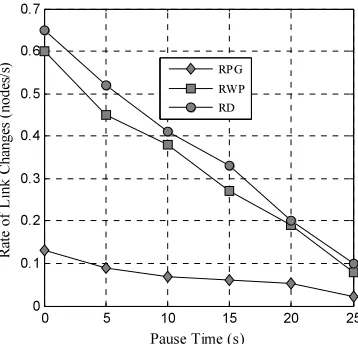
[image:9.595.112.291.387.559.2]The impact of node pause time on the rate of link changes under various mobility model is shown in Fig 3. The neighborhood dynamic characteristics of the network make frequent changes in topology. The performance of routing protocols is inefficient; the neighborhood of a mobile node is more dynamic. In the Fig 3, varying node pause time effect on the rate of link change is similar for both entity and group mobility models; however, the impact level is varied. The group mobility model, RPG has high relative behavior than the entity mobility models, and it has a low impact on neighborhood nodes than entity mobility models. In RPG, the communication range of a node is restricted to the group, and each node movement depends on each other in a group. However, in entity mobility models, the node movement is independent of each other. Thus, the RPG provides more duration to the neighbor links and the links break less often.
0 5 10 15 20 25
0 0.1 0.2 0.3 0.4 0.5 0.6 0.7
Pause Time (s)
R
at
e
of
L
ink
C
ha
nge
s
(node
s/
s) RP G
RW P RD
Figure 3: Pause Time Vs Rate of Link Changes
6. CONCLUSION
This paper addresses the different mobility models and its impact on geographical routing under a high frequency of node mobility. This paper characterizes the geographical routing protocols such as GPSR and POR under various mobility models using simulation methodology. Unpredictable node mobility makes the geographical routing protocols incapable to provide efficient communication. In the face of frequent link disconnections, the data packets are lost or delayed to the destination. The POR and GPSR perform better with the group mobility model such
as RPG. The POR performed well under both entity and group mobility model while GPSR had serious routing issues due to unpredictable node mobility. The POR experiences acceptable service delay and packet loss with the increase of node mobility. Through the simulation, it confirms that the performance of POR is better than GPSR. The simulation results reveal that the varying node pause time effects routing performance, and it is similar for both entity and group mobility models; however, the impact level is different
REFERENCES
[1] M. Frodigh, P. Johansson, P. Larsson, “Wireless ad hoc networking-The art of networking without a network”, Ericsson Review, Vol. No.4, pp. 248-263, 2000.
[2] R.R. Roy, “Mobility Model Characteristics”, Handbook of Mobile Ad Hoc Networks for Mobility Models, pp. 23-32, 2011
[3] Ivan Stojmenovic and University of Ottawa, “Position-Based Routing in Ad Hoc Networks”, IEEE Communications Magazine, pp. 2-8, 2002
[4] H. Frey, “Scalable Geographic Routing Algorithms for Wireless Ad Hoc Networks,” IEEE Network Mag., pp. 1-6, 2004
[5] Mousavi, S. M., Rabiee, H. R., Moshref, M., & Dabirmoghaddam. A, “Mobility pattern recognition in mobile ad-hoc networks”, In Proceedings of the 4th international conference on mobile technology, applications, and systems, pp. 302-309, 2007 [6] Tracy Camp, Jeff Boleng, and, Vanessa Davies,
“A Survey of Mobility Models for Ad Hoc Network Research”, Mobile Ad Hoc Networking: Research, Trends and Applications, Vol. 2, No. 5, pp. 483-502, 2002
[7] Fan Bai and Ahmed He, “A Survey of Mobility Models in Wireless Adhoc Networks”.
[8] Qunwei Zheng, Xiaoyan Hong, and Sibabrata Ray, “Recent Advances in Mobility Modeling for Mobile Ad Hoc Network Research”, 2004
[9] Guolong Lin, Guevara Noubir, and Rajmohan Rajaraman, “Mobility Models for Ad hoc Network Simulation”.
Networking, pp. 243-254, 2000.
[11] Bettstetter, Christian, Hannes Hartenstein, and Xavier Pérez-Costa, "Stochastic properties of the random waypoint mobility model: epoch length, direction distribution, and cell change rate", In Proceedings of the 5th ACM international workshop on Modeling analysis and simulation of wireless and mobile systems, pp. 7-14, 2002
[12] Bettstetter, and Christian, "Topology properties of ad hoc networks with random waypoint mobility." ACM SIGMOBILE Mobile Computing and Communications Review, Vol. 7, No.3 pp. 50-52, 2003
[13] Brust, M. R., & Ribeiro, C. H., “Border Effects in the Simulation of Ad Hoc and Sensor Networks”, 11th IEEE International Conference on Computer Modelling and Simulation, pp. 180-185, 2009
[14] T. Chu and I. Nikolaidis, “On the artifacts of random waypoint simulations,” in First International Workshop on Wired/Wireless Internet Communications in conjunction with the 3rd International Conference on Internet Computing, 2002
[15] Ruhrup, S., & Stojmenovic. I., “Contention-based geo routing with guaranteed delivery, minimal communication overhead, and shorter paths in wireless sensor networks”, IEEE International Symposium on Parallel & Distributed Processing (IPDPS), pp. 1-9, 2010
[16] Ruhrup, Stefan, et al, "Message-efficient beaconless geo routing with guaranteed delivery in wireless sensor, ad hoc, and actuator networks", IEEE/ACM Transactions on Networking, Vol. 18, No.1, pp. 95-108, 2010
[17] Kuhn, Fabian, Roger Wattenhofer, and Aaron Zollinger, "An algorithmic approach to geographic routing in ad hoc and sensor networks", IEEE/ACM Transactions on Networking (TON), Vol. 16, No.1, pp. 51-62, 2008
[18] Bose, Prosenjit, et al. "Routing with guaranteed delivery in ad hoc wireless networks." Wireless networks, Vol. 7, No.6, pp. 609-616, 2001
[19] Kuhn, F., Wattenhofer, R., & Zollinger, A., “Asymptotically optimal geometric mobile ad-hoc routing, In Proceedings of the 6th international workshop on Discrete algorithms
and methods for mobile computing and communications, pp. 24-33, 2002
[20] Dongjin Son, and Ahmed Helmy, “Mobility-Induced Location Errors and its Effect on Geographic Routing in Ad Hoc Networks: Analysis and Improvement using Mobility Prediction”, IEEE Transactions on Computing, Vol. ,3, No. 3, pp 233-245, 2004.
[21] Shengbo Yang, Chai Kiat Yeo, and Bu Sung Lee, “Toward Reliable Data Delivery for Highly Dynamic Mobile Ad Hoc Networks”, IEEE transactions on Mobile Computing, Vol. 11, No. 1, pp. 111-124, 2012
[22] Nordstrom, E., Gunningberg, P., & Lundgren, H., “A testbed and methodology for experimental evaluation of wireless mobile ad hoc networks”, In Testbeds and Research Infrastructures for the Development of Networks and Communities, pp. 100-109, 2005