EFFICIENT MULTIPATH LOCATION AWARE ROUTING
PROTOCOL FOR MOBILE AD HOC NETWORKS
1DR.A.RAJARAM, 2K.VINOTH KUMAR
1Associate Professor, Department of Electronics and Communication Engineering,
Karpagam College of Engineering, Coimbatore, India.
2Research Scholar, Karpagam University, Coimbatore, India
E-mail: , [email protected], [email protected]
ABSTRACT
Mobile ad hoc network consists of mobile node where no infrastructure exists. If a node wants to communicate with other node, it needs to obtain its location to forward the data packets. Due to high mobility nature, communication will get degraded because of less packet delivery rate. In previous location aware routing protocols, multipath routing is not deployed with location updation. In this paper, we propose Efficient Multipath Location Aware Routing Protocol (EMLARP) to improve the packet delivery rate based on location updation of mobile nodes and multipath routing. The proposed work consists of three parts. In first part, cluster enhanced multipath routing is introduced to improve link quality and load balancing. In second part, multipath routing is predicted based on given topology. Moreover, multipath routing messages are transmitted to obtain set of node disjoint paths. In third part, mobile node location is updated with use of network progression ratio to optimize the network cost. Based on simulation results from Network Simulation tool (NS 2.34), the proposed protocol achieves high packet delivery rate, more network lifetime, less delay, less packet delivery delay and communication overhead than existing schemes.
Keywords: Location Aware, Multipath Routing, Cluster Routing, Link Quality, Load Balancing, Packet
Delivery Rate, Network Cost And Delay.
1.
INTRODUCTIONMobile ad hoc networks consist of wireless hosts that communicate with each other in the absence of a fixed infrastructure. Some examples of the possible uses of ad hoc networking include soldiers on the battlefield, emergency disaster relief personnel, and networks of laptops. Sensor networks are a similar kind of network that have recently been investigated. Nodes in a sensor network are lighter, computationally less powerful, and more likely to be static compared to nodes in an ad hoc network. Hundreds or thousands of such nodes may be placed to monitor and control a physical environment from possibly remote locations. These nodes frequently switch their activity status to preserve battery power, which poses additional challenges for the design of efficient data collection algorithms. Ad hoc and sensor networks are self-organized and collaborative. Due to propagation path loss, the transmission radii are limited. Thus, routes between two hosts in a network may consist of hops through other hosts in the network. The task of finding and maintaining routes in the network is nontrivial since
host mobility causes frequent unpredictable topological changes.
2.
RELATED WORKWen-Hwa Liao et.al [1] investigated the routing problem in a MANET by exploiting the location information of mobile hosts. Basically, there are three issues to be addressed in this problem: route discovery, packet relay, and route maintenance. Depending on whether location information is utilized in each of these issues, we classify routing protocols as unaware, partially location-aware, and fully location-aware. The proposed protocol, called GRID, is fully location-aware because it tries to exploit location information in all these issues. a new routing protocol called GRID, which tries to exploit location information in route discovery, packet relay, and route maintenance.
In this paper [2], it was introduced that an Energy Efficient Location Aided Routing (EELAR) Protocol for MANETs which is based on the Location Aided Routing (LAR). It makes significant reduction in the energy consumption of the mobile nodes batteries by limiting the area of discovering a new route to a smaller zone. Thus, control packets overhead are significantly reduced. In EELAR a reference wireless base station is used and the network's circular area centered at the base station is divided into six equal sub-areas. At route discovery instead of flooding control packets to the whole network area, it was flooded to only the sub-area of the destination mobile node. The base station stores locations of the mobile nodes in a position table.
In this paper [3], DREAM protocol was introduced and some of location based protocols were analyzed. Distance Routing Effect Algorithm for Mobility (DREAM) is a location-based routing protocol work for Ad-hoc networks. Here in this comparison, distance and mobility plays an important role for ad hoc networks. DREAM protocols have some desirable properties of providing bandwidth and energy efficiency. With respect to existing protocols, DREAM achieves more bandwidth and energy which can be used for the transmission of data messages. The rate of control message generation is determined and optimized according to the mobility rate of each node individually. This protocol provide loop-free path, since each data message propagates away from its source in a specific direction. It is also adaptive to mobility, since the frequency with which the location information is disseminated depends on the mobility rate.
In this paper [4], it was proposed that novel routing protocol for MANET, the Energy- Aware Geographic Routing (EGR) protocol, that combines greedy routing, energy awareness routing and constrained flooding. This protocol effectively prolongs the network lifetime as well as provides an acceptable delivery ratio and end-to-end delay.
In this paper [5], it was proposed a Location Based Opportunistic Routing Protocol (LOR) to addresses the problem of delivering data packets for highly dynamic mobile ad hoc networks in a reliable and timely manner. This protocol takes advantage of the stateless property of geographic routing and the broadcast nature of wireless medium. When a data packet is sent out, some of the neighbor nodes that have overheard the transmission will serve as forwarding candidates, and take turn to forward the packet if it is not relayed by the specific best forwarder within a certain period of time. By utilizing such in-the-air backup, communication is maintained without being interrupted. The additional latency incurred by local route recovery is greatly reduced and the duplicate relaying caused by packet reroute is also decreased.
Karim et.al [6] proposed PRISM protocol which supports anonymous reactive routing in suspicious location-based MANETs. It relies on group signatures to authenticate nodes, ensure integrity of routing messages while preventing node tracking. It works with any group signature scheme and any location-based forwarding mechanism. It was evaluated its routing overhead and show that it can outperform anonymous link state based approaches under certain traffic patterns.
In this paper [7], power aware routing was proposed which helps in decreasing the routing overhead by utilizing the concept of global location information of mobile nodes. The proposed protocol Location Based Power Aware Routing (LBPAR) protocols use location information to minimize the Request Zone to reach the destination node. LBPAR will also help in reducing the overheads at each node by decreasing the number of calculations performed at each node, which in turn increased the battery life of node.
node decides to communicate, it first locates the destinations coordinates, using LAR scheme it will calculate the approximate Radius and the flood angle of the destination node. The source then creates a Route request message (RREQ), and broad casts it in the calculated direction only.
In this paper [9], it was introduced taxonomy of ad hoc routing protocols. It was divided the ad hoc routing protocols into three categories: (i) source-initiated (reactive or on-demand) (ii) table-driven (pro-active) (iii) location-aware (geographical). For each of these classes, it was reviewed that several representative protocols. While different classes of protocol operate under different scenarios, it usually shares the common goal to reduce control packet overhead, maximize throughput, and minimize the end-to-end delay. The main differentiating factor between the protocols is the ways of finding and/or maintaining the routes between source–destination pairs.
In this paper [10], it was suggested an approach to decrease overhead of route discovery by utilizing location information for mobile hosts. Such location information may be obtained using the global positioning system (GPS). It was demonstrated that how location information may be used by means of two Location-Aided Routing (LAR) protocols for route discovery. The LAR protocols use location information, by the time to reduce the search space for a desired route. Limiting the search space which results in fewer route discovery messages.
In [11], an algorithm is proposed which removes some of the drawbacks of the existing GPSR (Greedy perimeter stateless routing) position based routing algorithm. In proposed algorithm different algorithm has been used to planarize the graph so that it will not disconnect the route in case of location inaccuracy in perimeter mode whereas in GPSR in certain cases of location inaccuracy it will disconnect the graph and hence the packets will not be routed thereby decreasing packet delivery ratio.
In this paper [12], a node-disjoint location based multi-path routing protocol is proposed for mobile ad hoc networks to reduce the number of broadcast multi-path route discoveries and the average hop count per path from the source to the destination. During route discovery process, the intermediate nodes include their location information along with the distance in the Route-Request (MP-RREQ) packet. The destination node selects a set of node disjoint paths from the MP-RREQ packet received
and sends a Route-Reply (MP-RREP) packet on each of the node-disjoint paths.
In this paper [13], a location based associativity routing is proposed which makes use of physical location information of destination node to reduce the search space for route discovery only, and not for data delivery. It does not cover route maintenance in case of broken links. The Associativity-Based Routing Algorithm of selects the route, based on node’s associativity states. Therein, the search space used to determine the route to the destination node is equal to the entire network space and due to broadcast, the amount of routing related traffic increases, thereby consuming large portion of bandwidth.
Varun mishra et.al [14] proposed multi-path routing scheme constructs multiple paths from each node to reduce the possibility of congestion. In this routing scheme, each data packet is delivered to the number of nodes or neighbor using one of the paths and established minimum more than two paths. The proposed energy based multipath path selection algorithm provides a MAX energy path that spending among nodes which therefore maximizes the network lifetime. The MAX energy spending will reduce the amount of energy consumption which is usually given to other nodes that follow the routing procedure to establish the route on the bais of MAX energy selection basis. The performance is enhanced in term of performance metrics that proves that the performances of proposed scheme are better than compared scheme.
In this paper [16], it was presented that a meshed multipath routing (M-MPR) scheme, which allows some (if not all) intermediate nodes to have more than one forwarding direction to a given destination. In addition, it was proposed that selective forwarding of packets (SF) where the forwarding decision is taken dynamically, hop-by-hop, based on the conditions of downstream forwarding nodes. End to end FEC coding is also used to avoid acknowledgment based retransmission. A new mesh-based multipath searching scheme is proposed which requires a lower control overhead and a smaller nodal database than tree-based and sequential searching approaches.
In this paper [17], some interesting issues are addressed arising in such MANETs by designing an anonymous routing framework (ALARM). It uses node’s current locations to construct a secure MANET map. Based on the current map, each node can decide which other nodes it wants to communicate with. ALARM takes advantage of some advanced cryptographic primitives to achieve node authentication, data integrity, anonymity and untraceability. It also offers resistance to certain insider attacks.
The paper is organized as follows. The Section 1 describes introduction about MANET, Need for location aware routing in MANET. Section 2 deals with the previous work which is related to the location aware routing and multipath establishment. Section 3 is devoted for the implementation of Efficient Location Aware Routing Protocol. Section 4 describes the performance analysis and the last section concludes the work.
3.
IMPLEMENTATION OF EFFICENTMULTIPATH LOCATION AWARE
ROUTING PROTOCL
In the proposed protocol, cluster enhanced multipath routing is to overcome the problem of network unbalancing and node failures. In second phase, multipath routing is predicted and route request messages are broadcasted to attain set of node disjoint paths. In last, node location is update to achieve high packet delivery rate.
3.1 Cluster Enhanced Multipath Routing
In this phase, mobile nodes are divided in to virtual groups. In this group, nodes may be assigned as cluster head, gateway and cluster member participants. The main responsibility of cluster head
is to act as local coordinator, performing intra cluster packet transmission, issuing authentication to data packets and data forwarding, and so on. Cluster gateway is a non-cluster head node with inter-cluster links, so it can access neighboring clusters and forward information between clusters. A cluster member is usually called an ordinary node and it is a member of both cluster groups.
To address the problem of delivering data packets among the mobile nodes, the multipath routing is used. Due to dynamic nature of the network, mobile ad hoc routing faces many unique problems not present in wired networks. Generally in MANET where routes become obsolete frequently because of mobility and poor wireless link quality. The Multipath routing addresses these problems by providing more than one route to a destination node in order to avoid network failures. This routing appears to be a promising technique for ad hoc routing protocols, the multiple paths can be useful in improving the effective bandwidth of communication, responding to congestion and heavy traffic, increasing delivery reliability and security. The constant bit rate traffic can be distributed among multiple routes to enhance transmission reliability, provide load balancing, and secure data transmission.
In previous routing protocols, it utilizes only one single route for each pair of source and destination nodes. Due to node mobility, node failures, and the dynamic characteristics of the radio channel, links in a route may become temporarily unavailable and making the route invalid. This will lead to breakage of network communication. The overhead of finding alternative routes may be high and extra delay will be induced in packet delivery may be introduced. In cluster, source and intermediate nodes can use these routes as primary and backup routes. Alternatively, source node can distribute traffic among multiple routes to enhance transmission reliability, provide load balancing, and secure data transmission.
3.2 Prediction of Multipath Routing
L to obtain the modified graph L’ (R’, K’). The
minimum-hop m-n path is determined in the modified graph L’ (R’, K’), add it to the set ST and remove the intermediate nodes that were part of this
m-n path to get a new updated L’ (R’, K’). This
procedure is repeated until there exists no more m-n paths in the network. The set ST contains the node-disjoint m-n paths in the original network graph L. When a node is removed from a network graph, it is also removed all the links associated with the node.
3.2.1 Broadcasting of Multipath Route Message
If a source node has data packets to send to a destination and is not aware of any path to the latter, the source initiates a broadcast route discovery procedure by broadcasting a Multi-path Route Request (M-RREQ) message to its neighbors. Each node, except the destination, on receiving the first M-RREQ of the current broadcast process (i.e., a M-RREQ with a sequence number greater than those seen before), includes its Mobile Node Location Update Attribute, MP_LUA, in the M-RREQ message. The MP_LUA of a node
comprises the following: node ID, X, Y co-ordinate information, Current velocity and
Angle of movement with respect to the X-axis. The node ID is also appended on the “Route Record” field of the MP-RREQ message. Note that upon receiving a M-RREQ message, we do not let an intermediate node to immediately generate a M-RREP message to the source, even though the intermediate node might know of one or more routes to the destination. To determined set of of valid of node-disjoint paths that really exist at the time of the broadcast multi-path route discovery process, latest M_LUA will be collected. The packet format of M-RREQ message is illustrated in fig.1.
Source ID
Destination ID
Seq.No List of
Node IDs
Location update Attribute
4 8 8 4 5
Fig.1. Format Of M-RREQ Message
Once a destination receives a M-RREQ message, it extracts the path traversed by the message and the M_LUAs of the source and the intermediate nodes that forwarded the message. The destination stores the path information in a set, RREQ-Path-Set, maintained for every source with which the destination is in communication. The paths in the
RREQ-Path-Set are stored in the increasing order of
their hop count. Ties between paths with the same hop count are broken in the order of their time of arrival at the destination node. The M_LUAs are stored in the M-LUA-Database maintained for the
latest broadcast route discovery procedure initiated by the source. The destination runs a local path selection heuristic to extract the set of node-disjoint paths from the RREQPath- Set. The following pseudo code illustrates selection of node disjoint path.
Output: M_RREQ-KM-Set // set of node-disjoint
paths to be extracted from the M_RREQ-Path-Set
Begin: M_RREQ-KM-Set = Φ
Auxiliary Variables: MobilecandidatePath. Begin M_RREQ-KM-Path-Selection
1 while (M_RREQ-Path-Set ≠Φ) do 2 Extract the first path K in RREQ-Path-Set 3 MobilecandidatePath = True
4 for (every intermediate node u∈ K) do
5 for (every node-disjoint path KM-K in
M_RREQ-KM-Set) do
6 if (m is an intermediate node of KM-K) then 7 MobilecandidatePath =False
8 end if 9 end for
10 if (candidatePath is set to True) then
11 M_RREQ-KM-Set
∈
M_ RREQ-KM-Set U {K}12 end if 13 end while
14 return M_RREQ-KM-Set
15 End M_RREQ-KM-Path-Selection
The pseudo code traverses through the
M_RREQ-Path-Set in the order of the paths stored in it (in the
increasing order of the hop counts). The M-RREP message is then forwarded to the next node towards the source as indicated in the Route Record field of the message.
3.3 Node Location updation
the node at time MTIME and the co-ordinates of the targeted location to which the node is moving. After reaching the targeted location, a node can change its velocity and direction to move to a new destination location. Based on Network Progression Ratio, node location is updated to optimize the network cost.
3.3.1. Network Progress Ratio
In order to optimize the cost for designing network layer protocols, the following framework is designed.
|
|
|
|
)
(
EO
MO
KL
Cost
F
NPR−
=
Suppose that each edge has a cost measure. Node K, currently holding the packet, will forward it to neighbor
L, closer to destination O than itself, which minimizes the objective function. While progress clearly measures the advance of M toward O in the NPR framework, the cost measure can be hop count, power, reluctance, power reluctance, delay, and expected hop count, etc., The NPR framework generalizes different optimization objectives and provides a uniform solution to them.
4.
PERFORMANCE ANALYSIS4.1 Mobility Model
Random walks tend to keep all nodes close to their initial positions, and thus analysis using this model is largely misleading. We also believe that this is not a natural kind of movement, and suggest using movement pattern. One possible analogous design is as follows. Each node generates a random number, wait, in interval [0 . . . maxwait]. The node does not move for wait seconds. This is called the station time. When this time expires, the node chooses to move with a probability p. It generates a new wait period if it decides not to move. Otherwise, it generates a random number, travel, in interval [0, maxtravel], and a new random position within the same square in the second case. The node then moves from its old position to a new position along the line segment joining them, at equal speed for the duration of travel seconds. Upon arriving at the new location, the node again chooses its waiting period, etc. The mobility rate is
given by the formula
mobrate = p*maxtravel/(maxtravel + maxwait) and
is one of the main mobility parameters. Note that this movement pattern does not cover the case of nodes moving more or less in the same direction, which may often be the case in military and rescue operations. Thus, an additional component should
be added in experiments—moving with the same speed and in the same direction by all nodes.
4.2 Simulation Tool
Network Simulator (NS) is an event driven network simulator developed at UC Berkeley that simulates variety of IP networks. It implements network protocols such as TCP and UPD, traffic source behavior such as FTP, Telnet, Web, CBR and VBR, router queue management mechanism such as Drop Tail, RED and CBQ, routing algorithms such as Dijkstra, and more. NS also implements multicasting and some of the MAC layer protocols for LAN simulations. Currently, NS (version 2) written in C++ and OTcl (Tcl script language with Object-oriented extensions developed at MIT) is available.
We use NS3 to simulate our proposed algorithm. In our simulation, 200 mobile nodes move in a 1000 meter x 1000 meter square region for 80 seconds simulation time. All nodes have the same transmission range of 300 meters. The simulated traffic is Constant Bit Rate (CBR). Our simulation settings and parameters are summarized in table 1.
No. of Nodes 200 Area Size 000 X 1000 Mac 802.11 Radio Range 300m Simulation Time 50 sec Traffic Source CBR Packet Size 512 bytes Mobility Model Random Way Point Protocol AODV
Packet rate 6pkts/sec
4.3 Performance Metrics
We evaluate mainly the performance according to the following metrics.
Communication overhead: Communication overhead can be defined as the average number of control and data bits transmitted per data bits delivered. Control bits include the cost of location updates in the preparation step and destination searches and retransmission during the routing process.
Packet Delivery Ratio: The delivery rate is
Node degree: It is the important metric to evaluate
the performance of topology control algorithms. If the node degree is higher, it indicates that higher collision will be. So value of node degree should be kept small.
Network connectivity ratio: It determines the
nodes are connected in the intermediate region. It should be kept small while varying the average speed.
End-to-End Delay: This is also referred to as
latency, and is the time needed to deliver the message. Data delay can be divided into queuing delay and propagation delay. If queuing delay is ignored, propagation delay can be replaced by hop count, because of proportionality.
The simulation results are presented in the next part. We compare our proposed algorithm EMLARP with ALARM [17] in presence of topology control environment.
Figure 2 shows the results of connectivity ratio for varying the mobility from 5 to 25. From the results, we can see that EMLARP scheme has slightly lower connectivity ratio than the ALARM method because of location update of node calculations.
[image:7.612.312.529.79.346.2]Fig.2. Mobility Vs Connectivity Ratio
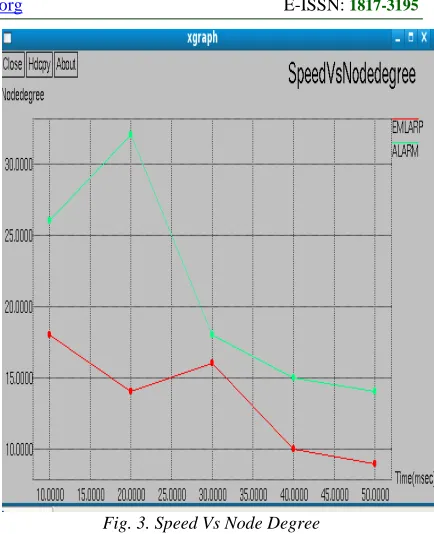
Fig. 3, presents the comparison of node degree It is clearly shown that the node degree of EMLARP has low overhead than the ALARM.
Fig. 3. Speed Vs Node Degree
Figure 4 shows the results of Time Vs End to end delay. From the results, we can see that EMLARP scheme has slightly lower delay than the ALARM scheme because of stable routes.
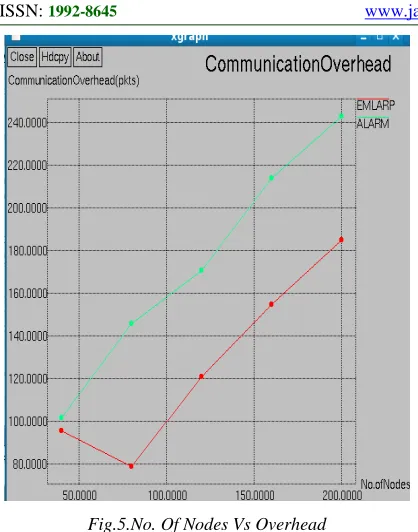
[image:7.612.92.547.382.654.2]Fig.5.No. Of Nodes Vs Overhead
[image:8.612.91.299.401.652.2]Fig. 5, presents the comparison of overhead while varying the nodes from 0 to 200. It is clearly shown that the of EMLARP has low overhead than the ALARM method.
Fig.6. Throughput Vs Packet Delivery Ratio
Figure 6 show the results of average packet delivery ratio for the simulation time 10, 20…50 secs for the 200 nodes scenario. Clearly our EMLARP scheme achieves more delivery ratio
than the ALARM scheme since it has both multipath routing and cluster enhancement features.
5.
CONCLUSIONDue to high dynamic nature of MANET, node location is not able to obtain quickly. To resolve this several schemes proposed node location procedure. But this does not contain multipath routing and cluster enhancement. In the proposed protocol, cluster enhanced multipath routing is to overcome the problem of network unbalancing and node failures. In second phase, multipath routing is predicted and route request messages are broadcasted to attain set of node disjoint paths. In last, node location is update to achieve high packet delivery rate. The proposed protocol EMLARP achieves better performance than existing schemes. In future, we have planned to implement power aware routing procedure with our protocol to consume minimum power.
REFERENCES :
[1] Wen-Hwa Liao , Jang-Ping Sheu and Yu-Chee Tseng, “GRID: A Fully Location-Aware Routing Protocol for Mobile Ad Hoc Networks”, Telecommunication Systems, 2001, Vol.18, No.1, pp.37-60.
[2] Mohammad A. Mikki, “ Energy Efficient Location Aided Routing Protocol for Wireless MANETs”, International Journal of Computer Science and Information Security, Vol. 4, No. 1 & 2, 2009, pp.1-9.
[3] Sourabh Pandey and Rajender Singh Yadav, “ Study of Location Based Energy Efficient AODV Routing Protocols In MANET”, International Journal of Engineering Inventions, 2013, Vol.3, No.2, pp.1-5.
[4] Gang Wang and Guodong Wang, “An Energy-Aware Geographic Routing Protocol for Mobile Ad Hoc Networks”, Inernational Journal of Software Informatics, Vol.4, No.2, June 2010, pp. 183-196.
[5] Jubin Sebastian E , Sreeraj V.R, Tauheed Ul Islam, “ Location Based Opportunistic Routing Protocol for Mobile Ad Hoc Networks”, American Journal of Engineering Research, Volume-01, Issue-01, pp-16-21. [6] Karim El Defrawy and Gene Tsudik,
[7] Dr. P.K.Suri1, Dr. M.K.Soni2 and Parul Tomar3, “Framework for Location Based Power Aware Routing in MANET”, International Journal of Computer Science Issues, Vol. 8, Issue 3, May 2011, pp.461-466. [8] Namrata Marium Chacko, 2Getzi P.
Leelaipushpam, “A reactive protocol for privacy preserving using location based Routing in MANETs”, International Journal of Computer Science and Network, Vol 2, Issue 2, 2013, pp.108-113.
[9] Sonam Jain and Sandeep Sahu, “ Topology vs Position based Routing Protocols in Mobile Ad hoc Networks: A Survey”, International Journal of Engineering Research & Technology (IJERT), 2012, Vol.1, No.3, 2012, pp.1-11.
[10]Young-Bae Ko and Nitin H. Vaidya, “Location-Aided Routing (LAR) in mobile ad hoc networks”, Wireless Networks, Vol.6 2000, pp.307-321.
[11]Geetam S. Tomar, “Position Based Routing for Wireless Mobile Ad Hoc Networks”, IJSSST, Vol.10, No.1, pp.10-15.
[12]Indu Kashyap & 1R.K. Rathy, “ An Efficient Location based Reactive Multi-path Routing Protocol for MANET”, International Journal of Computer Applications (0975 – 8887) Volume 40– No.9, 2012, pp.24-29.
[13]V.N.Sastry and P.Supraja, “Location-Based Associativity Routing for MANET”, IEEE Conference, 2005, pp.1-8.
[14]Mr. Varun Mishra, Mr. Gajendra Sonker, “Energy Aware and Multipath base Reliable Communication in MANET”, International Journal of Innovative Research in Computer and Communication Engineering, 2013, Vol. 1, Issue 5, pp.1149-1156.
[15]Xu Lin and Ivan Stojmenovic, “Location-based localized alternate, disjoint and multi-path routing algorithms for wireless networks”, Journal of parallel and distributed computing, science direct, 2003, Vol.63, pp.22-32.
[16]Swades De, Chunming Qiao and Hongyi Wu, “Meshed multipath routing with selective forwarding: an efficient strategy in wireless sensor networks”, Elseiver, Computer Networks, 2003, Vol.23,pp. 481–497.