© 2016, IRJET | Impact Factor value: 4.45 | ISO 9001:2008 Certified Journal | Page 431
Static Stress Analysis of Functionally Graded Circular Cylindrical Shell
Subjected to Internal Pressure
Akshaya Awari
11
Akshaya Awari, PG student, Department of Civil Engineering, S.S.D.G.C.T.’s Sanjay Ghodawat Group of Institutions
Atigre, Kolhapur– 416118, Maharashtra, India
---***---Abstract –
In this paper, a functionally graded circularcylindrical shell is studied under the internal pressure. For various arrangements of stiffeners the FGM circular cylindrical shell is studied for its deflection and the von-Mises stresses are analyzed.. Analytical modeling is based on first order shear deformation theory (FOST) [1, 2] and a finite element computational tool ABAQUS [3] is used to model the FGM cylindrical shell. Material properties are estimated by power law index.
Key Words: FGM, ABAQUS, Analytical solution, von-Mises
stresses, Circular Cylindrical shells
1. INTRODUCTION
Functionally graded materials(FGMs) are a class of composite materials that have been taken into consideration in the last two decades because of their special performance compared with conventional materials. FGMs are inhomogeneous materials made from different phases of material constituents, usually ceramic and metal, and their material properties change gradually along a certain direction, usually in the thickness one. The term FGM was originally presented in the 1984 by a group of scientists in Japan when they conducted research into materials that are resistant to extremely high temperatures for aircrafts and aerospace applications. Due to particular characteristics of functionally materials, these can resist high temperatures in various environments.
Shell structures are widely used in industrial applications such as deep drawing, roll forming and pressure vessels. With the increase in demand, FGMs have been widely used in general structures. Hence many functionally graded (FG) structures have been extensively studied, such as FG plates, FG cylindrical shells.
Many researchers are being working on Functionally Graded material. FGM Stiffened shells are used in several engineering applications to improve efficiency of the structures in terms of strength/weight. A.S. Oktem, J.L. Mantari, C. Guedes Soares [4] carried out the static analysis of FGM plates and doubly curved shells using a higher order deformation theory. Erasmo Viola, Francesco Tornabene,
Nicholas Fantuzzi [5] studied the static analysis of doubly curved laminated shells and panels using 2D higher order shear deformation theory. Dao Huy Bich, Dao Van Dung, Vu Hoai Nam, Nguyen Thi Phuong [6] carried out the nonlinear static and dynamic buckling analysis under axial compression ,GDE are derived and is solved by Galerkin procedure to obtain static critical buckling load and the nonlinear dynamic responses are found by fourth order Runge-Kutta method. J.L. Mantari, E.V. Granados [7] studied the static analysis of FG sandwich plates using new first order shear deformation theory. S.M.Shiyekar, Prashant Lavate [8] carried out bending analysis of FG plates using FEM computational tools ABAQUS. Ankit Gupta, Mohammad Talha [9] presented an overview of recent development in modeling and analysis of FGM and structures. M. Memar Ardestani, B. Soltani, Sh. Shams [10] carried out the analysis of stiffened FGM plates using first order shear deformation theory. Erasmo Viola, Luigi Rossetti, Nicholas Fantuzzi [11] analyzed the FGM Conical shells and panels subjected to meridian, circumferential and normal uniform loadings using 2D unconstrained third order shear deformation theories. Dao Huy Bich, Dao Van Dung, Vu Hoai Nam [12] studied the nonlinear dynamic analysis of an eccentrically stiffened FGM cylindrical panel based on classical shell theory with geometric nonlinearity in Von Karman- Donnell sense. Erasmo Viola, Luigi Rossetti, Nicholas Fantuzzi [13] presented the numerical investigation of FGM cylindrical shells subjected to mechanical loadings by using 2D unconstrained third order shear deformation theory.Ebrahim Asadi, Wenchao Wang, Mohamad S. Qatu [14] studied the exact static and free vibration solutions for isotropic and symmetric and anti-symmetric cross-ply cylindrical shells for different length to thickness and length to radius ratios.
2. FORMULATION OF FSDT
1.1 Introduction
© 2016, IRJET | Impact Factor value: 4.45 | ISO 9001:2008 Certified Journal | Page 432
not similar with the Mindlin theory like erroneousperception of many researchers through the use of misleading descriptions such as “Reissner-Mindlin plates” and “FSDT of Reissner”.The major difference between two theories was established by Wang et al. by derivating the bending relationships between Mindlin and Reissner quantities for a general plate problems. Since the Reissner theory was based on the assumption of a linear bending stress distribution, its formulation will inevitably lead to the displacement variation being not necessarily linear across the plate thickness. Thus, it is incorrect to refer to the Reissner theory as the FSDT which implies a linear variation of the displacements through the thickness. Another difference between two theories is that the normal stress which was included in the Reissner theory was omitted in the Mindlin.
The FSDT was used to model FG shells. Reddy and Chin [17] studied the dynamic response of FG cylinders and plates subjected to two different types of thermal loadings using the FSDT and the finite element method.
1.2 Definition of displacement field
(1a)
In the above relations, the terms and are the displacements of a general point ( ) in the domain in x, y and z directions respectively. The parameters are the inplane displacements and is the transverse displacement of a point (x, y) on the element middle plane. The functions are the rotations of the normal to the element middle plane about y- and x-axis respectively.
1.3 Strain- displacement relations
With the definition of strains from the linear theory of elasticity, assuming , the general strain-displacement relations in the curvilinear co-ordinate system are given as follows:
Substituting the expressions for displacements at any point within the space given by Eqs. (1a) for the displacement models considered herein, the linear strains in terms of middle surface displacements, for each displacement model can be obtained as follows:
Where,
1.4 Stress-strain relations and stress resultants
Assuming the principal material axes (1,2,3) and the shell axes (x,y,z) in the curvilinear co-ordinate system ,the three dimensional stress-strain relations for an cylindrical shell with reference to the principal material axes for the theory to be developed based on the displacement are defined as follows:
(2a)
Where,
, ,
, ,
, ,
These equations in compacted form may be written as
© 2016, IRJET | Impact Factor value: 4.45 | ISO 9001:2008 Certified Journal | Page 433
(2b)These equations in compacted form may be written as
in which the coefficients of the Q matrix, called as reduced elastic constants are defined in Appendix A.
The components of the strain vector and the corresponding components of the stress- resultant vector are defined as follows:
1.5 Equilibrium equations
For equilibrium equations, the total potential energy must be stationary and using the definitions of stress-resultants and mid-surface strains stated in above sections principal of virtual work yields
Where, U is the strain energy and W represents the work done by external forces. These are evaluated as follows:
(3a)
Integration through thickness and by substituting in terms of strains and introducing stress resultants, the above relations transform in the following form
(3b) In the above equation is the distributed transverse load. The governing equations of equilibrium can be derived from eq. (3b) by integrating the displacement gradients in mid surface strains by parts and setting the coefficients of derivatives of mid-surface displacements to zero separately. Thus one obtains the following equilibrium equations.
(3c)
In addition following line integrals are also obtained
(3d)
1.6 Closed form solutions
Sinusoidal variation of transverse load is considered as under:
, in which a and b are the dimensions of shell middle surface along the x and y axes respectively. The exact form of spatial variation of mid-surface displacements is given by
© 2016, IRJET | Impact Factor value: 4.45 | ISO 9001:2008 Certified Journal | Page 434
(4a)
Substitution of Eq.(3d) and series of Eq. (4a) into Eq.(3c) yields a set of linear algebraic equations in terms of the unknown amplitudes
.These equations can be expressed in matrix form as
Here , and F are given in Appendix B.
3. NUMERICALS AND RESULTS
In this paper, a FGM(a,b,c) circular cylindrical shell is studied when it is subjected to internal pressure of 20KN/m2 .where a,b,c are vibrational parameters through which the volume of ceramic changes throughout the thickness of the shell. Here we have analyzed the simply supported FGM1,1,4 circular cylindrical shell having dimensions R=500mm,L=1000mm. The shell is studied for different arrangements of stiffeners:
ARRANGEMENT A: Longitudinal (external) stiffeners
Fig 1
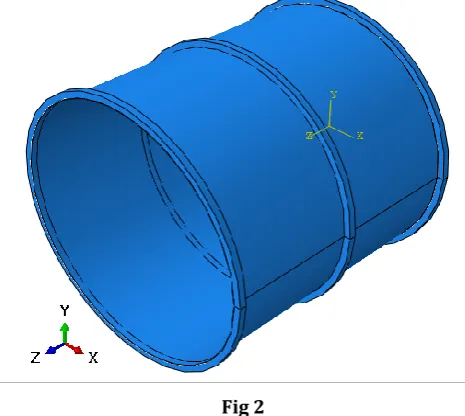
ARRANGEMENT B: Ring (external) stiffeners
Fig 2
ARRANGEMENT C: Ring (internal) stiffeners
Fig 3
[image:4.595.312.545.146.354.2] [image:4.595.41.262.464.684.2]© 2016, IRJET | Impact Factor value: 4.45 | ISO 9001:2008 Certified Journal | Page 435
Table1. Showing the results of FGM1,1,4 circularcylindrical shell subjected to internal pressure.
Pow er law inde x(p)
Type of
stiffeners displacMax. ement
Max. S-Miss
es stres
ses Max. norma l stresse
s(S11)
Max. norma
l stresse
s(S22)
Max. shear stresse s(S12)
P=0 Longitudinal
(external) 0.25055 4e02 5.43 5.573e02 2.567e02 1.288e02
Ring(extern
al) 0.34285 9e02 5.21 5.070e02 4.725e02 1.944e02
Ring(interna
l) 0.19015 4e02 5.16 4.906e02 3.925e02 2.106e02
P=0.
2 Longitudinal(external) 0.39585 8e02 5.60 5.750e02 2.674e02 1.328e02
Ring(extern
al) 0.32645 6e02 5.38 5.232e02 4.872e02 2.007e02
Ring(interna
l) 0.47855 9e02 5.32 5.062e02 4.052e02 2.174e02
P=2 Longitudinal
(external) 0.5815 8e02 6.80 6.976e02 3.424e02 1.612e02
Ring(extern
al) 0.548 0e02 6.55 6.364e02 5.896e02 2.448e02
Ring(interna
l) 0.2175 2e02 6.48 6.153e02 4.941e02 2.646e02
P=5 Longitudinal
(external) 1.9045 0e02 7.58 7.765e02 3.899e02 1.795e02
Ring(extern
al) 0.3972 1e02 7.28 7.075e02 6.546e02 2.724e02
Ring(interna
l) 0.631 5e02 7.20 6.838e02 5.498e02 2.942e02
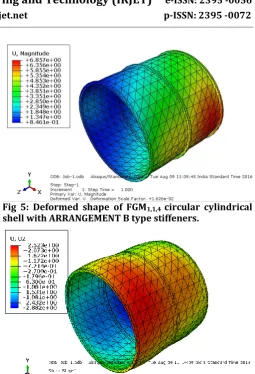
The deformed shapes of FGM1,1,4 are shown in fig 4,fig 5 and fig 6 for ARRANGEMENT A ,ARRANGEMENT B and ARRANGEMENT C respectively.
Fig 4: Deformed shape of FGM1,1,4 circular cylindrical
shell with ARRANGEMENT A type stiffeners.
Fig 5: Deformed shape of FGM1,1,4 circular cylindrical
shell with ARRANGEMENT B type stiffeners.
Fig 6: Deformed shape of FGM1,1,4 circular cylindrical
[image:5.595.306.562.56.431.2]shell with ARRANGEMENT C type stiffeners.
[image:5.595.62.297.106.486.2] [image:5.595.307.561.512.706.2] [image:5.595.37.261.555.743.2]© 2016, IRJET | Impact Factor value: 4.45 | ISO 9001:2008 Certified Journal | Page 436
Fig 8: von-Mises max stresses vs. power law index [image:6.595.34.282.71.289.2]Fig 9: von-Mises normal S11 stresses vs. power law index
[image:6.595.38.280.332.523.2]Fig 10: von-Mises normal S22 stresses vs. power law index
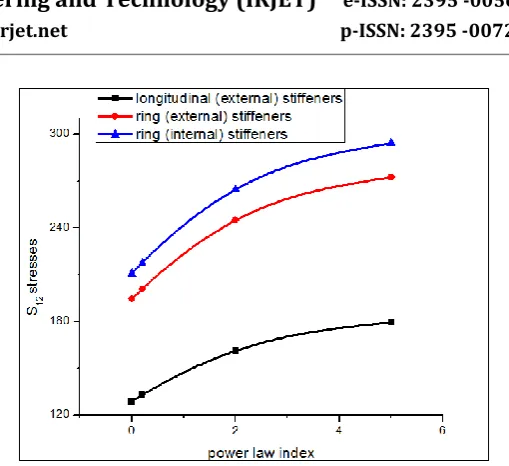
Fig 11: von-Mises shear S12 stresses vs. power law index
4. CONCLUSIONS
Functionally graded circular cylindrical shell when subjected to internal pressure, the ring (internal) stiffeners arrangement shows lowest S-Misses stresses while the longitudinal (external) stiffeners shows lowest shear stresses. The ring (internal) stiffener shows lesser deflection for power law index p= 0,2,5 but increases gradually for power law index p=1.The non-dimensional deflection increases as the power law increases.
ACKNOWLEDGEMENT
I acknowledge with thanks to faculty, teaching and non-teaching staff of the department, Structure Research library and Colleagues Mr.Dhananjay D. Patil for constant support to complete this work.
REFERENCES
[1] Huu-Tai Thai, Dong-Ho Choi, “A simple first-order shear
deformation theory for laminated composite plates” ,Composite Structures106(2013)754-763
[2] Schurg M,Wagner W.,Gruttmann F.,”An enhanced FSDT
model for the calculation of interlaminar shear stresses in composite plate structures” ,Compt Mech(2009)44:765.doi:1007/s00466-009-0410-7
[3] ABAQUS User’s Manual (2003). ABAQUS Version.6.10 [4] A.S.Oktem, J.L. Mantari, C. Guedes Soares, “Static
[image:6.595.37.277.557.744.2]© 2016, IRJET | Impact Factor value: 4.45 | ISO 9001:2008 Certified Journal | Page 437
theory” ,European Journal of Mechanics A/Solids36(2012)163-172
[5] Erasmo Viola, Francesco Tornabene, Nicholas Fantuzzi,
“Static analysis of completely doubly-curved laminated shells and panels using general higher-order shear
deformation theories” ,Composite
Structures101(2013)59-93
[6] Dao Huy Bich, Dao Van Dung, Vu Hoai Nam, Nguyen Thi
Phuong, “Nonlinear static and dynamic buckling analysis of imperfect eccentrically stiffened functionally graded circular cylindrical thin shells under axial compression” ,International Journal of Mechanical Sciences74(2013)190-200
[7] J.L. Mantari, E.V.Granados, “A refined FSDT for the static
analysis of functionally graded sandwich plates” ,Thin-Walled Structures90(2015)150-158
[8] S.M.Shiyekar, Prashant Lavate, “Flexure of power law
governed functionally graded plates using ABAQUS UMAT” ,Aerospace Science and Technology 46(2015)51-59
[9] Ankit Gupta,Mohammad Talha, “Recent development in
modeling and analysis of functionally graded materials and structures” ,Progress in Aerospace Sciences
[10] M. Memar Ardestani, B.Soltani, Sh. Shams, “Analysis of
functionally graded stiffened plates based on FSDT utilizing reproducing kernel particle method” , Composite Structures112(2014)231-240
[11] Erasmo viola, Luigi Rossetti, Nicholas Fantuzzi,
Francesco Tornabene, “Static analysis of functionally graded conical shells and panels using the generalized unconstrained third order theory coupled with the stress recovery” ,Composite Structures112(2014)44-65
[12] Dao Huy Bich, Dao Van Dung, Vu Hoai Nam, “Nonlinear
dynamical analysis of eccentrically stiffened functionally graded cylindrical panels” ,Journal of Composite Structure 94(2012)2465-2473
[13] Erasmo Viola, Luigi Rossetti, Nicholas Fantuzzi,
“Numerical investigation of functionally graded cylindrical shells and panels using the generalized unconstrained third order theory coupled with the stress recovery” ,Composite Structures94(2012)3736-3758
[14] Ebrahim Asadi, Wencho Wang, Mohamad S. Qatu, “Static
and vibration analyses of thick deep laminated cylindrical shells using 3D and various shear deformation theories” ,Composite Structures94(2012) 494-500
[15] R. D. Mindlin, “Influence of rotatory inertia and shear on
flexural motions of istotropic elastic plates”, Journal of Applied Mechanics. (1951) 31–38
[16] E. Reissner, “The effect of transverse shear deformation
on bending of elastic plates”, Journal of Applied mechanics. 12 (1945) 69 – 77.
[17] Reddy,Chin , “Thermomechanical analysis of functionally
graded cylinders and plates”, Journal of Thermal stresses 21(6),593-626
[18] Timoshenko SP, Woinowsky-Krieger S. Theory of plates