© 2017, IRJET | Impact Factor value: 5.181 | ISO 9001:2008 Certified Journal
| Page 1558
Optimum Relay Node Selection in Clustered MANET
Priyanka Badyal
1, Dr. Shuchita Upadhyaya
21
Research Scholar, Department of Computer Science & Applications, Kurukshetra University, Kurukshetra, India
2Professor, Department of Computer Science & Applications, Kurukshetra University, Kurukshetra, India
Abstract
: A mobile ad hoc network contains mobile nodesthat are associated with each other by means of wireless links. Frequent change in the topology and energy constraint are the main issues in MANET. Clustering helps in organising network topology in MANET up to a great extent and it also improves the performance of the network. This paper focuses on optimal selection of relay nodes that helps in forwarding the packets from source to destination. Therefore selection of cluster head and gateway node is done on basis of maximum remaining energy and minimum distance that eventually leads to low energy consumption in the network. Further comparison is performed on the basis of energy consumption, packet delivery ratio and throughput.
Key Words: Clustering, Gateway selection, Path
selection, Energy Conservation, Mobile ad hoc network
1. INTRODUCTION
A mobile ad hoc network is formed by collection of mobile nodes without any fixed infrastructure. It is self-configured network in which each node can communicate with another node using multi hop wireless links in its radio communication range. Each node can move independently, so network topology changes rapidly. Clustering helps in organising network topology up to a great extent by partitioning the network into clusters. Clusters are formed depending on the similar properties of the nodes. Efficient energy conservation plays a vital role in cluster formation, it helps in increasing the performance of MANET by increasing packet delivery ratio and throughput.
Cluster network contains three type of nodes.
i) Cluster Head- It is a local co-ordinator of cluster. It performs intra-cluster routing, packet forwarding etc. A cluster head does the resource management for its cluster members and perform inter-cluster and intra- cluster communication.
ii) Cluster Members- These are the ordinary nodes that exist as immediate neighbour of cluster head.
iii) Cluster Gateway-A cluster gateway is a non-cluster head node with inter-non-cluster links. It can access neighbouring clusters and exchanges cluster-related information between two clusters. It act as a common or distributed access point between two cluster head.
Some of the clustering algorithms are studied such as Low-energy adaptive clustering hierarchy algorithm, Hybrid energy efficient distributed clustering algorithm, Lowest ID clustering algorithm, Mobility based Metric clustering algorithm, Greedy perimeter stateless routing algorithm, Highest degree based clustering algorithm, Flexible weight based clustering algorithm, Flexible weight based clustering algorithm based on battery power, Enhance cluster-based Energy Conservation Algorithm [3][11][12] which focuses on selection of cluster head on basis of various parameters like mobility, lowest ID, distance velocity, highest degree.
The work carried out in this paper focuses on the selection of cluster head on basis of maximum remaining energy and selection of gateway node on basis of minimum distance from respective cluster head which further helps in low energy consumption in the network. The paper is organised as follows: Section 2 provides a review of literature that are related to different kind of clustering approaches, cluster head election and gateway discovery, Section 3 describes the proposed work for the selection of relay nodes. Section 4 discusses the results of the proposed work and Section 5 discusses the concluding remarks and the future scope of the paper.
Cluster member
(Ordinary node)
© 2017, IRJET | Impact Factor value: 5.181 | ISO 9001:2008 Certified Journal
| Page 1559
2. RELATED WORK
There are various algorithms that are related to clustering approach based on different parameters like velocity, movement pattern, distance and remaining energy of selecting a cluster head and a gateway node. These are described as follows:
Wang Ji Lu and Yu Zhen Wei [2] evaluated MANET system survivability by first improving the typical grey relation analysis method and then establishing the quantitative model. The quantitative evaluation method depends upon the network entropy difference. Further simulation is done by first setting up the experimental environment and then collecting data to evaluate the proposed method. Results show that the proposed method effectively evaluate the MANET system survivability.
InnEr et. al [4] proposed a MobDHop i.e. d-hop clustering algorithm for mobile ad hoc network that depends on mobility. A new metric is introduced to estimate the relative mobility of nodes by measuring the distance between nodes. Diameter of cluster is not limited to two hopes rather it is flexible and stability of cluster is determined by varying diameter. Simulation results show that mobility based d-hop clustering algorithm provides stable performance and hence can address scalability of routing protocol in large MANETs.
Gupta et. al [7] proposed an improved weighted clustering algorithm to form clusters. For evaluating the trustworthiness of nodes an automated trust management scheme is proposed that helps in detecting the malicious nodes and then removing them from the cluster heads and cluster members is also included. Parameters like packet drop rate, packet modified rate and packet misroute rate are considered for determining the trustworthiness of nodes. Simulation results show that the proposed approach performs better than the previous approaches.
J. John and P. Lakshmi [5] focused on optimal energy consumption and stability of nodes in a mobile ad hoc network by using Ant Colony Optimization. It helps in optimal selection of cluster head by improving the network lifetime, communication workload and mobility of the nodes. Cluster heads are selected on the basis of defined probability function i.e. the node that has the maximum value for the probability function is elected as cluster head, parameters like remaining energy, energy rate and mobility are considered for the same. The proposed approach results in more energy efficient and stable clusters.
M. Gavhale and P. D. Saraf [1] focused on the comparison between various clustering algorithms like Lowest ID(LID), Highest Degree(HD), LEACH(Low Energy Adaptive Clustering Hierarchy) for efficient cluster formation and cluster head selection by considering
various parameters like battery life, packet delivery ratio, speed, delay.
Govil et. al [10] proposed an efficient cluster head selection technique on the basis of energy conservation in mobile ad hoc network. Factors like battery power consumption and neighbour mobile node connectivity level are considered. This paper includes k mobile nodes and k batteries. That node is selected as the cluster head which has the minimum difference between sum (battery level point and connectivity level) and average from cluster selection table.
Manjula S and Suresha [6] used a mutimedoid grouping technique for the formation of clusters and for selecting cluster head. Grouping in ad hoc network decreases probability of intervention, increases competence and whole network throughput. Quality of service is achieved by selecting a suitable gateway. For service discovery, reactive routing approach is used and for routing IAODV protocol is used. Performance is evaluated by considering end to end delay, total packet delivery ratio and total power consumption. Simulation results show that the proposed algorithm shows better results than existing methods.
Young-jun Oh and Kang-whan Lee [3] proposed an advance energy-conserving optimal path schedule (A-ECOPS) algorithm by using the relative angle between the node and the coverage employed for selecting the intermediate node. Relative angle is the distance between source node and the base station, distance ratio is considered between them.
Rafi U Zaman and Khaleel ur Rahman Khan [9] focused on adaptive gateway discovery in heterogeneous network and addresses internet integrated MANET. Proactive, reactive and hybrid gateway discoveries are discussed. In this paper, two important parameters are used that are TTL value calculation method and GW_ADV periodicity calculation method.
3. PROPOSED WORK
The implementation is divided into the following steps: Network deployment
Cluster formation Path selection I. Network deployment
In this module, all the nodes are randomly deployed in the
network area. In MANET, the nodes are mobile so the network topology is dynamic in nature. The ordinary nodes forwards their data only to cluster heads.
Mobility
© 2017, IRJET | Impact Factor value: 5.181 | ISO 9001:2008 Certified Journal
| Page 1560
resembles the behaviour of mobile nodes. This modelhelps in accessing the movement of mobile nodes and also shows how their velocity, acceleration and location changes over time.
II. Cluster formation
In this module, clusters are formed to generate a random clustered network. It includes initial cluster creation, selecting the head of the cluster and then selecting the gateway of cluster.
Initial clustering
This module contains partitioning the whole network into distributed clusters that will cover all the mobile nodes in the network and further the whole network. Nodes which have similar properties belong to a particular cluster.
Cluster head selection
Various parameters are considered for the election of cluster head like the remaining energy, relative position of the node in the network, no. of devices connected, ID, weight, density and throughput of the node in several papers [6]. In this section, main focus is on optimal selection of cluster head as cluster head act as relay node for forwarding the packets from source to destination. Cluster head election is done on basis of remaining energy of the node as the node which has the maximum remaining energy helps in enhancing the performance of the network. Therefore is elected as the cluster head of that cluster and is preferable over that node which has less remaining energy. Higher remaining energy node will increases network lifetime. In entire network, energy is assigned to each and every node in the cluster until it covers all the nodes in the network. According to the energy distribution in a cluster, cluster head is elected i.e. the node with the maximum remaining energy is considered as the cluster head. A node in the cluster have to give highest priority to the cluster head as compared to the other nodes in the cluster.
Gateway selection
The main focus here is on reducing the energy consumption. As energy consumption increases with increase in distance [3] so to reduce energy consumption distance has to be decreased therefore optimal selection of relay nodes is essential. Gateway nodes act as relay nodes as they help in forwarding the packets. Therefore in a cluster, gateway node of source cluster is selected on basis of minimum distance from the destination cluster head and similarly gateway of destination cluster is selected which further helps in reducing energy consumption in whole network. In this part, first of all distance of each node in source cluster to destination cluster head is calculated and then the node which has minimum distance from destination cluster head is elected as gateway node of source cluster. Similarly in case of choosing destination gateway, distance of each and every node in the destination cluster to the source
cluster head is calculated and node which has minimum distance from source cluster head is elected as the gateway node of the destination cluster. In this way gateway of source and destination clusters are selected. The further route discovery is done in the next step to reach to the destination.
III. Path selection
Path selection depends on the path discovery. Main objective of path selection is to select an optimal path that consumes less energy and that minimises the control overhead. After specifying the source and the destination, path selection procedure starts. Path with the low energy consumption is preferred. Path selection is based on two type of communication i.e. intra–cluster communication and inter-cluster communication.
o Intra-cluster communication
The communication inside the cluster is termed as intra-cluster communication. The source node sends packet to the cluster head of that cluster and then cluster head sends packet
Inter-cluster communication
o Inter-cluster communication
The communication between two clusters is termed as inter-cluster communication. For that the source node forwards packet to the selected cluster head of that cluster which then forwards to the gateway node to be delivered to destination cluster. The gateway of source cluster sends the packet to the gateway of destination cluster which then forwards it to the selected cluster head of that cluster and eventually it reaches the destination node.
Sel. Path= {S-CH(S)-G(S)-G(D)-CH(D)-D}
Where S, D, CH and G stands for source, destination, cluster head and gateway node.
4. SIMULATION RESULTS
The proposed simulation is implemented in MATLAB 7.10.0 for windows xp. The simulation comprises of 50 portable mobile nodes. The comparison between the Service Discovery in Clustered MANET and Internet [6] approach and proposed approach is also depicted in the figure below.
Simulation parameters
© 2017, IRJET | Impact Factor value: 5.181 | ISO 9001:2008 Certified Journal
| Page 1561
TABLE I. SIMULATION PARAMETERSS. No. Simulation
parameters Value
1 Simulation area 100x100 2 Total no. Of nodes 50 3 Simulation time 10s 4 Mobility model Random
[image:4.595.31.283.122.401.2]waypoint 5 Pause time 0.8s 6 Packet size 4000 bits 7 No. of clusters 3
Fig.2 The result of the clustering shows there are three clusters in the network.
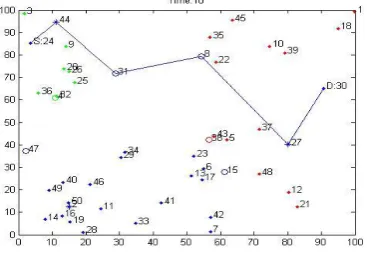
[image:4.595.336.531.465.703.2]The source and destination are chosen and then respective cluster heads and gateway nodes are selected and then through inter-cluster communication optimal path is selected.
Fig.3 Path Selection from source to destination.
From the result of the proposed work as shown in Fig.3 path selection is depicted at the maximum simulation time 10s.. The path selected consumes less energy than the base [6] approach.
Fig.4 Relation between number of packets and the simulation time.
The ratio of total number of packets sent to the total number of packets receive in simulation time 10s ia shown in Fig.4
Comparative analysis
In this paper, comparative analysis is done on the basis of three metrices- packet delievery ratio, throughput and energy consumption. Fig. 5 shows the comparison of packet delivery ratio of the Service Discovery in Clustered MANET and Internet [6] approach and the proposed approach. The results demonstrates that our proposed calculation performs better.
1. Packet Delivery Ratio – It is the ratio of total packets successfully received to the total packets sent in the maximum simulation time. In this paper, the packet delivery ratio of the proposed approach that is calculated to be 84.0000 is compared with the base approach [6] that is calculated to be 76.5556 and the graph related to this is shown below in Fig. 5.
Fig. 5 Packet Delivery Ratio (PDR) comparison [6].
[image:4.595.68.252.505.633.2]© 2017, IRJET | Impact Factor value: 5.181 | ISO 9001:2008 Certified Journal
| Page 1562
approach in terms of packet delivery ratio is shown inFig.5. Clearly PDR is greater in proposed approach so it gives better results.
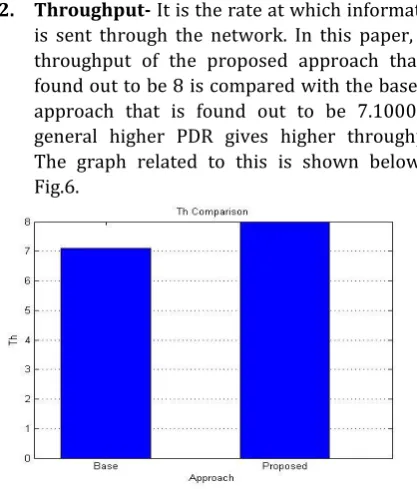
[image:5.595.55.264.144.389.2]2. Throughput- It is the rate at which information is sent through the network. In this paper, the throughput of the proposed approach that is found out to be 8 is compared with the base [6] approach that is found out to be 7.1000, in general higher PDR gives higher throughput. The graph related to this is shown below in Fig.6.
Fig. 6 Throughput comparison [6].
The comparison of throughput between Service Discovery in Clustered MANET and Internet [6] approach and proposed approach is shown. Clearly the proposed approach gives higher throughput, therefore it performs better.
3. Energy Consumption- In this paper, energy consumption is the main factor which effects the selection of the cluster head and gateway node that further effects the selection of path, so it is considered as a critical issue. If the selected path consumes more energy than it does not perform well compared to that path which consumes less energy.
Fig. 7 Energy consumption [6].
From Fig.7 Energy consumed in Service Discovery in Clustered MANET and Internet [6] approach is found out to be 0.0233 whereas in proposed it is found out to be 0.0023 which is less than the former approach. Clearly in proposed work, energy consumption is less, therefore it is more efficient.
5. CONCLUSION AND FUTURE WORK
The proposed approach provide a more efficient cluster head and gateway election approach as it selects the optimal relay nodes for forwarding the packets from source to destination by considering the parameters like energy consumption, packet delivery ratio and throughput. Performance of Service Discovery in Clustered MANET and Internet [6] approach is also compared with proposed approach and our simulation results show that the proposed approach performs better in terms of energy consumption, throughput and packet delivery ratio. In this paper our main focus is on selecting cluster head on basis of remaining energy and on selecting gateway node on basis of minimum distance from respective cluster head. In future real time testing can be done and work on QoS features like cost, bandwidth can be performed. Work on security feature can also be done.
REFERENCES
[1] M. Gavhale and P. D. Saraf,”Survey on Algorithms for Efficient Cluster Formation and Cluster Head Selection in MANET”, International Conference on Information Security and Privacy, pp. 477-482, 2016. [2] Wang Ji Lu and Yu Zhen Wei,”Research on
Evaluation of the MANET System Survivability”, Elsevier Journal of Procedia Environmental Sciences, vol.10, pp. 51-57, 2011.
[3] Young-jun Oh and Kang-whan Lee, “Energy-efficient and reliable routing protocol for dynamic-property-based clustering mobile ad hoc networks”, International journal of Distributed Sensor Networks, vol. 13(I), 2017.
[4] I. I. Er, W.K.G. Seah,”Mobility based d-hop clustering algorithm for mobile ad hoc networks”, IEEEWCNC, 2004, pp 2359-2364. [5] J. John and P Lakshmi, ”A reliable optimized
© 2017, IRJET | Impact Factor value: 5.181 | ISO 9001:2008 Certified Journal
| Page 1563
communication and signal processing, 2014,pp 51-55.
[6] Manjula S and Suresha,”Service Discovery in Clustered MANET and Internet”, International Conference on Computational System and Information System for Sustainable Solutions, 2016, pp 204-209. [7] N Gupta, R.K.Singh and
M.Shrivastava,”Cluster Formation through Improved Weighted Clustering Algorithm (IWCA) For Mobile Ad-hoc Networks”, IEEEWOCN, 2013, pp 1-5.
[8] Sunil Pathak and Sonal Jain, “An Optimized stable clustering algorithm for mobile ad hoc networks”, EURASIP Journal on Wireless Communications and Networking, 2017.
[9] Rafi U Zaman, Khaleel ur Rahman Khan, ”A Survey of Adaptive Gateway Discovery Mechanisms in Heterogeneous Networks”, 10.5815/ijcnis.2013.07.04.
[10] K.Govil, S. K. Gupta and A. Agarwal, “Cluster Head Selection Technique for Optimization of Energy Conservation in MANET”, International Conference on Parallel, Distributed and Grid Computing, 2014, pp. 39-42.
[11] Alinci et al. , ”Improving Reliability of cluster nodes in MANETs: A Fuzzy-Based Approach”, International Conference on Advanced Information Networking and Applications Workshops, 2016, pp. 577-584.