www.arpnjournals.com
IMPLEMENTATION OF BLUETOOTH COMMUNICATION IN DEVELOPING
A MOBILE MEASURING DEVICE TO MEASURE HUMAN FINGER
MOVEMENT
Alvin Jacob1,2, Wan Nurshazwani Wan Zakaria1,3 , Mohd Razali Bin Md Tomari1,4
1ADvanced Mechatronics Research Group (ADMIRE), Faculty of Electrical & Electronic Engineering, Universiti Tun Hussein Onn
Malaysia, 86400 Parit Raja, Batu Pahat, Johor, Malaysia
2 [email protected], 3 [email protected], 4 [email protected]
ABSTRACT
This paper focuses on evaluating and testing the usage of Bluetooth communication in a mobile measuring device to evaluate the flexion and extension of an athlete’s hand. This mobile measuring device is targeted for athlete that plays racket based sports, like Badminton which is a game that needs fast actions. For this sole reason human eyes are not enough to analyse the fast movement and an additional equipment is needed. This is where a solution is proposed, usage of a mobile measuring device that can capture the activities from the player’s hand. To maintain the mobility of the measuring device, wireless connection to a personal computer is used. The Bluetooth communication technology is used to send the data obtained from the player to a personal computer for further processing. The data will be later analysed by the coach or the player themselves to evaluate information on their performance. To evaluate the stability and feasibility of the develop communication protocol, experiments were conducted to measure the flexion of the player’s hand and send it through Bluetooth communication to a base station. The experiments result exhibits the capabilities of the Bluetooth communication in providing a wireless serial link between the transmitter and receiver for data transmission.
Keywords - Flex Sensor, Monitoring Device, Badminton, Bluetooth Communication
INTRODUCTION
Badminton can be considered as a fast racquet sport, this game requires extensive stamina and agility to be played. Badminton is played by either two opposing pairs (doubles) or two opposing players (singles), who position themselves on opposite halves of a rectangular court divided by a net (Grice, 2008). The sport of badminton probably originated more than 2000 years ago, where its origins in ancient civilizations in Europe and Asia and known as battledore (bat or paddle) and shuttlecock.
Battledore and Shuttlecock was simply a game where two people will hitting a shuttlecock backwards and forwards with a simple bat as many times as they could. They were considered as an upper class pastime in England and many European countries (Grice, 2008). Player’s score points by hitting the shuttlecock with their racquet over the net into their opponent’s half of the court. Each side may only strike the shuttlecock only once before it passes over the net. A point is gained as the shuttlecock has struck the floor on the opponent side. There have been many analysis done on the game itself to improve the rules and the game, but studies on tactics, strategy, or playing patterns of badminton players are however, very limited. Thus, the purpose of this study is to implement Bluetooth wireless communication into a mobile measuring device that is used to record a player’s finger extension and flexion and create an individual badminton player’s database on their personal way in grasping the badminton racket and in the way they play.
The data recorded from the player can also be used to prevent injuries caused by improper playing technique and fatigue, this alone will be beneficial to the performance of a player. Badminton is a fast sports and the human eyes are not designed to analyse all those fast movements. Current technology allows data collection with a high sample rate and a wide measuring range utilizing miniature sensors, this is because the light weight and small size of the sensors will not restrict the performance of the
badminton player (Jaitner & Gawin, 2007). Thus, the best method to capture all the data without hindering the player’s movement is by using wearable sensors.
Wearables sensors are sensors that can be attached to a human’s body to measure human movement and dynamics. To monitor this in a natural way there is a need for integrated sensors that are straightforward to use, comfortable to wear and wearable (Coyle, Morris, & Lau, 2009). Although monitoring and recording is important, there is a drawback in using wired connection for transferring the data from the player to personal computer for analysis. This method may hinders the movement of the player, thus Bluetooth communication is suggested and is implemented in the developed mobile measuring device.
HAND KINEMATICS
Continues analysis of the player’s movement is important but without the right information on which part of the player should be monitored, there will be an abundant of data that is needed to be analysed. To determine the parameter needed a kinematic model of a human hand is analysed. Kinematics is used to describe motion without consideration the forces acting on it, where a humans motion is projected in three dimensional position and all points of the body move along parallel path and have the same velocity and acceleration at any given instance (Vladimir M Zatsiorsky, 1998).
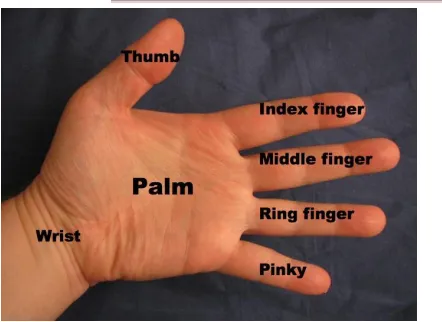
Figure 1: Human hand.
Based on Figure 1, the index finger, middle finger, ring finger and little finger except the thumb, all compose of four links and five DOFs. But the thumb has only three links and four DOFs and is much more complex because its movements also strongly involve the metacarpal bone. The dynamic of the index, middle and the ring finger would nearly be identical but measuring the thumb possess a challenge as there are more angle of movement and the joint has a larger DOFs that is needed to be measured.
Further analysis of a badminton training video by Nghia Tran on how a proper racket grip (Tran, 2010), revealed that the little finger is less utilised. Normally, the index, middle and ring fingers are used for grasping action.
BLUETOOTH COMMUNICATION TECHNOLOGY
Bluetooth technology is the global wireless standard enabling, convenient, secure connectivity for an expanding range of devices and services. It is an essential element for bringing everyday objects into the connected world (Group, 2014). Created by Ericsson in 1994, Bluetooth wireless technology was originally conceived as a wireless alternative to RS-232 data cables. Bluetooth technology exchanges data over short distances using radio transmissions. Bluetooth technology operates in the unlicensed industrial, scientific and medical (ISM) band at 2.4 to 2.485 GHz, using a spread spectrum, frequency hopping, full-duplex signal at a nominal rate of 1600 hops/sec (Group, 2014). The 2.4 GHz ISM band is available and unlicensed in most countries.
The Bluetooth wireless technology has been used in billions of products, from cars and mobile phones to medical devices and computers and even forks and toothbrushes for the past 10 years. Bluetooth technology not only provides a wireless serial connection between two paired device but it also allows you to share voice, data, music, photos, videos and other information wirelessly between paired devices.
Examples of data acquisition using Bluetooth wireless communication can be seen in the device developed by HongjinWang, which is a Portable Heart Rate Acquisition Instrument (Wang, Ren, Shi, Zhou, & Qian, 2011). The heart is a muscular organ in humans and other animals, which pumps blood through the blood vessels of the circulatory system. Hence, heart rate is closely related to the function and status of the human heart and is considered as the most important physiological parameters to human
[image:2.595.314.546.229.317.2]body, which reflects the body’s health in the aspects of cardiovascular, metabolism and mental (Wang et al., 2011). Advancement in technology has made detecting and monitoring heart rate more convenient as sensors are capable of sending the data obtained wirelessly for further analysis, as traditional electro-cardiogram meter are mainly connected by communication cable, and the operating platform is based on the wired device (Wang et al., 2011).The portable heart rate collection device consists of signal acquisition, signal transmission, signal reception and signal processing and display. The composition of heart rate acquisition system can be seen in figure 2.
Figure 2:The composition of heart rate acquisition system (Wang et al., 2011).
Signal acquisition happens when the arteries contract and relax, this permits the photodiode to measure the different intensity of the transmission light sent through the finger. So the heart rate can be collected by making use of the photosensitive element. The collected signals will be amplified and filtered before being sent to the transmission circuit. The signal transmission circuit utilises the Bluetooth communication technology to realize short-range wireless data transfer and receiving. Lastly, the data which is received by Bluetooth device is shown on the mobile device after digital-analog converter.
FINGER MOVEMENT AND MEASUREMENT
HARDWARE CONFIGURATION
Figure 3: Illustration of the overall system using Bluetooth Communication (Jacob, Wan Zakaria, & Md Tomari, 2015)
Figure 3 shows the overall hardware setup based on the hardware developed by (Jacob et al., 2015) to test the effectiveness of the flex sensor to measure human hand movement, the design have been adapted into this experiment to test the capability and usability of the Bluetooth wireless communication in sending the data received to a personal computer. From the experiment done in (A. M. Mohd Ali, A. J. M. Wahi, R. Ambar, 2011) and (Ambar, R, M.S. Ahmad, 2011), it can be concluded that when the flex sensor is bend inward, the resistance value increases as the angle of flex sensor is bend further. However, when it is bent outward, the resistance value decreased gradually. The flex sensors used are connected to an Arduino Uno microcontroller that will perform the analog-to-digital conversion. The obtained data will be sent to a personal computer through a HC-05 Bluetooth module which is also connected to the microcontroller.
The Bluetooth module that is used in this testing is HC-05 which is capable of acting as both master and slave devices. This module is a v2.0 model that uses GFSK (Gaussian Frequency Shift Keying) modulation that is capable of a maximum transfer rate of 2.1Mbps and is capable of transmission distance between 20 to 30m in free space. Baud rate is an important factor that is needed to be considered when it comes to data transmission. This module is capable of baud rate setting from 1200bps up to 1382400bps but for testing purpose 9600bps will be used for all test conducted. Another feature that is important in choosing communication module is security which is essential to prevent the data obtained from unauthorized access.
Bluetooth implements security in transmission by using pairing codes, paring codes are used to connect two Bluetooth devices together in order to obtain a transmission link. For example, a master Bluetooth device will initiate a pairing request to a slave Bluetooth device, in which the slave Bluetooth device will reply asking for a pairing code to be connected. Once the correct pairing code is matched,
the master and slave Bluetooth device can be connected through a wireless serial link which can be used to transmit data. This process is illustrated in Figure 4.
[image:3.595.302.551.116.232.2]
Figure 4: Flow diagram of the master and slave pairing process
DATA ACQUISITION
Arduino software is a free and open source which includes full development environment that can be easily downloaded from the internet. Arduino is programmed in C/C++ language where the IDE (Integrated Development Environment) is used to write sketches containing program code, to be uploaded into Arduino (Ambar, R, M.S. Ahmad, 2011).
First step is the baud rate and input/output setting for the microcontroller. Next, is the analog value acquisition from the sensors following by Analog-to-Digital conversion on the data received and map the obtained analog values into the angular value. This is done using the Arduino map library. Lastly, the data that has been processed is transmitted through the Bluetooth serial link to a personal computer where data processing is conducted to interpret all this data and display it to the player and coach.
RESULTS AND DISCUSSIONS
Review on previous works done regarding measuring flexion and extension of human finger done in (A. M. Mohd Ali, A. J. M. Wahi, R. Ambar, 2011) and (A. M. Mohd Ali, R. Ambar, 2012) provide a reference result to validate the test results obtained. Flex sensor is very much suited for the function of detecting the finger bend movements. Tests have been carried out to verify this result. The transmission of the obtained data from sensor is much as important as reading them, for this the Bluetooth wireless communication has been adapted into the system design to provide a reliable serial communication link and test were conducted to test and compare the performance of the wireless serial communication and the hardwired serial communication.
BLUETOOTH COMMUNICATION TEST
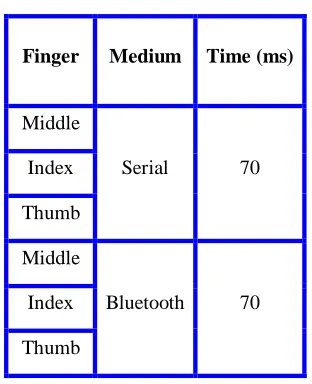
To test the capability of the Bluetooth communication, two different tests are conducted. First is the data transfer performance test, where the time taken for data transfer of 1) one sensor (middle finger) and 2) three sensor readings (thumb, index and middle finger) is measured. The measurement is taken form the time the microcontroller starts to send data to the personal computer. LIPO
Batte ry
Flex Sensor
Arduino
Target joints
HC-05 Bluetooth Module
Master Device
Initiate pairing request
Slave Device
Master and Slave device
paired
Master (Sends pairing code),
Eg: 1234
Request pairing
Table 1: Total time taken for One Sensor
Finger Medium Time (ms)
Middle Serial 29
[image:4.595.89.245.228.420.2]Middle Bluetooth 29
Table 2:Total time taken for Three Sensor
Finger Medium Time (ms)
Middle
Serial 70 Index
Thumb
Middle
Bluetooth 70 Index
Thumb
[image:4.595.44.289.578.696.2]The total time taken by the microcontroller to read one sensor value and transmit the sensor data is shown in Table 1, as this time includes all the initialisation process of the microprocessor before sensor measuring starts. The total time needed to read three sensor value is shown in Table 2, there is a slight reduce in the overall time taken since only the function to read the sensor is called repeatedly rather than calling the whole initlisation process. The difference in time is plotted into figure 5 for further analysis. Since the programming method used to read the sensors is sequential, the method of reading the sensor value is read one by one rather than all at once.
Figure 5: Measured time against measured angle
CONCLUSION
The proposed system was tested and there is still some data refining and code optimising that is needed to be done before the glove is worn by the player. The flex sensors was able to detect the fingers flexion and extension. When the flex sensor is bend inward, the resistance value
increases as the angle of flex sensor increases. A miniature op-amp circuit is added for better accuracy and reliability.
The evaluation in first real hardware experiment showed a good and promising performance for the wireless Bluetooth communication to replace the existing wired serial link between the device and personal computer. This communication method had fulfilled all the requirement for a mobile measuring device. Thus, this wireless Bluetooth serial link will be integrated in the final design.
In the programming part, the sequential programming increases the total time needed to read the sensor value this is because the system reads one finger after one. To enable this system to read all the sensor at once, the usage of RTOS (Real Time Operation System) is suggested. Tests will be conducted to determine the usability of RTOS in this measuring device.
ACKNOWLEDGMENT
This work was supported by Ministry of Education and Universiti Tun Hussein Onn Malaysia under Research Acculturation Collaborative Effort Grant Vot 1438.
REFERENCE
A. M. Mohd Ali, A. J. M. Wahi, R. Ambar, M. M. A. J. (2011). Development of Artificial Hand Gripper by using Microcontroller. International Journal of Integrated
Engineering, 3(3), 47–54. Retrieved from
http://penerbit.uthm.edu.my/ojs/index.php/ijie/article/view/3 74
A. M. Mohd Ali, R. Ambar, M. M. A. jamil. (2012). Artificial Hand Gripper Controller via Smart Glove for Rehabilitation Process. 2012 International Conference on
Biomedical Engineering (ICoBE), (February), 300–304.
Retrieved from
http://ieeexplore.ieee.org/xpls/abs_all.jsp?arnumber=61790 25
Ambar, R, M.S. Ahmad, M. M. A. J. (2011). Design and Development of a Multi-sensor Monitoring Device for Arm Rehabilitation. International Journal of Integrated
Engineering, 3(3), 55–62. Retrieved from
http://penerbit.uthm.edu.my/ojs/index.php/ijie/article/view/3 75
Coyle, S., Morris, D., & Lau, K. (2009). Textile-based wearable sensors for assisting sports performance. Wearable and Implantable Body Sensor Networks, 2009. BSN 2009.
Sixth International Workshop, 307–311.
http://doi.org/10.1109/P3644.56
Grice, T. (2008). Badminton : Steps to Success (2nd ed.). Human Kinetics. Retrieved from https://books.google.com/books?id=2b58Bz5lGFQC&pgis= 1
Jacob, A., Wan Zakaria, W. N., & Md Tomari, M. R. (2015). Quantitative Analysis of Hand Movement in Badminton. In 2015 2nd International Conference on
Computer and Communication Engineering
(ICOCOE’2015). Phuket, Thailand: Springer.
Jaitner, T., & Gawin, W. (2007). Analysis of Badminton Smash With a Mobile Measure Device Based on Accelerometry. XXV ISBS Symposium, Ouro Preto, Brazil, 282–284.
Tran, N. (2010). Badminton : Proper Racket Grip in
Badminton. University of California, United States:
YouTube. Retrieved from https://www.youtube.com/watch?v=2cnbHARo8nI
Virgala, I., Kelemen, M., & Mrkva, Š. (2013). Kinematic Analysis of Humanoid Robot Hand. American Journal of
Mechanical Engineering, 1(7), 443–446.
http://doi.org/10.12691/ajme-1-7-58
Vladimir M Zatsiorsky. (1998). Kinematics of human motion. American Journal of Human Biology (1st ed.).
Retrieved from
http://onlinelibrary.wiley.com/doi/10.1002/(SICI)1520- 6300(1998)10:6%3C808::AID-AJHB13%3E3.0.CO;2-E/abstract
Wang, H., Ren, W., Shi, Y., Zhou, T., & Qian, J. (2011). Design of portable heart rate acquisition instrument bases on Bluetooth transmission. 7th International Conference on
Wireless Communications, Networking and Mobile