Strength of Cations in Different types of N-Containing
bases
G.Ravi
*, Prof.A.Ravinder Nath
*, Jampaiah Amanaganti
*, Ch.Sathish Kumar
***
Department of bio technology & Pharmacy, College of Technology, Osmania University, Hyderabad, Andhra Pradesh (AP)-500007 **
Govt Degree College, Garla, Khammam, AP
Abstract- Using selected theoretical methods the affinity of a large range of bases towards model cations has been quantified. The range of model cations includes the methyl cation as the smallest carbon-centered electrophile, the benzhydryl and trityl cations as models for electrophilic substrates encountered in base-catalyzed synthetic procedures, and the acetyl cation as a substrate model for acyl-transfer reactions. Affinities towards these cationic electrophiles are complemented by data for base addition to Michael acceptors as prototypical neutral electrophiles.
I. INTRODUCTION
ation affinity values are important guidelines for the reactivity of Lewis and Brønstedt bases [1-3]. While proton affinity numbers (either as gas phase proton affinities or as solution phase pKa values) have been used for a long time in quantitative approaches to describe induced or base-catalyzed processes, affinity data towards carbon electrophiles have only recently been adopted as tools for the assessment of Lewis base reactivity [4]. This is mainly due to the scarcity of accurate experimentally measured or theoretically calculated
data. The performance of various theoretical methods to provide accurate affinity data has recently been analyzed and a number of cost efficient methods for the determination of accurate gas phase values have been identified [5,6]. Using these methods we now present a broad overview over the cation affinities of N-Centered nucleophiles.
II. RESULTS AND DISCUSSION
Methyl cation affinities (MCA)The methyl cation (CH3+) is the smallest carbocation which is Useful as a chemical probe for Lewis bases. The respective methyl cation affinity of a given Lewis base (LB) is obtained as the reaction enthalpy at 298.15 K and 1 bar pressure for the reaction shown in equation 1a for a neutral Lewis base and in equation 1b for an anionic base (Scheme 1). This definition is in analogy to that for proton affinities (PA) and implies large positive energies for most of the N-based Lewis bases used in catalytic processes. Using pyridine (1) as an example for a weak Lewis base, the methyl cation affinity corresponds to the enthalpy of the reaction in equation 1c and amounts to MCA(1) = +519.2 kJ/mol at the G3 level of theory [5].
LB-CH3
G 298
LB
+
CH31(a)
LB-CH3
G 298
N CH3
+
G 298
N
+
(1 Me)
1(c)
LB
+
CH3CH3
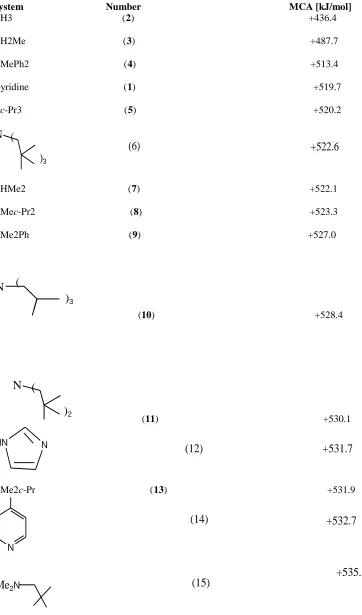
Table 1: MCA values for N-centered Lewis bases, ordered by increasing MCA values.
System Number MCA [kJ/mol] NH3 (2) +436.4
NH2Me (3) +487.7
NMePh2 (4) +513.4
pyridine (1) +519.7
Nc-Pr3 (5) +520.2
N (
)
3(6)
+522.6
NHMe2 (7) +522.1
NMec-Pr2 (8) +523.3
NMe2Ph (9) +527.0
N
(
)
3(10) +528.4
N (
)
2(11) +530.1
HN N
+531.7
(12)
NMe2c-Pr (13) +531.9
N
(14)
+532.7
Me
2N(15)
N(iPr)
3(16)
+536.0
MeN (
)
2(17)
+538.1
Me
2N
(19)
HN
(18)
+539.8
+541.3
NMe
3(20)
+543.3
Scheme 1: Reactions for the methyl cation affinity (MCA)
of a neutral Lewis base (1a), an anionic Lewis base (1b) and pyridine (1c).A recent analysis of theoretical methods found that calculations at the MP2(FC)/6-31+G(2d,p)//B98/6-31G(d) level of theory (inshort:"MP2-5")reproduce results obtained at the G3 level within 4.0 kJ/mol for selected small and medium-sized organo catalysts [5]. For pyridine (1) the MCA value obtained with this model amounts to MCA (1) = +518.7 kJ/mol, which is only 0.5 kJ/mol lower than the G3 value. The following discussion will thus be based on results obtained with the
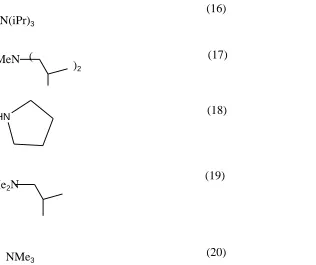
MP2-5model, if not noted otherwise. Methyl cation affinity values obtained for N-centered Lewis bases using this approach are collected in Table 1. For organo catalytic processes especially the Lewis bases 12, 14, 18, 24, note.
Pyridine is a comparatively weak nucleophile as already
[image:3.612.48.364.62.327.2]mentioned above. This also applies to imidazole (12), pyrrolidine (18) and a number of trialkylamines, all of which have MCA values below 550 kJ/mol. In the case of pyridine it ispossible to increase the Lewis basicity by introducing electron
Table 1: MCA values for N-centered Lewis bases, ordered by increasing MCA values. (Continued)
Nt-Bu3 (21) +545.5
NMe2Et (22) +548.6
NMet-Bu2 (23) +549.4
(24)
+550.0
N N
NMe2c-Bu (25) +551.0
NMe2(iPr) (26) +551.3
N N
(28)
+562.1
N
(30)
+580.5
N
(29)
+576.0
NPh
3(31)
+583.4
N N
(32)
+581.1
N N
N
(33)
609.0
III. TECHNICAL ASPECTS
It was shown recently that MCA values can be calculated with high accuracy with methods like G2, G3 or W1 [5]. Beside these expensive methods some MP2 calculations can also afford, slightly less, accurate results. For the MP2 calculations different combinations of polarization functions and diffuse functions were tested. In contrast, DFT methods such as B3LYP seem to be unsuitable for predicting MCA values in an adequate manner. A good compromise between computational effort and predictive value was found for the MP2(FC)/6-31+G(2d,p)//
B98/6-31G(d) level of theory. Therefore, all results described in this publication have been obtained using this
catalysis it is absolutely sufficient to consider differences in cation affinities between two different Lewis bases.
IV. CONCLUSION
REFERENCES
[1] de Rycke, N.; Couty, F.; David, O. R. P. Chem.–Eur. J. 2011, 17,12852– 12871. doi:10.1002/chem.201101755
[2] Larionov, E.; Zipse, H. WIREs Comp. Mol. Sci. 2011, 1, 601–619. doi:10.1002/wcms.48
[3] Denmark, S. E.; Beutner, G. L. Angew. Chem., Int. Ed. 2008, 47, 1560– 1638. doi:10.1002/anie.200604943
[4] Wei, Y.; Sastry, G. N.; Zipse, H. J. Am. Chem. Soc. 2008, 130, 3473–3477. doi:10.1021/ja0764409
[5] Wei, Y.; Singer, T.; Mayr, H.; Sastry, G. N.; Zipse, H. J. Comput. Chem.
2008, 29, 291–297. doi:10.1002/jcc.20790
[6] Wei, Y.; Sateesh, B.; Maryasin, B.; Sastry, G. N.; Zipse, H. J. Comput. Chem. 2009, 30, 2617–2624. doi:10.1002/jcc.21271
[7] Müller, C. E.; Schreiner, P. R. Angew. Chem., Int. Ed. 2011, 50, 6012– 6042. doi:10.1002/anie.201006128
[8] Held, I.; Xu, S.; Zipse, H. Synthesis 2007, 1185–1196. doi:10.1055/s-2007-965973
[9] Larionov, E.; Achrainer, F.; Humin, J.; Zipse, H. ChemCatChem 2012, 4,
559–566. doi:10.1002/cctc.201100313
[10] D'Elia, V.; Liu, Y.; Zipse, H. Eur. J. Org. Chem. 2011, 1527–1533. doi:10.1002/ejoc.201001507
[11] Held, I.; von den Hoff, P.; Stephenson, D. S.; Zipse, H. Adv. Synth. Catal.
2008, 350, 1891–1900. doi:10.1002/adsc.200800268
[12] Heinrich, M. R.; Klisa, H. S.; Mayr, H.; Steglich, W.; Zipse, H. Angew. Chem. 2003, 115, 4975–4977. doi:10.1002/ange.200352289 Angew. Chem., Int. Ed. 2003, 42, 4826–4828. doi:10.1002/anie.200352289
[13] Lindner, C.; Maryasin, B.; Richter, F.; Zipse, H. J. Phys. Org. Chem. 2010,
23, 1036–1042. doi:10.1002/poc.1726
[14] Enders, D.; Niemeier, O.; Henseler, A. Chem. Rev. 2007, 107, 5606–5655. doi:10.1021/cr068372z
[15] Marion, N.; Díez-González, S.; Nolan, S. P. Angew. Chem., Int. Ed. 2007,
46, 2988–3000. doi:10.1002/anie.200603380
[16] Nair, V.; Vellalath, S.; Babu, B. P. Chem. Soc. Rev. 2008, 37, 2691–2698. doi:10.1039/b719083m
[17] Grossmann, A.; Enders, D. Angew. Chem., Int. Ed. 2012, 51, 314–325. doi:10.1002/anie.201105415
[18] Maji, B.; Breugst, M.; Mayr, H. Angew. Chem., Int. Ed. 2011, 50, 6915– 6919. doi:10.1002/anie.201102435
[19] Mayr, H.; Bug, T.; Gotta, M. F.; Hering, N.; Irrgang, B.; Janker, B.; Kempf, B.; Loos, R.; Ofial, A. R.; Remennikov, G.; Schimmel, H. J. Am. Chem. Soc. 2001, 123, 9500–9512. doi:10.1021/ja010890y
[20] Mayr, H.; Patz, M. Angew. Chem. 1994, 106, 990–1010. doi:10.1002/ange.19941060905 Angew. Chem., Int. Ed. Engl. 1994, 33, 938–957. doi:10.1002/anie.199409381
[21] Breugst, M.; Zipse, H.; Guthrie, J. P.; Mayr, H. Angew. Chem., Int. Ed.
2010, 49, 5165–5169. doi:10.1002/anie.201001574
[22] Baidya, M.; Horn, M.; Zipse, H.; Mayr, H. J. Org. Chem. 2009, 74, 7157– 7164. doi:10.1021/jo901670w
[23] Brotzel, F.; Kempf, B.; Singer, T.; Zipse, H.; Mayr, H. Chem.–Eur. J. 2007,
13, 336–345. doi:10.1002/chem.200600941
[24] Kempf, B.; Mayr, H. Chem.–Eur. J. 2005, 11, 917–927. doi:10.1002/chem.200400696
[25] Zhu, X.-Q.; Wang, C.-H. J. Phys. Chem. A 2010, 114, 13244–13256. doi:10.1021/jp109149x
[26] Cheng, J.-P.; Handoo, K. L.; Parker, V. D. J. Am. Chem. Soc. 1993, 115,
2655–2660. doi:10.1021/ja00060a014
[27] Baidya, M.; Kobayashi, S.; Brotzel, F.; Schmidhammer, U.; Riedle, E.; Mayr, H. Angew. Chem., Int. Ed. 2007, 46, 6176–6179. doi:10.1002/anie.200701489
[28] Seco, J. M.; Quiñoá, E.; Riguera, R. Chem. Rev. 2004, 104, 17–118. doi:10.1021/cr000665j
[29] Wei, Y.; Sastry, G. N.; Zipse, H. Org. Lett. 2008, 10, 5413–5416. doi:10.1021/ol8023067
[30] Lindner, C.; Tandon, R.; Liu, Y.; Maryasin, B.; Zipse, H. Org. Biomol. Chem. 2012, 10, 3210–3218. doi:10.1039/c2ob07058h
[31] Hiratake, J.; Yamamoto, Y.; Oda, J. J. Chem. Soc., Chem. Commun. 1985,
1717–1719. doi:10.1039/C39850001717
[32] Hiratake, J.; Inagaki, M.; Yamamoto, Y.; Oda, J. J. Chem. Soc., Perkin Trans. 1 1987, 1053–1058. doi:10.1039/P19870001053
[33] Aitken, R. A.; Gopal, J.; Hirst, J. A. J. Chem. Soc., Chem. Commun. 1988,
632–634. doi:10.1039/C39880000632
[34] Aitken, R. A.; Gopal, J. Tetrahedron: Asymmetry 1990, 1, 517–520. doi:10.1016/S0957-4166(00)80538-8
[35] Bolm, C.; Gerlach, A.; Dinter, C. L. Synlett 1999, 195–196. doi:10.1055/s-1999-2570
AUTHORS
First Author – G.Ravi, Department of bio technology &
Pharmacy, College of Technology, Osmania University, Hyderabad, Andhra Pradesh (AP)-500007
Second Author – Prof.A.Ravinder Nath, Department of bio
technology & Pharmacy, College of Technology, Osmania University, Hyderabad, Andhra Pradesh (AP)-500007
Third Author – Jampaiah Amanaganti, Department of bio
technology & Pharmacy, College of Technology, Osmania University, Hyderabad, Andhra Pradesh (AP)-500007
Fourth Author – Ch.Sathish Kumar, Govt Degree College,
Garla, Khammam, AP
Correspondence Author – E-mail address