Analysis of Pseudorange-Based DGPS after Multipath
Mitigation
ThilanthaDammalage
Department of Remote Sensing and GIS, Sabaragamuwa University of Sri Lanka
Abstract- In Differential GPS (DGPS) processing technique the ultimate accuracy of the user location depends on the combined effect
of site-dependent errors (i.e. multipath, receiver clock error and etc.), which occur at the points of observation and the reference. Out of which, multipath is recognized as the most dominant and intricate site-dependent error. Previous study by Dammalage et al. (2010) evaluated the possible accuracy improvement of pseudorange-based DGPS positioning by C/A code multipath mitigation at the GPS reference stations applying wavelets transform. In this paper, three factors, which degrade the obtainable accuracy of the proposed multipath mitigation method, are identified and results are presented.
Index Terms- GPS Permanent Reference Station, Multipath, Pseudorange-based DGPS
I. INTRODUCTION
ifferential GPS (DGPS) is one of the most popular and comparatively accurate techniques to enhance the GPS positioning accuracies by minimizing most of the common mode errors (e.g. ionospheric, tropospheric, satellite clock errors, and so forth) in a combined operation (Bradford et al. 1996). The extent to which the common mode errors are diminished by DGPS depends on a number of factors, but mainly the separation of the reference and user GPS receivers (Hofmann-Wellenhof et al. 2001). Furthermore, DGPS observation accuracy is highly dependent on the receiver type, which varies with the capability of the carriers (L1 and L2) and/or code (C/A) measurements for position estimation. Accordingly, DGPS technique has been classified into two categories, namely carrier phase and pseudorange-based DGPS, where the accuracies vary from centimeter level to meter level respectively (Han et al.1997).
Moreover, several DGPS processing techniques can also be found, for instance, single difference and double difference which are very common in practice; yet depend on the capability of the receiver and the processing software (Baroni et al. 2005). Irrespective of the processing technique utilized in DGPS, the ultimate accuracy of the user location depends on the residual common mode errors and the combined effect of site-dependent errors (e.g. multipath, receiver and measurement noises) at the reference and the point of observation. Of the latter, the most dominant error has been identified to be the effect of multipath (Xu.G., 2003) and which is defined as the multiple receptions, by a GPS antenna, of one satellite signal due to reflections by surrounding objects (Misra et al. 2004). It has also been found that the error caused by multipath is highly variable in the time domain, showing quasi-sinusoidal oscillations of short periods of several minutes, hence creating complexity in mathematical representations (e.g., Daubechies et al.1990; Ogaja et al. 2007). Based on the inevitability of multipath, most permanent GPS reference stations are installed through careful site selection and/or augmentation with additional hardware (e.g., choke-ring) so that their differential correction data have minimal multipath effects (Chen et al. 2010; Maqsood et al. 2013). However, in most practical situations, minimal multipath or multipath-free site selection is not an easy task. As a consequence, some residual multipath errors and receiver noises are always remain and degrade the quality of DGPS corrections generated at the reference stations (Fan et al. 2006). By utilizing the double difference DGPS processing method, the bias term of the receiver clock can be completely eliminated (Baroni et al. 2005). Yet, the error terms caused by multipath and receiver noise remain unchanged as single difference DGPS.
II. PSEUDORANGE(C/ACODE)MULTIPATH
Having realized the fact, most of the modern GPS receivers are now employing multipath mitigation algorithms for their position estimations; there by ensure the negative influence of multipath from position estimations. For instance, Multipath Elimination Technology (MET) and Multipath Elimination Delay Lock Loop (MEDLL) are two popular techniques used to mitigate multipath at the receiver signal processing level (Townsend et al. 1994; Chen et al. 2013; ). Unfortunately, these methods are not effective in eliminating combined multipath caused by reference and user stations, on DGPS observations. Moreover, the effect of C/A code multipath error, on pseudorange-based DGPS observations, is more significant due to its magnitude. Which is almost ten times greater than that of the carrier phase measurements (Mertins, 1999) and it could be even about 150m due to the chip length of C/A code (Xu.G., 2003). Notwithstanding, a wide range of GPS receivers, from the low-cost to very expensive, offer pseudorange-based DGPS and commonly practiced by most of the GPS users due to its extended operational distance of several hundreds of kilometers from its reference station while the carrier phase DGPS operations are limited to several tens of kilometers (Dammalage et al. 2006).
In consideration of the merits and appraising the constrain effect of multipath error on C/A code measurements; the study proposed by Dammalage et al. (2010) aims to investigate the mitigation of the multipath effect on pseudorange-based DGPS corrections that are generated by a permanent GPS reference station. Furthermore, the study utilized the carrier phase and pseudorange measurements for the derivation of C/A code (pseudorange) multipath effect (Mp), which has been formulated by Han et al. (1997), taking advantage of
the fact that multipath and receiver noise on carrier phase are negligible compared to those of C/A code based pseudorange measurments. The C/A code multipath based on L1 and L2 frequencies are represented by equations (1) and (2), respectively.
1 2 1 1 1 1
2329
7200
2329
9529
)
(
M
pL+
ε
pL=
PR
L−
⋅
Φ
L+
⋅
Φ
L+
K
(1)2 2 1 2 2 2
2329
9529
2329
11858
)
(
M
LpPR
L L LK
L
p
+
ε
=
−
⋅
Φ
+
⋅
Φ
+
(2) Where; 1 L p ε and 2 L p ε
represent the noise of receiver and pseudorange measurements of PRL1 and L2
PR respectively. ΦL1andΦL2are
the carrier phase measurements in meters. K1 and K2 are functions of the multipath on carrier phase which include the unknown integer ambiguities. The multipath effect is considered to be a combination of harmonic signals and can be averaged out to zero over a few hours. Therefore, K1 and K2 can be estimated by averaging over a period of few hours. The result of these code and phase linear combinations give the noise embedded C/A code (pseudorange) multipath residuals and thus it is typically referred to as noisier multipath residuals (Satirapod et al. 2005). An attempt has, therefore, been made to de-noise the results obtained by equations (1) and (2) utilizing Wavelet Transform (WT) for the precise estimation of C/A code based pseudorange multipath error at permanent GPS reference stations. The obvious challenge of WT application in multi-resolution signal analysis is the selection of the best wavelet family and the level of decomposition (Fu et al. 1997, Graps A., 1995 and Mallat S. G., 1989).
Consequently, based on several field experiments and analyses, Dammalage et al. (2010) have identified the best wavelet family and the level of de-composition for the said de-noising process. Moreover, they have evaluated the possible accuracy improvement of pseudorange-based DGPS positioning by applying the proposed C/A code multipath mitigation method at the GPS reference stations. However, to further evaluate that fundamental study, this paper aims to investigate the accuracy diminishing factors effecting on C/A code multipath mitigation from pseudorange-based DGPS corrections with the application of proposed mitigation practice. In order to accomplish the said goal, the same data set collected through the field experiment discussed by Dammalage et al. (2010) is utilized for the analyses in this paper as well.
III. FIELDDATAACQUISITION
Dammalage et al. (2010) has established a field experiment with three known ground controls, adopting two receivers as permanent reference stations and the third as a user GPS. Three days of 24-hour observations with 1 second observation interval were recorded with an artificial signal reflector, made of concrete, wood and metal, at one of the references during day 1, 2 and 3 respectively as illustrated in figure 1(a). Day 4 observations were performed as in figure 1(b) and that has chosen as reference observations, to evaluate the effects of artificial multipath environments. Moreover, they have precisely measured the base-line distances D1, D2 and D3 by an electronic distance measurement (EDM) technique. Based on this known configuration, of GPS receivers and the signal reflectors, the additional multipath introduced by the reflectors was precisely calculated for each segment of the observations.
Day 1, Day 2 & Day 3 Day 4
Observation setup with creating multipath for reference GPS 01
Analyzing these field data, Dammalage et al. (2010) have concluded that the best wavelet family and the level of de-composition for the precise extraction of C/A code multipath are bi-orthogonal wavelet family and the 8th level of de-composition. Additionally, they have shown that about 60% of accuracy improvement of pseudorange-based DGPS is possible by mitigating the effect of multipath on C/A code at GPS reference stations.
IV. ANALYSISOFRESULTS
Accuracy and the precision of the C/A multipath residuals with respect to its accuracy and are very important to be considered while utilizing the previous multipath estimations (pre-modeled) for later generation of multipath free DGPS corrections by reference stations. However, the previous study revealed that the positional accuracy of DGPS observations, even after multipath mitigation, is still showing random deviations with time; most probably due to unmolded error terms including multipath.
Therefore, this study is focused to investigate the constrains of proposed C/A code multipath estimation methodology presented by Dammalage, et al. (2010). Thereby to further enhance the accuracy and precision of C/A code multipath mitigation for accuracy improved pseudorange-based DGPS positioning. Accordingly, three accuracy diminishing factors, which negatively affected on accurate and precise extraction of C/A code multipath, were identified and discussed herein.
A. Effect of cycle slip
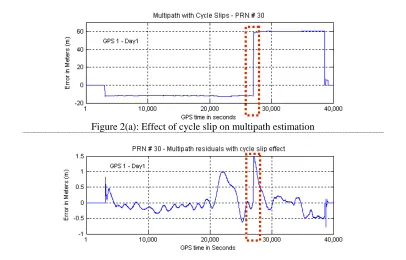
[image:3.612.103.509.489.749.2]Figure 2(b): Effect of cycle slip on multipath residuals.
Figure 2(c): Multipath residuals after filtering for cycle slip effect.
Figure 2: Effect of cycle slip on pseudorange multipath error estimations; before and after filtering for cycle slip.
In C/A code (pseudorange) multipath (Mp) estimation based on L1 and L2 frequencies, K1 and K2 are taken as a function of the
multipath on carrier phase with including the unknown integer ambiguities. In addition the multipath effect is considered to be a combination of harmonic signals and can be averaged out to zero over a few hours. Therefore, K1 and K2 can be estimated by averaging over a period of few hours (Han et al. 1997), which implies that the occurrences of cycle slip on carrier phase measurements could diminish the accuracy of estimated K value.
For instance, figure 2(a) illustrates the effect of cycle slip on multipath error calculated using equation (1). According to the figure an unexpected drastic change of calculated multipath error, of about 70 meters (change from about -10 m to 60 m), has seen after about 5 hours (between 25,000 and 30,000 seconds) of static observations. It is apparent that a change of such magnitude, even after average out these multipath residuals to estimate the respective K values, obviously creates unrealistic consequence. As a result, figure 2(b) shows the said effect in the final pseudorange multipath residuals. The figure verifies that at the point where the cycle slip occurs, the smoothly changing multipath residuals were changed drastically of about 1.5 meters. Therefore, cycle slip has been identified as one of the main source of accuracy diminishing factors; and once it occurs, which often introduce significantly higher magnitude of pseudorange multipath residuals.
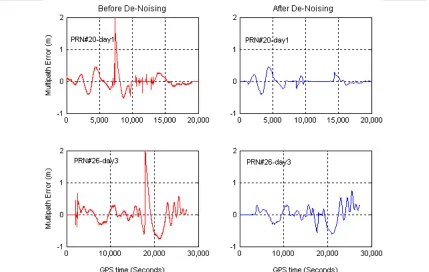
Therefore, this error source and the occurrences have to be identified carefully from the actual multipath variations and essentially filtered out to avoid its effect from accurate and precise pseudorange multipath estimations. Realizing the importance of eliminating the effect of cycle slip before estimating the pseudorange multipath residuals; this research has been extended to minimize the said effect by performing a filtering process to detect and eliminate it from the final multipath calculations. After applying the filtering process (without cycle slip effect) the resulted multipath residuals are shown in figure 2(c).
[image:4.612.93.516.65.202.2]Figure 3: Pseudo-range multipath residuals before and after de-noising for cycle slip and receiver noise errors.
B. Effect of un-modeled linear error component
Other than the effect of cycle slip the study has identified another significant factor, which effects negatively on calculated pseudorange multipath residuals based on the equations (1) and (2). As discussed previously, multipath is an error which forms quasi-sinusoidal oscillations with a period of several minutes and propagates along the zero magnitude of the time series distributions. However, the time series multipath residuals calculated based on equations (1) and (2), are incorporated with un-modeled linear component as illustrated in figure 4. According to the figure, the time series multipath residual errors with the said linear component are represented in red color. The direction of the liner trend is shown with a black double arrow. Therefore, to get the theoretical distribution trend and the actual magnitude of multipath error, the remaining un-model linear error terms have to be identified and eliminated. After eliminating the liner component the resulted multipath residuals are illustrated in blue color.
Further, dissimilar magnitudes of these linear distributions for each and every satellite were observed. These different magnitudes imply that the liner trends are not caused by the receiver clock or other receiver dependent bias. Therefore, these remaining un-modeled linear error components, even after DGPS corrections, are predicted to be the effect of satellite clock or orbital parameters. The magnitude differences of these multipath residuals with and without linear components are observed to be significant. Therefore, the un-modeled linear component has also been identified as the other main source of accuracy diminishing factor for the accurate and precise multipath residuals estimated based on equations (1) and (2).
[image:5.612.90.519.574.709.2]linear error component.
B. Effect of observation length
Further analyses were carried out to investigate the effect of observation length on precise pseudorange multipath extraction. Several hours long observations were utilized for the multipath computation and the resulted accuracies were evaluated for the identification of the effect of observation length.
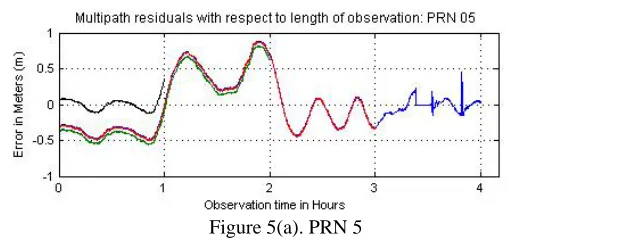
For instance, the time series pseudorange multipath residuals calculated for 1, 2, 3, and 4 hours of observation lengths, with 1 second epoch rate, for three different satellites (PRN 5, 30 and 22) are illustrated in figure 5. Each satellite selected for this illustration is observed with maximum of about 4 hours at GPS 1 station. Further, PRN 5 and 30 are two satellites with comparatively higher multipath effect and PRN 22 is relatively less effected and illustrated in figure 5(a), (b) and (c), respectively. Figure 5(a) and (b) effectively illustrate that when the multipath error is comparatively higher; then the observation length is an important factor to be conceded.
The accuracy of the computed multipath for 3 and 4 hours of observations for PRN 5 is almost similar; because after 3 hours of observations the multipath effect is comparatively low, the influence therefore become very less. However, the similar comparison for PRN 30 reflects significant deviations, due to the influence of comparatively high multipath effect between 3rd and 4th hour of observations. Most of the high multipath error phase is included within 1 and 2 hours for PRN 5 observations; therefore, the multipath residuals are not deviated significantly from 2 and 3 hours computation. However, for PRN 30, the said difference is significant; because its higher multipath error phase is extended well over 2 hours of observation. Moreover, for both satellites the multipath computed based on 1 hour observations are significantly different from all the other observation lengths and comparatively less accurate.
However, the observation length is not a significant factor for satellites which has comparatively less magnitude of multipath effect. For instance, the computed pseudorange multipath residuals for PRN 22, illustrated in figure 5(c), have not shown any significant deviation between each observation lengths. The similar scenario has been observed for all the satellites which have comparatively less magnitude of multipath. Considering the given facts and performing several more comparable analyses, it was found that the best possible accuracy of multipath residuals were obtained when utilizing the satellite full observation period in pseudorange multipath computation based on equations (1) and (2). Moreover, this scenario is highly significant for satellites effect with comparatively higher magnitude of multipath errors
Figure 5(a). PRN 5
[image:6.612.106.516.391.665.2] [image:6.612.172.490.397.520.2]Figure 5(c). PRN 22
1 hour 2 hours 3 hours 4 hours
Fig. 5. Time series multipath residuals with respect to the observation length.
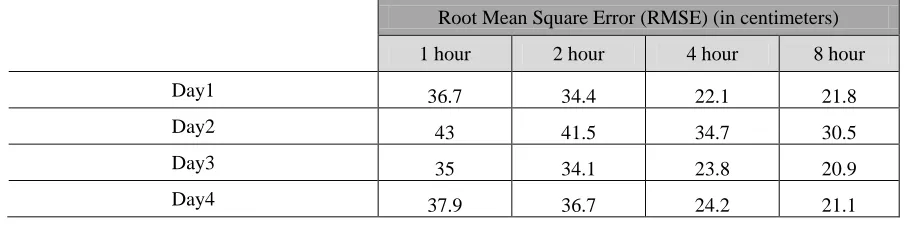
[image:7.612.97.509.57.221.2]In order to evaluate the positional accuracy of pseudorange-based DGPS prior to and after multipath mitigation; analyses were carried out by assuming GPS 01 as reference station and GPS 02 as rover. Accordingly, results for the baseline, GPS 01 – GPS 02, with four different (1, 2, 4, and 8 hour) observation lengths with 1 second epoch rate (DGPS processed) are illustrated in Table 1. Accordingly, the Root Mean Square Error (RMSE) is calculated for each observation lengths and illustrated in the table. A clear difference of RMSE is observed for each four different observation lengths. Further, the highest improvement is observed for the 8 and 4 hours observations. However, the improvement is comparatively lesser when the observation length is 1 and 2 hours, which reflects the presented effect of observation length on precise multipath estimation.
Table 1. Root Mean Square Error (RMSE) for 1, 2, 4 and 8 hour observations with 1 second epoch rate
Root Mean Square Error (RMSE) (in centimeters)
1 hour 2 hour 4 hour 8 hour
Day1 36.7 34.4 22.1 21.8
Day2 43 41.5 34.7 30.5
Day3 35 34.1 23.8 20.9
Day4 37.9 36.7 24.2 21.1
V. CONCLUSION
In this paper, cycle slip, remaining un-modeled linear error terms and observation length, were identified as accuracy diminishing sources of C/A code (pseudorange) multipath residuals calculated based on carrier and code combination. The magnitude differences of pseudorange multipath residuals before and after de-noising for cycle slip have identified as significant. Therefore, the effect of cycle slip should identified and eliminate before estimating the pseudorange multipath residuals. The remaining un-modeled linear error components are predicted to be the effect of satellite clock or orbital parameters due to their dissimilar magnitudes. However, the magnitude differences of the multipath residuals with and without linear components are observed to be significant. Hence, it should identified and eliminate from each multipath residuals. Observation length is also a significant factor for satellites which has comparatively higher magnitude of multipath than less effected one's. By several comparable analyses, it was found that the best possible accuracy of multipath residuals were obtained when utilizing the satellite full observation period in pseudorange multipath computation based on equations (1) and (2).
In this study, these three negatively influencing factors have identification and minimized successfully from C/A code multipath mitigation process. Based on the accomplished accuracy and precision, this study also highlights the potential application of multipath free real-time DGPS corrections at permanent reference stations towards supporting a growing number of high precision GPS applications.
ACKNOWLEDGMENT
[image:7.612.79.533.366.491.2]REFERENCES
[1] Bradford, W. P. and James, J. S., 1996. Global Positioning Systm: Theory and Applications. American Institute of Aeronautics and Astronautics, Washington, USA.
[2] Chen X., Dovis F., Pini M., 2010. An innovative multipath mitigation method using coupled amplitude delay lock loops in GNSS receivers. IEEE Position Location and Navigation Symposium, Indian Wells, CA, pp 1118–1126.
[3] Chen X., Dovis F., Peng S., 2013. Comparative studies of GPS multipath mitigation methods performance. IEEE Transactions on Aerospace and Electronic Systems, 49(3):1555–1568.
[4] Dammalage T. L., Srinuandee P., Samarakoon L., Susaki J. and Srisahakit T., 2006. Potential Accuracy and Practical Benefits of NTRIP Protocol Over Conventional RTK and DGPS Observation Methods. Proceedings of MapAsia, Bangkok, Thailand, 29 August- 1 September.
[5] Dammalage T.L., Satirapod C, Kibe S. and Ogaja C., 2010. Wavelet transformapplication to C/A Code multipath mitigation at GPS reference stations forimproved differential GPS corrections. Survey Review 42(317), 240-255.
[6] Daubechies I., 1990. The wavelet transform, time-frequency localisation and signal analysis. IEEE Transactions IT, 36 (5).
[7] Fan K. K. and Ding, X. L., 2006. Estimation of GPS Carrier Phase Multipath Signals Based on Site Environment. Journal of Global Positioning Systems, 5 (1-2): 22-28.
[8] Fu W. X. & Rizos, C., 1997. The applications of wavelets to GPS signal processing. 10th Int. Tech. Meeting of the Satellite Division of the U.S. Inst. of Navigation, Kansas City, Missouri, 16-19 September, 1385-1388.
[9] Graps A., 1995. An Introduction to Wavelets. IEEE Computational Sciences and Engineering, 2 (2): 50-61.
[10] Han S. and Rizos, C., 1997. Multipath effects on GPS in mine environments. Proceedings of 10th International Congress of the Int.Society for Mine Surveying, Fremantle, Australia, November 2-6, pp. 447-457.
[11] Hofmann-Wellenhof B., Lichtenegger, H. and Collins, J., 2001. GPS Theory and Practice. 5. Springer-Verlage/Wien, New York, U.S.A.
[12] Mallat S. G., 1989. A theory for multiresolution signal decomposition: the wavelet representation. IEEE Transactions on Pattern Analysis and Machine Intelligence, 11 (7): 674-693.
[13] Maqsood M., Gao S., Brown T. W. C., Unwin M., Xu J. D., 2013. A compact multipath mitigating ground plane for multiband GNSS antennas. IEEE Transactions Antennas and Propagation Magazine, 61(5):2775–2782.
[14] Mertins A., 1999. Signal Analysis: Wavelets, Filter Banks, Time-Frequency Transforms and Applications. John Wiley, ISBN-13: 978-0471986263. 330 pages. [15] Misra P. and Enge, P., 2004. Global positioning system signals, measurements, and performance. Ganga-Jamuna Press, Lincoln, Massachusetts, U.K. [16] Ogaja C. and Satirapod, C., 2007. Analysis of high-frequency multipath in 1-Hz GPS kinematic solutions. GPS Solutions, DOI 10.1007/s10291-007-0058-8. [17] Satirapod C. and Rizos, C., 2005. Multipath mitigation by wavelet analysis for GPS base station applications. Survey Review, 38 (295): 2-10.
[18] Townsend B. R. and Fenton, P. C., 1994. A Practical Approach to the Reduction of Pseudo-range Multipath Errors in a Ll GPS Receiver. Proceedings of 7th Int. Tech. Meeting of the satellite division of the U.S. Inst. of Navigation, Salt Lake City,Utah, U.S.A, 19-22 September.
[19] Xu Guochang, 2003.GPS Theory, Algorithms and Applications(2nd Edition), Springer-Verlag Berlin, Heidelberg, New York, U.S.A. AUTHORS
First Author – ThilanthaLakmalDammalage, PhD, Department of Remote Sensing and GIS, Sabaragamuwa University of Sri Lanka and [email protected].