7378
SSMDGS: SCHEDULING BASED STABLE MULTICAST DATA
GATHERING SCHEME FOR WSN
N. A. Natraj and S. Bhavani
Department of Electrical and Computer Engineering Karpagam Academy of Higher Education Coimbatore, Tamil Nadu, India E-Mail: [email protected]
ABSTRACT
Wireless Sensor Network (WSN) becomes familiar network where nodes are controlled in the presence of base station. In such case, nodes are communicated without the presence of base station. In this scenario, data gathering is a major challenge where nodes may get interrupted from external attackers. It leads to less network lifetime. In existing schemes, data gathering ratio is not improved highly without stable multicast routing scheme. In this research work, Scheduling based Stable Multicast Data Gathering Scheme (SSMDGS) is proposed for attaining balance between data gathering ratio and stability. It consists of three phases. In first phase, cluster construction and maintenance is implemented to support data gathering. Message creation time is estimated to reduce the overhead and delay. Energy is estimated before and after data gathering phase. The comparison of energy is done and maximum energy is attained after data gathering phase. Based on the extensive simulation results, SSMDGS achieves high data gathering ratio, energy efficiency, network lifetime, packet delivery ratio and low delay as well as overhead.
Keywords: WSN, cluster creation and maintenance, stable multicast route establishment, message creation time and energy consumption model.
1.INTRODUCTION
A. Wireless sensor network
In recent days, more attention has been paid towards Wireless Sensor Network (WSN) that uses mobile destination for knowledge assortment so as to support numerous applications, that is, enemy watching, healthcare watching, fireplace detection, environment watching, and natural events. In WSN, each sensor node is supplied with a battery, a microcontroller, memory, and a transceiver. In most of the applications, sink node collects knowledge from numerous sensors for process and decision-making. This node is supplied with powerful process capabilities at times. However, the sensor nodes could also be dead by exhausting off their battery when a particular amount. Once the energy is exhausted in such atmosphere, it is difficult to interchange or charge the batteries in a wide vary. Since WSN is full of limited process capabilities, low battery power and fewer memory make WSN atmosphere tougher. In most of the WSN applications, knowledge collection/transmission by sink node may be a tough task. The sensing element nodes are deployed within the atmosphere for sensing the information. The detected knowledge is then delivered to sink via intermediate nodes that are near sink via the multi-hop manner using wireless transmission. However, such approach of information assortment by sink has a major downside that is the sensing element nodes placed nearer to sink has to transmit a variety of data packets and so they need to exhaust a lot of power than the nodes that are farther removed from the sink. As a result, the network period reduces considerably. In [1], author proposed analytical research on data collection protocol to gathered sensored data in the network. The mobile path of destination node is calculated based on gathering point and shortest path
estimation. In a network, monitored regions were adopted to give a group of stored points. Based on the stored points, best stored point will be selected using NP hard problem. The number of quantities used for determining shortest path was also reduced. In [2], authors focused on survey of mobility based data collectors based on core architecture. Based on challenges and requirements, data collection schemes were also discussed to explore the scope of the research.
The paper is organized as follows. The Section 1 describes introduction about WSNs, data gathering and issues. Section 2 deals with the previous work which is related to the energy efficiency and data gathering algorithms. Section 3 is devoted for the implementation of proposed data gathering approach. Section 4 describes the performance analysis and the last section concludes the work.
2.RELATEDWORK
Swathika and Suganthi et al [3] proposed Load balanced Clustering (LBC) and Dual Data Uploading (DDU) method to provide good scalability and minimum delay from end to end node. All sensor nodes are self organized and grouped to form a cluster. The data packets are uploaded double times than existing works to balance the load using cluster heads. One more layer was adopted in this scheme i.e. mobile collection layer which is equipped with two antennas. All data packets are gathered from mobile collection layer and transported to static destination node.
7379
packets. Authentication was also provided based on securerouting method.
Sujithra and Venkatesan [5] developed the data gathering scheme based on genetic algorithm to increase the network lifetime. Two phases were introduced i.e. Route setup and Route Steady state phase. Cluster information was transmitted using base station query in dynamic manner. Those nodes who respond to the query, will be participated in the setup phase. The information was gathered by relay nodes from cluster heads to base station. Network load was balanced and packet loss was also reduced among relay nodes.
Nidhi et al [6] introduced a novel data collection model based on energy efficient mobile cluster approach to examine the mobility of cluster member and cluster head. Multiple clusters were also considered to control the mobility. This model was implemented with random walk model and mobility model based on horizontal line representation. Based on the results, it was shown to provide high network size and sending rate with increased cluster head density.
Rajashree et al [7] discussed the virtual multi-input and the multi output and low density parity code technique to provide information about data collectors inside the network region. A single antenna was adopted to transmit and receive the packets instead of deploying multiple antennas. Periodic code was provided to increase the energy efficiency and to improve the error correction in all kinds of packets. During data collection period, energy efficiency was improved by reducing power utilized unnecessarily.
Anna Raja and Karlmarx [8] had proposed the Information Driven Data Gathering (IDDG) to provide data availability whenever the user requires. The spatial correlation scheme was given to form cluster region to represent leader nodes as well as representative nodes. A representative value for cluster region was determined to sense the event during packet transmission.
In [9], a greedy scanning data collection strategy (GSDCS) was proposed to reduce energy consumption spent on routes by reducing longer route lengths. The trajectory of destination node was adjusted according to network states to choose secure nodes for transmission. For longer distances, source nodes are no longer required to upload the data. In event driven applications, destination nodes are arriving at the new event based on location of source nodes.
In [10], authors introduced a new data gathering scheme using single element with high mobility. The information was gathered from buffering nodes to reduce the delay occurred during data gathering process to increase the intensity level of data gathering. Only limited number of mobile sensor nodes was allowed to communicate with buffering nodes based on threshold value. Data traffic was also reduced to increase the network lifetime.
Guorui Li et al [11] explored an unbalanced threshold based distributed data collection scheme to
retain the gathered data and store it in all destination nodes. There are two algorithms used here i.e. unbalanced top K query algorithm and iterative hard algorithm. Each destination node synchronized gathered values based on the computation of unbalanced thresholds. Optimized gathered data packets were reconstructed using iterative algorithm.
In [12] authors presented reliable and energy efficient data gathering based routing protocol to increase the reliability of data packets. Due to the presence of cooperative routing, more energy consumption may be occurred for data gathering. To avoid this issue, all mobility destination nodes were adopted to reduce end to end delay and message latency.
Krupa [13] developed an advanced data gathering scheme to gather information about node locations. The gathered information was used to reduce energy consumption to improve the network lifetime. The high level of data gathering with more security was adopted based on measures taken. The node information was constantly updated to determine the neighbor node for packet forwarding.
Biju and Kumar [14] had proposed the Energy-Efficient Traffic Renovate Partitioning (EETRP) method to reduce the energy utilization using partitioning methods. Enhanced data gathering and centroid mean data gathering were to provide network connectivity. The mobile element value and network structure were derived and reconstructed using partitioning methods. High data gathering efficiency was attained using point gathering method with euclidean distance.
In [15], authors developed a hybrid data collection approach to increase the data gathering efficiency based on node clustering and mobile elements. Efficiency of intra cluster routing and low complexity track planning was provided using proposed data collection approach. Based on node density, cluster heads are chosen to gather information.
In [16], authors introduced travelling salesmen problem to illustrate data gathering in WSN. Based on visiting point, the length of paths is reduced and the computational power was also minimized. Based on the integration of visiting points, maximum number of visiting points was reduced. In travel path planning, data transfer rate was also considered and satisfied.
In [17] authors introduced a Nature inspired moving sink energy efficient data gathering protocol to reduce power consumption using coverage hole issue. Sensors are equipped with non rechargeable battery to increase network lifetime. In the initial transmission of information, packets were gathered from network field.
7380
3.SCHEDULING BASED STABLE MULTICASTDATA GATHERING SCHEME FOR WSN
In the proposed scheme, network model and mobility model are implemented to support data gathering phase. Time based synchronization is used to adopt TDMA schedule to all cluster members and cluster head. Anchor node is setup based on less mobility to monitor the data gathering rate.
Network model
In the proposed protocol, sensor nodes are assumed to be m1,m2, m3…..mn . There are n number of sensor nodes are deployed in K x K field to form a WSN. A undirected graph G(M,L) is used to represent WSN where M is set of nodes and L is set of network edges. Nodes are connected through multi-hop routing in a random manner. Mobility of nodes is kept either static or dynamic according to network states and resource constraints. Sensor nodes form a Cluster region where it consists of cluster members and Cluster Head (CH). The proposed network has some following characteristics.
Once the WSN is deployed sensor nodes or cluster members or cluster head is assumed to be static or dynamic.
Two kinds of pattern deployed in WSN i.e. Anchor nodes and Mobile Cluster Members (MCM).
During data gathering phase, forwarding cluster member collects received data packets and sensing data and stores it in long length of packets.
If sensor nodes are deployed, it will not be recharged during route maintenance phase.
All sensor nodes have some storage space and data gathering capacity and it will be reported to CH.
During data gathering phase, nodes collect the data and report it to CH through high stability routes.
Mobility model
Nodes are considered to be static or dynamic in WSN environment. In this case, the mobility model adopted is random walk model with vertical line representation. It is to achieve high data gathering efficiency in the presence of packet loss. Anchor nodes keep less mobility while remaining nodes keep high. To achieve maximum deliverability rate, random walk model is more suitable to locate the nodes with predetermined distance. Anchor node may also act as mobile collector.
Cluster construction and maintenance
In this phase, sensor nodes are grouped and formed 2 or 3 cluster regions. Anchor node collects the gathered data from source to destination node and sends it
to Cluster Head (CH). CH collects and sends the aggregated data packets to neighbor CH. There are four major phases in cluster construction i.e. Formation, CH selection, Data gathering phase and Data recovery.
Formation
In this phase, sensor nodes in WSN form cluster region. Only 4-5 routers are adopted for packet forwarding.
CH selection
In a cluster, relay node ak approaches to destination node D with high remaining energy and more number of end components in multi-hop communication, will be elected as Cluster Head (CH) for
period of time. Remaining energy of sensor node with high probability and minimum hop count between sensor nodes are the key factors for selecting CH. Router sensor node connects with other node with more number of end device components.Data gathering phase through time scheduling
In this phase, anchor node starts data gathering and moves along the predetermined path. The following steps are used to show data gathering process.
Step 1: Once the anchor node nears to data gathering point, it stops and broadcasts a “DGP (Data gathering packets) messages” to neighbor cluster members. This message contains ID of sensor nodes and amount of data gathered at particular point.
Step 2: If any sensor node receives the message, the contents of message will be checked. Once the nodes find their ID and data gathering rate, it will reply via DREP (Data Reply) messages to neighbor hop nodes.
Step 3: If any node is not able to retrieve their ID and DREP, it simply drop the packets.
Step 4: DREP message creation time
l,m is calculatedto show the delay occurred in packet forwarding. It is derived as,
11 , ,
0 ,
l
p m p m
m
l
F
Where
F
p,m is the delay at p hops. The messagecreation time is used to achieve time synchronization time.
Step 5: Two slots are maintained i.e. Q slot and E slot. In Q slot, data is collected and ready to listen information from cluster members. In E slot, sensed data is recorded and report it to CH. Step 6: Identify the average number of cluster members
once data gathering is completed. It is calculated as,
i i i
M
M
7381
WhereM
iis the average level of CM in each routediscovery phase, i.e.
M
i
2
i
1
tr
c.
is thedensity of sensor node.
r
cis the transmission coverage.n
i
1
,
2
,
3
....
.Step 7: In the TDMA schedule, every CM has three time slots. i.e. Request, Reply and Period. In Request slot, nodes send the gathered data packets to destination node. In reply phase, destination verifies the received packets from the CH. In period slot, synchronized slots are used to monitor the data gathering.
Step 8: In reply phase, mobile destination node sends the TDMA schedule to cluster members. For every cluster, TDMA schedule is generated for every cluster based on number of cluster members. After the schedule, destinations CH gather data and upload it to source CH.
Step 9: Based on message creation time and average number of cluster members, data gathering point will be chosen at the centre location of cluster.
Data recovery phase
In this phase, destination gathers data packets and takes responsible for sensor data from random measurements. Data is recovered from all destinations and sends it to source CH based on data gathering threshold value. This value is used to recover message with Q and E slot. Message is recovered by decrypting the packet information with private key of individual cluster members.
Stability based multicast routing
Once the distribution of sensor nodes is accomplished, sensor node must be aware of their location to increase location accuracy. Anchor nodes are always close to mobile sensor nodes to monitor the node and packet status. If any packets falls or lost from the link or node, it will be captured and reported to CH. CH reinitiates route discovery process to proceed the packet transmission. Mesh based multicast routing is adopted in this proposed protocol to achieve global connectivity.
Route discovery process
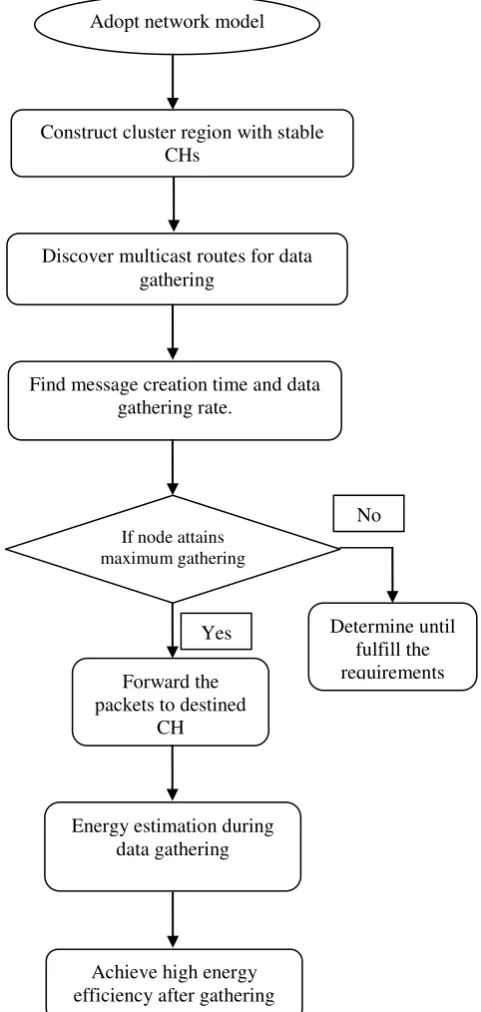
[image:4.595.308.549.98.605.2]CH chooses the route with high stability to forward control packets. CH first initiates Multicast Route Request (MRREQ) packets to neighbor node in one hop manner through primary routes. Nodes are joined by sending Multicast Route Reply (MRREP) packets. Stability of path is determined based on link capacity and received signal strength indicator. Link capacity is estimated based on the transmission capacity of links. Routes are mainly selected based on high link capacity. Received Signal strength is determined based on Signal to Noise Ratio (SNR). In multicast route discovery process, CH sends packets to Neighbor CH through intermediate cluster members.
Figure-1. Overview of proposed data gathering protocol.
If CH is not aware of any routes in the particular region, it simply floods the packets to all cluster members. Destination node avoids the repeated packets to avoid packet replication. It also finds the duplicate packets and delayed packets. Once these types of packets is found, it will not send MRREP packets to Source CH. Primary route is used by neighbor CH and it may secondary route to forward data packets. In order to reduce the overhead of excessive control packets, neighbor nodes provide own route information to CH. CH will store it in its routing table. Intermediate cluster members may forward data
Adopt network model
Construct cluster region with stable CHs
Discover multicast routes for data gathering
Find message creation time and data gathering rate.
Forward the packets to destined
CH If node attains maximum gathering
Determine until fulfill the requirements
Energy estimation during data gathering
Achieve high energy efficiency after gathering
No
7382
packets through another route to avoid any packetflooding.
Route maintenance process
The following steps are used to illustrate route maintenance process.
Step 1: CH sends data packets on known route to neighbor Cluster Member (CM). CM updates the routing table by reading data packet field. Step 2: Anchor node updates its routing table and
monitor multiple route information.
Step 3: CH always choose high stability node to reduce traffic and load in order to increase data gathering efficiency.
Step 4: If any node misroutes the information, it will be identified by CH. The black node or malfunction node will be immediately isolated from the network.
Step 6: Neighbor CM requests CH by sending Route Alteration Request (RAR) to improve network confidentiality.
Step 7: Multicast routes are formed and maintained to provide node connectivity.
Energy estimation after data gathering phase
The energy consumption after data gathering is estimated to increase network lifetime of sensor nodes. In this phase, energy is calculated before and after data gathering phase. By comparing these two energies, energy after data gathering phase is maximum. In one period slot, energy consumption for synchronized message
E
e
s is given as,
e
sk
E
eleck
a
r
ck
E
elecE
k is the number of bits, Eelec is the electrical unit and
aisthe amplified energy. The data is received in Q slot from cluster members. In E slot period, after data gathering, energy consumption in sample period is estimated as,
c amp elec
j j
j k E k r
M M e
E
1
4
It is determined using time synchronization method. In Figure-1 the flow of data gathering protocol is illustrated. Based on message creation time and data gathering ratio, the energy efficiency is increased.
Packet format of Proposed Approach
CH ID
Anchor node ID
Cluster member
ID
DGR MCT CRC
2 2 2 4 4 2
Figure-2. Proposed packet format.
In Figure-2 the proposed packet format is shown. Here
CH, Cluster member and Anchor node occupies 2 bytes. Data gathering rate is given as fourth field. Message creation time is the fifth field to generate message for period of time. CRC is Cyclic Redundancy Check to provide error detection and error correction.
4.PERFORMANCEEVALUATION
A. Simulation model and parameters
The proposed protocol is simulated using Network simulator tool (NS 2.34). It consists of two languages. i.e. C++ is a back end language and Tcl (Tool Command Language) is a front end language. In the proposed protocol simulation, 100 nodes are located in random region with 1200 x 1200 sq. meter region. Table-1 shows the illustration of simulation settings.
Table-1. Simulation settings and parameters.
No. of Nodes 100
Area Size 1200 X 1200 m2
Mac 802.15.4
Radio Range 200m
Simulation Time 100 sec
Traffic Source VBR
Packet Size 80 bytes
Package rate 5 pkt/s
Protocol LEACH
Mobility Model Random walk model
The following metrics are used to analyze the performance of proposed protocol SSMDGS.
Network lifetime: It is defined as the number of epochs consumed per time slot. It should be high.
Data gathering ratio: It is defined as the number of copies created and shared by nodes in gathering point.
End-to-end delay: The end-to-end-delay is averaged over all surviving data packets from the sources to the destinations.
Communication overhead: It is defined as the number of control packets normalized in the network. It should be very less to meet the QoS criteria.
Energy efficiency: It is the ratio of high residual energy to total available energy.
Packet delivery ratio: It is defined as the number of packets received to number of packet sent.
7383
NDCMC [15], STCDG [18] and LEACH in presence ofclustering environment.
Figure-3. Energy efficiency vs simulation time.
Figure-2 shows the results of total energy efficiency for varying the simulation time from 20 to 100 msec. From the results, we can see that scheme SSMDGS has high energy efficiency than the NDCMC, LEACH and STCDG scheme. While adopting the scheduling, energy level will be saved. Energy efficiency is improved by minimizing the time slot of message creation.
Figure-4, presents the network lifetime comparison for SSMDGS, NDCMC, LEACH, STCDG. It is clearly seen that number of epochs consumed by FDGS, is high compared to SDGP, LEACH and STCDG. Network lifetime is increased based on link capacity and stability of nodes.
Figure-4. Network lifetime vs no. of nodes.
Figure-5. Data gathering ratio vs mobility.
Figure-5 presents the comparison of data Gathering rate. It is clearly shown that the data gathering ratio of SSMDGS is higher than NDCMC, LEACH and STCDG. Data gathering rate is increased by adopting TDMA scheduling method to all cluster members in the cluster region.
Figure-6 shows the results of End to end delay Vs Pause time. From the results, we can see that SSMDGS scheme has slightly lower delay than SDGP, STCDG and LEACH scheme because of multicast rout stability method.
Figure-7, presents the comparison of overhead while varying the mobility from 5 to 30 bps. It is clearly shown that the delay of SSMDGS is lower than SDGP, STCDG and LEACH. During stable multicast route establishment, the excessive control packets are reduced.
7384
Figure-7. Communication overhead vs speed.Figure-8. Packet delivery ratio vs no. of nodes.
Figure-8 shows the Packet delivery ratio Vs Number of nodes. It is clearly shown that the delivery ratio of SSMDGS is more than SDGP, STCDG and LEACH. It is improved because of less network density with packet reliability.
5.CONCLUSIONS
In WSN, data gathering is a major issue to show the network performance. In the presence of unknown node, performance of network may get degraded. In this research work, Scheduling based Stable Multicast Data Gathering Scheme (SSMDGS) is adopted for balancing data gathering ratio and scheduling period. In this scheme, packets are scheduled with TDMA scheduler from CH to all cluster members to gather the data packets. Anchor nodes are used to monitor data gathering ratio and report it to CH. Network model is adopted to support maximum energy level with less message generation time. Stability based multicast routing protocol is implemented in cluster region to increase network stability. In future it is planned to implement security based data gathering with checkpoint routing to provide authentication and maximum data collection rate.
REFERENCES
[1] Wei Fu. 2016. Research on Data Collection based on Wireless Sensor Networks. International Journal of Future Generation Communication and Networking. 9(2): 113-122.
[2] Mohan B.A. and Dr. Sarojadevi H. A Review on Mobile Data Collector in Wireless Sensor Networks. International Journal of Latest Trends in Engineering and Technology. 7(4): 240-247.
[3] N. Swathika and P. Suganthi malavizhi. 2016. Mobile Data Gathering with LBC in Multiple Clusters in Wireless Sensor Networks. South Asian Journal of Engineering and Technology. 2(17): 128-132.
[4] Ms. Sandhya Bankar, Prof. Simran Khiani. Securely Data-Gathering Cluster-Based Wireless Sensor Network Design. International Journal of Engineering Research. 5(7): 618-621.
[5] T. Sujithra, R. Venkatesan. 2016. Genetic Algorithm based Energy Efficient Data Gathering in Wireless Sensor Networks. International Journal of Applied Information Systems. 11(2): 1-7.
[6] Nidhi GAUTAM, Sanjeev SOFAT and Renu VIG. 2016. Energy-efficient mobile cluster-head data collection model for Wireless Sensor Networks. Turkish Journal of Electrical Engineering & Computer Sciences. 24: 3448-3458.
[7] Rajashree J. Nimbhorkar, Lalit Dole. 2016. LDPC and Joint Virtual MIMO Technique for Data Gathering in Wireless Sensor Networks. International Journal of Engineering Science and Computing. 6(4): 4341-4345.
[8] K. Anna Raja, L. R. Karlmarx. 2016. Information Driven Data Gathering for Energy Efficient Wireless Sensor Network. Circuits and Systems. 7: 3886-3895.
[9] Chuan Zhu, Sai Zhang, Guangjie Han, Jinfang Jiang and Joel J. P. C. Rodrigues. A Greedy Scanning Data Collection Strategy for Large-Scale Wireless Sensor Networks with a Mobile Sink. Sensors. 16(1432): 1-28.
[10]T.Sujithra and R.Venkatesan. 2016. Energy Efficient Mobile Element Data Gathering in Wireless Sensor Networks. International Journal of Advanced Engineering Technology. 7(1): 687-692.
7385
[12]Tayyaba Liaqat, Mariam Akbar, Nadeem Javaid,Umar Qasim, Zahoor Ali Khan, Qaisar Javaid, Turki Ali Alghamdi and Iftikhar Azim Niaz. On Reliable and Efficient Data Gathering based Routing in Underwater Wireless Sensor Networks. Sensors. 16, 1391, pp. 1-28.
[13]Krupa. 2016. A Secure and Advanced Data Gathering Pattern for Wireless Sensor Networks. International Journal of Innovative Research in Computer and Communication Engineering. 4(5): 8409-8415.
[14]Biju Paul and N. Kumar. 2016. Data Gathering Protocol for Reducing Energy Utilisation in a Wireless Sensor Network. Science & Technology, Pertanika J. Sci. & Technol. 24(2): 381-392.
[15]Ruonan Zhang, Jianping Pan, Di Xie and Fubao Wang. 2016. NDCMC: A Hybrid Data Collection Approach for Large-Scale WSNs Using Mobile Element and Hierarchical Clustering. IEEE Internet of Things Journal. 3(4): 533-543.
[16]Chien-Fu Cheng, Chao-Fu Yu. 2016. Data Gathering in Wireless Sensor Networks: A Combine-TSP-Reduce Approach. IEEE Transactions on Vehicular Technology. 65(4): 2309-2324.
[17]Swain B., Satapathy S.S. 2016. Nature-Inspired Moving Sink Energy Efficient Data Gathering Protocol for Wireless Sensor Network. Artificial Intelligence and Evolutionary Computations in Engineering Systems. Advances in Intelligent Systems and Computing, Springer. 394: 1-8.