Journal of Chemical and Pharmaceutical Research
__________________________________________________
ISSN No: 0975-7384 CODEN(USA): JCPRC5
J. Chem. Pharm. Res., 2011, 3(6):839-845
Fabrication of starch-based microparticles by an
emulsification crosslinking method
Upadhyay Anand and Joshi Ambarish
Department of Applied Science, Jodhpur National University, Narnadi, Jhanwar Road, Jodhpur, Rajasthan
_____________________________________________________________________
ABSTRACT
In this study, starch-based microparticles (MPs) fabricated by a water-in-water (w/w) emulsification crosslinking method could be used as a controlled release delivery vehicle for food bioactives. Due to the processing route without the use of toxic organic solvents, it is expected that these microparticles can be used as delivery vehicles for controlled release of food bioactives. Octenyl succinic anhydride (OSA) starch was used as raw material. Optical microscopy showed OSA starch-based microparticles (OSA-MPs) had a good dispersibility. Scanning electron microscopy (SEM) showed OSA-MPs had a solid structure and spherical shape. X-ray diffraction (XRD) patterns revealed that OSA-MPs were of amorphous structure. Considering the analytical result, it appeared that the OSA starch concentration, poly (ethylene glycol) (PEG) molecular weight, volume ratio of dispersed phase/continuous phase and PEG concentration had significant effect on particle size.
Key Words: Starch-based microparticles, W/O emulsification, Crosslinking, Particle size.
_____________________________________________________________________________
INTRODUCTION
Controlled release technologies have been pioneered by pharmaceutical community, and now this technology has been adopted for the practical applications in food systems [1-3]. The use of microparticles (either microspheres or microcapsules) for controlled release of food bioactives such as vitamins, probiotics, bioactive peptides and antioxidants is a prospective field of interest in food, and some attempts have been made to fabricate microparticles for such
alginate-based microcapsules by spraying the oil-in-water (o/w) emulsion
consisting of sodium alginate as a coating material, α -tocopherol as a core material,
and Tween 80 as an emulsifier into CaCl2 solution. The results of in vitro α
-tocopherol releasing test suggested that the sodium alginate-based microcapsules were structurally resistant against the simulated gastric fluid, but released core material rapidly in the simulated intestinal fluid [4]. Lee and Rosenberg synthesized whey protein-based micro- capsules containing anhydrous milkfat by a process consisting of oil-in-water-in-oil (o/w/o) emulsification and subsequent heat gelation. The resulting microcapsules had very limited water-solubility (ranged from 0.2% to 6.3%) and may be suitable for controlled core release. However, few studies have been reported on the use of starch-based microparticles for the controlled release of bioactive compounds in food [5].
Starch, an abundant, non-toxic, biodegradable, edible, and relatively inexpensive material has been used widely in the entrapment of food ingredients [6-9] and drugs [10-12]. Research pertaining to the preparation of starch-based microparticles for food application has mainly been focused on using spray drying method. Nevertheless starch-based, spray-dried microparticles which dissolve rapidly after oral ingestion are not suitable for controlled release of food bioactives. Starch-based microparticles for controlled release pharmaceutical applications have been prepared by w a t e r -in-oil (w/o) emulsification crosslinking methods [13-16]. Crosslinking is an effective way to render microparticles water-insoluble, and the release profile of entrapped materials could be controlled by alter- ing the crosslinking degree. However, the w/o emulsification crosslinking method for the controlled release in food applications presents some challenges, particularly when toxic organic solvents are used as the continuous phase of the w/o emulsion [14,17]. These organic solvents might affect the stability of the encapsulated bioactive compounds and leave toxic residues incompatible with food applications. These product safety and stability concerns restrict the use of this method making it necessary to develop an alternative ‘‘safe” process.
An attractive method, which avoids the use of any toxic organic solvents, may offer possibilities to achieve our objective [18, 19]. It is based on the phenomenon that in aqueous two-polymer systems phase separation can o c c u r . In this method, an aqueous solution of a water soluble polymer is emulsified as a dispersed phase in an aqueous solution of p o l y (ethylene glycol) (PEG) as a continuous phase. Subsequently, the dispersed polymer phase is crosslinked to form microspheres w i t h h y d r o g e l ch ar ac ter resulting i n to the phase separation from continuous phase. Recently, microspheres fabricated in water-in-water (w/w) emulsion have been investigated for loading protein drugs [20]. In this work, the feasibility of fabricating crosslinked starch microparticles by w/w emulsification method was s t u d i e d . Trisodium trimetaphosphate (TSTP), which has b een reported to be an effective crosslinker for starch [21], was u s ed as crosslinking agent. TSTP is a solid of low toxicity with no reported adverse effects on humans [22]. Previous studies have shown that TSTP was an e f f e c t i v e crosslinking agent for f a b r i c a t i n g starch- based microparticles [23, 24].
scanning electron microscopy (SEM), and X-ray diffractometry (XRD).
EXPERIMENTAL SECTION
2.1. Materials
PEG 10,000 and PEG 20,000 were purchased from Finar Chemical (Ahmedabad, India). Octenyl succinic anhydride (OSA) starch (CAPSUL, National Starch and Chemical Ltd., Shanghai, China) is a modified starch derived from waxy maize and modified with n- octenyl succinic anhydride [2]. The preparation of TSTP has been reported elsewhere [ 2 5 ] . All other reagents were of analytical grade and used as received.
2.2. Fabrication of starch-based microparticles
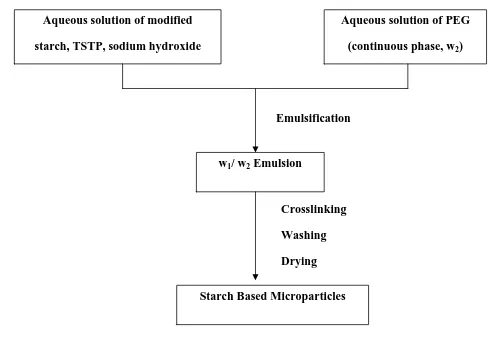
Starch-based microparticles were fabricated by a w/w emulsification crosslinking technique [ 1 8 ] modified as follows (Fig. 1). For a typical batch, aqueous solution of OSA starch, TSTP, sodium hydroxide (10 mL, 22% (w/w) OSA starch, 2.0% (w/w) TSTP and 1.5% (w/w) sodium hydroxide) which performed as dispersed phase (w1), was added drop wise into PEG (20,000) solution (100 mL, 30% solution in water (w/w) PEG) which per- formed as continuous phase (w2) under mechanical agitation (250 rpm) to obtain w1/w2 emulsion. The crosslinking reaction took place at 30°C with a constant agitation rate of 250 rpm. After 8 h, 100 mL of absolute alcohol was added into the emulsion to separate the microparticles. The resulting OSA starch-based microparticles (OSA-MPs) were
Aqueous solution of modified
starch, TSTP, sodium hydroxide
w1/ w2 Emulsion
Starch Based Microparticles
Aqueous solution of PEG
(continuous phase, w2)
Emulsification
Crosslinking
Washing
[image:3.595.58.547.242.581.2]Drying
collected and purified by multiple washing with deionized water and absolute alcohol. Finally, the microparticles were dried under vacuum at 40° C for 12 h and kept in closed containers before use.
2.3. Microsphere characterization 2.3.1. Optical microscopy
The morphology of OSA-MPs was observed using optical microscopy (CX31, Olympus Corporation, Japan). Dry microparticles were placed onto a glass slide and observed at a magnification of 100. Microphotographs were captured using digital image processing software.
2.3.2. Scanning electron microscopy (SEM)
The detailed morphology of OSA-MPs was studied by an S-450 scanning electron microscopy (Hitachi, Japan). Microparticles for SEM were mounted on metal stubs previously covered with double-side adhesive, and coated with gold in vacuum using an IB-3 ion coater (Eiko, Japan). The coated samples were scanned at an accelerating voltage of 15 kV.
2.3.3. X-ray diffraction (XRD)
An XD-2 X-ray diffractometer (Beijing Purkinje General Instrument Co., Ltd., China) was used in this experiment. X-ray powder diffraction analyses were performed at 36 kV and 20 mA with nickel filtered Cu Ka (wavelength 1.54,050 Å) radiation. The scattered intensities were measured with a scintillation counter. Powdered samples were scanned from 3 to 45 (2h) with a scanning speed of 0.5 min-1 and sampling interval of 0.02. The samples were studied at ambient temperature.
2.3.4. Particle size analysis
The particle size distributions of starch-based microparticles were determined using a Mastersizer 2000 laser particle analyzer (Malvern, UK). Considering that the microparticles can swell in the water, absolute alcohol was used as dispersant. Volume distribution of MPs samples was plotted using a computer program supplied by the manufacturer and the average particle size was expressed as volume weighted mean diameter (D [4, 3]) in micrometer.
RESULTS AND DISCUSSION
3.1. Morphology and structure of microparticles
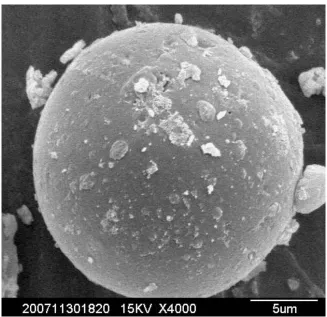
Optical microphotograph of OSA-MPs is presented in Fig. 2. It appears that OSA-MPs were spherical shape and well individualized. This observation demonstrates that starch-based microspheres with good dispersibility could be successfully fabricated by the w/w emulsification crosslinking method, using OSA starch as raw material. SEM picture of OSA-MPs shows a spherical shape and solid structure without wrinkle or concave on the surface (Fig. 3).
3.2. Structural organization of OSA-MPs
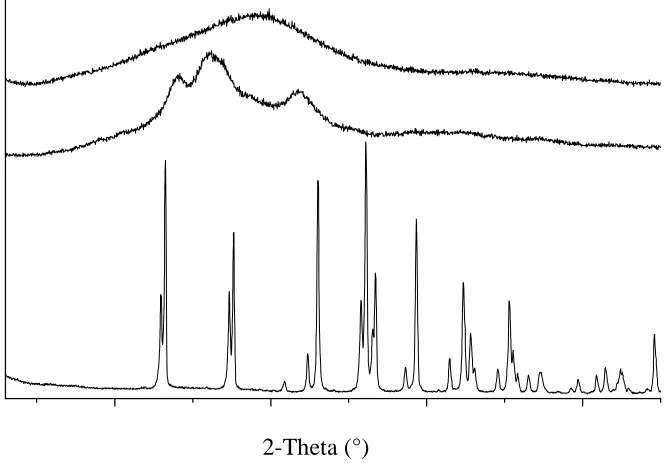
a flattened contour with no detectable peaks indicated that the OSA-MPs were of amorphous structure. This meant that there was no crystalline TSTP or OSA starch present in the microparticles [26].
Fig. 2. Optical microphotograph of OSA-MPs (100).
[image:5.595.158.485.403.720.2]In addition, due to an increase in the viscosity of continuous phase, the frequency of collisions during the agitation might decrease, resulting in the less aggregation of microparticles. The same effect was observed when a higher PEG concentration (X4) was used due to higher viscosty of continuous phase. This finding is in agreement with other reports [ 1 8 ] .
[image:6.595.148.482.172.404.2]2-Theta (°)
Fig. 4. XRD patterns of: (a) TSTP; (b) OSA starch; (c) OSA-MPs.
CONCLUSION
In this work, starch-based microspheres with good dispersibility were successfully fabricated by the w/w emulsification crosslinking method, using OSA starch as raw material. Since this process does not involve toxic organic solvents, they could be used as safe carriers for the controlled release of bioactive compounds in foods. SEM and XRD showed that OSA-MP microparticles were spherical, dense and amorphous. Of the seven parameters investigated in this study, OSA starch concentration and the volume ratio of w1/w2 had a significant and positive effect on the particle size, whereas PEG MW and PEG concentration had a significant and negative effect. The feasibility and the encapsulation efficiency of starch-based microspheres to entrap model bioactive compound using this method should be determined.
REFERENCES
[1] C Salles; A Tarrega; P Mielle; J Maratray; P Gorria; J Liaboeuf; J Liodenot.
Journal of Food Engineering, 2007, 82 (2), 189–198.
[2] A Soottitantawat; K Takayama; K Okamura; D Muranaka; H Yoshii; T
Furuta; M Ohkawara; P Linko. Innovative Food Science and Emerging
Technologies, 2005, 6 (2), 163–170.
[3] ME Malone; IAM Appelqvist. Journal of Controlled Release, 2003, 90 (2),
[4] S Yoo; Y Song; P Chang; HG Lee. International Journal of Biological
Macromolecules, 2006, 38 (1), 25–30.
[5] SJ Lee; M Rosenberg. Lebensmittel-Wissenschaft und- Technologie, 2000, 33
(2), 80-88.
[6] SM Jafari; E Assadpoor; B Bhandari; Y He. Food Research International,
2008, 41(2), 172–183.
[7] J Loksuwan. Food Hydrocolloids, 2007, 21 (5–6), 928–935.
[8] Ö A Bayram; M Bayram; A R Tekin. Journal of Food Engineering, 2005, 69
(2), 253–260.
[9] S Krishnan; R Bhosale; RS Singhal. Carbohydrate Polymers, 2005, 61 (1),
95–102.
[10]K Shitara; I Ikami; M Munakata; O Muto; Y Sakata. Clinical Oncology,
2008, 20 (3), 241–246.
[11]L Stertman; E Lundgren; I Sjöholm. Vaccine, 2006, 24 (17), 3661–3668.
[12] L Illum; AN Fisher; I Jabbal-Gill; SS Davis. International Journal of
Pharmaceutics, 2001, 222 (1), 109-119.
[13] J Yu; J Liu. Starch/Stäke, 1994, 46 (7), 252–255.
[14] G Hamdi; G Ponchel; D Duchêne. Journal of Controlled Release, 1998, 55
(2–3), 193–201.
[15] SR Mao; J M Chen; ZP Wei; H Liu; DZ Bi. International Journal of
Pharmaceutics, 2004, 272 (1–2), 37-43.
[16] F Atyabi; Manoochehri; Saeed; SH Moghadam; R Dinarvand. Archives of
Pharmacal Research, 2006, 29 (12), 1179–1786.
[17] MS Latha; AV Lal; TV Kumary; R Sreekumar; A Jayakrishnan.
Contraception, 2000, 61 (5), 329–334.
[18] O Franssen; WE Hennink. International Journal of Pharmaceutics,
1998, 168 (1), 1–7.
[19] RJ Stenekes; O Franssen; EM Van Bommel; DJ Crommelin; WE Hennink.
International Journal of Pharmaceutics, 1999, 183 (1), 29–32.
[20] GW Bos; R Verrijk; O Franssen; JM Bezemer; WE Hennink; DJ Crommelin.
Pharmaceutical Technology, 2001, 25 (10), 110–120.
[21] T Kasemsuwan; T Bailey; J Jane. Carbohydrate Polymers, 1998, 36 (4),
301–312.
[22] K Woo; PA Seib. Carbohydrtae Polymers, 1997, 33(4), 263–271.
[23] Y Fang; L Wang; D Li; B Li; B Bhandari; X D Chen; Z Mao. Carbohydrate
Polymers, 2008, 10.1016/j.carbpol.2008.03.005.
[24] PB Malafaya; F Stappers; RL Reis. Journal of Materials Science. Materials
in Medicine, 2006, 17 (4), 371–377.
[25] Y Zhang; XY Li; XL Zhai; WT Kang; Y Hou. Inorganic Chemicals
Industry, 2000, 32 (3), 28–29 (In Chinese).
[26] A Romero; F Cordobés; MC Puppob; A Guerrero; C Bengoechea. Food