Available online at www.jocpr.com 271
Analytical method validation for tablet of phenoxymethyl penicillin
potassium by RP-HPLC method
Baghel U.S.*1, Singhal M.2, Gupta M.M.1 , Singh H.P.3, Dave Shuchi 4, Sahu M.
*1
Jaipur College of Pharmacy, Sitapura, Jaipur, Rajasthan, India
2
School of Pharmaceutical Sciences, Jaipur National University, Jaipur, Rajasthan, India
3
B.N. College of Pharmacy, Udaipur, Rajasthan, India
4
Department of Pharmacogonosy, VNS College of Pharmacy, Bhopal (M.P.), India
5
Torrent Pharmaceutical Limited, Ahmedabad, Gujarat
_____________________________________________________________________________
Abstract
The present work described a simple, precise, accurate and linear reverse phase HPLC method for determination of Phenoxymethy penicillin potassium from tablet formulations. The determination was carried out on a Hypersil, ODS, C-18 (30cm 4mm) (3 to 10mm) 5µ column using a mobile phase of water: acetonitrile: glacial acetic acid (500:500:5.75).The flow rate and run time were 1ml/min and 10 min respectively. The method was reproducible with theoretical plates and % RSD.
Keywords: PENVK (Penoxymethy penicillin potassium), RP-HPLC, ICH guideline and USP.
_____________________________________________________________________________
Introduction
Phenoxymethylpenicillin potassium is potassium (6R)-6-(2-phenoxyacetamide) penicillinate produced by the growth of certain strains of penicillium notatum or related organisms on a culture medium containing an appropriate precursor[1]. Phenoxymethylpenicillin potassium is agent which is indicated for the treatment of bacterial infection . Chemically, It is the potassium salt of (2S,5R,6R)-3,3dimethyl-7-oxo-6[(phenoxyacetyl)anino]-4-thia-1-abicyclo[3.2.0]heptane-2-carboxylic acid[2].
Available online at www.jocpr.com 272 certain advantage in its simplicity, stability and time saving. The result of analysis was calculated by statistical method and recover studies as per ICH guideline and U.S.P. [6,7].
Materials and methods
Materials: Phenoxymethylpenicillin potassium BP reference substance was obtained from Micro Labs Ltd.(Banglore.India)Tablets of brand Phenoxymethylpenicillin 250mg,B.P.(Batch No.PKTB0001 Micro Labs Ltd.) Containing 250mg of PENVK were procured from a local pharmacy.HPLC Grade (Millipore filtered) acetonitrile , water and ARGrade Glacial acetic acid was used as the mobile phase.
Fig:-1 Phenoxy methyl penicillin potassium
Instrument: A HPLC (LC-2010HT, shimadzu, Japan) connected to computer loaded with class VP chromatographic software. System was coupled with SPD 10A UV detector. All weights were taken on semi microbalance (sartorious CP 2250)
Standard stock solution
The standard solution of Phenoxymethylpenicillin potassium was prepared by dissolving accurately weighed quantity of 125mg PENVK working standard in 30ml of mobile phase than make up to 50ml with mobile phase and filtered.
Chromatographic system
The determination was carried out on a hypercil ODS,C-18(25cm × 4mm,5 micron) column using a mobile phase of water ,acetonitrile and glacial acetic acid in ratio of 500:500:5.75respetively.The flow rate and runtime were 1ml/min and 10min respectively. The eluent was monitored at 254nm.The injection volume was 10µl.
Estimation of Phenoxymethyl penicillin potassium
20 Tablets was weighed and powdered. Transferred an accurately weighed portion of the powder ,equivalent to about 400.000USP Penicillin V unit to a 100ml volumetric flask, diluted with mobile phase to volume and shake for about 5minutes.Filtered a portion of this solution through a suitable filter of 0.5µ m of finer porosity and used the filtrate for assay.
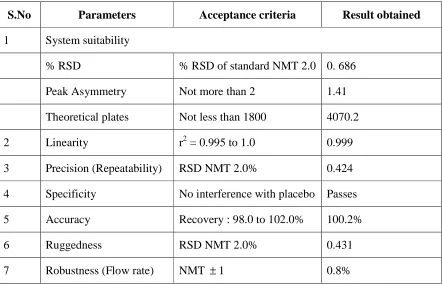
Available online at www.jocpr.com 273 This method was validated for statistical parameters i.e. system suitability, linearity, precision (reputability), specificity, accuracy, ruggedness and robustness criteria. Results of the method validation experiments are given in table 1
[image:3.595.78.520.282.566.2]The accuracy of the method was established at three levels in the range of 90% to 110% of the working concentration of sample. Calculated amount of PENVK was added in placebo to attain 90%, 100% and 110% of working concentration. Preparation was prepared as described in estimation of PENVK and each preparation was injected in duplicate % recovery and mean of %recovery was calculated at each level and recorded in table 1.
Table 1: Result of Method Validation Experiments of Phenoxymethyl Penicillin potassium.
S.No Parameters Acceptance criteria Result obtained
1 System suitability
% RSD % RSD of standard NMT 2.0 0. 686
Peak Asymmetry Not more than 2 1.41
Theoretical plates Not less than 1800 4070.2
2 Linearity r2 = 0.995 to 1.0 0.999
3 Precision (Repeatability) RSD NMT 2.0% 0.424
4 Specificity No interference with placebo Passes
5 Accuracy Recovery : 98.0 to 102.0% 100.2%
6 Ruggedness RSD NMT 2.0% 0.431
7 Robustness (Flow rate) NMT ±1 0.8%
The linearity was determined at 5 levels over the range of 80% to 120% of test concentrations. A standard linearity solution was prepared to attain concentration of 80%, 90%, 100%, 110% and 120% of the test concentration. Each linearity solution of sample was injected in duplicate. The mean area at each level is calculated and graph of mean area versus concentration is plotted. The correlation co-efficient was calculated and recorded.
Available online at www.jocpr.com 274 The Ruggedness was determined by analysis of aliquots from homogeneous lot by different analyst it was assayed by performing eight determination i.e. two concentration and two replicates of each concentration by two analyst. Weight taken by first analyst 279.4 mg and 351.2mg for the level of concentration of 80 and 100 percentages respectively similarly weight taken by next analyst 278.2 mg and 249.1mg for the level of concentration of 80 and 100 percentages respectively. The percentage RSD of above consecutive concentration was calculated
The robustness of method was established by making deliberate minor variation in the flow rate. Method was performed twice first by same procedure and second time by changing the flow rate1.2ml/min and the percentage deviation was calculated.
A typical chromatogram obtained in the present investigation is shown in fig 1.The result obtained were summarize in table.1. Prior to the analysis method was subjected to system suitability tests. It was determined by using the five working standard injections. The percentage RSD, peak symmetry and theoretical plates was calculated.
Fig.:- 2 Standard chromatogram of PENVK
The statistical parameters in method validation studies for linearity, precision, (repeatability), specificity, accuracy, ruggedness and robustness were justified the validity of the modified method. The result of the method validation studies given in table 1 has shown that the method is simple, accurate, and non –interference from table excipients.
Available online at www.jocpr.com 275 This method is simple, specific, and easy to perform and requires short time to analyze the samples. Low RSD value of precision makes this method suitable for use in quality control. This method enables determination of Phenoxymethylpenicillin potassium because of good separation of the chromatographic peak. The method was found to be linear, precise, accurate, rugged and robust.
Acknowledgement
The authors are thankful to Micro Labs Ltd.(Banglore.India) for providing the facility for work.
References
1. Indian pharmacopoeia, volume-II, the controller of publication, Delhi, 1996, 583
2. British pharmacopoeia, volume IV, the British pharmacopoeia commission, London, 2005. A-167
3. Lindberg RL; Huupponen RK; Huovinen P. Antimicrob Agents Chemother, 1984,
26(3); 300–302.
4. Genowefa P; katarzyna M; Stefan T. Journal of chromatography A, 2005, 1087(1-2); 197-202
5. Churilova NS. Antibiotic Medicinal Biotechnol, 1985, 30(2); 90-110
6. Text on validation of Analytical Procedures, International conference on Harmonization (ICH) of Technical requirement for registration of pharmaceuticals for Human use, ICH steering committee,1994