
The Method of Interacting Configurations in Complex
Number Representations: From Helium to the Complex
Atoms
V.M. Simulik
1,∗,
R.V. Tymchyk
1,
T.M. Zajac
2 1Institute of Electron Physics, National Academy of Sciences, Uzhgorod, 88000, Ukraine2Department of Electronic Systems, Uzhgorod National University, Uzhgorod, 88000, Ukraine
∗Corresponding Author: [email protected]
Copyright c2017 by authors, all rights reserved. Authors agree that this article remains permanently open access under the terms of the Creative Commons Attribution License 4.0 International License
Abstract
The transition from the He atom to the complex atoms description in the method of interacting configurations in the complex number representation has been presented. As a first step the problem of ionization of H− and Li+ions is considered. The spectroscopic characteristics of the Be, Mg and Ca atoms in the problem of the electron-impact ionization of these atoms are investigated. Few results in the photoionization problem on the1Pautoionizing states above the n=2 threshold of helium-like Be++ ion are presented. The energies and the widths of the lowest1S,1P,1D,and 1F autoionizing states of the Be, Mg atoms, and the lowest (1P) autoionizing states of Ca atom, are calculated. We con-sider briefly both a review of our previous results (together with results of other authors) and new calculations of our group. A brief review of the methods of the quasi-stationary states calculation is given.Keywords
Electron-impact Ionization of Atom, Au-toionizing States, Quasi-stationary States, Interacting Configurations Method1
Introduction
Investigations of autoionization phenomena in the frame-work of the problems dealing with the ionization and the electron scattering by atoms and ions were separated in the last decades into an independent branch of theoretical ato-mic physics. The scientific interest to the description of the processes of excitation and decay of quasi-stationary states is associated with a necessity to specify the parameters of ele-mentary processes, which are used in theoretical estimations and calculations in plasma physics, laser spectroscopy, so-lid state physics, and crystallography, at the development of technological methods of isotope separation at the atomic
le-vel, the designing of coherent ultra-violet and x-ray radiation generators, as well as in other physical domains.
The results of experimental researches concerning the au-toionizing states (AIS) located between the first and second ionization thresholds for helium and helium-like ions were qualitatively explained on the basis of the theory of isola-ted Fano resonance and in the diagonalization approxima-tion. The appearance of new experimental data on resonance structures in partial cross-sections of helium photoionization above the threshold of excited ion formation (more exactly, in the interval between the second and third thresholds, to which the AIS energies converge in the atomic ionization problem) brought about a number of theoretical issues dealing, first of all, with the description of the interaction of a considerable number of overlapping quasi-stationary states, which decay through several open channels. Theoretical calculations and the analysis of resonance structures decaying into several sta-tes of a residual ion should be carried out, in the general case, with regard for all interconfiguration interactions.
One of the first theoretical methods that made it possible to obtain results coinciding with experimental data was the method of overlapping configurations or the method of in-teracting configurations. In the terminology adopted in this work, this formalism is called the method of interacting con-figurations in the real number representation (see Section 5). An important step of the theory became the method of inte-racting configurations in the complex number representation (ICCNR method). This method was developed in works [1– 3] and successfully applied to the description of the quasi-stationary states of helium formed at its electron ionization in the energy interval above the threshold of excited ion for-mation.
[5, 6] and to the investigations of enough complex Be, Mg, Ca atoms, see, e. g., [7–13]. Few results in the photoio-nization problem on the1P AIS above the n=2 threshold of helium-like Be++ion are presented as well. The results were reported at the international conferences [5, 7–10] as some approbation of the method and found data. The complete description of the method formalism was given in [4], see, e. g., [13] as well. In [14] the choice of the ground state wave function for such precision calculations of the quasi-stationary states parameters has been considered and discus-sed. The comparison with theoretical calculations in other methods has been considered as well.
As one can see in the literature, beryllium [15–36], mag-nesium [15, 16, 18, 37–51] and calcium [52–58] atoms turns out to be the promising objects for researches; H− [59–69], Li+[70–76], Be++[71, 72] ions, as well. In the start of our step by step program from helium to complex atoms we deal with the lowest AIS of Be, Mg, Ca atoms and H−, Li+, Be++ ions. Note that today the physics of resonances phenomena in atomic shells considers different quasi-stationary states, con-verging to the high-lying thresholds, see, e.g. [76, 77]. Mo-reover, different complicated processes in atomic shells are under consideration. Thus, the ICCNR method in future has the wide domain of applications.
2
Few other well-defined and
popu-lar methods of atomic
characteris-tics calculations
Since we deal with the quantum-mechanical three body problem (see the reaction (1) below) let us consider ((at le-ast, briefly) the main methods for studying the three-particle quantum-mechanical scattering phenomena.
The Faddeev equations.The first well-defined mathema-tical method is based on Faddeev equations, see, e. g., [78– 80]. Indeed, some times the three body problem in quantum mechanics can be solved with the help of Faddeev equations. Nevertheless, this method is applied rarely for the calculati-ons in atomic problems. The reason is in the long-range pro-perty of Coulomb potential and, as a consequence, in the slow convergence of the corresponding series. Therefore, usually the method is applied for the simplest atomic systems [78– 80]. As an example, the method was applied for the (e, H) system, in which the hydrogen negative ion bound state and the lowest members of the resonances in both the singlet and the triplet J = 0 series were calculated [78]. Further, in [79] the AIS of He atom were calculated. The resonance ionization by fast protons was studied, which was possible for the short-range nuclear potential. In [80] the scattering of electrons and positrons on hydrogen atom below the n=2 threshold was investigated. Thus, the Faddeev equations are not applied for the complex atoms AIS calculations. The-refore, the Faddeev–Merkuriev integral equations [81] look more preferable for the calculation of processes in atomic
shell.
On the other hand both the Faddeev and ICCNR methods are based on the Lippmann-Schwinger-type equations. In-deed, the Faddeev formalism is started from the indication of the absence of uniqueness in the Lippmann-Schwinger solu-tions. This fact indicates some similarity between methods. However, the difference appears in T-operator analysis. Mo-reover, we do not appeal to three particle potential. Some other details about the three body problems with short-range interactions, application of Faddeev equations as well, can be found in [82].
The Fano method. Nevertheless, the start of theoretical calculations of resonance cross-sections in the photoioniza-tion problem is associated with the Fano paper [83]. The be-ginning of resonance profiles analysis can be found in [83] as well. The task of the new theory construction, which can take into account the coupled channels and can con-tain the spectroscopic characteristics of the interacting quasi-stationary states as the method parameters, has been formula-ted.In [84] the classification of two-electron excitation levels of helium has been suggested. Further, Fano demonstrates [85] that in the case of few interacting AIS, which decay into one open channel, the photoionization cross-section can be presented with explicit choosing of the members correspon-ding to the resonance process. The theory of isolated quasi-stationary state, which is observed in the cross-sections as the resonance, has been formulated by Fano in the paper [83]. In [86] the detailed description of the method has been given.
Diagonalization approximation. This method was very useful 50 years ago for investigations of the resonance scat-tering of slow electrons by many-electron atoms and ions. In this period it was a step forward. It was some unification of closed coupled channel approximation and interacting con-figuration method, in which only the diagonal elements of corresponding matrix were taken into account. The method was carried into atomic physics from the previous successful applications in the nuclear physics [87, 88]. Thus, the diago-nalization approximation was developed and realized by V.V. Balashov et al in articles [89, 90]. Further, see, e.g. [91], the method has been applied successfully for the quasi-stationary states description in the problems of photoionization and io-nization of atoms by electron impact in the region between the first and second ionization thresholds. The form reso-nances have been described in this method in the paper [92]. The studied problems have a peculiarity. The excited quasi-stationary states decay occurs into one open channel. The detailed diagonalization method description can be found in [91]. The possibility of application to other type experiments has been considered. Moreover, the diagonalization approx-imation was very useful in the investigations of scattering of photons and electrons on complex atoms ions, see, e.g., V.I. Lengyel et al [93] and the references therein.
ionization with few AIS excitation in the form of simple mulas can be found. The parameters look like the Fano for-mulae, see, e.g. [94]. Nevertheless, the author of the mo-nograph [95] does not determine the explicit expressions for his parameters. Shore parameters are determined from the solution of the integral equation system with singular kerns. In the isolated resonance approximation the system of this linear parameters is equivalent to the Fano system of para-meters. Today this system is widely used for the analysis and comparison of resonance curves, obtained in the experiments of different types.
Closed coupled channels approximation. The method was developed by Burke group in Belfast, see, e. g., [96, 97]. The important necessary principle has been realized. The formulation of this principle can be as follows. Theore-tical calculations and the analysis of resonance structures de-caying into several states of a residual ion should be carried out, in the general case, with taking into account the com-plete set of interconfiguration interactions [96, 97]. Note that isolated resonance approximation does not lead to the coin-cidence with experimental data in such problems. The clo-sed coupled channels approximation has been applied to the problems of photoionization and scattering of electrons by ions [96, 97]. Further application of method was realized in wide-range problems of photon and electron collisions with atoms and ions. The details can be found in [98]. Quantum-mechanical close coupling approach to molecular collisions can be found in [99]. Thus, the closed coupled channel met-hod [96–99] was a step forward in investigations of resonant processes.
Note on density functional theory.The difficulties in AIS theoretical description lead to the appearance of methods, which essentially depend from parameters taking from the experiment, not from the pure theory. Therefore, such appro-aches are not independent methods. The popular method of that kind is the density functional approach, see e.g. review in [100]. Thus, density functional theory, unfortunately, does not belong to so called exact quantum-mechanical methods. Moreover, the unique approach is absent. Many different va-riants of formalism have been developed by researches. Furt-hermore, in the problem of complex atoms AIS description all existing density functional approaches deal with essential difficulties. Therefore, obtained results are not of decisive character. Let us continue with independent theoretical ap-proaches.
R-matrix method. A step forward in the development of the calculation technique in the framework of coordinate re-presentation of the closed coupled channels approximation was given by R-matrix method, where the R-matrix forma-lism for the solution of the integro-differential equations sy-stem has been applied. Such method was suggested in the pa-per [101] of Wigner-Eisenbud for the solution of the nuclear physics problems. For the case of atomic physics the method has been modified in the papers of Burke, Taylor, Berringon, Eissner and Norrington, see, e.g. [102], where the calculation
procedure has been presented in details. Today the R-matrix method is the most spread in the complex atoms AIS inves-tigations [36, 102, 103]. This method is widely applied for the scattering of photons and electrons on the complex atoms both in ordinary [102] and B-spline [103] formalism.
The methods of interacting configurations. Here, con-trary to the ICCNR method, this formalism is called the met-hod of interacting configurations in the real number repre-sentation. It often becomes necessary to demonstrate the role of different multiconfiguration interactions in the resonance profiles formation, when the AIS excitation by the electrons and photons is studied. In the framework of coordinate re-presentation of closed coupled channels method the realiza-tion of this procedure is difficult, because in the channel of reaction the separation of single configuration, which corre-sponds to the concrete quasi-stationary state excitation, is im-possible (Note that AIS, which are different only in the main quantum number, belong to one and the same channel). The analysis of such problems is convenient to fulfill in the fra-mework of the methods, which follows from the shell model of nucleus. The configuration interaction method, see, e.g. [104], has been used at first in the problems with configura-tions overlapping of many particle systems discrete spectrum in nucleus. In the papers of Feshbach [105] and Bloch [106] the direct generalization of the method for the states with continuous spectrum has been given. In atomic physics the problem of configuration interaction method equations appli-cation for the direct calculations of the distribution of the os-cillations strengths transitions into the continuous spectrum has been considered by Fano [83–86]. Nevertheless, only the numerical methods of the integral equations solutions for the direct photoionization process have been formulated. In or-der to include the AIS calculation the method of [83–86] has been applied. Unfortunately, the obtaining of results for few AIS decay into few channels is impossible. This problem was overcome by the ICCNR method introducing, see, e.g. [1-4]. Note that the ordinary formalism of configuration interaction method (in our terminology the method of interacting con-figurations in real number representation) still is useful for calculations of processes in atomic shells [107].
The method of K-harmonics. This method has been described in details by Peterkop [108]. Some further deve-lopment can be found in [109–111]. As it is ordinary for such methods the wave function expansion over some basis function is used. In order to simplify the method of solution the part of expansion, which is related to functions of the con-tinuous spectrum and gives the integro-differential equations, is presented as the set in terms of K-harmonics or hyperspher-ical functions. Some exact formulae for K-harmonics method are given in [112].
simi-larity to Faddeev approach. The success of this method is evident, see, e.g., [66, 113]. However, the hyperspherical coordinates method is working good only for few body sys-tems (here with Coulomb interaction too) and is not applied for the complex atoms AIS investigations as well.
The multiconfiguration Hartree–Fock method. Useful multiconfiguration Hartree–Fock method has been developed by C. Froese Fischer [114–116], especially the program for numerical calculations.
The random phase approximation with exchange met-hod.The RPAE method is based on few physically available assumptions. The electrons in atom are considered as some dense gas. This assumption corresponds to low level of re-sidual interaction of electrons in comparison with its kinetic energy. The method is described in details in [117]. The ex-amples of application, e. g., for some states of Ar atom, are given in [118]. The application of multiconfiguration rela-tivistic random-phase approximation for Be can be found in [19].
The method of complex coordinate rotation has been developed by Y. Ho [73, 119–121]. The essence of the met-hod is the Ritz variational principle generalization, which gives the possibility for the calculations with complex test functions. At the manifold of the test function parameters the minimization of the Hamiltonians eigen values results as the vector of complex energies of the resonances under con-sideration. Note that method of complex coordinate rotation, as well as other methods bases on the Ritz variational prin-ciple, is formulated only for the calculations of wave functi-ons, which describe the coupled states in two-electron sys-tems, see, e. g., [73]. In [119] Hylleraas type wave functi-ons are used to calculate resonance parameters for intrashell states (the two electrons occupy the same shell), and pro-ducts of Slater-orbitals are used for intershell states (the two electrons occupy different shells). In [122] the configuration-interaction basis functions are applied.
3
General description of the method
In this section, the backgrounds of the method are briefly described.
The ICCNR method is a well-defined quantum-mechanical method for the calculation of parameters of atomic systems. This method is a development and a generalization of the known method of interacting configurations in the real num-ber representation. It has some advantages in comparison with the standard method of interacting configurations in the real number representation and other calculation methods for the energies and widths of quasi-stationary atomic sta-tes. First, this is a capability of finding not only the energies, but also the widths of quasi-stationary states. Second, there are new possibilities for the resonance identification. The ICCNR method makes it possible, on the basis of the results of calculations, to estimate the contribution of each resonance state to the cross-section of the process and, if the resonance
approximation is applicable, to introduce a set of parameters that determine the energies and the widths of quasi-stationary states, as well as the contours of resonance lines in the ioni-zation cross-sections. This approach also enables the appli-cability of approximate methods to the estimation of cross-sections in specific problems to be studied and the limits of their validity to be determined. Those advantages make it possible to successfully apply the ICCNR method not only to scattering processes, but also to much more complicated processes of atom ionization by electrons.
4
Motivation and goals
We presented here our step by step transition from the He atom description via the problem of ionization of H−, Li+ ions up to the enough complex atoms (such as Be, Mg and Ca) investigations. One of the goals of these investigations is to demonstrate that the ICCNR method can be useful for the complex atoms study on the level of popular R-matrix approach, see, e. g., [36].
The ICCNR method is applied here to the calculation of spectroscopic characteristics of AIS of Be, Mg and Ca atoms in the problem of the electron-impact ionization of these atoms. In particular, the energies and the widths of the lo-west (1S, 1P,1D,and1F) AIS of Be, Mg and Ca atoms are calculated. The important stage is the problem of ionization of H−, Li+ions.
The exact quantum-mechanical methods are welcome here because the experimental investigations of beryllium are complicated due to its chemical properties. Furthermore, the atomic shell of Be atom is not simple and is not very com-plex. Therefore, this atom is enough suitable object for the beginning of the application of the ICCNR method to the compound atomic systems investigations.
Here some results for Be atom [15–20] are compared with the calculations on the basis of ICCNR method. Further ana-lysis of literature shows that beryllium atom until today is the interesting experimental and theoretical problem [15–36]. The authors of [15–36] prefer the approbation of their expe-rimental and theoretical methods in the investigations of pro-cesses in the beryllium atomic shell.
scattering problem. The results were reported at the interna-tional conferences [5, 7–10]. This journal presentation is the expanded consideration of [5, 7–10].
5
Formalism of the method
Let us recall the foundations of the ICCNR method for the study of the processes of atomic ionization by the electron impact. Consider the equation of the examined reaction
A(n0L0S0) +e−(
− →
k0)→A+(nl1) +e−(
− →
k1) +e−(
− →
k),
(1) where−→k0,
− →
k1,
− →
k are the momenta of the incident, ejected, and scattered electrons, respectively. Then the generalized oscillator strength of the transition for the incident electron in the Born approximation is given by
dfnl1 dE (Q) =
E Q2
X
lL
|hnL1El| n
X
j=1
exp(i−→Q−→ri)|n0L0S0i|2.
(2) In this formulaE =k02−k2is the energy loss,
− →
Q =−→k0−
− →
k is the transmitted momentum, and|nl1El : LS0iis the wave function of an atom with total momentumLand spin
S0 provided that an electron with momentuml and energy
Eis in the field of ionA+, whose electron has the quantum numbers |nl1i. The function of the atomic ground state is given by|n0L0S0i.
Note that process (1) is a much more complicated physical phenomenon in comparison with the electron scattering by an atom. Exact theoretical calculations of such processes consti-tute a problem for modern theoretical physics. Therefore, the consideration of this problem for multielectron atoms in the framework of the ICCNR method is an important and chal-lenging scientific step.
The choice of the wave function for the ground state is dictated by a desirable accuracy of the final results of calcu-lations. In the case of two-electron systems, this is a multipa-rametric Hylleraas-type wave function [123], and, in the case of Be atom, this is, as a rule, a Hartree-Fock wave function obtained in the multiconfiguration approximation [114–116]. In our papers we used the Tweed [124] wave function as well, see [14] for details. The system of equations in the ICCNR method has the following form:
(En−E)aEiλn+
X
λ0
Z ∞
0
bEiλλ0(E0)Vnλ0(E0)dE0, (3)
X
m
aEiλmVmλ∗ 0(E0) + (E0−E)bEiλλ0(E0) = 0.
The multipliersaEi
λmandbEiλλ0(E0)are the coefficients of
ex-pansion of the wave functionΨE
λ(−→r1,−→r2)in the basis
ΨEλ(−→r1,−→r2) =
X
m
aEiλm|mi+
X
λ0
Z ∞
0
bEiλλ0(E0)|λ0E0idE0.
(4)
The basis wave functions satisfy the conditions
hm|Hb|ni=Enδnm,hλ0E0|Hb|λEi=Eδλλ0δ(E−E0),
(5) whereHb is the total Hamiltonian of the system.
The formal solution for the multiplierbEiλλ0(E0)is given by
bEiλλ0(E0) =P
P
ma Ei
λmVmλ(E)
E−E0 + [Aλλ0 (6)
±iπX
m
aEiλmVmλ0(E)]δ(E−E0),
whereVmλ(E) =hm|Hb|λEi. The matrixAλλ0 depends on
the asymptotic properties of the basis functions|λEi. Sub-stitution of Eq. (6) into Eq. (3) transforms the system of equations obtained in the ICCNR method into a system of linear algebraic equations for the coefficientsaEi
λm:
(En−E)aEiλn+
X
m
[Fnm(E)−iγnm(E)]aEiλm (7)
=−X
λ0
Aλλ0Vλ0n(E),
The latter can be expressed in terms of eigenvectors and ei-genvalues of the complex matrix
Wnm(E) =Enδnm+Fnm(E)−iγnm(E), (8) where
γnm(E) =π
X
λ
Vnλ(E)Vλm(E); (9)
Fnm(E) =
1
π Z ∞
0
γnm(E)
E−E0dE 0.
The analysis of formulas (8) and (9) allows one to compare various approximations, which can be done in the ICCNR method. One can see that, in the framework of this method, the following approximations are possible:
1) the method of interacting configurations in the real num-ber representation; this approximation corresponds to the neglect of complex componentsiγnm(E)in matrix (8);
2) the diagonalization approximation in the real number representation consists in that the sum of all non-diagonal membersFnm(E)−iγnm(E)in the matrixWnm(E)is neg-lected;
3) the diagonalization approximation involving the transi-tions outside the energy surface (or the diagonalization ap-proximation in the complex number representation) arises if the termFnm(E)is neglected in calculations.
The account for all members in matrix (8) is, in essence, the ICCNR method, the advantages of which over the indica-ted approximations are obvious.
excited ion formation [1, 2]. The partial amplitudes of the resonance ionization can be determined as follows:
T|0i→|λEi(E) =tdirλ (E) +
X
m
Hmλ(E)
εm(E) + 1
. (10)
The quantities in formula (10) are defined by the relations
tdirλ (E) =pC(E)hλE|ˆt|0i, (11)
Hmλ(E) = 2Vemλ(E)[tm(E)−iτm(E)]Γ−m1(E), (12) where
tm(E) =
p
C(E)hFemE|ˆt|0i, τm(E) =
p
C(E)hχEm|ˆt|0i. (13) Hence, the expressions for the cross-sections become para-metrized
σλ(E) =σλdir(E)+
X
m
Γm(E)Pmλ(E) +εm(E)Qmλ(E)
ε2
m(E) + 1
.
(14) The real functions Pmλ(E) and Qmλ(E) of the total energy E are the doubled real and imaginary, respectively, parts of the complex functionNmλ(E), which looks like
Nαm(E) =
X
λεα
Hmλ(E)(tdirλ (E)+
X
n
Hmλ(E)
εn(E)−εm(E) + 2i
)∗.
Hence, the resonance ionization cross-section is determined by a collection of the following functions of the total energy
E:σλdir(E),Nαm(E),εm(E), andΓm(E). See more details about the formalism of the method (for two electron systems) in the article [4].
6
The results of the calculations
Here the electron-impact ionization of the H−, Li+ ions and Be, Mg, Ca atoms in the interval of AIS excitation are considered.
6.1
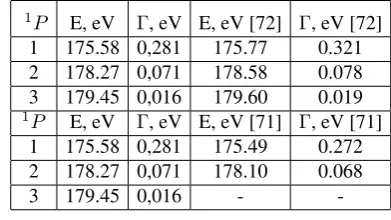
The positions of the autoionizing states of the H− and Li+ions, converging to the threshold n=3The results of the calculations for electron-impact ioniza-tion of H−, Li+ ions are presented. The ICCNR method is used. The positions of four lowest AIS of the H− ion and three lowest Li+ ions, converging to the threshold n=3, are given in the Tables 1 and 2, respectively. The comparison with experimental and theoretical results of other authors is presented in these tables as well.
Furthermore, first and forth resonances of Table 1 can be compared with AIS E=12.650, Γ=0.02758 and E=12.837,
[image:6.595.324.532.125.267.2]Γ=0.00163 in [59], respectively. Moreover, three quasi-stationary states of Table 2 can be compared with resonances E=175.80, E=178.18 and E=179.37 in [70], respectively.
Table 1.Energies and widths of the lowest AIS of the H−ion, converging to the threashold n=3, in the ICCNR method
No E, eV Γ, eV E, eV [63] Γ, eV [63] 1 12.6598 0.0304 12.6586 0.0329 2 12.7801 0.0010 12.7677 0.0012 3 12.8479 0.0026 12.8382 0.0030 4 12.8591 0.0018 12.8416 0.0022 No E, eV Γ, eV E, eV [60] E, eV [61]
[image:6.595.330.526.325.435.2]1 12.6598 0.0304 12.6605 12.6602 2 12.7801 0.0010 12.7656 12.7658 3 12.8479 0.0026 12.8330 12.8332 4 12.8591 0.0018 12.8394 12.8408
Table 2.Energies and widths of the lowest1PAIS of the Li+ion, conver-ging to the threshold n=3, in the ICCNR method
1P E, eV Γ, eV E, eV [72] Γ, eV [72] 1 175.58 0,281 175.77 0.321 2 178.27 0,071 178.58 0.078 3 179.45 0,016 179.60 0.019 1P E, eV Γ, eV E, eV [71] Γ, eV [71]
1 175.58 0,281 175.49 0.272 2 178.27 0,071 178.10 0.068
3 179.45 0,016 -
-6.2
Energies and widths of the lowest autoionizing sta-tes of Be atomIn brief report [7], using the ICCNR method, the investiga-tion of the electron-impact ionizainvestiga-tion of a Be atom in the AIS excitation interval has been started, and the spectra of energy loss were analyzed. The photoionization of this atom has been studied as well. The AIS that arise in this problem can be compared with the AIS that are formed in the problem of electron scattering at the corresponding ion. In calculations, the Coulomb wave functions were used as basis configurati-ons. For every term, up to 25 basis configurations were taken into account.
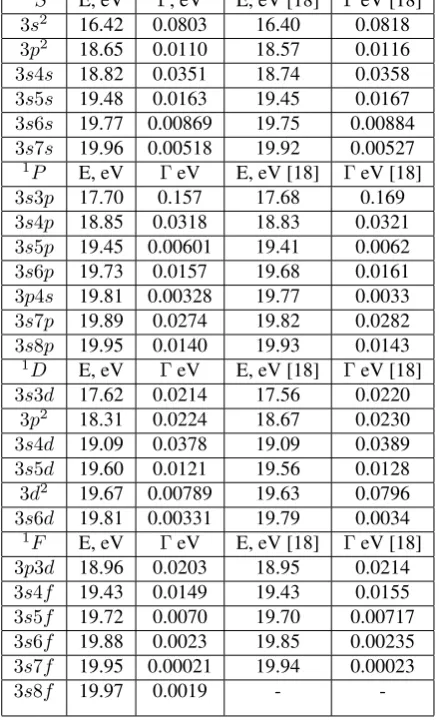
Table 3.Energies and widths of the lowest AIS (1S,1P,1D,and1F) of a beryllium atom obtained in the ICCNR approximation in the problem of the electron-impact ionization of an atom. In the paper [18], the energies of AIS were calculated in the diagonalization approximation in the framework of the problem of electron scattering by a Be+ion
1S E, eV Γ, eV E, eV [18] ΓeV [18]
3s2 16.42 0.0803 16.40 0.0818
3p2 18.65 0.0110 18.57 0.0116
3s4s 18.82 0.0351 18.74 0.0358
3s5s 19.48 0.0163 19.45 0.0167
3s6s 19.77 0.00869 19.75 0.00884
3s7s 19.96 0.00518 19.92 0.00527 1P E, eV ΓeV E, eV [18] ΓeV [18]
3s3p 17.70 0.157 17.68 0.169
3s4p 18.85 0.0318 18.83 0.0321
3s5p 19.45 0.00601 19.41 0.0062
3s6p 19.73 0.0157 19.68 0.0161
3p4s 19.81 0.00328 19.77 0.0033
3s7p 19.89 0.0274 19.82 0.0282
3s8p 19.95 0.0140 19.93 0.0143 1D E, eV ΓeV E, eV [18] ΓeV [18]
3s3d 17.62 0.0214 17.56 0.0220
3p2 18.31 0.0224 18.67 0.0230
3s4d 19.09 0.0378 19.09 0.0389
3s5d 19.60 0.0121 19.56 0.0128
3d2 19.67 0.00789 19.63 0.0796
3s6d 19.81 0.00331 19.79 0.0034 1F E, eV ΓeV E, eV [18] ΓeV [18]
3p3d 18.96 0.0203 18.95 0.0214
3s4f 19.43 0.0149 19.43 0.0155
3s5f 19.72 0.0070 19.70 0.00717
3s6f 19.88 0.0023 19.85 0.00235
3s7f 19.95 0.00021 19.94 0.00023
3s8f 19.97 0.0019 -
-In the literature, there are no similar results obtained on the basis of exact computational methods, in particular, on the basis of the method of interacting configurations and, moreo-ver, on the basis of the ICCNR one. The comparison with the results of paper [18] found in the diagonalization approxima-tion (see Table 3) is indirect, because it deals with a different object in a different problem. Nevertheless, it really eviden-ces the reliability of the results obtained here.
Here we are able to add energies and the widths in the pho-toionization problem of the1PAIS below the n=3 threshold of helium-like Be++ion. The first three1Presonances above the n=2 threshold are presented. The results are compared with theoretical calculations of [78, 79]. These results are presented in Table 5.
Table 4. Comparison of the energies obtained with the use of the ICCNR method for the AIS of a beryllium atom, which are located between the corresponding first and second ionization thresholds, with the results of other authors
1P E, eV E, eV [15] E, eV [16] E, eV [17]
2p3s 10.71 10.71 10.93 10.77
2p3d 10.84 11.86 11.86 11.86
2p4s 12.03 11.97 12.10 12.07
2p4d 12.42 12.47 12.50 12.49 1P E, eV E, eV [18] E, eV [19] E, eV [20]
2p3s 10.71 10.73 10.63 10.91
2p3d 10.84 11.85 12.03 11.83
2p4s 12.03 12.09 12.09 12.09
2p4d 12.42 12.49 12.61 12.44
Table 5. Comparison of the energies and the widths obtained with the use of the ICCNR method for the AIS below the n=3 threshold of a helium-like Be++ion with the theoretical results of other authors (the first three1P
resonances above the n=2 threshold are under consideration)
E, eV Γ, eV E, eV [71] Γ, eV [71] E, eV [72] Γ, eV [72]
329.18 0.318 329.50 0.324 329.55 0.412
333.24 0.0081 333.35 0.086 333.69 0.088
337.47 0.0019 - - 337.66 0.0023
6.3
Electron-impact ionization of a Mg atom in the in-terval of the excitation of autoionizing statesThe investigation of the ionization of Mg atoms (and Mg+ ions) by photons and electrons is a challenging problem, which is proved by both experimental and theoretical papers of many authors (see, e.g., publications [8, 9, 18, 37, 38] con-sidered here). In brief articles [8, 9], we started to study the electron-impact ionization of a Mg atom in the AIS excita-tion interval with the use of the ICCNR method. In Table 6, the results of our calculations for the energies and the widths of the lowest AIS (1S,1P,1D,and1F) of a Mg atom obtai-ned in the electron-impact ionization problem in the ICCNR approximation are presented.
[image:7.595.53.273.166.528.2]of the R-matrix method [38] can be made. In Table 7, the energy positions and the widths calculated for the1PAIS of a magnesium atom with the use of the ICCNR method are di-rectly compared with the experimental data of paper [37] and the theoretical data obtained with the help of the R-matrix formalism [38], as well as with the problem of electron scat-tering by a Mg+ion [18].
Table 6.Energies and widths of the lowest AIS (1S,1P,1D,and1F) of a
Mg atom obtained in the ICCNR approximation in the problem of electron-impact ionization of an atom. In paper [18] the energies of autoionizing states were calculated in the diagonalization approximation in the framework of the problem of electron scattering by a Mg+ion
1S E, eV ΓeV E, eV [18] ΓeV [18]
4s2 13.08 0.0987 13.06 0.1010
3d2 14.61 0.0480 14.66 0.0502
4s5s 14.92 0.0425 14.97 0.0473
4s6s 15.48 0.0196 15.53 0.0185
3d4d 15.59 0.0140 15.64 0.0129
4s7s 15.78 0.0115 15.80 0.0107
4s8s 15.80 0.0069 -
-1P E, eV ΓeV E, eV [18] ΓeV [18]
4s4p 14.15 0.157 14.18 0.143
3d4p 15.01 0.172 14.95 0.162
4s5p 15.34 0.0324 15.29 0.0301
4s6p 15.68 0.0682 15.64 0.0667
3d4f 15.77 0.0481 15.74 0.0448
4s7p 15.85 0.0059 15.86 0.0048
3s8p 19.95 0.0140 19.93 0.0143 1D E, eV ΓeV E, eV [18] ΓeV [18]
3d4s 13.62 0.262 13.66 0.272
3d2 14.31 0.253 14.38 0.269
4d4s 14.89 0.0192 14.96 0.0189
3d5s 15.28 0.0869 15.30 0.0951
4p2 15.47 0.0570 15.49 0.0578
3d4d 15.58 0.0865 15.55 0.0876
4s5d 15.69 0.0258 15.66 0.0248 1F E, eV ΓeV E, eV [18] ΓeV [18]
3d4p 14.15 0.0225 14.66 0.0230
4s4f 15.01 0.0110 15.28 0.0113
3d5p 15.34 0.0540 15.53 0.0589
3d4f 15.53 0.0052 15.63 0.0053
4s5f 15.68 0.0201 15.71 0.0205
3d6p 15.77 0.0104 15.88 0.0109
4s6f 15.85 0.0125 15.90 0.0131
Thus, the original scientific results found with the help of the ICCNR method for the energies and the widths of the lo-west AIS (1S,1P,1D,and1F) of a Mg atom in the problem of electron-impact ionization of this atom are presented (see Table 6). Their novelty consists in the application of the exact calculation method, namely, the method of interacting
confi-gurations and, the more so, the ICCNR method. The com-parison with the calculations of corresponding energies and widths of AIS carried out in the diagonalization approxima-tion in the problem of electron scattering by Mg+ions (Table 6) is indirect (a different object in a different problem), but really testifies to the reliability of the results obtained. Some of the results obtained here, namely, the energy positions of the1PAIS of a Mg atom, can be directly compared with the experiment and the R-matrix calculations (see Table 7). The results of calculations carried out with the use of the ICCNR method are in good agreement with the corresponding cal-culations using the R-matrix method [38] and experimental results [37] (see Table 7).
Table 7.Comparison of the energies and the widths of the AIS of a magne-sium atom obtained with the use of the ICCNR method with the experiment [37] and R-matrix calculations for1P-states [38] (paper [38]: the
photoioni-zation problem and the photoioniphotoioni-zation threshold; work [18]: the scattering problem)
1
P E, eV ΓeV E, eV [18] ΓeV [18]
4s4p 14.15 0.157 14.18 0.143
3d4p 15.01 0.172 14.95 0.162
4s5p 15.34 0.0324 15.29 0.0301
3d5p 15.53 0.0775 15.56 0.0758
4s6p 15.68 0.00682 15.64 0.00667
3d4f 15.77 0.0481 15.74 0.0448
4s7p 15.85 0.00592 15.86 0.00476
4s8p 15.90 0.0087 -
-3d6p 15.93 0.0295 -
-4s9p 15.95 0.0011 -
-1
P E, eV ΓeV E, eV [38] ΓeV [38] E, eV [37]
4s4p 14.15 0.157 14.2213 0.3921 14.18
3d4p 15.01 0.172 14.9048 0.6078
-4s5p 15.34 0.0324 15.3133 0.0931
-3d5p 15.53 0.0775 15.7264 0.0890 15.24
4s6p 15.68 0.00682 15.6653 0.0142 15.61
3d4f 15.77 0.0481 - -
-4s7p 15.85 0.00592 15.8675 0.0095 15.83
4s8p 15.90 0.0087 15.9802 0.0111 15.98
3d6p 15.93 0.0295 16.007 0.0417
-4s9p 15.95 0.0011 16.065 0.0019 16.06
6.4
Electron-impact ionization of a Ca atom in the in-terval of the excitation of autoionizing states [image:8.595.310.543.313.590.2]obtained by other authors.
Table 8.Comparison of the energies and the widths obtained with the use of the ICCNR method for the AIS of a Ca atom with the theoretical results of other authors [53, 54] and the experiment [52]
1P E, eV E, eV [52] E, eV [53] E, eV [54]
3d5p 6.601 6.59 6.604 6.633
3d6p 7.033 7.02 7.038 7.080
3d7p 7.397 7.39 7.342 7.415
3d8p 7.465 7.47 7.471 7.502
3d9p 7.551 - 7.556 7.575
3d10p 7.610 - 7.614 7.624
4p5s 7.159 7.13 7.166 7.300
3d4f 6.937 - 6.938 6.960
3d5f 7.240 7.25 7.248 7.260
3d6f 7.425 - 7.427 7.427
3d7f 7.523 - 7.529 7.527
3d8f 7.591 - 7.596 7.593
1P ΓeV ΓeV [52] ΓeV [53] ΓeV [54]
3d5p 0.0801 0.21 0.0702 0.0846
3d6p 0.0059 0.17 0.0056 0.0067
3d7p 0.0451 - 0.0509 0.0399
3d8p 0.0261 0.14 0.0232 0.0315
3d9p 0.0163 - 0.0141 0.0282
3d10p 0.0140 - 0.0101 0.0207
4p5s 0.0129 0.15 0.0139 0.0132
3d4f 0.00006 - 0.000004 0.00001
3d5f 0.0059 - 0.0028 0.00003
3d6f 0.0019 0.17 0.0014 0.0024
3d7f 0.0009 - 0.0011 0.00007
3d8f 0.00007 - 0.00008 0.00006
7
Conclusions
The method of interacting configurations in the complex number representation, which was applied earlier to the des-cription of quasi stationary states of a helium atom [1–3], is under consideration. The calculation of the ionization pro-cesses for more complicated atomic systems is suggested. New results as well as the brief review of our previous in-vestigations are presented. In the problem of the electron-impact ionization the spectroscopic characteristics of the lo-west AIS of Be, Mg, Ca atoms and H−, Li+, Be++ ions were studied. The energies and the widths of the lowest AIS (1S, 1P, 1D,1F) of Be, Mg atom, together with the lowest (1P) AIS of Ca atom and Li+, Be++ions, were calculated. Lowest quasi stationary states of H−ion were studied as well. The found results were compared with known experimental data and calculations on the basis of other methods. Hence, we may draw conclusion about a successful verification of
the ICCNR method for the calculation of AIS of complex atoms and the processes of electron-impact ionization and excitation of such atoms.
REFERENCES
[1] S.M. Burkov, N.A. Letyaev, S.I. Strakhova, T.M. Zajac. Photon and electron ionization of helium to the n=2 state of He+, J. Phys. B: At. Mol. Opt. Phys., Vol.21, No.7, 1195–1208 (1988).
[2] S.M. Burkov, T.M. Zajac, S.I. Strakhova. Ionization of helium by fast electrons in the region over the threshold of exiting ions formation, Opt. Spektrosk., Vol.63, No.3, 17–25 (1988).
[3] S.M. Burkov, S.I. Strakhova, T.M. Zajac. Total and partial ge-neralized oscillator strengths for transitions to the continuum of helium, J. Phys. B: At. Mol. Opt. Phys., Vol.23, No.20, 3677–3690 (1990).
[4] T.M. Zajac, V.M. Simulik. The method of interacting con-figurations in complex number representation. Application for calculations of spectroscopic characteristics of quasi-stationary states in two electron systems, Int. J. Pure. Appl. Phys., Vol.3, No.3, 243–260 (2007).
[5] T.M. Zajac, A.I. Opachko, V.M. Simulik. Photoionization of Li+ ion above the excited ion formation threshold. Book of Abstracts of 4-th CEPAS Conference, Cluj-Napoca, Romania, 18-20 June, 2008, p. 139.
[6] T.M. Zajac, A.I. Opachko, V.M. Simulik. Application of the method of interacting configurations in complex number re-presentation to the problem of the ionization of ions, Uz-hgorod Univ. Sci. Herald, Ser. Phys., Vol.22, No.1, 82–86 (2008) (in ukrainian).
[7] A.I. Opachko, V.M. Simulik, R.V. Tymchyk, T.M. Zajac. Lowest autoionizing states of beryllium in photoionization problem. Book of abstracts of 43-th EGAS Conference, University of Fribourg, Fribourg, Switzerland, 28 June–2 July, 2011, p. 203.
[8] T.M. Zajac, A.I. Opachko, V.M. Simulik, R.V. Tymchyk. Ionization of Mg atom by electron-impact in the region of autoionizing states excitation. Book of abstracts of 41-th EGAS Conference, University of Gdansk, Gdansk, Poland, 8–10 July, 2009, p. 156.
[10] V.M. Simulik, R.V. Tymchyk, T.M. Zajac. Autoionizing states of Ca in the problem of ionization of calcium atom by the electrons. Book of abstracts of 44-th EGAS Conference, University of Gothenburg, Gothenburg, Sweden, 9–13 July, 2012, p. 197.
[11] V.M. Simulik, T.M. Zajac, R.V. Tymchyk. Calculations for electron-impact ionization of beryllium in the method of inte-racting configurations in the complex number representations, arXiv: 1608.04078v1 [physics, atom-ph] 14 Aug. 2016. 5 p.
[12] T.M. Zajac, V.M. Simulik, R.V. Tymchyk. The beryllium atom lowest autoionizing states in the method of interacting configurations in the complex number representations, Int. J. Theor. Math. Phys., Vol.6, No.4, 111–116 (2016).
[13] V.M. Simulik, T.M. Zajac, R.V. Tymchyk. Application of the method of interacting configurations in the complex number representation to calculating the spectroscopic characteristics of the autoionizing states of Be, Mg and Ca atoms, Ukr. J. Phys., Vol.60, No.11, 1094–1100 (2015).
[14] V.M. Simulik, T.M. Zajac, R.V. Tymchyk. Choice of the wave function for the helium ground state for precision calculati-ons of quasi stationary state parameters, Ukr. J. Phys., Vol.61, No.11, 950–955 (2016).
[15] G. Mehlman-Ballofet, J.M. Esteva. Far ultraviolet absorption spectra with auto-ionized levels of beryllium and magnesium, Astrophys. J., Vol.157, No.2, 945–956 (1969).
[16] J.M. Esteva, G. Mehlman-Ballofet, J. Romand. Spectres d’absorption dans l’ultraviolet lointain de Be, B, C, N, Mg, Al et Si, Journal of Quantitative Spectroscopy and Radiative Transfer, Vol.12, No.9, 1291–1303 (1972).
[17] P.L. Altic. Photo-ionization cross section of beryllium near threshold, Phys. Rev., Vol.169, No.1, 21–26 (1968).
[18] V.L. Lengyel, V.T. Navrotsky, E.P. Sabad. Resonant scattering of low-energy electrons by Be+and Mg+ ions, J. Phys. B: At. Mol. Opt. Phys., Vol.23, No.16, 2847–2867 (1990).
[19] H.C. Chi, K.N. Huang, K.T. Cheng. Autoionizing le-vels of beryllium from the multiconfiguration relativistic random-phase approximation, Phys. Rev. A., Vol.43, No.5, 2542–2545 (1991).
[20] D.S. Kim, S.S. Tayal, H.L. Zhou, S.T. Manson. Photoioniza-tion of atomic beryllium from the ground state, Phys. Rev. A., Vol.61, No.6, 062701–062709 (2000).
[21] T.M. Clark et al. Observation of autoionizing states of beryllium by resonance-ionization mass spectrometry, J. Opt. Soc. Am. B., Vol.2, No.6, 891–896 (1985).
[22] R Moccia, P Spizzo. One-photon transition probabilities and photoionisation cross section calculations of Be, J. Phys. B: At. Mol. Phys., Vol.18, No.17, 3537–3554 (1985).
[23] H. Bachau, P. Galan, and F. Martin. Feshbach-model potential approach for the study of resonant and bound states of Be-like ions, Phys. Rev. A., Vol.41, No.7, 3534–3544 (1990).
[24] N. Miura, Y. Osanai, T. Noro, F. Sasaki. Theoretical deter-mination of energies and widths of autoionizing states of the Be atom, J. Phys. B: At. Mol. Opt. Phys., Vol.29, No.13, 26892699 (1996).
[25] K. Bartschat, P.G. Burke, M.P. Scott. Electron-impact exci-tation of beryllium, J. Phys. B: At. Mol. Opt. Phys., Vol.29, No.20, L769–L772 (1996).
[26] J. Colgan et al. Electron-impact ionization of all ionization stages of beryllium, Phys. Rev. A., Vol.68, No.3, 032712(1–9) (2003).
[27] R. Wehlitz, D. Lukic, J. B. Bluett. Resonance parameters of autoionizing Be 2pnlstates, Phys. Rev. A., Vol.68, No.5, 052708(1–5) (2003).
[28] C.P. Ballance et al. Electron-impact excitation of beryllium and its ions, Phys. Rev. A., Vol.68, No.6, 062705(1–11) (2003).
[29] M.A. Uddin et al. Electron-impact ionization of beryllium isoelectronic ions, Int. J. Mass. Spectr., Vol.244, No.1, 76–83 (2005).
[30] J.C. Cardona, J.L. Sanz-Vicario. Autoionizing states in beryllium-like atomic systems using explicitly correlated coordinates, J. Phys. B: At. Mol. Opt. Phys., Vol.41, No.5, 055003(1–10) (2008).
[31] M.R. Talukder. Electron impact total ionization cross sections of beryllium and boron isoelectronic ions, Appl. Phys. B., Vol.93, No.2-3, 567–574 (2008).
[32] W.C. Chu, C.D. Lin. Theory of ultrafast autoionization dynamics of Fano resonances, Phys. Rev. A., Vol.82, No.5, 053415(1–9) (2010).
[34] J.M.N. Djiokap, A.F. Starace. Resonant enhancement of the harmonic generation spectrum of beryllium, Phys. Rev. A., Vol.88, No.5, 053412(1–15) (2013).
[35] T. Maihom et al. Electron-impact ionization cross sections of beryllium and beryllium hydrides, Eur. Phys. J. D., Vol.67, No.1, 2(1–5) (2013).
[36] O. Zatsarinny, K. Bartschat, D.V. Fursa. Calculations for electron-impact excitation and ionization of beryllium, J. Phys. B: At. Mol. Opt. Phys., Vol.49, No.23, 235701(1–9) (2016).
[37] M.A. Baig, J.P. Connerade. Extensions to the Spectrum of Doubly Excited MgI in the Vacuum Ultraviolet, Proc. Roy. Soc. Lond. A., Vol.364, December 20, 353–366 (1978).
[38] D.S. Kim, S.S. Tayal. Autoionizing resonances in the photoionization of ground state atomic magnesium, J. Phys. B: Atom. Mol. Opt. Phys., Vol.33, No.17, 3235–3247 (2000).
[39] Y.L. Shao, C. Fotakis, D. Charalambidis. Multiphoton ionization of Mg in the wavelength region of 300-214 nm, Phys. Rev. A., Vol.48, No.5, 3636–3643 (1993).
[40] M.J. Ford et al. Electron-impact double ionization of magne-sium, Phys. Rev. A., Vol.57, No.1, 325–330 (1998).
[41] K. Bartschat, D. Weflen, X. Guan. Electron-impact ionization of magnesium, J. Phys. B: Atom. Mol. Opt. Phys., Vol.40, No.16, 3231–3239 (2007).
[42] T.K. Fang, Y.K. Ho. Determination of resonance energies and widths of Mg 3pnl1Deand1F0doubly excited states by the stabilization method with the B-spline-based configuration interaction approach, J. Phys. B: Atom. Mol. Opt. Phys., Vol.32, No.15, 3863–3872 (1999).
[43] A. Reber, F. Martin, H. Bachau, R.S. Berry. Two-photon above-threshold ionization of magnesium, Phys. Rev. A., Vol.65, No.6, 063413(1–7) (2002).
[44] A. Reber, F. Martin, H. Bachau, R.S. Berry. Three-photon above-threshold ionization of magnesium, Phys. Rev. A., Vol.68, No.6, 063401(1–10) (2003).
[45] A. Reber et al. Above-threshold ionization near the 3p4d1F0 autoionizing state in magnesium, Phys. Rev. A., Vol.71, No.5, 053402(1–7) (2005).
[46] D. Rassi, V. Pejcev, T.W. Ottley, K.J. Ross. High-resolution ejected-electron spectrum of magnesium autoionising levels following two-electron excitation by low-energy electron impact, J. Phys. B: Atom. Mol. Phys., Vol.10, No.14, 2913–2921 (1977).
[47] T.M. El-Sherbini, A.A. Rahman. Autoionizing states in MgI, Annalen der Phys., Vol.39, No.5, 333–337 (1982).
[48] T.N. Chang. 3pnp1Sautoionization states of the magnesium atom, Phys. Rev. A., Vol.36, No.11, 5468–5470 (1987).
[49] C.J. Dai. Resonance profiles of Mg 3pnsautoionizing states, Chin. Phys. Lett., Vol.12, No.3, 152–155 (1995).
[50] R.F. Boivin, S.K. Srivastava. Electron-impact ionization of Mg, J. Phys. B: Atom. Mol. Opt. Phys., Vol.31, No.10, 2381–2394 (1998).
[51] J.A. Ludlow et al. Electron-impact single ionization of Mg and Al+, Phys. Rev. A., Vol.79, No.3, 032715(1–6) (2009).
[52] J.E. Kontrosh, I.V. Chernyshova, O.B. Shpenik. Near-threshold electron-impact ionization of calcium atom, Opt.Spectrosc., Vol.110, No.4, 500–507 (2011).
[53] O.I. Zatsarinny, V.I. Lengyel, E.A. Masalovich. Resonance structure in the electron-impact excitation of Ca+ below the 5sthreshold, Phys. Rev. A., Vol.44, No.11, 7343–7354 (1991).
[54] P. Scott, A.E. Kingston, A. Hibbert. Photoionization of neutral calcium, J. Phys. B: Atom. Mol. Phys., Vol.16, No.21, 3945–3959 (1983).
[55] S.M. Kazakov, O.V. Khristoforov. Electron spectra from autoionizing states of strontium and calcium excited by low and intermediate-energy electrons, Sov. Phys. JETP, Vol.61, No.4, 656–664 (1985).
[56] D. Cvejanovic, A.J. Murray. Single ionization of calcium by electron impact, J. Phys. B: Atom. Mol. Opt. Phys., Vol.36, No.17, 3591–3605 (2003).
[57] D. Cvejanovic, A. J. Murray. Single ionization of calcium by electron impact, J. Phys. B: Atom. Mol. Opt. Phys., Vol.36, No.8, 3591–3605 (2003).
[59] M.E. Hamm et al. Observation of narrow resonances in the H− photodetachment cross section near the n=3 threshold, Phys. Rev. Lett., Vol.43, No.23, 1715–1718 (1979).
[60] R.S. Oberoi. Auto-ionization states of two electron atoms, J. Phys. B: Atom. Mol. Phys., Vol.5, No.6, 1120–1125 (1972).
[61] K.T. Chung. Projection-operator approximation for autoioni-zation states in the inelastic scattering region, Phys. Rev. A., Vol.6, No.5, 1809–1813 (1972).
[62] C.D. Lin. Feshbach and shape resonances in the e-H 1P system, Phys. Rev. Lett., Vol.35, No.17, 1150–1153 (1975).
[63] L.A. Morgan, M.R.C. McDowell, J. Callaway. Electron-impact excitation of resonances below the n=3 levels of atomic hydrogen, J. Phys. B: Atom. Mol. Phys., Vol.10, No.16, 3297–3305 (1977).
[64] B.L. Christensen-Dalsgaard. Two-electron correlation: diabatic states, Phys. Rev. A., Vol.29, No.2, 470–487 (1984).
[65] A. Macias, A. Riera. Use of a simple method for the reso-nance widths of1Pstates in He-like systems, Europhys. Lett., Vol.2, No.5, 351–358 (1986).
[66] A.G. Abrashkevich et al. Doubly excited states of H−and He in the coupled-channel hyperspherical adiabatic approach, Phys. Rev. A., Vol.45, No.7, 5274–5277 (1992).
[67] A.G. Abrashkevich, M. Shapiro. Theory of two-electron atoms interacting with intense laser pulses: the one-photon ionization of He and the photodetachment of H−, J. Phys. B: Atom. Mol. Opt. Phys., Vol.29, No.4, 627–644 (1996).
[68] A. Burgers, E. Lindroth. Doubly excited states in the negative hydrogen ion, Eur. Phys. J. D., Vol.10, No.2, 327–340 (2000).
[69] M. Dieng, I. Sakho, M. Biaye, A. Wague. The Intra-shell singlet and triplet doubly excited states energy calculations of helium-like Ions using special forms of the Hylleraas-type wave functions, Chin. J. Phys., Vol.48, No.1, 38–48 (2010).
[70] R. Bruch, G. Paul, J. Andra, L. Lipsky. Antoionization of foil-excited states in Li I and Li II, Phys. Rev. A., Vol.12, No.5, 1808–1824 (1975).
[71] Y.K. Ho. Autoionization states of helium isoelectric sequence below the n=3 hydrogenic thresholds, J. Phys. B: At. Mol. Opt. Phys., Vol.12, No.3, 387–400 (1979).
[72] A. Wague. Application of the diagonalization approximation to the n=3 resonant photoionization of helium-like systems, Z. Phys D. At. Mol. Clust., Vol.6, No.4, 337–344 (1987).
[73] Y.K. Ho. Complex-coordinate calculations for doubly excited states of two-electron atoms, Phys. Rev., Vol.23, No.5, 2137–2149 (1981).
[74] K. Berrington, S. Nakazaki. Direct and indirect ionization processes near the Li ”hollow-atom” threshold, J. Phys. B: Atom. Mol. Opt. Phys., Vol.31, No.2, 313–327 (1998).
[75] S. Diehl et al. New high-resolution measurements of doubly excited states of Li+, J. Phys. B: Atom. Mol. Opt. Phys., Vol.32, No.17, 4193–4207 (1999).
[76] N. Koyama, A. Takafuji, M. Matsuzawa. High-lying doubly excited states of H−and He: II.1P0states. J. Phys. B: Atom. Mol. Opt. Phys., Vol.22, No.4, 553–558 (1989).
[77] S.I. Themelis. High-lying doubly excited states of He and H−: electron correlations and classification schemes, Cent. Eur. J. Phys., Vol.3, No.3, 324338 (2005).
[78] J.C. Ball, C.Y. Chen, D.Y. Wong. Faddeev equations for atomic problems and solutions for the (e,H) system, Phys. Rev., Vol.173, No.1, 202–213 (1968).
[79] V.N. Mileev, V.S. Senashenko, E.Yu. Tsymbal. On the theory of resonance ionization at atoms by fast protons, J. Phys. B: Atom. Mol. Opt. Phys., Vol.14, No.15, 2625–2633 (1981).
[80] A.A. Kvitsinsky, A. Wu, C.Y. Hu. Scattering of electrons and positrons on hydrogen using the Faddeev equations, J. Phys. B: Atom. Mol. Opt. Phys., Vol.28, No.2, 275–285 (1995).
[81] L. D. Faddeev, S. P. Merkuriev. Quantum scattering theory for several particle systems, Kluver, Dordrech, 1993.
[82] E. Nielsen, D.V. Fedorov, A.S. Jensen, E. Garrido. The three body problems with short-range interactions, Phys. Rep., Vol.347, No.5, 373–459 (2001).
[83] U. Fano. Effects of configuration interaction on intensities and phase shifts, Phys. Rev., Vol.124, No.6, 1866–1878 (1961).
[85] U. Fano, J. W. Cooper. Line profi1es in the far-uv absorption spectra of the rare gases, Phys. Rev., Vol.137, No.5A, 1364–1379 (1965).
[86] U. Fano. Correlations of two excited electrons, Rep. Prog. Phys., Vol.46, No.2, 97–165 (1983).
[87] V.V. Balashov, V.B. Beliaev, R.A. Eramjian, N.M. Kabachnik. Resonance mechanism of neutron emission in muon capture reaction in oxygen, Phys. Lett., Vol.9, No.2, 168–170 (1964).
[88] V.V. Balashov, G.Ya. Korenman, V.L. Korotkin, V.N. Fetisov. Excitation of the giant dipole resonance inµ-capture, Nucl. Phys. B., Vol.1, No.3, 158–168 (1967).
[89] V.V. Balashov, S.I. Grishanova, I.M. Kruglova, V.S. Senas-henko. Possibilities of diagonalization method for calculating the atomic system resonances, Phys. Lett. A., Vol.27, No.2, 101–102 (1968).
[90] V.V. Balashov, S.I. Grishanova. Isobaric analogue resonance as a collective effect of strong coupling of channels, Phys. Lett. B., Vol.28, No.3, 157–158 (1968).
[91] V.V. Balashov, A.N. Grum-Grzhimailo, N.M. Kabachnik. Po-larization and correlation phenomena in atomic collisions, Springer-Verlag, Berlin, 2000.
[92] V.V Balashov, S.S Lipovetsky, V.S Senashenko. On the shape of resonance lines in the spectra of electrons ejected from atoms by fast particles, Phys. Lett. A., Vol.40, No.5, 389–390 (1972).
[93] V.I. Lengyel, V.T. Navrotsky, E.P. Sabad. Resonance phe-nomena in electron-atom collisions, Springer-Verlag, Berlin, 1992.
[94] B.W Shore. Scattering theory of absorption line-profiles and refractivity, Rev. Mod. Phys., Vol.39, No.2, 439–462 (1967).
[95] B.W Shore. The theory of coherent atomic excitation, Vol.1,2, John Wiley and Sons, New York, 1990.
[96] P.G. Burke, A. Hibbert, W.D. Robb. Electron scattering by complex atoms, J. Phys. B: Atom. Mol. Phys., Vol.4, No.2, 153–161 (1971).
[97] K.A. Berrington, P.G. Burke, W.C. Fon, K.T. Taylor. Photoi-onisation of helium, J. Phys. B: Atom. Mol. Phys., Vol.15, No.17, L603–L608 (1982).
[98] V.P. Jigunov, B.N. Zaharyev. Closed coupled channels met-hods in quantum scattering theory, Atomizdat, Moscow, 1974 (in russian).
[99] P. McGuire, D.J. Kouri. Quantum mechanical close coupling approach to molecular collisions.jz-conserving coupled
sta-tes approximation, J. Chem. Phys., Vol.60, No.6, 2488–2499 (1974).
[100] R.G. Parr, W. Yang. Density-functional theory of atoms and molecules, Oxford university press, New York, 1989.
[101] E.P. Wigner, L. Eisenbud. Higher angular mornenta and long range interaction in resonance reactions, Phys. Rev., Vol.72, No.1, 29–41 (1947).
[102] P.G. Burke. R-matrix theory of atomic collisions, Springer, New York, 2011.
[103] O.I. Zatsarinny, K. Bartschat. The B-spline R-matrix method for atomic processes: application to atomic structure, electron collisions and photoionization, J. Phys. B: At. Mol. Opt. Phys., Vol.46, No.11, 112001(1–39) (2013).
[104] D.E. Ramaker, D.M. Schrader. Multichannel configuration-interaction theory: Application to some resonances in helium, Phys. Rev. A., Vol.9, No.5, 1980–1991 (1974).
[105] H. Feshbach. Unified theory of nuclear reactions, Ann. Phys., Vol.5, No.4, 357–390 (1958).
[106] C. Bloch. Une formulation unifie de la thorie des ractions nuclaires, Nucl. Phys., Vol.4, No.1, 503–528 (1957).
[107] P. Bogdanovich, R. Karpukiene. The theoretical study of the overlapping configurations 2s2p53l and 2s22p44l in Ar X, J. Phys. B: At. Mol. Opt. Phys., Vol.38, No.10, 1557–1568 (2005).
[108] R.K. Peterkop. Theory of ionization of atoms by electron impact, Zinatne, Riga, 1975 (in russian).
[109] V.A. Khyr et al. Cluster spectroscopic factors in the K-harmonics method, Phys. Lett. B., Vol.76, No.3, 273–276 (1978).
[110] W. Bian, X. Zhao, Y. Wang, Y. Wang. Direct solution of the Schrdinger equation for some muonic molecules, Chem. Phys., Vol.242, No.2, 195–202 (1999).
[111] E. Nielsen, D.V. Fedorov, A.S. Jensen, E. Garrido. The three-body problem with short-range interactions, Phys. Rep., Vol.347, No.5, 373–459 (2001).
[113] A.G. Abrashkevich, M.S. Kaschiev, S.I. Vinitsky. A new method for solving an eigenvalue problem for a system of three Coulomb particles within the hyperspherical adiabatic approach, J. Comput, Phys., Vol.163, No.2, 328–348 (2000).
[114] C. Froese Fischer. The Hartree-Fock method for atoms – a numerical approach, John Wiley and Sons Inc., New York, 1977.
[115] C. Froese Fischer. A general multi-configuration Hartree– Fock program, Comp. Phys. Comm, Vol.14, No.1-2, 145–153 (1978).
[116] C. Froese Fischer. The MCHF atomic-structure package, Comp. Phys. Comm, Vol.128, No.3, 635–636 (2000).
[117] M.Ya. Amusia. Atomic photoeffect, Springer-Verlag, Berlin, 1990.
[118] M.Ya. Amusia, A.S. Kheifets. The influence of ”‘two-electron–two-hole”’ excitations on the3s−14pautoionization profile in Ar atoms, Phys. Lett. A., Vol.82, No.8, 407–411 (1981).
[119] Y.K. Ho. Doubly excited1P0
resonances in He, Z. Phys. D., Vol.21, No.3, 191–196 (1991).
[120] Y.K. Ho. Doubly-excited1,3P0autoionization states of He between the N = 4 and N = 6 thresholds of He+ions, Z. Phys. D., Vol.42, No.2, 77–81 (1997).
[121] Y.K. Ho, Z-C. Yan. Calculation of the He− 1s2s22S reso-nance using fully correlated Hylleraas functions, Phys. Rev. A., Vol.59, No.4, R2559–R2562 (1999).
[122] L. G. Jiao, Y.K. Ho. Complete supermultiplet structures for the doubly excited intrashell resonances of H− associated with the H (N = 2, 3, and 4) thresholds, Phys. Rev. A., Vol.89, No.5, 052511(1–9) (2014).
[123] E.A. Hylleraas. Uber den Grundzustand des Heliumatoms, Z. Phys., Vol.48, No.7-8, 469494 (1928).
![Table 7. Comparison of the energies and the widths of the AIS of a magne-sium atom obtained with the use of the ICCNR method with the experiment[37] and R-matrix calculations for 1P-states [38] (paper [38]: the photoioni-zation problem and the photoionization threshold; work [18]: the scatteringproblem)](https://thumb-us.123doks.com/thumbv2/123dok_us/8791203.909347/8.595.310.542.313.591/comparison-obtained-experiment-calculations-photoioni-photoionization-threshold-scatteringproblem.webp)
![Table 8. Comparison of the energies and the widths obtained with the use ofthe ICCNR method for the AIS of a Ca atom with the theoretical results ofother authors [53, 54] and the experiment [52]](https://thumb-us.123doks.com/thumbv2/123dok_us/8791203.909347/9.595.48.277.163.497/comparison-energies-obtained-theoretical-results-ofother-authors-experiment.webp)
