Two examples to break through classical
theorems on Nash implementation with
two agents
Wu, Haoyang
Wan-Dou-Miao Research Lab, Suite 1002, 790 WuYi Road,
Shanghai, China.
2010
Two examples to break through classical theorems on Nash implementation with two agents
Haoyang Wu
Wan-Dou-Miao Research Lab, Suite 1002, 790 WuYi Road, Shanghai, 200051, China.
[E. Maskin, Rev. Econom. Stud. 66 (1999) 23-38] is a seminal paper in the field of mechanism design and implementation theory. [J. Moore and R. Repullo,Econometrica 58(1990) 1083-1099] and [B. Dutta and A. Sen,Rev. Econom. Stud. 58(1991) 121-128] are two fundamental papers on two-player Nash implementation. Recently, [H. Wu, http://arxiv.org/pdf/1004.5327v1 ] proposed a classical algorithm to break through Maskin’s theorem for the case of many agents. In this paper, we will give two examples to break through the aforementioned results on two-agent Nash implementation by virtue of Wu’s algorithm. There are two main contributions of this paper: 1) A two-player social choice rule (SCR) that satisfies Condition µ2 cannot be Nash implemented if an additional Conditionλ′ is satisfied. 2) A non-dictatorial two-player weakly
pareto-optimal SCR is Nash implementable if Conditionλ′ is satisfied. Although the former
is negative for the economic society, the latter is just positive. Put in other words, some SCRs which are traditionally viewed as not be Nash implementable may be Nash implemented now.
Keywords: Quantum games; Mechanism design; Implementation theory; Nash imple-mentation; Maskin monotonicity.
1. Introduction
Mechanism design is an important branch of economics. Compared with game the-ory, the theory of mechanism design just concerns a reverse question: given some desirable outcomes, can we design a game that produces them? Ref. [1] is a fun-damental work in the field of mechanism design. It provides an almost complete characterization of social choice rules that are Nash implementable. In 1990, Moore and Repullo [2] gave a necessary and sufficient condition for Nash implementation with two agents and many agents. Dutta and Sen [3] also independently gave an equivalent result for two-agent Nash implementation. In 2009, Busetto and Codog-nato [4] gave an amended necessary and sufficient condition for Nash implementa-tion with two agents. These papers together construct a framework for two-agent Nash implementation.
In 2010, Wu [5] claimed that quantum strategies dramatically change the the-ory of mechanism design when the number of agents is larger than three, i.e., by virtue of a quantum mechanism, agents who satisfy Condition λ can combat Pareto-inefficient social choice rules instead of being restricted by the traditional mechanism design theory. Although current experimental technologies restrict the
2
quantum mechanism to be commercially available, Wu [6] proposed an algorithm that helps agents benefit from the quantum mechanism immediately when the num-ber of agents is not very large (e.g., less than 20). Following the aforementioned results, it is naturally to ask what will happen if quantum strategies are considered in the field of Nash implementation with two agents. This paper just concerns this question.
The rest of this paper is organized as follows: Section 2 recalls preliminaries of two-agent Nash implementation published in Ref. [4]. Section 3 is the main part of this paper, two examples that break through Moore and Repullo (1990) and Maskin (1999) are given in detail.
2. Preliminaries
Consider an environment with a finite set I = {1,2} of agents, and a (possibly infinite) setAof feasible outcomes. Each agenti∈Ihas a complete and transitive preference relation onA, which is denoted by Ri. For eachi ∈ I, P(Ri) denotes the strict preference relation corresponding to Ri. An ordered pair of preference
relations R = (R1, R2) is called a preference profile. The unrestricted domain of
preferences, denoted by RA, is the set of all preference profiles on A. The
un-restricted domain of strict preferences, denoted byPA, is the set of all profiles of
linear orderings onA. A domain of preference is a setR ⊆ RAof preference profiles.
For anyi∈I,R∈ Randa∈A, letLi(a, R)≡ {c∈A:aRic}, andMi(C, R)≡
{a∈C:aRic, for allc∈C}, for anyC⊆A.
Given a domain of preferencesR, a social choice rule (SCR) is a correspondence
f :R →A, which associates a nonempty setf(R)⊆Awith each preference profile
R∈ R. An SCRf is dictatorial if there existsi ∈I for whom f(R) =Mi(A, R), for allR∈ R. An SCRf is weakly Pareto optimal if for all R∈ Randa∈f(R), there is nob∈Asuch that bP(Ri)a, for alli∈I.
A mechanism is a function g :S →A, which associates an outcome g(s)∈A
with each pair of strategies s = (s1, s2) ∈ S = S1 ×S2, where Si denotes the strategy space of agenti ∈ I. For each R ∈ R, the pair (g, R) defines a game in normal form. LetN E(g, R)⊆S denote the set of pure strategy Nash equilibria of the game (g, R). A mechanism is said to implement the SCR f if for all R ∈ R,
{g(s) :s∈N E(g, R)}=f(R).
Definition 1An SCR f satisfies Conditionµ2 if there is a setB and, for each
i∈I,R∈ R, anda∈f(R), there is a setCi(a, R)⊂B, witha∈Mi(Ci(a, R), R);
moreover, for each 4-tuple (a, R, a′, R′)∈A×R×A×R, witha∈f(R),a′∈f(R′),
there ise=e(a, R, a′, R′)∈C1(a, R)∩C2(a′, R′); finally, for eachR∗∈ R, we have:
(i) ifa∈M1(C1(a, R), R∗)∩M2(C2(a, R), R∗), thena∈f(R∗);
(ii) ifc∈Mi(Ci(a, R), R∗)∩Mj(B, R∗), fori, j∈I,i6=j, thenc∈f(R∗);
(iii) ifd∈M1(B, R∗)∩M2(B, R∗), thend∈f(R∗);
(iv) if e = e(a, R, a′, R′) ∈ M1(C1(a, R), R∗)∩M2(C2(a′, R′), R∗), then e ∈
Theorem 1 (Moore-Repullo, 1990): A two-player social choice function is Nash implementable if and only if it satisfies Conditionµ2.
Theorem 2 (Maskin, 1999): A two-player weakly pareto-optimal SCR is Nash implementable if and only if it is dictatorial.
3. Main results
[image:4.595.199.422.506.579.2]3.1. Breaking through Moore-Repullo’s theorem
Table 1. SCR1: a two-player SCR that satisfies condition
µ2. Hence, it can be Nash implemented traditionally. How-ever, Wu’s algorithm makes SCR1 not Nash implementable. As a result, the Moore-Repullo’s theorem is broken through.
StateR1 StateR2 StateR3
agent1 agent2 agent1 agent2 agent1 agent2
a3 a2 a4 a3 a2 a2
a1 a1 a1 a1 a1 a3
a2 a4 a2 a2 a3 a4
a4 a3 a3 a4 a4 a1
f(R1) ={a1} f(R2) ={a2} f(R3) ={a2}
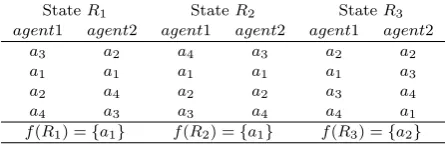
Table 2. SCR2: a two-player Pareto-optimal non-dictato-rial SCR. According to Maskin’s impossibility theorem, it can not be Nash implemented. However, Wu’s algorithm makes it Nash implementable (see Table 1). As a result, the Maskin’s impossibility theorem on Nash implementation with two agents is broken through.
StateR1 StateR2 StateR3
agent1 agent2 agent1 agent2 agent1 agent2
a3 a2 a4 a3 a2 a2
a1 a1 a1 a1 a1 a3
a2 a4 a2 a2 a3 a4
a4 a3 a3 a4 a4 a1
f(R1) ={a1} f(R2) ={a1} f(R3) ={a2}
Consider the SCR1 specified by Table 1. A = {a1, a2, a3, a4}, R ={R1, R2}. LetB=A,Ci(a, R) =Li(a, R) fori∈I, R∈ Randa∈f(R), i.e.,
4
Obviously,
a1∈M1(C1(a1, R1), R1) ={a1}, a1∈M2(C2(a1, R1), R1) ={a1}, a2∈M1(C1(a2, R2), R2) ={a2}, a2∈M2(C2(a2, R2), R2) ={a2}, a2∈M1(C1(a2, R3), R3) ={a2}, a2∈M2(C2(a2, R3), R3) ={a2}.
For each 4-tuple (a, R, a′, R′)∈A× R ×A× R, let
e(a1, R1, a1, R1) =a1∈C1(a1, R1)∩C2(a1, R1) ={a1, a4}, e(a1, R1, a2, R2) =a2∈C1(a1, R1)∩C2(a2, R2) ={a2, a4}, e(a1, R1, a2, R3) =a2∈C1(a1, R1)∩C2(a2, R3) ={a1, a2, a4}, e(a2, R2, a1, R1) =a3∈C1(a2, R2)∩C2(a1, R1) ={a3}, e(a2, R2, a2, R2) =a2∈C1(a2, R2)∩C2(a2, R2) ={a2}, e(a2, R2, a2, R3) =a2∈C1(a2, R2)∩C2(a2, R3) ={a2, a3}, e(a2, R3, a1, R1) =a1∈C1(a2, R3)∩C2(a1, R1) ={a1, a3, a4}, e(a2, R3, a2, R2) =a2∈C1(a2, R3)∩C2(a2, R2) ={a2, a4}, e(a2, R3, a2, R3) =a2∈C1(a2, R3)∩C2(a2, R3) ={a1, a2, a3, a4}.
Case 1): ConsiderR∗=R1,f(R∗) ={a1}.
For rule (i):
M1(C1(a1, R1), R∗)∩M2(C2(a1, R1), R∗) ={a1} ∩ {a1}={a1},
M1(C1(a2, R2), R∗)∩M2(C2(a2, R2), R∗) ={a3} ∩ {a2}=φ,
M1(C1(a2, R3), R∗)∩M2(C2(a2, R3), R∗) ={a3} ∩ {a2}=φ.
Hence, rule (i) is satisfied.
For rule (ii):
M1(C1(a1, R1), R∗)∩M2(B, R∗) ={a1} ∩ {a2}=φ,
M1(C1(a2, R2), R∗)∩M2(B, R∗) ={a3} ∩ {a2}=φ,
M1(C1(a2, R3), R∗)∩M2(B, R∗) ={a3} ∩ {a2}=φ,
M2(C2(a1, R1), R∗)∩M1(B, R∗) ={a1} ∩ {a3}=φ,
M2(C2(a2, R2), R∗)∩M1(B, R∗) ={a2} ∩ {a3}=φ,
M2(C2(a2, R3), R∗)∩M1(B, R∗) ={a2} ∩ {a3}=φ.
Hence, rule (ii) is satisfied.
For rule (iii):
M1(B, R∗)∩M2(B, R∗) ={a3} ∩ {a2}=φ.
For rule (iv):
e(a1, R1, a1, R1) =a1, M1(C1(a1, R1), R∗)∩M2(C2(a1, R1), R∗) ={a1} ∩ {a1}={a1},
e(a1, R1, a2, R2) =a2, M1(C1(a1, R1), R∗)∩M2(C2(a2, R2), R∗) ={a1} ∩ {a2}=φ,
e(a1, R1, a2, R3) =a2, M1(C1(a1, R1), R∗)∩M2(C2(a2, R3), R∗) ={a1} ∩ {a2}=φ,
e(a2, R2, a1, R1) =a3, M1(C1(a2, R2), R∗)∩M2(C2(a1, R1), R∗) ={a3} ∩ {a1}=φ,
e(a2, R2, a2, R2) =a2, M1(C1(a2, R2), R∗)∩M2(C2(a2, R2), R∗) ={a3} ∩ {a2}=φ,
e(a2, R2, a2, R3) =a2, M1(C1(a2, R2), R∗)∩M2(C2(a2, R3), R∗) ={a3} ∩ {a2}=φ,
e(a2, R3, a1, R1) =a1, M1(C1(a2, R3), R∗)∩M2(C2(a1, R1), R∗) ={a3} ∩ {a1}=φ, e(a2, R3, a2, R2) =a2, M1(C1(a2, R3), R∗)∩M2(C2(a2, R2), R∗) ={a3} ∩ {a2}=φ,
e(a2, R3, a2, R3) =a2, M1(C1(a2, R3), R∗)∩M2(C2(a2, R3), R∗) ={a3} ∩ {a2}=φ.
Hence, rule (iv) is satisfied.
Case 2): ConsiderR∗=R2,f(R∗) ={a2}.
For rule (i):
M1(C1(a1, R1), R∗)∩M2(C2(a1, R1), R∗) ={a4} ∩ {a3}=φ,
M1(C1(a2, R2), R∗)∩M2(C2(a2, R2), R∗) ={a2} ∩ {a2}={a2},
M1(C1(a2, R3), R∗)∩M2(C2(a2, R3), R∗) ={a4} ∩ {a3}=φ.
Hence, rule (i) is satisfied.
For rule (ii):
M1(C1(a1, R1), R∗)∩M2(B, R∗) ={a4} ∩ {a3}=φ,
M1(C1(a2, R2), R∗)∩M2(B, R∗) ={a2} ∩ {a3}=φ,
M1(C1(a2, R3), R∗)∩M2(B, R∗) ={a4} ∩ {a3}=φ,
M2(C2(a1, R1), R∗)∩M1(B, R∗) ={a3} ∩ {a4}=φ,
M2(C2(a2, R2), R∗)∩M1(B, R∗) ={a2} ∩ {a4}=φ,
M2(C2(a2, R3), R∗)∩M1(B, R∗) ={a3} ∩ {a4}=φ.
Hence, rule (ii) is satisfied.
For rule (iii):
M1(B, R∗)∩M2(B, R∗) ={a4} ∩ {a3}=φ.
6
For rule (iv):
e(a1, R1, a1, R1) =a1, M1(C1(a1, R1), R∗)∩M2(C2(a1, R1), R∗) ={a4} ∩ {a3}=φ,
e(a1, R1, a2, R2) =a2, M1(C1(a1, R1), R∗)∩M2(C2(a2, R2), R∗) ={a4} ∩ {a2}=φ,
e(a1, R1, a2, R3) =a2, M1(C1(a1, R1), R∗)∩M2(C2(a2, R3), R∗) ={a4} ∩ {a3}=φ,
e(a2, R2, a1, R1) =a3, M1(C1(a2, R2), R∗)∩M2(C2(a1, R1), R∗) ={a2} ∩ {a3}=φ,
e(a2, R2, a2, R2) =a2, M1(C1(a2, R2), R∗)∩M2(C2(a2, R2), R∗) ={a2} ∩ {a2}={a2},
e(a2, R2, a2, R3) =a2, M1(C1(a2, R2), R∗)∩M2(C2(a2, R3), R∗) ={a2} ∩ {a3}=φ,
e(a2, R3, a1, R1) =a1, M1(C1(a2, R3), R∗)∩M2(C2(a1, R1), R∗) ={a4} ∩ {a3}=φ, e(a2, R3, a2, R2) =a2, M1(C1(a2, R3), R∗)∩M2(C2(a2, R2), R∗) ={a4} ∩ {a2}=φ,
e(a2, R3, a2, R3) =a2, M1(C1(a2, R3), R∗)∩M2(C2(a2, R3), R∗) ={a4} ∩ {a3}=φ.
Hence, rule (iv) is satisfied.
Case 3): ConsiderR∗=R3,f(R∗) ={a2}.
For rule (i):
M1(C1(a1, R1), R∗)∩M2(C2(a1, R1), R∗) ={a2} ∩ {a3}=φ,
M1(C1(a2, R2), R∗)∩M2(C2(a2, R2), R∗) ={a2} ∩ {a2}={a2},
M1(C1(a2, R3), R∗)∩M2(C2(a2, R3), R∗) ={a2} ∩ {a2}={a2}.
Hence, rule (i) is satisfied.
For rule (ii):
M1(C1(a1, R1), R∗)∩M2(B, R∗) ={a2} ∩ {a2}={a2},
M1(C1(a2, R2), R∗)∩M2(B, R∗) ={a2} ∩ {a2}={a2},
M1(C1(a2, R3), R∗)∩M2(B, R∗) ={a2} ∩ {a2}={a2},
M2(C2(a1, R1), R∗)∩M1(B, R∗) ={a3} ∩ {a2}=φ,
M2(C2(a2, R2), R∗)∩M1(B, R∗) ={a2} ∩ {a2}={a2},
M2(C2(a2, R3), R∗)∩M1(B, R∗) ={a2} ∩ {a2}={a2}.
Hence, rule (ii) is satisfied.
For rule (iii):
M1(B, R∗)∩M2(B, R∗) ={a2} ∩ {a2}={a2}.
For rule (iv):
e(a1, R1, a1, R1) =a1, M1(C1(a1, R1), R∗)∩M2(C2(a1, R1), R∗) ={a2} ∩ {a3}=φ,
e(a1, R1, a2, R2) =a2, M1(C1(a1, R1), R∗)∩M2(C2(a2, R2), R∗) ={a2} ∩ {a2}={a2}, e(a1, R1, a2, R3) =a2, M1(C1(a1, R1), R∗)∩M2(C2(a2, R3), R∗) ={a2} ∩ {a2}={a2},
e(a2, R2, a1, R1) =a3, M1(C1(a2, R2), R∗)∩M2(C2(a1, R1), R∗) ={a2} ∩ {a3}=φ,
e(a2, R2, a2, R2) =a2, M1(C1(a2, R2), R∗)∩M2(C2(a2, R2), R∗) ={a2} ∩ {a2}={a2},
e(a2, R2, a2, R3) =a2, M1(C1(a2, R2), R∗)∩M2(C2(a2, R3), R∗) ={a2} ∩ {a2}={a2},
e(a2, R3, a1, R1) =a1, M1(C1(a2, R3), R∗)∩M2(C2(a1, R1), R∗) ={a2} ∩ {a3}=φ,
e(a2, R3, a2, R2) =a2, M1(C1(a2, R3), R∗)∩M2(C2(a2, R2), R∗) ={a2} ∩ {a2}={a2},
e(a2, R3, a2, R3) =a2, M1(C1(a2, R3), R∗)∩M2(C2(a2, R3), R∗) ={a2} ∩ {a2}={a2}.
Hence, rule (iv) is satisfied.
To sum up, the SCR1 given in Table 1 satisfies Condition µ2. Therefore, ac-cording to Moore-Repullo’s theorem, the SCR is Nash implementable.
However, according to Wu [6], we can design a classical algorithm by which the Moore-Repullo’s theorem will be broken through if the following Condition λ′ is
satisfied. 1)λ′
1: Given an SCRf, a preference profileR∈ Randa∈f(R), if there exists R′ ∈ R, R′ 6=R, a′ ∈f(R′) such that a′Riafor each agent i ∈N, and a′Pjafor
at least one j ∈ N, then in going from R′ to R, both of two agents encounter a
preference change arounda′.
2)λ′
2: Consider the payoff to the second agent, $CC >$DD, i.e., he/she prefers
the expected payoff of a certain outcome (generated by rule 1) to the expected payoff of an uncertain outcome (generated by rule 3).
3)λ′
3: Consider the payoff to the second agent, $CC>$DC.
TheMatlab program in Ref. [6] is directly available for two agents by simply settingn= 2.
3.2. Breaking through Maskin’s impossibility theorem with two agents
Maskin [1] showed that a two-agent weakly Pareto optimal SCR, defined on the unrestricted domain of preferences, is Nash implementable if and only if it is dic-tatorial. However, according to the aforementioned discussion, the non-dictatorial SCR2 specified by Table 2 is weakly Pareto optimal and can be Nash implemented by using the Wu’s algorithm. Therefore, the Maskin’s impossibility theorem on Nash implementation with two agents is broken through. In this sense, the quan-tum mechanism is beneficial for both the designer and the agents.
References
8
2. J. Moore and R. Repullo,Econometrica 58(1990) 1083-1099.
3. B. Dutta and A. Sen, Rev. Econom. Stud.58(1991) 121-128.
4. F. Busutto and G. Codognato,Social Choice and Welfare32(2009) 171-179. 5. H. Wu, Quantum mechanism helps agents combat “bad” social choice
rules. International Journal of Quantum Information, 2010 (accepted). See http://arxiv.org/pdf/1002.4294v3