Munich Personal RePEc Archive
How Fragrant are perfumes? A Micro
Perspective from Middle East
Pillai, Rajasekharan and Babu, Febina and Hameed, Hana
and Rajan, Remya and Vijay, Shiji
Birla Institute of Technology, Kingdom of Bahrain
June 2009
Online at
https://mpra.ub.uni-muenchen.de/19591/
W orking paper: BI T-B/ W P/ 04_09
How Fragrant are perfumes?
A Micro Perspective from Middle East
K. R. Pillai
Febina Babu
Hana Hameed
Remya Rajan
Shiji Vijay
Birla Institute of Technology
Kingdom of Bahrain
1
How Fragrant are perfumes?
A Micro Perspective from Middle EastK. R. Pillai, Febina Babu, Hana Hameed, Remya Rajan & Shiji Vijay*
Abstract
Satisfaction is a consumer post-purchase evaluation of the overall service
experience. As an important determinant of customer loyalty and retention, firms
exhibit most care to maintain customer satisfaction intact, unless it cannot be
up-scaled. Middle East is known for its fancy towards cosmetics in general and
perfumes in particular. The present study, which was conducted as micro level,
undertaken in the Kingdom of Bahrain, attempts to understand the customer
satisfaction of perfumes. The study discusses, inter alia, brand consciousness,
brand loyalty, loyalty towards vending outlets etc.
Key words: Customer satisfaction, perfume market, brand consciousness, brand loyalty, shop loyalty, consumer exploitation, purchase behaviour, buying motive
JEL classification: D 03, M 30, M 31
The primacy of customer satisfaction, as an affective response of varying intensity
(Giese and Cote, 2000), cannot be overlooked in a dynamic and competitive market place.
Being the direct determining factor of customer loyalty, it, in turn, is a central determinant of
customer retention. Studies (Mittal and Kamakura 2001; Keiningham, Perkins-Munn and
Evans, 2003; Cooil et al,2007) have shown that high levels of customer satisfaction have
been linked to customer retention, increased share of spending and positive word of mouth
public relation. Referrals and positive word-of-mouth (Reichheld, 2006) by contented
customers, indisputably, ensures highest repurchase frequencies. The market place in the 21st century is fast changing and prone to many vulnerabilities. Hence customer retention and
growth are uncompromising prerequisites of staying in business. Increasingly competitive
organizations are regularly surveying their customers’ satisfaction, aiming to uncover the
clients’ expectations and to find whether these expectations have been met impeccably.
Customer satisfaction surveys help to send the message that the business greatly appreciates
their customers’ input, while providing ample opportunity to enhance products and services.
These customer relations are keys to optimizing marketing efforts and improving company
performance.
A study on customer satisfaction of perfumes has great significance in the Middle
East in general, and Bahrain in particular. This is due to the reasons such as the beauty and
fashion consciousness of the people, and the fancy for perfumes and cosmetics among the
Arab population. Due to higher disposable incomes, aggressive marketing, changing
consumer habits, and the demographics, the demand for perfumes is increasing in Bahrain.
Therefore, studying the factors that affect the consumption patterns, the feedback on the
various brands and perfume outlets, and consumers’ awareness of brands is of great
importance. The study results can be replicated in other areas of the Arab region. Therefore
it can be a guide for prospective entrepreneurs with an idea to introduce new brands in
perfumes.
The Regional perspective
The Middle East is regarded as the cradle of the perfume industry. Bahrain, which
has a population of more than 0.7 million, and its floating population continues to grow as
the place has become a hub of international financial market, has a growing economy.
Therefore, market for perfumes is seemed consistent and is on an increasing pace. The craze
and demand of perfume is ever growing among the Arabs and other nationals in Bahrain,
and due to this reason, the perfume industry has become a multi-billion dollar industry. The
demand for perfumes is the highest in Bahrain in general. People, who like Arab perfumes
go for them, not French perfumes, and vice versa. Since it is a temperate, arid desert area,
people perspire and need a strong perfume. The demand for fragrances soars during the
months ofShabaan andRamadan. There are several successful perfume traders that provide tempting perfumes, beauty products and high-quality Arabic fragrances. Well known
designers or glamorous personalities who lend their names to perfumes gain instant attention
in the market.
In addition to the Arab nationals, a large number of expatriates also contribute a
significant market for perfumes in Bahrain. The large demand for perfumes among them is
due to aggressive marketing, changing consumer habits, higher disposable incomes and the
introduction of Arabic perfumes in spray format and an increased presence of stores in malls.
Many tourists want to try Arabic perfumes as an alternative to what is available in their
home countries. It is another experience of the Arabic culture.
The research problems of this project include various issues that are dominant in the
perfume industry in Bahrain, one of them being the differences in prices of perfumes.
Various brands of perfumes are sold at different price ranges by different perfumes outlets.
Consumers of perfumes are seemed to be exploited through selling of duplicates of famous
brands at the original prices of the branded ones. Another issue of great significance is
related to the religious sentiments of the local people; that is, with respect to the alcohol
content in perfumes. Use of such perfumes is considered taboo in the Middle Eastern
countries. The various demographic characteristics of Bahrain’s population, which includes
several nationalities, is also a key issue as the diversity in nationality, income and lifestyle
makes the analysis of customers’ expectation a complex task.
This study attempted to explore the level of customer satisfaction of perfumes in the
Kingdom of Bahrain. In this regard the various factors that influence consumers buying
behavior are also attempted to study. It is also to be understood that Bahrain is a dwelling
place to many nationalities resulting great diversity in the various demographic features of
its population and, hence, has a significant influence on consumer behaviour. The targeted
customers’ brand consciousness and brand loyalty will also be investigated.
The Theoretical Settings of the Study
Customer satisfaction has long been recognized as a process (Oliver, 1981) and is the
difference between consumers’ perceived and expected performance of a product or service.
In other words, customer satisfaction occurs when performance is higher than expected,
while dissatisfaction occurs when performance is lower than expected. Overall, to gain
customer satisfaction, some argue that organizations need to exceed predictive expectations
of customers, rather than just satisfy expectations (Spreng and Mackoy, 1996). According to
Schneider and White (2004), satisfied customers most likely will become loyal which can
then translate into higher profits organizations. As such, the relationship between customer
customers are more likely to intend to repurchase (Taylor and Baker, 1994; Patterson and
Spreng, 1997).
Customer satisfaction has become one of the key issues for companies in their efforts to
improve quality in the competitive marketplace. It can be seen as either a goal or a
measurement tool in the development of quality. Customer satisfaction is considered to
affect customer retention and, therefore, profitability and competitiveness (Anderson and
Sullivan, 1993). According to Jones and Sasser (1995), complete customer satisfaction is the
key to securing customer loyalty and generating superior long-term financial performance. It
is also apparent that high customer satisfaction leads to the strengthening of the relationship
between a customer and a company, and this deep sense of collaboration has been found to
be profitable.
Customers compare the perceived performance of a product (service, goods) with some
performance standard. Customers are satisfied when the perceived performance is greater
than the standard (positively disconfirmed), whereas dissatisfaction occurs when the
performance falls short of the standard (negatively disconfirmed). Additionally, there is an
extensive difference between the loyalty of merely satisfied customers and those who are
completely satisfied. Customers who are just satisfied find it easy to switch suppliers when a
better offer comes along. As a result, the significance of customer satisfaction is emphasized
in markets where competition is intense (Kotler 2000; Jones and Sasser 1995).
Customer satisfaction brings many benefits as satisfied customers are not very price
sensitive, buy additional products, are less influenced by competitors and stay loyal longer.
To them customer satisfaction has been deemed directly to affect customer retention and
companies' market share. In order to achieve customer satisfaction, companies must
understand what their customers need and how those needs are met. Grönroos (2001)
emphasizes that customers also have certain wishes regarding how they want to be treated;
furthermore, he notes, the service or physical product purchased has to fit into the
customer’s internal value-generating processes.
Customer satisfaction has been observed as an important theoretical as well as practical issue
outcome of marketing activity whereby it serves as a link with various stages of consumer
buying behavior. For instance, if customers are satisfied with a particular service offering
after its use, then they are likely to engage in repeat purchase and try line extensions.
Customer satisfaction is widely recognized as a key influence in the formation of consumers'
future purchase intentions (Taylor and Baker, 1994). Satisfied customers are also likely to
tell others of their favorable experiences and thus engage in positive word of mouth
advertising (File and Prince, 1992).
Levesque and McDougall (1996) confirmed and reinforced the idea that unsatisfactory
customer service could lead to a drop in customer satisfaction and willingness to recommend
the service to a friend. This would lead to increase in switching by customers. So, the
significance of customer satisfaction and customer retention in strategy development for a
'market oriented' and 'customer focused' firm cannot be underestimated. It can be considered
as the essence of success in today's highly competitive world of business. It is increasingly
becoming a corporate goal as more and more companies strive for quality in their products
and services (Bitner and Hubbert, 1994). In this context, an understanding of 'determinant of
customer satisfaction' (Churchill and Suprenant, 1982; McDougall & Levesque, 2000) is of
great significance to marketers.
It is generally accepted that customer satisfaction often depends on the quality of product or
service offering (Anderson and Sullivan, 1993; McDougall & Levesque, 2000). For this
reason, research on customer satisfaction is often closely associated with the measurement of
quality. Thus, both service quality and customer satisfaction share a close relationship,
though they are normally conceptualize as unique (or separate) constructs.
Organizations must learn exactly what their customers expect from them (Berry &
Parasuraman 1991). Unless an organization knows what its customers consider important,
the organization will not be able to determine what changes are necessary to meet the desired
expectations. Varied expectations are generated from both internal customers and external
Methodological Issues
The method we have used in our study is of descriptive research. The main purpose of the
research is to give a narrative account of the state of affairs as it exists in the study area. The
method of descriptive research is apt to measure items such as frequency of buying a
product, preferences of people, or similar data (Kothari, 2006). Survey method was used to
collect data related to demographic profile, general buying behaviour, and the behavioral
variables of the respondents. The demographic factors such as gender, age, income and
nationality were studied to understand their influence on explanatory variables. The research
also included the collection of other descriptive information such as consumption pattern,
feedback on access to outlets, service, physical facilities and the level of satisfaction among
customers.
Analytical part of this report has been done keeping the broad aim and objectives of the
study in mind. The raw data were entered in to Micro Soft Excel’s platform, after proper
scrutiny. The processed data were analysed by the widely used statistical tools available in
the MS Excel and SPSS programmes. The descriptive statistics such as Arithmetic mean,
Standard deviation, percentages and cross tabs and inferential statistics like Correlation and
Regression were used to analyse and interpret the data. Likert scale analysis was also done to
identify the attitudinal dimensions of the respondents.
Personal Profile of the Respondents
As it has already been stated above, expatriate population constitutes half of the kingdom’s
demographic strength. However, the nationality attributes of the sample respondents show
that around 60% of our respondents comprise of Indian citizens. It is also interesting to know
that Indian migrant population comes around 35% of total population in the Kingdom. By
the time the migrant workers visit their home country during vacations and other occasions,
they place a remarkable demand for almost all fancy items, including perfumes. The next
highest category (30%) of respondents belongs to Bahrain nationality. Being the local
residents in the Middle East this category of consumers is known for their beauty and
cosmetic awareness. The other categories of respondents consist of other Middle East, Other
Age factor is an important determinant of buying motivations, in general, and cosmetic
products, in particular. Hence age study was also thought to be useful. The age category of
the respondents covered under the survey shows that about half the sample belong to the
prime age category of 15-25 years. It is clearly manifested from the data that the trendy
preferences of youth may influence the market of perfumes in the kingdom and the market
itself may be highly volatile due to impulsive preferences of this prime age group out of fad
or fashion. More than one-fourth of the total respondents belong to 25-35 age categories.
The senior age group covered under the study (+45) constitutes only 9% of the total sample.
The Arithmetic mean of all the ages of the respondents came up to 28.5 with a Standard
deviation of 10.54. This portrays that the mean age of the respondents fall in the age
category of 25-35 years.
The analysis of gender characteristics shows that more than half of the respondent was
males and 48% were women. This shows strong gender orientation in structuring the
perfume market in the kingdom. Though most of the perfumes are female-centric, our study
shows that the purchase is effected by their male counter parts. We have not attempted to
unravel who initiate the purchase, as it was outside the purview of the study. It was came out
during the period of study the those who initiate the purchase and those who realize the
purchase may not be same in most number of cases. We could clearly delineate the thin
demarcation between the concepts such as ‘customer’ and ‘consumer.’
The average per capita income of Bahrain is USD 24,151 (USD 1 = BD 0.36). The majority
of the respondents belong to the higher income group (23.3%), with an average monthly
income of more than USD 4167. The study discovered that the population in Bahrain has
high purchasing power irrespective of their nationality status. The Arithmetic mean of the
monthly family income was USD 2903. A standard deviation of 470.27 was estimated which
implies that income is highly dispersed in the series.
Consumption of Perfumes
The respondents’ consumption behavior of perfume is studied under this section. It was
attempted to understand whether cosmetics constitute a permanent addition to their shopping
focused nature of our study we were interested to know the import of perfumes in the
cosmetic category. The field data show that 82% of the respondents considered perfumes as
an important part of their cosmetics while 18% of them not.
With respect to buying motives, nationality status and level of income were the two
explanatory variables that were considered to study their influence on purchase decisions. A
regression analysis was conducted to estimate whether the nationality attributes influence the
regularity in the use of perfumes; that is whether perfumes being a permanent addition to
cosmetics. The regression co-efficient is estimated as - 0.013, which implies that the impact
of nationality attribute not only insignificant but negative. Perfume consumption, being a
permanent addition to cosmetics, is not depended upon the nationality of the respondent.
Another analysis is with respect to cosmetic consumption is related to the level of income of
the consumer. We wanted to know whether income influences the cosmetics consumption of
the respondents. The regression between levels of income and cosmetic consumption
variable gave the co-efficient as -0.161, which implies that family income is not a
determinant of perfumes being a permanent addition to cosmetics. Hence it has been proved
that perfume consumption is independent of either nationality of level of income.
It is also attempted to study the level of awareness of customers to cosmetic products. The
study shows that majority of respondents are conscious about cosmetics (58%). Among the
rest, 21.6% is very conscious about cosmetics. The per cent of conscious and neutrally
conscious respondents is 36.6% each. The estimated correlation value between nationality
and consciousness towards cosmetics was 0.379, which implies a positive moderate
correlation.
The respondents mentioned cross section of reasons for buying perfumes. To get a clear
picture the entire response categories have been recorded here. More than one-third of the
respondents buy perfumes for their personal use, with a percentage of around 35%. Around
30% of the respondents buy perfumes for personal use and family. For 18% of the
respondents it is for themselves, their family and also as a gift. The rest of the respondents
It was also attempted to study how much the respondents spend, on an average, on perfumes
annually. The average amount of money spent on perfumes shows that majority of the
respondents (30%) spend USD70 - 140 on perfumes annually. Around 12% of the
population spent less than USD 70 and between USD 140 - 200 on perfumes each. The per
cent of customers who spent between USD 200 - 275 and more than USD 275 is 9% each.
The findings are consistent to the high purchasing capacity in the kingdom by and large. The
arithmetic mean calculated for the respondents’ expenditure on perfumes was USD 156.27
with a standard deviation of 33.7. This implies that most of the respondents are buying
perfumes in the price range of USD 140 - 200 and the standard deviation says that there is
less deviation i.e. there is a high degree of uniformity in the responses.
The correlation between monthly family incomes of the respondents and the expenditure on
perfumes is 0.318 which means that there is a moderate correlation between the two. This
means that the expenditure on perfumes depends on the monthly family income. Similarly
the expenditure on perfumes was also correlated with the average monthly expenditure
which resulted in 0.081 which is low correlation. This implies that average monthly
expenditure does not necessarily relate to expenditure on perfumes.
The analysis of buying frequency of perfumes explains that most of the customers purchase
perfumes only when needed. This portion of the sample constitutes 71.6%. Among the rest
of the respondents, 13.3% buy perfumes once in a month and 11.6% buy it every month. A
correlation between nationality and frequency of perfume purchase resulted as 0.037. This is
a low correlation which implies that nationality does not affect the frequency of perfume
purchase. The correlation between monthly income and the frequency of purchase of
perfumes came to be -0.026 which implies negative correlation i.e. the average monthly
income of the respondent does not have an impact on the frequency of perfumes purchase.
With respect to the category of perfumes reveals that customers who prefer only French or
only Arabic perfumes are 40% and 20% respectively. Almost 36% of them have an
inclination towards both the two types of perfumes.
The Likert scale was used to analyse the attitudinal preference towards the choice of
motives it was understood that scent is the most preferred motive to buy perfumes, followed
by long lasting and affordability. It is clear from the analysis that the consumers are rational
than impulsive buyers. Celebrity endorsement is the least preferred buying motive.
Attitude towards Perfume Outlets
The study also attempted to identify whether the consumers have any preference towards
outlets. The data illustrate that more than 60% of the population have their preferred outlets
to buy perfumes while around 37% does not have any preferred brands. The correlation
between nationality and the preference towards outlets, estimated to 0.592, which is perfect
correlation this denotes that the nationality of respondents has a positive impact on
preference of outlets. The underlying factor for this relationship may be due to the
inclination of Indian expatriate population to purchase things from the shops run by Indian
nationals. No other demographic factor has as much bearing on outlets preference as that of
nationality status. A correlation between gender and outlet preference had an estimated value
of -0.113, which is a negative correlation, implying negative and negligible correlation.
It was also attempted to explore the attitude towards the preference of vending outlets based
on seven parameters such as availability of variety of perfumes and latest brands, location,
discount, accessibility, gift vouchers and Credibility of outlets. About 97% agree that they
prefer a particular outlet for the variety of perfumes. The major motivator shop preference is
understood to be availability of variety of perfumes, which is followed by availability of
latest brands and credibility of outlets. It implies that customer satisfaction is an undeniable
factor of customer loyalty and retention. The Likert scale was used to analyse the data and
the analysis of overall average attitudes towards the factors related to preferred outlets shows
that the respondents, on the whole, agree the variety of features of their chosen shops.
Brand awareness
Customers’ awareness about various brand availability in Bahrain shows that a comfortable
majority among the respondents are very brand conscious, being 63% use only branded
perfumes. The most popular brands in Baharain are identified to be Escada, Dior, Chanel,
Davidoff, Lacoste and Givenchy. Certain demographic features of the respondents were
respondents buying branded perfumes has a negative correlation of -0.0034, which implies
that a respondent buying branded perfumes is not based on nationality. Another correlation
was between age and buying branded perfumes which resulted in -0.29. A correlation
between gender and buying branded perfumes was 0.185 which is a positive correlation. It
implies that gender has an impact on buying branded perfumes. Monthly family income has
less impact on buying branded perfumes which was 0.069 and consciousness towards
cosmetics has a negative correlation of -0.0283.
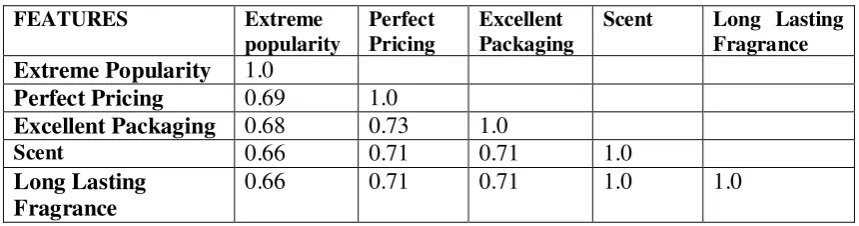
A multiple correlation was attempted to understand the sensitivity among the unique features
of the preferred brands from the perspectives of the respondents. The results of multiple
correlation (see table 1, in appendix) show that each and every variable is either perfectly
and correlated highly and the nature of correlations is positive. It is interesting to see form
the table that the correlation between the products features such as long lasting fragrance and
scent is perfect and positive (being the co-efficient 1.0). The next highest correlation (0.73)
is between excellent packaging and perfect pricing. Hence product features exhibit an
explicit mutuality each other. The specific feature of this analytical results show that there
are more than one pairs that are having the same estimated value. For example, it is evident
from the table that the results for scent & extreme popularity (0.66) and long lasting
fragrance & popularity (0.66) are same.
It was also attempted to find out the level of awareness of the respondents with respect to the
availability of duplicates in the local market. A Clear cut majority (93.3%) of the
respondents is aware of the presence of duplicates for branded perfumes in the market. This
indicates that there is a large scale selling of perfume counterfeits.
The Overall customer satisfaction
Consumers were sometimes satisfied with one aspect of the choice/consumption experience,
but dissatisfied with another aspect. In this case, satisfaction and dissatisfaction can be
viewed as different dimensions. The consumer might be satisfied with the functionality of a
product, but not the purchase experience. In this case, satisfaction and dissatisfaction are
viewed as bipolar opposites when the consumer reaction is consistent across all focal aspects
of the choice/consumption experience (Giese& Cot, 2000)
As a first step to estimate customer satisfaction, it was attempted to understand the
dimensional frequency of contentment with respect to the value for money. Majority of the
respondents (59%) believed that they always get complete value for the money that they
spent on perfumes, while, a 39% of them were of the opinion that they get value for the
money spent only occasionally. The proportion of dissatisfied customers is very negligible
(2%). Correlation between consciousness towards cosmetics and value acquired from
purchase is -0.085, which is a negative correlation. This implies that consciousness towards
cosmetics has no impact on value acquired. In a correlation between buying branded
perfumes and value acquired the result was 0.3306. It is a moderate correlation which
implies that the buying of branded perfumes can be because of the value acquired and vice
versa.
An attempt was made to understand whether the customers are subject to any form of
exploitation. The respondents were asked to express whether they were experienced any
exploitation, if so the number of times it happened. The data show that 46% of the
respondents suspected of exploitation, though not sure, during the purchase. Out of which
20% have the feeling that it occurred more than once. Another 40% have not faced any such
exploitation, and about 13.3 % of them are unaware whether they have been exploited or not.
Conclusion
Satisfaction is an overall customer attitude expressing the psychological contentment or
fulfillment towards a product or service, and its intensity can be estimated as the difference
between perceived and actual performance. It is a highly personal assessment that is greatly
influenced by individual expectations. These expectations, in turn, are constantly changing
with the changes in the several factors that influence the satisfaction derived by customers
from the use of a product. Customer expectation is formed from his acquired knowledge and
influence from his/her surrounds that together form benchmarking for satisfaction. Hence, customer
satisfaction involves understanding customer expectations and meeting them fully. There are
profitability. Some of these factors that influence customers’ satisfaction levels are lifestyles,
income levels, education and increase of awareness about market and related factors, and
cultural changes etc.
BIBLIOGRAPHY
1. Anderson, Eugene W. and Sullivan, M. W. (1993) The Antecedents and Consequences of Customer Satisfaction for Firms, Marketing Science, Vol. 12 (2), pp. 125 - 143
2. Berry, Leonard L. and A. Parasuraman (1991) Marketing Services: Competing Through Quality,New York: Free Press
3. Bitner, Mary Jo and Amy R. Hubbert (1994) “Encounter Satisfaction versus Overall Satisfaction Versus Quality.” Pp. 72–84 in Service Quality: New Directions in Theory and Practice. Roland T. Rust and Richard L. Oliver (Eds.). New York: Sage Publications, Inc.
4. Churchill G.A. and C. Supernant (1982) An investigation into the determinants of customer satisfaction.Journal of Marketing Research, Vol. XIX, Nov. 1982, pp. 491 – 504.
5. Cooil, Bruce, Timothy, L. Keiningham, Lerzan Aksoy and M. Hsu (2007) A Longitudinal Analysis of Customer Satisfaction and Share of Wallet: Investigating the Moderating Effect of Customer Characteristics, Journal of Marketing, Vol. 71 (1), pp. 67-83.
6. File K. M. and Prince, R. A. (1992) Positive Word-of-Mouth: Customer Satisfaction and Buying Behaviour,International Journal of Banking Marketing, Vol. 10 (1), pp. 25 – 29.
7. Giese, Joan L. and Cote, Joseph A. (2002) Defining Consumer Satisfaction,
Academy of Marketing Science Review, Vol. 2000 (1), http://www. amsreview.org/articles/giese01-2000.pdf, Accessed online 16th August 2009.
8. Grönroos, C. (2001) The perceived service quality concept – a mistake?Managing Service Quality, Vol. 11 (3), pp. 150 – 152.
10. Keiningham, Timothy L, T. Perkins-Munn and H. Evans (2003) The Impact of Customer Satisfaction on Share of Wallet in a Business-to-Business Environment,
Journal of Service Research,Vol. 6 (1), pp. 37-50.
11. Keiningham, Timothy L., Lerzan Aksoy, Bruce Cooil and TorWallin Andreassen (2008) Linking Customer Loyalty, MIT Sloan Management Review, Vol. 49 (4), Sum. 2008, pp. 51-57
12. Kothari, C. R. (2006) Research Methodology, New Delhi: Wishwa Prakasan.
13. Kotler, Phlip (2000) Marketing Management. 10th ed., New Jersey: Prentice-Hall.
14. McDougall, G & Levesque, T. (2000) Customer satisfaction with services: putting perceived value into the equation. Journal of Services Marketing, Vol. 14 (5), pp. 392. 410.
15. Mittal, Vimal and W. Kamakura (2001) Satisfaction, Repurchase Intent and Repurchase Behavior: Investigating the Moderating Effect of Customer Characteristics,Journal of Marketing Research,Vol. 38 (1), February 2001, pp. 131-142.
16. Oliver, Richard L. (1981) Measurement and Evaluation of Satisfaction Processes in Retail Settings,Journal of Retailing, Vol 57(3), Fal 1981, pp.25 - 48
17. Patterson, Paul G. Richard A., and Spreng (1997) Modeling the Relationship Between Perceived Value, Satisfaction and Repurchase Intentions in a Business-to-Business, Services Context: An Empirical Examination, International Journal of Service Industry Management, Vol. 8 (5), pp. 414 – 434
18. Reichheld, Fred (2006) The Micro Economics of Customer Relationships,MIT Sloan Management Review, Vol. 47 (2), Win. 2006, pp. 73-78.
19. Schneider, B. & S. White (Eds.) (2004) Service quality: Research perspectives. Thousands Oaks: Sage Publications.
20. Spreng, R.A. and Mackoy, R. D. (1996) An Empirical Examination of a Model of Perceived Service Quality and Satisfaction, Journal of Retailing, Vol. 72 (2), Summer 1996, pp. 201 – 214
22. Woodruff, R. B. (1997) Customer value: The next source for competitive advantage,
[image:17.595.95.525.180.293.2]Journal of the Academy of Marketing Science, Vol. 25, pp.139 - 153.
Table 1: Correlation among unique features of preferred brands
FEATURES Extreme
popularity
Perfect Pricing
Excellent Packaging
Scent Long Lasting
Fragrance
Extreme Popularity 1.0
Perfect Pricing 0.69 1.0
Excellent Packaging 0.68 0.73 1.0
Scent 0.66 0.71 0.71 1.0
Long Lasting Fragrance
0.66 0.71 0.71 1.0 1.0
Source: Primary Survey