Cloud Computing and Networking – Challenges and Solutions in delivery
of Media
David Kweku Asare Robertson
1Ahmed Hassane Ahmed Dabouga
21,2
Symbiosis Institute of Computer Studies and Research (SICSR), Atur Centre, Gokhale Cross, Model
Colony, Pune, Maharashtra, India
Abstract— Cloud computing is the process of accessing theservices of a personal computer or a local server through networking over the internet to store, manage or process data without the direct physical access. Cloud computing and Networking have basically minimized and somehow eliminated the need for having an infrastructure to support hardware and software integration in order to run an organization that satisfies its clients. Cloud computing and networking though an angelic form of computing; meaning it has come with a plethora of benefits to users, like every other discovery or invention has its challenges. In this paper, we explain cloud computing and networking, relate it to our most quintessential activities and state some discovered some of the challenges and solutions in the delivery of media that we have gained through our literature review and survey. Key words: Cloud Computing, Networking, Virtualization, Content Delivery Network, Big Data
I. INTRODUCTION
Since the dawn of time even before the discovery of fire man has known nothing more natural than collecting and sharing data. This might sound very absurd but is also true in many ways. The only change over the years, centuries and millennia in this natural act is the medium of gathering and sharing the data and the type of data. An example of this is the Neanderthals in the early years of time (B.C.) they hunted and gathered (medium) herbs, plants and fruits (data/information) to feed and survive.
With the current innovation in information technology at an outstandingly progressive rate, storage has been one of the foremost needs for organizations and even individuals especially with a virtual presence as the world is becoming more and more of global village. Cloud computing has enabled many to save, connect and share media in the form of documents, videos, pictures and other forms of data without having to directly host such data on personal computers, mainframes or devices.
Content Delivery Network has been the main feature of cloud computing in the delivery of such media. Over the years, data and information gathering and sharing has become the trend, norm and utmost important detail of the present day and age. From pictures and videos hosted and accessed through Instagram and Facebook by users to the streaming of videos and TV programs by television stations and companies, data delivery is the bedrock of the world as a global village.
Cloud computing and networking though it seems as heaven sent like every other good thing has some challenges affiliated to it. Hence, the primary objective of this research paper is to identify some of these challenges and also solutions to the delivery of media.
A. Cloud computing
Cloud computing is the process of accessing the services of a personal computer or a local server through networking over the internet to store, manage or process data without the direct physical access. It involves on-demand network access to computing resources such as networks, servers, storage, applications and services [3]. A simple example of cloud computing is Dropbox, a cloud service which allows users to store and access documents only through the internet.
The rise of modern digital society and the amount of data now available to collect, store, manage, analyze and share is growing and it is becoming more common for organizations to adjust to this need in order to survive in the ever growing market of data. Hence, a growing number of organizations are moving from the traditional way of computing to the cloud computing [3]. A few reasons for this major decision are;
1) Easy access of information through the Internet
2) Reduction of cost in running and installation of computer systems
3) Increase in storage
[image:1.595.306.546.346.502.2]4) Reduction of the need for skilled IT personnel
Fig. 1: basic Architecture of cloud computing
II. CLOUD ACCESS TYPES
1) Public Cloud:
This is the access type of cloud computing that involves cloud service providers offering cloud and computing resources to the general public. The public has no control or initial capital investment on the infrastructure simply the services over the Internet. With this access type, the biggest issue is the network and security is low.
2) Private Cloud:
3) Hybrid Cloud:
This is the access type of cloud computing that simply represents the combination of the public and private cloud. Part of the service infrastructure runs in private cloud whereas the other part runs on public cloud. Amazon Virtual Private Cloud is an example of this access type, serving as a bridge between an organization’s infrastructure and Amazon Web Services (AWS).
4) Community Cloud:
This is the access type of cloud computing that involves multiple organizations sharing infrastructure within a specific community whether it is on-site or managed by a third party. These organizations combine their efforts to address common concerns.
B. Delivery Models
There are different delivery models of cloud computing that are offered as services according to the purpose and preference of organizations. The three main models are essential in understanding the general delivery of media, they are:
1) Infrastructure as a Service (IaaS):
This is the situation where cloud computing providers allow clients to use of physical and virtual computers, extra storage, networking devices and other hardware components that make up a computing system. The virtual machines are run by hypervisors and it is the responsibility of client users to install operating system images on the virtual machines [1]. It is basically the use of hardware components without physically owning it or having it present.
2) Platform as a Service (PaaS):
This is the situation where cloud computing providers give platforms such as web servers and programming environments for clients to use remotely. It’s usually used by developers as on-demand remote environments for developing, testing and managing applications as it delivers a part of the virtual machine [1].
3) Software as a Service (SaaS):
This cloud computing model of delivery allows cloud clients and users access and use of software on the cloud infrastructure. The user has access to only to already installed and running software on the cloud thus eliminating the need for the software to be installed and executed on their own computers [1]. The software is maintained by cloud service providers which eases the burden of ensuring a flowing application by the user. An example of a SaaS is Microsoft Office 365, providing the full functionality of the Microsoft Office Suite through the internet.
The model used by any organization depends on the purpose of that organization and is provided by either the organization themselves or cloud service providers on a pay as you go basis.
III. CONTENT DELIVERY NETWORK
Content delivery networks or content distribution networks, (CDNs) are defined in the Internet Engineering Task Force (IETF) as a type of content network, which emerged centered on “content”. CDNs can be seen as virtual overlay networks built on top of generic IP to solve performance problems related to network congestion and to improve web content
accessibility in a cost-effective and user-efficient way [5]. With respect to networking, CDN is simply a system of distributed servers across several locations usually in different countries or states to deliver faster content of data to the closest client to the servers [7]. In cloud computing, the delivery of media is handled by the content delivery network. CDN involves a network of servers around the world that saves a copy of files needed by a user on a server closest to the user for easy and faster access.
Although CDNs succeed in delivering content with high availability and performance, they could not properly handle the heavy workload on edge servers at one point earlier on.
Over the years, money has been invested in building heavyweight and integrated data centers for cloud computing all over the world. Recent years have witnessed great successes of cloud computing like Amazon Web Services, Google Cloud Platform, Microsoft Azure, big data processing like Apache Hadoop, Cassandra, and Spark, cloud storage like Amazon S3, Dropbox, Box, Google Drive and Google Cloud Storage, and Microsoft OneDrive, virtualization like VMware, Virtual Box. Based on these cloud platforms, today’s content distribution systems can reliably host a huge amount of content [6]. As a result we have seen a massive shift of individuals into the cloud computing paradigm of networking and yet cloud computing is still evolving.
IV. METHODOLOGY
In this section of our research paper, we have clearly stated the research methodology taken and used in pursuit of our objective. The various ways we adopted in gaining more knowledge and a broader perspective on the subject matter are as follows.
We conducted a survey on 56 working professionals in the IT industry with the goal of understanding how much the current IT professionals have an understanding and make use of cloud computing in their respective organizations. This survey helped us identify our approach on this research paper whether we write with a technical perspective audience in mind or an average computer user audience.
Also we retrieved and made use of books and citations of authors on the subject to further understand the technicalities and activities 2.involved.
V. ANALYSIS
In this section, we analyze and give a deduction on the results of our survey in pictorial form. Below are the questions asked and their respective responses are in the figures that follow.
Question
no. Questions
1 What role do you play in your organization? 2 What type of organization are you part of?
3 Do you use cloud computing in your organization?
4 Which cloud system does your organization use?
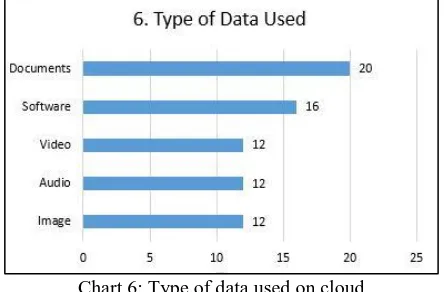
6 What kind of data (media) does your organization store on the cloud?
7 Does your organization use any Content Delivery Network (CDN) service? 8 Which CDN does your organization use? 9 Why do you use this CDN?
10 Why does your organization not use cloud computing?
11 If your organization has considered cloud computing, which one would you use?
12 Reason for choice
13 What is your concern for not using CDN? 14 Are you planning to use CDN in the future?
The following are the graphical and summary responses for the related questions above, based on these questions some provided multiple options for one or more selected response and some options however also led to other related questions.
Chart 1: Role in the organization
The survey shows a dominant percentage of 43% of individuals work in Executive roles of their respective organizations, followed by 15% occupying other roles which includes Assistant professor, Specialist, Teacher, Consultant and an even 7% each for Solutions architect, Project manager, Software engineer, IT manager, Business manager and senior level manager.
Chart 2: Type of organization
This is the response for the question on what type of organization individuals are a part of. The dominant sector is that of Banking with 36%, followed by Other option which include Education, Trading, Mechatronics and KPO with 36% all together and finally Consumer services with 28%.
Chart 3: Whether cloud is used in the organization The response for whether an organization was using cloud computing was 57% saying no and 43% saying yes. This particular response specifically helped us understand and determine our approach in writing this research.
Chart 4: Cloud system used
This was a follow up question for those that responded yes as the response for the previous question. Shows the dominant cloud system implemented by the organizations with 46% being Federate (Hybrid) cloud, 29% being on-Premise cloud and 25% being Public cloud.
The response on the cloud delivery service used by the organizations was 38% use Platform as a Service, 37% use Infrastructure as a Service and 25% use Software as a Service. With this response multiple options could be selected by an individual. Hence, the seemingly uneven numbers in correlation with the previous response.
Chart 6: Type of data used on cloud
This response shows the dominant file type used by organizations in cloud computing with 20 people choosing Documents, 16 choosing Software, 12 choosing Video, Audio and Images respectively. This question also allowed multiple choice answers in the response.
Chart 7: Whether organizations use CDNs
In this response, 16 chose No and 8 chose Yes. This shows the extent of knowledge and use of CDN even in the IT sector [7].
CDN Service Numb
er
Google Cloud Platform 4
Microsoft Azure CDN 6
Others (Amazon CloudFront, Cloud Flare,
[image:4.595.316.540.61.248.2]MaxCDN) 2
Table 1: Q8. Response to which cloud product used in organization
Reasons for CDN Number Less Expensive 6
Easy to use 6 Speed in response 6
Security 6
Scalability 3
Table 2: Q9. Response to why the choice of CDN service Reason for No Cloud Number
Expensive 4
Security 8
Legal Issues 4
[image:4.595.56.278.138.284.2]No need 20
Table 3: Q10. Response to why no cloud system in the organization
Chart 8: Q11. Response for any cloud consideration in the future.
This is the follow-up response to the question that asks if any consideration of cloud computing and which cloud service provider. Responses had Google Cloud Platform as the choice of the majority with 24, Amazon Web Services with 4 and 0 choosing both none and Microsoft Azure in the options given.
Reason for Choice Number Easy to use 12 Less expensive 1 Speed in functions 18
[image:4.595.44.548.336.763.2]Security 5
Table 4: Q12. Reasons for choice Reason for no CDN Number
Security issues 3 Optimization issues 2 Access issues 8
No need 8
Table 5: Q13. Response to why no CDN service Future use of CDN Number
Yes 12
No 4
Table 6: Q14. Response to consideration of CDN service for future use
VI. CHALLENGES
1) Expensive: Cloud computing has proven itself time and time again that it is not for everyone. This can further be seen in Table 3 where our survey response discovers one of the main reasons why people do not adopt cloud computing in their organizations is due to the fact that it is expensive to implement, deploy and manage
2) Downtime: Like any mechanism made by man that involves moving parts be they virtual or physical, the architecture no matter how well thought out design or safety precautions implemented has a possibility of failure. The CDN though designed with redundancy in mind is not perfect and hence if it goes down negatively impacts the performance of the organization (8). 3) Inadequate personnel: One of the challenges faced by
[image:4.595.47.294.545.762.2]entering into the cloud computing phase the need for more personnel with technical knowledge and skills also keeps rising.
4) Location (Distance): The location of the CDN might not seem like a major factor or challenge in the delivery of media but over time it has been noticed by some organizations that it is (9). The CDN servers are usually located in different regions or countries to ensure the security and safety of the data which takes us to the English saying, “Don’t put all your eggs in one basket”. The organization must ensure they have knowledge of where their servers are located and whether the traffic routing is efficient in achieving access and distribution. Also the network appliances and servers are configured to a static physical network which creates a location dependency constraint [4].
5) Data Security and Privacy: Data security and privacy is one of the leading concerns of organizations when employing the medium of data transfer and sharing through cloud computing (9). The sensitivity of data in the 21st Century can be compared to the harnessing of electric power in the 20th Century. Technology is simply a tool in the hands of man, one can therefore choose to do good or evil with it. As technology keeps improving so does the corruption that comes with it, the number of black hat hackers also keeps going up hence the probability of them trying to or even accessing sensitive data goes high and this is a concern to organizations due to the fact that this arrangement of storing or transfer of data is basically handing such sensitive data to a third party to keep secure.
6) Governance and Control: Cloud computing after permissions and compliance is normally centralized (9) and some sort of control is given to the personnel or department in-charge, though there less to little control or governance of the data and information. This is a challenge because the main data going through the channels of distribution.
VII. POSSIBLE SOLUTIONS
A. Education:
One of the solutions of the delivery of media in cloud computing is education. Cloud centered can offer educative workshops and training as part of their societal responsibilities. In Chart 3 we can observe that most people in organizations are unaware or not using of cloud computing even in the IT industry. IT colleges and schools should also further adopt to teaching and adding cloud computing as a syllabus. The educational institutes that already have cloud computing in their syllabus need to add an advance syllabus to keep up with the rate at which the technologies are rising.
B. Government Intervention:
Governments of developed or developing countries should adopt more cloud computing and networking in their day to day activities. This can further develop into cloud computing policies that aim to protect the interests of users and cloud service providers together. Furthermore, government bodies can promote research and development activities with the use of cloud computing.
C. Data encryption models:
Previously stated in the challenges that affect the delivery of media data and security continue to become a growing issue with cloud. The bigger the increase in the number of cloud users the more frequent the malicious activity in the cloud [6]. One of the best solutions for this problem is the adoption of more secure data encryption models for security and privacy of the data during distribution. The respective cloud service providers have the option of adopting more and better data encryption techniques and models but at more expensive costs for the organization.
D. Adoption of big data schemes:
The increase usage of social media over the past 10 years has created the period of big data in cloud computing [6]. Big data is the collection of data that is huge in size compared to the average data collected in cloud computing and has an exponential growth rate. An organization that deals specifically in collecting and moving around data should consider the adoption of big data under cloud computing.
VIII. CONCLUSION
In this paper, we have discussed both some challenges and possible solutions of the delivery of media in cloud computing and networking with the hope that it serves as a good basis of being informative on the subject.
An emerging technology with a representation as the solution to most of our networking and storage problems, cloud computing has proved itself an interesting and necessary factor today. Aside its expensiveness and other challenges, cloud seems to be of more help than harm in the long run.
REFERENCES
[1] Nidal M. Turab, Anas Abu Taleb, Shadi R. Masadeh, ”Cloud computing challenges and solutions”
[2] Muslim Elkotob and Karl Andersson, “Challenges and Opportunities in Content Distribution Networks: A Case Study”
[3] Dejan Kovachev, “Mobile Multimedia Services in the Cloud”
[4] Siamak Azodolmolky, Philipp Wieder, Ramin Yahyapour, “Cloud Computing Networking: Challenges and Opportunities for Innovations”
[5] Fatimah Alghamdi, Saoucene Mahfoudh, and Ahmed Barnawi, “A Novel Fog Computing Based Architecture to Improve the Performance in Content Delivery Networks”
[6] Christos Stergiou & Kostas E. Psannis, “Efficient and secure BIG data delivery in Cloud Computing”
[7] George Pallis and Athena Vakali, “Insight and Perspectives for Content Delivery Networks”
[8] How to Avoid CDN Problems with Network EDGE Orchestration, blog by Gernot Scheichl
https://www.edgewaternetworks.com/blog/avoid-cdn-problems-with-network-edge-orchestration
[9] Challenges of Cloud Implementation blog by Farhan Saeed