ISSN: 1992-8645 www.jatit.org E-ISSN: 1817-3195
DEVELOPMENT AND APPLICATION OF A STAGE-GATE
PROCESS TO REDUCE THE UNDERLYING RISKS OF IT
SERVICE PROJECTS
1 EUN-JOO JEONG, 2 SEUNG-RYUL JEONG
1
Kookmin University, Graduate School of Business IT, Seoul, South Korea
2
Kookmin University, Graduate School of Business IT, Seoul, South Korea
E-mail: [email protected] [email protected]
ABSTRACT
Recently IT service projects have increased to introduce new technology as like data analytics, IoT (Internet of Things), cloud and mobile computing and to change or improve business process of finance, manufacturing, service, and government and public organizations, but lots of projects were failed due to cost-overrun, schedule delay, and fail to pass user acceptance test on time, and fail to align company’s objective and strategy.
There are several critical factors of project failure, for example, incorrect project cost estimation, lack of enterprise-wide risk management, unfair contract agreement, and missing or incomplete user requirements, and low quality level of design and development, and lack of user participation or cooperation for user requirement definitions and user acceptance test.
To prevent the critical risk factors of project, the risks should be identified and assessed during project lifecycle, and report to project governance board, and the project governance board should make the Go/No-Go decision at the end of each project stage.
The purpose of this thesis is to develop the project SGP(Stage-Gate Process) for enterprise-wide risk management structure to reduce the project failure rate, and for helping to achieve the company’s objective and strategy, and then to verify the effectiveness of the project SGP through application of the SGP to actual IT service projects.
We can aware the SGP is very useful to reduce the failure rate of project through preventing the cost-overrun, schedule delay, and failure to pass for user acceptance test. The SGP is consisting of assessment of deliverable by project management office and quality assurance, and Go/No-Go decision making based on quality criteria by executives for enterprise-wide risk and quality management at the end of each project stage. And we confirmed the effectiveness of SGP through FGI (Focus Group Interview), the result show that the SGP is very useful to manage cost, risk, and quality, but the effectiveness of SGP is dependent on company’s project governance structure and process, and project governance board’s attention and support to the SGP process.
Keywords: Stage-Gate Process, Project management office, Risk Management, Project Stakeholder, IT
Service Project, Project governance board
1. INTRODUCTION
IT service projects in Korea have recently began utilizing new technologies such as the Internet, smart phones, and Big Data to upgrade the level of automation and information-diffusion in factory, banking, and securities system to maintain sustainable competitive advantages and to meet the company’s strategy and objectives.
However, IT projects face various types of risks that may lead to project delays and/or cost overruns, along with failure to comply with government laws and regulatory body recommendations/mandate.
This may lead to legal issues and shadow the company’s image. So, project risk should be properly identified and managed [1] [2].
ISSN: 1992-8645 www.jatit.org E-ISSN: 1817-3195
such, project governance roles that entail risk checks at each stage of the project are needed.
IT service projects face many risks. Project risks can be classified by knowledge area such as time, cost, quality, legal and suppliers (refer to table 1), or by stages of IT service project life cycle (refer to table 2).
Table 1: Risks in IT Service Project, by Area [2]
Area Risks Stakeholders Time Delivery
schedule delay
Sponsor Customer Cost Cost overruns Sponsor Quality Failure to meet
quality criteria
System manager Customer Legal Damages
Disputes
Legal Sponsor Suppliers Violation of fair
trade laws and guidelines for subcontractors
[image:2.612.87.298.349.563.2]Regulatory bodies Fair trade Committee
Table 2: Risks in IT Service Project, by Stage [1]
Stages Risks
Proposal Lower cost estimation
Violation of law and regulations Contract Unfair and irrational contracts Analysis Lack of user involvement
Unclear requirement
Design Requirements not clearly defined Requirements changed/expanded Poor design quality
Development Delay in development and/or hardware installation Poor quality of program code Test Requirements changed/expanded
Unclear test criteria Lack of user involvement Go-live Functional errors and performance
issues
Delay in data migration
Poor quality of data migration Lack of operational readiness
2. LITERATURE REVIEW
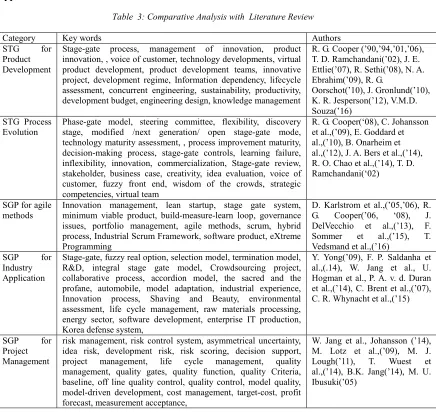
There are lots of studies about stage-gate process. (refer to Table 3 at Appendix A). Studies about
stage-gate process can be categorized by
application to new product development [4-16]; evolution of stage-gate process [17-25]; application with agile methods [26-31]; application to R&D; automobile, software development industries [32-38]; and application to project risk, quality, and cost management [39-47].
I think that the merits of this study are application to actual project’s risk & quality by assessing the deliverable of project lifecycle
phases; application of stage-gate process aligned with project governance structure which define role and responsibilities of organization related to project; focus at application of stage-gate process for integrated management of risk, cost, and quality. We focus at risk and cost management during proposal and contract negotiation phases before project contract agreement, and focus at quality management during project execution and closing phases after project contract agreement.
Also I think that the demerits of this study are mainly application of traditional stage-gate process with limited environment of customer contracted project in IT service projects, because the project budget and schedule are very strict to change of customer requirements and open innovation of product.
The similar from same type of studies are risk management of project management, stage-gate process, purpose and activities by each stage, project lifecycle phases as stages, case study, and lowering risk [39-41].
And the different from same type of studies are: this study focus at integration of risk, quality, cost, and performance management; define role and responsibility of project team and PMO/QA organizations with entire project lifecycle including pre-project and project execution phases. While other study focus at the relationship between risk management, project phases and rolling-wave planning using and case study.
From previous studies, we have found that studies regarding risk management with stage-gate process seldom apply these to actual IT service projects.
In this study, we develop a stage-gate process based on project milestones for effective project risk management and full stakeholder satisfaction, and apply the same to actual IT service projects. Chapter 2 provides the background for this study. Chapter 3 introduces the stage-gate process developed in this study to IT service projects. Chapter 4 validates the proposed stage-gate process by applying it to actual IT service projects. In the last chapter, we discuss the results and limitations of this study as well as possibilities for future research.
3. BACKGROUND KNOWLEDGE
3.1 IT Service Project
Enterprises have recently increased and
ISSN: 1992-8645 www.jatit.org E-ISSN: 1817-3195
[image:3.612.312.522.211.537.2]service project, project team members conduct strategic planning, analyze user requirements, design the IT system based on the user requirements, develop and test the integrated information system using hardware and software, and operate and optimize the integrated information system [48]. And IT service project creates new services that integrate IT with industrial knowledge to upgrade an organization’s competitiveness and improve its value and products [49]. Thus, members of IT service project teams have to be proficient in IT technologies, possess relevant industrial knowledge and understanding, and excellent project-management skills, as all are needed to manage project factors such as scope, schedule, cost, and risk [2]. Project team members gather and analyze users’ business requirements and the system’s functional and non-functional requirements during the analysis stage [2]. The requirements of the users and the system can be unclear due to invisible software characteristics. Moreover, during system integration testing, user requirements often change, and these changes may affect system quality, and introduce delays in the system integration test, cause cost overruns, and even delay the user acceptance test. In Korea, suppliers and buyers sign contracts using firm-fixed pricing and turnkey approach for IT service project agreements [50]. In a turnkey contract, the supplier is to deliver the system the user requires on time, and the customer is obliged to pay the supplier depending on the results of the user acceptance test (refer to table 4) [1].
Table 4: Rights and Obligations of Contractors
Party Rights Obligations Customer Timely
completion of the system
Payment to be made after inspection of deliverables Supplier Payments at
pre-defined stages or upon project completion
Deliver an acceptable system on time to the user
3.2 Project Stakeholders
Project stakeholders are the individuals, groups or organizations affected by, or affecting, the project. As such, it is necessary to document relevant information regarding their interest and
involvement. Stakeholders may be actively
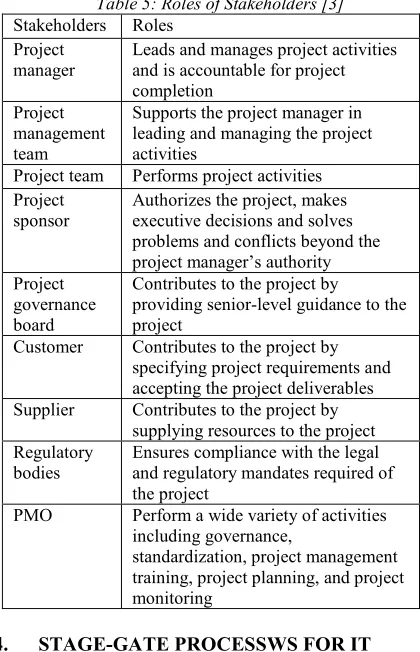
involved in the project, may be internal or external to the project, and may be at varying authority levels. The table 5 defines the project stakeholders and their roles (refer to table 5) [3].
The project governance board is a formal team comprising executive leaders (or their delegates) from across the organization. Their mission is to direct the organization strategically, using projects to meet organization goals. The key services provided by the project management office (PMO) are monitoring and controlling the project activities, aggregation and analysis of information, and reporting and recommendations to project board [3].
Table 5: Roles of Stakeholders [3]
Stakeholders Roles Project
manager
Leads and manages project activities and is accountable for project completion
Project management team
Supports the project manager in leading and managing the project activities
Project team Performs project activities Project
sponsor
Authorizes the project, makes executive decisions and solves problems and conflicts beyond the project manager’s authority Project
governance board
Contributes to the project by
providing senior-level guidance to the project
Customer Contributes to the project by specifying project requirements and accepting the project deliverables Supplier Contributes to the project by
supplying resources to the project Regulatory
bodies
Ensures compliance with the legal and regulatory mandates required of the project
PMO Perform a wide variety of activities including governance,
standardization, project management training, project planning, and project monitoring
4. STAGE-GATE PROCESSWS FOR IT
SERVICE PROJECTS
4.1 Outputs by Stage of IT Service Project
IT service project life cycle can be divided into the sales, contracting and planning, analysis,
design, coding, testing, open/delivery, and
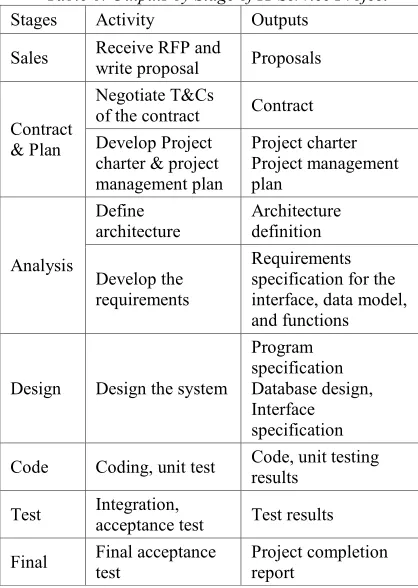
completion stages. Project team members produce the outputs by activities of each stage (refer to table 6) [2].
ISSN: 1992-8645 www.jatit.org E-ISSN: 1817-3195
Project charter includes the goal and objectives, and success criteria for the project output. Project management plans entail utilizing process/domain knowledge and understanding the requirements of the project environment [3].
At requirement analysis stage, functional and non-functional, and qualitative attributes of the product or software are defined; and specifications relating to product validation and requirements from the product are written. After the analysis stage, the design, coding, testing, and open/delivery
stages entail meeting the functional and
nonfunctional requirements.
In the final project completion stage, it is confirmed whether the goals and objectives of the project as defined in the project charter have been achieved.
[image:4.612.312.522.230.402.2]It is thus clear that project/product requirements need to be scrutinized at both the planning and completion stages to ensure output quality [51].
Table 6: Outputs by Stage of IT Service Project
Stages Activity Outputs
Sales Receive RFP and
write proposal Proposals
Contract & Plan
Negotiate T&Cs
of the contract Contract Develop Project
charter & project management plan
Project charter Project management plan
Analysis
Define architecture
Architecture definition
Develop the requirements
Requirements specification for the interface, data model, and functions
Design Design the system
Program specification Database design, Interface specification
Code Coding, unit test Code, unit testing results
Test Integration,
acceptance test Test results
Final Final acceptance test
Project completion report
4.2 Stakeholders’ Requirements
The project comprises various types of stakeholders such as the sponsor, management, marketing or product manager, technical support and system engineering staff, users and customers, procurers, and regulatory and legal department
personnel (refer to table 7). The sponsor approves the project initiation and identifies business goals and objectives. The management supplies the resources and constraints. The legal and regulatory ensure compliance in such issues as laws, regulations, and IPRs. Customers, users, marketing or product manager, and SMEs have functional requirements, while technical support staff and operators and system engineering personnel have nonfunctional requirements and assign quality attributes [3].
Table 7: Requirements of Stakeholders [3]
Stakeholder Requirements Executives,
Sponsor
Alignment with the company’s strategies and objectives, while meeting schedule and margin constraints
Government, Regulatory bodies, Fair trade committee
Ensure compliance with the fair trade law and subcontract laws (payment schedule, work order with formal contract, prohibit unfair discounts, and prohibit misuse of patents) Users Functional requirements, maintenance
of delivery schedule System
manager
Non-functional requirements, Operational efficiency, system performance
4.3 Developing the Stage-Gate Process for IT Service Projects
4.3.1 Stage-gate process
A stage-gate process is both a conceptual and an operational model for moving a new product form idea to launch (refer to figure 1). It is a blueprint for managing the new product process to improve effectiveness and efficiency. Stage-Gate is based on the premise that some projects and project teams really understand how to win-they get it [4] [5] [6].
[image:4.612.90.299.343.637.2]ISSN: 1992-8645 www.jatit.org E-ISSN: 1817-3195
The advantages of SGP are capital expenditure is controlled as an exit at every gate; time spent on projects are controlled as an exit at every gate; adding clarity and flexibility to project management especially in research; weak projects are ended sooner; focus on quality of project execution, important project steps and completeness of the project; allows for fast-paced, parallel processing with a multifunctional team approach; cross departmental collaboration; strong customer & competition orientation [41]
The disadvantage of SGP are adherence to rigorous gate controls can harm the development of new products by introducing project inflexibility which increase inability to acquire new information and incorporate it successfully into the project after its approval at the initial stages and can’t make major changes to the project after its approval [10]; and STG are limited in their ability to respond to the threats, opportunities and dynamic changes from customers and markets that arise throughout the innovation process [29].
[image:5.612.315.523.77.209.2]In PRINCE2, the Business Case is developed at the beginning of the project and maintained throughout the life of the project, being formally verified by the Project Board at each key decision point, such as end stage assessments, and confirmed throughout the period that the benefits accrue (refer to figure 2) [52].
Figure 2: Development path of the Business Case [52]
PRINCE2 have seven processes such as SU, IP, DP (Directing a Project), SB (Managing a Stage Boundary), CP, CS (Controlling a Stage), and MP (Managing Product Delivery) (refer to figure 3). The purpose of the SB process is to enable the Project Board to be provided with sufficient information by the Project Manager so that it can review the success of the current stage, approve the next stage plan, review the updated Project Plan, and confirm continued business justification and acceptability of the risks [52].
[image:5.612.314.522.405.554.2]* SU (Starting up a Project), IP (Initiating a Project), SB (Managing a Stage Boundary), CP (Closing a Project)
Figure 3: The PRINCE2 processes [52]
A stage-gate process, is a project management technique in which an initiative or project (e.g., new product development, process improvement, and business change) is divided into stages or stages, separated by gates and there are many suggested different project lifecycle phases or stages (refer to table 8 at Appendix B) [53].
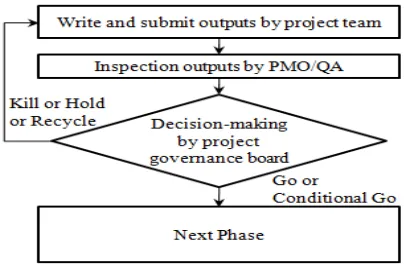
[image:5.612.96.296.433.570.2]At each stage, project team write and gather the information and share to PMO, PMO analysis the information written by project team and report to project board. And project board members make the decision of Go/Kill (refer to figure 4) [18].
Figure 4: Stage-gate structure [18]
At each gate, the continuation of the process is decided by (typically) a manager or a steering committee. The decision is based on the information available at the time, including the business case, risk analysis, and availability of necessary resources (e.g., money, and people with correct competencies) [53]. Gates or decision points are placed at places in the product development process that are most beneficial to making decisions regarding continuance of project execution [53].
The production areas between the gates are idea
generation, establishment of feasibility,
ISSN: 1992-8645 www.jatit.org E-ISSN: 1817-3195
and product launch. Gates provide various points during the process where an assessment of the quality of an idea is undertaken. It includes three main issues [53]:
Quality of execution: Checks whether the
execution of the previous step meets the quality requirements.
Business rationale: Does the project continue to
look like an attractive idea from an economic and business perspective.
Action plan: The proposed action plan and the
requested resources are reasonable and sound. A gate meeting can lead to four results: go, kill, hold, recycle, or “Conditional go.” Gates have a common structure and consist of three main elements [53]:
Deliverables: What the project manager and team
deliver to the decision point. These deliverables are decided at the output of the previous gate, and are based on a standard menu of deliverables for each gate.
Criteria: Questions or metrics on which the
project is judged in order to determine a result and prioritize a decision.
Outputs: Results of the gate review, a decision,
along with an approved action plan for the next gate, and a list of deliverables and date for the next gate.
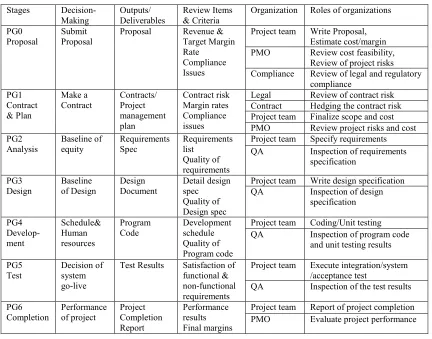
[image:6.612.324.526.412.545.2]We developed the stage-gate process (refer to table 9 at Appendix C) for IT service projects. The project governance board makes the decision at each stage based on reports written by the PMO and QA. We divide the project life cycle to six stages by proposal and contract of project, analysis, design, develop, and test of product, and completion of project. Project board members can make decisions of Go/Kill of each stage based on review reports of outputs or deliverables by PMO. The PMO review the items depend on outputs or deliverables by each stage. There are different roles and responsibilities such as making the outputs by project team, review risks and quality by PMO, QA, and legal departments [54].
A project management office (PMO) is a group or department within a business, agency or enterprise that defines and maintains standards for project management within the organization. The PMO strives to standardize and introduce economies of repetition in the execution of projects. The PMO is the source of documentation, guidance and metrics on the practice of project management and execution [55-58].
5. APPLICATION OF THE STAGE-GATE PROCESS TO AN IT SERVICE PROJECT
When applying a stage-gate process to an IT service project, the PMO established the stage-gate process and gives guideline to the project team [54]. The sales and project team define the outputs or deliverables in a proposal, charting out the project management plan; detail the requirements and design specifications; collect and present the results of system tests; make and submit the completion report to the PMO and QA. The PMO and QA review and inspect the risks and quality of outputs, and summarize the results of the review and inspect, reporting the summary to the project governance board. The project governance board then makes a decision based on this report: go, kill, hold, recycle, or conditional go (refer to figure 5) [54].
We applied this stage-gate process to several actual projects: a new, large banking system, a security system, and an insurance system.
We find that at the sales or proposal stage, the projects can be tailored for emphasis on target margin rate and risk criteria to meet the company’s strategies and objectives, thus increasing the profit rate of the project and optimizing the utilization of human resources.
Figure 5: Application of Stage-Gate process [54]
At the contract stage, we can remove or reduce the risks included in contract documents using checklists and by enabling decision-making criteria for contract T&Cs and the project management plan.
At the system analysis stage, we can clearly and formally set the baseline for functional and non-functional requirements, and can more effectively manage the amendments made to the requirements during the system development and testing stage. In this regard, having a pre-set baseline helps avoid conflicts over the amendments.
ISSN: 1992-8645 www.jatit.org E-ISSN: 1817-3195
the quality of the program code at the developing stage; and decide on the go-live of the system based on the satisfaction level over the functional and non-functional requirements at the integration and system test stage. Using go/no-go decision-making at each stage, critical errors can thus be avoided or forestalled. Otherwise, critical problems and issues
are identified at project completion stage
concurrently, and may delay or fail the project. The stage-gate process model can thus “divide and conquer” such critical issues.
There are total 109 projects which contracted with external customers were completed before application of SGP from 2009 to 2012 in an IT service company. And total 27 projects of the completed projects during same period were failed. SO, the average failure rate of project was 24.5% during before application of SGP. But there are total 46 projects were completed after application of SGP from 2013 to 2014 in same company, and 5 projects were failed. So the average failure rate of projects was 10.8% after application of SGP. The average failure rate of project is improved by 13.7% with application of developed the SGP (refer to table 10). The project failure or cost-overrun means that the actual cost at final stage exceed the planned cost at initial stage which includes cost of human resources, materials, expenses, and project reserve. The project reserve depends on risk level of project and project characteristics [58].
Table 10: Failure rate of IT service projects [58]
Year ‘09 ‘10 ‘11 ‘12 ‘13 ‘14
Completed
Projects 26 22 33 28 26 20 Failed
projects 6 5 9 7 3 2
Rate(%) of
failed projects 23 22.7 27.3 25 11.5 10 SGP
application before SGP after SGP Ave. rate of
failed project
24.5% (27/109)
10.8% (5/46)
Improvement
Of failure rate 13.7%
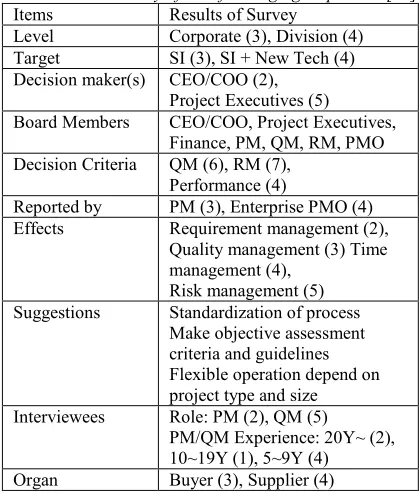
To verify the effectiveness of SGP of IT service projects, we conducted Focus Group Interview (FGI) with seven experts in different IT service companies and summary the results of FGI (refer to table 10). The interviewees have at least 5 years of PM or QM experiences. Stage-gate process were implemented at corporate or division levels. And final decisions are made mainly by project executives and decisions by quality and risk and
performance criteria. The information for decision are reported by PM or Enterprise PMO. We can
find that stage-gate process can increase
[image:7.612.312.522.206.453.2]management level of requirement, quality, time, risk areas. Also they suggested standardization of process; make objective assessment criteria and guidelines; and flexible operation depend on project type and size [59].
Table 10: Summary of FGI for Stage-gate process [59]
Items Results of Survey Level Corporate (3), Division (4) Target SI (3), SI + New Tech (4) Decision maker(s) CEO/COO (2),
Project Executives (5) Board Members CEO/COO, Project Executives,
Finance, PM, QM, RM, PMO Decision Criteria QM (6), RM (7),
Performance (4)
Reported by PM (3), Enterprise PMO (4) Effects Requirement management (2),
Quality management (3) Time management (4),
Risk management (5) Suggestions Standardization of process
Make objective assessment criteria and guidelines Flexible operation depend on project type and size Interviewees Role: PM (2), QM (5)
PM/QM Experience: 20Y~ (2), 10~19Y (1), 5~9Y (4) Organ Buyer (3), Supplier (4)
6. CONCLUSIONS
IT service projects in Korea have recently began utilizing new technologies such as the IoT (Internet of Things), mobile and cloud, and data analytics to upgrade the level of automation and information-diffusion in factory, banking, and securities system to maintain sustainable competitive advantages and to meet the company’s strategy and objectives.
However, IT projects face various types of risks that may lead to project delays and/or cost overruns, along with failure to comply with government laws and regulatory body recommendations/mandate. This may lead to legal issues and shadow the company’s image.
As such, stakeholder requirements should be properly scoped and plans should be made to satisfy these.
[image:7.612.89.299.459.617.2]ISSN: 1992-8645 www.jatit.org E-ISSN: 1817-3195
governance that entails risk management at each stage of the project is needed.
In this study, we develop a project stage-gate process based on project milestones for effective project risk management and full stakeholder satisfaction, and successfully apply the same to actual projects. Using the Go/No-Go decision-making inherent in the stage-gate process at each stage, critical errors can thus be avoided or forestalled. Otherwise, critical problems and issues
are identified at project completion stage
concurrently, and may delay or fail the project. The stage-gate process can thus “divide and conquer” such critical issues and the help mitigate the risks which identified during project execution and meet various kind of stakeholder’s requirements.
We can know that the failure rate of project have reduced by 13.7% after SGP application. The reasons why the SGP application reduced the failure rate of project are filtering the project aligned to company’s objectives and strategies by process of profit hurdle rate and enterprise-wide
risk governance structure, project contract
management to make the terms & condition of contract agreement fair and reasonable, user requirement engineering management to prevent incomplete and missing requirements, and quality assurance of design and development, user participation and cooperation to pass the user acceptance test on time.
And the FGI show that the SGP can help to manage risk, quality, and time of project
effectively. Also the FGI suggest that
standardization of SGP process is needed, making criteria of assessment and decision objective, and operate SGP flexibly depend on project type and environment.
There are some open issues when apply the stage-gate process:
.Criteria for risk level and cost feasibility assessment based on project size and type are needed for Go/No-Go decision-making.
.Enterprise-wide PMO & QA should have knowledge and experience for assessment of risk and quality, lack of competency of them may make the assessment wrong, and project board may make Go-/No-Go decision wrong.
.SGP success or failure may depend on project governance board structure, and awareness of the SGP function ad importance. Enterprise-wide project governance structure is more efficient to manage company-wide risk and quality
This study, however, have limitations: we discuss application focusing at IT service project with customer (or buyer)-supplier and turn-key type
contract, and water-fall type methodology in Korea’s domestic project environment. Future research should look into broad applicability of the SGP to agile, incremental type methodology, and other project type as like construction, plant, and ship-building.
REFERENCES:
[1] E. J. Jeong, S. R. Jeong, “A Checklist for
Assessment of Risks Involved in IT Service
Project Contract”, Journal of Internet
Computing and Services (JICS), Vol. 15, No. 4, Aug. 2014, pp. 57-65
[2] E.J. Jeong, J.H. Bae, S.R. Jeong, “Guidelines
Aimed at Reducing the Risks of User Acceptance Delay in the Context of an IT
Service Project Management Plan”,
International Journal of Electrical and
Computer Engineering, Vol. 5, No. 4, Aug. 2015, pp. 832~839
[3] PMI, A Guide to the Project Management
Body of Knowledge fifth edition, 2013
[4] R.G. Cooper, “Stage-Gate Systems: A new
Tool for Managing New Products”, Business Horizons, 1990, pp. 44-54
[5] R.G. Cooper, “Perspective: Third-Generation
New Product Processes”, Journal of Product Innovation Management, Vol. 11, 1994, pp. 3-14
[6] R.G. Cooper et al., “Optimizing The
Stage-Gate Process: What best-Practice of
Companies DO-I”, Research-Technology
Management, 2002, pp. 21-27
[7] T. D. Ramchandani, “Role of Stage Gates in
Effective Knowledge Sharing During the Product Development Process”, Thesis for the degree of master of science in MIT, 2002
[8] N. A. Ebrahim et al., “Modified stage-gate: A
conceptual model of virtual product
development process”, African Journal of Marketing Management, Vol. 1, No. 9, 2009, pp. 211-219
[9] J. Gronlund et al., “Open Innovation and the
Stage-Gate Process: A Revised Model for
New Product Development”, California
Management Review, Vol. 52, No. 3, 2010, pp. 106-131
[10]R. Sethi et al., “Stage-Gate Controls, Learning
Failure, and Adverse Effect on Novel New Products”, Journal of Marketing, Vol. 72, 2008, pp. 118-134
[11]J. E. Ettlie et al., “Modified Stage-Gate
ISSN: 1992-8645 www.jatit.org E-ISSN: 1817-3195
[12]K. R. Jesperson, “Stage-to-Stage Information
Dependency in the NPD Process: Effective Learning or a Potential Entrapment of NPD Gates?”, Journal of Product Innovation Management, Vol. 29, No. 2, 2012, pp. 257-274
[13]V. M. de Souza et al, “Combining Stage-Gate
model using Set-Based concurrent engineering and sustainable end-of-life principles in a product development assessment tool”, Journal of Cleaner Production, 2016, pp. 3222-3231
[14]R.G. Cooper, “The seven principles of the
latest Stage-Gate method add up to a
streamlined, new-product idea-to-launch
process”, www.stage-gate.com, 2006,
[15]K. v. Oorschot et al., “Get Fat Fast: Surviving
Stage-Gate in NPD”, Journal of Product Innovation Management, Vol. 27, 2010, pp. 828-839
[16]R. E. Anderson, “Can stage-gate systems
deliver the goods?”, Finance Executive, 1993, pp. 34-37
[17]Phase-gate model, https://en.wikipedia.org/
wiki/Phase%E2%80%93gate_model
[18]R. G. Cooper, “Perspective: The Stage-Gate
Idea-to-Launch Process-Update, What’s New, and NexGen Systems”, The Journal of Product Innovation Management, Vol. 25, 2008, pp. 213-232
[19]E. Goddard et al., “Beyond stage-gate
processes: How to successfully exploit technology in large engineering firms”,
International Journal of Technology
Intelligence and Planning, Vol. 6, No. 4, 2010, pp. 340-355
[20]C. Johansson et al., “How are Knowledge and
Information Evaluated? Decision-Making in
Stage-Gate Processes”, International
Conference on Engineering Design, ICED’09, 2009, pp. 8.195-8.206
[21]J. A. Bers et al., “Extending the Stage-Gate
Model to Radical Innovation- the Accelerated Radical Innovation Model”, Journal of Knowledge Economics, Vol. 5, 2014, pp. 706-734
[22]R. O. Chao et al., ”Incentives in a Stage-Gate
Process”, Production and Operation
Management, Vol. 23, No. 8, 2014, pp. 1286-1298
[23]www2.cdc.gov/cdcup, Stage Gate Review
[24]B. Onarheim et al., “Distributed idea screening
in stage-gate development processes”, Journal of Engineering Design, Vol. 23, No. 9, 2012, pp. 660-673
[25]M. H. Sebell et al., ”Stage Gates: Good or Bad
for innovation?”, www.creativerealities.com /pdfs/StageGatesGoodorBad.pdf
[26]J. DelVecchio et al., “Tools for Innovation
Management: A comparison of lean startup
and the stage gate system”,
http://ssrn.com/abstract=2534138, 2013
[27]T. Vedsmand et al., “Integrating Agile with
Stage-Gate-How New Agile-Scrum Methods Lead to Faster and Better Innovation”, http://www.innovationmanagement.se/2016/08 /09/integrating-agile-with-stage-gate/
[28]D. Karlstrom et al., “Integrating agile software
development into stage-gate managed product
development”, Empirical Software
Engineering, Vol. 11, 2006, pp. 203-225
[29]A. MacCormack et al., “Developing Products
on “Internet Time”: The Anatomy of a Flexible Development Process”, Management Science, Vol. 47, No. 1, 2001, pp. 133-150
[30]A.F. Sommer et al., “Improved Product
Development Performance through
Agile/Stage-Gate Hybrids”,
Research-Technology Management, 2015, pp. 34-44
[31]D. Karlstrom et al., “Combining Agile
Methods with Stage-Gate Project
Management”, IEEE Software, 2005, pp. 43-49
[32]Y. Yong, “An integral stage gate system and
the best tool matching each phrase
respectively for R&D project”, Proceeding of
the 3rd International Conference on Risk
Management & Global e-Business, Vol. 2, 2009, pp. 913-917
[33]F. P. Saldanha et al., “Challenging the
stage-gate Model in Crowdsourcing: The Case of Fiat Mio in Brazil”, Technology Innovation Management Review, 2014, pp. 28-35
[34]U. Hogman et al., “Applying stage-gate
processes to technology
development-Experience from six hardware-oriented
companies”, Journal of Engineering and Technology Management, Vol. 30, 2013, pp. 264-287
[35]P. A. v. d. Duin et al., “Contextual Innovation
Management Using a Sage-Gate Platform: The case of Philips Shaving and Beauty”, Journal of Product Innovation Management, Vol. 31, No. 3, 2014, pp. 489-500
[36]A.C. Brent et al., “Environmental impact
ISSN: 1992-8645 www.jatit.org E-ISSN: 1817-3195
2, 2007, pp. 111-122
[37]V. Ambartsoumian et al., “IMPLEMENTING
QUALITY GATES THROUGHOUT THE ENTERPRISE IT PRODUCTION PROCESS”,
Journal of Information Technology
Management, Vol. 22, No. 1, 2011, pp. 28-38
[38]C. R. Whynacht et al., “Targeting the
transitions: applying stage-gate thinking in strategic environmental assessment”, Impact Assessment and Project Appraisal, Vol. 33, No. 2, 2015, pp. 126-134
[39] W. Jang et al., “A stage-gate integrated risk
control system for LNG plant projects”,
Journal of Natural Gas Science and
Engineering, Vol. 22, 2015, pp. 437-446
[40] C. Johansson, “Managing Uncertainty and
Ambiguity in Gates: Decision Making in
Aerospace Product Development”,
International Journal of Innovation and Technology Management, Vol. 11, No. 2, 2014,
[41] M. Lotz et al., “Investigating the risk
management potential of a stage/phase-gate project management approach”, Journal of Contemporary Management, Vol. 6, 2009, pp. 253-273
[42] M. J. Lough, “Design Development Quality
Management Phase Checklist-Project Phase Checklist Series”, AIA Best Practices, 2011
[43] T. Wuest et al., “Application of the stage gate
model in production supporting quality
management”, Proceedings of the 47th CIRP
Conference on Manufacturing Systems, Vol. 17, 2014, pp. 32-37
[44] B.K. Jang, “A Study on the development
quality control by application of QFD and Stage-gate in defense system”, Journal of Korean Society of Quality Management, Vol. 42, No. 3, 2014, pp. 279-290
[45] A. Roth et al., “Staged Evolution with Quality
Gates for Model Libraries” , Proceedings of the International Workshops on Document Changes: Modeling, Detection, Storage and Visualization, Vol. 1008, 2013
[46] U. Ibusuki, “Costing Management in the
Stage-Gate System”, AACE International Transaction, 2005, pp. IT.04.1-IT.04.04
[47]T. Flohr, “Defining Suitable Criteria for
Quality Gates”, International Conferences on Software Process and Product Measurement , 2008, pp. 245 - 256
[48] Understanding of IT Service Industry, Korea
Information Technology Service Industry Association, 2013
[49] K.B. Lee, et al., “A Study on the Influencing
factors on the Profit Improvement Rate of IT Service Projects”, The Korea Society of Management Information System”, 2010, pp. 262-286
[50] H.S. Kim, “An Improvement of SI
Contracting Laws and Regulations in Korea”, Korea Society of IT Services, Vol. 1, No.1, 2013, pp. 29-43,
[51] S. Y. Ryu, System Analysis and Requirement
Engineering, Hanti Media, 2013
[52] Andy Murray, et al., Managing Successful
Projects with PRINCE2 2009 edition, TSO (The Stationary Office), 2009
[53] Wikipedia, Stage-gate model,
https://en.wikipedia.org/wiki
[54] SK Holdings company, “Guideline for
project Stage Gates Process”, 2013
[55] Wikipedia, Project Management Office,
https://en.wikipedia.org/wiki
[56] V. Tasic, “Project Management
Office-Typology and benefits”, business informatics, Vol. 1, No. 31, 2014, pp.173-182
[57] Cuthbert, “The Role of the Project
Management Office”, PM World Journal Vol. 1, No.5, 2012
[58] SK Holdings company, Internal Report for
Project Results, 2015
[59] E. J. Jeong, “FGI results of Stage-gate
ISSN: 1992-8645 www.jatit.org E-ISSN: 1817-3195
[image:11.612.93.529.104.518.2]Appendix A
Table 3: Comparative Analysis with Literature Review
Category Key words Authors
STG for Product Development
Stage-gate process, management of innovation, product innovation, , voice of customer, technology developments, virtual product development, product development teams, innovative project, development regime, Information dependency, lifecycle assessment, concurrent engineering, sustainability, productivity, development budget, engineering design, knowledge management
R. G. Cooper (’90,’94,’01,’06), T. D. Ramchandani(’02), J. E. Ettlie(’07), R. Sethi(’08), N. A. Ebrahim(’09), R. G.
Oorschot(’10), J. Gronlund(’10), K. R. Jesperson(’12), V.M.D. Souza(’16)
STG Process Evolution
Phase-gate model, steering committee, flexibility, discovery stage, modified /next generation/ open stage-gate mode, technology maturity assessment, , process improvement maturity, decision-making process, stage-gate controls, learning failure, inflexibility, innovation, commercialization, Stage-gate review, stakeholder, business case, creativity, idea evaluation, voice of customer, fuzzy front end, wisdom of the crowds, strategic competencies, virtual team
R. G. Cooper(‘08), C. Johansson et al.,(’09), E. Goddard et al.,(’10), B. Onarheim et al.,(’12), J. A. Bers et al.,(’14), R. O. Chao et al.,(’14), T. D. Ramchandani(‘02)
SGP for agile methods
Innovation management, lean startup, stage gate system, minimum viable product, build-measure-learn loop, governance issues, portfolio management, agile methods, scrum, hybrid process, Industrial Scrum Framework, software product, eXtreme Programming
D. Karlstrom et al.,(’05,’06), R. G. Cooper(’06, ‘08), J. DelVecchio et al.,(’13), F. Sommer et al.,(’15), T. Vedsmand et al.,(’16)
SGP for Industry Application
Stage-gate, fuzzy real option, selection model, termination model, R&D, integral stage gate model, Crowdsourcing project, collaborative process, accordion model, the sacred and the profane, automobile, model adaptation, industrial experience, Innovation process, Shaving and Beauty, environmental assessment, life cycle management, raw materials processing, energy sector, software development, enterprise IT production, Korea defense system,
Y. Yong(’09), F. P. Saldanha et al.,(.14), W. Jang et al., U. Hogman et al., P. A. v. d. Duran et al.,(’14), C. Brent et al.,(’07), C. R. Whynacht et al.,(’15)
SGP for Project Management
risk management, risk control system, asymmetrical uncertainty, idea risk, development risk, risk scoring, decision support, project management, life cycle management, quality management, quality gates, quality function, quality Criteria, baseline, off line quality control, quality control, model quality, model-driven development, cost management, target-cost, profit forecast, measurement acceptance,
ISSN: 1992-8645 www.jatit.org E-ISSN: 1817-3195
Appendix B
ISSN: 1992-8645 www.jatit.org E-ISSN: 1817-3195
[image:13.612.89.521.133.472.2]Appendix C
Table 9: Developing a Stage-Gate Process for IT Service Projects
Stages Decision- Making
Outputs/ Deliverables
Review Items & Criteria
Organization Roles of organizations
PG0 Proposal
Submit Proposal
Proposal Revenue & Target Margin Rate
Compliance Issues
Project team Write Proposal, Estimate cost/margin PMO Review cost feasibility,
Review of project risks Compliance Review of legal and regulatory
compliance PG1
Contract & Plan
Make a Contract
Contracts/ Project management plan
Contract risk Margin rates Compliance issues
Legal Review of contract risk Contract Hedging the contract risk Project team Finalize scope and cost PMO Review project risks and cost PG2
Analysis
Baseline of equity
Requirements Spec
Requirements list
Quality of requirements
Project team Specify requirements QA Inspection of requirements
specification
PG3 Design
Baseline of Design
Design Document
Detail design spec Quality of Design spec
Project team Write design specification QA Inspection of design
specification
PG4 Develop- ment
Schedule& Human resources
Program Code
Development schedule Quality of Program code
Project team Coding/Unit testing QA Inspection of program code
and unit testing results
PG5 Test
Decision of system go-live
Test Results Satisfaction of functional & non-functional requirements
Project team Execute integration/system /acceptance test
QA Inspection of the test results
PG6 Completion
Performance of project
Project Completion Report
Performance results Final margins
![Table 2: Risks in IT Service Project, by Stage [1]](https://thumb-us.123doks.com/thumbv2/123dok_us/8907943.957737/2.612.87.298.349.563/table-risks-service-project-stage.webp)
![Figure 4: Stage-gate structure [18]](https://thumb-us.123doks.com/thumbv2/123dok_us/8907943.957737/5.612.96.296.433.570/figure-stage-gate-structure.webp)