IJPSR (2018), Volume 9, Issue 12 (Research Article)
Received on 02 April, 2018; received in revised form, 03 June, 2018; accepted, 26 June, 2018; published 01 December, 2018
A COMPARATIVE STUDY OF LEDIPASVIR SOLID DISPERSION TECHNIQUE USING SPRAY DRYING AND HOT-MELT EXTRUSION
Purna Chandra Reddy Guntaka * and Srinivas Lankalapalli
GITAM Institute of Pharmacy, GITAM University, Rushikonda, Visakhapatnam - 530045, Andhra Pradesh, India.
ABSTRACT: Ledipasvir is an inhibitor of the HCV NS5A protein, which is required for viral replication used in the treatment of hepatitis C. Ledipasvir is practically insoluble (less than 0.1 mg/mL) across the pH range of 3.0-7.5 Due to low solubility, it results into poor bioavailability after oral administration. Therefore, solid dispersions (SDs) of Ledipasvir
were prepared by two methods, i.e. spray drying technique and hot-melt
extrusion by using various carriers like polyvinyl caprolactam-polyvinyl
acetate-polyethylene glycol graft copolymer (soluplus), hypromellose 5
cPs and copovidone (kollidonVA64) to increase its aqueous solubility. Faster and high drug release was found in the SDs which was prepared by spray drying technique (SDT) with co-povidone in the ratio of 1:2 as compared with hot melt extrusion (HME) using drug substance and soluplus in the ratio of 1:2. There are 5 folds increases in the solubility of Ledipasvir prepared by SDT and HME compared with plain drug substance. FSD3 and FHM9 are finalized as optimized formulations prepared by SDT and HME based on their solubility, drug substance
content and in-vitro drug dissolution studies. FT-IR, XRD and DSC of
SDs by SDT and HME showed a change in crystalline structure toward an amorphous form of Ledipasvir. The obtained results suggested that developed Ledipasvir SDs by SDT and HMT has potential for oral delivery and might be an efficacious approach for enhancing the therapeutic potential of Ledipasvir.
INTRODUCTION: According to BCS classifica-tion, class II and IV drugs are considered as poorly water soluble. So enhancement of bioavailability of solid dosage forms remains a challenge due to their solubility criteria 1.Approximately 40% or more of new chemical entities being generated through drug discovery programs are poorly water-soluble 2, 3.
QUICK RESPONSE CODE
DOI:
10.13040/IJPSR.0975-8232.9(12).5145-54
Article can be accessed online on:
www.ijpsr.com
DOI link: http://dx.doi.org/10.13040/IJPSR.0975-8232.9(12).5145-54
Poorly water-soluble crystalline drugs, when in the amorphous state tend to have higher solubility. Drug in its amorphous state shows higher drug release because no energy is required to break up the crystal lattice during the dissolution process. Therefore, result in a higher dissolution rate 4. Spray drying is an efficient technology for solid dispersion manufacturing process since it allows extreme rapid solvent evaporation leading to form fast transformation of an API-carrier solution to solid API-carrier particles. Solvent evaporation kinetics certainly contributes to formation of the amorphous solid dispersions 5, 6. Hot melt extrusion technology (HME) is a continuous process
Keywords:
Ledipasvir, Hot-melt extrusion, Spray drying, Soluplus, Co-povidone, Hypromellose 5 cPs Correspondence to Author: Purna Chandra Reddy Guntaka
Research Associate,
GITAM Institute of Pharmacy, GITAM University, Rushikonda, Visakhapatnam, Andhra Pradesh, India.
manufacturing process that can be successfully used for the development of water insoluble active substances. By providing excellent mixing of a drug and polymer carrier within the extrusion barrels HME can facilitate increased dissolution rates of insoluble drugs 7, 8. The objective of this study is to prepare a pharmaceutically equivalent, stable robust formulation using carrier’s hypromellose 5cPs, polyvinyl caprolactam-poly-vinyl acetate-polyethylene glycol graft copolymer, grade soluplus and copovidone.
Ledipasvir drug substance is a pale yellow powder. Ledipasvir is an inhibitor of the HCV NS5A protein, which is required for viral replication. Resistance selection in cell culture and cross-resistance studies indicate Ledipasvir targets NS5A as its mode of action. Ledipasvir indicates for the treatment of hepatitis C. Ledipasvir is practically insoluble (less than 0.1 mg/mL) across the pH range of 3.0-7.5 and is slightly soluble below pH 2.3 (1.1 mg/mL) 9, 10.
Because of its low aqueous solubility we used spray dry technology to enhance its solubility. The prepared batches of different tablets were evaluated for uniformity of weight, thickness, hardness,
friability, disintegration test and in-vitro dissolution study with tablets.
MATERIALS AND METHODS: Harvoni®
(Marketed Product) tablets were obtained from Gilead sciences, Inc., Foster City, CA Made in Ireland. Ledipasvir drug substance was gifted by Hetero Drugs Ltd., Hyderabad, India. Micro-crystalline cellulose, grade avicel pH 102 was gifted by FMC biopolymer, USA. Hypromellose 5 cPs was gifted by DOW chemical, USA. Colloidal silicon dioxide (Aerosil 200) was gifted by Evonik, Germany. Polyvinyl caprolactam-polyvinyl acetate-polyethylene glycol graft copolymer, grade soluplus, copovidone was gifted by BASF, USA; Lactose monohydrate (Super Tab 11 SD) and croscarmellose sodium was gifted by DFE Pharma, Germany. Magnesium stearate was gifted by Peter Greven, Netherlands. All other Polymers and solvents used were of analytical grade.
Spray Drying: Solid dispersions have been widely used to enhance the solubility, dissolution rate, and bioavailability of poorly soluble drugs. Ledipasvir is a poorly soluble drug to enhance dissolution rate by using spray drying technology.
FIG. 1: EQUIPMENT OF SPRAY DRIER
Preparation of Ledipasvir Solid Dispersions by Using Spray Drying: Ledipasvir was added slowly to 5:5 solvent mixtures of dichloromethane and acetone under continuous stirring and stirred well untill it get a clear solution. By using copovidone, hypromellose 5cPs and polyvinyl caprolactam-polyvinyl acetate-polyethylene glycol graft copolymer (soluplus) was added to the above drug solution and stirred well untill it get a clear solution. The above solution was subjected to spray drying using BUCHI spray dryer (Inlet air temperature 60 - 70 °C, Aspiration 90 - 100%;
TABLE 1: PARAMETERS CONSIDERED DURING SPRAY DRYING
Atomizer qualifications Spray drying parameters
Nozzle tip 0.5 mm Inlet temperature 60 - 70 °C
Nozzle diameter 0.8 mm Pump rate for spraying Solution 25 - 35%
[image:3.612.51.563.97.334.2]Cap diameter 1.4 mm Nitrogen gas pressure 30mm Hg
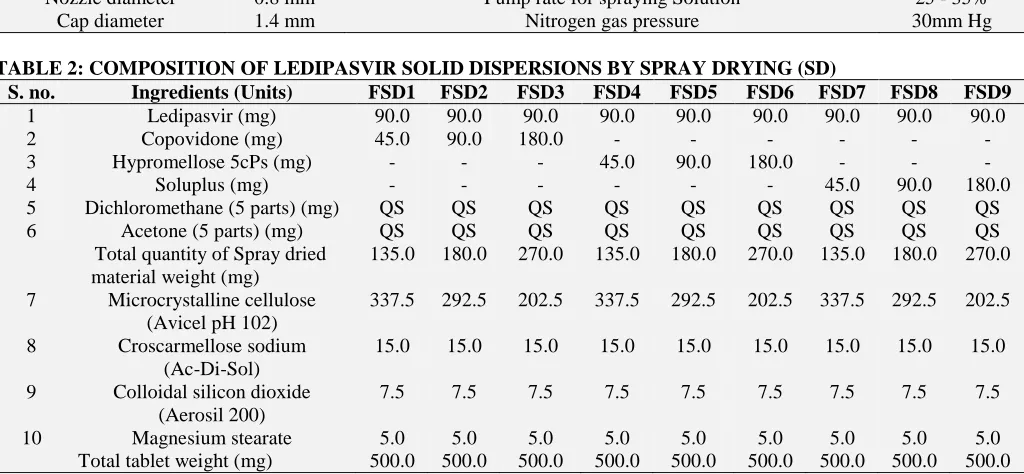
TABLE 2: COMPOSITION OF LEDIPASVIR SOLID DISPERSIONS BY SPRAY DRYING (SD)
S. no. Ingredients (Units) FSD1 FSD2 FSD3 FSD4 FSD5 FSD6 FSD7 FSD8 FSD9
1 Ledipasvir (mg) 90.0 90.0 90.0 90.0 90.0 90.0 90.0 90.0 90.0
2 Copovidone (mg) 45.0 90.0 180.0 - - - -
3 Hypromellose 5cPs (mg) - - - 45.0 90.0 180.0 - - -
4 Soluplus (mg) - - - 45.0 90.0 180.0
5 Dichloromethane (5 parts) (mg) QS QS QS QS QS QS QS QS QS
6 Acetone (5 parts) (mg) QS QS QS QS QS QS QS QS QS
Total quantity of Spray dried material weight (mg)
135.0 180.0 270.0 135.0 180.0 270.0 135.0 180.0 270.0
7 Microcrystalline cellulose (Avicel pH 102)
337.5 292.5 202.5 337.5 292.5 202.5 337.5 292.5 202.5
8 Croscarmellose sodium (Ac-Di-Sol)
15.0 15.0 15.0 15.0 15.0 15.0 15.0 15.0 15.0
9 Colloidal silicon dioxide (Aerosil 200)
7.5 7.5 7.5 7.5 7.5 7.5 7.5 7.5 7.5
10 Magnesium stearate 5.0 5.0 5.0 5.0 5.0 5.0 5.0 5.0 5.0
Total tablet weight (mg) 500.0 500.0 500.0 500.0 500.0 500.0 500.0 500.0 500.0
\\\
Manufacturing Process:
Step-1: Solid dispersions of Ledipasvir with copovidone (one set of trials), hypromellose 5 cPs (second set of trials) and soluplus (third set of trials) were prepared by Spray drying process. Step-2: The spray dried mixture of step no 1, microcrystalline cellulose (Avicel pH 102), croscarmellose sodium (Ac-Di-Sol) and colloidal silicon dioxide (Aerosil 200) were sifted together through # 30 mesh and mixed well in poly bag for 10 min.
Step-3: Magnesium stearate sifted through #40 mesh and added to step no 2 mixed in poly bag for 5 min manually.
Step-4: The lubricated blend of step no 3 was compressed by using 9.00 mm round shaped punches.
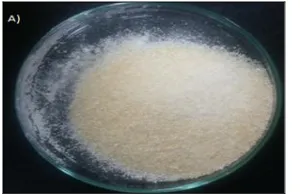
FIG. 2: A) LEDIPASVIR PLAIN DRUG B) SPRAY DRIED MATERIAL OF FSD3
Evaluation of Ledipasvir Solid Dispersions: Solubility Studies of Ledipasvir Solid Dispersions: Solubility measurements of Ledipasvir were performed according to a published method. Ledipasvir with carriers were shaken for the 48 h at room temperature. Subsequently, the suspensions were filtered through a Whatman filter paper. Filtered solution of Ledipasvir was analyzed by using UV 330 nm.
Drug Content: Solid dispersions equivalent to 90 mg of Ledipasvir were weighed accurately and dissolved in 100 ml of methanol. The solution was filtered, diluted and drug content was analyzed at 330 nm against blank by UV spectrometer. The actual drug content was calculated using the following equation as follows:
[image:3.612.54.295.615.728.2]TABLE 3: IN-VITRO DISSOLUTION STUDIES TEST PARAMETERS
Instrument Electro lab- USP type II dissolution test apparatus
Dissolution medium 1.5% Polysorbate 80 in pH 6.0 phosphate
buffer with 0.0075 mg/ml (BHT) butylated hydroxy toluene.
Apparatus USP apparatus – II (Paddle type)
Temperature 37 ± 0.5 ºC
RPM 75
Volume of medium 900 ml
Sampling intervals 5, 10, 15, 20, 30, 45 and 60 min
Sample volume 10 ml withdrawn and replaced with 10 ml
of dissolution medium.
RESULTS ANDDISCUSSION:
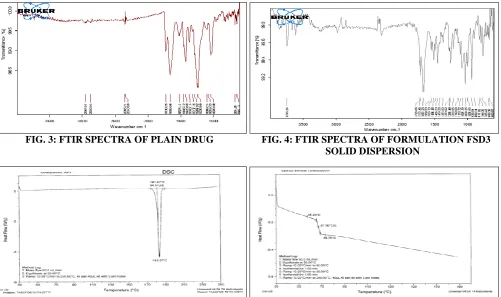
FT-IR Studies: FT-IR spectrums are mainly used to determine if there is any interaction between the drug and any of the excipient used. The prominent peaks of Lediapsvir was observed Fig. 3 the region 1659 cm-1 due to >N-H (Secondary amine NH
bend), 1287 cm-1 due to –C-N (primary amine, CN stretch), 1238 cm-1 due to –C-C (vibration), 1099 cm-1 due to –C-N (primary amine, CN stretch), 1039.5 cm-1 due to cyclohexane ring vibrations. The optimized formulation FSD3 Fig. 4 displayed the characteristic peaks at wave numbers nearer to that of plain Ledipasvir Fig. 3. Overall there was no alteration in the characteristic peaks of the optimized formulation suggesting that there was no interaction between the drug and polymers. Differential Scanning Calorimetry: The DSC thermo grams of Plain Ledipasvir showed in Fig. 5, sharp endothermic peak at melting point (183 ºC), indicating that the drug is crystalline. The absence of drug peak in the solid dispersion formulation FSD4 [Ledipasvir: Copovidone (1:2)] indicating the drug was in amorphous form.
FIG. 3: FTIR SPECTRA OF PLAIN DRUG FIG. 4: FTIR SPECTRA OF FORMULATION FSD3 SOLID DISPERSION
FIG. 5: DSC THERMOGRAMS OF PLAIN DRUG AND OPTIMIZED FORMULATION FSD3 XRD ANALYSIS
The XRD of Ledipasvir consist of sharp multiple peaks, indicating the crystalline nature of the drug. SD optimized formulation FSD3 [Ledipasvir: Copovidone (1:2)] when exposed to X-ray beam, disappearance of all crystalline endothermic peaks and characteristic intensities of Ledipasvir Fig. 6. This indicates complete transformation of crystalline Ledipasvir into amorphous form during Spray drying process.
From the XRD studies, it is clearly confirmed that the drug substance in spray dried powder (FSD3) converted into amorphous form.
[image:4.612.50.300.77.205.2] [image:4.612.58.559.307.604.2]forms of drug agglomerates with ordered shape and size Fig. 7A. The surface characteristics of SD of optimized formulation FSD3 Fig. 7B show rough
disordered and intact structures, which subsequently help dissolve drug when comes in contact with aqueous fluid.
FIG. 6: POWDER X-RAY DIFFRACTION PATTERNS OF A) LEDIPASVIR PLAIN DRUG B) OPTIMIZED FORMULATION OF SD3
FIG. 7: SEM IMAGES OF A) LEDIPASVIR PLAIN DRUG, B) OPTIMIZED FORMULATION FSD3
Evaluation Parameters:
Solubility Studies of Ledipasvir Solid Dispersions: Nine formulations of solid dispersions were prepared by spray drying method / technique with their respective Polymer. After preparation of solid dispersion by spray drying process, the resulting spray dried mixture was analyzed for solubility of drug substance and were compared with plain drug substance itself. The formulation with [(Ledipasvir:
Copovidone (1:2)] FSD3 which had shown increased solubility almost 5 fold as compared to that of the plain drug (Plain drug solubility is 0.04).
TABLE 4: SOLUBILITY STUDIES AND DRUG CONTENT OF SOLID DISPERSIONS PREPARED BY SPRAY DRYING METHOD
S. no. Formulation Solubility (mg/ml) % Drug content
1 Plain drug 0.04 ---
[image:5.612.183.444.104.235.2]2 FSD3 0.22 98.5%
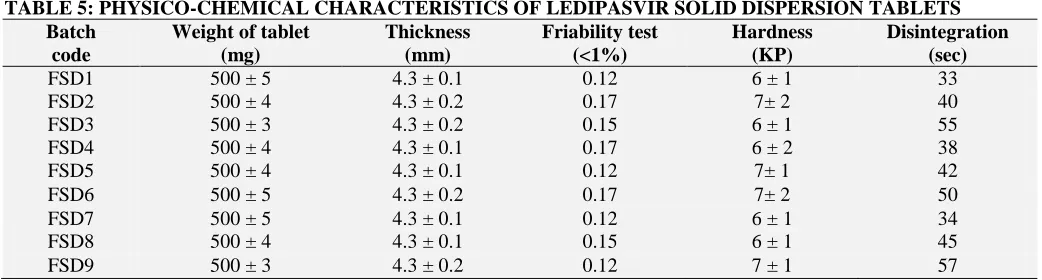
TABLE 5: PHYSICO-CHEMICAL CHARACTERISTICS OF LEDIPASVIR SOLID DISPERSION TABLETS Batch
code
Weight of tablet (mg)
Thickness (mm)
Friability test (<1%)
Hardness (KP)
Disintegration (sec)
FSD1 500 ± 5 4.3 ± 0.1 0.12 6 ± 1 33
FSD2 500 ± 4 4.3 ± 0.2 0.17 7± 2 40
FSD3 500 ± 3 4.3 ± 0.2 0.15 6 ± 1 55
FSD4 500 ± 4 4.3 ± 0.1 0.17 6 ± 2 38
FSD5 500 ± 4 4.3 ± 0.1 0.12 7± 1 42
FSD6 500 ± 5 4.3 ± 0.2 0.17 7± 2 50
FSD7 500 ± 5 4.3 ± 0.1 0.12 6 ± 1 34
FSD8 500 ± 4 4.3 ± 0.1 0.15 6 ± 1 45
FSD9 500 ± 3 4.3 ± 0.2 0.12 7 ± 1 57
In-vitro Dissolution Studies: The drug release data obtained for formulations FSD1 to FSD9 are tabulated in Table 6. The Table shows the
[image:5.612.63.552.273.408.2] [image:5.612.46.567.560.700.2]55%, 76% and 83% for FSD1 to FSD9 respectively and was 34.0% in 60 min for plain drug. In-vitro studies reveal that there is marked increase in the dissolution rate of Ledipasvir from all the solid dispersions when compared to plain Ledipasvir itself.
From the in-vitro drug release profiles, formulation FSD3 containing [(Ledipasvir: Copovidone (1:2)] was best formulation which shows high dissolution rate i.e. 98.0% compared with other formulations. This may be attributed to the increase in drug wettability, conversion to amorphous.
TABLE 6: IN-VITRO DISSOLUTION PROFILE OF PLAIN DRUG AND DIFFERENT FORMULATIONS OF LEDIPASVIR SOLID DISPERSIONS (FSD1-FSD9)
Time in Cumulative % drug release
min Plain Drug HARVONI FSD1 FSD2 FSD3 FSD4 FSD5 FSD6 FSD7 FSD8 FSD9
0 0 0 0 0 0 0 0 0 0 0 0
5 7 25 12 18 34 8 13 15 9 14 16
10 15 58 21 29 66 15 25 22 16 31 24
15 21 72 32 59 78 24 36 57 26 40 59
20 25 89 44 72 92 33 48 70 35 52 69
30 33 95 57 85 96 39 61 78 42 63 78
45 33 97 59 89 97 45 65 83 47 67 80
60 34 97 61 93 98 52 72 85 55 76 83
FIG. 8: IN-VITRO DISSOLUTION PROFILES OF PLAIN DRUG, MARKETED PRODUCT AND SPRAY DRIED LEDIPASVIR TABLETS
The dissolution profiles of Ledipasvir solid dispersions prepared by spray drying (FSD3) shown that the drug release was slightly on higher side at initial time points compared with Marketed product. The solid dispersion formulations by SDT shown highest drug release i.e. and 98.0% respectively after 60 min, where plain drug release was only 34.0% and marketed product release was 98.0%.
MATERIALS AND METHODS: Hot Melt Extrusion:
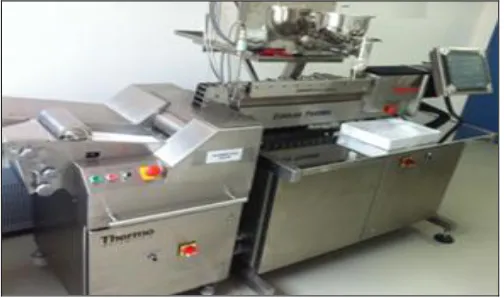
Preparation of Ledipasvir Solid Dispersions by HME: Ledipasvir solid dispersions were prepared by using different carriers like soluplus, hypromellose 5 cPs, copovidone. Thermo Fischer, HME Parma 24 - Twin Screw Model was used for the preparation of solid dispersions with the feed rate of 1 to 1.25 Kg/hour, Torque: 4 Barr and 10 different zones of temperature as from 20 ± 2 ºC to
[image:6.612.53.384.167.427.2]180 ± 2 ºC with cooling/chillers zone maintained at 2 - 5 ºC (where melt will be converted into the pieces of flakes) shown in Table 7.
FIG. 9: EQUIPMENT OF HOT MELT EXTRUDER
TABLE 7: TEMPERATURE RANGES TO BE MONITORED DURING PROCESSING OF HOLT MELT EXTRUSION (HME)
Name of the zone Temperature Barrel conveying Unit /
Zone – I
20 ˚C ± 2 ˚C
Zone – II 20 ˚C ± 2 ˚C
Zone – III 40 ˚C ± 2 ˚C
Zone – IV 80 ˚C± 2 ˚C
Zone – V 120 ˚C ± 2 ˚C
Zone – VI 120 ˚C ± 2 ˚C
Zone – VII 145 ˚C± 2 ˚C
Zone – VIII 145 ˚C ± 2 ˚C
Zone – IX 145 ˚C ± 2 ˚C
Zone – X 145 ˚C ± 2 ˚C
Die Zone 25 ˚C± 2 ˚C
Cooling / Chillers zone
Maintained at 2 - 5˚C (where melt will be converted into
[image:6.612.314.566.350.499.2]TABLE 8: COMPOSITION OF LEDIPASVIR SOLID DISPERSIONS BY HOT MELT EXTRUSION (HME)
S. no. Ingredients (Units) FHM1 FHM2 FHM3 FHM4 FHM5 FHM6 FHM7 FHM8 FHM9
1 Ledipasvir (mg) 90.0 90.0 90.0 90.0 90.0 90.0 90.0 90.0 90.0
2 Copovidone (mg) 45.0 90.0 180.0 - - - -
3 Hypromellose 5cps (mg) - - - 45.0 90.0 180.0 - - -
4 Soluplus (mg) - - - 45.0 90.0 180.0
Total quantity of hot melt extrusion material weight (mg)
135.0 180.0 270.0 135.0 180.0 270.0 135.0 180.0 270.0
5 Microcrystalline cellulose
(Avicel pH 102)
337.5 292.5 202.5 337.5 292.5 202.5 337.5 292.5 202.5
6 Croscarmellose sodium
(Ac-Di-Sol)
15.0 15.0 15.0 15.0 15.0 15.0 15.0 15.0 15.0
7 Colloidal silicon dioxide
(Aerosil 200)
7.5 7.5 7.5 7.5 7.5 7.5 7.5 7.5 7.5
8 Magnesium stearate 5.0 5.0 5.0 5.0 5.0 5.0 5.0 5.0 5.0
Total tablet weight (mg) 500.0 500.0 500.0 500.0 500.0 500.0 500.0 500.0 500.0
Manufacturing Process:
Step-1:Ledipasvir was taken with copovidone (one set of trials), hypromellose 5 cPs (second set of trials) and soluplus (third set of trials) were sifted together through #40 mesh and mixed well in poly bag for 10 min. The above mixture was hot melt extruded by using above mentioned temperature at different zones. The extrudes were transparent in FHM2, FHM3, FHM8 and FHM9. Remaining extrudes were opaque in nature. The extrudes crushed into motar and pestle. The powder was granular in nature and sifted through #30 mesh.
FIG. 10: HOT MELT EXTRUDES OF FHM9
Step-2: The Extrudes of step no 1, microcrystalline cellulose (avicel pH 102), croscarmellose sodium (Ac-Di-Sol) and Colloidal silicon dioxide (aerosil 200) were sifted together through #30 mesh and mixed well in poly bag for 10 min.
Step-3: Magnesium stearate sifted through #40 mesh and added to step no 2 mixed in poly bag for 5 min manually.
Step-4: The lubricated blend of step no 3 was compressed by using 9.00 mm round shaped punches.
Evaluation of Ledipasvir Solid Dispersions: Solubility Studies of Ledipasvir Solid Dispersions: Solubility measurements of Ledipasvir were performed according to a published method.
Ledipasvir with carriers were shaken for the 48 h at room temperature. Subsequently, the suspensions were filtered through a Whatman filter paper. Filtered solution of Ledipasvir was analyzed by using UV 330 nm.
Drug Content: Solid dispersions equivalent to 90 mg of Ledipasvir were weighed accurately and dissolved in 100 ml of Methanol. The solution was filtered, diluted suitable and drug content was analyzed at ëmax 330 nm against blank by UV
spectrometer. The actual drug content was calculated using the following equation as follows: % Drug content = Actual amount of drug in solid dispersion ×100 / Theoretical amount of drug in solid dispersion In-vitro Drug Release Studies: The in vitro drug release profile for each solid dispersion as well as plain drug was performed using USP type 2 dissolution apparatus. The sample equivalent to 90 mg of Ledipasvir was added and the conditions maintained were shown in the Table 9 as follows: The samples were drawn at specified time intervals and the obtained samples were analyzed by using UV/Visible spectrophotometer at 330 nm. The cumulative percentage release was calculated.
TABLE 9: IN-VITRO DISSOLUTION STUDIES TEST PARAMETERS
Instrument Electro lab- USP type II dissolution
test apparatus
Dissolution medium 1.5% Polysorbate 80 in pH 6.0
phosphate buffer with 0.0075 mg/ml (BHT) butylated hydroxy toluene
Apparatus USP apparatus – II (Paddle type)
Temperature 37 ± 0.5 ºC
RPM 75
Volume of medium 900 ml.
Sampling intervals 5, 10, 15, 20, 30, 45 and 60 min
Sample volume 10 ml withdrawn and replaced with 10
[image:7.612.101.251.408.505.2]RESULTS AND DISCUSSION:
FT-IR Studies: FT-IR spectrums are mainly used to determine if there is any interaction between the drug and any of the excipient used. The optimized formulation FHM9 Fig. 11 displayed the characteristic peaks at wave numbers nearer to that of plain Ledipasvir Fig. 3. Overall there was no alteration in the characteristic peaks of the optimized formulation suggesting that there was no interaction between the drug and polymers.
FIG. 11: FTIR SPECTRA OF FORMULATION FHM9 SOLID DISPERSION
Differential Scanning Calorimetry: The DSC thermo grams of Plain Ledipasvir showed in Fig. 12, sharp endothermic peak at melting point (185oC), indicating that the drug is crystalline. The absence of drug peak in the solid dispersion formulation FHM9 [(Ledipasvir: Soluplus (1:2)] indicating the drug was in amorphous form.
FIG. 12: DSC THERMOGRAMS OF OPTIMIZED FORMULATION FHM9
XRD Analysis: The XRD of Ledipasvir consist of sharp multiple peaks, indicating the crystalline nature of the drug. SD optimized formulation FHM3 [(Ledipasvir: Soluplus (1:2)] when exposed to X-ray beam, disappearance of all crystalline endothermic peaks and characteristic intensities of Ledipasvir Fig. 13. This indicates complete transformation of crystalline Ledipasvir into
amorphous form during hot melt extrusion process. From the XRD studies, it is clearly confirmed that the drug substance in extrudes (FHM9) converted into amorphous form.
FIG. 13: POWDER X-RAY DIFFRACTION PATTERNS OF OPTIMIZED FORMULATION OF FHM9
Scanning Electron Microscopy: Surface micro-graphs of prepared hot melt extrusion (FHM9) and plain Ledipasvir were determined using SEM technique. The SEM micrograph of plain Ledipasvir Fig. 7A was observed with large crystalline forms of drug agglomerates with ordered shape and size. The surface characteristics of SD of optimized formulation FHM9 Fig. 14 show rough disordered and intact structures, which subsequently helps to dissolve drug when comes in contact with aqueous fluid.
FIG. 14: SEM IMAGES OF OPTIMIZED FORMULATION FHM9
Evaluation Parameters:
Solubility Studies of Ledipasvir Solid Dispersions: Nine formulations of solid dispersions were prepared by hot melt extrusion / technique with their respective polymer.
TABLE 10: SOLUBILITY STUDIES AND DRUG CONTENT OF SOLID DISPERSIONS PREPARED BY HOT MELT EXTRUSION METHOD
S. no. Formulation Solubility (mg/ml) % Drug content
1 Plain drug 0.04 ---
After preparation of solid dispersion by Hot melt extrusion process, the resulting extrudes mixture was analyzed for solubility of drug substance and were compared with plain drug substance itself.
[image:9.612.47.562.121.248.2]The formulation with [(Ledipasvir: soluplus (1:2)] FHM9 which had shown increased solubility almost 5 fold as compared to that of the plain drug (Plain drug solubility is 0.04 mg/ml).
TABLE 11: PHYSICO-CHEMICAL CHARACTERISTICS OF LEDIPASVIR SOLID DISPERSION TABLETS Batch
no.
Weight of tablet (mg)
Thickness (mm)
Friability test (<1%)
Hardness (KP)
Disintegration (Sec)
FHM1 500 ± 3 4.2 ± 0.1 0.10 7 ± 1 55
FHM2 500 ± 4 4.2 ± 0.2 0.09 7 ± 2 45
FHM3 500 ± 3 4.1 ± 0.2 0.07 8 ± 1 40
FHM4 500 ± 4 4.2 ± 0.1 0.11 7 ± 2 52
FHM5 500 ± 3 4.2 ± 0.1 0.09 7 ± 1 49
FHM6 500 ± 4 4.1 ± 0.2 0.08 8 ± 1 42
FHM7 500 ± 3 4.2 ± 0.1 0.10 7 ± 1 45
FHM8 500 ± 3 4.2 ± 0.1 0.08 8 ± 1 40
FHM9 500 ± 3 4.1 ± 0.1 0.07 8 ± 1 35
In-vitro Dissolution Studies: The drug release data obtained for formulations FHM1 to FHM9 are tabulated in Table 12. The Table shows the cumulative percent drug released for all formulations. Cumulative percent drug released after 60 min was 63%, 78%, 92%, 49%, 63%, 81%, 65%, 80% and 95% for FHM1 to FHM9 respectively and was 34% in 60 min for plain drug. In-vitro studies reveal that there is marked increase
in the dissolution rate of Ledipasvir from all the solid dispersions when compared to plain Ledipasvir itself. From the in-vitro drug release profiles, formulation FHM3 containing [(Ledipasvir: Soluplus (1:2)] was best formulation which shows high dissolution rate i.e. 95.0 % compared with other formulations. This may be attributed to increase the conversion of Drug to amorphous.
TABLE 12: IN-VITRO DISSOLUTION PROFILE OF PLAIN DRUG AND DIFFERENT FORMULATIONS OF LEDIPASVIR SOLID DISPERSIONS (FHM1-FHM9)
Time in Cumulative % drug release
min Plain Drug HARVONI FHM1 FHM2 FHM3 FHM4 FHM5 FHM6 FHM7 FHM8 FHM9
0 0 0 0 0 0 0 0 0 0 0 0
5 7 25 10 16 20 9 11 16 12 17 25
10 15 58 22 28 44 21 26 28 25 30 55
15 21 72 37 40 61 31 38 45 39 42 70
20 25 89 49 62 82 39 49 65 51 64 90
30 33 95 60 74 89 46 59 78 60 75 92
45 33 97 62 76 91 48 60 80 63 79 94
60 34 97 63 78 92 49 63 81 65 80 95
FIG. 15: IN-VITRO DISSOLUTION PROFILES OF PLAIN DRUG, MARKETED PRODUCT AND HOT MELT EXTRUSION OF LEDIPASVIR TABLETS
The dissolution profiles of Ledipasvir solid dispersions prepared by Hot melt extrusion (FHM9) shown that the drug release was almost all
equal at initial time points compared with marketed product. The solid dispersion formulations by FHM9 shown highest drug release i.e. and 95.0% respectively after 60 min, where plain drug release was only 34% and Marketed product release was 98%.
[image:9.612.53.344.418.662.2]was slightly on higher side at initial time points from Ledipasvir solid dispersion by spray drying when compared with hot melt extrusion technique. The drug release of the marketed product was found to be 97% (HARVONI tablet). The increase in the dissolution rate of Ledipasvir is in the order of solid dispersions of SDT>HME> plain drug substance.
The mechanism involved are solubilization and improved wetting of drug substance with hydrophilic carriers rich microenvironment formed at the surface of the drug substance crystals after dissolution rate. The crystallinity of drug substance was reduced in solid dispersion formulation with polymers. Results from FT-IR concluded that there was no defined interaction between Ledipasvir and carriers. DSC and XRD showed a conversion of crystal structure toward an amorphous form of Ledipasvir. Finally it could be concluded that solid dispersion of Ledipasvir using hydrophilic polymers by SDT and HMT would improved the aqueous solubility, dissolution rate and thereby enhancing its systemic availability.
ACKNOWLEDGEMENT: We are thankful to GITAM University, Rushikonda, Visakhapatnam,
India, for providing all computational resources that were used to carry out this work.
CONFLICT OF INTEREST: Authors declare no conflict of interest.
REFERENCES:
1. Manogna K: Enhancement of solubility of poorly soluble
drugs by solid dispersion 2017; 5(4): 17-23.
2. Mir KB and Khan NA: Solid dispersion: overview of the
technology 2017; 5: 2378-2387.
3. Shrestha S, Sudheer P, Sogali BS and Soans D: A review:
solid dispersion, a technique of solubility enhancement 2017; 16(1).
4. Nikghalb LA: Solid dispersion: Methods and polymers to
increase the solubility of poorly soluble drugs 2012; 2 (10): 170-175.
5. Worku APZA: Manufacturing of solid dispersions of
poorly water soluble drugs by spray drying: Formulation and process considerations 2013; 453(1): 30: 253-284.
6. Patel BB: Revealing facts behind spray dried solid
dispersion technology used for solubility enhancement 2015; 23(4): 352-365.
7. Airport HSA: Hot melt extrusion: A novel approach for
the development of poorly soluble drugs. 2014: 24-26.
8. Maniruzzaman M: A review of hot-melt extrusion: process
technology to pharmaceutical products 2012; Article ID 436763: 1-9.
9. Childs-Kean LM: Ledipasvir/sofosbuvir in the treatment of
chronic hepatitis C. 2017.
10. Gritsenko D: Ledipasvir/Sofosbuvir (Harvoni): Improving
options for hepatitis C virus infection 2015; 40(4): 256-259, 276.
All © 2013 are reserved by International Journal of Pharmaceutical Sciences and Research. This Journal licensed under a Creative Commons Attribution-NonCommercial-ShareAlike 3.0 Unported License.
This article can be downloaded to ANDROID OS based mobile. Scan QR Code using Code/Bar Scanner from your mobile. (Scanners are available on Google Playstore)
How to cite this article:
Guntaka PCR and Lankalapalli S:A comparative study of ledipasvir solid dispersion technique using spray drying and hot-melt extrusion.