IJPSR (2014), Vol. 5, Issue 3 (Research Article)
Received on 05 October, 2013; received in revised form, 10 December, 2013; accepted, 16 February, 2014; published 01 March, 2014
STABILITY INDICATING METHOD DEVELOPMENT AND VALIDATION OF CHOLINE FENOFIBRATE IN PHARMACEUTICAL DOSAGE FORMS BY RP-HPLC
E. Samyukta and Prathima Srinivas*
Sri Venkateshwara College of Pharmacy and Research Center, Madhapur, Hyderabad-81, Andhra Pradesh, India ABSTRACT: A simple, precise, accurate and stability indicating RP-HPLC method was developed and validated for the determination of choline fenofibrate in delayed release tablet dosage form. Separation was achieved under optimized chromatographic conditions on an inertsil ODS column (150 x 4.6 mm, 5µ particle size). The mobile phase consisted of potassium dihydrogen phosphate buffer pH 2.5 and acetonitrile in the ratio 32:68, an isocratic elution at a flow rate of 1.5mL/minute at ambient temperature. The detection was carried out at 300nm using Shimadzu UV-visible detector HPLC system. The retention time of fenofibrate was found at 3.70 minutes and the calibration curve was linear in the concentration range of 18-42µg/mL (r2=1). The limit of detection and the limit of quantification were found to be 2.40µg/mL and 7.28µg/mL respectively. The amount of fenofibrate present in dosage form was 100.9%. The proposed method was validated as per the ICH guidelines and during recovery studies the % recovery was found to be 98.37%. The method was found to be simple, linear, specific, rugged and suitable for the routine analysis of choline fenofibrate in the delayed release tablet dosage form.
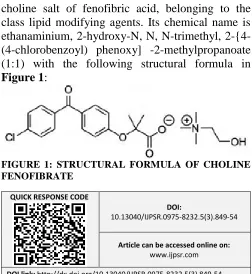
INTRODUCTION: Choline fenofibrate is a choline salt of fenofibric acid, belonging to the class lipid modifying agents. Its chemical name is ethanaminium, 2-hydroxy-N, N, N-trimethyl, 2-{4-(4-chlorobenzoyl) phenoxy] -2-methylpropanoate (1:1) with the following structural formula in
Figure 1:
FIGURE 1: STRUCTURAL FORMULA OF CHOLINE FENOFIBRATE
QUICK RESPONSE CODE
DOI:
10.13040/IJPSR.0975-8232.5(3).849-54
Article can be accessed online on:
www.ijpsr.com
DOI link: http://dx.doi.org/10.13040/IJPSR.0975-8232.5(3).849-54
The empirical formula is C22H28CINO5 and the
molecular weight is 421.91. Choline fenofibrate is freely soluble in water.
The melting point is approximately 210°C. Choline fenofibrate is a white to yellow crystalline powder, which is stable under ordinary conditions.
EXPERIMENTAL:
Chemicals and reagents: The reference sample
and API was a kind gift from MSN Labs,
Hyderabad,India.
HPLC grade water, methanol, acetonitrile were purchased from E. Merck Co., Mumbai, India, and
Potassium dihydrogen ortho phosphate,
dipotassium hydrogen, ortho phosphate AR grade were purchased from S D Fine Chem Limited, Mumbai, India.
Keywords:
RP-HPLC, Choline fenofibrate, delayed release tablets Correspondence to Author:
Dr. Prathima Srinivas
Sri Venkateshwara College of Pharmacy and Research Center, Madhapur, Hyderabad-8, Andhra Pradesh, India
[image:1.612.47.299.475.749.2]Apparatus and HPLC conditions: Shimadzu high-pressure liquid chromatography instrument
supplied with Inertsil ODS C18 column
(150x4.6mm; 5µ) with UV detector was used in the study.
1. Preparation of Buffer solution: 3.4gm of potassium dihydrogen ortho phosphate was dissolved in 1000mL MilliQ water, pH of this solution was adjusted to 2.5±0.05 with ortho phosphoric acid solution and was mixed well. This solution was then filtered through 0.45µ membrane filters.
2. Diluents: Diluent A: Water; Diluent B: Methanol: Water 80:20v/v
3. Mobile Phase: Mobile phase was prepared by mixing pH 2.5 buffer solutions and acetonitrile in the ratio 32:68v/v.
Sample Preparation:
1. Preparation of standard stock solution:
Accurately weighed 100mg of choline
Fenofibrate working standard was
transferred into a 100mL volumetric flask, to which 50mL of diluent B was added and
sonicated to dissolve the material
completely, then the volume was made up to 100mL using diluent B. 10mL of this solution was diluted to 100mL using diluent A (stock II).
2. Preparation of sample solution: Twenty tablets were finely crushed in a mortar pestle and 100mg equivalent weight of the powder was weighed into a 100mL volumetric flask. To this 50mL of diluent B was added and sonicated to dissolve the material completely. Then the volume was made upto 100mL using diluent B (stock I). 10mL of this solution was diluted to 100mL using diluent A and mixed well.
3. Calibration: Five different concentrations (18, 24, 30, 36 and 42μg/mL) of Choline fenofibrate solutions were prepared for linearity studies. The responses were measured as peak areas and plotted against concentration.
4. Estimation of Choline fenofibrate from tablet formulation: 10µL standard solution and the sample solution were injected separately into the chromatographic system and the area for the Choline fenofibrate peak was measured. The %Assay was
calculated by using the following formula.
Amount of Choline Fenofibrate present in the portion of tablet powder (% label claim) =
A2 W1 D1 TW --- x --- x --- x --- x P A1 D2 W2 LC
Where; A1= average area of standard preparation, A2= average area sample preparation, W1= weight of standard (mg), W2= weight of sample (mg), D1= dilution of standard solution, D2= dilution of sample solution, TW= average weight of tablets, LC=label claim, P= % purity of standard
5. System Suitability:
1) Tailing factor for the peak due to Choline
Fenofibrate in Standard solution should not be greater than 2.0.
2) Theoretical plates for the Choline
Fenofibrate peak in Standard solution should not less than 2500.
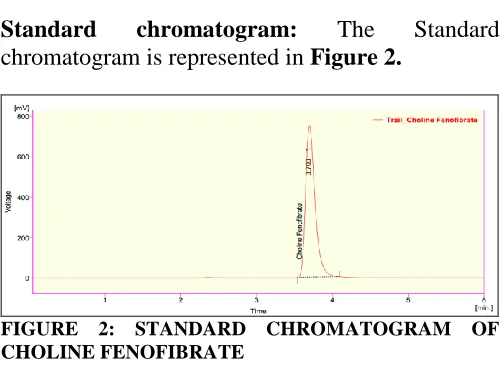
Standard chromatogram: The Standard
chromatogram is represented in Figure 2.
FIGURE 2: STANDARD CHROMATOGRAM OF CHOLINE FENOFIBRATE
Validation Parameters 3, 4, 5:
[image:2.612.314.564.426.610.2]2. Linearity: From stock solution 18µg/mL, 24µg/mL, 30µg/mL, 36µg/mL and 42µg/mL solutions were prepared and injected into the chromatographic system. A graph was plotted for peak area and concentration (on x-axis concentration and on y-axis peak area)
illustrated in figure 3. The correlation
coefficient value is mentioned in table 1. The
linearity chromatograms are represented in
figures 4-8.
TABLE 1: LINEARITY READINGS
Conc. (µg/mL) Area
18 812.57
24 1083.42
30 1354.28
36 1625.14
42 1896
Correlation coefficient (r2) 1.00
FIGURE 3: CALIBRATION CURVE OF CHOLINE FENOFIBRATE
FIGURE 4: LINEARITY SAMPLE 01- 18µg/mL
FIGURE 5: LINEARITY SAMPLE 02 - 24µg/mL
FIGURE 6: LINEARITY SAMPLE 03- 30µg/mL
FIGURE 7: LINEARITY SAMPLE 04- 36µg/mL
FIGURE 8: LINEARITY SAMPLE 05- 40µg/mL
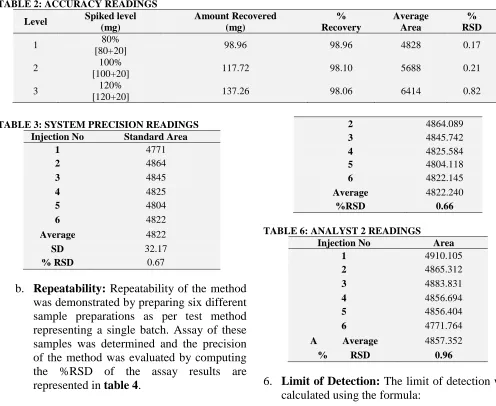
3. Accuracy: Accuracy -80%, Accuracy - 100% and Accuracy -120% solutions prepared using the standard stock solution and injected separately into the chromatographic system. The amount found and amount added for Choline fenofibrate and the individual recovery and mean recovery values were Calculated and
tabulated in Table 2.
4. Precision:
a. System Precision: System precision was evaluated by injecting standard solution six times and the %RSD was calculated and
TABLE 2: ACCURACY READINGS
Level Spiked level
(mg)
Amount Recovered (mg)
% Recovery
Average Area
% RSD
1 80%
[80+20] 98.96 98.96 4828 0.17
2 100%
[100+20] 117.72 98.10 5688 0.21
3 120%
[120+20] 137.26 98.06 6414 0.82
TABLE 3: SYSTEM PRECISION READINGS
Injection No Standard Area
1 4771
2 4864
3 4845
4 4825
5 4804
6 4822
Average 4822
SD 32.17
% RSD 0.67
b. Repeatability: Repeatability of the method was demonstrated by preparing six different sample preparations as per test method representing a single batch. Assay of these samples was determined and the precision of the method was evaluated by computing the %RSD of the assay results are
[image:4.612.280.547.48.424.2]represented in table 4.
TABLE 4:REPEATABILITY READINGS
Injection No. Standard Area
1 4910.10
2 4865.32
3 4883.83
4 4856.69
5 4856.40
6 4771.76
Average 4857.35
SD 46.63
% RSD 0.96
5. Intermediate Precision/ Ruggedness: To evaluate the ruggedness of the method, different analysts performed precision on different days. The values of the relative standard deviation of five replicate injections of the standard solutions were calculated and
represented in table 5 and 6.
TABLE 5: ANALYST 1 READINGS
Injection No Area
2 4864.089
3 4845.742
4 4825.584
5 4804.118
6 4822.145
Average 4822.240
%RSD 0.66
TABLE 6: ANALYST 2 READINGS
Injection No Area
1 4910.105
2 4865.312
3 4883.831
4 4856.694
5 4856.404
6 4771.764
A Average 4857.352
% RSD 0.96
6. Limit of Detection: The limit of detection was calculated using the formula:
LOD= 3.3* S.D/Slope
The slope and standard deviation (SD) values were calculated using the linearity graph and the limit of detection was found to be 2.40µg/mL.
7. Limit of Quantification: The limit of quantification was calculated using the formula:
LOQ = 10* S.D/Slope
The slope and standard deviation (SD) values were calculated using the linearity graph and the limit of quantification was found to be 7.28µg/mL.
8. Robustness: As part of the Robustness, deliberate changes were made in the Flow rate and wavelength to evaluate the impact on the method.
[image:4.612.47.293.446.700.2]was prepared and analyzed using the varied flow rates along with method flow rate.
b) The wavelength was varied from 298nm and
302nm. Standard solution 10 µ/mL was
prepared and analyzed using varied
wavelengths along with method wavelength.
When flow rate and wavelength were varied it was found that the method was not affected significantly. Hence it indicates that the method is robust even by change in the flow
rate (±0.2%) and wavelength (±2nm of λmax).
The results are represented in table 7.
TABLE 7: ROBUSTNESS READINGS
Condition Theoretical Plates (NLT 3000) Asymmetry (NMT 2.0)
Wavelength 298nm 4399 1.679
Wavelength 302nm 4439 1.786
Flow rate 1.3mL 4367 1.78
Flow rate 1.7mL 4048 1.56
9. Stability of solution and the mobile phase:
The solution stability of Choline fenofibrate was determined by leaving test solution and standard solutions in tightly capped volumetric flasks at room temperature for up to 48 hrs and measured the drug content at every 24 hrs against freshly prepared standard solution. The stability of the mobile phase was also determined by freshly prepared solutions of Choline fenofibrate at 24 hrs and for 48 hrs
interval. The mobile phase was not changed during the study. The variability in the estimation of drug content was within ± 10% during solution stability and mobile phase stability. The results from solution stability and mobile phase stability experiments confirmed that sample solution; standard solution and mobile phase were stable up to 48 hrs. The
results obtained are represented in Table 8.
TABLE 8: SOLUTION STABILITY READINGS
Time (hours)
Bench top stability Refrigerator stability Mobile phase stability
% Assay of Choline
Fenofibrate % Assay of Choline Fenofibrate
% Assay of Choline Fenofibrate
Initial 102 102 102
After 24 hours 102 102 102
After 48 hours 102 102 102
10.Forced degradation studies: Stress studies were performed using Choline fenofibrate 135 mg tablet to provide an indication of the stability-indicating property and specificity of proposed method. The stress conditions employed for degradation study included acid hydrolysis (1 N HCl at 60°C for 30 mins), base hydrolysis (1N NaOH at 60°C for 30 mins),
oxidation (10% H2O2 at room temperature for
24hrs), thermal (105°C for 30 mins), and
photolytic degradation (drug product exposed to UV radiation for 2 hrs).
11.Stability studies:
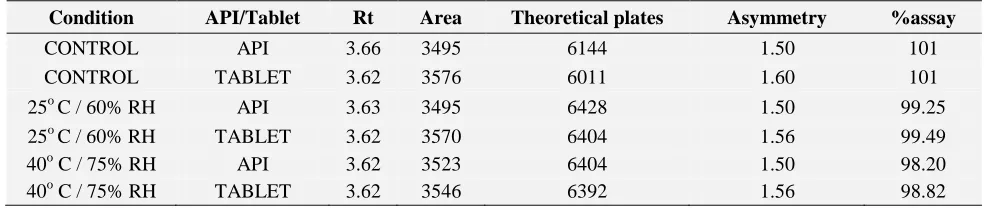
a. Accelerated stability studies: These were performed on both API and tablet dosage
form for 6 months under two conditions: 25oC
/ 60% RH and 40oC/75% RH. The results
[image:5.612.59.551.632.736.2]obtained at the end of the period are tabulated in table 9.
TABLE 9: ACCELERATED STABILITY STUDIES READINGS
Condition API/Tablet Rt Area Theoretical plates Asymmetry %assay
CONTROL API 3.66 3495 6144 1.50 101
CONTROL TABLET 3.62 3576 6011 1.60 101
25o C / 60% RH API 3.63 3495 6428 1.50 99.25
25o C / 60% RH TABLET 3.62 3570 6404 1.56 99.49
40o C / 75% RH API 3.62 3523 6404 1.50 98.20
RESULTS AND DISCUSSION:
System suitability results:
1) Tailing factor obtained from the standard
injection is 1.60
2) Theoretical Plates obtained from the
standard injection is 4266.
Assay Results: % Assay of Choline fenofibrate delayed release tablets = 100.9
DISCUSSION:
1. The diluent and excipients did not interfere
with the drug peaks and thus the method was specific. The HPLC chromatograms recorded for the diluent and drug matrix (mixture of the drug and excipients) showed no interfering peaks within retention time ranges.
2. The method was found to be linear in the range
of 18µg/mL, 24µg/mL, 30µg/mL, 36µg/mL and
42µg/mL concentration with r2=1.
3. The recovery results were in the range of
98-102%. The study proves that the method was accurate.
% Recovery at 80% level= 98.96, % RSD=0.17
% Recovery at 100% level= 98.10, % RSD=0.21
% Recovery at 120% level= 98.06, % RSD=0.82
4. The % RSD for six replicate standard injections
of Choline Fenofibrate during system precision was 0.67.
5. The % RSD for six replicate standard injections
of Choline Fenofibrate during repeatability was 0.96.
6. The %RSD of analyst 1 was 0.56 and analyst 2
was 0.69 during intermediate precision studies.
7. By changing flow rate and wavelength and the
method was found pass system suitability parameters.
8. The LOQ was found to be 2.40µg/mL and LOD
was 7.28µg/mL.
9. % Assay values are found between 98.0 and
102.0 and the results obtained meet the system suitability requirements, which indicate that the analyte solutions and mobile phase are stable up to 48 hours.
10. No degradation was observed under any stress
conditions and No interferences due to any degradation products were seen in the main peak.
11.The dosage form was found to be stable during
accelerated stability studies with acceptable assay % between 98-102.
CONCLUSIONS: A simple and efficient stability indicating RP-HPLC method was developed and validated for quantitative analysis of Choline fenofibrate in delayed release tablet dosage form. The method was found to be precise, accurate, linear, robust and rugged during validation. Satisfactory results were obtained from the validation of the method. Stability of the analyte solutions and mobile phase were found to be stable upto 48hrs and no significant change in %assay was observed during accelerated stability studies.
REFERENCES:
1. Choline Fenofibrate drug profile information available online at URL: http://www.amidrugs.com/choline-fenofibrate-856676-23-8.html
2. Choline Fenofibrate drug profile information available online at URL: http://www.rxlist.com/trilipix-drug.htm
3. ICH GUIDELINES Q2B Validation of analytical procedures: Methodology
4. ICH Q1A (R2), Stability Testing of new Drug Substances and Products.
5. ICH Q1B, Photostability testing on new drug substances and products.
All © 2013 are reserved by International Journal of Pharmaceutical Sciences and Research. This Journal licensed under a Creative Commons Attribution-NonCommercial-ShareAlike 3.0 Unported License.
This article can be downloaded to ANDROID OS based mobile. Scan QR Code using Code/Bar Scanner from your mobile. (Scanners are available on Google Playstore)
How to cite this article: