5859
INNOVATIVE PARADIGM OF EDUCATION
OF KNOWLEDGE –COMPETENCY FORM BASED ON
ONTOLOGY
1 KUBEKOV B.S., 2 BEYER D., 3UTEGENOVA А.U., 4 ZHAKSYBAEVA N.N.
1 Departmentof Computer and program engineering «Turan» university
2Germany – FH Schmalkalden University of Applied Sciences
3 Kazakh National Research Technical University named after K.I. Satpayev
4 Departmentof Computer and program engineering «Turan» university
E-mail: 1[email protected], 2[email protected], 3[email protected],
ABSTRACT
The article describes an innovative methodology for shaping educational components of a planned training, based on ontology of reference concepts of educational content and an algebraic model of knowledge mapping - expression of knowledge on the basis of which subjects of the foundation and major-specific courses curriculum should be designed. The main purpose of the proposed methodology is to create knowledgeable content of the semantic database to design teaching and methodological materials for courses curriculum.
Keywords: The Ontology Model, Characteristic Model, Concept, Specifying Concept, Consistency And
Variability, A Composition Relations, Aggregation Relations, An Alternative Choice Relations, The Concept Of Paradigm, Specification Of Knowledge Expressions, Graph Models..
1. PARADIGM SHIFT IN EDUCATION AND
FORMALISMS OF CONCEPT
MODELING
Paradigm of education (from the Greek paradeigma - an example, a sample) is the initial conceptual framework, a model of problem statement and their solutions in the field of education [1]. Paradigms of education are well established and generally accepted ideas, theories or doctrines that are practically used by all workers in the field of education while organizing study and training processes or in the education management. Each educational paradigm is executed through its goals,
principles, content and its corresponding
technologies. The shift in paradigms is linked to the modification or change in thinking and viewpoints among the absolute majority of workers in the field of education.
Transition to a new education paradigm requires from higher education not only the reproductive data transfer from a teacher to a student, but also development of progressive learning activities. The innovation of the proposing methodology is that
organization and presentation of learning
information are associated with the competence models of each of the stages of the CDIO engineering education environment, based on project training with application of ontological engineering, whereas the significance of the technique lies in enhancing the cognitive ability of students.
The term of paradigm in the modern designing of software systems designates a way of constructing systemic abstractions based on the properties of commonality and variability. Under the paradigm of education we will understand the basic model of a specific way of organizing of learning information, based on the properties of commonality and variability and as a whole as the leading approach for choice of content, forms of organization of education and ways of teaching and training.
5860 Leading engineering schools and technical universities of the United States, Canada, Europe, the United Kingdom, Africa, Asia and New Zealand (more than 40 universities in 20 countries around the world) participate in the joint "CDIO Global Initiative" project since 2002. The CDIO program proceeds from the principle that the establishment and development of products and systems throughout their life cycle creates necessary context of engineering education.
CDIO builds an environment of engineering education in which technical knowledge and practical skills are taught, learned and applied in practice. Future engineers should be able to "Conceive - Design - Implement", and also "Operate" complex products and systems in contemporary conditions and work as a team in order to obtain added value. During the training they must learn to manage engineering processes, design and create products and systems and to apply gained knowledge by working in industrial organizations.
Educational technologies are based on recent up-to-date advances in information technology, on attraction of engineering knowledge and in particular ontological engineering. Despite the existence of flexible and diverse methods and tools of education technologies, substantial efforts will be required to develop methods for organizing and presenting knowledge and designing of educational resources, which would ensure a full use of wide range of pedagogical, educational and information technologies within a single educational paradigm framework.
Traditionally, the most frequently used forms of knowledge mapping are production, network, framing, algebraic models, graphs and sets. In this line, in our opinion, an object-oriented paradigm suitable as a reasonable form for presenting teaching models and educational resources, this has a large set of possibilities for modeling, designing and visualizing educational resources, as well as tools for modeling properties and mechanisms for their interaction.
Let us consider the possibility of presenting of educational resources by using the ontology and a characteristic model.
The ontology defines the conceptualization, which underlies the formalism of knowledge presentation. Whereas, modeling of characteristics is the main technique for identifying and fixing the commonality and variability on ontology concepts and properties of characteristics, which makes it
possible to develop reusable educational
components to design learning courses, as well as
for adaptation of curriculum to the required professional competencies of a graduate [2,3].
Educational systems should be flexible and adaptable on the account of analysis and implementation of abstractions of commonality and variability of educational resources and resources, which imposes a certain responsibility on the selection of such abstractions, which will remain unchanged in time and adaptable to new conditions and requirements. Such stability is more relevant to the abstractions of general educational course curriculum, partially to basic courses and in a greater extent, variability will be more relevant for the abstractions of the study of major-specific courses. Therefore, when planning educational process, it is necessary to stress primarily on major-specific courses and on knowledge of what changes will be introduced to the requirements of professional competencies of a graduate in future.
The application of ontology and characteristic models for learning requires firstly, conduction of analysis of the structure and organization of content of the educational material of courses. Secondly, the creation of visual-mental images, that is, associatively related structures of the concepts of the educational material, which represent an integral system of knowledge both within the framework of a separate discipline, course or a subject area as a whole. Thirdly, the use of practice-oriented learning mechanisms, which contribute to the acquisition of skills and abilities by the trainees [4].
The process of ontology building begins with the definition of basic abstractions of a subject field - reference concepts that make up the semantic knowledge of the subject area, where each of them is identified by a set of specifying concepts. Visually, the ontology of the reference concept is represented by a conceptual graph.
If the ontology is used to present and organize knowledge of the subject field, then the properties of commonality and variability of concepts of the ontology are described by using the characteristic model.
Proposed below knowledge presentation rules are based on the following concepts [2]:
1) Semantic knowledge or in other words semantic content of educational tools and learning resources can be identified by an arbitrary set of reference and only reference concepts of the subject field.
5861
"benchmarks" with the help of which
systematization of knowledge takes place. At the same time, concepts are subjective since their semantics are determined by the context in which they were used.
3) Ontology is a detailed specification of the conceptual (terminological) structure of the subject area. The main purpose of the ontology is to define the formal semantics of knowledge in order to process it, which allows based on common terminology to connect the possibility of computerized processing of information with convenient forms of its storage and presentation for human perception.
4) The ontology is defined as a triple of sets: Om = <C, R, M>, where C is the set of concepts or terms of the subject area; R is the set of relations between concepts; M – mechanisms, by which interpretation of a set of functions is performed, defined on concepts and relations in ontology. Ontology, therefore, is a hierarchical structure of the concepts of the subject area.
5) The parental concept is a product of abstraction, that is, an abstract component of general nature that expresses commonality for all its child concepts.
6) A copy of the parental concept will be considered a finite set of specifying concepts in ontology related to each other by the relationships "Composition", "Aggregation" and "Alternative choice", by means of which a semantic identity with the parental concept is carried out.
7) Visually, the ontology can be represented by an approximate graph G, vertices of which are concepts, and the edges are the relationships between them. The root vertex of a graph is a reference concept of a subject area, the identification of which is limited to no more than two levels of child concepts of the hierarchy, in which any optional specifying concept is a hanging vertex, that is, the vertex that does not have its own specifying child concepts.
8) Semantic knowledge of the subject area is represented by sets of necessary and sufficient set of reference concepts of the subject area and each of them is subject to identification by child concepts.
9) To systematize specific concepts, the "semantic identity" category is used, which is defined by the following relationships:
- "Composition" relationship - the relation in which such property as commonality for the child concept is reflected and the presence of the child concept in all parental concept copies is mandatory;
- "Aggregation" relationship - the relation in which the property of variability for the child concept is reflected and the presence of the child concept in parental concept copies is optional;
- "Alternative choice" relationship - the relation in which the property of alternative choice of a child concept is reflected and its presence in parental concept copies is optional.
Identification and specification semantics of the listed relationships will be explained with the aid of specially developed notation based on the algebraic
model of knowledge presentation and
representations in the form of knowledge expression.
Semantics of identification and specification of the "Composition"
Relationship
We believe that the "Composition" relationship generates a set of obligatory specifying child concepts of the parental concept, provided that the latter is an obligatory concept of the subject area.
Let Ci be the reference concept of the subject area, then Ci, as a composition of specifying concepts can be represented by the following knowledge expression:
Ci <= * Ci1 * Ci2 ... * Cik; (1)
Where the symbol '*' before the specifying concept Cij shows its mandatory use to identify the reference concept Ci, whereas the symbol '<=' denotes implication relationship in which the set of specifying concepts Ci1, Ci2, ..., Cik entails the identification of the reference concept Ci. Implication therefore is associated with causality.
The semantics of identification and specification of the "Aggregation" relationship
The "Aggregation" relationship is a combination of mandatory and optional child concepts or a set of optional child concepts of the parental concept, provided that the latter is an obligatory concept of the subject area. If the parental concept is optional, then it cannot undergo to further specification, which is also true for any specifying concept.
5862 Ci <= + Ci1 + Ci2 ... + Cik; (2)
Where the symbol '+' indicates the optionality of the specifying concept for the identification of the concept Ci.
The semantics of identification and specification of the "Alternative choice" relationship
The "Alternative Choice" relationship is defined for mandatory or for a combination of mandatory and optional or only for optional child concepts of the parental concept, provided that the parent concept is an obligatory concept of the subject area. Let Ci be the reference concept of the subject area, then the identification of Ci through the alternative choice relationship can be displayed by one of the following knowledge expressions:
Ci <= * Ci1 ~ + Ci2; either Ci <= * Ci1 ~ * Ci2; or Ci <= + Ci1 ~ + Ci2; (3)
Where the symbol ‘~’- tilde indicates the possibility of the alternative choice of the mandatory Ci1, or an optional specifying concept of Ci2, or the possibility of alternative choice of the mandatory Ci1, or the mandatory specifying concept of Ci2, or the possibility of an alternative choice of an optional Ci1, or an optional specifying concept of Ci2.
For the case of two specifying concepts possible alternative sets will be: (Ci1), (Ci2), (Ci1, Ci2).
Suppose that some semantic knowledge is defined from the necessary and sufficient set of reference concepts C1, C2, ... Ci ... CN, in which copies of any of reference concepts will be the permissible sets of specifying child concepts.
Using the introduced relationships, let us consider the following examples of possible cases of identification of the reference concept of Ci and its representations in the form of knowledge expression.
1) Knowledge expression Ci <= * Ci1 * Ci2 * Ci3; in which the reference concept Ci is identified by a composition of three mandatory child concepts.
2) Knowledge expression Ci <= + Ci1 + Ci2 + Ci3; in which the reference concept Ci is identified by an aggregation of three optional child concepts.
3) Knowledge expression Ci <= * Ci1 * Ci2 + Ci3; in which the reference concept Ci is identified
by a composition of two mandatory and aggregation of one optional child concept.
4) Knowledge expression Ci <= * Ci1 * Ci2 ~ + Ci3; in which the reference concept Ci is identified by a composition of two mandatory and aggregation of one optional child concept but for the mandatory concept of Ci2 and the optional concept Ci3, there is an alternative to choose.
5) Knowledge expression Ci <= + Ci1 ~ + Ci2 + Ci3; in which the reference concept Ci is identified by aggregation of three optional child concepts, and for the optional concepts Ci1 and Ci2, there is an alternative to choose.
6) Knowledge expression Ci <= * Ci1 * Ci2 ~ * Ci3; in which the reference concept Ci is identified by a composition of three mandatory child concepts, and for the mandatory concepts Ci2 and Ci3 there is an alternative to choose.
7) Knowledge expression Ci <= * Ci1 (* C1 + C2) * Ci2; in which the reference concept Ci is identified by a composition of two mandatory Ci1 and Ci2 child concepts, where the mandatory concept Ci1 has its own level of identification, as the composition of the mandatory child concept C1 and aggregation of an optional child concept C2, the semantics of which are defined by the context of the concept Ci1.
8) Knowledge expression Ci <= * Ci1 (* C1 ~ + C2) + Ci3; in which the reference concept Ci is identified by the composition from mandatory Ci1 and aggregation of optional Ci3 child concepts and besides, the mandatory concept Ci1 has its own identification level as an alternative choice of the mandatory C1, or the optional C2 concept.
The given examples of identification of the reference concept Ci represent hierarchical structures from the specifying concepts of the first and second levels, the relationships between the concepts of which allow to:
- carry out the analysis of the subject area with the purpose of determining semantic knowledge and their representations by sets of reference concepts;
- identify reference concepts by the structures of the specifying concepts of the subject area and specify them by commonality and variability properties;
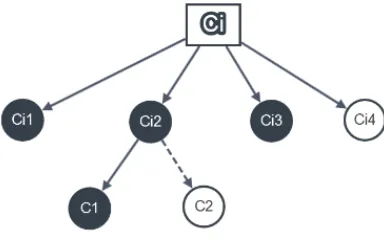
5863 Figure 1 shows an example of the ontology of Ci reference concept, which is identified by the concepts of the first level - Ci1, Ci2, Ci3 and Ci4, from which Ci2 defines the context of the second level concepts - C1, C2.
Figure 1. Conceptual Graph Of The Ontology Of Ci Reference Concept
The expression of knowledge of the reference concept of Ci has the form:
Ci <= * Ci1 * Ci2 (* C1 ~ + C2) * Ci3 + Ci4; (4)
where symbol '~' – tilde, in the expression of knowledge determines the "Alternative choice" relationship for the specifying concepts of second level C1 and C2. For building conceptual graphs Cytoscape.js network library was used, in which mandatory concept is represented by a black circle, optional is not shaded, and the "Alternative choice" relationship is represented by a dotted arrow.
2. CDIO AND
COMPETENCE-KNOWLEDGEABLE FORMAT OF
PRESENTATION OF EDUCATIONAL COMPONENTS
The Global CDIO Initiative is a project-oriented learning technology, which is student-centered and integrated with problems and experiences of actual production. Education, organized by using of CDIO approach is based on construction of basic technical knowledge in the context of planning, designing, production and application of processes and technologies of development of engineering facilities, processes and systems. The project approach and the stages of the worldwide CDIO initiative should be considered as the context of the
educational environment, which facilitates
acquiring the knowledge, skills and practical skills
for the professional engineering degree of a learner. Within the framework of such an educational environment, an integrated approach should be formed to identify student's educational needs and develop a sequence of training activities aimed at their satisfaction. Mastering certain levels of competencies by a student is considered as the ability to use and combine knowledge and skills depending on the changing requirements of a particular situation or problem. Thus, competency is an integrated concept and expresses a student's ability to apply independently various elements of knowledge and skills in a certain professional context. The level of independence is of particular importance, as it exactly allows to differentiate between different levels of competencies.
Comprehensive technology of identifying of
educational needs, training activities and
educational resources are the basis for planned studying, so called CDIO Syllabus.
CDIO Syllabus uses CDIO Standards in which specific learning outcomes are presented in the form of detailed list of competencies or qualification requirements of an engineer. The list of planned learning outcomes, in the light of the qualification requirements for graduates, is determined by the results of the analysis of needs and the conduction of expertise of engineering programs users.
Developed in that way the required learning outcomes are therefore serve as the basis for determining the learning objectives, modeling and subsequent design of educational programs, for learning process and evaluating students’ achievements.
To model the educational trajectory of a student in accordance with the required competencies, it is necessary to have educational knowledgeable components in the format of ontologies and expressions of knowledge.
To construct educational knowledgeable
components of courses in the "Computer Science and Software" degree the followings were adopted:
- SWEBOK core knowledge concept - the IEEE regulatory document in the field of software engineering,
5864 - concept of ontological engineering,
- concepts of representation and organization of knowledge based on ontology
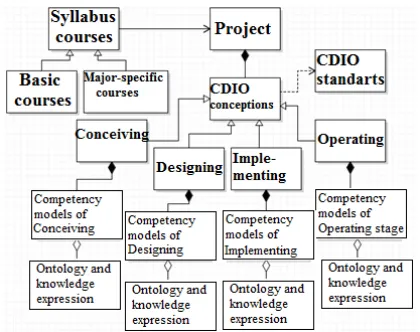
[image:6.612.89.299.218.384.2]All these concepts have formed the basis for the adaptive educational environment developed for these purposes [5], main system components of which with consideration of syntax of the UML notation are presented in Figure 2.
Figure 2. The Main System Components Of The Educational Environment
3. EXAMPLES OF CONSTRUCTING OF SEMANTIC KNOWLEDGE OF THE DISCIPLINE
"Distributed Applications Development
Technology"
To demonstrate introduced formalisms on organization of ontologies and their specification by expressions of knowledge, let us consider "The Client-server Model Banking System" project [6] and the stage of Conceiving, the first of four stages of the CDIO initiative to develop this project. Within the framework of the Conceiving stage, we will form competency models, present them with the corresponding ontologies and expressions of knowledge. Ontology and the corresponding expression of knowledge will form the educational component. All educational components of all stages of the CDIO initiative formed in this way will have to be used to design "Distributed Applications Development Technology" course in "Computer Science and Software" degree.
At the "Conceiving - Idea" stage, a market research takes place to seek if there is a need for engineering products and the possibilities for its satisfaction, audit of the project's subject area, vision development of the future system and its functionality; defining of technology and the upper level of the architecture of the system, planning production of products (technologies, technical objects, systems and technological processes), compiling conceptual, technical and business plans;
project management of development and
production of products, labor costs evaluation and project budget correction for the system design.
To obtain specifications for software artifacts the analysis of requirements for technical specification is carried out, a meaningful statement of the problem is formulated, conceptual models of the subject area and user interface are selected, subtasks and methods to accomplish them are defined. In the Conceiving phase it is also advisable to generate tests to search for errors in the software being designed with mandatory indication of the expected results.
A competency model of the CDIO stage is a set of reference concepts of professional, basic and
additional competencies, which determine
necessary and sufficient level of semantic knowledge required for development of distributed application software.
For professional competencies of the Conceiving stage seven reference concepts were identified, each of them is identified by the ontology of the specifying concepts of the first and second levels and is specified by the expression of knowledge.
For instance, let us take the reference concept C1 - Requirements engineering, and specify it with the following concepts of the first and second levels:
* С11 - levels of requirements for the application: + С1 - business requirements; ~ + C2 - document - concept; * С3- functional requirements; * C4-non-functional requirements; + С5 - reverse requirements.
* С12 - model of system precedents: * С1 - abstract precedent; * C2 is a concrete precedent; * C3-relationship between use cases.
* С13 - the scenario of events: * С1 - the specification of a precedent; + C2 - data flows diagram; ~ + C3 state transition diagram; ~ + C4 - "event-response" table.
5865 After defining the ontologies of reference concepts of the professional competencies of the Conceiving stage, we specify ontologies in the form of knowledge expressions. For the chosen C1 reference concept, the expression of knowledge will have the following form:
C1 <= * C11 (+ C1 ~ + C2 * C3 * C4 + C5) * C12 (* C1 * C2 * C3) * C13 (* C1 + C2 ~ + C3 ~ + C4) + C14; (5)
[image:7.612.316.528.113.205.2]and visually as an oriented graph, as shown in Figure 3.
Figure 3. Conceptual Graph Of The C1 Reference Concept - Requirements Engineering
The same procedure takes place for reference concepts of the basic and additional competencies of the competency model of the Conceiving stage.
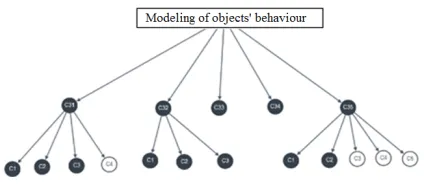
For example, let us consider reference concept C3 - Modeling the objects’ behavior of basic competencies and specify it with concepts of the first and second levels:
* С31 - a diagram of precedents: * С1-relationship -Include; * С2 - С1-relationship -Extend; * С3 – relationship - Generalization; + C4 relationship -Cooperation.
* С32 - interaction diagram: * С1 - sequence diagram; * С2 - cooperation diagram; * С3 – parallel cooperation diagram.
* С33 - conditions diagram. * С34 - time chart.
* С35 - activity diagram: * С1 - activity and action, * С2 - initial and final states, + С3 - objects and streams of objects; + C4 - branching and consolidation of control flows, + C5 - signals.
Expression of knowledge of C3 reference concept can be written as follows:
C3 <= * C31 (* C1 * C2 * C3 + C4) * C32 (* C1 * C2 * C3) * C33 * C34 * C35 (* C1 * C2 + C3 + C4 + C5); (6)
and the conceptual graph is shown in Figure 4.
Figure 4. Conceptual Graph Reference Concept C3 - Modeling Behavior Of Objects
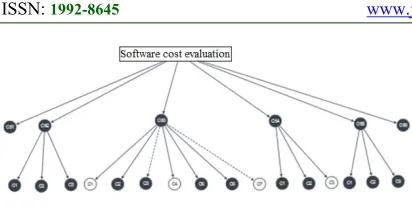
Finally, we will consider an example of reference concept of C5 – Software cost estimation of additional competencies. We specify C5 reference concept with concepts of the first and second levels:
* С51 - parameters of the project evaluation for software development;
* С52 - productivity evaluation: * С1 - the size indicator; * С2 - the functional indicator; * С3 - method of object points.
* С53 – prime cost estimation: + С1 - method of algorithmic modeling of prime cost; * С2 - method of expert evaluation; ~ * C3 - method of evaluation by analogy; + C4 - Parkinson's law; * С5 – price nominating method to win the project; * С6 - top-down approach of preliminary estimation of prime cost; ~ + C7 is a bottom-up approach to the preliminary estimation of prime cost.
* С54 - COCOMO: * С1 - level of preliminary prototyping; * C2 - the level of preliminary design; + С3 - post-architectural level.
* С55 - algorithmic cost models in project planning: * С1 - cost of target hardware; * С2 - the cost of the platform; * С3 - the cost of system development.
* С56 – schedule of project implementation and hiring of personnel.
Expression of knowledge of reference concept of C5 can be written as follows:
C5 ˂=* C51 * C52 (* C1 * C2 * C3) * C53 (+C1 * C2 ~ * C3 + C4 * C5 * C6~ + C7) * C54 (* C1 *
C2 + C3) * C55 (* C1 * C2 * C3) * C56; (7)
[image:7.612.92.293.260.326.2]5866
Figure 5. Conceptual Graph Of Reference Concept C5 – Software Project Cost Estimation
For all describes examples of reference concepts of professional, basic and additional competencies of the competency model of the Conceiving stage, three algebraic models and their representations are represented by knowledge expressions. They are educational components of being planned study CDIO Syllabus and along with other educational components of the remaining three stages of the CDIO initiative, will have to be used to Design
"Distributed Applications Development
Technology" course.
Thus, by using the example of "Distributed Applications Development Technology" course this article describes the methodology of constructing of educational components of being planned training, which incorporates necessary and sufficient knowledge in order for students to complete all business operations to develop “The Client-server Model Banking System” project. For reference concepts of professional, basic and additional competencies of the competency model of the Conceiving stage, the expressions of knowledge were presented, which make up the semantic database of being planned study CDIO Syllabus.
The main goal of the proposed methodology is to create knowledgeable content of the semantic database to design teaching and methodological materials for course curriculum. At the same time, the semantic database of professional competencies is intended to design major-specific courses, whereas the semantic database of basic and additional competencies is for designing basic subjects of the course.
All concepts and provisions of the proposed methodology were implemented in the form of web application on ASP.NET MVC Web Application platform, the target framework .NET Framework 4.6.1. Also, Entity Framework v6.1.3; JQuery v2.1.4; Bootstrap v3.3.7; Newthonsoft. Json v6.0.3; Microsoft. Owin v3.0.1; CytoscapeJS v2.7.1 technologies were used. The template was shaped based on the UBold Dashboard, HTML5 and CSS3
templates. The database has been developed using Microsoft SQL Server Express 2016.
4 BACKGROUND TO THE DEVELOPMENT OF THE PROJECT, THE RATIONALE OF SCIENTIFIC NOVELTY
- The necessity of transition to the autonomy of educational institutions in the planning of curricula and the formation of individual learning paths
- The need for flexible learning from the perspective of the relationship between individual and organizational goals of the institution and the requirements of the labor market;
- The necessity of transition to innovative formats of knowledge presentation and organization, in particular, the use of ontological approach and appropriate models knowledge display;
- The necessity of application of the concepts and standards of the Worldwide CDIO initiative in engineering education;
- The need for rapid content updates of educational content in accordance with the new trends and changes in the development of Computer science and information technology;
- The need to improve managerial mechanism due to the proactive planning and implementation of educational programs and processes;
- The necessity of transition to Smart-learning paradigm as a fundamentally new educational environment that unites teachers, students and knowledge, and involving the transfer of the intelligence and experience of the teacher in the environment of e-learning that will enhance mobility and quality of educational services and products.
5 THE PROJECT IMPORTANCE IN
NATIONAL AND INTERNATIONAL
SCALE
5867 approach and strengthening the cognitive abilities of students. New educational content based on ontologies of concepts that will allow students to acquire skills and knowledge in accordance with the competence-based model and teacher to develop an individual approach for each student through elective disciplines.
The President Of The Republic Of Kazakhstan N.. Nazarbayev in "Strategy "Kazakhstan - 2050": New political course of the established state" outlined the following priorities in education: "We expect to implement modernization of teaching methods and actively develop online education systems creating regional school centers... We should intensively introduce innovative methods solutions and tools in a domestic education system, including distance learning and training online, accessible to everyone.., to change the direction and emphasis of curricula of secondary and higher education, having included there programs on training in practical skills and gaining practical qualifications..."
6 THE IMPACT OF THE RESULTS ON THE
DEVELOPMENT OF SCIENCE AND
TECHNOLOGY AND THE EXPECTED SOCIAL AND ECONOMIC EFFECT
The above tasks and the results obtained for the modernization of traditional educational programs and processes under these premises the project will have a corresponding impact on the development of steps to reform education in the Republic of Kazakhstan.
Expected social effect will be possible massive introduction of intelligent information-educational environment and tools Smart-technologies in educational institutions for the new (network) generation, but also in a qualitative change in the content of education, its methods and tools.
In addition to social effect, the expected result will contribute to the mobility curriculums of universities for related professions, presenting equal opportunities for student learning regardless of time and place, possibility of realization of the continuity of the educational process and the integrity of educational information.
7 EXPECTED RESULTS
1) The expected scientific and socio-economic effect: New methods of ontological engineering
learning content on the formation of a knowledge component for the design disciplines and the curriculum of the specialty are supposed to be introduced in the management field of educational programs and processes. To offer new tools and methods of Smart-learning, in accordance with the competency models of the stages of CDIO and project method of learning for educational institutions of Kazakhstan.
2) ) To justify the necessity of the educational
changing process nature in favor of
individualization of learning and application tools of Smart technology.
3) The applicability of the research results: it is planned to spread the results and recommendations of the project to change the structure of educational institutions and trends in the organization of the educational process, with the aim of introducing a new level of quality of educational services and products.
4) The results target consumers: the Project aims to use various educational organizations for optimal formation of educational plans and programs, with the aim of improving the evaluation of the potential of the studied group, revealing narrow and critical sides.
5) Opportunities for breakthrough results that contain risks; influence on the development of science and technology: In education, we plan transition to the new educational paradigm of representation and organization of knowledge in the improvement of the managerial mechanism by proactively planning and implementing educational programs and processes available to a wide range of educational institutions of the Republic of Kazakhstan.
6) Results dissemination among potential users, communities, scientists and the general public: it is assumed that the final project design will be developed in a common and standard form, that should not cause difficulties in the learning and usage by the teachers and students, and will be
contributed to the development of the
5868
8. CONCLUSION
The possibility of generation of a family of reusable educational components using paradigms of representation and organization of knowledge, based on modern concepts and tools in education and information technology. Definitions of knowledge models - ontology concepts and characteristics; Model Specification knowledge and expressions of knowledge by means of language specifications and the graph model. The possibility of representation of the concepts of educational
information using ontology models and
characteristic patterns. The possibility of
representation of the concepts of educational
information using ontologies and models
modeley.Na characteristic example of the analysis of educational content opening theme of discipline " Programming Technology " shows the features of the application of the conceptual model of knowledge for the formalization of concepts of educational content and its visualization by means of interpreting language and graph model .
REFRENCES:
[1] Shmyreva N.A., Gubanova M.I., Kretsan Z.V. Pedagogical systems: scientific foundations,
management, development prospective. -
Kemerovo, 2002. p. 99.
[2] Kubekov Bulat, Kuandykova Janna,
Utepbergenov Irbulat, Utegenova Anar.
Applying of the conceptual model of knowledge for the formalization of concepts of educational content. 9th International Conference "Applying of information and communication technologies-AICT2015", Rostov-on-Don, Russia, 14-16 October 2015. pp. 588-594.
[3] Kubekov Bulat, Utegenova Anar, Naumenko Vitaliy. Applying of ontological engineering to represent knowledge and training sessions. 10th International Conference on Application of Information and Communication Technologies -AICT2016, Baku (Azerbaijan), 12-14 October 2016, pp.115-118.
[4] Kubekov B.. Educational components formation technology for the planned CDIO SYLLABUS education. 9th annual International Conference of Education, Research and Innovation - ICERI2016, Seville (Spain), 14-16 November, 2016, pp. 6139-6145.
[5] Kubekov BS, Utegenova AU PhD student, Antonov A.V student. Ontological approach in a being planned training. Materials of the fifteenth open All Russian conference "Teaching Information Technologies in the Russian Federation", May 11-13, 2017. Arkhangelsk, Northern (Arctic) Federal University. Moscow State University named after Lomonosov M.V. [6] Goma H. UML. Designing Systems of
Real-time, Parallel and Distributed Applications. М.: DMK Press, 2014.-pp.704 .