7253
WHY DO PEOPLE HAVE SELF-DISCLOSURE ON SNS?
BASED ON FEATURES OF SOCIAL MEDIA
1SAE BOM LEE, 2SEOKHUN KIM
1Reserarch Professor. Kyung Hee University, Big Data Research Center, South Korea
2Professor. Bai Chai University, Department of Electronic Commerce, South Korea
E-mail: 1[email protected], 2[email protected](Corresponding Author)
ABSTRACT
Social media is an open online platform that allows individuals to share their thoughts, opinions, experiences, and information on social network based on the advent of the era of Web 2.0 and to create or expand relationship with others. Social Network services is also included in social media. This study aims to identify why people use SNS for Facebook. The purpose of this study is to understand why people use social networking through the characteristics of social media. Finally, we analyze 287 data by structural equation model and use AMOS 18.0 for analysis. As a result, two of the six hypotheses were rejected and four hypotheses were adopted. Users are posing posts on Facebook and self-disclosure them for communication others and their identity. Thus, users are using Facebook in order to share various information. There are implications that the reasons for using Facebook by an empirical test. Therefore, Facebook will have to try to make it a space where users can communicate more effectively and establish their identity.
Keywords: Social Media, Social Network Service, Self-Disclosure, Communication, Satisfaction
1. INTRODUCTION
“Social Network Services (SNS or social media) is an online platform that people use to build social networks or social relations with others people who share similar personal or career interests, activities, backgrounds or real-time connections” [1, 2]. SNS for modern people is expanding the scope of narrow relationship. Many people are enjoying a space where they can make connections with strangers and exchange various information. 88.5% of internet users use Facebook in Korea [3]. However, the number of users who have run apps at least once a month is stagnant. Some individual users are becoming increasingly reluctant to use SNS as their privacy is exposed to an unspecified number of people and frequent exchanges with unwanted counterparts.
SNS is increasing not only for individuals but also for companies, because SNS can communicate directly with customers, such as being able to publicize companies with low cost. Facebook also increased its value and sales on Facebook due to corporate involvement. However, if Facebook users are no longer using Facebook, it will be a blow to businesses as well as Facebook. Therefore, it is
important to create postings by individuals on Facebook.
According to Lin et al [4], “broadcast status updates / posts on social media that contain some form of information can be treated as self-disclosure”. Self-disclosure means that individuals upload not only photos and videos, but also their thoughts and opinions through the post on the Facebook. In order for SNS to continue to grow, it is essential that users to write their posts in SNS.
7254
2. THEORETICAL BACKGROUD AND HYPOTHESES
2.1 Social Networking Service
In the SNS terminology, the meaning of social is from the English word ‘society’ and is interpreted as ‘people are gathered’, and the meaning of network means that the network where people are gathered by a series of relations. Therefore, a social network, which is a combination of the two, can explain its meaning as 'the network to which people are connected'.
SNS refers to the fact that the concept of social relations has been transferred into a virtual space called to internet. These services supports the networking or all possible people in the offline space, enabling them to from relationships online, making it easier and quicker to express individuals, allowing more people to connect through time and place. Social media is an open and communicative medium led by the general public, as opposed to mass media, which is represented by existing newspapers and broadcasting. According to Jung [6], among social media categories, SNS is an online networking service that supports the formation of a more active human network that transcends time and space by implementing existing social relationships online.
SNSs have expanded to provide services to millions of people around the world. SNSs are support a wide range of interests and practices. SNS allow individuals to make a profile to share photos, personal information, opinions and join groups of friends [7 -8]. SNS have become one of the most popular means of online social interaction and emotion sharing and sites consider continued use of essential for their long-term success [9].
People have various reasons for using SNS are followings. First, users can used some service for blogging or sharing content and media [10]. Second, many SNSs allow users to join or create groups that they can interact with other users who have similar interests [11]. Third, SNSs provide ways to maintain contact with users’ friends, but also for meeting new people [12].
2.2 Self-Disclosure
Self-disclosure refers to the act of revealing one’s identity and position and showing oneself to others, it means to let others know about oneself [13]. Lee et al [14] stated that using SNS is similar to exposing information related to oneself, and it is
necessary to expose oneself in order to make an active relationship and to share information. Self-disclosure is the voluntary and intentional behavior performed by an individual’s subjective judgment [15].
This study defined self-disclosure as ‘the intention to expose meaningful information and express personal life on Facebook’. As individuals expose their daily life, the more likely they are using Facebook. Public self-disclosure on SNS have some unique properties compared to self- disclosure in offline one-to-one communication. First, public self-disclosure is often not directed to a single person, but simultaneously to several people [16]. Second, public self-disclosure made by a specific person is often included in the flow of information of others [17].
Although not initially, Facebook is now almost a feast for links and comments. Most postings are meaningless posts, or most of the advertising. These posts are also things from people who are connected with users get from somewhere or shared.
Recently, on Facebook, it seems that some individuals are not just a content creator, but a content-spreader (not even knowing if information is true or not). It has become a space for to share meaningless photos, videos, and information. Also, many ads are being shared as posts. Some users only produce contents, and other users do not act as content producers on Facebook. For companies that operate social media, this can be a threat. Users do not produce contents means that there is less use of social media or SNS.
Recent researches of self-disclosure have explored how online communities can develop user confidence and self-disclosure. Posey et al [18] developed self-disclosure models in online communities. They studied the effects of social influence, social benefits, social costs and reciprocity on self-disclosure. Nevertheless, there are insufficient research on self-disclosure intention in SNS. Therefore, this study intends to understand the behavior of users in the SNS by using self-disclosure intention as a dependent variable.
2.3 Satisfaction
7255 relationship [19]. Customer satisfaction is studied as important variables explaining customer’s intention to use and repurchase intention in management information and marketing research [20,21]. Satisfaction means satisfying the customer’s expectation level that is higher than the predetermined level in the achievement response by the customer’s subjective evaluation about the degree of meeting the needs and desires of the customers [20].
In this study, we defined the satisfaction as the user’s subjective evaluation about the degree of meeting the needs and desires of users. According to previous researches, the subjective wellbeing or happiness that refers to the optimal psychological experience increases the royalty, such as intentional revisit of SNS [22]. Main motivation for using SNS are passing time and entertainment and their satisfaction. These are related to the level of self-disclosure [22, 23]. Therefore, there is high possibility that satisfaction from the use of SNS affects the SNS self-disclosure.
H 1: User satisfaction will have a positive effect on self-disclosure intention.
2.4 Features of Social Media
There is little theoretical discussion on how the factors related to the characteristics of online media such as media usage motivation and online privacy affect the process of online self-disclosure. We tried to figure out which features of Facebook were satisfying by users in order to confirm their self-disclosure intention. We used seven functional features of social media [24].
The characteristics are as follows [24, 25]. First, the identity represents “the extent to which users reveal their identities in a social media”. User identity expression can often occur through conscious or unconscious self-disclosure of subjective information such as thoughts, feelings, likes and dislikes [25]. Second, the conversation represents “the extent to which users communicate with other users in a social media”. Third, sharing represents “the extent to which users exchange, distribute, and receive content”. Social media made up of people who are connected by shared object such as text, video, picture, sound, link, location and etc. Fourth, the presence represents “the extent to which users can know if other users are accessible”. Fifth, the relationships represent “the
extent to which users can be related to other users”. How users of social media platforms are connected determines how information is exchanged. Sixth,
reputation represents “the extent to which users can identify the standing of others, including themselves, in a social media”. Finally, the groups are “the extent to which users can form communities and sub-communities” [24]. Therefore, the following hypotheses were set.
H 2: User identity will positively affect the satisfaction of SNS.
H 3: Information sharing will positively affect the satisfaction of SNS.
H 4: Social relationship will positively affect the satisfaction of SNS.
H 5: Reputation will positively affect the satisfaction of SNS.
H 6: Communication will positively affect the satisfaction of SNS.
3. METHODS
This study has the following process to verify the study. First, the characteristics of SNS were studied and made as a factor. We added variables based on news articles and previous research on SNS. Second, a research model was established based on variables. Third, a survey technique was used to collect data. The population sample was selected from among individuals who are using Facebook and have experience writing posts in Korea. The survey questioned and measurements were constructed to conduct the survey. Fourth, statistical analysis was conducted through the AMOS, SPSS statistical package after the survey. The following describes how to design measurements and how to conduct surveys.
3.1 Measurements
7256 were excluded from the seven characteristics of social media. Finally, we set seven variables and 25 items. All items were measured on a seven-point Likert scale. The questionnaires used in this study is shown as Appendix 1.
3.2 Samples
[image:4.612.313.522.137.286.2]Initially, we ran a pilot study on SNS users to determine any ambiguous items that needed to be revised. This study conducted on online survey for Facebook users in August 2015, and collected a total of 300 respondents through an online survey. A total of 287 respondents were analyzed through SPSS 18.0 and AMOS 18.0.
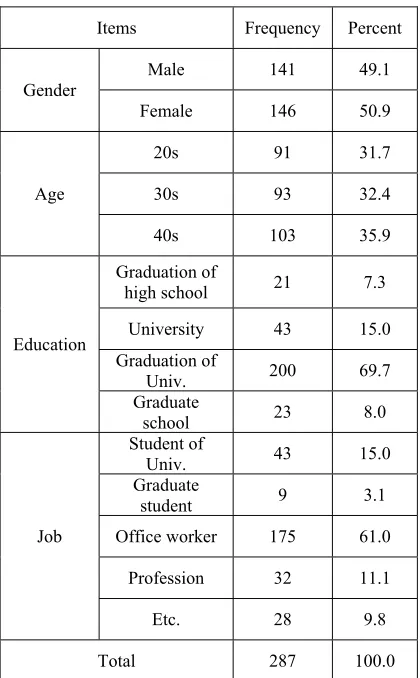
[image:4.612.90.300.379.718.2]Table 1 shows the results of the demographic analysis using SPSS 18.0. It showed that 49.1% of males and 50.9% of females participants. The age range of 31.7% in 20s, 32.4% in 30s, and 35.9% in 40s. The highest number of graduate of university was 69.7%. In the occupation, 61% of office workers were the most.
Table 1. The results of the demographic analysis
Items Frequency Percent
Gender Male 141 49.1
Female 146 50.9
Age
20s 91 31.7
30s 93 32.4
40s 103 35.9
Education
Graduation of
high school 21 7.3
University 43 15.0
Graduation of
Univ. 200 69.7
Graduate
school 23 8.0
Job
Student of
Univ. 43 15.0
Graduate
student 9 3.1
Office worker 175 61.0
Profession 32 11.1
Etc. 28 9.8
Total 287 100.0
In this study, the research model is set up as shown in Figure 1.
Figure 1: Research Model
4. RESULTS
4.1 Reliability and validity of measurement model
For this study, structural equation modeling was used to test the hypotheses and AMOS 18.0 is applied. This study was divided into two stages for analysis. Firstly, confirmatory factor analysis (CFA) was conducted to verify the reliability and validity of the measurement model. Secondly, to test the structural model.
7257
4.2 Structural model and hypotheses testing
The purpose of this study is to prove how the social media’s features affects satisfaction and self-disclosure behavior on SNS.
The structural model was evaluated and it was well converged. The results indicated that the chi-square of the structural model at 614.62 with d.f. of 256, the ratio of chi-square to d.f. at 2.401, GFI at 0.858, AGFI at 0.819, NFI at 0.892, CFI at 0.933, RMR at 0.191 and RMSEA at 0.07 were acceptable. The fit statistics for model were weak, but most fits are confirmed to be relatively valid.
[image:5.612.90.302.483.640.2]Figure 2 and Table 2 shows the results of the research hypotheses (H1-H6). According to the analysis result, four hypotheses were adopted among the six hypotheses. The analysis results of the model can be summarized as follows: First, users’ satisfaction affected the self-disclosure intention positively (b=0.663, p<0.01). Therefore, H1 was supported. Second, the “user identity” affected the users’ satisfaction positively (b=0.258, p<0.01). H2 was supported. Third, the information sharing affected the users’ satisfaction positively. Therefore, H3 was supported (b=0.277, p<0.01). Forth, the effect of social relationship on satisfaction was not statistically significant (b=0.089, p>0.05). Therefore, H4 was rejected. Fifth, the reputation not affect users’ satisfaction (b=0.089, p>0.05), H5 was rejected. Lastly, H6 was also supported. The communication affected the self-disclosure intention positively.
Figure 2: The Results of Research Model
Table 2. Results of Structural Equation Model
Path Estimate value P- Results
UI SAT 0.258 *** Accepted
IS SAT 0.277 *** Accepted
SR SAT 0.089 0.367 Rejected
REP SAT 0.089 0.179 Rejected
COMM SAT 0.238 0.017 Accepted
SD SD 0.663 *** Accepted
5. DISCUSSION
This study attempted to test the influence of the social media’s features on the satisfaction of SNS and self-disclosure. The analysis results can be summarized as follows.
First, this study showed the variables like focused user identity, information sharing, social relationship, reputation and communication which explained the features of social media also can be applied for the satisfaction in SNS. Previous studies measured the variety variable as a factor which affected the intention on behavior in SNS [22, 28].
Second, satisfaction was appeared to affect the self-disclosure positively. As the user experience more satisfaction, the scale of self-disclosure intention becomes large and the intimacy grows. Previous study has suggested that satisfaction with SNS affects the continuously intention to use [29]. It has been argued that SNS is appropriate for expanding offline relationships to online relationships, or that there is a high similarity between online and offline interpersonal relationships. Satisfaction with the relationship in the offline is more likely to expose themselves [30]. Therefore, the higher the satisfaction level of SNS, the more the intention is to express oneself or reveal their feelings.
7258 Forth, information sharing has effects on satisfaction. SNS is offering a range of opportunity for sharing information with other users. Many researches revealed that the purposes of SNS are related to maintaining users’ networks and sharing information [31]. Information sharing behaviors are tied closely with social networking aspects and continuous use in SNS.
Fifth, social relationship has not effects on satisfaction about Facebook. Previous research suggest that users would like to be connected to others and to communicate with others [32]. However, in this study, users are not satisfied with SNS because of excessive social network expansion.
Sixth, reputation on SNS was appeared to not affect the satisfaction positively. Pai and Arnott [31] suggest that users share information and make a post related to desire for popularity and gaining respect from others. This value can no longer induce users to engage in SNS or self-disclosure on their posts.
Seventh, communication has effect satisfaction on Facebook positively. It seems to be satisfied with the communication with the acquaintances who have the current relationship, rather than the new person.
6. DIFFERENCE FROM PRIOR WORKS
Previous research on SNS has used dependent variables for the initial acceptance intention [5] and continuous use of SNS [9] based on technology acceptance model (TAM) and expectation confirmation theory (ECT).
However, this study differs from previous research in that used intention to self-disclosure as a dependent variable. Self-disclosure refers to the intention to expose one’s own self and one’s thoughts through postings on the SNS. Through the posts posted by the users on the SNS, they can share various photos and opinions, and can establish relationships with new people. In other words, if the users do not post on the SNS, the utilization rate for the SNS will be reduced. Therefore, this study, unlike previous studies, asked about intention to write a post directly rather than intention to continuous use.
Next, this study divides the characteristics of SNS into five variables, and examined which characteristics have the greatest effect on satisfaction. This is different from the fact that social media features are used away from many used variables such as perceived usefulness.
7. CONCLUSIONS
At the key of social media is the continued involvement of users in generating their contents. Social network services also require users to constantly create posts in order to facilitate their use. Therefore, this study examined the reasons why users use Facebook based on social media features and, consequently, whether they relate to the creation of posts.
As a result of research, user identity and information sharing and communication among SNS features, were found to affect satisfaction, and information sharing showed the greatest influence. Also, the more users are satisfied with Facebook, the more they are willing to expose their thoughts, opinions and daily life on Facebook. People recognize Facebook as the best place to express themselves. They satisfied with the use of Facebook in that they express their identity through self-disclosure, share various information, and communicate with others rather than the relationship with others.
The implications of this study are as follows. First, this study is meaningful that we have studied the satisfaction of Facebook users in relation to the features of social media. We were able to identify variables which are especially important to users. Second, there are implications that the research model was created and empirically tested to understand the behavior of users on Facebook. Facebook have to develop an appropriate strategy based on the variables presented in this study.
However, this study has limitation in that it focuses on the Facebook case without comparing the various SNSs. In future research, it is necessary to compare several SNSs in order to find out what characteristics are different in each SNSs.
ACKNOWLEGEMENT
This work was supported by the research grant of Pai Chai University in 2018.
REFRENCES:
[1] J. A. Obar and S. Wildman, “Social Media Definition and the Governance Challenge: An Introduction to The Special Issue”,
Telecommunication. Policy, Vol. 39, No. 9
2015, pp.745-750.
[2] H. Y. Amichai and T. Hayat, “Social Networking”, The International Encyclopedia
7259 DOI: 10.1002/9781118783764
[3] DMC report, 2017 Social Media Usage Behavior and AD Contact Attitude Analysis Report, July, 2017
[4] R. Lin, A. Levordasha, and S. Utz, “Ambient Intimacy on Twitter”, Cyberpsychology, Journal of Psychosocial. Research on
Cyberspace, Vol. 10, 2016, pp.1-16.
[5] O. B. Kwon and Y. Wen, “An empirical study of the factors affecting social network service use”, Computers in Human Behavior, Vol. 26,
2010, pp. 254–263.
[6] H. S. Jung, “The Evolution of Korean Social Network Service focusing on the Case of Kakao Talk”, Journal of Digital Convergence,
Vol.10, No. 10, 2012, pp. 147-154.
[7] K. F. Hew, “Students’ and teachers’ use of Facebook”. Computers in Human Behavior,
Vol. 27, 2011, pp. 662–676.
[8] S. Mouakket, “Factors influencing continuance intention to use social network sites: The facebook case”, Computers in Human
Behavior, Vol. 53, 2015, pp.102-110.
[9] N. K. Lankton, E. V. Vance Wilson, and E. Mao, “Antecedents and determinants of information technology habit”. Information &
Management, Vol. 47, 2010, pp. 300–307
[10] K.Yuta, N. Ono, and Y. Fujiwara, “A gap in the community-size distribution of a large-scale social networking site” , 2007, Arxiv preprint arxiv:/physics/0701168,arxiv.org.
[11] N. Ellison, C. Steinfield, and C. Lampe, “The benefits of Facebook ‘‘friends”: Social capital and college students’ use of online social network sites”. Journal of Computer-Mediated
Communication, Vol. 12, 2007, pp. 1143–1168
[12] Boyd, D.M., & Ellison, N.B. “Social network sites: Definition, history, and scholarship”.
Journal of Computer-Mediated
Communication, Vol. 13, No. 1, 2007,
Available from
http://jcmc.indiana.edu/vol13/issue1/boyd.ellis on.html.
[13] SM. Jourard and P. Lasakow, “Some Factors in Self-Disclosure”, J. Abnorm. Psychol, vol.
56, 1958, pp. 91-98.
[14] S. B. Lee, L. Fan, S. C. Lee and Y. H. Suh, “Effects of Self-Presentation and Privacy Concern on an Individual's Self-Disclosure: An Empirical Study on Twitter”, Korean
Management Science Review. Vol. 29, 2012,
pp. 1-20.
[15] Y. R. Son and E. A. Park, “he Effects of Self-disclosure, Interpersonal Relation Dispositions on Internet Community Activity: Focused on Cyworld Mini-homepage”, Media, Gender &
Culture, Vol. 15, 2010, pp.157-284.
[16] M. Burke, and R. Kraut, “Growing Closer on Facebook: Changes in Tie Strength Through Social Network Site Use”, ACM. Association
for Computing Machinery. In Proceedings of
the 32nd annual ACM conference on Human
factors in computing systems, April 26,
(Toronto, Canada), 2014, pp. 4187-4196. [17]. Lin and S. Utz, “Self-Disclosure on SNS: Do
Disclosure Intimacy and Narrativity Influence Interpersonal Closeness and Social Attraction?”, Computers in Human Behavior,
Vol. 70, 2017, pp. 426-436.
[18] C. Posey, P. B. Lowry, T.L. Roberts and T. S. Ellis, “Proposing the online community self-disclosure model: the case of working professionals in France and the U.K. who use online communities”, European Journal of
Information Systems, Vol.19, 2010,
pp.181-195.
[19] S. Ganesan, “Determinants of Long-Term Orientation in Buyer-Seller Relationships”,
Journal of Marketing, Vo. 58, No. 2, 1994, pp.
1-19.
[20] R. L. Oliver, Satisfaction: A Behavioral Perception on the Consumer, New York: McGraw-Hill, 1997.
[21] Z. Deng, Y. Lu, K. K. Wei, and J. Zhang, “Understanding Customer Satisfaction and Loyalty: An Empirical Study of Mobile Instant Messages in China”, International Journal of
Information Management, Vol. 30, 2010, pp.
289–300.
[22] K. T. Kwak, S. K. Choi, B. G., Lee, “SNS flow, SNS self-disclosure and post hoc interpersonal relations change: Focused on Korean Facebook user”, Computers in Human
Behavior, Vol. 31, 2014, pp. 294-304.
[23] W.P. Special, and K.T. Li-Barber, “Self-disclosure and student satisfaction with
Facebook”, Computers in Human
Behavior, Vol. 28, No. 2, 2012, pp. 624-630.
[24] J. H. Kietzmann, K. Hermkens, I. P. McCarthy, and B. S. Silvestre, “Social Media? Get Serious. Understanding the Functional Building Blocks of Social Media”, Business
Horizon, Vol. 54, 2011, pp. 241- 251.
[25] A. Kaplan and M. Haenlein, “Users of the World, Unite! The Challenges and Opportunities of social media”, Business
7260 [26] R.P. Bagozzi, and Y. Yi, “On the Evaluation
of Structural Equation Models”, Journal of the
Academy of Marketing Science, Vol. 16, 1988,
pp. 74-94.
[27] K. A. Bollen, Structural Equations with Latent Variables, Wiley, New York, 1989.
[28] T. Zhou, H. Li, and Y. Liu, “The Effect of Flow Experience on Mobile SNS Users’ Loyalty”, Industrial Management & Data
Systems, Vol. 110, No.6, 2010, pp. 930-946.
[29] S. B. Lee, Y. Wang, and Y. H. Suh, “Factors Affecting the Mobile Instant Messenger Satisfaction, Loyalty, and Switching Intention”,
Journal of Korean Society Quality
Management, Vol. 43, No. 4, 2015, pp.
545-558.
[30] C.L. Kujath, Facebook and MySpace: Complement or Substitute for Face-to-Face Interaction?”, Cyberpsychology, Behavior and
Social Networking, Vol. 14, 2011, pp. 75-78.
[31] P. Pai, and D. Arnott, “User adoption of social networking sites: Eliciting uses and gratifications through a means-end approach”,
Computers and Human Behavior, Vol. 29,
2013, pp.1039–1053.
[32] S. Oh and S.Y. Syn, “Motivations for sharing information and social support in social media: A comparative analysis of Facebook, Twitter, Delicious, YouTube, and Flickr”, Journal of the Association for Information Science and
Technology, in press.
[33] J. Iivari, “Perceived Sociability of Use and Individual Use of Social Networking Sites: A Field Study of Facebook Use in the Arctic”,
Open Journal of Information Systems, Vol. 1,
2014, pp. 23- 53.
[34] N. H. Jung, H. J. Han, and C. M. Goo, “Mediating Roles of Attachment for Information Sharing in Social Media: Social Capital Theory Perspective”, Asia Pacific
Journal of Information Systems, Vol. 22, 2012,
pp. 101-123.
[35] S. J. McMillan, and J. S. Hwang, “Measures of perceived interactivity: an exploration of the role of direction of communication, user control, and time in shaping perceptions of interactivity”, Journal of Advertising, Vol. 31,
2002, pp. 29-42.
[36] A. Bhattacherjee, “Understanding Information Systems Continuance: An Expectation Confirmation Mode”, MIS Quarterly, Vol. 25,
No. 3, 2001, pp. 351-370.
[37] H. Krasnova, S. Spiekermann, K. Koroleva, and T. Hildebrand, “Online Social Networks: Why we disclose”, Journal of Information
7261
APPENDIX1.QUESTIONNAIRES IN THE STUDY.
Variables Items
User Identity [33]
1 Facebook gives me sufficient means to represent my identity(Such as name, photo, address and contact information)
2 Facebook gives me means to represent my identity in the way I like
3 Facebook gives me sufficient means to introduce myself (such as hobbies, interests, work and educational background)
4 Facebook gives me means to introduce myself in the way I like
Information Sharing [34]
1 I can easily share some videos, photos through Facebook.
2 I can often share funny stories, videos, and photos through Facebook.
3 I can often share information about my study or work (news, photos, etc.) through Facebook.
Social Relation-ship [33]
1 I think using Facebook is an effective way to broaden social networks.
2 When using Facebook I maintain acquaintance relationship.
3 When using Facebook I create acquaintance relationship.
Reputa-tion [24]
1 The number of times about 'Like' on my post is important to me in Facebook.
2 I am sensitive that how often certain users talk about me in Facebook.
3 I earn respect from others by participating in Facebook.
4 Participating in Facebook activity would enhance my personal reputation in Facebook
Communi-cation [35]
1 The Facebook enables conversation with new people or people I know.
2 The Facebook allows two-way communication with other users.
3 The Facebook enables real-time communication with other users.
Satisfaction [36]
1 How do you feel about your overall experience of using? Very Dissatisfied/Very Satisfied
2 Very Displeased/ Very Pleased
3 Very frustrated/Very contented
4 Absolutely terrible/Absolutely delighted
Self-disclosure [37]
1 I expose my feelings, thoughts, and opinions through Facebook.
2 I find time to keep my profile up-to-date. (SEDI2)
3 I keep my friends updated about what is going on in my life through the Facebook.
7262
APPENDIX 2.RESULTS OF MEASUREMENTS MODEL
Variables Items Estimate CR AVE
User Identity
UI_1 0.774
0.894 0.679
UI_2 0.848
UI_3 0.824
UI_4 0.848
Information Sharing
IS_1 0.926
0.896 0.742
IS_2 0.793
IS_3 0.860
Social Relationship
SR_1 0.731
0.880 0.712
SR_2 0.907
SR_3 0.882
Reputation
REPU_1 0.821
0.924 0.754
REPU_2 0.815
REPU_3 0.902
REPU_4 0.929
Communication
COMM_1 0.760
0.820 0.603
COMM_2 0.758
COMM_3 0.810
Satisfaction
SAT_1 0.900
0.877 0.642
SAT_2 0.804
SAT_3 0.755
SAT_4 0.737
Self-disclosure
SD_1 0.789
0.908 0.713
SD_2 0.869
SD_3 0.865
7263
APPENDIX 3.RESULTS OF DISCRIMINANT VALIDITY
User Identity
Information Sharing
Social
Relationship Reputation
Communica-tion
Self-disclosure Satisfaction
User
Identity 0.824 Information
Sharing 0.607 0.861
Social
Relationship 0.622 0.528 0.844
Reputation 0.523 0.625 0.564 0.868
Communicati
on 0.631 0.41 0.776 0.4 0.776
Self-disclosure 0.658 0.575 0.611 0.494 0.613 0.844