ORIGINAL RESEARCH ARTICLE
EFFECT OF SQUARE STEPPING EXERCISE ON LOWER LIMB COORDINATION IN YOUNG
OLD POPULATION
*1
Sheetal C Awari and
2Dr. Pooja Sharma
1
BPT, Intern, Maharashtra University of Health Sciences, Late Shri Fakirbhai Pansare Education Foundation
College of Physiotherapy, Pune, Maharashtra, India
2
MPT Neurology, Assistant professor, Late Shri Fakirbhai Pansare Education Foundation
College of Physiotherapy, Pune, Maharashtra, India
ARTICLE INFO ABSTRACT
Aim and Objective: To determine the effect of square stepping exercise(SSE) on lower limb
coordination in young old population.
Design: Experimental study.
Method: 40 subjects with age group: 65-74 years were randomly assigned into two groups: SSE
group (n =20), control group (n = 20). SSE group received 4 weeks of Square stepping exercise training. Control group received 4 weeks of Frenkel’s exercise training.
Results: Comparing the post values of grades of coordination of SSE group and control group,
SSE group (p < 0.0001, t = 13.077) showed a significant improvement than control group (p = 0.0009, t = 3.943).
Conclusion: Square stepping exercise is better than Frenkel’s exercise in improving lower limb
coordination in young old population.
Copyright © 2018,Sheetal C Awari and Dr. Pooja Sharma. This is an open access article distributed under the Creative Commons Attribution License, which permits unrestricted use, distribution, and reproduction in any medium, provided the original work is properly cited.
INTRODUCTION
Aging is the accumulation of changes in an organism overtime or later part of life. It is a multidimensional process of physical, psychological and social change. Older people are defined according to a range of characteristic including chronological age, change in social role and change in functional abilities.
Geriatric classification
65 years to 74 years = Young old.
75 years to 84 years= Older old.
85 years above= Oldest (Cress, 1999).
One of the most prominent hallmarks of aging is a dramatic and often devastating decline in motor skills (Richard S. Mann, 2012).
*Corresponding author: Sheetal C Awari
BPT, Intern, Maharashtra University of Health Sciences, Late Shri Fakirbhai Pansare Education Foundation College of Physiotherapy, Pune, Maharashtra, India
It is known that older people are prone to fall related risks which can make them totally or partly dependent on their family and the community. Age-related loss in physiologic capacities contributes to the decline in physical function in the elderly population. It is well established that there is a decline in muscle performance with advancing age. Normal aging involves a gradual decline in cognitive function based on neurological processes that change with age (Camila Vieira Ligo TEIXEIRA, 2013). Alteration in the ability to execute smooth, accurate, controlled motor responses occurs with normal aging. With the loss of muscle mass, strength, and endurance and the deterioration of neurologic control of our movements and slower reflexes that occur with age the fear of falling is warranted. A serious problem faced by older adults, their families, and health care practitioners is the increased prevalence of falls and fall-related fractures in adults aged 65 years or more (Ryosuke Shigematsu, 2008). Typically, a decline in motor coordination leads to problems in walking, including the ability to maintain a uniform gait and balance. Falls due to a loss of balance and motor coordination are a
ISSN: 2230-9926
International Journal of Development Research
Vol. 08, Issue, 07, pp.21812-21816, July,2018
Article History:
Received 18th April, 2018
Received in revised form 19th May, 2018
Accepted 01st June, 2018
Published online 30th July, 2018
Available online at http://www.journalijdr.com
Key Words:
Young old population; Square stepping exercise (SSE); Frenkel’s exercise;
Equilibrium and non-equilibrium Coordination tests.
Citation: Sheetal C Awari and Dr. Pooja Sharma. 2018. “Effect of square stepping exercise on lower limb coordination in young old population”, International Journal of Development Research, 8, (07), 21812-21816.
major cause of serious injuries in older adults (Richard S. Mann, 2012). Cardiovascular and muscle strength training helps significantly to reduce the risk of falling. However, specific agility, balance and coordination training can even further reduce the risk of falling. Coordination is the ability to execute smooth, accurate, controlled motor responses. Schmidt and Lee define coordination as the “behavior of two or more degrees of freedom in relation to each other to produce skilled activity”. Coordination is the ability to control a number of movement segments or body parts in a refined manner resulting in a well- timed motor output. The ability to control multiple movement components at any one particular time becomes increasingly difficult with advanced age across a variety of movements including aiming, reaching and grasping. Coordinated movements are characterized by appropriate speed, distance, direction, timing, and muscular tension. Coordinated movement, which is smooth, accurate and purposeful, is brought about by the integrated action of many muscles, superimposed upon a basis of efficient postural activity (M. Dena Gardiner, 2005). Dr. H. S. Frenkel aimed at establishing voluntary control of movement by the use of any part of the sensory mechanism which remained intact, notably sight, sound and touch, to compensate for the loss of kinaesthetic sensation. The process of learning this alternative method of control is similar to that required to learn any new exercise, the essentials being: Concentration of the attention, Precision and Repetition. The ultimate aim is to establish control of movement so that the patient is able and confident in his ability to carry out these activities which are essential for independence in everyday life (M. Dena Gardiner, 2005). The square stepping exercise (SSE) programme was created by Shigematsu and Okura in order to improve the balance of practitioners, thereby decreasing the risk of falls (Camila Vieira Ligo TEIXEIRA, 2013). The SSE program was tolerated well by participants. SSE is a new and low-cost method designed to improve lower-extremity functional fitness, with strength and balance training. Therefore potentially suitable to be carried out in the context of care for older adults. This novel type of exercise training can be performed on a thin felt mat (250 * 100 cm) divided into 40 small squares (25 * 25 cm) (Ryosuke Shigematsu, 2008). The SSE training programme consisted of a series of forward, backward, lateral and diagonal steps, and with each sequence, the complexity of the step combinations increased. Square stepping exercise may include toe walking or complex pattern of walking as a progression (BerihuFisseha, 2017). The sequences of the programme were organized according to six different difficulty levels: Junior, Basic, Semi-Regular, Regular, Senior and Master. Examples of the Junior, Basic, Regular and Master patterns (Camila Vieira Ligo TEIXEIRA, 2013). Several step patterns have been created, which participants must follow. As a form of systematic physical activity, SSE is a training programme that requires physical exertion and cognitive function, specifically concentrated attention, memory and executive functions. The few existing studies on SSE are promising and show the programme’s effectiveness on functional fitness components, including balance, lower limb strength, flexibility and agility, and consequently a reduction in the risk of falls. A potential limitation on the effects of SSE is, it has not been used alone as a training protocol; SSE has been performed in conjunction with stretching and muscular endurance exercises. Thus, there is a gap in scientific knowledge about the independent effects of SSE (Camila Vieira Ligo TEIXEIRA, 2013). Previous study shows that SSE is a physical activity that positively influences
cognitive functions in non-demented older people. The result of the previous study showed a significant improvement in global cognitive status, concentrated attention and mental flexibility. SSE can also be performed indoors so certainly appears to be advantageous over unidirectional and outdoor walking which is less beneficial pertaining to fall prevention and it is also unsafe for older adults. The benefit of SSE also extends beyond preventing fall such as improving functional ability, fitness of lower extremities and health status among older adults (Berihu Fisseha, 2017).
MATERIALS AND METHODS
Materials used: Square stepping exercise mat, Marker, Stopwatch.
Methodology: 40 subjects were divided into 2 group by random allocation. Both group were assessed with equilibrium and non-equilibrium coordination tests. 20 subjects were given square stepping exercise training for twice a week for four weeks. The subject had to walk over the square stepping exercise mat for 40 mins. The SSE group performed only the SSE sequences without any other motor exercise. Subjects were instructed to step on the mat according to the pattern that the therapist had shown. Subjects had to complete each pattern level twice correctly to move to the next pattern level. The frenkel’s exercise had been explained and demonstrated to 20 subjects. It was been done twice a week for four weeks. In frenkel’s exercise, the patient was explained and demonstrated the walking pattern over the specific markings on the floor for 40 min. Frenkel’s exercises given to the subjects are:- walking forwards over the markings on the floor, walking sideways over the markings on the floor, tandem walking over a straight line. The first simple exercises should be adequately performed before progressing to more difficult patterns.
RESULTS
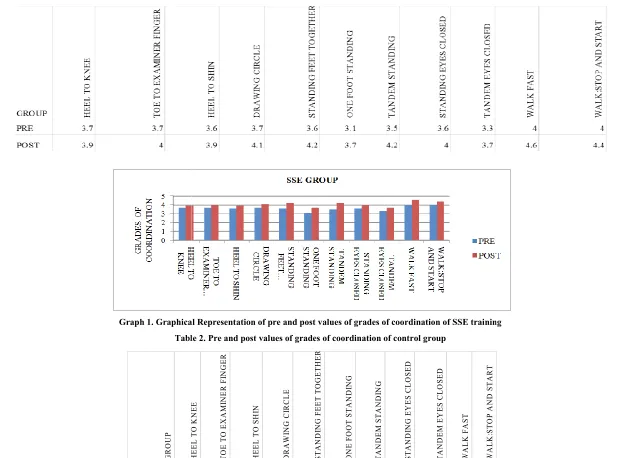
Data was analysed using paired ‘t’ test and unpaired ‘t’ test. In between group (SSE group and control group comparison) significance was calculated using unpaired ‘t’ test and within the group (pre and post training comparisons of SSE group and control group) significance was calculated by using ‘t’ test to compare the grades of coordination in young old population. There were no drop outs of the subjects from the study. The results obtained for grades of coordination of control group showed a significant improvement and p value obtained was p = 0.0009 and t = 3.943. The results obtained for grades of coordination of SSE group showed highly significant improvement and p value obtained was p < 0.0001 and t = 13.077. However, on comparison of post assessment values of grades of coordination of SSE group and control group, the results obtained for grades of coordination of SSE group showed significant improvement than control group and p value obtained was p < 0.0001 and p = 0.0009 respectively and t = 13.077 and t = 3.943 respectively. According to the graph there is highly significant improvement in grades of coordination assessed by the equilibrium and non-equilibrium coordination tests such as standing on one foot, tandem standing, walk as fast as possible in SSE group as compared to control group. This suggests that there is significant effect of square stepping exercise on lower limb coordination in young old population since there is highly statistical significant difference in p value, p < 0.0001 on comparison of pre and post values of SSE group.
Table 1.
Graph 1. Graphical Representation of pre and post values of grades of coordination of SSE training
Table 2. G R O U P H E E L T O K N E E PREVALUE 3.6 POSTVALUE 3.8
21814 International Journal of Development Research, Vol. 08, Issue, 0
Table 1. Pre and post values of grades of coordination of SSE training
Graphical Representation of pre and post values of grades of coordination of SSE training
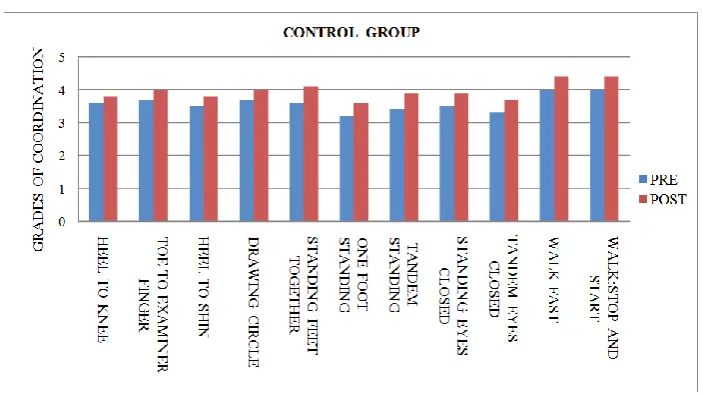
Table 2. Pre and post values of grades of coordination of control group
H E E L T O K N E E T O E T O E X A M IN E R F IN G E R H E E L T O S H IN D R A W IN G C IR C L E S T A N D IN G F E E T T O G E T H E R O N E F O O T S T A N D IN G T A N D E M S T A N D IN G S T A N D IN G E Y E S C L O S E D T A N D E M E Y E S C L O S E D W A L K F A S T W A L K :S T O P A N D S T A R T
3.6 3.7 3.5 3.7 3.6 3.2 3.4 3.5 3.3 4 4
3.8 4 3.8 4 4.1 3.6 3.9 3.9 3.7 4.4 4.4
International Journal of Development Research, Vol. 08, Issue, 07, pp.21812-21816, July, 2018
The results obtained of post values of SSE group and control group shows highly significant p value p < 0.0001, t = 13.077 of SSE group whereas, p = 0.0009, t = 3.943 of control group. This suggests that SSE is more effective than frenkel’s exercise on lower limb coordination in young old population.
DISCUSSION
The purpose of this study was to find the effect of square stepping exercise (SSE) in lower limb coordination in older adults. The primary finding of this study was that SSE is
effective in lower limb coordination in older adults. Kannus et
al., explained that falls are the leading cause of unintentional
injury and premature death among community dwelling older adults (Berihu Fisseha, 2017). Falls among older adults are a serious public health problem that can cause fatal injuries sometime, also affects psychosocial status and more importantly quality of life. After tripping, a quick, firm step movement to prevent a fall that involves high flexion velocities in the hip, knee and ankle plantar is important. Because SSE training offered steps that consisted precisely of quick hip, knee and ankle plantar flexions, the SSE participants acquired adequate step ability after a 4-week regimen (Ryosuke Shigematsu, 2008). SSEs were designed based on the principles of proactive and reactive responses enhancement which logically may improve reaction time
during corrective stepping during recovering balance after tripping among the older subjects.
Further it is hypothesized to induce agonist and antagonist muscle activations in lower extremities thus improving lower extremities fitness (Berihu Fisseha, 2017). The SSE program was tolerated well by participants. SSE is a tech and low-cost form of exercise and therefore potentially suitable to be carried out in the context of care for older people. Our findings also suggest that SSE training is appropriate to achieve the desired results in lower limb coordination. It was hypothesized that this particular exercise would significantly affect this fitness category, because SSE consists of quick, multi-directed movements which all contribute to improving lower limb coordination. Improved coordination can directly help prevent falls but can also help the person roll rather than crash as the person go down. In order to confirm the significance of the SSE regimen, advantages and disadvantages should be discussed. In the first week, some participants appeared to be disinterested in SSE; however, after several sessions, all participants started enjoying them, and attempted to follow the complex step patterns. When we see the applicability of SSE to our setup it is easy, cost effective and can be applied in group. Portable, low-cost, low-tech mats, such as those used in this study, have the additional advantage of being unaffected by weather, space, or availability of time; SSE can be performed at home, in community centers, or in parks. Because no adverse events were observed, we can only speculate on the disadvantages. One example may be that SSE itself, particularly when lifting the heels, is associated with
[image:4.595.124.476.52.249.2]Graph 2. Graphical Representation of pre and post values of grades of coordination of control group
Figure 1. Patterns of square stepping exercise
falls, due to the accompanying shift in gravity. Therefore, the speed and complexity of SSE should be increased gradually, depending on each participant’s ability. This approach can also help participants to familiarize themselves with this type of training. Older adults with good muscle power and confidence in avoiding falls tend to fall because they walk briskly like young people. If this is the case, SSE may be particularly useful in helping these people to avoid falls. Significant effect of SSE was detected over walking or no treatment to improve balance as well to prevent fear of fall and improve perceived
health status. Berihu Fisseha et al., has emphasized on
prevention of falls and fall related injuries by improving
balance in older people (Berihu Fisseha, 2017). McClure et al.,
explained that SSE can also be performed indoors so certainly appears to be advantageous over unidirectional and outdoor walking which is less beneficial pertaining to fall prevention and it is also unsafe for older adults. (Berihu Fisseha, 2017).
Shigematsu et al., explained the benefit of SSE also extends
beyond preventing fall such as improving functional ability, fitness of lower extremities and health status among older adults (Berihu Fisseha, 2017). Alan Davis mentioned that Frenkel’s exercise is used to improve coordination. Frenkel aimed at establishing voluntary control of movement by the use of any part of the sensory mechanism which remained intact, notably sight, sound and touch, to compensate for the loss of kinaesthetic sensation.
The process of learning this alternative method of control is similar to that required to learn any new exercise, the essentials being: Concentration of the attention, Precision and Repetition. The ultimate aim is to establish control of movement so that the patient is able and confident in his ability to carry out these activities which are essential for independence in everyday life (Glady Samuel Raj). Therefore, Frenkel’s exercise is used to improve coordination. However, in the current study, the effects of Frenkel’s exercise were smaller than those of SSE. The difference in effect size between the 2 training regimens may be due to the specificity of training, particularly the quick movements in SSE.SSE training consists of complex patterns of walking over the square stepping exercise mat and SSE training also follows the principle of frenkel’s exercise: Concentration of the attention, Precision and Repetition which is contributing to the improvement of lower limb coordination in older population. The study shows that the grades of equilibrium and non-equilibrium coordination tests show significant improvement in SSE GROUP at the end of 4 weeks. In SSE group, grade of equilibrium and non-equilibrium coordination tests has increased from 3.75 to 4.65. There is significant improvement in grades of coordination assessed by equilibrium and non-equilibrium coordination tests such as standing on one foot, tandem standing, walk as fast as possible in SSE group as compared to control group. Therefore, SSE is effective in improving lower limb coordination in older adults. The subjects’ age ranged from 65-74. In this study both male and female subjects were included. But comparison between female and male subjects for baseline measurements and overall improvement has no significant in both groups. Thus the result shows that there is no gender or age associated with improvement.
Acknowledgement
I am very glad to present this project as a part of my final year. Also I wish to express my sincere gratitude to all those who
really helped me. I am deeply grateful to the god almighty and my parents for being the guiding start in my life. I am extremely thankful to Dr. SWATI BHISE Principal, L.S.F.P.E.F. College of Physiotherapy. I express my deed sense of gratitude to my project guide Dr. POOJA SHARMA whose constant interest in the project kept me going and who was always available with her suggestion. Special thanks to my friends and batch mates for their help and support. Last but not the least I express my sincere thanks to all subject who participated and gave their full co-operation for the study.
REFERENCES
Agility, Balance and Coordination Training, 2012.
BerihuFisseha, BalamuruganJanakiraman, AsmareYitayeh, HariharasudhanRavichandran, Effect of square stepping exercise for older adults to prevent fall and injury related to fall: systematic review and meta-analysis of current evidences. Journal of Exercise Rehabilitation 2017;13(1). Camila Teixeira, Jessica Pereira, SebastiaoGobbi, Lilian
Teresa BuckenGobbi, Effect of square-stepping exercise and basic exercises on functional fitness of older adults. Article in Geriatrics & Gerontology International 2012;13(4).
Camila Vieira Ligo TEIXEIRA, Sebastiao GOBBI, Jessica Rodrigues PEREIRA, Thays Martins VITAL, Salma
Stephany Soleman HERNANDEZ, Ryosuke
SHIGEMATSU and Lilian Teresa Bucken GOBBI, Effects of square-stepping exercise on cognitive functions of older people. PSYCHOGERIATRICS 2013; 13. Campbell MJ, McComas AJ, Petito F. Physiological changes
in ageing muscles. Journal of Neurology, Neurosurgery and Psychiatry. 1973;36(2):174–182.
Caroline J. Ketcham and George E. Stelmach; Movement Control in the Older Adult, National Academy of Sciences, 2004.
Cress ME, Buchner DM, Questad KA, Esselman PC, deLateur BJ, Schwartz RS. Exercise: Effects on physical functional
performance in independent older adults. Journals of
Gerontology Series A: Biological Sciences and Medical
Sciences. 1999; 54(5):M242–248.
Glady Samuel Raj, Physiotherapy in Neuro-conditions. First
Edition, 2006.
Howard LoWine, Balance training seems to prevent falls, injuries in seniors.
M. Dena Gardiner, The principles of exercise therapy, Fourth Edition. 2005.
Pavol MJ, Owings TM, Foley KT, Grabiner MD. Mechanisms leading to a fall from an induced trip in healthy older adults. J GerontolABiolSci Med Sci 2001; 56A: M428-37. Richard S. Mann, The decline of motor coordination during
aging, 2012 Senior Scholar Award In Aging.
RyosukeShigematsu, Tomohiro Okura, Tomoaki Sakai, and TainaRantanen, Square-stepping exercise versus strength and balance training for fall risk factors. Aging clinical and experimental research March 2008, Vol. 20, No. 1. Susan B. O’Sullivan, Thomas J. Schmitz, Physical
Rehabilitation, Fifth Edition.
Timothy CY Kwok, KC Lam, PS Wong, WW Chau, Kenneth SL Yuen, KT Ting, Elite WK Chung, Jessie CY Li, Florence KY Ho, Effectiveness of coordination exercise in improving cognitive function in older adults: a prospective study. Clinical Interventions in Aging 2011:6.
Waqar Naqvi, Physiotherapy in community rehabilitation. 2012.